This counts

The chickadees have been singing again and it’s time to order seed potatoes and onion starts. The year has barely had time to rub sleep from her eyes, and the frozen peaches are not even dented by my hunger for their winter warmth, and I feel like I just got the potatoes stored away in the paper bags and moderate temperature that seems to have—mostly—succeeded in keeping them edible through the winter.

How can it already be time to think of choosing carrot and lettuce seeds, of where to plant beets and how to make more room for green beans, of the soil’s stirrings and the young yawns of growing things in my garden? It might be months, still, before I can visit the sweetgrass and turn the soil, but it is time, already, in the midst of this winter, to be planning for the next.

I was away most of last week committed to what I’lll broadly call parental duties, long hours of chaperoning, most of which took place in the confines of a hotel my kid and I rarely left. By the time the commitment was done, my body felt stunned from lack of movement. I spent two hours on Monday walking through town and along the river trails, relieved at the sight of water, the freedom to wander, the flurry of chickadee-company, and the surprise of what might be a new construction along the riverbank.

The drive home had been painstakingly slow, through hours of fog that seems to mark most of this winter’s personality. I hadn’t seen Moon at all for what feels like weeks until three nights ago, moonglow through the fog, Her bright self mostly hidden from the skies I live under until the dark, dreamy hours of this morning.

I watched Her there for an hour, remembering what moonfall feels like and ignoring my usual routines. A few hours later, on our way to school, She was cast slight pink in the pre-dawn sunlight that crept out from behind the mountains. 

Who else, I wondered, might be watching that alpenglow wrap itself around Moon?


Why put all those words and observations on a page, why share them with you? What is this human urge to story? To shape the narratives we see around us, to call attention to beauty and comprehend grief? Why write? 

I’ve seen this question lobbed about since I was old enough to understand the concept of philosophy, if not philosophy itself. What is the compulsion to create? Why do we care so much? 

I don’t have any better answers than anyone else. All I know is that I become a grumpy, unpleasant person when I don’t write. It’s a compulsion. It’s joyous and beautiful, to be lost in a narrative, but it’s also demanding and ruthless. Writing left me once for a few months, just flat walked out the door. I had thought that if that ever happened, if I couldn’t create, I would feel bereft. I thought I wouldn’t know myself. But what I felt was free. I kept thinking of all the things I could do with my life now that I weren’t driven to shape them into narrative of some kind.

Writing came back after about three months of that release, as if wandering through the door after an argument: “I just went for a walk. Needed some air.” And there we were again, back in a lifelong need to story, to do whatever it is that happens between my interaction with the world I exist in and the way my mind—or whatever it is—decides those experiences and thoughts should sound, feel, taste.

Writing is very, very weird. 

The novelist Elif Shafak wrote recently of a 16-year-old girl in Afghanistan who loved to read, who dreamed of libraries and pizza and of meeting Shafak herself after reading one of her novels, and who was killed by a suicide bomber. 

“I am tired of being attacked and stigmatised and labelled by fanatics and zealots and ultranationalists only because I am a writer,” wrote Shafak.

“But when I feel so down and despondent, I think of Marzia and I think of every other aspiring novelist and aspiring poet in the world who were never given even half the chances that were provided to me throughout my life: books, bicycle, pizza, electricity . . . I will never belittle any of these. 

I have no doubt that Marzia would have become an amazing storyteller if only she had been encouraged and if only her life had not been brutally taken away from her. I feel like all of us in the writing community owe something deep and precious to all the Marzias on this planet. We owe them a sincere commitment to literature.”

Writing is weird but it’s also necessary and it exists far beyond any arbitrary measures of success and failure. I’ve written before of my stepmother’s great-aunt, the Russian poet Marina Tsvetaeva, and her life that knew little but hardship and brutal loss, and how throughout it she wrote poetry so meaningful and beloved that to this day there are museums dedicated to her all across the country.

At the end of my life, all I can ask for is that I’ve done the best work possible and used whatever skills and talents I’m fortunate enough to have to create something of beauty and meaning. Maybe one book, one essay, one single line, might reach the one person who really needs it.

“It is as simple and as powerful as that,” wrote Shafak. 

“The love of books and libraries and the joy of reading. This is all we need. This is why we keep on writing.”

There’s something more, too: that delight and spark that Marzia knew reading and writing held for her, the world-opening potential of stories that I remember feeling at her age. 

I think many of us write because we can’t help it, because it’s a jealous lover or a hunger that can’t be sated or whatever metaphor works for you. When that leaves us, even if it’s only for a while, we still have what’s left: we write for one another. And what a gift that is. Stories can break empires; they can tell our hearts we’re not alone. They make us laugh. They make us grateful to be alive.


It’s been foggy and somewhat rainy for days and days, but today the cold was biting again. I didn’t dress warmly enough and my fingers were numb by the time I dropped off my kid at school. 

As I was turning away from the building, blowing on my hands, I saw a cluster of ten-year-olds, their pom-pom hats wobbling as they turned, ignoring the school bell to send frosty breath up toward a bald eagle soaring low overhead. 

The crossing guard watched, and me, too, and we smiled at each other, and I held close the gratitude I always feel at the sight, at watching children hold their breath because they see a bald eagle and they know. You pause for such birds. The soul bows. And I hold the knowledge I wish these kids never to have, that my gratitude is weighted with the knowledge that bald eagles were almost extinct when I was growing up.

High on the mountainsides just outside of town, the first light of dawn brushed the snow, the same light that was coaxing alpenglow from Moon. A flurry of snow rose in the light, over three thousand feet above me, and I wondered which of those sunshot flakes will be the first to meet spring’s young strawberries.

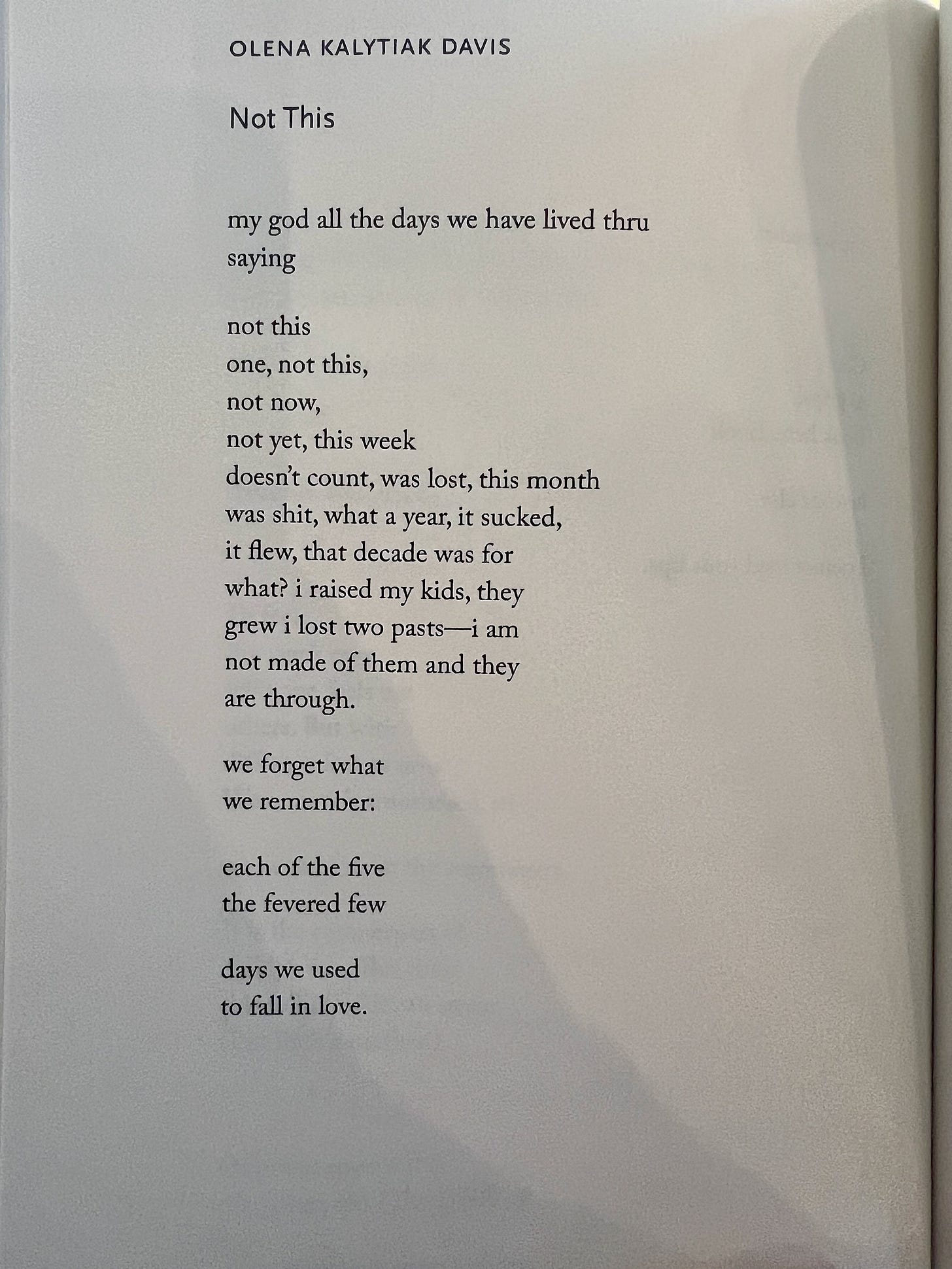
I received a surprise care package this week from a friend who knew I’d been going through some difficult personal things recently. Among tea and a kind note were two books of poetry. This poem, titled “Not This,” by Olena Kalytiak Davis, appears in one of them, The World Has Need of You: Poems for Connection, and I keep rereading it, finding something new to catch my thoughts each time.

The starlight of integrity

When I was 19, I watched my father walk into a meeting room with the Chechen mafia. 

My father has run a small coffee roasting business in Moscow, Russia, since 1992—or ran it for 30 years, until Putin invaded Ukraine and also made it illegal for U.S. citizens to have any part in managing a Russian business. Those three decades have had so many wild and surreal stories that I could probably make narrative out of nothing but “running a coffee roasting business in Russia” for the rest of my life. I was there at the beginning, watching my parents and their co-venturists from Montana Coffee Traders rent a building aside the mud-grooved roads behind the Komsomol’skaya train station, where wild dogs roamed and people were always trying to bum papirossi off of me—tiny, harsh cigarettes. I didn’t smoke.

In 1995, I had just finished my first year of college, where I also worked as a barista at a small coffee shop and roaster in St. Paul, Minnesota. The business in Russia was building its first coffee carts: small, mobile espresso stands that they would place in supermarkets around the city. I was there to train some of the employees on how to make lattes, cappuccinos, stiff Americanos—not stiff enough, at first, for all the new customers annoyed that the flavored sugar syrups were non-alcoholic.

The Soviet Union had collapsed shortly after we left the country in 1991, bringing down the Iron Curtain that had kept my father in exile for 17 years and opening up the country to free-market enterprises like this coffee roastery. Oligarchs started claiming the massive profits from state-run enterprises like oil fields and steel factories almost immediately, and the mafia moved in on small businesses shortly thereafter. There was no way to do business in Moscow without dealing with a mafia until years later, when the police figured out their own corruption and bribery mechanisms and took over the mafia’s role.

In the years between when he had to meet regularly with Igor from the Chechen mafia, and when the Moscow police had his phone tapped, my father said something to me that I’ve never forgotten: “How do you do anything as a person of integrity in a corrupt system like this?”

My father’s company has managed to remain solvent throughout decades of social and economic upheaval. It’s stayed small, and still employs many of the people who started there, a small raft of security and honest work in a country where both are scarce. He is also a person of integrity and honesty, whose ethics have been pushed and challenged throughout every single one of those years, into choices that have no right or wrong answers, only a hopeful contemplation of what does the most good.


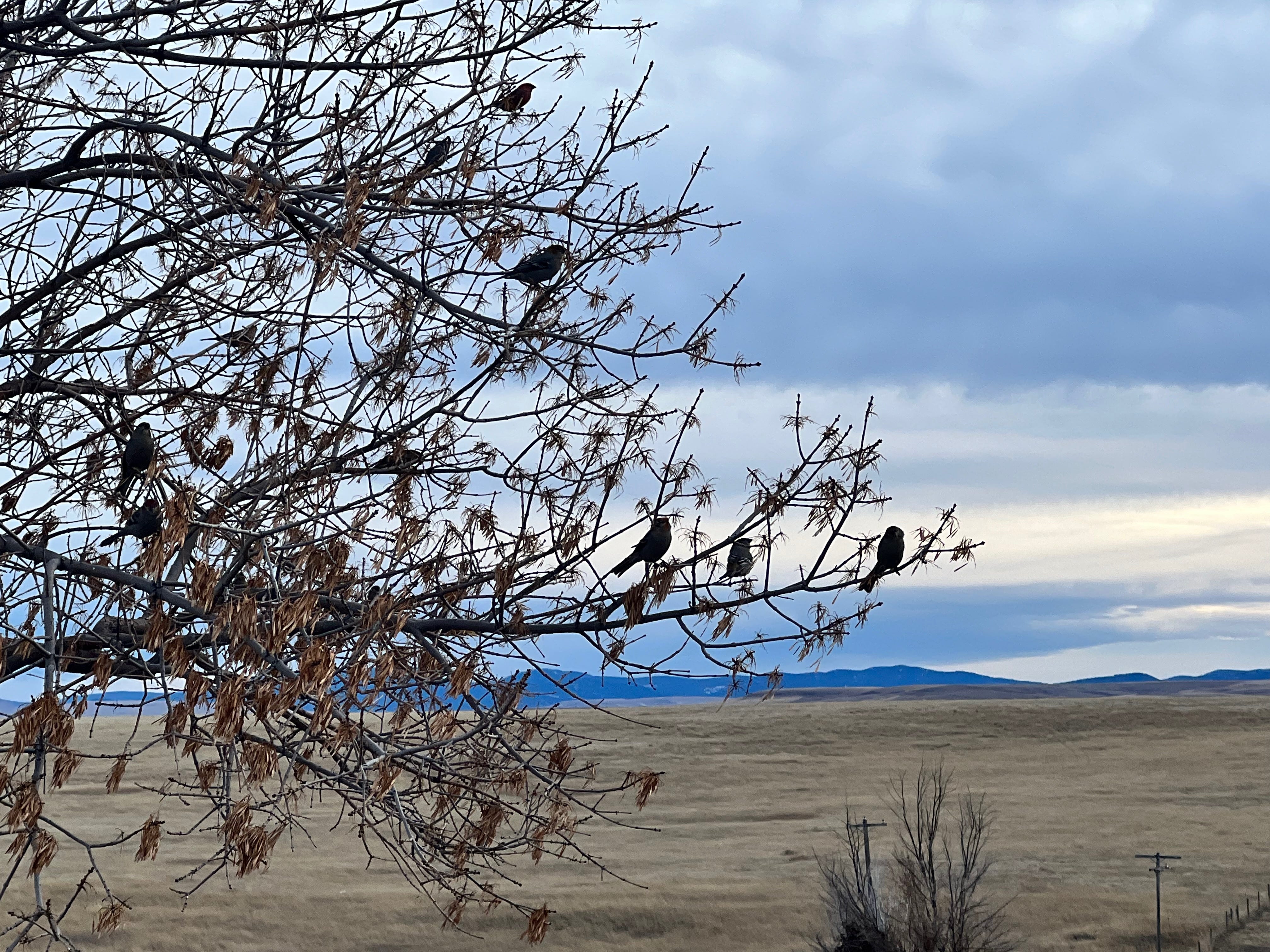
A flock of what I think were Bohemian waxwings kept me company the entire two hours I spent wandering the Old Highland Cemetery outside of Great Falls.

Last week, after a research trip to meet with the archivist at the historical museum in Great Falls, Montana, I joined my family and some friends at a hot springs for solstice. In both Great Falls and at the hot springs, Moon showed up and I can’t tell you how relieved I was to see Her. Especially driving through the mountains toward Great Falls and the prairie and farmland of eastern Montana, out of the low gray skies that are a near-constant in the winter where I live. I hadn’t seen Her, or the stars, in well over a week. I stopped the car at several points to stand in Her light, a moonlight waterfall. Moonfall. 

There was something other-worldly about it, by which I mean this-worldly. The this-world that too much of most of our daily lives washes out and hides from us. The this-world I soak in when I go to forest service cabins or my stepdad’s cabin, far from any electricity, especially electric lighting, where the stars can show their brilliant, miraculous selves. 

I was re-watching The Hobbit the other night, and remembered all the nights, so many nights, I’ve spent in my life under unfiltered starlight, alone or with family or friends. I’ve always thrilled to the elves’ love of starlight in those stories, which I think was described more fully in The Silmarillion but which Tauriel’s lines in the movie bring to life so beautifully:

“All light is sacred to the Eldar. But what elves love best is the light of the stars.”

“I’ve always thought it was a cold light, remote and far away,” said Kili.

“It is memory,” Tauriel responded. “Precious and pure. Like your promise. 

I have walked there sometimes, beyond the forest and up into the night. I have seen the world fall away, and the white light forever fill the air.”

I have seen the world fall away. That is what happens when I’m out there those nights, walking out or simply looking up when sleep leaves for a time to linger in starlight; and at dawn and twilight when the sun rises and sets as if he has all the time in the world—which he does, far more than this world itself has—and the times I’ve seen Moon come up from behind the mountains, as if She were gathering all of existence in Her light. A world that feels whole, one you can wander without fences or property lines, borders or walls, greed or war.

From the hot springs, I drove my younger kid to the Bison Range instead of going straight home. It’s just far enough from where I live that I hadn’t taken them yet, though I knew they’d love the place. We saw bald eagles on the drive in and out—four in total, very active; it’s always awesome, in the older sense of the word, to see them that close—a cluster of buffalo on a distant hill below the low fog line, and a kestrel taking off from a fence post in front of us.

My kid asked a lot of questions about the land and the bison, questions I couldn’t answer without entangling myself in inadequate language. They know about invasion and theft, and the museum at the Bison Range did a much better job than I could ever hope to of describing the history of that specific land, the buffalo herd, and the Confederated Salish & Kootenai Tribes’ relationship with all of it. 

Trying to tell these histories without using the word “own” is difficult, though it’s made easier with someone who already understands the sheer wrongness of ownership, as my kids both do—instinctively, somehow, on their own, having arrived at that belief. Maybe they got it from living in a place where “No Trespassing” and “Private Property” signs are ubiquitous and it’s hard to understand why you can’t just walk where your feet and mind wish to go. Or maybe this is an understanding that is innate to most people, and we have to be taught to think differently. To say, “The federal government used to own the Bison Range and then gave it back to the CSKT” makes absolutely no sense, especially without including the rest of the story, the original theft of all that land, all this land, and more. How can you give back, much less own, what was never rightfully yours in the first place?

The wrongness of it can’t be told enough, or in enough ways, and one of my biggest struggles with the work I’m doing here is finding effective ways to explain, for people who don’t already get it, that wrongness—of ownership itself, and more specifically what it means to take land that all rely on for sustenance and survival, and turn it into private property, into capital. It’s like a rift in reality that many people can perceive but far too many can’t, and I don’t know that we can make much progress in the world until they do.

There’s a display at the museum that shows the effects of the Dawes Act of 1887, also known as the General Allotment Act, which forced reservation land into individual private ownership and demanded that any reservation land not subsequently owned by individual Native Americans be open to white settlement. The display shows the erosion of land by mostly white settler private property claims more clearly than anything I’ve ever read. It’s startling every time I look at it, even though I know that history, and even without considering the travesty of justice that “reservations” are to begin with. 

There is no owning here, no gentle waves of agricultural settlement that are ubiquitous in U.S. history stories. There is only taking. Like everywhere else in the world where “landed property” is a legally protected value. There is only theft, violence, and the power to defend it. Visiting the Bison Range is a reminder of this, and of what all this land could be again. A world made whole.

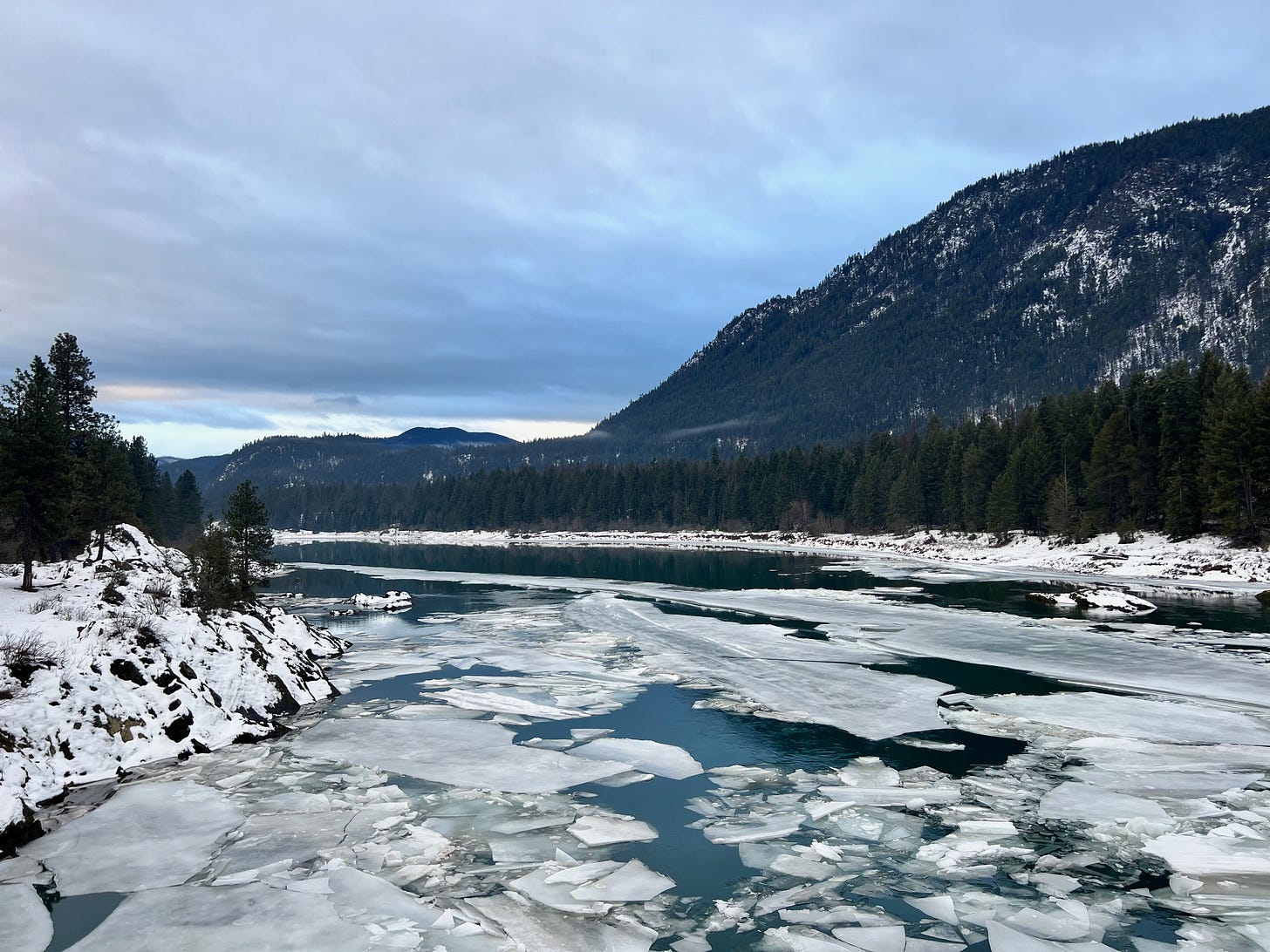
Sunrise over the frozen river last March from near the cabin I stay at most often.


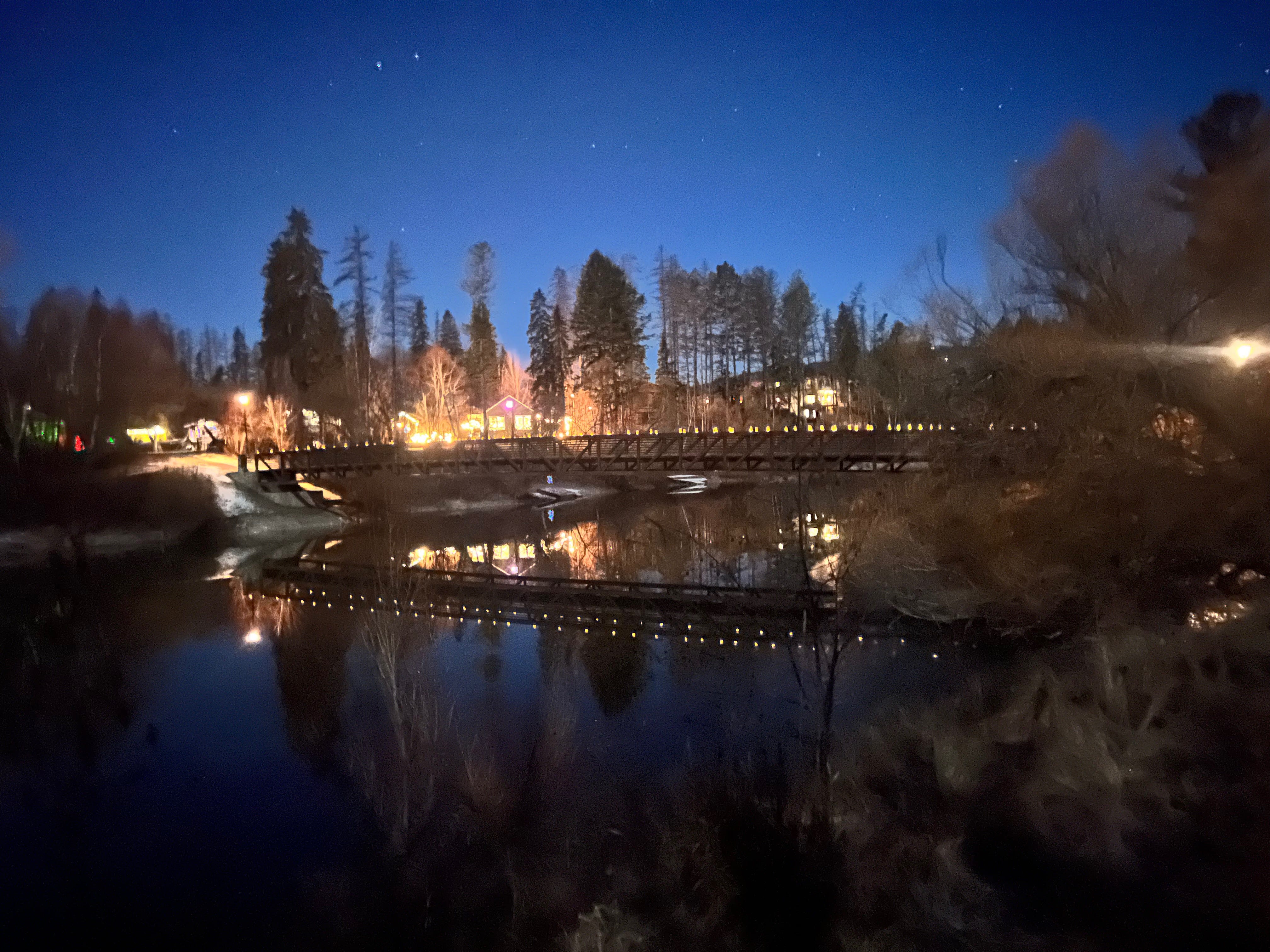
Every year there is a Luminaria near where I live, down by the footbridge that rests over the river. It was begun in honor of people I care for deeply and all the others who care for them, and one another, here. It’s about the only part of the Christmas season I enjoy, and I’ve been grateful every year since I moved back that it’s there, keeping connected all the people who comprise the heart of this community, a place and people that most visitors never see. 

This year I had heard a rumor that it might be the Luminaria’s last because event permitting has become difficult. After saying hello to whole bunches of my favorite people, faces I couldn’t recognize in the dark but whose friendly gaits and voices were familiar, I handed my kid my phone to take photos of the candlelight glittering off the water and settled in for conversation with the person who’d started this tradition, asking him about the permitting issue.

Considering what has been happening in Substack-world regarding monetized publications by Nazis, this person’s explanation felt almost ironic: in late 2016 and early 2017, my town was terrorized through an online neo-Nazi hate campaign, with people in the Jewish community specifically targeted for death threats, including months of personal phone calls and emails. I don’t really want to go into it more specifically again. I wrote some about it and its effects on me here (trigger warning for anti-Semitism), but, as is the case with her response this week to Substack’s Nazi issueAnne Helen Petersen’s reporting on what happened, from when she was still at BuzzFeed, remains the best I’ve seen.

The reason that getting a permit for the Luminaria is difficult now is because the city revamped its block party and event permitting process in the wake of the threatened neo-Nazi march at that time. The march never occurred but the threat is ever-present.

Though I was appointed to the Board of Parks late last year, I don’t yet know all the details of how these permits work—we spend a surprising amount of time trying to figure out how to mitigate damage to Depot Park’s grass from the annual Oktoberfest—but am personally very interested in making sure we can keep the Luminaria going.

These gatherings are important. Maybe you have a similar tradition where you are, or one around Solstice, or harvest festivals, or religious or spiritual or ancient practices I know nothing about. Or maybe they exist near you and you’re not aware of them. These traditions create what’s called culture. They bring people into relationship with one another, and into relationship with this-world. The land and water, animals and moonlight. 

Like walking, traditions and rituals remind us that we are animals evolved in relationship with this planet, with the life and light that co-create existence.

I was thinking the other morning about my father’s struggles with how to maintain integrity in a corrupt and unjust system, and the struggles that all of us face at one point or another with our ethics, morals, and values, and I remembered something Tyson Yunkaporta, author of Sand Talk, said in an interview once:

“We’re at the beginning of a thousand-year cleanup. What generations to come will need most is good stories, and good cognition.”

Good stories and good cognition. I think about that a lot now, and something 

Swarnali Mukherjee wrote recently in an essay about the colonial history of tea in India:

“Are we all also not fireflies, sending coded signals across the continuum of space and time by beaming our light into the quantum of gift we leave behind in our pursuit to build a better world, in pursuit of finding others who can decode the signals, who can see our light?”

Good stories and good cognition are like fireflies, or the lights of the Luminaria, sending signals of understanding and solidarity across the night, their seasonality hinge points as this planet, this-world, makes its annual circumambulation of the sun, whose light makes all of our lives possible. 

Not every question has an absolute answer. But we can each of us try to be a firefly, a candle’s small flame, sending our solidarity across space and time. Or at least I can try, try my best to be a light—starlight brought by memory.

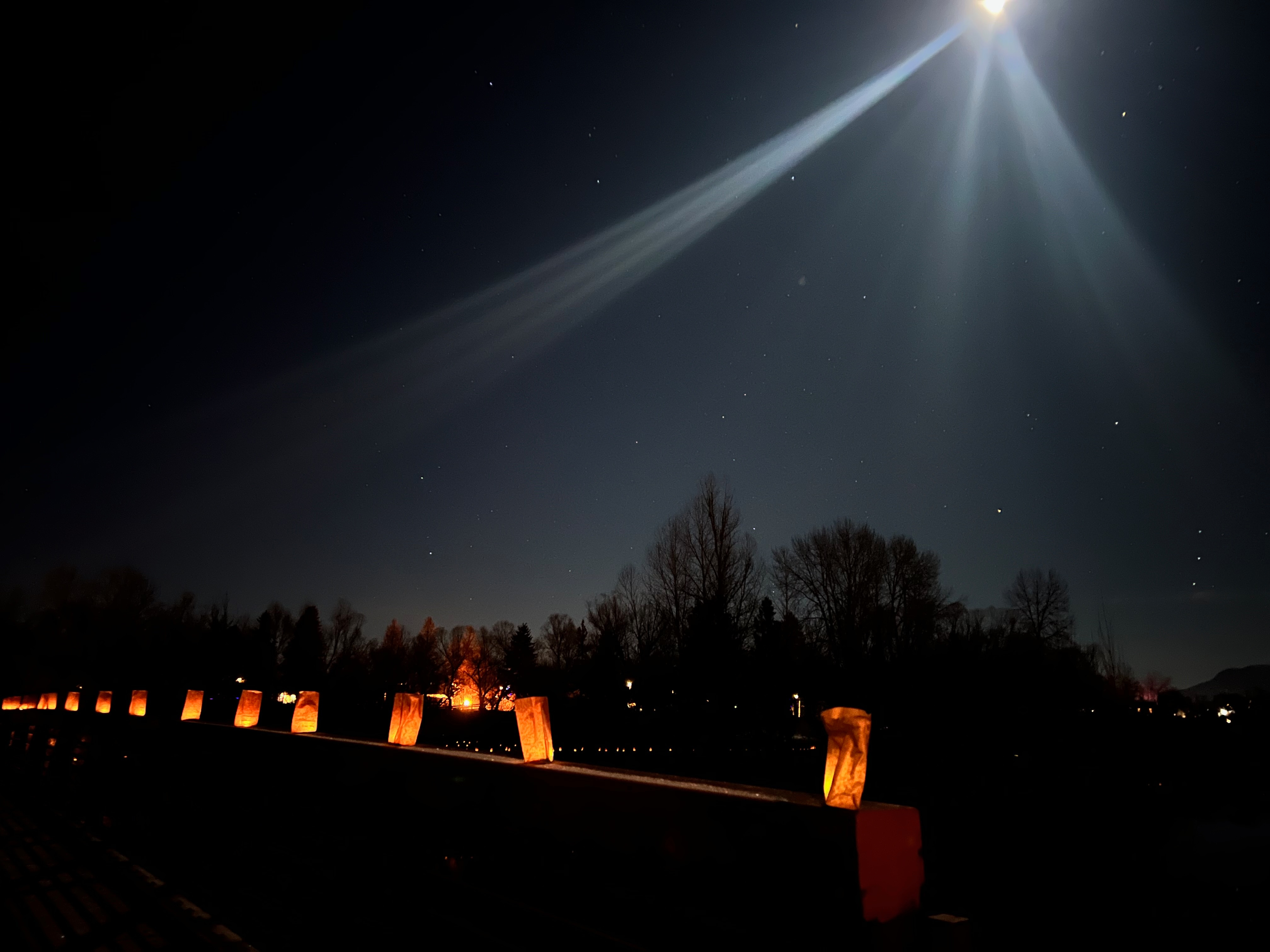
My kid took this photo, of the footbridge with its Luminaria lights and their reflection in the river, starlight above. I was very impressed!