Art harder

My mother sent me a birthday card years ago that I have put above my desk everywhere I’ve lived since. On the front is a reproduction of a painting by Deborah DeWit Marchant, dated 1994: a woman, brown-haired and pale-skinned like me, is sitting in a booth at a diner, next to a window. On the table in front of her are an empty plate with what looks like the remains of pie, a glass of water, a cup of coffee, and an open book. Her left hand rests against her face and she is reading. The street looks wet with recent rain. The woman’s hair is even braided back, as mine almost always is.

The painting is titled “The Artisans Cafe.” There’s a sense of peace in it I’ve always loved, a sense of allowance—this woman can sit there getting lost in a book, no other demands on her attention for at least a little while.
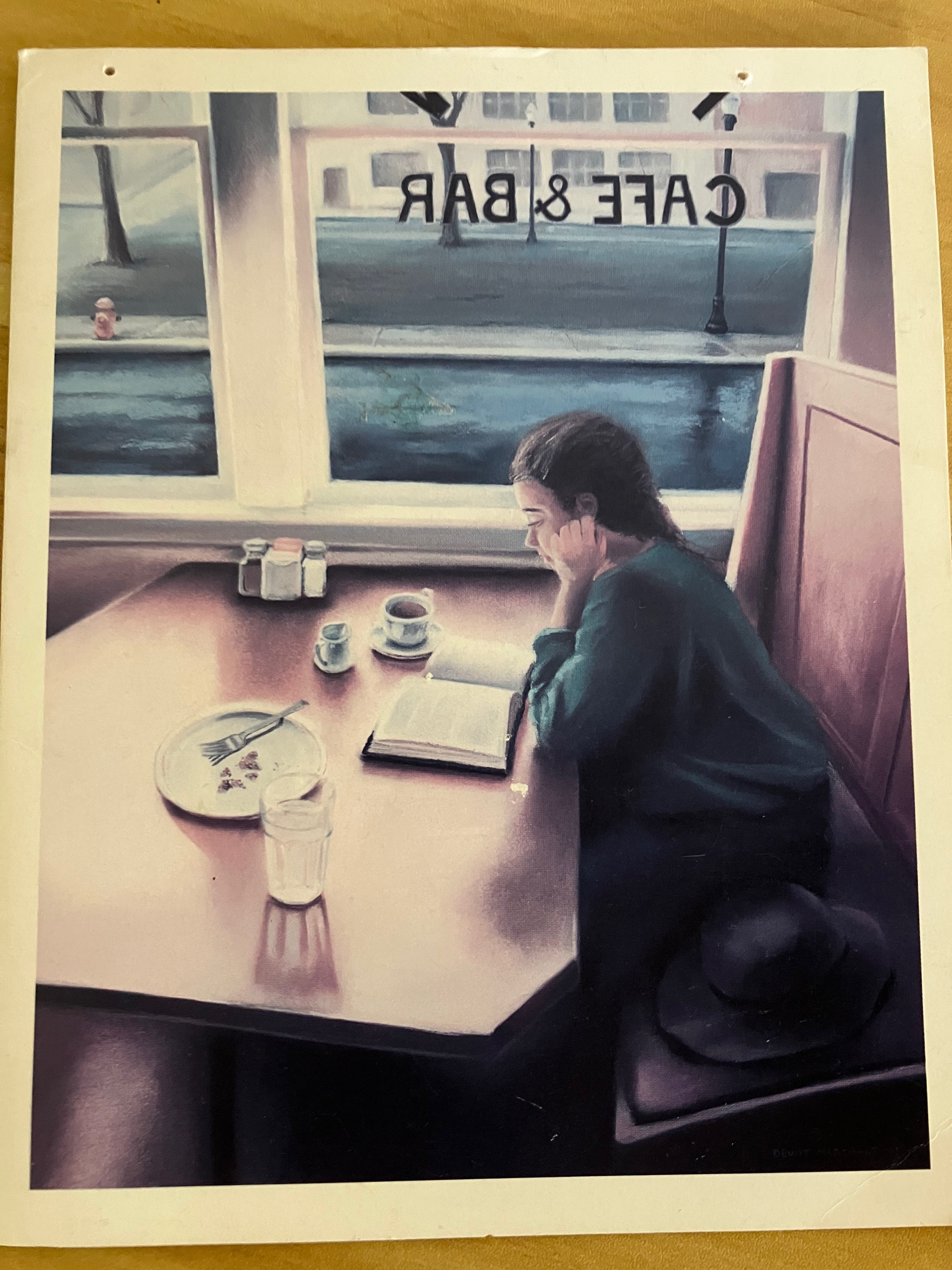
Reproduction of “The Artisans Cafe,” Deborah DeWit Marchant

For years I’ve looked at that picture with both longing and an internal struggle. It speaks to me of the kind of permission to rest that too few people in this life, including me, feel they can allow themselves. I’ve been caring for others since I was four years old, when my younger sister was born, and when I look at that picture I see a moment for myself when everyone is fed and occupied, all the dishes are done, and the floor swept, the laundry folded and put away, the endless tasks of housekeeping and people-caring soothed and calmed and, for the moment, finished. Complete. It’s a moment that never comes.

Maybe it’s the pie plate that gets me. This woman has eaten, and has time to enjoy her book, and her coffee while it’s hot, and doesn’t even have to wash the plate. What a luxury.

I long for the moment in that picture nearly every day. It takes a lot of mental effort to give it to myself once in a while, breathe into the moment, any moment, even while the laundry remains overflowing and last night’s frying pan is waiting to be scrubbed and the peas need picking and the strawberries weeded and forms filled out and the bank account stressed over . . .

In the original draft of this, I followed that line with a list of all the things I’m behind on, everything that keeps piling up, but those details aren’t important. Each of you has your own list, your own burdens and worries and piles of laundry.

None of it will ever be caught up on permanently, much as I long for that moment, and in the midst of it all is my own work, which has been intensive for a while and will be for a few months more. An essay for this newsletter about the conflation of wealth and power that I keep needing to cut down (really, there’s no need to quote every book on this subject I’ve ever read but it’s hard, and do you really want to know exactly how Aristotle advised overthrowing oligarchy? yes, probably), essays for non-Substack outlets, and a lot of editing. A lot of editing.

Over the past six months I’ve been helping my friend Kathleen McLaughlin, longtime journalist and author of the fantastic book Blood Money, with a new anthology of essays by Montana writers she’s putting together for University of Oklahoma Press. It’s been a project she’s been shepherding for over two years and it’s finally taking “holy crap this is real” shape. I have an essay in it, but far more interesting to me is that I’ve been working with over twenty writers copy editing and helping develop their essays about Montana. In over twenty years of copy editing, which I mostly do for K-12 textbook publishers, it’s one of the most satisfying and challenging projects I’ve ever worked on.

It’s interesting being immersed in this editing just at the moment when what is marketed as artificial intelligence—but LLMs, or large language models, are not in fact anything of the sort, not yet—is being pushed as capable of taking over work like mine and I wonder, between rounds of essay edits, if I should take up the manager of the local tire shop on his persistent job offers. That job comes with health insurance and in America that’s far more precious than gold.

There are many levels to the speed of this technology’s adoption that are worrisome but out of my control, from people’s willingness to believe it truly is revolutionary simply because they’re told it is, to a complete bypassing of the reality that most of these systems are built entirely on stolen labor and stolen work—my book is among thousands used to train the LLMs with neither compensation nor my permission—and deployed not to improve people’s lives but to further bloat tech companies’ profits, to the deep, disturbing willingness to withdraw the possibility of creative work (much less income for it) from human beings who sorely need it.

A subscriber here once recommended this post to me, by science fiction and fantasy author Catherynne M. Valente, about artificial intelligence and creativity, that I’ve hung onto, while watching people who, for various reasons, justify the use of a product built on stolen labor and being used to replace the creative work not just of writing, but of editing:

“It can and will get ugly. But oh my god, people won’t stop writing or creating or performing, and they won’t stop coding, either, not the ones who love it and are passionate about it, certainly not because AOL Instant Essayist can, too. That shit is compulsive. From hands on a cave wall to these words on this screen, we cannot stop trying to express ourselves, and if one thing about our dumbfuck monkey dance on this call of salt will never change, it’s that. The unending plaintive scream of people trying to connect, to be heard, to be seen, to be known, to take what is inside us and make it manifest on the outside. . . .

Take away art and we’re going to art harder just to spite you.”

It’s also a really funny essay (while managing to be both slightly depressing in its realism and also empowering in its “fuck you we’re going to be human anyway” manifesto), so I’m going to quote another paragraph just because:

“This is not the optimistic part of the essay. Sorry. This the god dammit we spent literally all of science fiction telling you not to do this can you actually not for once part of the essay. Oh you’re definitely doing it anyway? And shoving me in my locker afterward? Perfect.”

For those who’ve never done it, this might be hard to believe, but editing is at least as creative as writing is. It is art. There is something almost indescribable about helping a writer tell their story or find how to say what they want to say in the best way possible, and in the way that is truest to who they are. It’s psychology and architecture, sociology and tailoring. It’s working with live wires of human storytelling all the damn time.

A writer I used to be friends with once told me that he thought my work as a copy editor simply involved “fixing commas and stuff.” I laughed, but was surprised at his assumption, since I figured he had to have worked with copy editors on his own writing once in a while. I do fix commas, true, but it’s a very small part of my job, which is far more about communication and storyweaving than it is about grammatical rules—which I know well enough to, frankly, not care. At least, not unless I’m being paid to. I’ll never correct your typos, unless you want to pay my hourly rate.

Copy editing is, for me and the copy editors I’m friends with, the people I respect, something far more in-depth. Something vibrant. It’s working with language at the level where it lives, before it gets pinned down in a dictionary like a butterfly specimen on a corkboard.

This really came home to me working on this recent project. So many writers, each with their own voice, style, strengths, and stories to tell. Editing is never just working with words or narrative; it’s approaching that narrative as an animal whom you have to get to know before touching. That animal could be affectionate, happy, traumatized, wild. Anything. The animal is alive and individual, their own self. That’s the point.

It’s working with who the writer of that narrative is, and the readers they want to reach. Sometimes, sadly to me, that means accepting when a writer is allergic to revision and balks at editorial feedback, meaning I only do the bare minimum. Frustrating, especially when there’s talent and potential, but I can’t force people to do their own stories credit. I just accept that they don’t want to know their work any more deeply than they want to know themselves and move on.

Other times, it’s the delight of working with someone who’s never published before and is eager to learn how to bring the best out of their own story in their own voice; or the delight of working with longtime, professional writers who feel the same. There are copy editors who will dictate to writers how to shape their story, but it makes me happy not to be one of them. It’s more fun.

This anthology project has eaten up an enormous amount of my time and energy over the past six or so months. It’s reminded me why I almost never teach or lead workshops: giving feedback in the way I do comes from the same creative place my writing does. I give of myself to other people’s work the same as I give of myself to my own writing, or to my kids, and I have to be careful with that. A couple of times I told Kathleen I had to take a break because my creative well was empty, and since she was of course doing even more work on the project than I was, she understood.

But it’s been far more of a gift to me. In the midst of a lot of personal and global turmoil, it has been a sheer pleasure to challenge myself, to be part of something I think is valuable and important, and to work intensively with such a large and varied group of writers, to be reminded that each one of them is an absolutely unique human being. As we all are.

It’s been both creatively fulfilling and soothing to my humanity—with each exchange and round of edits with each writer, with email conversations that veered into moments of shared experience and running jokes in their essays’ comments, I was reminded that there are no seething, personality-free masses of humanity, only people each with their immediate and intergenerational traumas, their struggles, hopes, memories, and battle-scarred heart.

Yesterday morning I woke up to the sound of a sandhill crane passing by, making me think of a few weeks ago when I heard my first of the spring as I waited in line at the tire shop before dawn to get my winter tires switched over and wondered if my ten-year-old car with 200,000 miles on it can handle another decade.

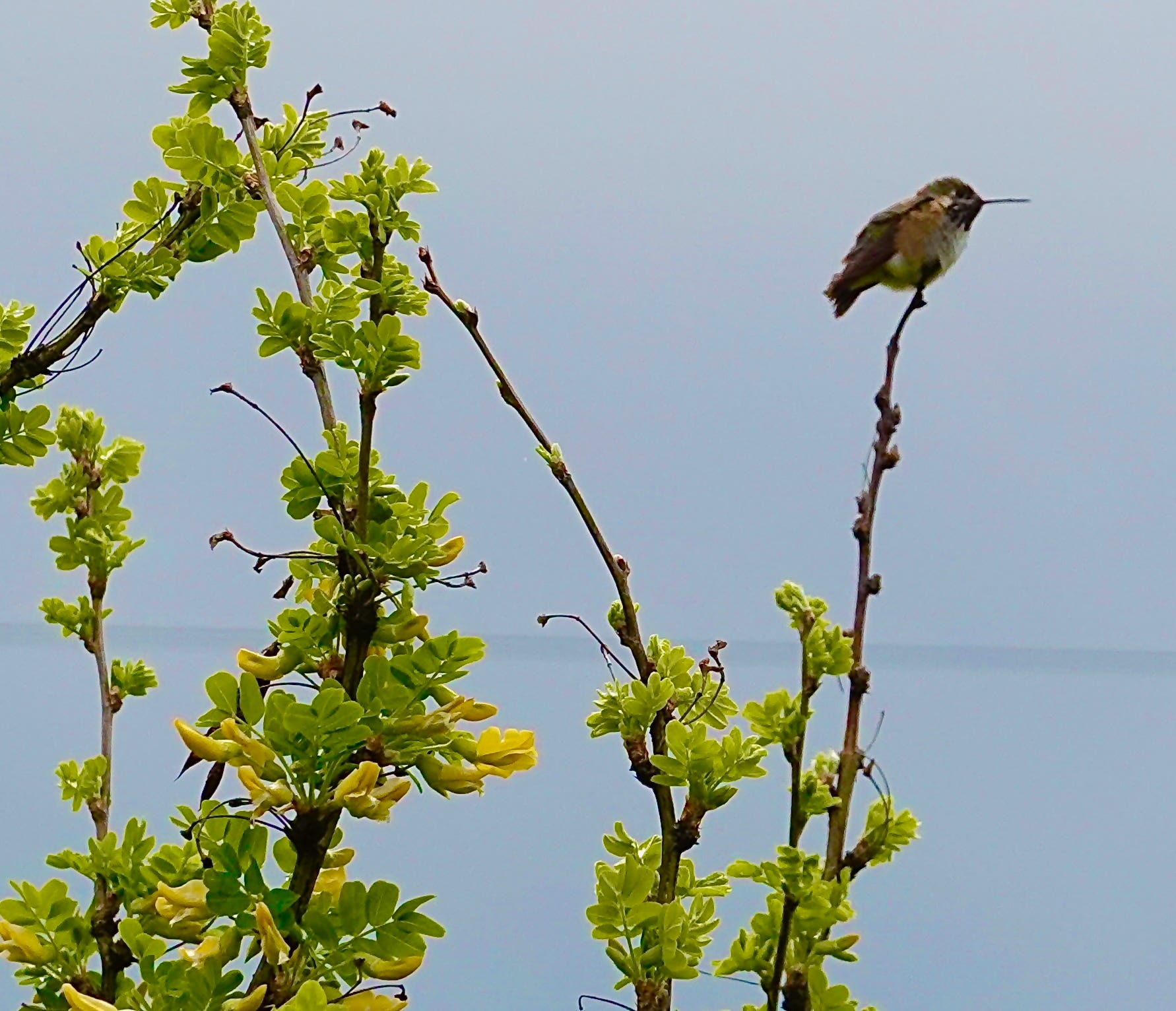
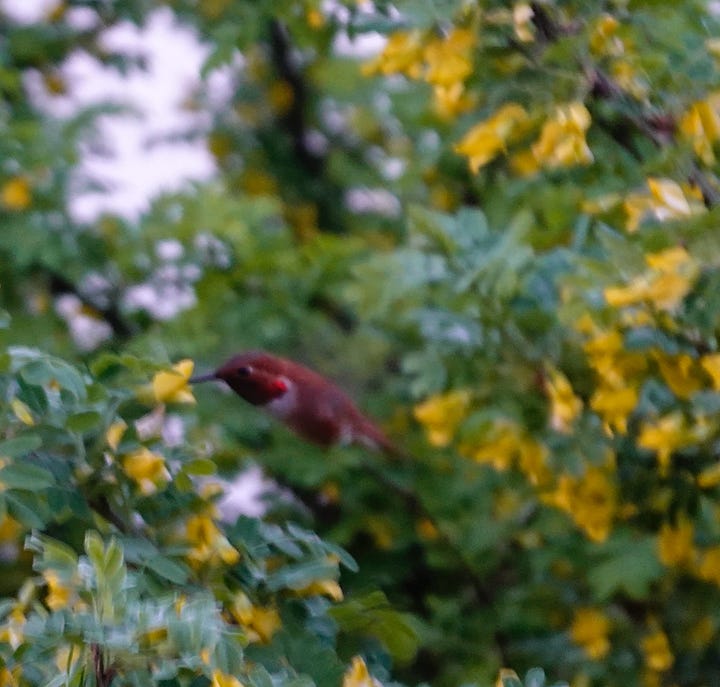
And earlier this week I came back from a self-guided Montana history trip with my younger kid (who’s been homeschooling this academic year) to meet the lilacs at home just beginning to open, and the two resident hummingbirds back in the caragana bushes. The tobacco plants and tomato starts thriving under the grow light my brother-in-law gave me, and the onion sets accusing me silently of neglect while the sweetgrass is thriving.
That night I stayed up to watch the full Moon rise in the southeast, an eerie green-blue glow through the night’s slight fog, the western sky still darkening from Sun who sets far too late this time of year for my taste, lover as I am of the cold and dark of winter.

It was, I’ve heard, a full Moon in Scorpio, a Moon for letting go, a release of what no longer works in our lives. I’ve got plenty of that, I thought, and hoped the murky moonlight would help some of it dissipate.

I have a new editing project starting just as this other one is finishing. It’s a book by someone I’ve worked with before on her audiobook, which I’ve often recommended, about algorithms and bias. She’s a roboticist who worked for NASA on the Mars Rover and is one of the smartest people I’ve ever had the good fortune to know in this life. My creative editor self is excited to immerse in that work.

Her book? It’s about the promises, pitfalls, and prejudices of artificial intelligence, by someone who knows these technologies better than almost anyone else—and, unlike many of us who criticize them, loves them while being clear-eyed about their flaws and risks.

Talking about this project with her brought me back to Ursula Franklin’s book The Real World of Technology, based on her talk in the 1980s that was recommended to me ages ago by a subscriber here and has become one of my touchstones since then.

“While we should not forget that these prescriptive technologies are often exceedingly effective and efficient, they come with an enormous social mortgage. The mortgage means that we live in a culture of compliance, that we are ever more conditioned to accept orthodoxy as normal, and to accept that there is only one way of doing ‘it.’”

Enormous social mortgage. What of our future freedoms and choices do we give up with every unquestioned technology adoption? Who else’s choices and freedoms do we strip in the process without their consent?

In times of darkness as well as times of rapid change, having clarity can feel almost impossible. It’s one of the reasons that I wrote before last year’s U.S. presidential election that one factor many people were missing was keeping the right to protest at all, to fight back, something that is currently—and unsurprisingly—quickly being criminalized. What kinds of choices can you make when the rights you thought were foundational, at least in theory, are being broken up and carted away?

There are at least as many answers to this question as there are human beings alive at any given moment. My own is to look at my Russian-Jewish grandparents and the kinds of choices they made living under the authoritarian dictator Joseph Stalin.

But it’s valid to look also, I think, to that unique human gift of creativity. The messy, tangled, most often unproductive and unprofitable, process that has been somehow fundamental to the history of our entire species, across the planet and over hundreds of thousands of years. One of the answers to how one remains free is—thank you, Catherynne M. Valente—to art harder.

Until all the children in the world live without fear of hunger, violence, oppression, or abuse and every border is marked only by a tree, a greeting, and a bit of cultural orientation, claims of technological progress are, for the most part, mirages obscuring accumulation of wealth and profit. (I’m not talking about developments like vaccines. Vaccines are great, as are many other technologies. But technological “progress” is not the unmitigated good it’s assumed to be—see the entire century of building a car-centric world and the attendant pollution, severed communities, and human health consequences.) They might be developments most of us have no control over, but we can choose to keep our humanity as intact as possible.

I see no reason to give up writing or editing, even when so many believe the marketing hype that says LLMs can do those tasks just as well. I don’t, frankly, care whether they can or not. I care that people believing it’s true will probably eviscerate my ability to make a living doing something I love, but that won’t stop me from doing it. Storytelling, as I’ve written before, is for me paired with walking—a fundamental human experience, core to who we are as a species. I don’t intend on giving that up, even if I need to get a job at the tire shop to pay the rent and feed my kids. It’s not a bad job and the people there are nice.

Editing and writing are, for me, represented by that old birthday card above my desk. Every word considered or line scratched out in my notebook, every minute sitting with a writer’s essay and trying to sink into what it is they’re truly trying to say, and to whom, is a moment of rest, clarity, and the ineffable spark of insight. It’s life, interwoven with the hummingbird outside my window and the river that runs through town and the heartaches and losses and beauty of human experience. It’s connection to whatever it is that holds it all together—holds us, all, together.

It is my chance to live in the Artisans Cafe whenever and however I can.

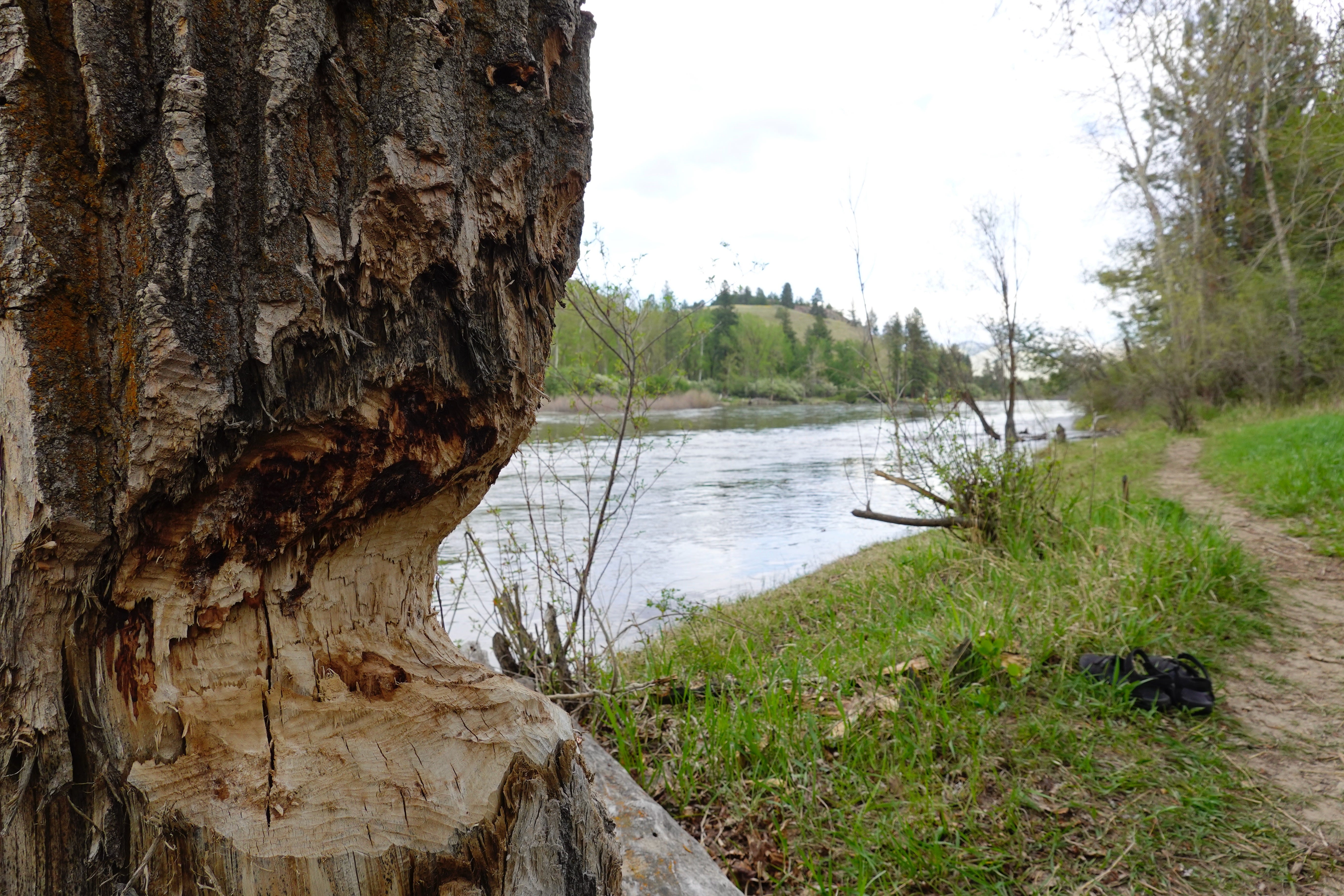
My kid and I stopped in Missoula on our way home from the history trip, took a wander along the big-shouldered ponderosa pines of Maclay Flats and were rewarded with fresh beaver chew. Every moment of our lives is a struggle between contributing to technology’s social mortgage, which we can’t always escape, and . . . this.
Fox Owns Herself

If you’re new here, welcome to On the Commons!

Here, we explore questions as varied (but related) as: What is the difference between attention that fractures us and attention that restoresWhat role have three 15th-century papal bulls served in the “claiming” of land worldwide by Christian peoples of European descent, and how have those claims evolved?

New writing! Elementals, a new anthology from the Center for Humans & Nature, is out now: “The Elementals series asks: What can the vital forces of Earth, Air, Water, and Fire teach us about being human in a more-than-human world?”

I have an essay titled “Trespassing” in Air, alongside stellar writers like Báyò Akómoláfé, Ross Gay, and Roy Scranton. Other volumes include writing from Robin Wall Kimmerer, Andreas Weber, Tyson Yunkaporta, Sophie Strand, Joy Harjo, and many more. As with their previous series Kinship, this anthology brings healing and guidance to a world sorely in need of both.

This essay, on the legal question of where ownership originates, and the perspective gained by thinking in geological time, was originally published November 11, 2022.


One mid-morning on a bitterly cold November day, I was sitting at a table with my younger sister, her two little girls, and my younger kid. We were staying at a rented Forest Service cabin in Montana’s North Fork valley, no internet or electricity or running water, having recently cleaned up from breakfast and playing an interminable game of Unstable Unicorns.

I glanced up from my hand with the two “Neigh” cards I kept forgetting to use, when I lost control of words and patted my kid on the arm enthusiastically several times before managing to say, “There’s a fox on the porch!”

My kid had been hoping to see a fox in person for ages and thought I was joking, but no. She was right there looking at us through the window. I’ve seen a number of foxes around our town, but my kid somehow always misses out.

We all put our cards down and padded from window to window as the fox tracked around the cabin, watching her until she disappeared back into the woods.

One of the most famous and pivotal property law cases in U.S. history, the 1805 case Pierson v. Post, involves the hunting of a fox. The legalities of that particular case have staying power for a reason. They hinge on the question of what grants ownership: labor or possession? Was it Post, who was hunting the fox, or Pierson, who actually killed it, who owned the animal in the end? New York State Supreme Court reversed a lower-court decision in Post’s favor and granted ownership to Pierson. The written decision reached back through centuries of legal thinking, drawing even from the Byzantine emperor Justinian I.

Law students—and people like me who study too much about this stuff—can get hung up for ages arguing about the ownership philosophies of William Blackstone and John Locke and whether it was the labor of the hunt, or the person who had physical possession in the end, that determined ownership. Labor and possession being two keystones of property law.

Yet rarely is it asked: What about the fox herself?

How can ownership really be debated or discussed without considering whether every entity has rights in and of themselves? To exist, to wander freely, to sniff around a porch for food humans might have neglected to store. To decide they don’t want to hang out and watch those said humans play Unstable Unicorns.


The five of us were staying at this cabin in my usual run-away-from-election-news routine. I have an unfortunate emotional reaction to elections. I’m sure it’s not uncommon, but it’s exhausting and also completely useless to be refreshing news every few seconds, tracking outcomes to events that I have zero control over. A few years ago I started renting cold, electricity-free, mouse- and packrat-loved cabins far away from internet service over election days. It’s something I hope I can keep doing as long as Montana, where I live, still has early absentee voting widely available. Which might not be long.

When we drove up to the cabin, my sister said, “Are you fucking kidding me?” in response to the stunning view, and I said, “When do they light the beacon fires?” because it really did look like the beacon-lighting scene in the movie version of Lord of the Rings. This is from two people who live barely an hour’s drive away and grew up here. You’d think we’d be used to the beauty. You’d be wrong.

But I don’t just engage in this ritual so that I can get away from it all and admire the view. I persist in it because I want to spend that day reminding myself of why I care. I’m not interested in politics because I’m into politics. I’m interested, and emotionally invested, because I care about this world we all share, these ecological and social and spiritual commons. Going away to a silent river valley, spending all night feeding the wood stove every hour because it’s well below freezing, watching Sun rise over the mountains, being surprised by a fox—these things remind me why I volunteer in my community, why I encourage people to attend school board and city council meetings now and then, why keeping places like the North Fork free from too much human development is important, why the political bent of my home county breaks my heart all the time, and has done since I was a teenager.

It also reminds me that my heartbreak isn’t even a noticeable microbe in the span of geological time.

A few years ago we visited Zion National Park in Utah, another place of surreal beauty. I stopped on a trail to observe the facing cliff for a while, so tall it felt unreal. All that orange- and red-tinted rock, and somewhere deep down in the face, a single, narrow band of black. How much time did that band represent in the hundreds of feet of stone surrounding it? A thousand years? Ten thousand? Everything that happened in a span of time far beyond humans’ ability to grasp, pressed into that one bit of different-colored rock, a tiny note for future observers to see: Something happened here. For millennia. And yet in the vastness of geological time it barely left a mark.


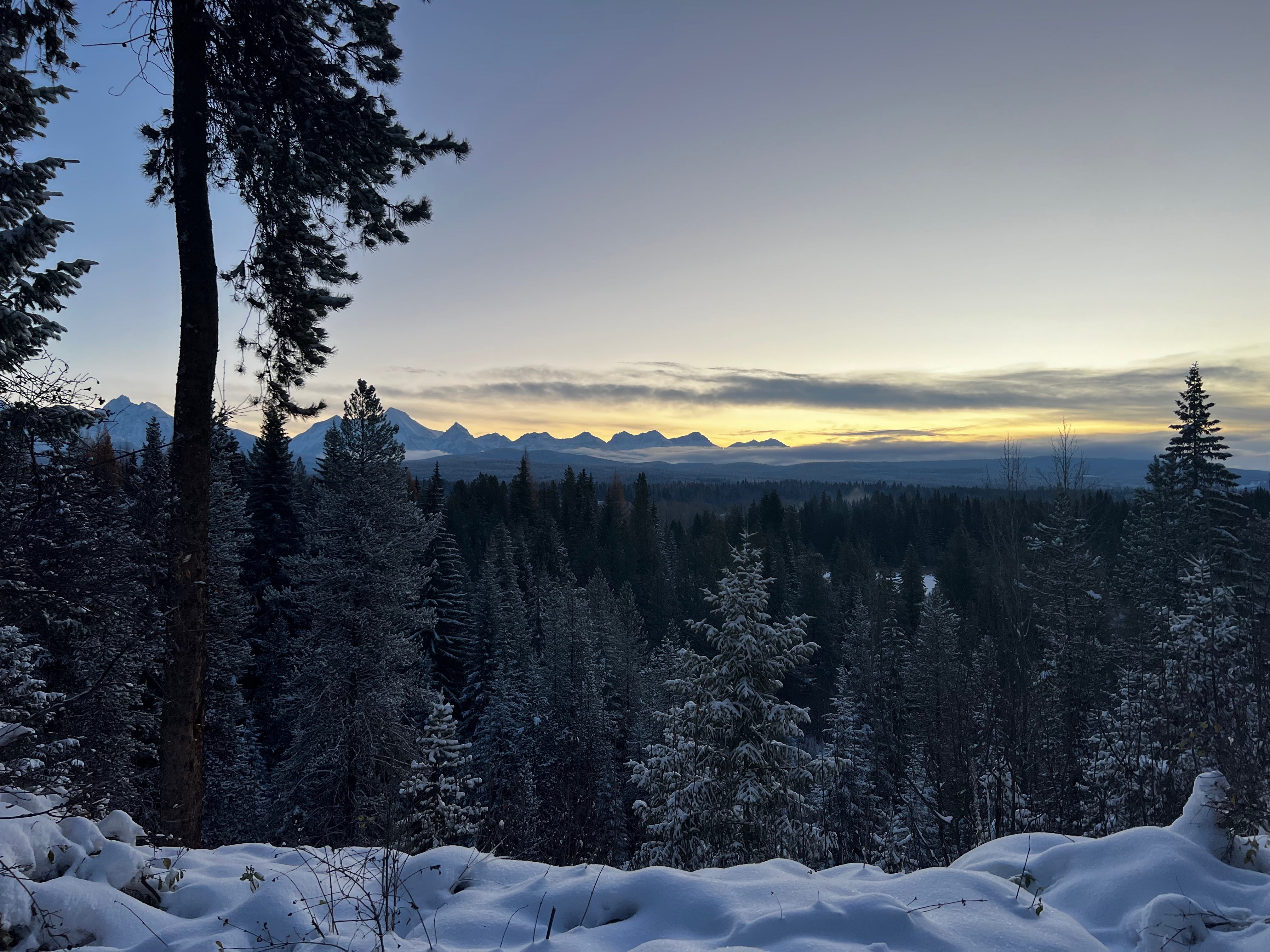
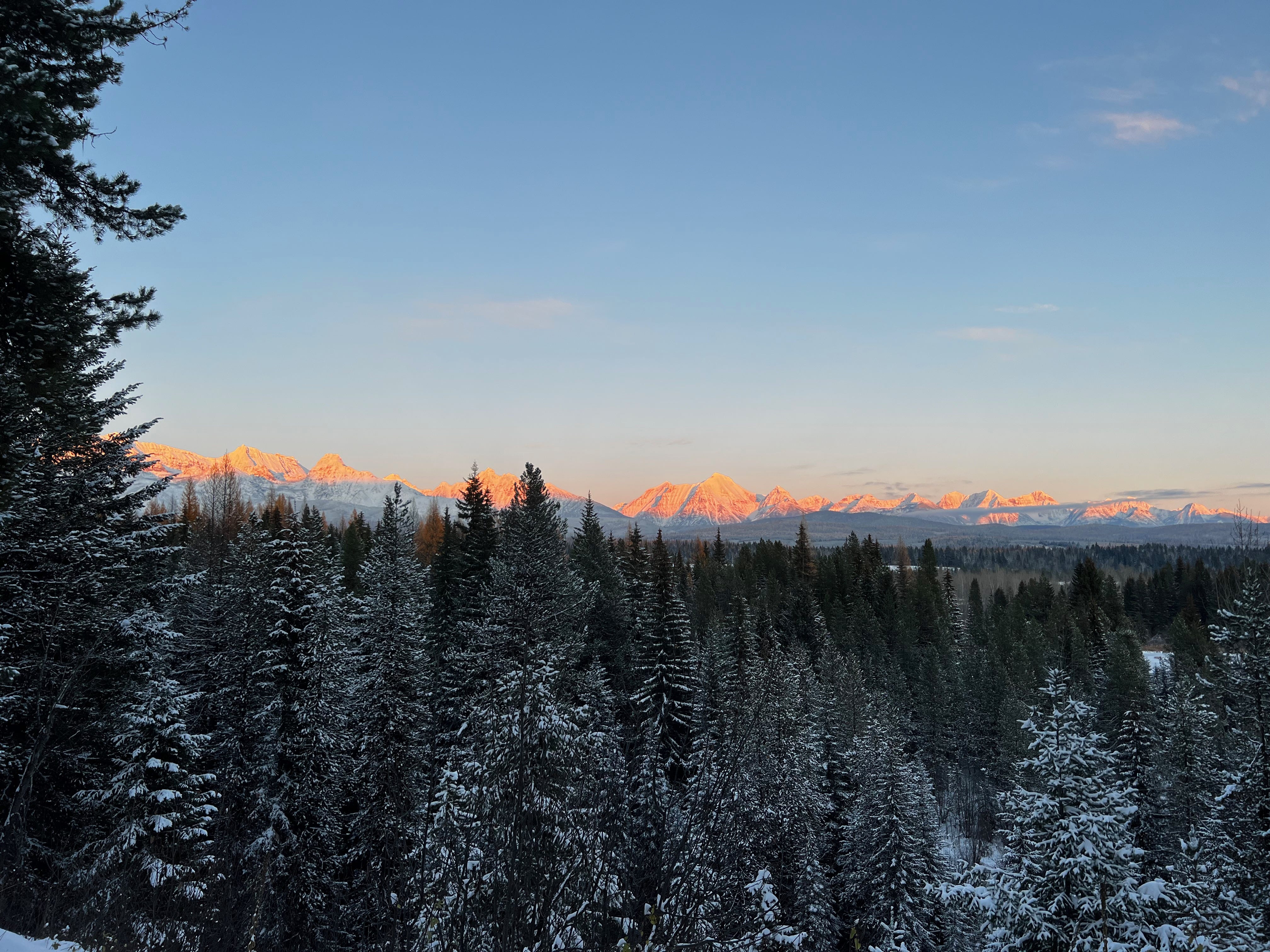
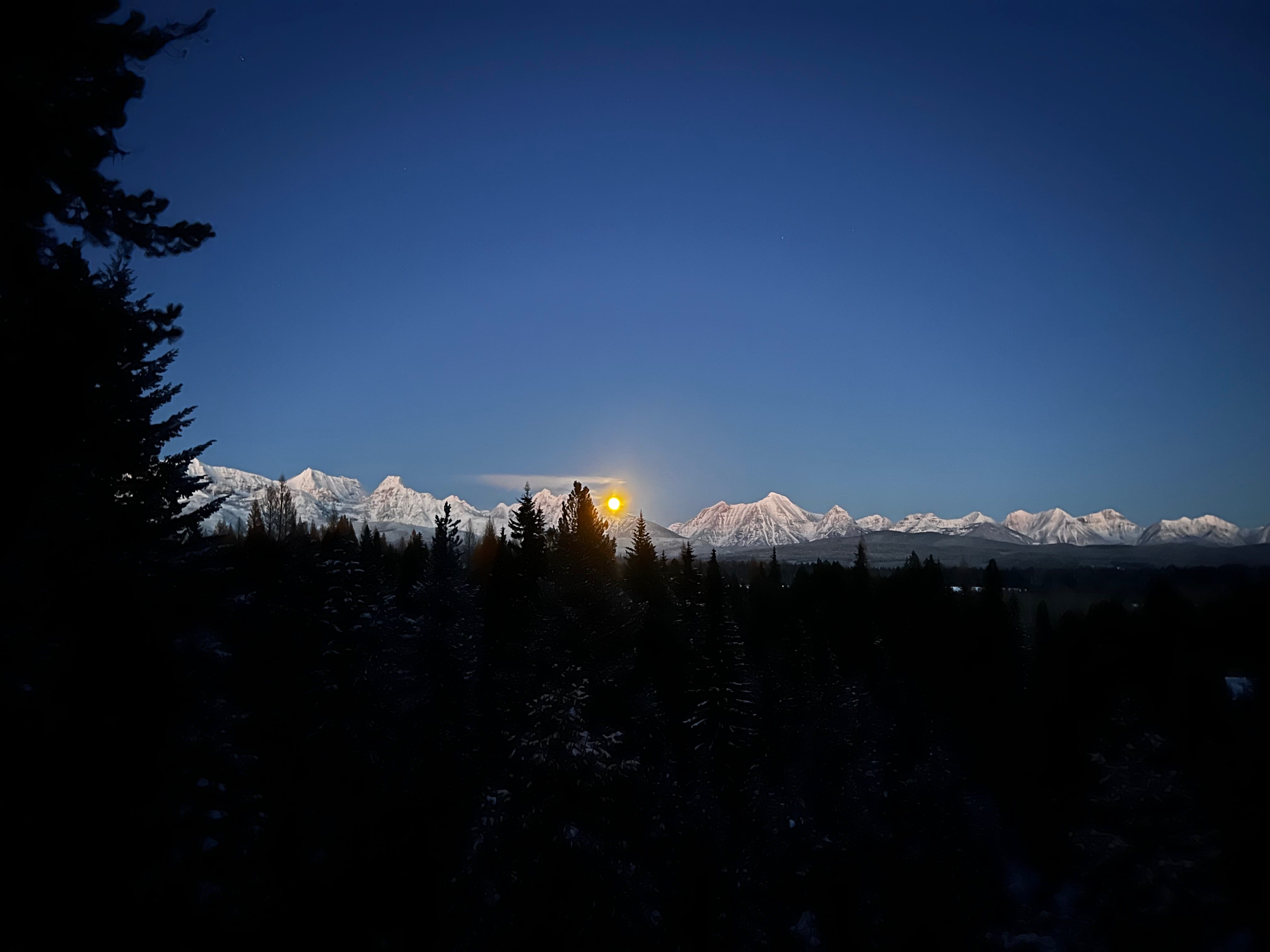
Several hours after the fox left us, alpenglow from the sunset hit the snow-covered peaks of Glacier National Park (pictured below), looking deceptively like a sunrise, and barely forty-five minutes later full Moon rose behind them (pictured at the top of this post), covering the entire valley with the kind of unfiltered indigo sky-light I sometimes forget exists, and we all stood in our pajamas and watched it, our breath spilling out into the frozen air.

I thought about the fox’s visit, and Pierson v. Post and the question of property, and how long ago it was that some humans decided to claim ownership over others—water, women, wildlife, and seeds; our relationship with those contain the ancient genesis of ownership, I continue to believe—and then create justifications for such claims through centuries of philosophical, religious, and legal argument.

What could change if we inverted that relationship? If we started from an assumption that all beings own themselves, that every being has agency and choice?

Our lives are so short. The events that shake our worlds so brief, against the timespan of stone. No matter what is forgotten of these times—eventually, everything will be, and everything for hundreds and thousands of years on either side of us, even foxes and Unstable Unicorns—it still matters how we care for one another. How we practice kindness, how we love, how we watch Moon rise and whom we share it with.

The joys and the pains are not everything, but they are not nothing.

In the comments on the original essay, Charlotte Hand Greeson shared a link to law professor Ann Tweedy’s then-recently published poem from the point of view of the fox, “Pierson v. Post’s Unheard Voice.” You can download the full poem from that link—it’s beautiful—but here’s a taste:

“I learned since that the man on the horse and the man on foot quarreled
about the right to kill me, had a third person decide. . . . 

. . . Students still study the story
but give me not a moment of their time. I am the invisible focal point. . . .

. . . You are right to think that, alive, no one could own me.
That’s the only true part of your story.”

Sunset’s alpenglow on the peaks of Glacier National Park

Nothing in Excess

I recently spoke with a class at Michigan State University about walking, health, and cultural views of wellness. As happens during most of my talks with college students, at least one came prepared with a question that left me scrambling for an answer.

Undergraduates consistently show up with a broader range of interests than I find elsewhere—when I spoke at Dartmouth earlier this year, I stopped in the middle of our two hours just to comment that I had never spoken with a group that had such persistent interest in bus systems. It gave me hope, I said, because public transit might seem boring to many people but it’s central to finding ourselves in a cleaner, more just, and less extractive world. At the University of Montana a couple years ago, it was one about propaganda and Mikhail Bulgakov’s The Master and Margarita, which I hadn’t read in years.

During this most recent talk, among several excellent questions was one about the architecture of prisons.

Incarceration and abolition matter to me, but, as I told the student, those subjects are well outside my areas of expertise.

The moment I said that, I paused, remembering a study I’d read very early on in my walking research about psychology, mental health, and architecture. I’d wanted to make more use of that study than I did—my editor was, rightfully, constantly reining in my enthusiasm for straying into research that was, at best, adjacent to walking. In the end, that study only informed one sentence.

I couldn’t remember the details of the study, but managed to scrape a memory that it had said something about how the designs of prisons and schools affect people’s self-perception, along with something that has stuck with me from Jane Brox’s book Silence about the design of a near-silent early prison in America.

What does it do to people, I asked the students, to have every aspect of your life controlled as a constant message that you aren’t to be trusted? Which related to the student’s secondary question about neighborhoods—if you live in a neighborhood that doesn’t have sidewalks or parks, or shade or access to green spaces, or is cut through by a 4- or 5- or 6-lane road and there’s no way for kids to walk to school safely—much less if you live in a region under constant oppression and surveillance, ripped from freedom by razor wire and armed patrols—that’s a pretty strong message about whose neighborhoods and lives are valued, whether by your own city officials or a colonizing imperial power.

Extend that to the criminalization of anyone who can’t afford a home at all, and the message about who matters couldn’t be clearer.

When my literary agent and I were first sending around the book proposal for A Walking Life to publishers, I had phone calls with a number of editors. On one of them, with a publisher that leaned more literary, the editor said, “I could see you know your subject, but I didn’t realize you were a policy wonk.”

It wasn’t a compliment.

That editor wanted the book but wanted me to restructure it as a kind of international intellectual and literary stroll, which was the kind of writing about walking I explicitly wrote my book to move away from. I was tired, and still am, of walking literature being by and about people, largely people of great privilege, wandering the world in their heads. Maybe that’s why I’ve been walking barefoot so much in the last year. I want to feel the ground, not just think about it.

His comment stumped me in the moment because I’m not really a policy wonk. What I thought of—a week after our conversation, of course; I’m a slow thinker—is that there is a difference between being into policy, and knowing your subject well enough to be able to talk about it as knowledgably as possible.

That aspect of writing nonfiction is important to me. I over-research nearly everything I write. It’s absurd. But it matters to me because, when someone has taken the time to read my book or one of these essays or shown up for a talk, I want to be able to respect their—your—time and attention in return. I do that by being as thorough as I possibly can for each aspect of a subject that captures my interest.

When editing my recent piece for High Country News, my focus on centuries of violent rebellions against enclosures of the commons in England came after back and forth with the editors about the current-day relevance of enclosures: when nobility and other landowners enclosed what had been commonly shared and carefully managed land, eviction of tenants, often entire villages of people, was usually part of the process. The Highland Clearances in Scotland is one of the best-known mass evictions in Britain’s history, but millions of acres were stolen and hundreds of thousands of people evicted throughout England before landowners turned their full attention to Scotland.

Mass homelessness inevitably followed, and in the wake of enclosure acts, the government pursued criminalization of being without work and/or a place to live: the Vagrancy (or Vagabonds) Act of 1547, for example, in which any “able-bodied” person who was found to be out of work for three days was to be branded with a V and sold into slavery for two years; or the Vagabonds and Beggars Act of 1494, in which “vagabonds, idle and suspected persons” were to be put in stocks for three days and nights and given nothing but bread and water and then evicted from the town.

“Evicted to go where exactly?” is just as relevant today as it was then. The fact that the Vagrancy Act turned out to be impractical to enforce isn’t the point.

The city of Kalispell, Montana, just a few miles from me and where my father and stepmother live, recently stopped short of pulling the operating permit for my region’s only low-barrier houseless shelter after years of complaints by those who seek to criminalize being without a home; while Missoula, Montana, followed in the steps of many municipalities to make it illegal to camp in city limits overnight.

During a discussion on land ownership and enclosure acts last year, one commenter noted on a section about anti-homeless laws in 1500s England—relating them to the U.S.’s current affordable housing crisis—that, “‘Skin in the game’ counts, while skin itself doesn’t.” People’s lives, in other words, matter less than property values. It matters that this was true during centuries of the theft of the commons, because it’s not new. Like most injustices, it takes different forms, but we’re still living with it.

I’ve read more books than I care to count at this point on land theft and the commons alone for this book I keep promising you all. In every one I learn something new, most of which will never make it into narrative. But I know by now that there’s always a chance that some fact or story that I can pull out of my bedraggled brain will be useful to someone someday, and while I don’t think that makes me a policy wonk, it does give me a lot of satisfaction.

But policy knowledge doesn’t hurt, either. Holding knowledge about walking’s gifts and potential along with knowing about the systems, legacy infrastructure, and ongoing policies—like road designs that are mandated (not just suggested) to optimize traffic flow, even at the expense of healthy ecosystems and human lives—helps me, and I hope helps everyone I share it with. It can be easy to see that a road is unsafe for anyone walking, but you can’t change that reality if you don’t know that federal requirements determine its design. We have to know where the barriers are in order to dismantle them.

Similarly for land ownership and private property: knowing the history of enclosure and rebellions, and the lack of any true foundation for, say, exclusive private property rights in land, matters for how we perceive the paradigms and stories we function within.

Changing a paradigm is hard, involving as it does a massive upheaval of perception and possibility, and especially hard if you can’t see it for what it is. The ancient Greek maxim to “know thyself”—inscribed on the Temple of Apollo—applies equally to knowing the structures that shape our world and our expectations of it. If we want life to count more than skin in the game, more than profit, we have to know what we’re fighting.

Also inscribed on the Temple was the maxim “Nothing in excess,” which, when it comes to research, I’m not very good at adhering to. But then, who defines “excess”? I’ve been reading Guy Standing’s Plunder of the Commons, which turns out to have very little information I need, but even if I never write about the Lauderdale Paradox of 1801, in which James Maitland, the eighth earl of Lauderdale, showed how public wealth decreases as private wealth increases, someday it might be exactly the historical link that someone out there needs.

I don’t generally wonder if the research I do is excessive—I assume it is—but it feels like the excesses of nature: the way I can walk around town right now and eat handfuls of serviceberries, or how there are so many ripe raspberries coming out of the garden that three families can’t eat them all, which means I had enough to make a batch of seedless raspberry jam last week.

The research I do is frequently boring, written as it is for academic expectations and requirements, but it is rarely without some kind of gift, some spillover of story or insight or simple information that makes me feel like I’ve been rewarded. It leaves a richness, and like all true gifts, the greatest pleasure is in being able to share it.

The East India Company and the power of corporate stories

Welcome back to On the Commons! For those of you who are new here, On the Commons is a newsletter exploring ownership and its inevitable injustices, investigating centuries of philosophical and legal arguments made in defense of private property for a much simpler explanation: theft. Or in other words, “I took it; now it’s mine,” and the consequences both large and small for our shared world. 

This is an updated, slightly revised version of a post first published on 31 December 2021. This is the third in a series of essays republished from earlier years. The previous one was on the Doctrine of Discovery.

Both top and bottom photos are of No Trespassing signs on the fence of land owned in my town by the Burlington Northern-Santa Fe railway company.


The Boston Tea Party is one of the defining stories of America’s founding as a nation. I remember learning about it year after year in school in the 1980s. Probably every American kid does. What was never said in those scrappy little classrooms across Montana is that the story of the Boston Tea Party is also one of the sharpest tools wielded in defense of the mythologies that make up the American ideal. The fact that it was an illegal riot that destroyed private property doesn’t just get glossed over; it’s never presented that way, not in the U.S. anyway. To present it that way would fly in the face of the American ideology that private property is bedrock. Instead, the story is presented as noble: the little nation that could refusing injustice imposed by a far-off monarchy. 

What also gets glossed over is that the impetus for the riot wasn’t simply taxes; it was taxes imposed by government in order to benefit a private corporation.

The struggle over taxes in the British colonies of North America had been ongoing for years. The tax on tea, however, had a second purpose besides enriching King George III: the British Parliament wanted to keep the tea tax as a symbolic acknowledgment that the government maintained its right to tax the colonies, but they also wanted to help the East India Company claw its way out of debt. The story of the Boston Tea Party, the real one, points to the longer history of government enabling corporate power and profit until it essentially becomes an arm of the corporation itself.

The East India Company had its own private army. It in effect controlled all of India at one point, nominally representing Britain’s interests but serving its own. 

Swarnali Mukherjee has written extensively in Berkana about what the British Crown and the East India Company’s actions meant for the economy of India. I encourage you to read the entirety of her essay on this subject, to understand the importance of the point she makes:

“The construction of railways was funded by Indian taxpayers, and the economic benefits often flowed back to Britain in the form of profits pocketed by British shareholders. The total wealth drain of India under British rule, in today’s value is an estimated $45 trillion.”

As with many of our modern corporate-government revolving doors and mutual back-scratching habits, the interests of the corporation often enveloped, or became, those of the state, as noted in this Financial Times article on the East India Company and its implications for modern capitalism

“The EIC remains history’s most ominous warning about the potential for the abuse of corporate power — and the insidious means by which the interests of shareholders can seemingly become those of the state. . . .

For just as the lobbying of the Anglo-Persian Oil Company was able to bring down the government in Iran and United Fruit that of Guatemala in the 1950s; just as ITT lobbied to bring down Salvador Allende’s Chile in the 1970s and just as ExxonMobil has lobbied the US more recently to protect its interests in Indonesia, Iraq and Afghanistan, so the EIC was able to call in the British navy to enhance its power in India in the 18th century. And just as Facebook today can employ Nick Clegg, the former UK deputy prime minister, so the EIC was able to buy the services of Lord Cornwallis, who surrendered Yorktown to Washington.”

It’s a long but excellent article (and unfortunately I think now paywalled), detailing the Company’s permission to wage war, and instances of forced privatization across the world at the Company’s behest. It also points to England having isolated itself from the rest of Europe due to wars over religion (I assume the author was referring to the abandonment of Catholicism and establishment of the Church of England) as a factor prompting the country to look for markets outside of Europe, a vital ingredient for colonialism: 

“The English were forced to scour the globe for new markets and commercial openings further afield, and to do so they had no compunction but to use, for the first time in history, unbridled corporate violence.” 

One of the questions I keep asking myself is if government, of almost any form but particularly of the nation-state, has always existed to serve private interests. Its main claim to enforcement of law is a monopoly on state violence, most often employed in the name of protecting private property, rather than protecting citizens from harm.

This is obvious when you look at laws and police actions against something like constructing an oil pipeline. The pipeline is private property built in pursuit of profit; therefore, it qualifies for legal protection from the state even though it threatens clean air, water, and soil—even if it takes others’ private property in turn. The U.S. government’s power of eminent domain, after all, was first used for private gain when railroads were being built across the continent, and has continued to be wielded in the name of private profit ever since—the Supreme Court decision in Kelo v. City of New London (2005) and the Pennsylvania District Court case granting eminent domain to a pipeline builder over the objections of a family of maple tree farmers in 2016 are only very recent examples of a longstanding pattern.

What to do about it is another question. Even democratically elected representatives are eager, as we see all too clearly every day, to promote corporate interests over that of their constituents if it assures them a safer and longer place in a seat of power. We need democracy and the right to vote, but those tools aren’t enough to assure a livable planet and lives of dignity. They are necessary conditions, but not sufficient.

There’s a tendency to just say, f— it, burn it all down and start over. But that’s been done more than once throughout history, in several places within living memory, and all it results in is a lot of suffering and the same cycles starting over again. It’s as if there’s something broken at the center of humanity, or at least a sizable portion of humanity, and we’re never going to find a better way to live together until we clearly define the shape and scope of that brokenness. As long as we* accept structures that prioritize private profits over life and health, pollution and structural injustice is all we’ll get. 

If I believed in the devil, it would be someone in a sharp suit promising me two or three generations of decent jobs in exchange for the water, soil, and air I depend on, with the added bonus of sacrificing my kids’ health and senses of themselves as free human beings. It is the purest kind of evil to smile and hand out some cash while snipping the threads that link us to life.

The stories we tell and accept about ourselves and others have tremendous power. If we can change the stories, maybe we can begin to change something about our lives.

Instead of trying to burn it all down, plenty of people focus on building from the ground up—better systems, better ways of doing and being and living: this profile of a local food and farm co-op in Washington is a reminder that even when things feel like they’re falling apart, there are people and networks all over the world trying to piece them back together. Montana’s Alternative Energy Resource Organization (AERO) has been working against corporate agriculture for decades, from lobbying for a different kind of Farm Bill that works for people and food rather than commodities, to producing the bulk of the country’s organic lentils and heirloom grains like kamut. Oakland’s Unity Council has also been working for decades on affordable housing, higher-quality food access, and integrated public transportation in Fruitvale, one of the city’s poorest areas.

There are plenty more. I’m reminded of these organizations and people every time I work on a story about urban planning, affordable housing, or pedestrian advocacy. They are everywhere. They just never get featured on cable news or the podcasts of so-called “thought leaders.”

Changing our systems to serve people involves all of these efforts. And they don’t have to be scaled up—they have most power and efficacy when they stay connected to a particular place and community. Instead of scaling up small, workable, place-based systems, we need to take out the support systems that keep oppressive conglomerations afloat, from tax subsidies to weak interpretation of anti-monopoly laws (which should always include what monopolies truly cost life). And of course to change the way a large percentage of human beings see themselves as co-existing with the rest of life, which is no small task after millennia of negating and oppressing this reality.

During a recent U.S. election cycle, my state elected a governor who ran on the tired trope of lowering taxes, “creating jobs,” and being a successful businessman. People in my state are actually very good at “creating jobs.” Small business owners sometimes feel as common as pine trees. Many of those jobs—upwards of 70,000—are dependent on a healthy commons in the form of clean rivers full of fish and public lands that provide the kind of solace and clean air that no job could touch. 

It’s often hard to get people to acknowledge the existence of these jobs and the kind of healthy shared commons that make them possible because our idea of a “job” is so starved of meaning and hamstrung by identity and self-perception. (Journalism jobs have fallen by 65% in the last 20 years, for example, while coal jobs have fallen by 61%, but we don’t hear much about the former.) Working in a lumber mill is a job; working as a fishing guide is, too, but also somehow isn’t the kind of job you’re talking about when you’re voting for “job creators.” Real jobs means lumber mills, slaughterhouses, car factories, oil pipelines, tech engineers. It means hundreds of people, massive profits for the bosses, and a no-holds-barred attitude when it comes to environmental destruction. Maybe it’s the type of job or maybe it’s the number of people employed at each operation, but there are plenty of small businesses that somehow don’t count when it comes to political rhetoric.

This is just a story we’ve been told, one that people then tell one another. But we are capable of telling different stories. We just need more people doing so, and then acting on them. 

The East India Company and various colonial governments were very effective at telling stories. They’ve left legacies of imperial pride that still resonate and warp people’s thinking today, and blind us to the dangers of corporate power. As that Financial Times article pointed out:

“We still talk about the British conquering India, but that phrase disguises a more sinister reality. For it was not the British government that began seizing chunks of India in the mid-18th century, but a dangerously unregulated private company headquartered in one small office, five windows wide, in London.”

The company did so with the support of the British Crown, and when the EIC was facing further debts from their activities and obligations worldwide, the Crown stepped in once again to help them recoup losses through a monopoly and tax on tea in what they saw as their “possessions” in America. To quote from the Boston Tea Party’s own museum:

“The British East India Company was suffering from massive amounts of debts incurred primarily from annual contractual payments due to the British government totaling £400,000 per year. Additionally, the British East India Company was suffering financially as a result of unstable political and economic issues in India, and European markets were weak due to debts from the French and Indian War among other things. Besides the tax on tea which had been in place since 1767, what fundamentally angered the American colonists about the Tea Act was the British East India Company’s government sanctioned monopoly on tea.”

The East India Company is one of many lessons throughout history of the dangers inherent in encouraging the mutual support of corporate and state power. There are countless examples to explore, like the land stolen throughout North America and given by the U.S. government to railway companies, with profits for the railway and timber industries continuing even to the present day. The timber company Weyerhaeuser, for example, first bought 900,000 acres from the Northern Pacific Railway in 1900, and now profits off of not just the trees grown on land they own, but on the land itself, which the combination of state and corporate power has turned into “real estate.” 

Phrases like that—“real estate”—carry their own stories, their own burials of what land has been, could be, and is. 

We can change what we believe, starting with what we think we know about history and the real, live world around us. We can tell better stories about what is possible and what we’re capable of. We need to, because corporate growth and greed will not stop taking and commodifying and destroying all that makes life worthwhile, nor will it stop fabricating stories that make vast numbers of people believe it’s inevitable, unstoppable, and probably for the best. We need more stories, better stories, and we need them everywhere in hopes that those stories can, over time, change what is.

Change takes a lot of time and a lot of work. We can start by finding and amplifying as many instances as possible of people doing real work in real communities to make their worlds better. We can commit to finding, and believing in, different stories—the ones that make us realize a different world is possible, and then making it probable.

*“We” is a word I frequently stumble over and have begun to specify more clearly since this piece was first published. Fundamentally, I think English just needs a different word, or a few different words, to bring about more nuance when talking about societal thinking that shouldn’t be characterized as “us vs. them” while also finding ways to make it clear who is meant by every varied instance of “we.”

We are marvelous

Graffiti Pier, Philadelphia, Pennsylvania


Several people have asked how No Trespassing, this book I’m writing, is coming along. It is, it’s coming along, I promise! Many months later than I’d planned, but given that I have a job (for those who don’t know, I work as a copy editor for K-12 textbook publishers) and am the primary caregiver in my household, I should have planned more flexibly. I thought tinkering out this first chapter on land ownership would be straightforward, since it’s what I’ve researched most, but that might be part of the problem. It keeps sprawling, with always another book to read, on top dealing with of a number of personal situations over the last couple months. You know, weeks of scrambling around some half-emergency but also doesn’t everyone want to know just a little more about how much John Locke tailored his philosophy to justify colonial land theft? 

I can research forever, it’s a problem. 

I’m finally feeling like it’s taken form enough to get back in touch with my generous beta readers about their timelines and availability. The second chapter, on water, was written for my original book proposal, so it should take far less time to get in shape (famous last words). Thank you for your patience and interest in this work! I think it’s important, and I’m grateful that you do, too.

A couple of weeks ago I met someone I’ve revered for years: Lucy, named Dink’inesh in Amharic, meaning “you are marvelous.” Dink’inesh is of the species Australopithecus afarensis, one of Homo sapiens’ many hominin ancestors, and lived approximately 3.2 million years ago. Paleoanthropologist Jerry DeSilva, whom I interviewed about bipedalism for A Walking Life and who invited me to Dartmouth College to talk with students recently, showed me around his lab and there she was—a replica; Lucy herself is safely in Ethiopia, her home—resting on a foam bed sculpted to fit her bones. 

It’s hard to describe how thrilling this kind of meeting is for me. I wrote about the feeling in A Walking Life, when Nick Ashton at the British Museum handed me a cast of fossilized footprints found on the Norfolk coast and estimated to be between 800,000 and 900,000 years old; it’s the depth of time that gets me, that immense geological knowing of planetary life. 

Thrill is the best word I can think of to describe these encounters. A shiver down the spine, the sense of being in the presence of wonder and mystery, life that puts every one of my own existential worries into the context of time so vast that it’s a miracle we’re even aware of our own existence.


On that same trip, I got to meet up and walk with several people whose conversation and company put those same existential worries into a different kind of context, the one brought by reminders of our interconnections and relationships. The contexts that make human life beautiful and worthwhile for me and remind me what I learned while researching A Walking Life: most people want the best for others. Sometimes it can feel like that “most” barely scrapes 50% of humanity, but it’s there nevertheless. I’ve learned it over and over, probably because I’ve had to learn it over and over. It’s too easy for me to believe the opposite.

I got to meet, in person for the first time ever, two women I’ve been in a writing group with for well over a decade. We were meeting over Google Hangouts once a month long before online gatherings became the norm! To be able to hug them both, walk through Mount Auburn cemetery in Cambridge, Massachusetts, while we talked, and share food and more hugs, meant more to me than I realized it would. These people have been special to me through half of my writing life and almost my entire parenting life, and I’m grateful, even, for all the hard times we’ve shared together.

Before I met with Jerry DeSilva and his students, field biologist Bryan Pfeiffer, who writes the excellent nature-focused newsletter Chasing Nature, went farther out of his way than he should have so that we could go for a walk together on part of the Appalachian Trail and into an ice-covered hemlock forest, looking for mosses and lichens and talking about writing, books, the trials and tribulations of digital media platforms, and what I could use to take better pictures of Moon if I give up my smartphone (something I’m thinking about). I’ve learned so much about birds, dragonflies, buds, and photography from Bryan’s writing, it’d be hard to describe it all, but it doesn’t come close to hanging out in person for a few hours.

From there I had a fly-through visit with an old friend from graduate school, and then took a bus and then a train to Philadelphia, where JJ Tiziou let me stay at his place so I could participate in his Walk Around Philadelphia, which is in its third year. I was really looking forward to this walk because I love that kind of thing but even more so because writers Thomas Pluck and Chad O live in the region and had told me they signed up for it. 

I wrote a whole book about walking, I might have mentioned a few times, and I wholeheartedly believe in its gifts for us as individuals, for our communities, for nature and our sense of belonging in this world. But I feel like I’m always relearning those same lessons. I was looking forward to talking with Chad about his 

Scientific Animism work, and meeting Tom and telling him how much I enjoyed his posts about the New Jersey Pine Barrens, and his thriller The Boy from County Hell, which I’d read on the plane (as I said to him, I don’t usually read thrillers because I don’t handle violence well, but I fell for the characters immediately and it made a welcome break from forcing myself through chapters of Ellen Meiksins Wood’s The Origin of Capitalism), and when we were all gathered at the meeting spot I met reader Caroline (hi!), who’d come up from Washington, D.C., and whose work in Kazakhstan I still want to know more about.

It was in walking with these people and having these conversations that I remembered all the things I believe about walking, that it connects us to one another and to ourselves, that it reminds us that we’re animals evolved on a living planet, that it makes our interactions richer, that it brings us face to face with a world that our species has been co-evolving with even before Lucy and her people lived what I’m certain were loving, fraught, rich lives on the land that is now called Ethiopia. 

Tom has a great post on his newsletter about this walk, which has more and better photos—including a selfie of the two of us—and Chad found me an almost completely faded “No Trespassing” sign that I’d overlooked while wondering if I should crawl through a hole in the fencing. 

When A Walking Life was being published, I told the marketing people that I’d wanted to write a book for the “everywalker.” I was tired of reading about philosophers and writers wandering through pristine woods and up remote mountain peaks. This is our world, I’ve said. We have the right to walk it, in all its glory and grit.

Being reminded of these realities matters to me. These connections and relationships matter to me. All of it: walking with old friends I’d never met in person, walking with a friend and colleague in a gorgeous frozen forest, walking with new friends and acquaintances along the sometimes ragged-looking borders of a city beloved (hopefully) by a million and a half people. 


I carried Lucy with me that day, walking the border of Philadelphia. In his descriptions of the walk, JJ asks participants to consider borders and boundaries, including within ourselves. Where are our own mental and physical limitations? How do we negotiate decisions, like which half-formed path to take in a woods unknown to any of us, or when to stop at the end of the day?

After miles of walking through woods and on concrete, my left knee let me know how much it disapproved of all this motion. The group tried unsuccessfully to find a place for a cold drink and possibly hot food; Tom and I lingered back, talking and, in my case, wondering when I could give my knee a rest. 

When paleoanthropologist Donald Johanson first found Lucy in 1974, he found her left knee crushed beyond repair, destroying a key piece of evidence about her bipedalism.* But her spine, pelvis, and foot bones, along with other evidence from nearby fossils of her species, confirm that she walked upright on two legs. If I remember correctly what Jerry DeSilva has told me, signs in her vertebra also point to the possibility that she lived with pain.

Lucy tells us a tremendous amount about how we came to be what we are. One of the reasons I find the presence of her kind of deep time so thrilling is that these details of evolution tell us just as much about who we are, if we let them. Lucy likely experienced pain, just like I did walking miles around Philadelphia. Did she ever ask her group to slow down, take a break, as I perhaps should have?

Walking with a group, especially when I’m tired or hungry or need a bathroom or am in pain, reminds me of something else I learned when researching walking: the hominin fossil record has many examples of people with various disabilities, whether from injury or birth, being valued and fully equal members of their communities. The weight of scientific evidence points to the reality that we evolved to be interdependent, and to care for one another—a reality innate to our development, not an offshoot of it. The more recent proposition that humans evolved to be individualistic and competitive is contradicted by millions of years of hominin history.

I was more than happy to come back home, catch up on sleep (and a backlog of laundry, homework, and decaying food in the fridge), go for a walk with a couple of close friends and another longer walk by myself, and coddle my aggrieved knee. But getting out and meeting people, slowing down and walking with them instead of corresponding over texts and emails, brought me back to what this is all about, the writing, the walking, the living, the multi-dimensional relating, the negotiating of physical and emotional needs: it’s about one another, and how we manage to live, and walk, together.

We exist. It’s a miracle. Time is vast, our lives are brief. Remember: you are marvelous.

*There is a particular angle the knee develops in upright walking, called a bicondylar angle, a tilt in the femur caused by downward pressure as babies start to walk. Jerry DeSilva wrote about these details, and his work with Lucy and many other hominin fossils, in his excellent book First Steps: How Upright Walking Made Us Human


This sky! Philly, you beauty.

This counts

The chickadees have been singing again and it’s time to order seed potatoes and onion starts. The year has barely had time to rub sleep from her eyes, and the frozen peaches are not even dented by my hunger for their winter warmth, and I feel like I just got the potatoes stored away in the paper bags and moderate temperature that seems to have—mostly—succeeded in keeping them edible through the winter.

How can it already be time to think of choosing carrot and lettuce seeds, of where to plant beets and how to make more room for green beans, of the soil’s stirrings and the young yawns of growing things in my garden? It might be months, still, before I can visit the sweetgrass and turn the soil, but it is time, already, in the midst of this winter, to be planning for the next.

I was away most of last week committed to what I’lll broadly call parental duties, long hours of chaperoning, most of which took place in the confines of a hotel my kid and I rarely left. By the time the commitment was done, my body felt stunned from lack of movement. I spent two hours on Monday walking through town and along the river trails, relieved at the sight of water, the freedom to wander, the flurry of chickadee-company, and the surprise of what might be a new construction along the riverbank.

The drive home had been painstakingly slow, through hours of fog that seems to mark most of this winter’s personality. I hadn’t seen Moon at all for what feels like weeks until three nights ago, moonglow through the fog, Her bright self mostly hidden from the skies I live under until the dark, dreamy hours of this morning.

I watched Her there for an hour, remembering what moonfall feels like and ignoring my usual routines. A few hours later, on our way to school, She was cast slight pink in the pre-dawn sunlight that crept out from behind the mountains. 

Who else, I wondered, might be watching that alpenglow wrap itself around Moon?


Why put all those words and observations on a page, why share them with you? What is this human urge to story? To shape the narratives we see around us, to call attention to beauty and comprehend grief? Why write? 

I’ve seen this question lobbed about since I was old enough to understand the concept of philosophy, if not philosophy itself. What is the compulsion to create? Why do we care so much? 

I don’t have any better answers than anyone else. All I know is that I become a grumpy, unpleasant person when I don’t write. It’s a compulsion. It’s joyous and beautiful, to be lost in a narrative, but it’s also demanding and ruthless. Writing left me once for a few months, just flat walked out the door. I had thought that if that ever happened, if I couldn’t create, I would feel bereft. I thought I wouldn’t know myself. But what I felt was free. I kept thinking of all the things I could do with my life now that I weren’t driven to shape them into narrative of some kind.

Writing came back after about three months of that release, as if wandering through the door after an argument: “I just went for a walk. Needed some air.” And there we were again, back in a lifelong need to story, to do whatever it is that happens between my interaction with the world I exist in and the way my mind—or whatever it is—decides those experiences and thoughts should sound, feel, taste.

Writing is very, very weird. 

The novelist Elif Shafak wrote recently of a 16-year-old girl in Afghanistan who loved to read, who dreamed of libraries and pizza and of meeting Shafak herself after reading one of her novels, and who was killed by a suicide bomber. 

“I am tired of being attacked and stigmatised and labelled by fanatics and zealots and ultranationalists only because I am a writer,” wrote Shafak.

“But when I feel so down and despondent, I think of Marzia and I think of every other aspiring novelist and aspiring poet in the world who were never given even half the chances that were provided to me throughout my life: books, bicycle, pizza, electricity . . . I will never belittle any of these. 

I have no doubt that Marzia would have become an amazing storyteller if only she had been encouraged and if only her life had not been brutally taken away from her. I feel like all of us in the writing community owe something deep and precious to all the Marzias on this planet. We owe them a sincere commitment to literature.”

Writing is weird but it’s also necessary and it exists far beyond any arbitrary measures of success and failure. I’ve written before of my stepmother’s great-aunt, the Russian poet Marina Tsvetaeva, and her life that knew little but hardship and brutal loss, and how throughout it she wrote poetry so meaningful and beloved that to this day there are museums dedicated to her all across the country.

At the end of my life, all I can ask for is that I’ve done the best work possible and used whatever skills and talents I’m fortunate enough to have to create something of beauty and meaning. Maybe one book, one essay, one single line, might reach the one person who really needs it.

“It is as simple and as powerful as that,” wrote Shafak. 

“The love of books and libraries and the joy of reading. This is all we need. This is why we keep on writing.”

There’s something more, too: that delight and spark that Marzia knew reading and writing held for her, the world-opening potential of stories that I remember feeling at her age. 

I think many of us write because we can’t help it, because it’s a jealous lover or a hunger that can’t be sated or whatever metaphor works for you. When that leaves us, even if it’s only for a while, we still have what’s left: we write for one another. And what a gift that is. Stories can break empires; they can tell our hearts we’re not alone. They make us laugh. They make us grateful to be alive.


It’s been foggy and somewhat rainy for days and days, but today the cold was biting again. I didn’t dress warmly enough and my fingers were numb by the time I dropped off my kid at school. 

As I was turning away from the building, blowing on my hands, I saw a cluster of ten-year-olds, their pom-pom hats wobbling as they turned, ignoring the school bell to send frosty breath up toward a bald eagle soaring low overhead. 

The crossing guard watched, and me, too, and we smiled at each other, and I held close the gratitude I always feel at the sight, at watching children hold their breath because they see a bald eagle and they know. You pause for such birds. The soul bows. And I hold the knowledge I wish these kids never to have, that my gratitude is weighted with the knowledge that bald eagles were almost extinct when I was growing up.

High on the mountainsides just outside of town, the first light of dawn brushed the snow, the same light that was coaxing alpenglow from Moon. A flurry of snow rose in the light, over three thousand feet above me, and I wondered which of those sunshot flakes will be the first to meet spring’s young strawberries.

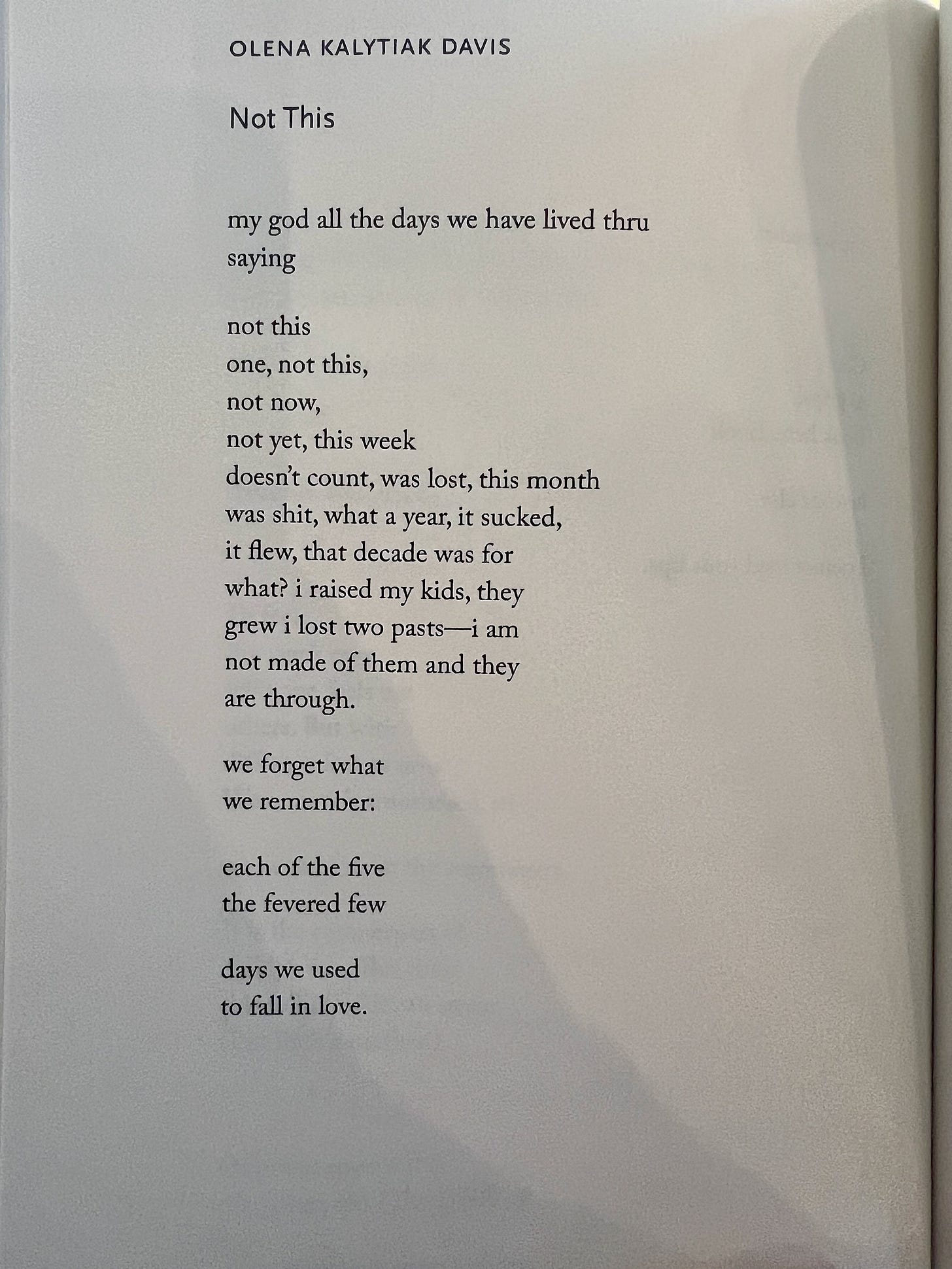
I received a surprise care package this week from a friend who knew I’d been going through some difficult personal things recently. Among tea and a kind note were two books of poetry. This poem, titled “Not This,” by Olena Kalytiak Davis, appears in one of them, The World Has Need of You: Poems for Connection, and I keep rereading it, finding something new to catch my thoughts each time.