Fox Owns Herself

If you’re new here, welcome to On the Commons!

Here, we explore questions as varied (but related) as: What is the difference between attention that fractures us and attention that restoresWhat role have three 15th-century papal bulls served in the “claiming” of land worldwide by Christian peoples of European descent, and how have those claims evolved?

New writing! Elementals, a new anthology from the Center for Humans & Nature, is out now: “The Elementals series asks: What can the vital forces of Earth, Air, Water, and Fire teach us about being human in a more-than-human world?”

I have an essay titled “Trespassing” in Air, alongside stellar writers like Báyò Akómoláfé, Ross Gay, and Roy Scranton. Other volumes include writing from Robin Wall Kimmerer, Andreas Weber, Tyson Yunkaporta, Sophie Strand, Joy Harjo, and many more. As with their previous series Kinship, this anthology brings healing and guidance to a world sorely in need of both.
This essay, on the legal question of where ownership originates, and the perspective gained by thinking in geological time, was originally published November 11, 2022.


One mid-morning on a bitterly cold November day, I was sitting at a table with my younger sister, her two little girls, and my younger kid. We were staying at a rented Forest Service cabin in Montana’s North Fork valley, no internet or electricity or running water, having recently cleaned up from breakfast and playing an interminable game of Unstable Unicorns.

I glanced up from my hand with the two “Neigh” cards I kept forgetting to use, when I lost control of words and patted my kid on the arm enthusiastically several times before managing to say, “There’s a fox on the porch!”

My kid had been hoping to see a fox in person for ages and thought I was joking, but no. She was right there looking at us through the window. I’ve seen a number of foxes around our town, but my kid somehow always misses out.

We all put our cards down and padded from window to window as the fox tracked around the cabin, watching her until she disappeared back into the woods.
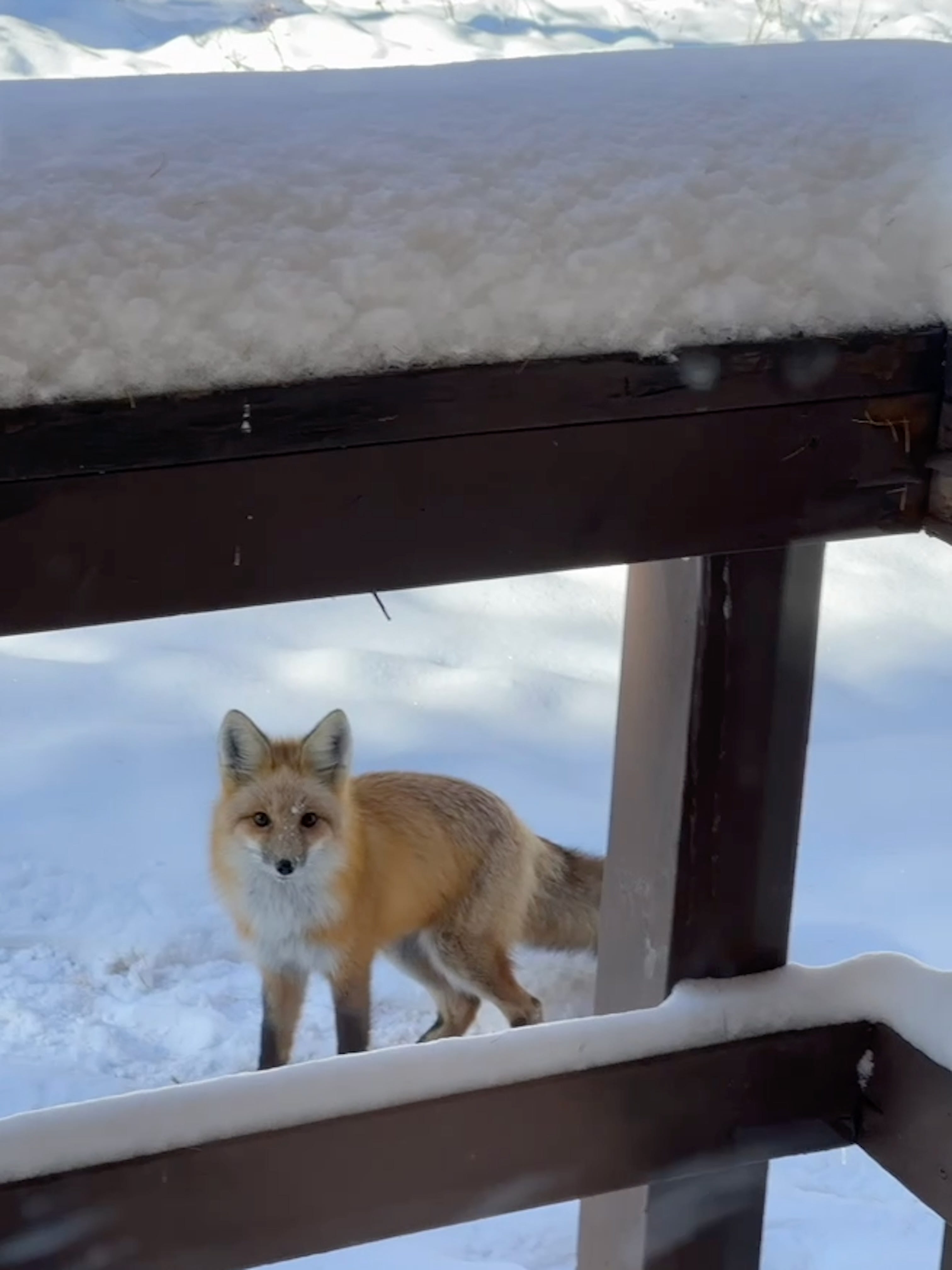
One of the most famous and pivotal property law cases in U.S. history, the 1805 case Pierson v. Post, involves the hunting of a fox. The legalities of that particular case have staying power for a reason. They hinge on the question of what grants ownership: labor or possession? Was it Post, who was hunting the fox, or Pierson, who actually killed it, who owned the animal in the end? New York State Supreme Court reversed a lower-court decision in Post’s favor and granted ownership to Pierson. The written decision reached back through centuries of legal thinking, drawing even from the Byzantine emperor Justinian I.

Law students—and people like me who study too much about this stuff—can get hung up for ages arguing about the ownership philosophies of William Blackstone and John Locke and whether it was the labor of the hunt, or the person who had physical possession in the end, that determined ownership. Labor and possession being two keystones of property law.

Yet rarely is it asked: What about the fox herself?

How can ownership really be debated or discussed without considering whether every entity has rights in and of themselves? To exist, to wander freely, to sniff around a porch for food humans might have neglected to store. To decide they don’t want to hang out and watch those said humans play Unstable Unicorns.


The five of us were staying at this cabin in my usual run-away-from-election-news routine. I have an unfortunate emotional reaction to elections. I’m sure it’s not uncommon, but it’s exhausting and also completely useless to be refreshing news every few seconds, tracking outcomes to events that I have zero control over. A few years ago I started renting cold, electricity-free, mouse- and packrat-loved cabins far away from internet service over election days. It’s something I hope I can keep doing as long as Montana, where I live, still has early absentee voting widely available. Which might not be long.

When we drove up to the cabin, my sister said, “Are you fucking kidding me?” in response to the stunning view, and I said, “When do they light the beacon fires?” because it really did look like the beacon-lighting scene in the movie version of Lord of the Rings. This is from two people who live barely an hour’s drive away and grew up here. You’d think we’d be used to the beauty. You’d be wrong.
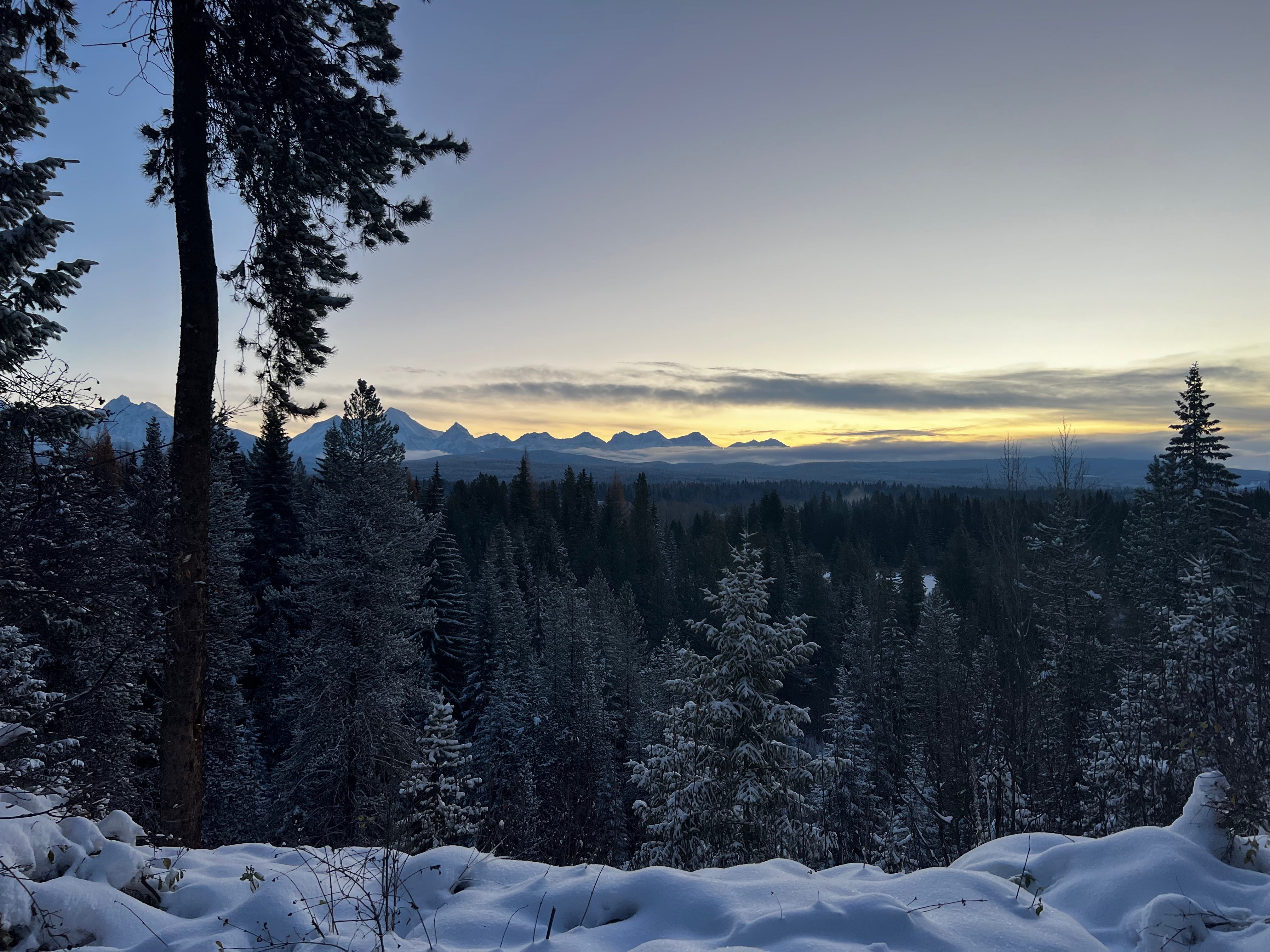
But I don’t just engage in this ritual so that I can get away from it all and admire the view. I persist in it because I want to spend that day reminding myself of why I care. I’m not interested in politics because I’m into politics. I’m interested, and emotionally invested, because I care about this world we all share, these ecological and social and spiritual commons. Going away to a silent river valley, spending all night feeding the wood stove every hour because it’s well below freezing, watching Sun rise over the mountains, being surprised by a fox—these things remind me why I volunteer in my community, why I encourage people to attend school board and city council meetings now and then, why keeping places like the North Fork free from too much human development is important, why the political bent of my home county breaks my heart all the time, and has done since I was a teenager.

It also reminds me that my heartbreak isn’t even a noticeable microbe in the span of geological time.

A few years ago we visited Zion National Park in Utah, another place of surreal beauty. I stopped on a trail to observe the facing cliff for a while, so tall it felt unreal. All that orange- and red-tinted rock, and somewhere deep down in the face, a single, narrow band of black. How much time did that band represent in the hundreds of feet of stone surrounding it? A thousand years? Ten thousand? Everything that happened in a span of time far beyond humans’ ability to grasp, pressed into that one bit of different-colored rock, a tiny note for future observers to see: Something happened here. For millennia. And yet in the vastness of geological time it barely left a mark.


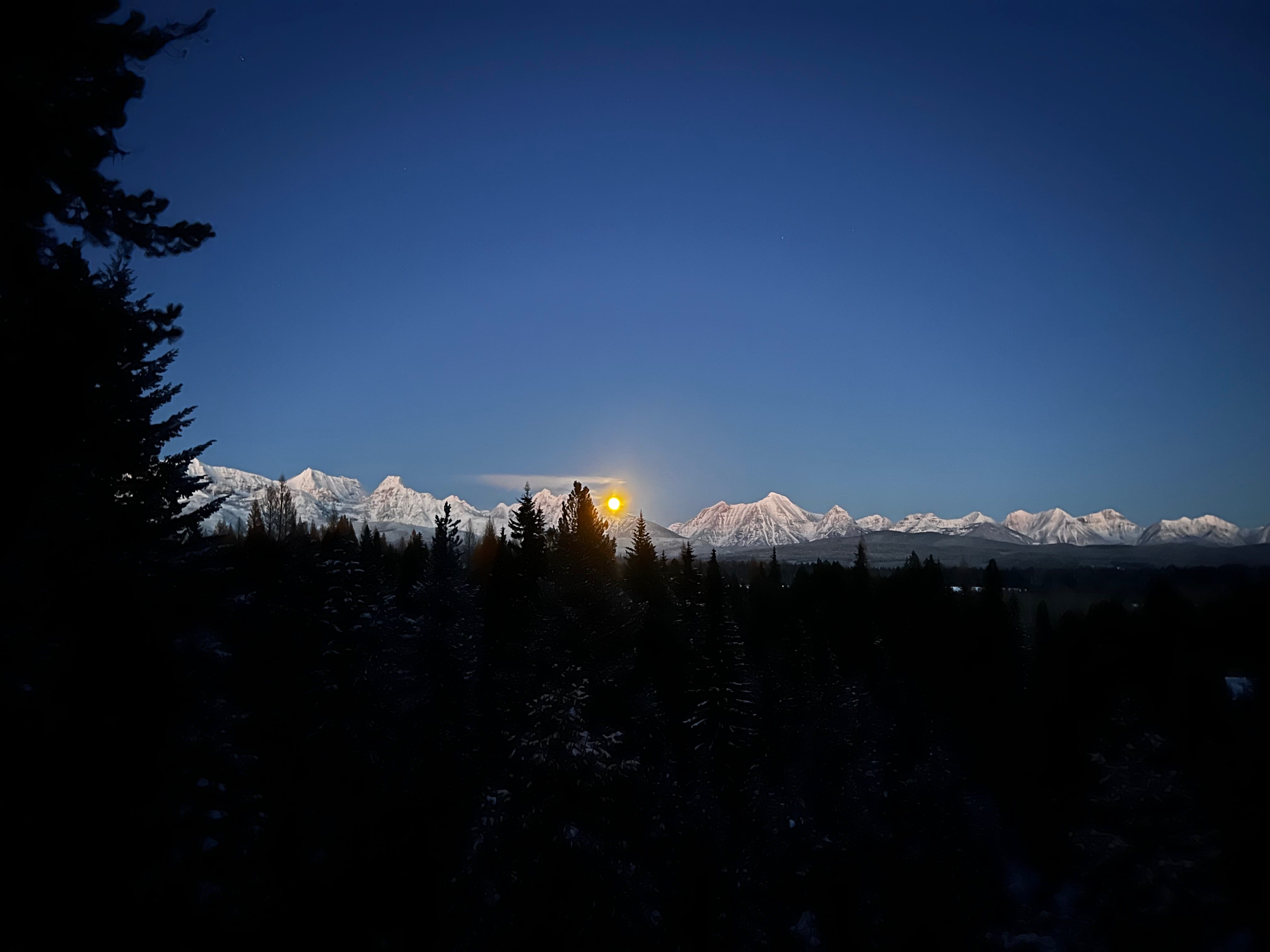
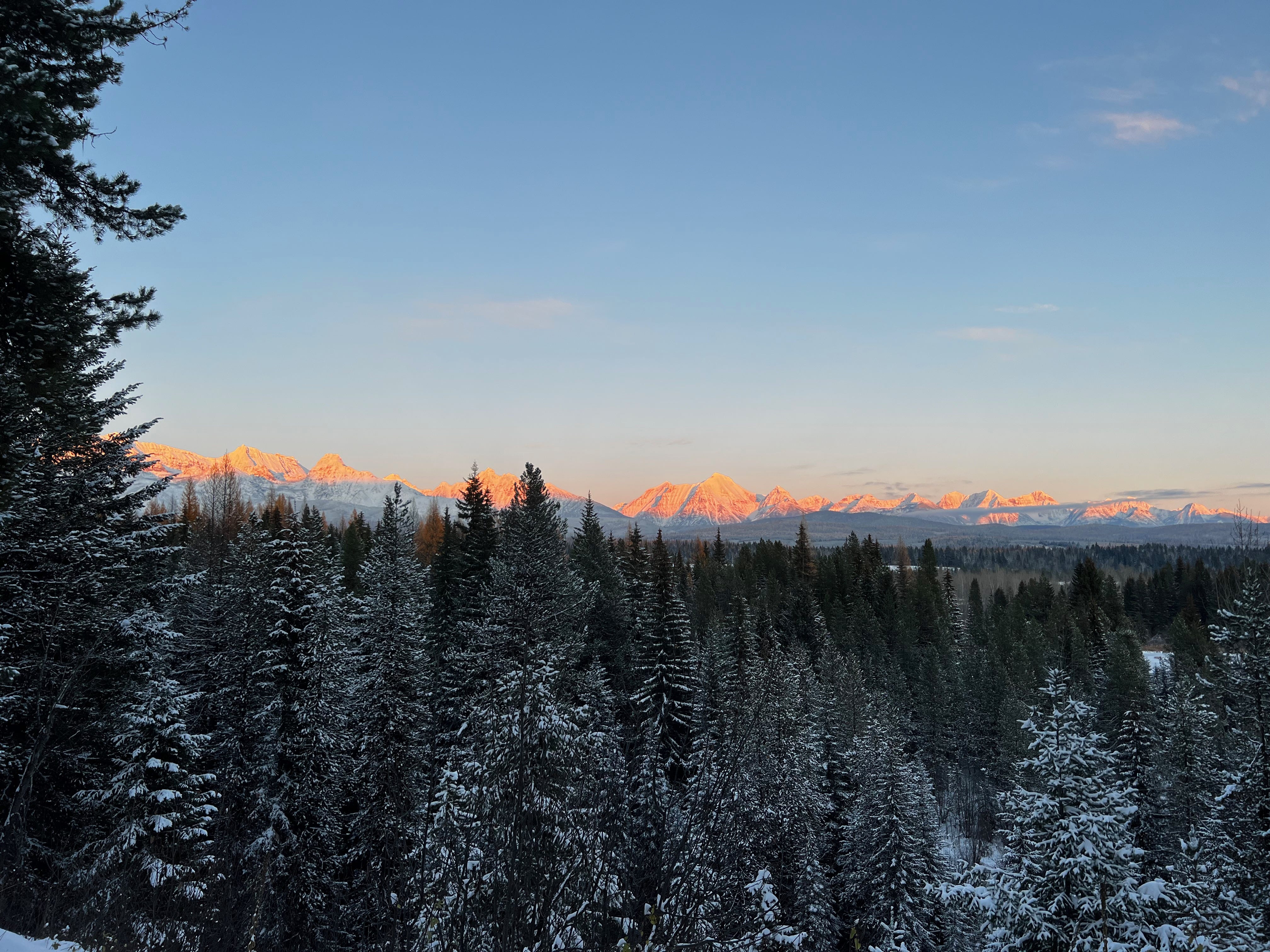
Several hours after the fox left us, alpenglow from the sunset hit the snow-covered peaks of Glacier National Park (pictured below), looking deceptively like a sunrise, and barely forty-five minutes later full Moon rose behind them (pictured at the top of this post), covering the entire valley with the kind of unfiltered indigo sky-light I sometimes forget exists, and we all stood in our pajamas and watched it, our breath spilling out into the frozen air.

I thought about the fox’s visit, and Pierson v. Post and the question of property, and how long ago it was that some humans decided to claim ownership over others—water, women, wildlife, and seeds; our relationship with those contain the ancient genesis of ownership, I continue to believe—and then create justifications for such claims through centuries of philosophical, religious, and legal argument.

What could change if we inverted that relationship? If we started from an assumption that all beings own themselves, that every being has agency and choice?

Our lives are so short. The events that shake our worlds so brief, against the timespan of stone. No matter what is forgotten of these times—eventually, everything will be, and everything for hundreds and thousands of years on either side of us, even foxes and Unstable Unicorns—it still matters how we care for one another. How we practice kindness, how we love, how we watch Moon rise and whom we share it with.

The joys and the pains are not everything, but they are not nothing.

In the comments on the original essay, Charlotte Hand Greeson shared a link to law professor Ann Tweedy’s then-recently published poem from the point of view of the fox, “Pierson v. Post’s Unheard Voice.” You can download the full poem from that link—it’s beautiful—but here’s a taste:

“I learned since that the man on the horse and the man on foot quarreled
about the right to kill me, had a third person decide. . . . 

. . . Students still study the story
but give me not a moment of their time. I am the invisible focal point. . . .

. . . You are right to think that, alive, no one could own me.
That’s the only true part of your story.”

Sunset’s alpenglow on the peaks of Glacier National Park
Nothing in Excess

I recently spoke with a class at Michigan State University about walking, health, and cultural views of wellness. As happens during most of my talks with college students, at least one came prepared with a question that left me scrambling for an answer.

Undergraduates consistently show up with a broader range of interests than I find elsewhere—when I spoke at Dartmouth earlier this year, I stopped in the middle of our two hours just to comment that I had never spoken with a group that had such persistent interest in bus systems. It gave me hope, I said, because public transit might seem boring to many people but it’s central to finding ourselves in a cleaner, more just, and less extractive world. At the University of Montana a couple years ago, it was one about propaganda and Mikhail Bulgakov’s The Master and Margarita, which I hadn’t read in years.

During this most recent talk, among several excellent questions was one about the architecture of prisons.

Incarceration and abolition matter to me, but, as I told the student, those subjects are well outside my areas of expertise.

The moment I said that, I paused, remembering a study I’d read very early on in my walking research about psychology, mental health, and architecture. I’d wanted to make more use of that study than I did—my editor was, rightfully, constantly reining in my enthusiasm for straying into research that was, at best, adjacent to walking. In the end, that study only informed one sentence.

I couldn’t remember the details of the study, but managed to scrape a memory that it had said something about how the designs of prisons and schools affect people’s self-perception, along with something that has stuck with me from Jane Brox’s book Silence about the design of a near-silent early prison in America.

What does it do to people, I asked the students, to have every aspect of your life controlled as a constant message that you aren’t to be trusted? Which related to the student’s secondary question about neighborhoods—if you live in a neighborhood that doesn’t have sidewalks or parks, or shade or access to green spaces, or is cut through by a 4- or 5- or 6-lane road and there’s no way for kids to walk to school safely—much less if you live in a region under constant oppression and surveillance, ripped from freedom by razor wire and armed patrols—that’s a pretty strong message about whose neighborhoods and lives are valued, whether by your own city officials or a colonizing imperial power.

Extend that to the criminalization of anyone who can’t afford a home at all, and the message about who matters couldn’t be clearer.

When my literary agent and I were first sending around the book proposal for A Walking Life to publishers, I had phone calls with a number of editors. On one of them, with a publisher that leaned more literary, the editor said, “I could see you know your subject, but I didn’t realize you were a policy wonk.”

It wasn’t a compliment.

That editor wanted the book but wanted me to restructure it as a kind of international intellectual and literary stroll, which was the kind of writing about walking I explicitly wrote my book to move away from. I was tired, and still am, of walking literature being by and about people, largely people of great privilege, wandering the world in their heads. Maybe that’s why I’ve been walking barefoot so much in the last year. I want to feel the ground, not just think about it.

His comment stumped me in the moment because I’m not really a policy wonk. What I thought of—a week after our conversation, of course; I’m a slow thinker—is that there is a difference between being into policy, and knowing your subject well enough to be able to talk about it as knowledgably as possible.

That aspect of writing nonfiction is important to me. I over-research nearly everything I write. It’s absurd. But it matters to me because, when someone has taken the time to read my book or one of these essays or shown up for a talk, I want to be able to respect their—your—time and attention in return. I do that by being as thorough as I possibly can for each aspect of a subject that captures my interest.

When editing my recent piece for High Country News, my focus on centuries of violent rebellions against enclosures of the commons in England came after back and forth with the editors about the current-day relevance of enclosures: when nobility and other landowners enclosed what had been commonly shared and carefully managed land, eviction of tenants, often entire villages of people, was usually part of the process. The Highland Clearances in Scotland is one of the best-known mass evictions in Britain’s history, but millions of acres were stolen and hundreds of thousands of people evicted throughout England before landowners turned their full attention to Scotland.

Mass homelessness inevitably followed, and in the wake of enclosure acts, the government pursued criminalization of being without work and/or a place to live: the Vagrancy (or Vagabonds) Act of 1547, for example, in which any “able-bodied” person who was found to be out of work for three days was to be branded with a V and sold into slavery for two years; or the Vagabonds and Beggars Act of 1494, in which “vagabonds, idle and suspected persons” were to be put in stocks for three days and nights and given nothing but bread and water and then evicted from the town.

“Evicted to go where exactly?” is just as relevant today as it was then. The fact that the Vagrancy Act turned out to be impractical to enforce isn’t the point.

The city of Kalispell, Montana, just a few miles from me and where my father and stepmother live, recently stopped short of pulling the operating permit for my region’s only low-barrier houseless shelter after years of complaints by those who seek to criminalize being without a home; while Missoula, Montana, followed in the steps of many municipalities to make it illegal to camp in city limits overnight.

During a discussion on land ownership and enclosure acts last year, one commenter noted on a section about anti-homeless laws in 1500s England—relating them to the U.S.’s current affordable housing crisis—that, “‘Skin in the game’ counts, while skin itself doesn’t.” People’s lives, in other words, matter less than property values. It matters that this was true during centuries of the theft of the commons, because it’s not new. Like most injustices, it takes different forms, but we’re still living with it.

I’ve read more books than I care to count at this point on land theft and the commons alone for this book I keep promising you all. In every one I learn something new, most of which will never make it into narrative. But I know by now that there’s always a chance that some fact or story that I can pull out of my bedraggled brain will be useful to someone someday, and while I don’t think that makes me a policy wonk, it does give me a lot of satisfaction.

But policy knowledge doesn’t hurt, either. Holding knowledge about walking’s gifts and potential along with knowing about the systems, legacy infrastructure, and ongoing policies—like road designs that are mandated (not just suggested) to optimize traffic flow, even at the expense of healthy ecosystems and human lives—helps me, and I hope helps everyone I share it with. It can be easy to see that a road is unsafe for anyone walking, but you can’t change that reality if you don’t know that federal requirements determine its design. We have to know where the barriers are in order to dismantle them.

Similarly for land ownership and private property: knowing the history of enclosure and rebellions, and the lack of any true foundation for, say, exclusive private property rights in land, matters for how we perceive the paradigms and stories we function within.

Changing a paradigm is hard, involving as it does a massive upheaval of perception and possibility, and especially hard if you can’t see it for what it is. The ancient Greek maxim to “know thyself”—inscribed on the Temple of Apollo—applies equally to knowing the structures that shape our world and our expectations of it. If we want life to count more than skin in the game, more than profit, we have to know what we’re fighting.

Also inscribed on the Temple was the maxim “Nothing in excess,” which, when it comes to research, I’m not very good at adhering to. But then, who defines “excess”? I’ve been reading Guy Standing’s Plunder of the Commons, which turns out to have very little information I need, but even if I never write about the Lauderdale Paradox of 1801, in which James Maitland, the eighth earl of Lauderdale, showed how public wealth decreases as private wealth increases, someday it might be exactly the historical link that someone out there needs.

I don’t generally wonder if the research I do is excessive—I assume it is—but it feels like the excesses of nature: the way I can walk around town right now and eat handfuls of serviceberries, or how there are so many ripe raspberries coming out of the garden that three families can’t eat them all, which means I had enough to make a batch of seedless raspberry jam last week.

The research I do is frequently boring, written as it is for academic expectations and requirements, but it is rarely without some kind of gift, some spillover of story or insight or simple information that makes me feel like I’ve been rewarded. It leaves a richness, and like all true gifts, the greatest pleasure is in being able to share it.

This counts

The chickadees have been singing again and it’s time to order seed potatoes and onion starts. The year has barely had time to rub sleep from her eyes, and the frozen peaches are not even dented by my hunger for their winter warmth, and I feel like I just got the potatoes stored away in the paper bags and moderate temperature that seems to have—mostly—succeeded in keeping them edible through the winter.

How can it already be time to think of choosing carrot and lettuce seeds, of where to plant beets and how to make more room for green beans, of the soil’s stirrings and the young yawns of growing things in my garden? It might be months, still, before I can visit the sweetgrass and turn the soil, but it is time, already, in the midst of this winter, to be planning for the next.

I was away most of last week committed to what I’lll broadly call parental duties, long hours of chaperoning, most of which took place in the confines of a hotel my kid and I rarely left. By the time the commitment was done, my body felt stunned from lack of movement. I spent two hours on Monday walking through town and along the river trails, relieved at the sight of water, the freedom to wander, the flurry of chickadee-company, and the surprise of what might be a new construction along the riverbank.

The drive home had been painstakingly slow, through hours of fog that seems to mark most of this winter’s personality. I hadn’t seen Moon at all for what feels like weeks until three nights ago, moonglow through the fog, Her bright self mostly hidden from the skies I live under until the dark, dreamy hours of this morning.

I watched Her there for an hour, remembering what moonfall feels like and ignoring my usual routines. A few hours later, on our way to school, She was cast slight pink in the pre-dawn sunlight that crept out from behind the mountains. 

Who else, I wondered, might be watching that alpenglow wrap itself around Moon?


Why put all those words and observations on a page, why share them with you? What is this human urge to story? To shape the narratives we see around us, to call attention to beauty and comprehend grief? Why write? 

I’ve seen this question lobbed about since I was old enough to understand the concept of philosophy, if not philosophy itself. What is the compulsion to create? Why do we care so much? 

I don’t have any better answers than anyone else. All I know is that I become a grumpy, unpleasant person when I don’t write. It’s a compulsion. It’s joyous and beautiful, to be lost in a narrative, but it’s also demanding and ruthless. Writing left me once for a few months, just flat walked out the door. I had thought that if that ever happened, if I couldn’t create, I would feel bereft. I thought I wouldn’t know myself. But what I felt was free. I kept thinking of all the things I could do with my life now that I weren’t driven to shape them into narrative of some kind.

Writing came back after about three months of that release, as if wandering through the door after an argument: “I just went for a walk. Needed some air.” And there we were again, back in a lifelong need to story, to do whatever it is that happens between my interaction with the world I exist in and the way my mind—or whatever it is—decides those experiences and thoughts should sound, feel, taste.

Writing is very, very weird. 

The novelist Elif Shafak wrote recently of a 16-year-old girl in Afghanistan who loved to read, who dreamed of libraries and pizza and of meeting Shafak herself after reading one of her novels, and who was killed by a suicide bomber. 

“I am tired of being attacked and stigmatised and labelled by fanatics and zealots and ultranationalists only because I am a writer,” wrote Shafak.

“But when I feel so down and despondent, I think of Marzia and I think of every other aspiring novelist and aspiring poet in the world who were never given even half the chances that were provided to me throughout my life: books, bicycle, pizza, electricity . . . I will never belittle any of these. 

I have no doubt that Marzia would have become an amazing storyteller if only she had been encouraged and if only her life had not been brutally taken away from her. I feel like all of us in the writing community owe something deep and precious to all the Marzias on this planet. We owe them a sincere commitment to literature.”

Writing is weird but it’s also necessary and it exists far beyond any arbitrary measures of success and failure. I’ve written before of my stepmother’s great-aunt, the Russian poet Marina Tsvetaeva, and her life that knew little but hardship and brutal loss, and how throughout it she wrote poetry so meaningful and beloved that to this day there are museums dedicated to her all across the country.

At the end of my life, all I can ask for is that I’ve done the best work possible and used whatever skills and talents I’m fortunate enough to have to create something of beauty and meaning. Maybe one book, one essay, one single line, might reach the one person who really needs it.

“It is as simple and as powerful as that,” wrote Shafak. 

“The love of books and libraries and the joy of reading. This is all we need. This is why we keep on writing.”

There’s something more, too: that delight and spark that Marzia knew reading and writing held for her, the world-opening potential of stories that I remember feeling at her age. 

I think many of us write because we can’t help it, because it’s a jealous lover or a hunger that can’t be sated or whatever metaphor works for you. When that leaves us, even if it’s only for a while, we still have what’s left: we write for one another. And what a gift that is. Stories can break empires; they can tell our hearts we’re not alone. They make us laugh. They make us grateful to be alive.


It’s been foggy and somewhat rainy for days and days, but today the cold was biting again. I didn’t dress warmly enough and my fingers were numb by the time I dropped off my kid at school. 

As I was turning away from the building, blowing on my hands, I saw a cluster of ten-year-olds, their pom-pom hats wobbling as they turned, ignoring the school bell to send frosty breath up toward a bald eagle soaring low overhead. 

The crossing guard watched, and me, too, and we smiled at each other, and I held close the gratitude I always feel at the sight, at watching children hold their breath because they see a bald eagle and they know. You pause for such birds. The soul bows. And I hold the knowledge I wish these kids never to have, that my gratitude is weighted with the knowledge that bald eagles were almost extinct when I was growing up.

High on the mountainsides just outside of town, the first light of dawn brushed the snow, the same light that was coaxing alpenglow from Moon. A flurry of snow rose in the light, over three thousand feet above me, and I wondered which of those sunshot flakes will be the first to meet spring’s young strawberries.

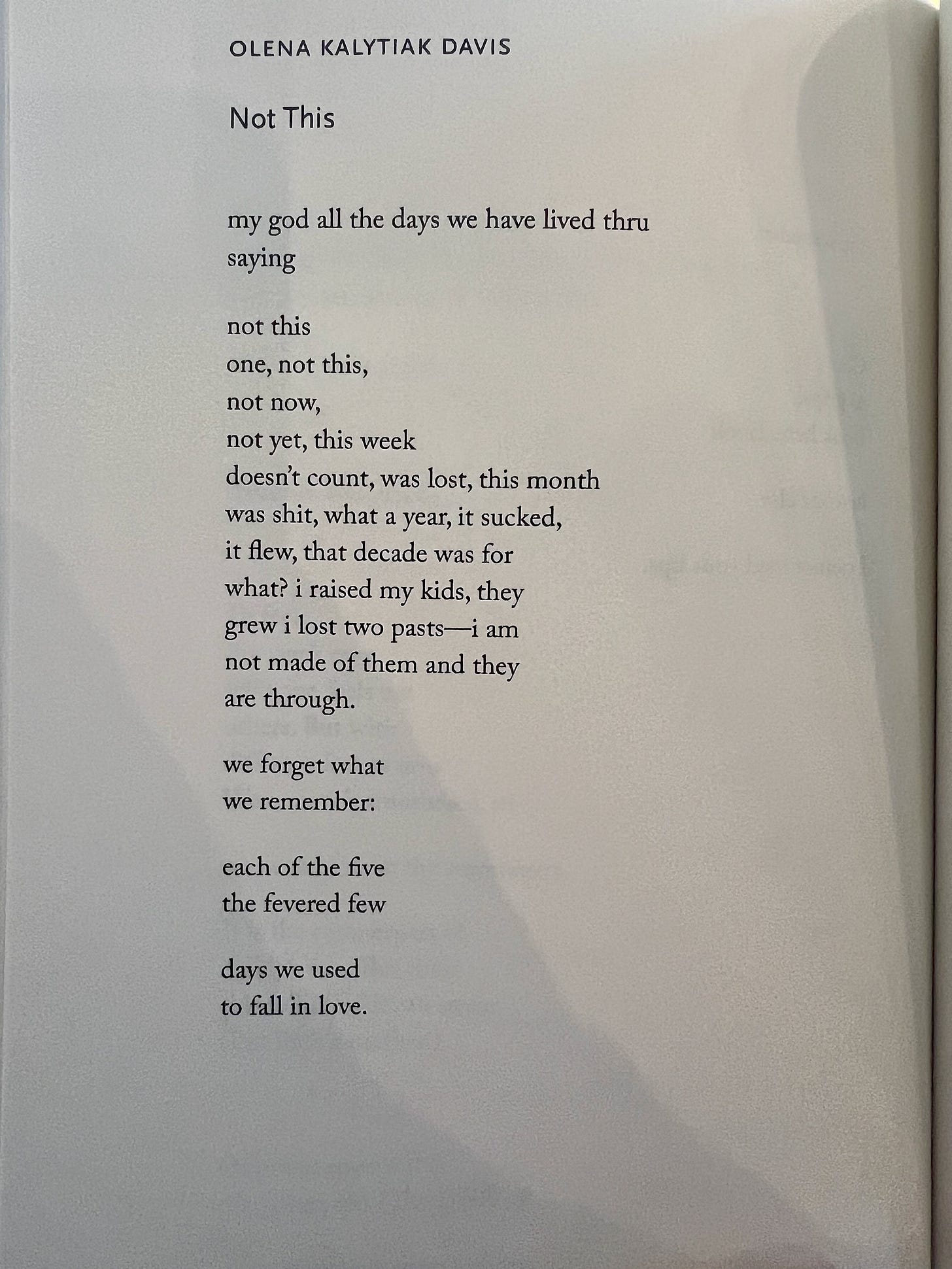
I received a surprise care package this week from a friend who knew I’d been going through some difficult personal things recently. Among tea and a kind note were two books of poetry. This poem, titled “Not This,” by Olena Kalytiak Davis, appears in one of them, The World Has Need of You: Poems for Connection, and I keep rereading it, finding something new to catch my thoughts each time.