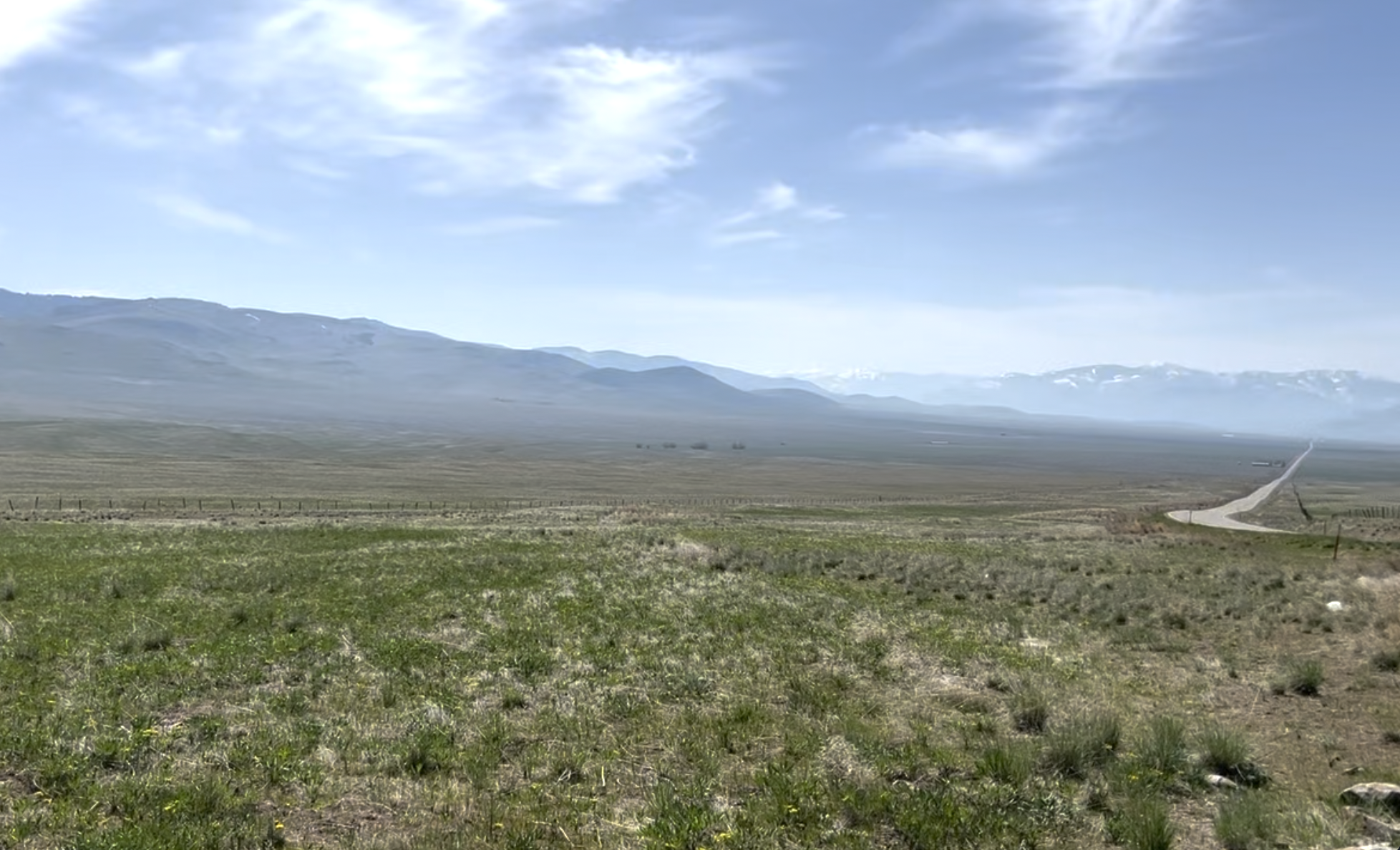
No Trespassing

Introduction

No Trespassing: How the Ancient Struggle for Ownership, Private Property, and the Rights of the Commons Will Define Our Future

Reminder: Comments are closed. Feel free to print for yourself, or email me an address for a hard copy (international is fine, too). Also, I added some section breaks because Substack wouldn’t support all the formatting I had in Word, so the hard copies I mail will look a little different. I hope to have Chapter 1 (titled “Claim”) ready by the end of September, but no promises.


Introduction

“The dominant culture has been writ large with the concept of private property. This prevents the connection to land physically, psychologically, and spiritually. It seems to me that this is the fundamental cause of the climate crisis, and actually made it inevitable once privatization became nearly ubiquitous.” —We Are the Middle of Forever: Indigenous Voices from Turtle Island on the Changing Earth, Edited by Dahr Jamail and Stan Rushworth

“Earthers get to walk outside into the light. Breathe pure air. . . . And what do they do? They look past that light, past that blue sky. They see the stars and they think, ‘Mine.’” —The Expanse, Season 1, Episode 5

There is a spread of Montana, tumbling south from the borders of Glacier National Park and enclosed within a national forest, that I am in love with. And when I say “in love” I mean in love. The place, 165,000 acres of prairie, grassland, rivers, and alpine forest known as the Badger-Two Medicine, makes me feel equally glorious and weak-kneed, like a besotted teenager. I feel that way about Montana in general, but the Badger-Two Med is a place I could easily see risking my life to protect.

The hills are covered with prairie flowers and grasses, a rare sight in a region where most native prairie has been plowed under for the cultivation of wheat and cattle, and they remain unbroken by the barbed wire fencing so ubiquitous throughout the eastern part of the state. The Badger-Two Med is home to grizzly bears, wolves, and native cutthroat trout, and holds Badger Creek and a fork of the Two Medicine River, two main water sources for Montana’s northern plains.

It’s a place of silence and winds and open sky that was taken from the Blackfeet Nation as part of the 1895 agreement that also took land used to create the eastern portion of Glacier National Park. Together, they’re known as the Ceded Strip. The land was paid for, but the U.S. government hadn’t left the Blackfeet Nation much of a choice: the treaty—which some say was meant to be for a 50-year lease rather than an outright sale—was signed after the government repeatedly failed to meet its other obligations and people were starving.

I am not, as far as I know, related to any of the many nations who have lived for millennia in relationship with the land now known as Montana. I grew up in this state because my mother’s great-grandparents came out from Danish-ruled Prussia via Illinois and settled on land that the U.S. government gave them to homestead, whose ownership of they never questioned.

That land is still in my family, ranched by the son of my grandfather’s cousin. I take my kids to visit sometimes. We stay in the old house that my ancestors constructed from a Sears kit to replace their original sod dugout, marvel at the longevity of the massive, solid Dutch-style barn that my great-grandfather built with his brothers and father well over a hundred years ago, and walk the gnarled hills that harbor elk and my cousin’s cattle and miles of barbed-wire fencing that we slip through to stroll from pasture to pasture. I have no legal claim to this place—the son of my cousin-however-many-times-removed will inherit it—but I feel tied to it. Connected, just as I have always felt connected to the entire place called Montana. Even during the twenty years I spent living overseas and on the U.S.’s east coast, I felt the tether to this land, its space and mountains and scent of pines always there to remind me who I was.

Since I returned home with two children and a spouse, I’ve wondered more what love for this place means in the face of the original theft. I feel an emotional connection to the ranch my cousin works and the one a little further north that my mother grew up on, and the unbroken vastness of the Badger-Two Medicine. But all of that land was stolen from Native Nations and either handed to invaders like my family, or kept by the U.S. government as public land. Do I have a right to love it at all?

Among all the broken and stolen rights and oppressions this continent has seen over the last several hundred years, one thing white settlers have almost never questioned is our right to belong. Maybe it’s time we started.

*****

This isn’t a book about belonging. That question, though, what “belonging” means, is entangled within the ancient legacies of ownership and property. In the culture many of us live in, the dominant one in North America, when it comes to land, I own this is deemed equivalent to I belong here. But that paradigm is not one that has always been, or even is, universally accepted.

Ownership is a human construction. It’s not like gravity or a law of thermodynamics or even the territorial behaviors of mammals. It’s simply us. Property lines imposed on land are the most obvious manifestation of ownership, but even these are only a powerful legal fiction. They create an imagined reality, telling me that what I do in the space I have taken ownership of, whether it’s a studio apartment or a ten-thousand-acre ranch, won’t have an effect beyond those boundaries. But air and water and soil don’t care about property lines. Treatment of them as empty neutral spaces is a legacy of long-outdated legal definitions of ownership and private property rights. 

Even the legal walls between what is protected as yours or mine can prove as porous as the property lines we pretend we draw. I might think I own the land my house sits on, but what happens when a natural gas company is given eminent domain to build a pipeline through my yard, and I don’t have the right to stop them from digging? This happens to people in America all the time. In 2016, a family of maple syrup farmers in Pennsylvania lost ninety percent of their mature maple trees after a pipeline company fought for eminent domain over their property and won. Worldwide, communities and individuals battle constantly against sand and gravel mining operations, oil drilling, natural gas pipelines, luxury housing developments, deforestation . . . the legacy of damage and destruction has increased through the twenty-first century, disconcertingly in tandem with the scientific knowledge that continuing our modern way of living is likely to make future human life impossible.

Ownership is not just a set of legal precedents. It extends a sense of being, of self, beyond the body out into the world to claim something else—or someone else—as “mine.” The history of ownership is about the millennia-long fight for liberty—political, economic, intellectual, creative, spiritual, and physical. It was most likely born after the advent of agriculture and what is called civilization and involves nothing less than the struggle of every one of us for the right to live. 

Delving into ownership’s history exposes thousands of years of a false separation from nature, from the rest of life, including one another, and a psychological trick that has allowed humans all across the world to build legal empires framing a fractured but fundamental myth: that anything we have the means and ability to take can be an absolute possession. Mine, or yours. That any of us can own anything at all.

*****

When my husband and I bought an empty lot in my small Montana hometown, there was some confusion about the property line, a lack of the kind of absolute clarity required by property ownership. I wanted to divide the lot into thirds and give two parts to my sisters, but to pursue that option (if we could even afford it), we had to find out exactly where our ownership ended, and at which point the overgrown patches of knapweed and Canada thistle became our neighbor’s problem. The thirty-year-old apple tree was clearly within our property boundaries, but what about the little berm crowded against the neighbor’s fence where the overgrown grass hid purple lupine?

The surveyor came out with her equipment, picked through the county’s deed records, and concluded that our neighbor’s fence was placed ten feet into our yard. One of the boundary corners was also missing. To find its exact point she’d have to dig up the street to find the original monument stone so she could measure our property corners from it.

What, I asked her, suddenly far more curious than I’d ever been about the invisible legal lines that snaked under the streets of my hometown, is a monument stone?

*****

I have an obsession with deep time, with geology and paleontology and sedimentation and eons, with the massive movement of the universe, the way that stars are born, and in the mind-bending possibilities contained in billion-year time spans. When I look at how many millions of years dinosaurs were around, how long they’ve been gone, and how vast epochs are compressed in a thin band of stone visible on the side of a mountain that’s been shoved around by glaciers and tectonic plates, the measly few hundred thousand years or so that Homo sapiens have existed comforts me. I worry less about our divisions and weird tendency toward us-and-them thinking and dehumanization. The planet has been around for a very long time, mountains and rocks remind me. Maybe humans just have a lot of growing up to do.

Earth is old. Humans haven’t been on it that long. But in that time we have managed to cause an enormous amount of change. One of the most fundamental has been the creation of private property and its consequences. The planet is a whole, interconnected, living thing, and we humans are animals, living parts of that whole. Yet somewhere along the way some humans invented the idea that they could artificially divide up the whole, giving some to certain people and perhaps a whole lot more to others. Rights of use were created within those imaginary lines: the right to farm, to build homes, to raise animals; to mine, to pollute, to enslave and exploit other people.

I say “we” as if this eagerness for privatization is true of all humanity, but plenty of people know that this isn’t and has never been the case. And while more people are coming to understand the destruction wrought by European colonialism over the past five hundred years and its effects on Indigenous people and ways of living worldwide, those European lands themselves once had very different ways of living and owning that were overthrown, oppressed, and destroyed by colonizers and land-hungry local elites. So where, or when, did this idea come from? The Romans? The Greeks? The Sumerians? Does anybody actually know when human people, hunter-gatherers, cultivators, and wanderers of Earth, first pointed to a landmark, or a fruit tree, or a spring, or a patch of cultivated grain, and said, “That is mine”?

There are theories but no certainties. Nobody—at least that I have found—can say definitively where the idea was born that granted my husband and me ownership over patches of invasive knapweed and an apple tree. What they can say is that private ownership disrupted—almost always through violence—settled ways of sharing resources and land, and continues to fly in the face of the biologies realities of a living planet.

That apple tree cares nothing for ownership. More years than not, it produces more fruit than we can possibly pick, eat, can as sauce, or dehydrate for winter. It will give its bounty, feeding all who are hungry or craving, with or without a title of ownership. Completely opposite to the constructs that currently define my rights to it, including access: the tree might produce more fruit than my family can consume, but anyone else who steps into my yard to glean some—or even smell the tree’s heady, apple-y fragrance or climb its inviting branches—without permission is legally trespassing, and if they reach out a hand to pick the fruit, I could claim theft. I wouldn’t, but that is what the law condones. Those apples, rather than being seen as a vital source of sustenance that could be managed in a way that benefits more people and wildlife than just my family, are my property.

The surveyor’s comment about a monument stone made me curious: what was such a thing, and what story did it play in the long saga of human ownership? Because as it turns out, all ownership is about stories humans tell ourselves.

*****

Every major shift in ownership and property rights throughout history is like those geological layers exposed on mountainsides. In some ways, the layer of our time, of now, grants freedom and a kind of liberty, if you’re lucky enough to own a house or a portion of land; in far more ways, it erodes the possibilities of the same—land hoarders can lock up access to nature, to forests and grasslands and fields and water and apple trees, while wealth hoarders can lock up access to income and capital. At the same time, multi-billion-dollar fossil fuel corporations retain their property right to pollute, earning yet more wealth while stealing future generations’ rights to a habitable planet and a livable future.

What we own and how we own changes over generations. It wasn’t that long ago that people were considered ownable, and not just in the land now called the United States. Enslavement is still a reality for millions of people worldwide. It also wasn’t that long ago that even the most privileged of women were considered the property of a father or a husband—in some societies this is still the case, and even in America there are plenty who would like to see that relationship reestablished.

It took centuries to develop the tangle of private property rights that have led to modern pollution of clean water and air. And colonization and erosion of individual agency and free will—if such a thing exists—now spill out into the future of humanity, where all the data attached to our public and private lives is claimed as private property, hoarded and turned into profit for massive corporations, with consequences for our collective and individual futures that we haven’t even begun to comprehend.

Ownership reaches into every corner of life. If we seek to build a future that has a chance for the amorphous freedoms and liberties many claim to hold so dear, we have to take a hard look at what ownership grants us, and what it takes away. Because its ability to do both shifts according to how we move its boundaries: what rights of trespass we forbid, which ones we grant, and in which of these we’re allowed a true choice.

*****

This book will move through time and iteration, through battles for rights of the commons and colonialism, to fights for clean water in the face of fossil fuel extraction and mining, to defense of arable soil and open-source, tradable, savable seeds. From abortion rights to data mining and the Outer Space Treaty, to the often buried commons-based systems of living and sharing life that defined human existence for at least tens of thousands of years.

Through all of it will be a reminder that how we codify and legally enforce ownership is a reflection of what society values, and a reminder that we can choose to define ownership differently.

In our current time, property laws reflect the value of turning a profit, of commodification both of nature and one another. This attitude was brought starkly to the fore early in the Covid-19 coronavirus pandemic, when certain high-profile politicians and pundits called for the elderly and vulnerable to sacrifice themselves for the sake of what they said was the economy but was in fact simply the falling stock market—in other words, for the vulnerable to sacrifice themselves for the benefit of the already wealthy. Their views laid bare a fundamental problem with the dominant economic model: If an economy doesn’t serve the purpose of reducing suffering and improving quality of life, then what exactly is it for? Even if we were forced to accept that a healthy economy needs the sacrifice of every other living being on this planet—which nobody ever should have to accept—an economy that requires the deaths and suffering of hundreds of thousands of people because it’s too inflexible to serve true human needs even in times of crisis seems a pretty shoddy thing to leave future generations.

It doesn’t have to be that way. We can define rights of ownership differently. We can create economic models that prioritize the values of kinship, relationship, and community. Any economy could be linked just as easily to the health of rivers and air, and the values of nurturing and caregiving, as the dominant one currently is to the Dow Jones industrial average or the FTSE 100 or the Hang Seng, or whatever metric a country’s economic system is subject to. These are choices we can make, if we’re allowed.

Societies, and their legal manifestations of values, can be slow to change. But then, so are rocks slow to change. Just because something takes a long time doesn’t mean it’s not worth doing.

*****

One set of my great-great-grandparents came from Schlwesig-Holstein in Danish-ruled Prussia, first to Illinois and eventually to the Montana territory, where they bent their wills, their backs, and their hearts to a homestead protected by hills rolling out from the Square Butte geological formation. They took advantage of the 1862 Homestead Act, which granted parcels of 160 acres to any citizen who wanted to stake a claim, and the subsequent Enlarged Homestead Act of 1909 that granted 320 acres to those who could make that land productive. Like many homesteaders, my ancestors paid their $18 filing fee and then brought European and midwestern farming practices to a land wholly unsuited for it. Unlike fifty percent of their cohort, they somehow made it work, grew wheat and raised cattle on the arid prairie, survived droughts and excruciating winters tucked into wrinkled draws and springs hidden among the prairie grasses in the Highwood Mountains of central Montana. My grandfather’s cousin continued to work the same ranch until a few years ago, when he died and his son took over.

The connection homesteaders felt to the land they claimed—those who managed to survive the hard winters and droughts and not succumb to the insanity of loneliness—was real. But it was newly born care, nothing like the connection of people whose land they’d helped steal. My ancestors weren’t chatty people and didn’t talk about their connection to land, except for my grandfather now and then when he was sober, but they passed some kind of love on to my mother and to me and my sisters all the same, a sense of connectedness to the ranch and surrounding regions that, for me at least, is unrivaled even by the people I love.

Love and care are the flip side of the violence that private property can wreak on those around it. A sense of home. Ownership has the capacity to divide families, destroy representative systems of government, level mountains, and drain aquifers. Private property laws also allow us, within certain limits, to own land in such a way that we feel free to invest in it both our labor and our affection, hoping to build something for ourselves and our posterity if we choose to have any.

That care, that sense of home, is a compelling story, one that is still being used to justify colonial thefts of land worldwide. It’s a story that can only benefit those who own, not those who don’t, and certainly never those whose ways of owning, sharing, or relating to land, water, and the rest of life isn’t legally recognized.

The story those laws perpetuate is one that the peasants, freed serfs and villeins, and common people of Europe had not known for generations by the time my ancestors left the continent: knowledge that this soil under your feet cannot be taken away by a capricious landlord or vengeful monarch. It’s possible that America’s Revolutionary War was pursued not in the name of abstract human rights and freedoms, but so that a few wealthy land speculators could buy and steal land without asking for permission from their monarch; their promise of land for other settlers from Europe—who were either indifferent or grateful that it had been stolen from people already living there—was sure to earn them support. “Private property can be yours” is a seductive thing to hear when you’ve never known the security of land.

Those same laws of private property are, however, fragile as well as unjust. Even another’s enforcement of their own property rights can ruin yours. European countries’ colonization of much of the world should be a lesson in this fragility: private property rights are yours to keep, until someone more powerful wants them.

Ownership is a potent tool for creation, but far more often for destruction. It should never be wielded lightly. If this planet is to sustain future generations of humans, it must be wielded very differently.

*****

Despite the Badger-Two Medicine’s protection from settlers and development for over a century, it’s still under threat. The Blackfeet Nation and the Glacier-Two Medicine Alliance have been fighting several leases for oil and gas development that were granted in the area in 1982, some of which were upheld in the 1990s, some of which were rescinded in the 2000s, and one of which is still the subject of ongoing litigation. Knowing that development will continue to threaten the sacred area, some have been seeking permanent protection in the form of a national monument. But aside from ignoring the original theft from a sovereign nation, even that form of protection would no longer be a guarantee—as shown by areas like Bears Ears National Monument, which was designated by one president but whose boundaries were severely shrunk by the subsequent one, and restored by yet another. Law can be as fickle as humans ourselves.

The judge who upheld the last remaining Badger-Two Med oil lease in late 2022 called the forty-year saga “Kafkaesque” in his decision, saving his anger for the changes and refinements of federal mineral leasing law—which he called an “interminable, and insufferable, bureaucratic chess match”— and its effects on the holder of the lease, rather than for the injustices the Blackfeet Nation faced. True justice would see that land returned.

Betrayed by the neglect of law in one decade and then saved from extraction by adherence to it in another, this land has been subject to the always-shifting legal interpretations of private property laws and whichever human societal paradigms were paramount at the time. It shouldn’t be, but that is what property law does: it tries to enforce the values and priorities that gave birth to its own narrative. It tells a story.

*****

Which brings me back to that monument stone, laid somewhere under the road my house sits next to, a legacy of the surveying of America that began with the Land Ordinance of 1785 when European settler-invaders walked past the Mississippi River and into the west with 22-yard lengths of chain, measuring and marking off 36-square-mile townships and turning a vast land into a mirage of disconnection. The surveying of America was an enactment of Thomas Jefferson’s vision of freedom contained in the potential of a nation of self-sufficient yeoman farmers—and his stated desire to steal as much land as possible for that purpose from Native Nations—combined with the hard fact that the Revolutionary War had left the country deeply in debt. Once the lands were surveyed, they could be sold, and the fact that they were already Indigenous territory and managed under a completely different system of relationship made no difference to the newly independent government’s dreams.

The monument stone sitting under the street near my house is most likely a simple rock, the surveyor has told me. On it the original surveyors who came out to Montana would have chiseled some reference points that would stay put through the decades, perhaps longitude and latitude, perhaps noting specific trees that looked to last for a few more centuries. Until we pay her to dig it up and see for certain, we won’t know what it looks like or what it says about our property ownership. But whether or not we shell out the money to have it located, that stone still spills the story of ownership into past both ancient and recent. The original surveyors planted that stone and others like it all across America. And in doing so, they turned this land into private property. Humanity’s original myth.
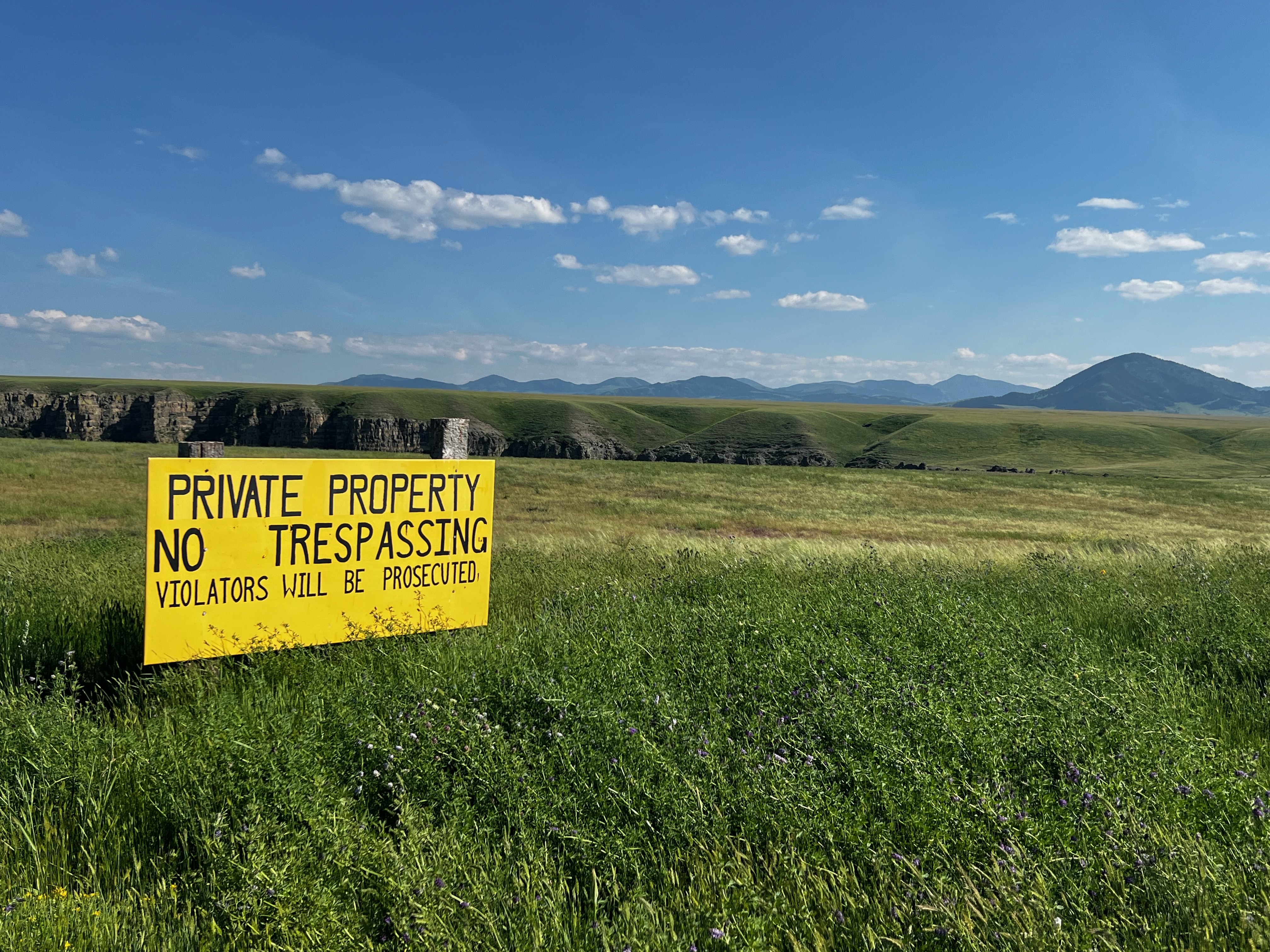
Private Property

“No Trespassing” book update and a little photo journey . . .

Do you ever think about private property? I think about it constantly, in interactions online, real-life conversations, sitting in “my” yard near “my” caragana bushes drinking “my” tea and reading “my” book, or walking along the public riverside trails around town, or when I mention “my” kids.

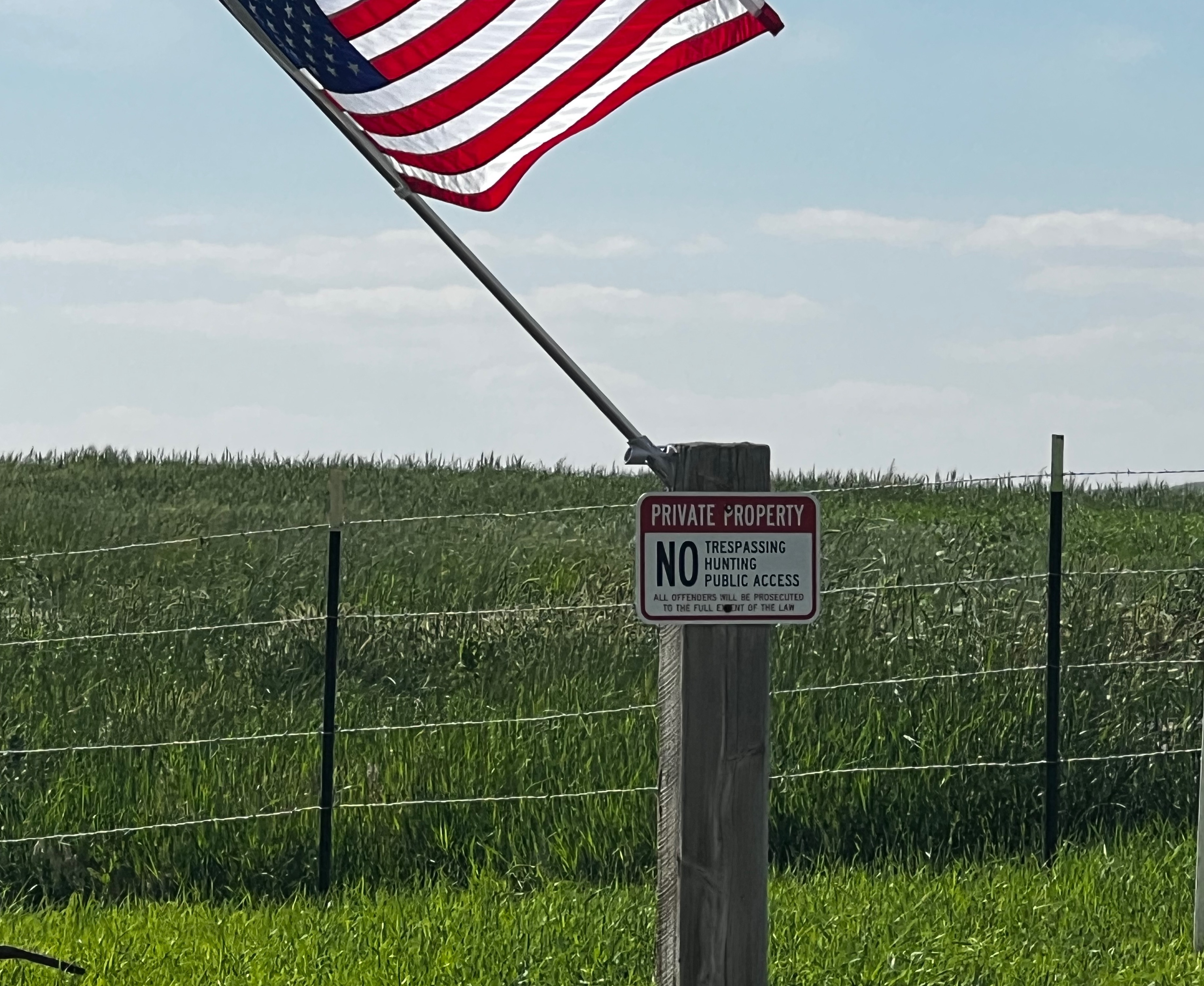
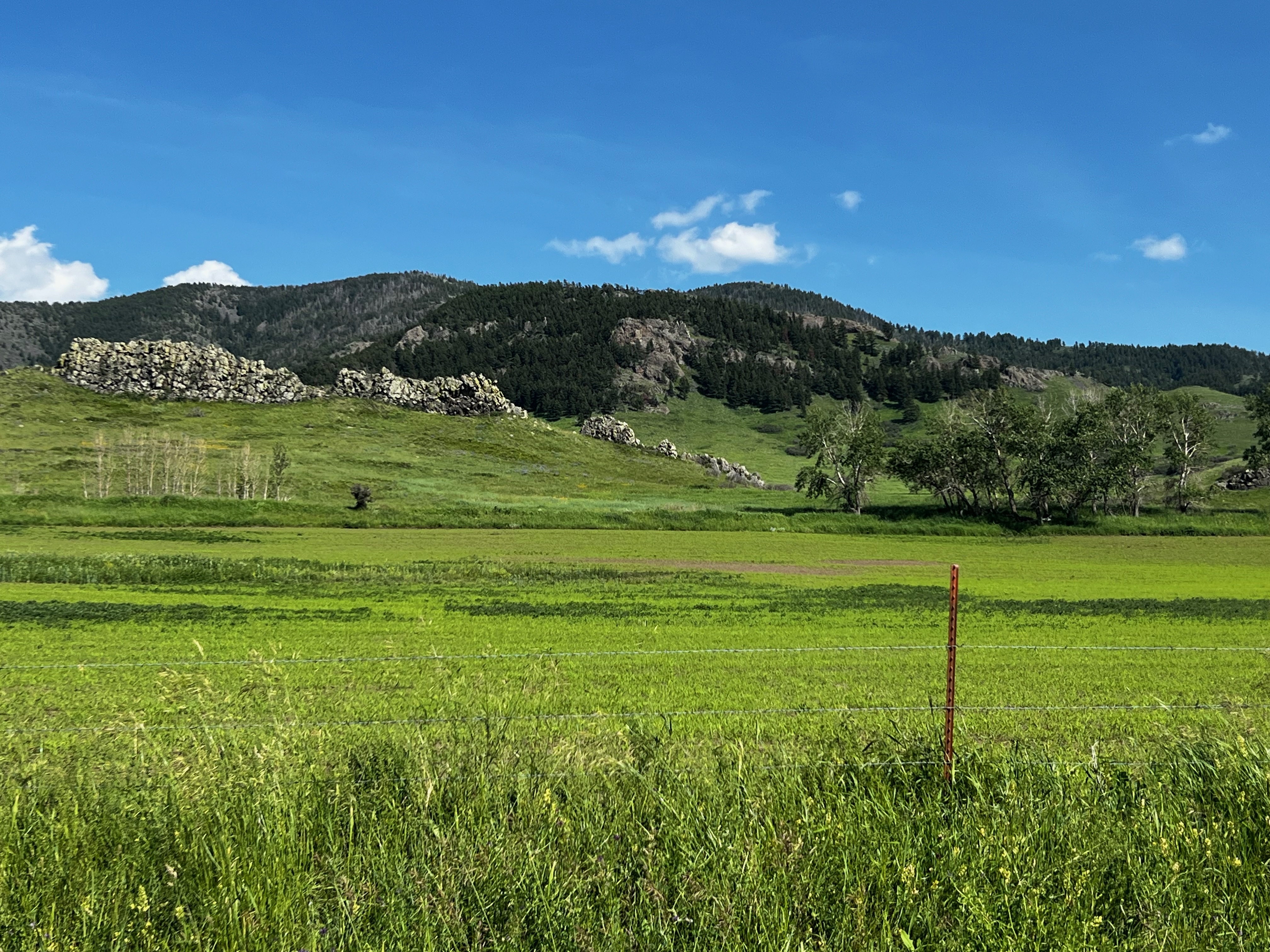
I think about it in particular every time I see a sign like the above. What makes this land “property,” and what makes it private? And why do so many humans think that these rights and laws are static, fixed, forever unchanging? I recently finished reading Neal Ascherson’s book Black Sea, about the millennia of human history surrounding the Black Sea, and if one thing is certain it’s that models of rights, property, and ownership will never remain the same in any given region.


After my Dear Butte writing residency finished last week, I spent a few days driving through Montana’s Gallatin Valley, where I mostly grew up, and then up to Fort Benton on the Missouri River, down through the Golden Triangle and Big Sag, where my mother grew up. One of the gifts of having time and space to yourself for a long period is that buried ideas start to work their way loose. In this case, it was realizing that the first chapter of No Trespassing (which is about land ownership) needed less research and more of a sense of place.

Morning birdsong that kept my notebook closed and my ears open while sitting on a bank of the Missouri River

I will be posting the introduction to No Trespassing next week. A couple of things:

1) I’ll be turning off comments for book chapters. I want these to feel like a book you’re reading (which it is!) rather than posts or other media you need to keep up with. You can email me or make comments on other posts about them or write me a letter or whatever you like, including nothing at all, but the point is that you should be able to read these in your own time with your own thoughts. Or don’t read them! Take a nap! Go for a walk!

2) I’ve been talking with the local copy shop about options for printing and lightly binding these chapters for anyone who would like to have print copies sent. If you would like a print version, you’ll have to send me (amalchik@gmail.com) a mailing address, though of course you can always print them out yourself. I’m trying to find a version that you can recycle easily, but that’s harder than I thought it would be unless I leave the pages completely loose.

(I’m not trying to be fancy about this with the copy shop. I replaced the drum in my printer recently in a desperate effort to not have to buy a new printer, and now everything comes out slightly blurry. It’s also more cost-effective to use the copy shop’s toner instead of my own.)

If you’ve been hedging on whether or not to upgrade to a paid subscription, now is a great time. This whole endeavor is pretty research-intensive. An overview of No Trespassing’s chapters and structure is here.

No Trespassing is about how the struggle between private property and the commons has shaped human histories and will shape our futures. It’s about ownership, which is an amorphous concept whose genesis has been theorized but I doubt will ever be known. Ownership dictates almost everything about our shared lives on this planet, while being so embedded in thinking, values, and laws that it’s almost invisible.

My goal with this book is to bring ownership out into the light. Just because we don’t know where it came from does not mean that we can’t know what it is and how it’s used. The introduction of No Trespassing will get into that a bit, and of course there’s always the collection of short posts I wrote to accompany the Threadable land ownership readings.

Ownership is about far more than land, but the further I read and think about this idea, the more it seems to me that the legal concepts buttressing ownership’s legitimacy grew from two things: how humans own land (and justify that), and how humans treat water (and justify it). And in some places those two things were intertwined millennia ago to justify control of women, reproduction (including seeds), and bodily autonomy for almost everyone. Huge concepts and debatable ideas, all of these, but I think this is where things start from.

For this book, I start with land. Chapter 1 of No Trespassing, on land ownership, will I hope be ready for you by the end of September. It’s centered slightly more on Europe and England than North America because I’m looking for the beginnings of the private property structures we live under—the theft of the commons—as well as at their consequences. The transition from land ownership on the European continent to justifications for spreading that ownership, theft, and oppression worldwide through the Doctrine of Discovery is a hinge point. The chapter itself begins with the regions now known as Montana because that is the land I love most and the land that made me.

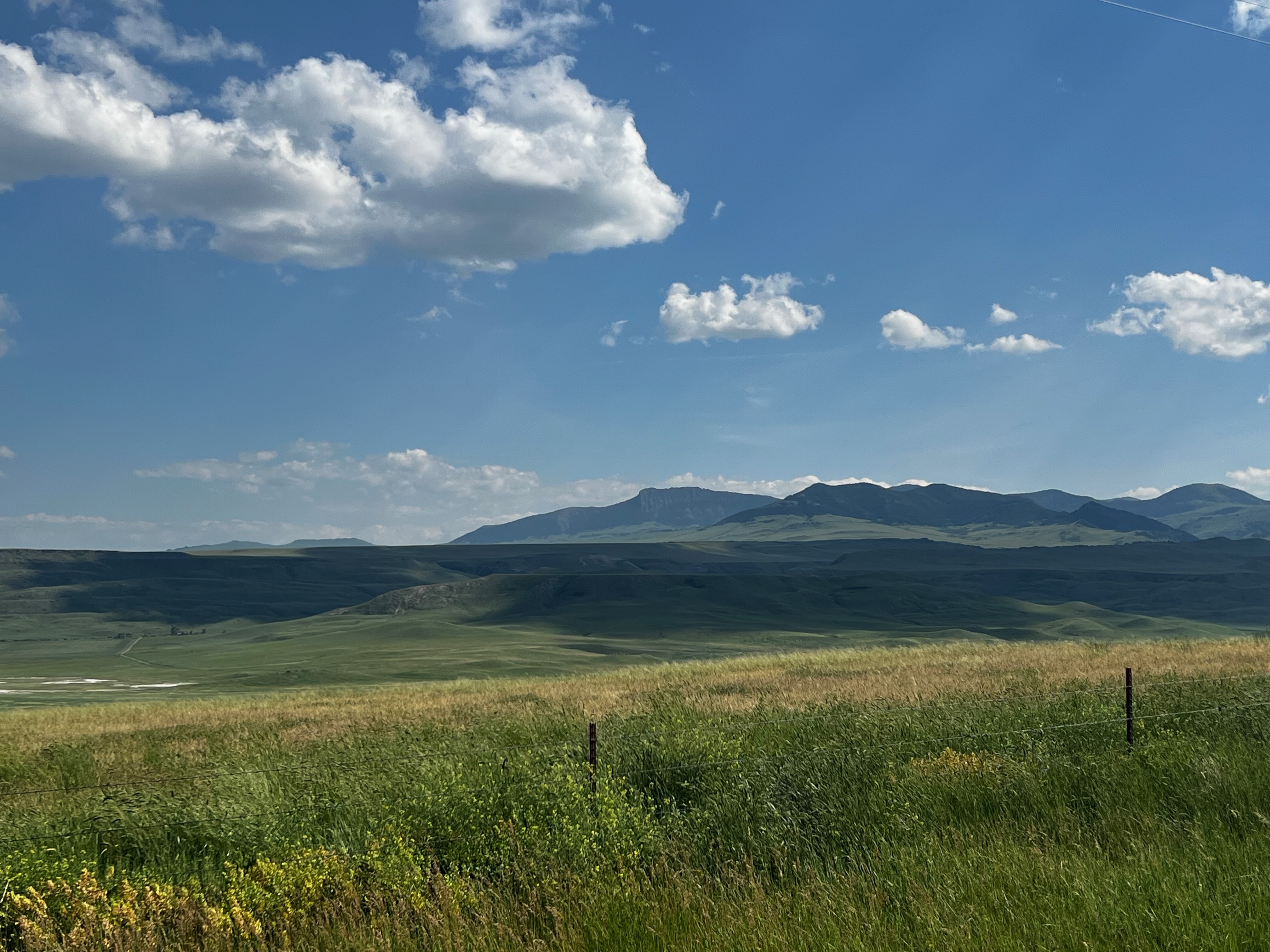
Here are the tentative beginnings that I was thinking about as I drove through the landscapes in these photos:

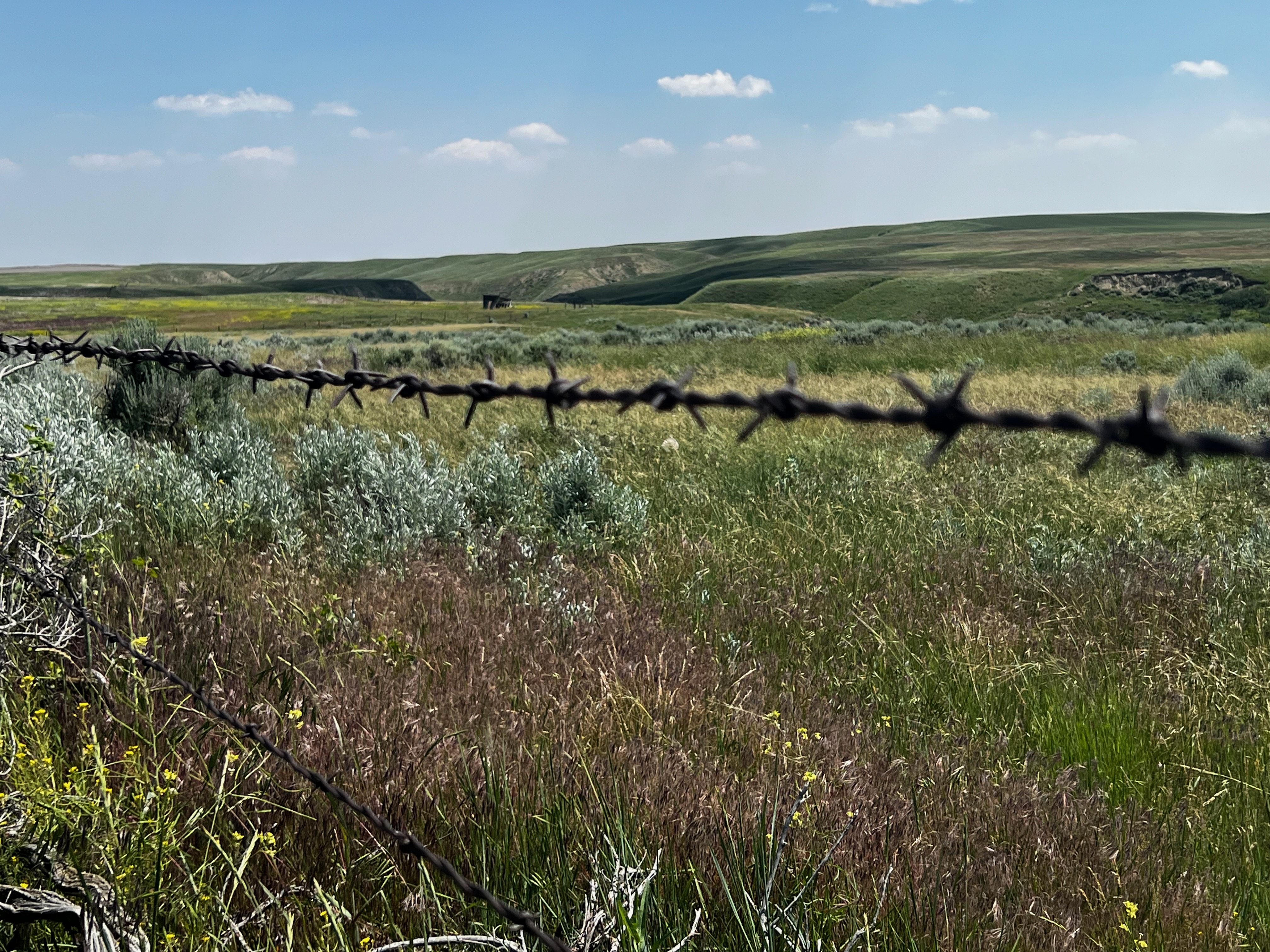
If I wanted to walk those hills, I couldn’t. There’s the barbed wire, stretching for miles across the wheat fields and cattle pastures, out of sight. Even stronger is the psychological barrier that says, “This is private property. You cannot trespass.”

Imagine what this land once was, well over ten thousand years after the overflow of Glacial Lake Great Falls carved the Shonkin Sag and tens of millions of years after volcanic eruption formed what are now called the Highwood Mountains. Imagine the wheat fields covered in unfenced prairie, steppe, and buffalo. All this land is now bound up in an entirely different story, a legal one of private property and the more recent justification known as “stewardship”—better taken care of, but that same care being used to defend continuing private ownership along with the original theft.

Many of those who own land here are descended from people given the initial acreage in exchange for a small fee, as my own ancestors were. By what right? This question is anything but abstract: Where did the U.S. government get its right to first steal, and then give away, people’s land? Was it a legal right? A divine one?

Where does anybody get the right to own land at all? Does this right actually exist, or is it simply a mythological overlay spread upon theft? The more I read of land ownership’s early years, the more it seems that the taking came first, and the justification afterward: laws written and philosophies shaped over the centuries to bolster claims to something that those with more power wanted to call their own.

A couple of the questions guiding my writing on this right now: Where did this idea come from? What are people so afraid of losing if we let it go? (Also there’s a lot of geology embedded through parts of No Trespassing because I love geology and deep time.)


Where my grandfather ranched in east-central-ish Montana, there’s wheat fields and cattle pasture on all sides, some fenced, some not, all bound by the rules of property ownership. And by the rules, evidently, of rural life, no road signs required. (GPS will not help you out here. There’s very little if any service.)

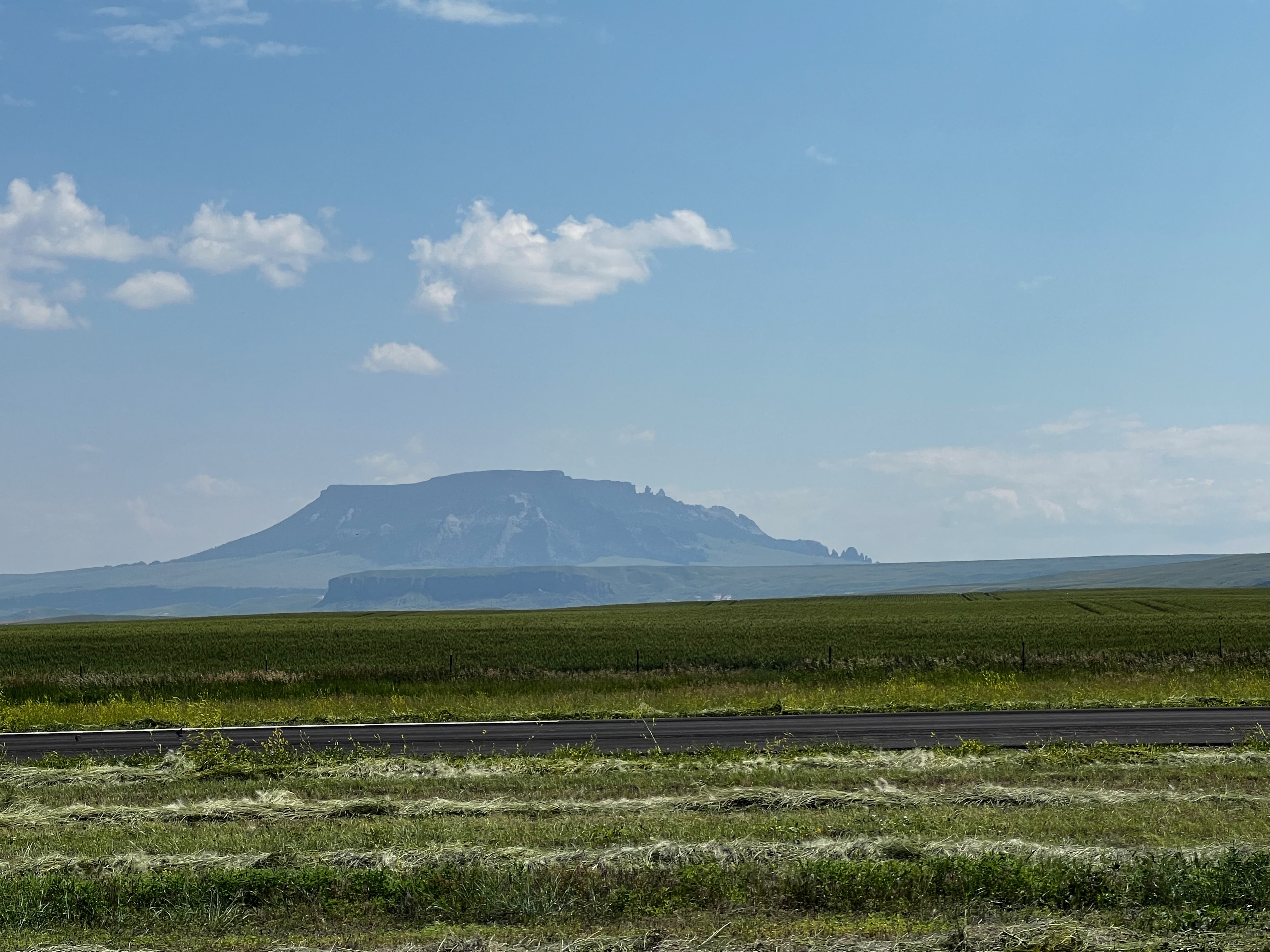
You could walk out to Square Butte (below) from the edge of this tiny town. Except you can’t: your gaze might be free to cast itself across the fields and hills to that ridgeline, but your body isn’t. That land is private property, and you cannot step on it without permission.

I love this part of the state, honestly, despite the barbed wire and mostly monocropped farmland (with notable exceptions of farmers working on no-till practices, cover crops, organic lentils and kamut, and any number of other methods to nurture soil instead of strip-mine it) and cows instead of bison and insistent “no trespassing” signs. Every time I approach it, driving south from the Hi-Line or east from Great Falls, I can’t help imagining what it once was, what it could be again. With buffalo back instead of cows, and prairie grasses instead of fertilizer-fed and weedkiller-protected wheat.

I spent six hours driving these lanes, pulling out the atlas to figure out which dirt road to turn down next—which didn’t always help; I got lost twice after hitting road-splits that weren’t on the map and had no signs—watching the Highwood Mountains approach and then recede, dipping down into the Big Sag and up out again, listening to black metal musician Blackbraid or silence, frequently turning off the car and getting out to listen to the birds. I didn’t stop at a single spot the entire time where there wasn’t at least one meadowlark singing.

Meadowlarks, mud-rutted tracks that remain a warning about the gumbo stickiness of these roads in wet weather, one field covered in prairie dog housing and noisy with their chirps, curlews and yellow-headed blackbirds, many wary pronghorn, and milkweed that appeared among the intermittent sage and wildflowers, a plant I never expected to see near American farmland.

Prairie dogs and friends

There's good in this world worth fighting for

Walking composition

5% of this quarter’s On the Commons revenue will be given to All Nations Health Care. Next quarter’s 5% will be given to the People’s Food Sovereignty Project.

If you’re in need of a somewhat frivolous half-hour, Christy Hays Pickett had me on her Butte, America, radio show as part of the Dear Butte writing residency. We talked about candy, I read from a section on loneliness in A Walking Life—loneliness seems to be in the air these days—and we somehow stumbled into my wheat-ranching grandfather’s flying days and speculation on the probability that I’m a Russian spy. Christy is a very entertaining radio host and a wonderful singer-songwriter. (The interview starts at about one hour three minutes-ish into the audio on that link and goes for 25-30 minutes.)


I did a podcast interview last week that ended up spinning itself into three hours of conversation (I’ll share it when it’s out; it will be edited way down), and one of the things we talked about was something that’s come up in conversation hundreds of times over the past several years: how do people connect across divides, across conflicting values and ideas of how the world should be?

Living in a county in Montana from which some of the worst legislation has inflicted itself on this state, not to mention that half my family lives in Russia, whose government chose to invade neighboring Ukraine with no justification, I know there aren’t easy answers to this. I believe in connecting with people, meeting them where they are, all the usual things. And I try to live that life. Aside from the other work I do, I walk three to five miles a day, most days, around town. People stop to talk with me all the time. Old friends, acquaintances, strangers. Sometimes we’re just talking about someone’s dog or their job, and sometimes others are telling me how to fix the world or that the Moon landing was faked and I’m trying to figure out where our common ground is.

When strongly opposing worldviews are between us, connection isn’t always enough. Anyone who’s put at risk by even one powerful person’s ideas of what the world and humans and our societies should be, or of how humans should be allowed to treat the entire living world, or of what some people think they’re entitled to take, knows this.

“Necessary but not sufficient” is one of the most useful metaphors I’ve ever drawn from my mathematics background. Connecting is necessary. Building trust and relationships are necessary. Committing to the place you’re in is, I think, necessary. It doesn’t mean any of it is sufficient enough to change what happens. But fighting for what’s good in the world is worth doing because it’s fighting for good, not because you know you’ll win. To indulge myself in a little Lord of the Rings (movie version) and quote Samwise Gamgee,

“I know now folks in those stories had lots of chances of turning back, only they didn’t. They kept going because they were holding on to something. That there’s some good in this world, Mr. Frodo, and it’s worth fighting for.”

I am frequently worn out with in-real-life connecting and listening and persisting with difficult conversations. I’d like to check out completely and go live in a cabin in the woods, which is a thing that, unlike most people, I actually have the option of doing thanks to my stepfather building one in the 1970s. But even if I didn’t believe in doing the work that allows for a better world, it’s a mirage to think that any of us can truly escape the problems created by paradigms of domination. Frodo and Sam learned that on their quest to destroy the One Ring: the Shire was what kept them going, and at some point they realized also that it could never have been a refuge from what would happen if they failed.

Connection and understanding will not solve a divide created by belief systems that deny others’ right to exist, or only allow existence within narrow parameters. The only thing you can do is work hard enough or fight hard enough to diminish that paradigm’s power.

We all have our own capacities. I hope you are able to honor yours, while knowing that not everybody has that option. I’m not going to give up having difficult conversations, even if I never see one changed mind in my entire life (though honestly I could do with my anti-vaxx neighbor stopping with trying to get me to read Robert F. Kennedy Jr.’s book) and even though I have trouble with anything that feels like confrontation. Spending time alone in the woods and the garden and on the prairie and by rivers and with people I care about restores and re-centers me, and also reminds me of what restores the world herself; it’s not all about me or my immediate family and friends. The more of us who can manage some of that, the better chance we have of leaving a decent world for generations we’ll never see. It’s not sufficient, but it’s still necessary.


I was listening to a brief, light-on-the-brain podcast on the way to Butte, and ended up going back to it a couple more times for these lines:

“When I post about about how others did me wrong, it gets lots of engagement. Posts about personal accountability, much less. And that says a lot about us as a damn animal.”

I haven’t had a social media account for almost three years now and don’t miss it. I abandoned each platform for different reasons, and each for more than one reason, but the common thread and the fundamental one I’ve kept coming back to (and what keeps me off of Substack’s Notes) is This is not who I want to be. I would rather walk away from my writing career entirely than sacrifice my attention, my compassion, and my humanity to its growth.

I kept playing those podcast lines over and thinking of my quips a few weeks ago about fly-fishing white guys dominating all the environmental literature space. Which I still think is true! But it’s mostly not the fault of the writers themselves, and are acerbic comments the way to change it? Anyone who’s been reading this for any length of time knows my answer is going to be no, at least not for me. And not just because, while I have never enjoyed reading a single thing about fly fishing ever, not even once, I do personally like fishing.

What I was trying to get at was that the structures of publishing and the literary world are, like so many other things, shaped by hierarchies and the false scarcity inherent in the needs of capital and the “free” market. Anyone who thinks publishing is immune from these forces has never looked at the relationship between most books’ marketing budgets and their sales. Publishers (I’m talking about big publishers more than smaller ones) choose which books get those resources, which ones succeed, and there isn’t a lot of reasoning in the choices.

The crux of the issue is that the successes are then held up as the model for what any particular subject or genre is meant to be, whether it’s environmental writing or science fiction—their style or tone or perspective becomes the only acceptable way to approach whatever is being written about.

Taking science fiction’s relatively recent renaissance as a huge example, it’s obvious that this model is simply wrong. Falsely limiting the variety of any type of writing chokes off creativity and narrows the chance that any given person out there in the world will come across—or write!—a story they sorely need.

Someone shared a passage from an interview with poet and essayist Ocean Vuong recently that speaks to the heart of how the literary world’s structures attempt to co-opt creativity:

“Competitions, prizes and awards are part of a patriarchal construct that destroys love and creativity by creating and protecting a singular hierarchical commodification of quality that does not, ever, represent the myriad successful expressions of art and art making. If you must use that construct, you use it the way one uses public transport. Get on, then get off at your stop and find your people. Don’t live on the bus, and most importantly, don’t get trapped on it.”

(Not sure I exactly get the bus metaphor, and also not sure patriarchal constructs are the only issue here, but I agree in general and always like knowing someone’s a fan of public transit.)

That construct works in tandem with publishing itself. Only a few people receive awards and accolades and big book advances, which doesn’t negate the fact that everyone has a right to creativity. To write. To tell their stories. To express their own ways of seeing the world’s beauty and talking about their own pain. To see the worth in their own stories without needing an audience of thousands or millions to validate them. A system of scarcity constrains that ability, and limits the kinds of stories we get to read.

We all connect with different work. Science fiction and fantasy have brought a tremendous amount to my life, and will continue to do so, while for many people those genres hold no interest. There are nonfiction writers who have changed thousands of people’s lives for the better but whose narratives I can’t seem to connect with. None of these things makes the work good or bad, worthy or not.

I’m as judgmental as anyone else, and on this I’m trying to do better. Just because I don’t want to read anything about fly fishing ever again doesn’t mean there aren’t people out there who want and even need that writing. I just don’t want the publishing and literary worlds to cede those books and writers every possible resource and bit of space and attention at the expense of all the other stories and storytellers who make this world a more interesting and complex place.


Human societies always, always need connection and relationships and trust, much of which is built or broken through the stories we tell one another, and the stories we believe—the stories we think we know—about one another. I don’t think that will ever change, and at the same time connection and relationships aren’t always enough. Sometimes we are forced to fight against or walk away from those who would harm us.

Trying to figure out where that line is—where talking works and where fleeing or fighting back in some form is the only option—might be one of the more slippery questions that comfortable people face. It’s that very comfort that misleads many into thinking things are fine or action is unnecessary. This was pointed out to me in several different ways when I was interviewing researchers for an essay on riots that I wrote for Aeon a few years ago:

“People don’t engage in unrest for the fun of it, or because they’ve lost their rationality to a mob mentality; they do it because they feel they have no other choice.”

It’s very easy to think people who are not ourselves do have a choice when our own safety or comfort isn’t what’s under threat, when we can tell ourselves a different story about what’s happening. But the structures and systems supposedly in place to make democracy and justice work are often broken, dysfunctional, or intentionally undermined, and that has always been the reality.

This is something stories help us to do: to enter into suffering that isn’t necessarily one’s own, and to understand what’s at stake. To work for what is right rather than for what benefits us. Aragorn, Merry, Pippin, and the rest of the surviving Fellowship of the Ring didn’t go into battle assuming they’d survive it and be covered in glory; they did it to give Sam and Frodo, and therefore the rest of Middle Earth, a chance. They imagined lives other than their own.

When we can encourage as many iterations of as many stories as possible to be told and heard, what people imagine is possible becomes multi-dimensional rather than one, linear, acceptable way of being.

We need imagination and courage if we’re ever going to see change for the better, if we’re ever going to see a world where everyone can read the books, smell the flowers, write the stories, go for the walks, be fed and sheltered and loved without fear, be their full, true selves on a living planet that has no need to restrict who that is, a planet who has, and always has had, enough for all. A planet who herself needs our love, care, stories, and courage. There’s good in this world of so many kinds, and it’s always worth fighting for.


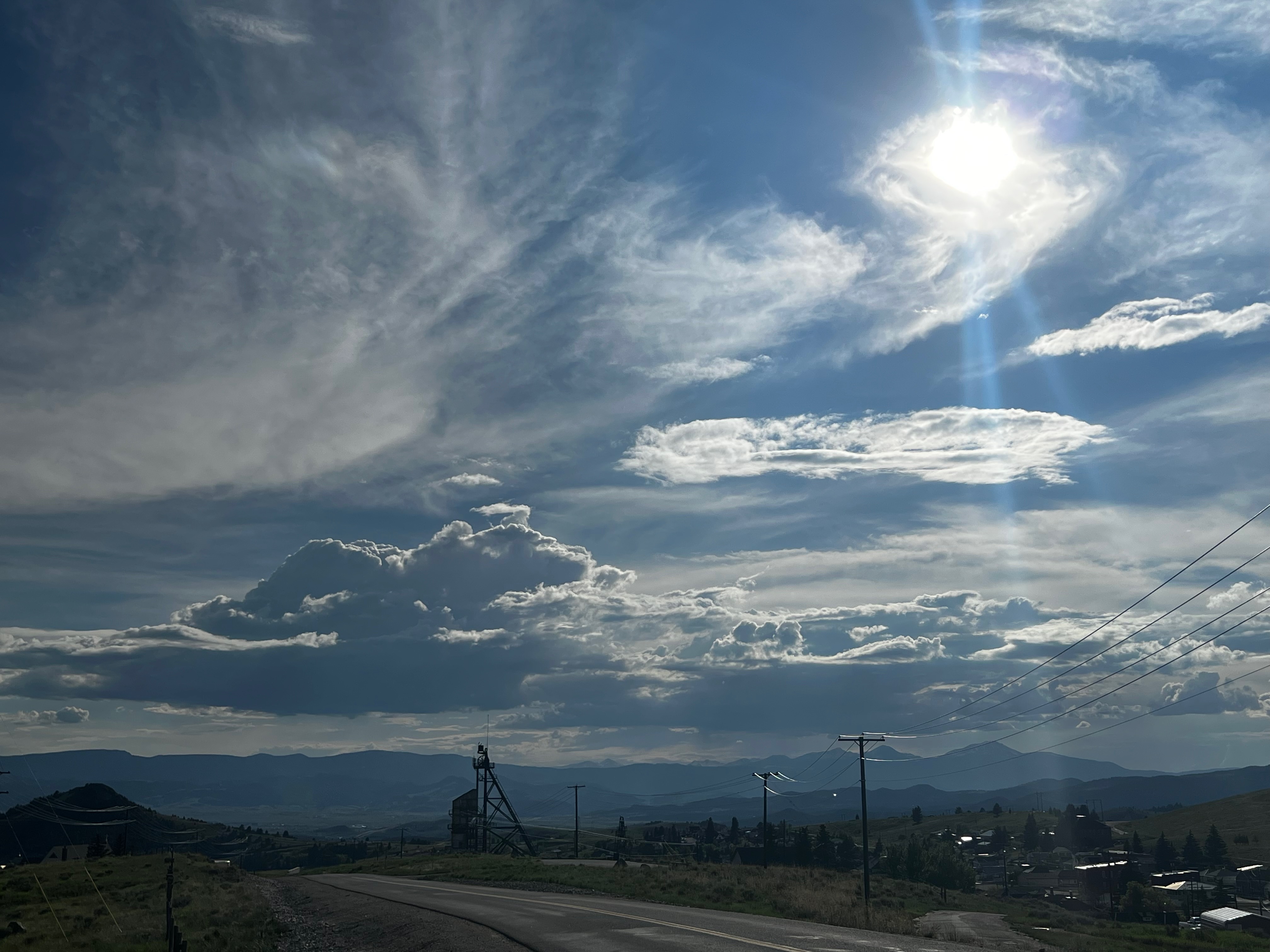
Thunderstorm over Butte. Montana summers used to have a lot of thunderstorms when I was growing up, especially in August. They’ve been almost daily here and it’s made me nostalgic.

I know too many people in pain right now for all sorts of reasons, with societal pressures adding not-so-slowly to the crushing weight, and am hoping you can take a minute to check in with yourself. I’ve been getting a lot of questions about these kinds of things recently, whether over email or in interviews or personal conversation, mostly about connecting across divides and about loneliness. A lot of us are not doing well.
Loneliness and isolation are weapons used by totalitarian and authoritarian governments for a reason: to make us forget our interconnectedness, to make us believe that whatever our struggles, we are alone. But none of us, truly, is alone, no matter how convincingly the deadening weight of loneliness creeps into the limbs. You are not alone.

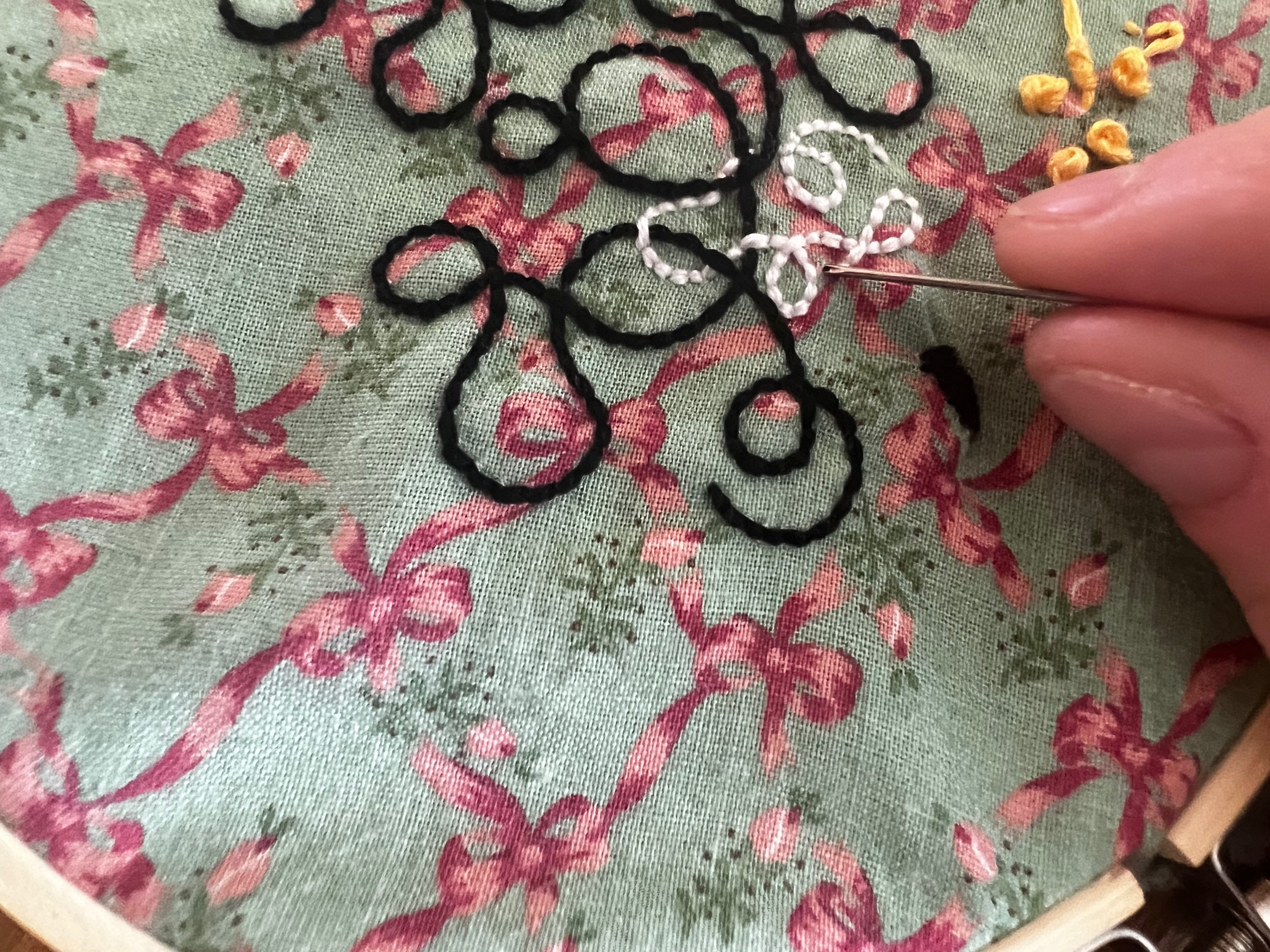
Stitching something to life

Walking composition

I am currently at the Dear Butte writing residency, in Butte, Montana. In a vast state with varying skies I am stupidly in love with in every region, I’d put Butte up as a contender for having the prettiest and most dynamic of them. And the proudest crows. I thought the crows around my house were pretty happy in the fir and spruce trees, but nothing like the crows hanging out on the mining headframes around Butte.

Dear Butte provides a gift of time and space that I’m having trouble wrapping my head around. No workshops, no flurry of writing residency social obligations. You get to be by yourself! On top of that, it gives you up to ten days in the most welcoming, creativity-friendly house I think I’ve ever been in. I’m not exaggerating, I’d like to move in. There are photos of it in the Dear Butte link above.

On Monday, June 12th, as part of the community engagement aspect of this residency, I’ll be meeting with people locally for a walk and conversation about walking’s role in building community, and how communities tell their own stories. Details are here if you’re in the area and want to join!


I have an old box of embroidery thread that belonged to my great-grandmother. I don’t know if she used it much. I’ve never seen anything she might have made, and my own maternal grandmother had other interests, like flying planes and taking care of her small dogs and whole lifetime of service. Maybe there’s a reason I ended up with this box of thread skeins, some of which looked like they’d never been untied. Maybe nobody ever used them.

My other grandmother, the one who’d spent most of her life in Leningrad after leaving the Pale of Settlement that Jewish people had been confined to until the 1917 Russian Revolution, was another story. She embroidered colorful, elaborate pillowcases of flowers and birds. She cross-stitched table runners and made tablecloths out of a kind of picked-thread style that people in that part of the world still make: picking out and pulling threads in linen cloth to create patterns similar to lace. She was a metallurgical engineer and had, as I’ve written before, a life that was rarely anything but hard, but my father has told me that even when she got deeply depressed, she would sit down in the evenings and work on a tablecloth or pillowcase. She was always making something.

Lighthearted enough to fly

Walking composition

Yesterday I went for a long walk along the river after an exhausting couple days full of demands and weighty darknesses, and was rewarded by being able to watch a bald eagle’s long flight overhead, strong wings carrying him through the air with only one brief beat downward. I watched him until it looked like he would keep on going out of sight, but instead he hung around after tangling with a couple of crows. Or, they tried to tangle, but he kept somersaulting as he flew, the curve of wings and tumble through the air repeated over and over as the crows followed him around in a wide circle and I watched from under a willow by the river.

I’ve never seen the mating fall that bald eagles perform, where two birds grip talons and tumble down through the air, but seeing this lone bird flip around with such ease, without being thrown off-course or disoriented, was breathtaking. I can’t think of many humans who even come close to that level of bodily confidence. Certain athletes, maybe, like gymnasts and freestyle skiers and circus performers. What weighs us down besides the density of our bones and lack of wings?


When I was in grade school, the boy who lived two houses down from me and who was my same age started trapping me next to the schoolyard right after we got out for the day. He threatened to beat me up if I went home, and after making sure I understood that he meant it, he left for home himself. I waited until I was sure he was long gone before walking home via a different route.

I can’t remember what his given name was, only that everyone called him Bud. His home was not a happy one, but somehow I can’t think of many homes in that town that were happy. Even most of our teachers seemed miserable; some time after my family moved away I heard that the PE teacher had been fired for breaking a kid’s arm. It didn’t come as a surprise. I remember trading certain kinds of stories with my friend Maggie while we were trying to avoid a loose dog that kept knocking kids down on the cut-up town ice skating rink, which sat on an empty lot near my friend Cindy’s house. Cindy with the awesome tree house, whose mom once washed my mouth out with soap when I let out a swear word, whose neighbor hated kids, and whose goldfish I accidentally killed through over-feeding.

Bud didn’t threaten me after school for very many days, and never got around to beating me up. I did once see him in a massive fistfight with another boy after school when we were in fifth grade. Looking back, all I can think is that he was a miserable kid. The kind of desperate, unhappy rage that leaked out of him feels familiar now that I know what it looks like, what it means a person might be carrying. This could be entirely wrong, a projection onto the past, but my memory is convinced that he was hurting. That he felt a need to exert some control because his life was unwelcoming, and I was there.

Personal pain can spill out onto others in so many ways. For several years now, my younger sister has practiced and given trainings on trauma-informed management, something I now wish a lot more people knew about. One thing I’ve learned from her work—and from living—is that it’s always more likely than not that any person I meet or talk with is carrying at least one specific or chronic trauma, one I might never know anything about. And that the enormity of any given person’s trauma might be beyond my comprehension. I might never know what pain they’re in, what kinds of weights have attached themselves to their bodies, or where.

We moved away from my original hometown when I was ten, and I haven’t thought of Bud or his younger sister (who was my friend—a mean friend at the time, but a friend nonetheless) in decades. This memory came back to me as I was on my way home after walking my own daughter to school this morning, looking for bald eagles and wishing we could all shake off the weights of grief and trauma as easily as I’ve seen eagles shake off crows.

I wondered what happened to Bud, to everyone else in that family. And then I remembered something that happened to his sister due to yet another unhappy home and another unhappy boy, and wondered whether these cycles ever stop. If one of those cycles, at least, has now stopped, or if that brokenness and pain is continuing to spread itself out into the world, as so much brokenness and pain does, on down through the generations.


I write a lot about property and land ownership, about the suffering caused by a few people insisting that they have the right to own far more than they’ll ever need. Of what it means that laws are written to allow those people to refuse access to land and water and everything else needed for survival, simply due to the legal fiction of ownership.

What about emotional space, what people spill out into the world around them? (A question that has infinite layers—even ownership has its own compelling emotional components.) What about a child who couldn’t figure out how to deal with his pain beyond spreading it—even ineffectually—to someone else (and likely inward to himself, too), who for all I know became an adult spreading it to another generation right now? What demands do I myself make of others that’s an unfair draw on their own emotional capacity?

Somewhere in the last couple years here, I wrote about Riane Eisler’s book Nurturing Our Humanity,* which is one of the few I’ve ever read that really digs into how an upbringing saturated in private household domination helps to perpetuate authoritarian cultures. On psychologist Else Frenkel-Brunswick’s “F scale” that measures an individual’s compatibility with fascist rule, Eisler wrote that,

“People who scored high on this F scale had typically grown up with a great fear of punishment in families with powerful authority figures. . . . In short, her findings not only foreshadowed Milgram’s and Earl’s later findings that people from authoritarian backgrounds tended to follow orders regardless of how much they hurt others, they also showed that these people were prone to vote for and support authoritarian leaders.”

Later in the book, Eisler wrote about the strange but widespread belief that “what happens in families and to children is of little if any real importance.”

I watched that bald eagle fly and flip its way around the bothered crows for a long time, far longer than I usually get to watch eagles—their flight path almost always takes them out of my sight relatively quickly—and I think it’s one of those memory-hours that’s going to stick with me. I’d just come up from a public dock where I’d been sitting with my feet in the river, wrapping myself in temporary relief from others’ needs of me, watching the light that reflected off the water ripple its way along the undersides of the willow branches while swallows and red-winged blackbirds demanded attention.

And then the eagle came by, with his combination of strength and ease that made my own spine and shoulders feel stronger for a few minutes. Like I, too, was flying even if my feet stayed on the ground. What would it be like to have the strength for all the world asks of us, and yet be able to move with such joyful lightness? To release all that we carry without making it another’s burden.

*Flipping through my marked-up, Post-It-noted copy of Riane Eisler’s book, I almost wish I’d waited to read it until further along in my own writing of No Trespassing. I also wish more people would read it. There’s a lot of important research there and I’ve already forgotten much of it.

Planting potatoes, unearthing the past

Essay

Isn’t “unearth” a strange word? Can anything really be un-earthed? Maybe un-earthing is one of the sources of this world’s biggest problems.


Last week, on a warm day wedged among thunderstorms, chilly rain, and the thick, unwelcome smoke that drifted down from wildfires in Alberta, I finally got potatoes planted.

The seed potatoes, sliced in half and left to cure a few days earlier, tucked into the dirt like they were coming home. I scooped soil out of each hole and patted it back over, warm from the sun. The swallows were busy overhead—still investigating the nesting box but I’m not sure they’ll take it; as usual, they seemed more interested in the woodpecker-battered siding of my sister’s house next door.

A large bee roamed over a flowering lupine, and in what felt like silence but was just the absence of most human-made noise, a breeze went through the willows, firs, and hidden apple and plum trees across the road. It’s a sound that, along with the robins and chickadees, is so constant I sometimes forget to notice it. Kneeling among the potato beds, I paused the planting to listen. I generally relegate podcasts and music to car rides and household chores and making dinner. That is, indoors. The hours out of the house and car are mostly given to what’s there, even if it happens to be neighborhood lawnmowing day or a walk that takes me along the highway. The brush-scrape of the shovel into the compost pile. The birds and slight buzz of the bees, which will become more constant when the borage blooms and the dandelions pop up again; the high pitch of the hummingbird zooming up and fluttering down among the caragana; the shush-rustle of the trees; even the sound of the sifting dirt in my hand as I scoop out room for a potato and make sure to cover exposed worms.

I’m still sad at the loss of so many stored potatoes over December and January due to the cycle of intense cold and wind followed by warmer days of rain, but it’s a nice thing about living in a place where winter has a grip to loosen: the promise of renewal. I’m suddenly tracking the blossoms on the strawberries and planting seeds with an eye to autumn, reminding myself to save the beans and tomatoes until there’s no threat of frost. And we’ll have a chance with potatoes all over again.

I bought my seed potatoes late, which meant ending up with varieties I’m uncertain of because everything else was sold out, but even in the base soil of dense clay that makes up my garden, previous years’ potatoes keep showing up healthy and well-grown. With all the added compost, I’m hoping this year’s will come up even better, will easily feed the families that rely on this rectangle of land as long as I keep them watered and covered.

"I just want us to be good to each other"

Walking composition

“Who can help the heart, which is grand and full of gestures?”
—from “Association Copy,” Camille T. Dungy

I am very late starting my garden this year. Things have been busier than they were this time last year and it feels like the cold has hung on a lot longer. We had a spate of days hot enough that I started wearing sandals, but since then it’s been wet and chilly, with some wind-blasting rainstorms. Yesterday, I spent a lot of time outside working and walking, and watched as storms loomed from behind the mountains to the north, and then the ones to the east, and then seemed to be coming from the southwest. All day, dark, streaky virga of promised rain moved in a circle around town but never overhead.

Last week I had four yards of compost delivered during a chilly drizzle, and the next two days it poured. All I could think about were the seeds and potato starts in my garage, waiting for me to get myself together and do something besides the single three-hour burst of weeding quack grass from the strawberry beds and around the lettuces that reseeded themselves from last year.

The peas need planting. The potatoes do, too, in the beds hopefully enriched a bit by the peas I grew in them the last two years, a little more like soil and a little less like clay you could throw pots out of. The raspberries and fruit trees are leafing out, flowers already going over on the apple trees, and strawberry flowers are popping up all over. Tomatoes, cucumbers, peppers and pumpkins, squash and sunflowers, green beans and radishes—some will seed from last year like the lettuce did, while others I’ll have to buy from a farm stand that unlike me had wherewithal (that is, a greenhouse) to start them somewhere warm months ago.

It’s the spreaders and reseeders I really love. The cherry tomatoes I know will come up again because so many grew last year from the previous year’s seeds that I thinned out enough to feed most of my neighborhood. The potatoes we missed last fall whose leaves will show aboveground weeks from now from where they’ve been hiding. The strawberries who sent out enough new runners last year that I had to build a second bed. The sweetgrass starts a neighbor is giving me, the mint that, as hoped, has started to spread. The borage that reseeds itself voraciously and that the bees adore. The swallow that seems interested in the nesting box a friend installed last year.

All of it a reminder every single year that abundance is something nature loves. There is the too much, as inevitably happens with zucchini and my friends’ plum trees, but more to the point: always enough for everyone.


I just picked up and started reading Camille Dungy’s new book Soil: The Story of a Black Mother’s Garden. I’ve liked Dungy’s poetry since meeting her at a very small environmental-science writing conference years ago. She was grounded and engaging and smart as hell and also encouraging to everyone in her workshop (it was poetry, so that wasn’t me; mine was nonfiction) but also everyone else, and all of it without devaluing the clear brilliance of her own work. The writing world has a lot of ego in it; Dungy’s the kind of writer who proves that you can be among the best without dragging ego around as a kind of jewel-encrusted armor trying to stiff-arm people and blind them at the same time.

I’ve been looking forward to this book and even listened to an interview with her about the writing of it, which is a rare thing for me. The last time I spared attention to listen to “writing craft” podcasts was when Longform launched over 10 years ago, and it was close to a year by the time I got fed up wondering when they’d interview someone who wasn’t connected with Yale.

I listened to the interview just before picking up Dungy’s book, and was swept up again with her incredible intelligence, insight, and love for the world. And her perspective on what needs to change not just in the writing and reading people think is necessary, but in how we perceive the world around us:

“In the book I describe being very frustrated with some major texts in environmental writing, and my daughter asking me why I was so angry—I was setting the table with great fervor—and I explained that I was frustrated by this absent-ing of people in the writers’ lives in the environmental canon. . . .

I had reread Pilgrim at Tinker Creek before the shutdowns began and was, like, ‘This is beautiful writing. She is an amazing writer, and an amazing thinker. But also why did she construct herself in such a solitary mode?’ And what is particularly galling to me was this sense that here she is just walking out looking—I’m quoting her—looking at the tree with the lights in it, and wandering through these open fields, and she’s writing in one of the most tumultuous cultural and political moments in American history, and she is writing in the epicenter of some of the biggest civil rights and women’s rights struggles in America. In the center of it. And that is just disappeared from the work.”

It’s long past time for this narrative style to change, perhaps especially in nature and environmental writing, which is so heavily dominated by white men—often in love with fly fishing, at least judging by the best sold and most widely read “nature” books about Montana that are really not about Montana or even nature at all but about these men and rivers in a way that I find personally off-putting and exclusionary. Writers who cannot seem to reconcile humans’ existence in their own lives, much less in the wildernesses in which they often hope to pit themselves against physical risks and avoid the much more difficult ones of interpersonal human relations, and even less what’s going on in the social-political realities around them.

“I have grown intolerant of that. I can’t be fully interested and engaged in writing that seems to erase me. Because all of those concerns about civil rights struggles and women’s rights struggles and those kinds of things—if those don’t move forward, if they don’t get paid attention to, if they don’t get talked about, that negatively affects my ability to move forward in the world. I want writing that engages with the beauty of the greater than human world and the necessity of protecting it but also engages with this reality of politics and human cultural interactions. It was imperative to me to write into that . . . I’m expressing it here as anger, but it’s also exhaustion and hunger. To write into that hunger.”

Reading Soil and listening to the interview with her, I realized that I have been hungry for more writing like Dungy’s. Her writing about motherhood, nature, and schooling children through the early Covid years went straight into me, down to having years ago given my kids the exercise ball I used to use as a work chair. Women in writing, but especially mothers in writing, is something I’ve been frustrated about and trying to change since those early travel writing years, and in essays I published years ago questioning why being a mother and a writer is seen as a literary less-than. It’s easy to say it isn’t, but publishing statistics and how parents’ stories are framed and marketed tell the real story. As if parenthood in all its forms can never be as real as some guy tramping off into wilderness all alone and being called intrepid. As if other people in our lives don’t exist—or at best exist as subjects and characters, never as people in their own right.

Maybe mothers can’t write about nature in a way that excludes other humans because they don’t have days that exclude other humans, Dungy said. And beyond that, far more than that, it’s a problem rather than an asset that so many people are able to write book after book about the wonders of nature and their love for it without including hints of what is going on in human society at the time. That they don’t have the imagination to think that you can write about struggles against prejudice and injustice and rivers. As if there is some pristine wilderness of the human any more than there is a pristine wilderness of nature.

Soil might be a book to avoid for people who flinch at critiques of a canon—including Mary Oliver, whose “Tell me, what is it you plan to do with your one wild and precious life?” which ends the poem “The Summer Day” most of us reading people are familiar with, if only because it’s quoted so widely.

“I’ll tell you what I would have done,” wrote Dungy in Soil. “The dishes, the laundry, a pile of work for pay. Forget feeding a grasshopper. At least three times a day, I’m figuring out what to feed my family.”

“Here is the contract the culture has made: In becoming a mother, the one precious life I am expected to think about is seldom my own.”

Narrative that included every speck of one’s life would be tiresome, but I was almost overwhelmed with relief when Dungy talked about the vacuity of environmental and nature writing that erases humans as well as the upheavals they cause and the injustices they fight against.

And the lives we live. I write about ownership and the commons and commodification and walking and science—and I don’t think it’s an accident that almost all the books on my shelves on these subjects are written by men—and my love for this world I live in. Those subjects require a lot of research and thought and narrative-shaping and searching for anything outside the mainstream culture, but it matters that as I typed this post, I also dealt with emotional upheaval over a broken friendship (middle school really sucks), geometry homework, giving my sister a ride to and from a place that actually fixed her car (and that all the car repair places around here are backed up for months because of labor and parts shortages), scrounging for lunch, looking longingly at the garden, reminding myself to switch out the winter tires, calling my dad back, talking with several people about how to fight back against the sweeping injustices coming from our state legislature and governor, missing a friend, and cleaning up dog puke.

The point in Dungy’s writing is that it’s about people and place, people in place, people with place, people of place.

“Efforts to reduce natural diversity almost always result in some form of depletion,” she wrote, an observation that she is clear applies just as much to people and places as they do to a garden. (Though I will never, I hope, comprehend why people have such issues with dandelions. They’re cheerful, abundant, soft to walk on, and edible. But then, not everyone has the quantity of thistles and knapweed that live in my yard. I’ll take more dandelions any day.)

Just as people are not one story, neither are places. Every single one deserves to have the variety and complexity of their stories recognized and told.


One of the things that hit me repeatedly during the first year or two of Covid was coming to terms with who I knew who could be relied on to engage in care for others, and who couldn’t. I was reminded forcefully of what a friend said she learned from going through cancer treatment many years ago, and the friends who stuck with her through it: don’t disappear.

I give a lot to others—time, energy, food, labor—anything I can manage, really, and it’s been a long hard lesson not to wear myself to shreds in the process. But the hardest part of it is seeing where there’s no reciprocity. Not to me, but to others. When I get to the end of my days what will matter to me isn’t if people are caring for me, if I get some kind of return on what I’ve tried to give and how I’ve tried to show up, but how many people I see engaging in reciprocity and care for everyone else. What wears me out isn’t giving the care myself, but the lack of it in so many others. That’s something I carry with me every time I camp or rent a forest service cabin alone. Why don’t more people care?

Getting my hands back into the garden brought me back to questions of imposed scarcity and mutual, collective care. Who will share, and who won’t? Who will be there for you in a crisis or a trauma, and who will disappear? Who will use crises to further their own ends rather than leaning into community? Who is helping to build a future where all of it doesn’t have to be so difficult?

In the Threadable reading circle The Viral Underclass, Elise Mitchell posted two excerpts from How We Stay Free: Notes on a Black Uprising, one of which was a detailed account of takeovers of empty public housing by The Philadelphia Housing Action. It’s a well-told play-by-play story and resource for anyone working on houselessness. And at the end, the author’s weariness echoed many people’s I’ve heard recently—and for years—involved in issues of justice, equity, and care:

“Honestly, I don’t even know what winning is. I just want us to be good to each other and hopefully we’re taking care of each other. That means all of us—not just your clique.”

That is probably the best articulation of how I hope humanity can change, and what I see ownership and domination paradigms and their falsely created scarcity and hierarchies having prevented not just for centuries, but for millennia. That’s where so many of the barriers are baked in. The narratives driving those paradigms have often failed, and too often won, but the vision of a future where their role is diminished and mutual care is paramount is not only right in front of us, but all around us.

This isn’t technically a walking photo. I stopped by the side of the road an hour and a half’s drive southwest-ish from where I live. I turned off the car, stepped out, and found myself overrun with meadowlark song.

A particular thank you to everyone who commented last week. That was actually a tough one to write, and I also appreciate the thoughtful replies with regards to links. I originally wrote this week’s “list of things to read and listen to” without the hyperlinks, as I did last week, but as I was revising it I thought maybe it’s time to give it a pause entirely.

Every time the digital world feels like it tries to speed us up, my response is to try to go deeper underwater and see where we—or at least I—can slow down. We’re not always given a lot of choice in how we work or where our attention is dragged, but when that choice is there and it’s pushing me to do more, and more quickly, that’s when I dig my heels in, slow down, and then wonder if I can offer others a release from the pressure. I can’t do much about, say, Substack’s insistence on telling you how many minutes a post will take you to read rather than letting you judge if it’s worth your attention, but I can try to make spaces where they feel less like minutes and more like time.

Whether here or anywhere else—online or off—try checking in with your mind and breath, see what’s making you feel harried and rushed. Is there anything you can do about it? And do you have the space to help someone else who has fewer choices?

In the paths of butterflies

Walking composition

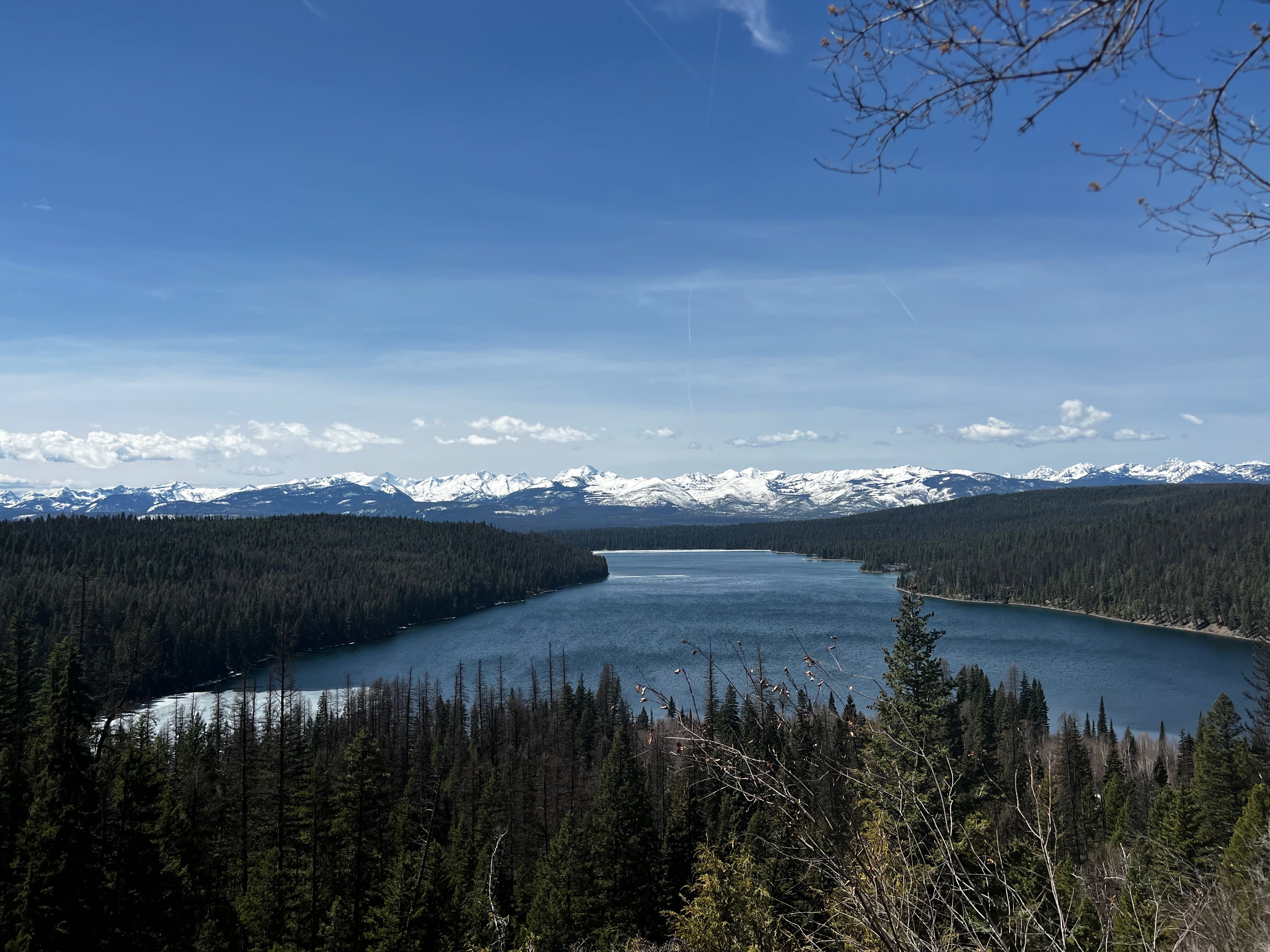
Mostly blue sky over snow-capped mountains on the far horizon, with a lake surrounded by evergreen forest in the foreground.

“You don’t waste no time at all. / Don’t hear the bell but you answer the call.”
—“Hammer to Fall,” Queen

Last week I spent a few days at a Forest Service cabin near Holland Lake in Montana’s Swan Valley, an area that holds a lot of childhood memories for me. My family used to camp there a lot. Often enough that those memories are smeared together in my mind, like what a rainstorm does to the chalk drawings my kids and nieces and the neighbor kids make in our driveway. 

This was a cabin I’d rented last January but ended up not using because it has an electronic lock—electricity! rare thing in these places and not something I actually want—and it was 15 degrees below zero (–26C) and the battery drained or the mechanism froze. Or something. Anyway, I couldn’t get inside. One of the things that makes me not completely despair over an anti-human digital future is how poorly all this stuff does in the cold. My phone always dies within an hour or so when I’m out hunting or skiing.

Electricity turned out not to be a boon this time, either. The cabin is at the edge of a packer campground. I wouldn’t have minded being surrounded by pack mule and horse corrals waiting for outfitter trips into the Bob Marshall Wilderness, especially as there was nobody there (I suppose the mountains are still too deep in winter for those trips), but stepping outside in the middle of the night to see Moon and the stars and being dazzled instead by street lights shining over every single (empty!) corral was an unpleasant surprise.

It didn’t deter the morning birds, but it was startling—bright lights right on the edge of the wilderness, ostensibly in preparation for heading into wilderness, reminded me of the countless stories I’ve seen about trash heaps at the bottom of Mount Everest, and the mistaken beliefs any of us might harbor about the impacts of our off-grid or wilderness or outdoorsy/nature-y activities. 

Morning birdsong, during which you are free to imagine no brightly lit empty corrals in the forest.

And a loon . . . (one call at the very beginning of the recording and one right at the end with the background sound of the nearby running creek in between)

It wasn’t the best few cabin nights I’ve had. Along with a bunch of reading, I was focused on tackling an already overdue essay that proceeded to fall apart in my hands like some aged, friable fabric. And the cabin’s heat went out two hours after I got there. After poking around, I figured that the propane tank was likely empty after the demands of a bitterly cold winter and I was in for three nights much colder than I’d prepared for. 

The first night, before I realized the heat was gone completely and wasn’t just being fussy, I delved further and further into my sleeping bag, waking up every hour, and had to talk myself into getting out of bed the next morning only to discover that it was almost ten degrees warmer outside than in. 

I probably should have slept outside the whole time for that reason—though the corrals’ streetlights were a strong deterrent—but did spend pretty much all my waking hours outdoors, trying to find patches of sun and going inside only to switch reading material or make more tea. Being underslept and chilly left me without quite enough brain power to tackle the essay that fell apart; I was cold and very tired and a little annoyed at the all-night lighting. I was uncomfortable, in other words, and eventually wondered if that might be good for me. Humans only recently started spending most of their time indoors with access to constant temperature control, and even that’s only for a certain percentage of people. There’s a fair amount of research about what this does to our bodies and the planet, but what about other aspects of ourselves? Our doubts, our fears, our worries, our happiness, our capacity to deal with the problems of the everyday as well as the existential.


Among my favorite parts of The Lord of the Rings is Bilbo’s warning to Frodo: “It’s a dangerous business, Frodo, going out of your door. You step into the Road, and if you don’t keep your feet, there is no knowing where you might be swept off to.” 

I always feel that when I start walking. Even in my hometown among familiar alleys and sidewalks and streets: if I just keep going, I could end up anywhere. Any of us could. If you weren’t stopped by fences and freeways or motorways and “no trespassing” signs and militarized borders, you could walk the planet, as long as you had access to a boat at some points. The entire world spills out from every footfall like it’s being remade as you walk. I still think that’s magical.

Looking at the basic trail map inside the cabin and knowing that this campground was an entry point into the Bob Marshall Wilderness complex made my feet tingle. I took a break from the essay that seemed to hate me and headed up the hiking trail. I only wanted to get a couple miles to the waterfall at the far end of the lake, but if I had brought better shoes and more food and some other things, I could have kept going for hours and hours until the snow got too deep and I pitched a tent against a snowdrift with only the stars for company.

I actually didn’t even make it to the waterfall that day, due to a relatively fresh bear track about a mile and a half up the trail. It made me rethink being a solitary, edible human roaming the woods. I wish I’d taken a photo of my hand in it for scale; it’s the kind of thing you can see often enough around here but it still thrills every time. It makes the bear spray I carry seem utterly inadequate, but also gifts me with that deep, ringing feeling of being alive. Bringing to awareness the smell of last year’s pine needles on the trail, the pitch dripping from a newly cut fallen tree, the robins and woodpeckers echoing through the woods, the chilly damp in the air and the acute knowledge of being surrounded by so much life that I can’t see. It’s good to be reminded that it’s not just the stars for company.

Bear paw print pressed into wet soil, surrounded by dried pine needles.

The evening I got home from that time away, I opened up one of the few newsletters that I’ve come to know as one that will always inform and surprise me, field biologist Bryan Pfeiffer’s Chasing Nature, to a post about the surge of nature photos uploaded to iNaturalist from people all over Ukraine, whether in active battle zones or not. “Nature inspires those who know how to see it even in the most difficult moments,” Pfeiffer shared from a zoologist colleague in Ukraine.

That essay came at an auspicious moment for me. Sitting outside the cabin wishing for more sunshine or that I’d remembered to bring a sweater, I’d been thinking a lot about a conversation I’d had with my father the previous week, about his recent trip to St. Petersburg in Russia during which he’d visited his family and all the old haunts that had formed the stories of his childhood. Places he’d walked—stories he’d walked, honestly—with my younger sister and me in 1991 after he was finally allowed back into the Soviet Union after 17 years of exile and could show us his homeland.

It’s an almost minuscule sorrow among all the griefs of this war, but it hit me both that my father was trying to face the possibility of never returning there again after he comes back to Montana this time, or at least not soon, and that I might never see most of my family in Russia again. My life changed drastically after meeting them when I was 14 years old. A grandmother I’d never met and whose language I didn’t speak. The only close cousins I have. Relatives who hiked hours in the woods on summer days to collect a year’s worth of berries and mushrooms and who showed me pictures of people I resembled. 

It was a world, and people, I never expected to know growing up in Montana during the Cold War. My father was an exile and until I was almost ten years old we didn’t even have a telephone, much less money for overseas calls. I don’t know how much they cost in the 1980s but when we called more often in the early and mid-90s they ran about $10 a minute. Russia was a world completely foreign and yet when I finally went there it was deeply familiar, a feeling that remains inexplicable to this day and one I’m not sure I’ll have the chance to experience again. 

I step out my door or onto a trail and imagine walking all the way to Alaska and waiting for a boat, the long trails in northern Russia that my cousins and aunts and uncle—and now stepbrother and nephew and nieces—walk to gather mushrooms in August connected like some kind of ley line to the ones beneath my own feet, kept apart only by the worst consequences that human imagination and greed can conjure up. To lose it, again, is a small loss among all the awful losses of the world, but it’s there all the same.


The second morning, still cold from a night in the cabin and thinking about the multi-dimensional yet fragile qualities of human languages (especially in the hands of someone whose essay is falling to pieces), I walked to the falls from a trailhead on the other side of the lake near the lodge. In summertime, it’s heavily populated but at the end of April I was the only person there for most of the afternoon. At one point before the waterfall I almost turned back because the undergrowth was getting thick and all I could think about was hiding places for mountain lions and—again—how edible humans are. Mountain lions don’t really care about bear spray, as far as I know. You never know where you might be swept off to once you step on a road, including as someone’s lunch. Even Bilbo Baggins narrowly escaped being eaten by trolls. And I don’t really want to get eaten by a mountain lion, but I especially don’t want one to get in trouble for eating me.

On my way back, I stopped in a sunny opening to look out at the view (that’s the photo up top), at this lake where my sisters and I had spent a notable number of hours jumping from the rope swing after our parents canoed over to it. A lot of memories of the Milky Way bursting with stars and energetic days of paddling and swimming, along with one memory so bad it gave me a panic attack when I drove here for a friend’s wedding some years ago, a reaction that had made me nervous about returning this time. But that, too, is part of a life: a bad experience isn’t discrete, packed away like some curiosity waiting to be dealt with and removed. It’s mixed in with all the good, as they are with it. I needed to come back, and on my own, to spend a little time with the smeared-together sketches of my life that happened here, some of the experiences that make me who I am. Holland Lake was the first place in my life I ever saw the Northern Lights, come to think of it, some summer night sitting outside of the tent as my mother pointed out the shimmer in the sky over the towering mountains.

I was trying to pick that memory out of all the others—how old was I? We camped here enough summers that I can’t remember—when a butterfly circled my head so close that it buzzed the hair that an earlier high wind had picked loose. I moved to take my phone out for a photo while it flew around, but the butterfly wasn’t having it. In fact, every single time I tried to slip my phone out, he disappeared.

I sat down on a rock at the edge of the trail and waited. He landed behind me, where I could just barely see him at the side of my vision. I turned slowly to look at him and he lifted off again. It happened a couple more times so I stopped. No photos, no direct eye contact, got it. I sat there for a long time as the wind died down and the sun got warm, talking in my head to the rocks and the butterfly until another woman came up the trail and the butterfly disappeared.

It seemed early to see butterflies—not to mention the poor confused bee stumbling around the snowbank outside the cabin that morning—but it was not my last butterfly encounter of this trip. I came across several more on the hike down the trail, and later that day as I sat on the steps of the cabin trying to salvage some essay paragraphs, another came to visit and hung out on my hand and in my hair for long enough that I wondered if I needed to invite him to share an early pot roast dinner with me. 

Brief announcements

Threadable readings (science fiction, immigration, class) + land ownership resources

Just a short post here to gather together a few loose ends:

  • I put together a post, pinned to the top of this newsletter’s home page, that has links to all of the Threadable-related posts on Land Ownership, as well as the resources for learning about Land Back, which came up during one of those discussions. I didn’t email it out but it’s there if you want to share or refer to it. I’ll probably add to it as time goes on, as I do for walking resources on my website.

  • The Threadable reading circle on The Commons & Belonging in Science Fiction & Fantasy has started, beginning with Hao Jingfang’s short story “Folding Beijing” and her companion essay “I Want to Write a History of Inequality.” Clicking this link should take you to the reading circle if you have the app installed (still for iOS only; you can download it here), though my history with that isn’t spectacular! But it should at least take you to the app, where you can find the reading circle. The second reading will be Rebecca Roanhorse’s “Welcome to Your Authentic Indian Experience” followed by Octavia Butler’s story “Bloodchild” (print only) and Nnedi Okorafor’s “The Book of Phoenix.”

    I think this one’s going to be a lot of fun. I’m not planning on doing individual Substack posts for each reading as I did for land ownership because talking about fiction is very different from summarizing nonfiction research and I’m allergic to reading or writing literary criticism, but I will talk about these stories and make sure to tell you what we’re reading. They will, I think, integrate naturally into discussions of and writing about the commons and how we each envision sharing a world, and our own place in it. There are a lot of fantastic science fiction writers working right now whose stories I’m excited to talk about with people.

  • There are also two other Threadable circles I’ve joined and am reading in: Immigration, run by Julie Schwietert Collazo; and The Viral Underclass, run by Dr. Elise Mitchell.
    Dr. Mitchell is an historian of health and healing in the Black Atlantic and her first reading, from Steven Thrasher’s book The Viral Underclass, was eye-opening for me. I love the way she (and Thrasher) are thinking about pandemics and public health.
    I think of Julie Schwietert Collazo as a comrade. We’ve known each other online for years, and she long ago became someone I looked up to for her talent, strength, and generosity, including to other writers like me. She’s written several books and also co-founded Immigrant Families Together. She’s just an incredible human and I love having her as a guide reading books like Undocumented Motherhood.

  • The international science + literature Reclaiming the Commons conference in Portland, Oregon, July 9-12. If you are around and interested in this subject, the conference looks amazing. There are hundreds of sessions with speakers and presenters from all over the world, on subjects from fisheries commons to narrative (that’s my panel) to ecopoetics to fire

  • This is unlikely to be a conference I can make it to, but I really hope one of you out there can: The Religious Origins of White Supremacy: Johnson v. M’Intosh and the Doctrine of Christian Discovery, hosted by the Indigenous Values Initiative and Syracuse University, December 8-10. They are currently calling for panel proposals and will soon be calling for art proposals, so please share with interested students, artists, and researchers.

Been getting outside a bit more without snow boots on! I wear those things day in and day out for about six months of the year. My feet feel much lighter now and I can venture to places where the bald eagles evidently hang out.

Readings on land ownership

Links to essays and readings from the Threadable reading circle on land ownership

These are all of the posts related to the Threadable land ownership reading circle in one place. If you’re interested in exploring these readings, they’re all open and free to share. They run from questions about the legal rights actually attained when owning private property, to enclosures of the commons in 1500s England, to the Doctrine of Discovery articulated in the 1823 U.S. Supreme Court case Johnson v. M’Intosh and the destruction it spread across the world.

I’ll add to this post whenever I come across something new (though won’t send it out; it’s just a living resource), and will leave it open to share and read.

Threadable reading circle selections:

  1. Owning the Earth, by Andro Linklater
    (enclosures of the commons and resistance in 1500s England)

  2. The Land We Share, by Erik. T. Freyfogle
    (law is a story that evolves; private property rights can’t be and have never been absolute)

  3. The Charter of the Forest (signed in 1217) and “The Charter of the Forest: Evolving Human Rights in Nature” law article
    (commons rights to land, food, water, etc., that were once known and defended throughout Britain)

  4. Land: How the Hunger for Ownership Shaped the Modern World, by Simon Winchester
    (how is “reclaimed” or “new” land managed, as in the Netherlands?)

  5. BONUS: Book review of Simon Winchester’s Land because I hated it so much

  6. In the Courts of the Conqueror: The 10 Worst Indian Law Cases Ever Decided, by Walter R. Echo-Hawk
    (deep dive into the 1823 U.S. Supreme Court case Johnson v. M’Intosh and how it enshrined the Doctrine of Discovery into U.S. law)

  7. The three 15th-century papal bulls that comprise the Doctrine of Discovery
    (the documents showing how the Catholic Church and the 15th-century monarchs of Spain and Portugal justified theft of land, resources, and enslavement of non-Christian people across the world)

  8. Our History Is the Future: Standing Rock versus the Dakota Access Pipeline, and the Long Tradition of Indigenous Resistance, by Nick Estes
    (the theft of the Black Hills, and how the hunger for private property and commodification destroy both rights and relationships)

  9. Progress & Poverty, by Henry George (1879)
    (private land ownership is unjust, and that injustice compounds over time)

  10. Commentaries on the Laws of England in Four Books, by William Blackstone (1753)
    (one of the foundational texts justifying private property rights, but he still can’t find the basis of private ownership in land)

  11. Second Treatise of Government, by John Locke (1690)
    (pretty much the same as Blackstone—doesn’t really know why we have private land ownership but is going to defend it anyway!)

  12. The Book of Trespass, by Nick Hayes
    (documenting the injustices behind privately owned estates in England)

  13. Nature’s Trust: Environmental Law for a New Ecological Age, by Mary Christina Wood
    (treating land as a commodity is unsustainable in the long run; seeing it as a commonwealth and reinvigorating the idea of the public trust might be a better way forward)