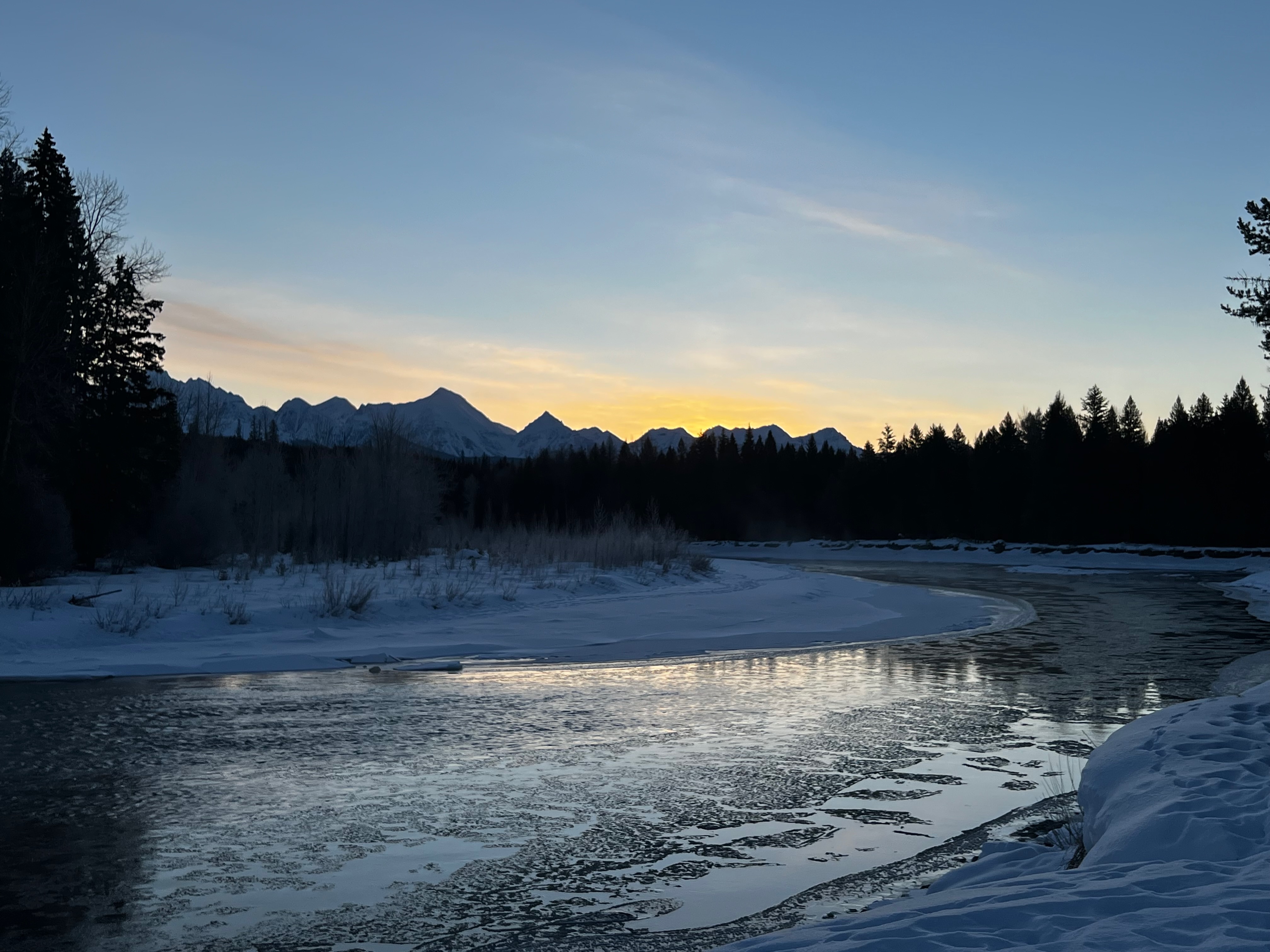
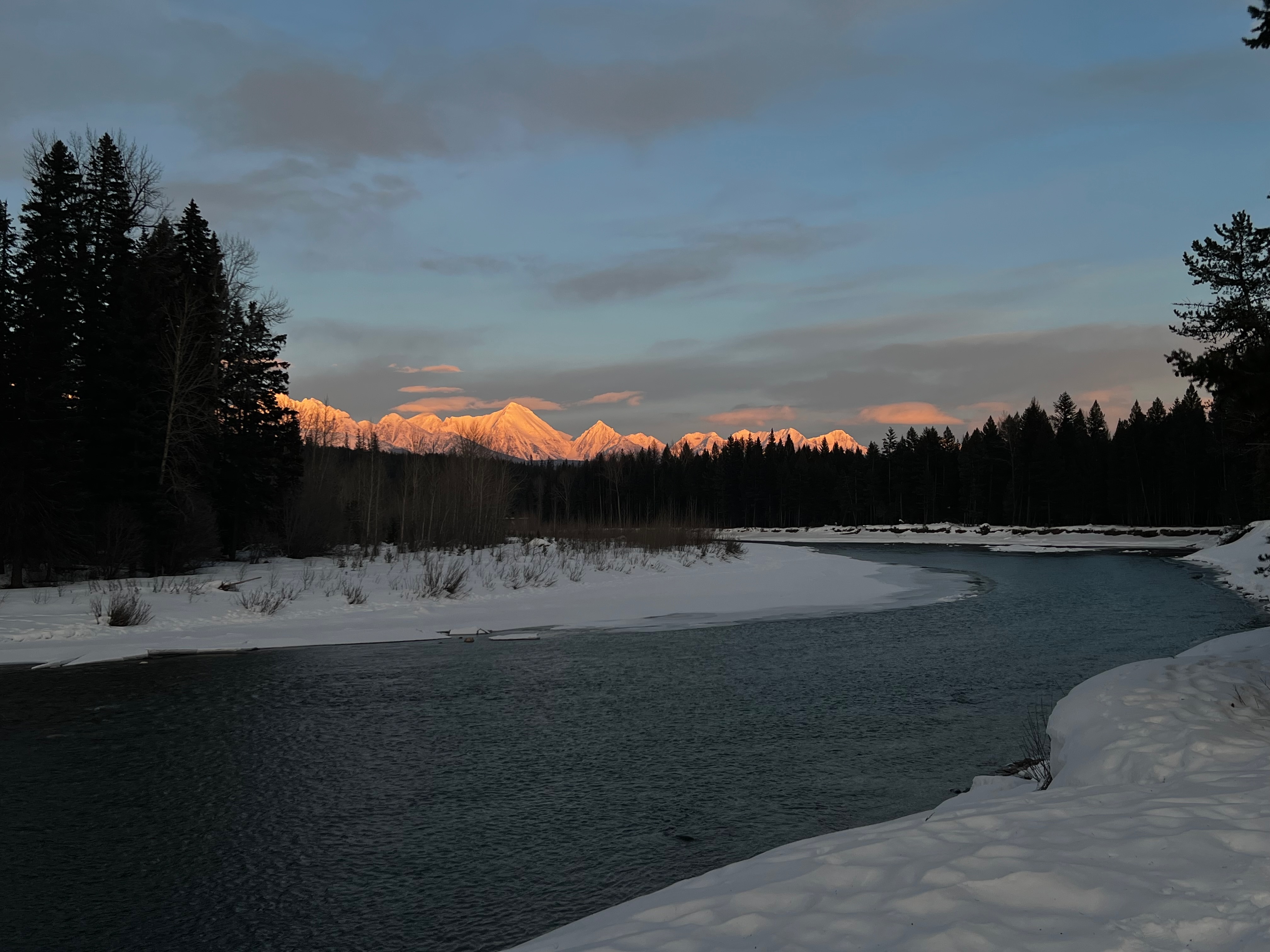
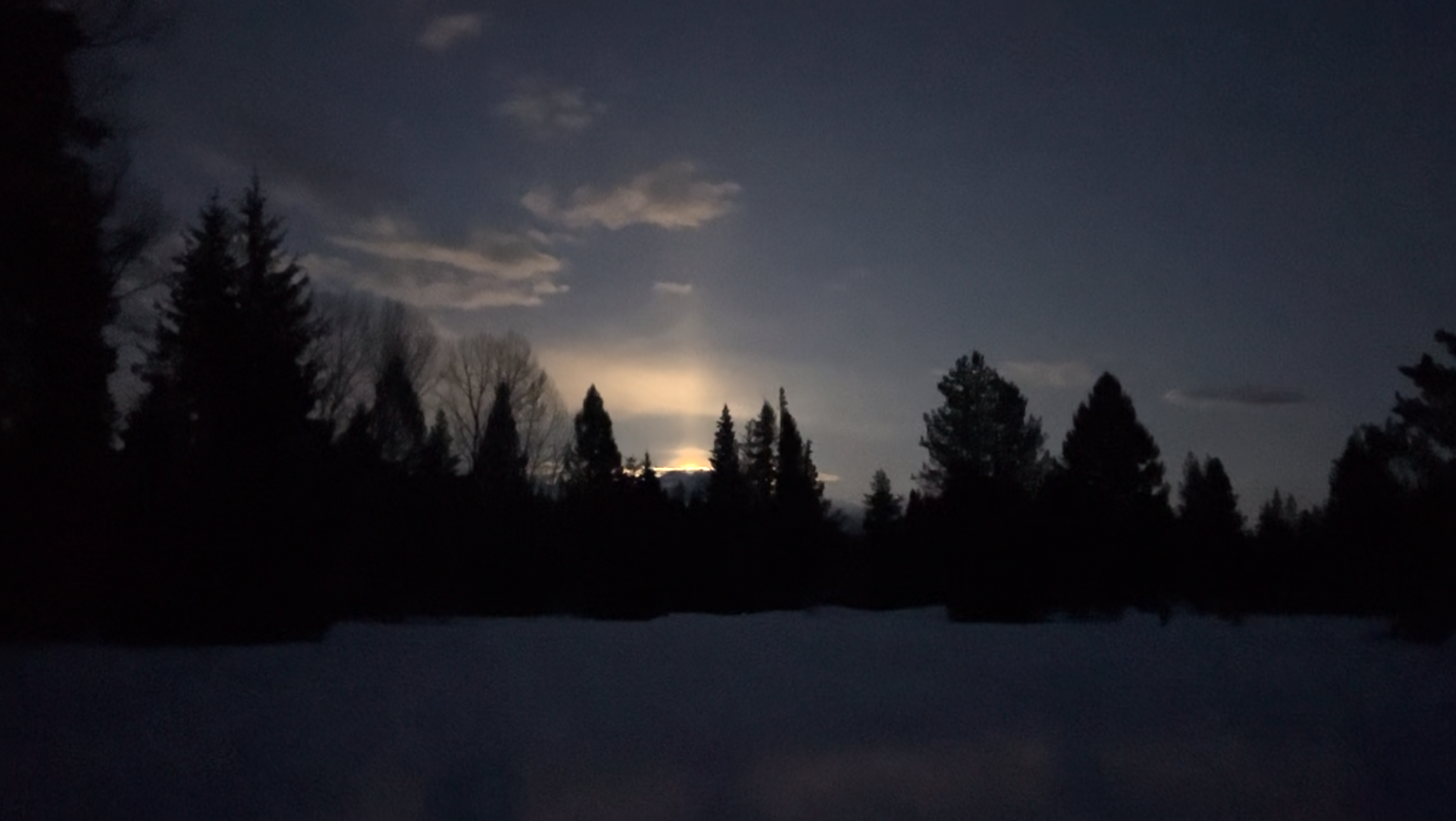
Yesterday I went for a long walk along the river after an exhausting couple days full of demands and weighty darknesses, and was rewarded by being able to watch a bald eagle’s long flight overhead, strong wings carrying him through the air with only one brief beat downward. I watched him until it looked like he would keep on going out of sight, but instead he hung around after tangling with a couple of crows. Or, they tried to tangle, but he kept somersaulting as he flew, the curve of wings and tumble through the air repeated over and over as the crows followed him around in a wide circle and I watched from under a willow by the river.
I’ve never seen the mating fall that bald eagles perform, where two birds grip talons and tumble down through the air, but seeing this lone bird flip around with such ease, without being thrown off-course or disoriented, was breathtaking. I can’t think of many humans who even come close to that level of bodily confidence. Certain athletes, maybe, like gymnasts and freestyle skiers and circus performers. What weighs us down besides the density of our bones and lack of wings?
When I was in grade school, the boy who lived two houses down from me and who was my same age started trapping me next to the schoolyard right after we got out for the day. He threatened to beat me up if I went home, and after making sure I understood that he meant it, he left for home himself. I waited until I was sure he was long gone before walking home via a different route.
I can’t remember what his given name was, only that everyone called him Bud. His home was not a happy one, but somehow I can’t think of many homes in that town that were happy. Even most of our teachers seemed miserable; some time after my family moved away I heard that the PE teacher had been fired for breaking a kid’s arm. It didn’t come as a surprise. I remember trading certain kinds of stories with my friend Maggie while we were trying to avoid a loose dog that kept knocking kids down on the cut-up town ice skating rink, which sat on an empty lot near my friend Cindy’s house. Cindy with the awesome tree house, whose mom once washed my mouth out with soap when I let out a swear word, whose neighbor hated kids, and whose goldfish I accidentally killed through over-feeding.
Bud didn’t threaten me after school for very many days, and never got around to beating me up. I did once see him in a massive fistfight with another boy after school when we were in fifth grade. Looking back, all I can think is that he was a miserable kid. The kind of desperate, unhappy rage that leaked out of him feels familiar now that I know what it looks like, what it means a person might be carrying. This could be entirely wrong, a projection onto the past, but my memory is convinced that he was hurting. That he felt a need to exert some control because his life was unwelcoming, and I was there.
Personal pain can spill out onto others in so many ways. For several years now, my younger sister has practiced and given trainings on trauma-informed management, something I now wish a lot more people knew about. One thing I’ve learned from her work—and from living—is that it’s always more likely than not that any person I meet or talk with is carrying at least one specific or chronic trauma, one I might never know anything about. And that the enormity of any given person’s trauma might be beyond my comprehension. I might never know what pain they’re in, what kinds of weights have attached themselves to their bodies, or where.
We moved away from my original hometown when I was ten, and I haven’t thought of Bud or his younger sister (who was my friend—a mean friend at the time, but a friend nonetheless) in decades. This memory came back to me as I was on my way home after walking my own daughter to school this morning, looking for bald eagles and wishing we could all shake off the weights of grief and trauma as easily as I’ve seen eagles shake off crows.
I wondered what happened to Bud, to everyone else in that family. And then I remembered something that happened to his sister due to yet another unhappy home and another unhappy boy, and wondered whether these cycles ever stop. If one of those cycles, at least, has now stopped, or if that brokenness and pain is continuing to spread itself out into the world, as so much brokenness and pain does, on down through the generations.
I write a lot about property and land ownership, about the suffering caused by a few people insisting that they have the right to own far more than they’ll ever need. Of what it means that laws are written to allow those people to refuse access to land and water and everything else needed for survival, simply due to the legal fiction of ownership.
What about emotional space, what people spill out into the world around them? (A question that has infinite layers—even ownership has its own compelling emotional components.) What about a child who couldn’t figure out how to deal with his pain beyond spreading it—even ineffectually—to someone else (and likely inward to himself, too), who for all I know became an adult spreading it to another generation right now? What demands do I myself make of others that’s an unfair draw on their own emotional capacity?
Somewhere in the last couple years here, I wrote about Riane Eisler’s book Nurturing Our Humanity,* which is one of the few I’ve ever read that really digs into how an upbringing saturated in private household domination helps to perpetuate authoritarian cultures. On psychologist Else Frenkel-Brunswick’s “F scale” that measures an individual’s compatibility with fascist rule, Eisler wrote that,
“People who scored high on this F scale had typically grown up with a great fear of punishment in families with powerful authority figures. . . . In short, her findings not only foreshadowed Milgram’s and Earl’s later findings that people from authoritarian backgrounds tended to follow orders regardless of how much they hurt others, they also showed that these people were prone to vote for and support authoritarian leaders.”
Later in the book, Eisler wrote about the strange but widespread belief that “what happens in families and to children is of little if any real importance.”
I watched that bald eagle fly and flip its way around the bothered crows for a long time, far longer than I usually get to watch eagles—their flight path almost always takes them out of my sight relatively quickly—and I think it’s one of those memory-hours that’s going to stick with me. I’d just come up from a public dock where I’d been sitting with my feet in the river, wrapping myself in temporary relief from others’ needs of me, watching the light that reflected off the water ripple its way along the undersides of the willow branches while swallows and red-winged blackbirds demanded attention.
And then the eagle came by, with his combination of strength and ease that made my own spine and shoulders feel stronger for a few minutes. Like I, too, was flying even if my feet stayed on the ground. What would it be like to have the strength for all the world asks of us, and yet be able to move with such joyful lightness? To release all that we carry without making it another’s burden.
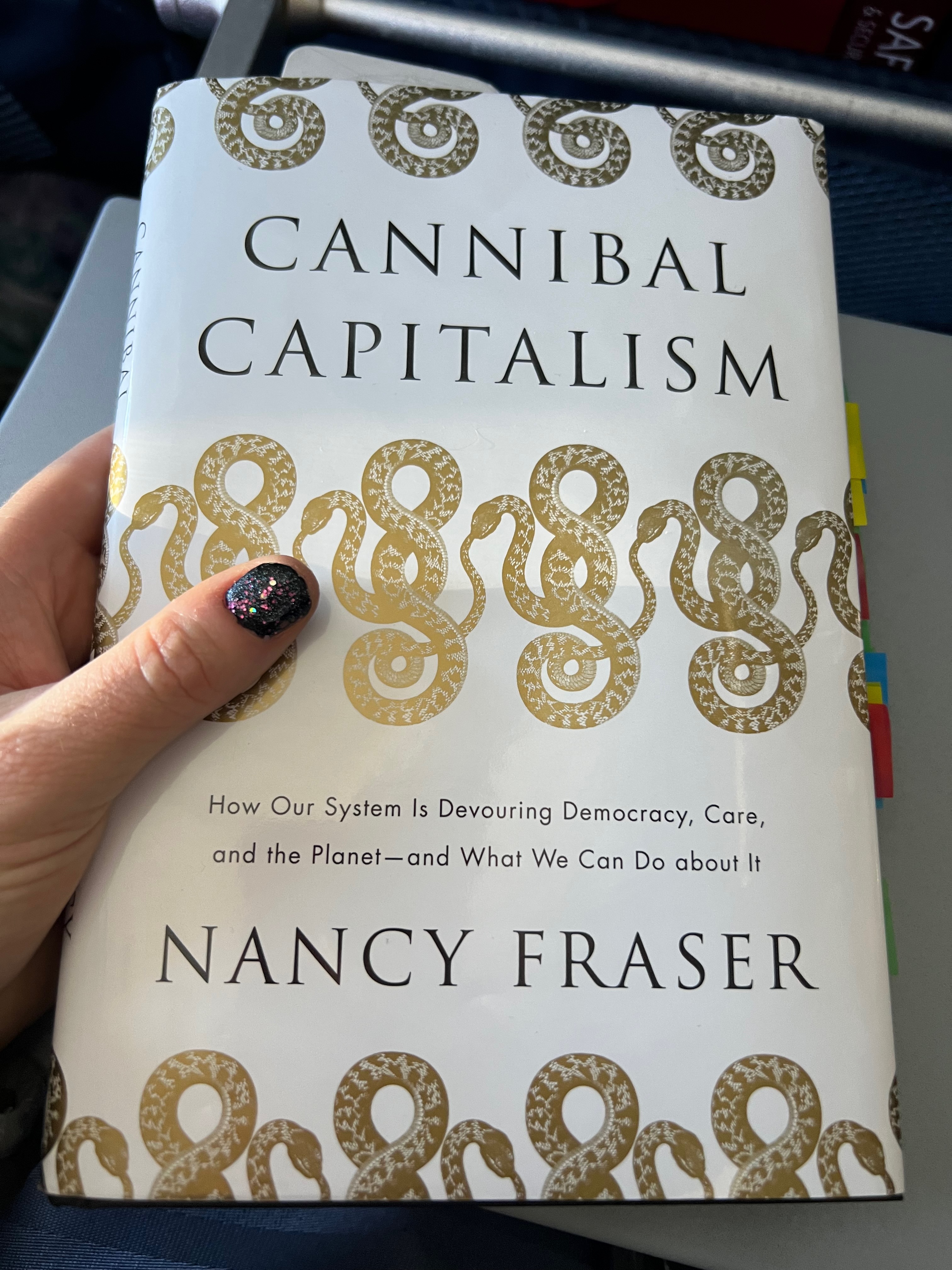
*Flipping through my marked-up, Post-It-noted copy of Riane Eisler’s book, I almost wish I’d waited to read it until further along in my own writing of No Trespassing. I also wish more people would read it. There’s a lot of important research there and I’ve already forgotten much of it.
Isn’t “unearth” a strange word? Can anything really be un-earthed? Maybe un-earthing is one of the sources of this world’s biggest problems.
Last week, on a warm day wedged among thunderstorms, chilly rain, and the thick, unwelcome smoke that drifted down from wildfires in Alberta, I finally got potatoes planted.
The seed potatoes, sliced in half and left to cure a few days earlier, tucked into the dirt like they were coming home. I scooped soil out of each hole and patted it back over, warm from the sun. The swallows were busy overhead—still investigating the nesting box but I’m not sure they’ll take it; as usual, they seemed more interested in the woodpecker-battered siding of my sister’s house next door.
A large bee roamed over a flowering lupine, and in what felt like silence but was just the absence of most human-made noise, a breeze went through the willows, firs, and hidden apple and plum trees across the road. It’s a sound that, along with the robins and chickadees, is so constant I sometimes forget to notice it. Kneeling among the potato beds, I paused the planting to listen. I generally relegate podcasts and music to car rides and household chores and making dinner. That is, indoors. The hours out of the house and car are mostly given to what’s there, even if it happens to be neighborhood lawnmowing day or a walk that takes me along the highway. The brush-scrape of the shovel into the compost pile. The birds and slight buzz of the bees, which will become more constant when the borage blooms and the dandelions pop up again; the high pitch of the hummingbird zooming up and fluttering down among the caragana; the shush-rustle of the trees; even the sound of the sifting dirt in my hand as I scoop out room for a potato and make sure to cover exposed worms.
I’m still sad at the loss of so many stored potatoes over December and January due to the cycle of intense cold and wind followed by warmer days of rain, but it’s a nice thing about living in a place where winter has a grip to loosen: the promise of renewal. I’m suddenly tracking the blossoms on the strawberries and planting seeds with an eye to autumn, reminding myself to save the beans and tomatoes until there’s no threat of frost. And we’ll have a chance with potatoes all over again.
I bought my seed potatoes late, which meant ending up with varieties I’m uncertain of because everything else was sold out, but even in the base soil of dense clay that makes up my garden, previous years’ potatoes keep showing up healthy and well-grown. With all the added compost, I’m hoping this year’s will come up even better, will easily feed the families that rely on this rectangle of land as long as I keep them watered and covered.
As I dug the potatoes in, pulled thistles, and checked on the clusters of radish seedlings, I thought a lot about my Russian grandmother and her time as a World War II evacuee in the Ural Mountains. How she fed her family, the stories I’ve heard about their existence on little but potatoes and mushrooms, their almost complete lack of meat. What would she have given then for this kind of abundance? For a valley so rich in food that even my purchased dirt now comes solely from a small business that picks up and composts local food waste?
In late August 1941, as Germany’s Army Group Nord closed in around Leningrad for what would turn out to be an almost 900-day siege, my grandmother was evacuated from the city with her two small children, my aunt and uncle. They were on posledni poezd, my father has told me, the last train out of the city.
Over a decade ago, I happened to be in St. Petersburg and had a chance to sit down with my father and his brother and record some of my uncle’s memories of this time, with my father translating because my uncle doesn’t speak English and my Russian is elementary at best. It might be the only conversation of that kind my family will ever have a record of, and listening again to their exchanges and infrequent laughter, even interrupted by my own occasional stumbling Russian and the sounds of my aunt in the kitchen, feels like a small treasure.
There is a lot of documentation about the siege (I recommend Anna Reid’s Leningrad over Harrison Salisbury’s The 900 Days but it depends on your taste; I prefer stories about real people’s lives and experiences rather than extensive details of troop movements, plus Reid had access to far more documentation released after 1991), but asked my uncle for stories because I wanted to have some feel for what my own family had been through. How my grandmother coped in that time.
There are only so many details you can glean generations-removed from any experience. My father and uncle both said that the adults who’d lived through the siege and its aftermath almost always refused to talk about it. Many hadn’t survived, and if they had, that was what they wanted to focus on—not uncommon among generations who’ve lived through an enormous collective trauma.
Those of us who want some intimacy with the stories that live within us have to make do with what’s given. It never feels close to enough.
The train journey from Leningrad to a village a few kilometers from Kushva, around 1400 miles away on the far eastern side of the Ural Mountains, took a month. Eight families lived and cooked for that month in a shared freight car, picking up cold and boiling water whenever they stopped at a station. For the most part, my uncle Tolya said, they ate kasha. “Chyordnaya kasha. Ee belie.” Black kasha. And white. Tolya was five. His sister, my aunt Nela, was barely out of toddlerhood. Their father stayed in Leningrad to work at the factory and monitor communications until he ended up in a hospital after almost starving to death and then being bombed into the water on Lake Ladoga’s frozen Road of Life, and my own father wouldn’t be born for another few years.
“Black kasha,” or just “kasha,” is what we call buckwheat. I’ve had it in my uncle’s house served at breakfast or with dinner, steaming hot grains topped with a chunk of butter, laced with salt. Even decades after the Soviet Union fell and people no longer had to stand in long lines for the occasional sausages or bag of fruit, kasha was a staple I’d been accustomed to seeing for almost any meal.
In the 1940s, it was more than a staple. For Leningrad families sent to live as evacuees, kasha was their only caloric intake for a month. And it was far more than my grandfather and thousands like him would shortly have to eat, left behind German lines to keep the Leningrad factories running and eventually die of starvation and cold.
It was one of the most bitter winters Russia had ever experienced. Poor planning, Stalin’s willful ignorance of the realities of the coming battlefronts, and an early-on German bombing of one of the main storage depots had left Leningrad’s remaining residents on rations so scant that starvation starting setting in almost immediately.
Eventually, people were boiling leather for the nutrition. Eventually, they ate bread so high in sawdust as a replacement for flour they might as well have been chewing two-by-fours. Eventually, they starved to death—around 630,000 people over the course of the siege, though some estimates say it was closer to a million. In the first winter in particular it was so cold, and there were so many bodies, that survivors hauled their loved ones across town on child’s sleds to the cemetery where the corpses stacked and piled in their thousands. I’ve been to that cemetery, overwhelmed at the vast space where the city’s starved are honored in long, endless-seeming rows.
My family, like all the others, was boarded in the village with a local family—who resented their presence—and given a plot of land to grow potatoes: two meters by one hundred. “They lived off the land, basically, survived on the land,” my father and uncle told me. “People could live more or less fed only if they have their own potatoes.” My grandmother grew potatoes, chopped wood, and foraged for mushrooms in between working on the factory line as a metallurgical engineer.
“She had bloody hands.”
Transcribing my father’s translation of that line, which my uncle says matter-of-factly, I remembered the first time I ever met my grandmother, when I was fourteen: the tiny pastries she made to welcome us; my younger sister and I helping to make meat-filled pilmeni in her tiny Leningrad apartment where even the stairwell smelled of cucumbers.
These two clips are of my father and his brother talking about the family’s food situation during their years living as evacuees in the Ural mountains. The first is about potatoes and gardening; the second is about lack of meat. Correction to my own translation attempts on that second one: lard isn’t beef fat; it’s rendered pork fat. Suet is beef fat.
My hands are in no such condition after curing and planting potatoes and moving four yars of compost. Sometimes I get blisters working in the garden or weed-whacking along the neighbors’ fences, and am frequently stabbed by thistles, but I can wear gloves if I need to, and nobody’s survival is dependent on my cultivation.
Starvation has been used as a tool of empire and colonialism, and provoked as the consequences of war, for thousands of years. When I dig and plant in this garden, it’s with a lot of pleasure, but also with a constant sense of wrongness, knowing that my own family, my maternal grandfather’s family, was able to move to the region that now makes up Montana as a result of theft, betrayal, deceit, and government-enforced starvation that too few settlers are aware of.
Starvation is not a hard state to provoke in Russia, where the phrase “agriculturally marginal” has been applied by many historians. The history of that land, and of its leaders reaching for rich, fertile soil in lands like Ukraine, can’t help but evoke questions of how we survive in the places we live, what “survival” even means, much less balance. What is currently called Russia is a vast land where many different people have lived for thousands of years, and yet the story of the land and people is still dominated by the mythologies of a nation shaped by an aggrieved sense of inherited exceptionalism and a constant grasping for something more.
Potatoes, which are now ubiquitous in Russian households, didn’t even arrive in the country until the late 1600s, over a century after they were introduced to Europe. They were called “devil’s apples” (supposedly because people didn’t know how to grow or cook them, and ended up eating them green or uncooked and in other states that caused illness), and mandates to cultivate potatoes in the mid-1800s led to massive but finally unsuccessful riots by imperial and state peasants—people legally owned by the tsar and the state. I often wonder what Russian serfs survived on before potatoes were accepted as a food (grains, mostly, which often failed), but the reality is that, like the people who stayed in Leningrad under siege and had no potatoes to cultivate, many didn’t.
The abundance that I’m able to plant in a garden, which will come back to me and others many times over, belies a story of scarcity, of hardscrabble and want. It clashes up against what I know of my grandmother’s bloody hands and of how my uncle helped his own grandmother raise carrots, peas, and beets in a small vegetable plot next to that metallurgical factory in the Urals. It defies my own memories, even, of the Soviet Union and early post-Soviet Russia, all the babushkas sitting on upturned buckets selling the produce of their rural dacha gardens: tomatoes, small pickling cucumbers, sunflower seeds wrapped in a cone of newspaper.
I haven’t seen a kercheifed woman sitting on a bucket by the sidewalk selling herbs or tomatoes in decades, but I can still smell the fronds of dill, still taste the sunflower seeds between my teeth.
It’s perennially interesting to me that many of the foods associated most closely with Russia—as well as with much of Europe—originally came from what are currently called North and South America. What is a Russian identity without a handful of sunflower seeds to crack open or potatoes to peel? Would anybody know anymore? (Okay, borscht—made from beets, which originally came from the Mediterranean region, thrive in cold climates, and are remarkably versatile. I spend half my summers eating cold borscht, and have even made lip gloss with beet as a colorant.)
Yesterday I planted some sunflowers. Pulled quackgrass out from around the raspberries and turned over a little soil, poked the seeds in the ground. Hesitated over pinching off some strawberry runners and ran my fingers over the potato leaves already up among the peas—we must have missed some last fall when harvesting the potatoes, and here they are making more food, not only unasked, but without my having put in any extra work. Their appearance reminded me of my mother-in-law in England telling me how she and her husband were still finding potatoes in a spot they’d first planted them decades previously.
Potatoes feel subversive, food cached for urgent needs and uncertain futures. Is someone in that village in the Ural Mountains still finding potatoes my grandmother planted?
I wonder if my grandmother ever got a chance to smell the dirt she bled over while digging potatoes. If she ever got to pause between working at the factory and laboring for her family’s survival to listen to the birds, or rest her feet under a rustling aspen grove. I wonder if she longed for meat and bread, if she had the energy to cry at night while her children slept.
My grandmother’s life was never anything but hard, but like many people with hard lives she knew how to welcome laughter and cultivate joy. Almost all the photos I’ve seen of her show a smile playing in the corners of her mouth. I’d give a lot to be able to feed her a plate of potatoes I’ve grown, chop the wood for her, let her sit in the sun and watch the bees bobble in the lupine and the swallows nest in my sister’s house.
I wonder what it would take to have a world where everyone has access to what we need for survival, and nobody has to bleed for it.
A few quick notes:
My Threadable reading circle of science fiction and fantasy short stories has started reading Rebecca Roanhorse’s “Welcome to Your Authentic Indian Experience.” I’ve read this story a bunch of times and feel like I read a different layer every time. What is a “self,” actually? And can we ever truly know what it’s like to experience life as someone else might? (If you have iOS, you can join that reading circle through this link. The first read was Hao Jingfang’s “Folding Beijing.” The next will be Octavia Butler’s “Bloodchild” from her collection Bloodchild—no online versions of that one.)
Speaking of science fiction, Mike Sowden at Everything Is Amazing posted the second half of our conversation together, where we basically just geeked out about science fiction and fantasy for a long time.
Reminder that all On the Commons posts are now open for all subscribers, paid and free. I sent out an email explaining this change, but if you have any questions, feel free to email or ask in the comments.
“Who can help the heart, which is grand and full of gestures?” —from “Association Copy,” Camille T. Dungy
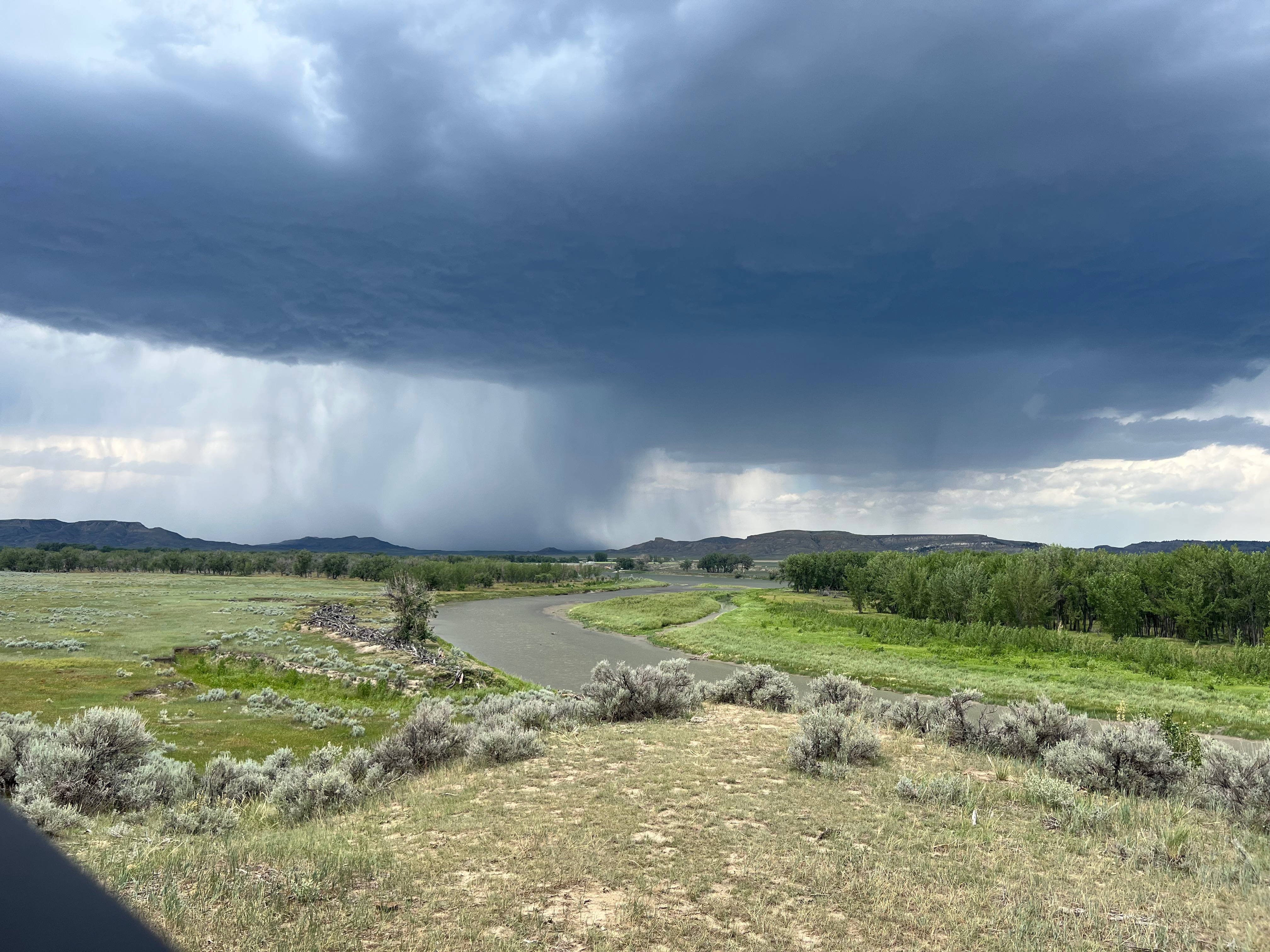
I am very late starting my garden this year. Things have been busier than they were this time last year and it feels like the cold has hung on a lot longer. We had a spate of days hot enough that I started wearing sandals, but since then it’s been wet and chilly, with some wind-blasting rainstorms. Yesterday, I spent a lot of time outside working and walking, and watched as storms loomed from behind the mountains to the north, and then the ones to the east, and then seemed to be coming from the southwest. All day, dark, streaky virga of promised rain moved in a circle around town but never overhead.
Last week I had four yards of compost delivered during a chilly drizzle, and the next two days it poured. All I could think about were the seeds and potato starts in my garage, waiting for me to get myself together and do something besides the single three-hour burst of weeding quack grass from the strawberry beds and around the lettuces that reseeded themselves from last year.
The peas need planting. The potatoes do, too, in the beds hopefully enriched a bit by the peas I grew in them the last two years, a little more like soil and a little less like clay you could throw pots out of. The raspberries and fruit trees are leafing out, flowers already going over on the apple trees, and strawberry flowers are popping up all over. Tomatoes, cucumbers, peppers and pumpkins, squash and sunflowers, green beans and radishes—some will seed from last year like the lettuce did, while others I’ll have to buy from a farm stand that unlike me had wherewithal (that is, a greenhouse) to start them somewhere warm months ago.
It’s the spreaders and reseeders I really love. The cherry tomatoes I know will come up again because so many grew last year from the previous year’s seeds that I thinned out enough to feed most of my neighborhood. The potatoes we missed last fall whose leaves will show aboveground weeks from now from where they’ve been hiding. The strawberries who sent out enough new runners last year that I had to build a second bed. The sweetgrass starts a neighbor is giving me, the mint that, as hoped, has started to spread. The borage that reseeds itself voraciously and that the bees adore. The swallow that seems interested in the nesting box a friend installed last year.
All of it a reminder every single year that abundance is something nature loves. There is the too much, as inevitably happens with zucchini and my friends’ plum trees, but more to the point: always enough for everyone.
I just picked up and started reading Camille Dungy’s new book Soil: The Story of a Black Mother’s Garden. I’ve liked Dungy’s poetry since meeting her at a very small environmental-science writing conference years ago. She was grounded and engaging and smart as hell and also encouraging to everyone in her workshop (it was poetry, so that wasn’t me; mine was nonfiction) but also everyone else, and all of it without devaluing the clear brilliance of her own work. The writing world has a lot of ego in it; Dungy’s the kind of writer who proves that you can be among the best without dragging ego around as a kind of jewel-encrusted armor trying to stiff-arm people and blind them at the same time.
I’ve been looking forward to this book and even listened to an interview with her about the writing of it, which is a rare thing for me. The last time I spared attention to listen to “writing craft” podcasts was when Longform launched over 10 years ago, and it was close to a year by the time I got fed up wondering when they’d interview someone who wasn’t connected with Yale.
I listened to the interview just before picking up Dungy’s book, and was swept up again with her incredible intelligence, insight, and love for the world. And her perspective on what needs to change not just in the writing and reading people think is necessary, but in how we perceive the world around us:
“In the book I describe being very frustrated with some major texts in environmental writing, and my daughter asking me why I was so angry—I was setting the table with great fervor—and I explained that I was frustrated by this absent-ing of people in the writers’ lives in the environmental canon. . . .
I had reread Pilgrim at Tinker Creek before the shutdowns began and was, like, ‘This is beautiful writing. She is an amazing writer, and an amazing thinker. But also why did she construct herself in such a solitary mode?’ And what is particularly galling to me was this sense that here she is just walking out looking—I’m quoting her—looking at the tree with the lights in it, and wandering through these open fields, and she’s writing in one of the most tumultuous cultural and political moments in American history, and she is writing in the epicenter of some of the biggest civil rights and women’s rights struggles in America. In the center of it. And that is just disappeared from the work.”
It’s long past time for this narrative style to change, perhaps especially in nature and environmental writing, which is so heavily dominated by white men—often in love with fly fishing, at least judging by the best sold and most widely read “nature” books about Montana that are really not about Montana or even nature at all but about these men and rivers in a way that I find personally off-putting and exclusionary. Writers who cannot seem to reconcile humans’ existence in their own lives, much less in the wildernesses in which they often hope to pit themselves against physical risks and avoid the much more difficult ones of interpersonal human relations, and even less what’s going on in the social-political realities around them.
“I have grown intolerant of that. I can’t be fully interested and engaged in writing that seems to erase me. Because all of those concerns about civil rights struggles and women’s rights struggles and those kinds of things—if those don’t move forward, if they don’t get paid attention to, if they don’t get talked about, that negatively affects my ability to move forward in the world. I want writing that engages with the beauty of the greater than human world and the necessity of protecting it but also engages with this reality of politics and human cultural interactions. It was imperative to me to write into that . . . I’m expressing it here as anger, but it’s also exhaustion and hunger. To write into that hunger.”
Reading Soil and listening to the interview with her, I realized that I have been hungry for more writing like Dungy’s. Her writing about motherhood, nature, and schooling children through the early Covid years went straight into me, down to having years ago given my kids the exercise ball I used to use as a work chair. Women in writing, but especially mothers in writing, is something I’ve been frustrated about and trying to change since those early travel writing years, and in essays I published years ago questioning why being a mother and a writer is seen as a literary less-than. It’s easy to say it isn’t, but publishing statistics and how parents’ stories are framed and marketed tell the real story. As if parenthood in all its forms can never be as real as some guy tramping off into wilderness all alone and being called intrepid. As if other people in our lives don’t exist—or at best exist as subjects and characters, never as people in their own right.
Maybe mothers can’t write about nature in a way that excludes other humans because they don’t have days that exclude other humans, Dungy said. And beyond that, far more than that, it’s a problem rather than an asset that so many people are able to write book after book about the wonders of nature and their love for it without including hints of what is going on in human society at the time. That they don’t have the imagination to think that you can write about struggles against prejudice and injustice and rivers. As if there is some pristine wilderness of the human any more than there is a pristine wilderness of nature.
Soil might be a book to avoid for people who flinch at critiques of a canon—including Mary Oliver, whose “Tell me, what is it you plan to do with your one wild and precious life?” which ends the poem “The Summer Day” most of us reading people are familiar with, if only because it’s quoted so widely.
“I’ll tell you what I would have done,” wrote Dungy in Soil. “The dishes, the laundry, a pile of work for pay. Forget feeding a grasshopper. At least three times a day, I’m figuring out what to feed my family.”
“Here is the contract the culture has made: In becoming a mother, the one precious life I am expected to think about is seldom my own.”
Narrative that included every speck of one’s life would be tiresome, but I was almost overwhelmed with relief when Dungy talked about the vacuity of environmental and nature writing that erases humans as well as the upheavals they cause and the injustices they fight against.
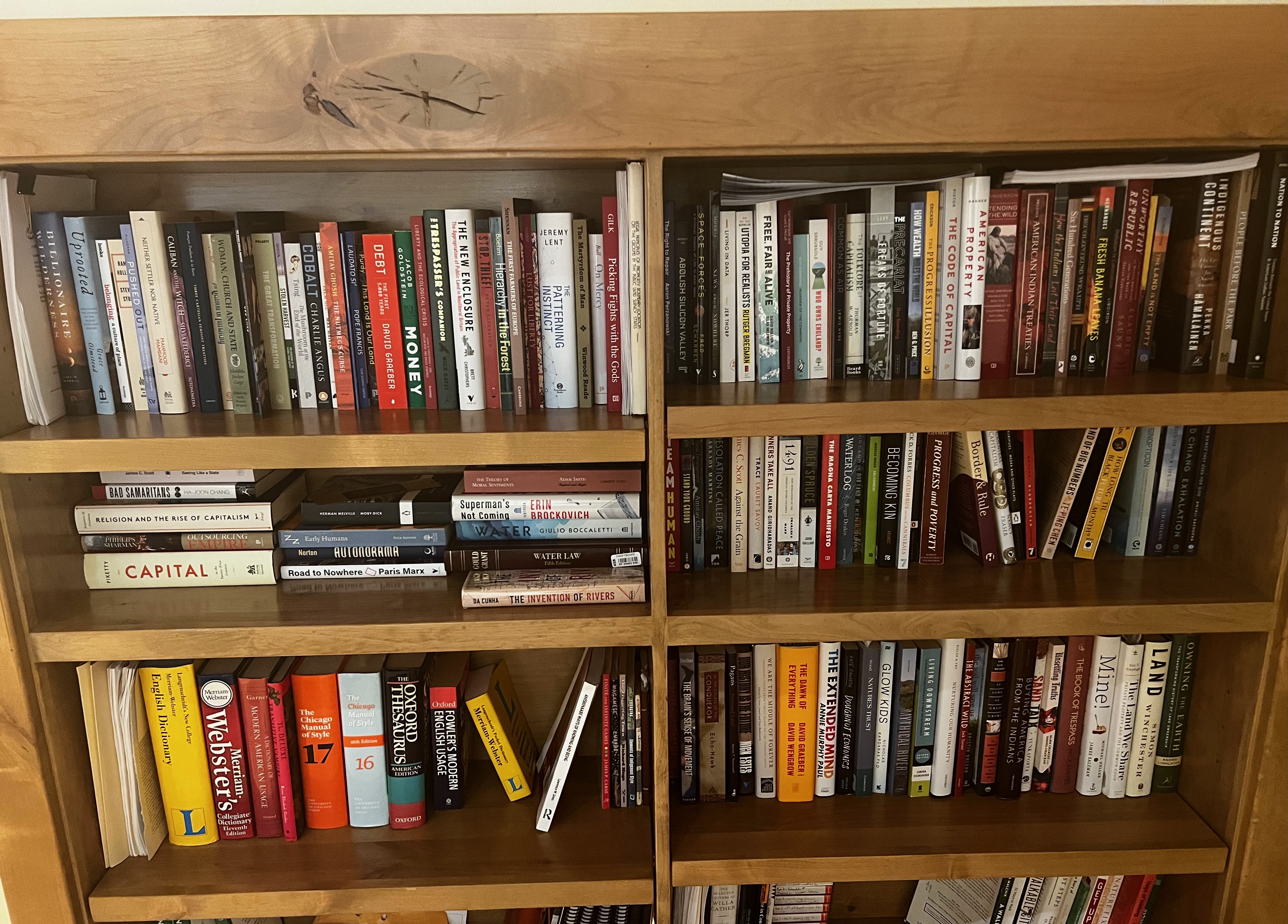
And the lives we live. I write about ownership and the commons and commodification and walking and science—and I don’t think it’s an accident that almost all the books on my shelves on these subjects are written by men—and my love for this world I live in. Those subjects require a lot of research and thought and narrative-shaping and searching for anything outside the mainstream culture, but it matters that as I typed this post, I also dealt with emotional upheaval over a broken friendship (middle school really sucks), geometry homework, giving my sister a ride to and from a place that actually fixed her car (and that all the car repair places around here are backed up for months because of labor and parts shortages), scrounging for lunch, looking longingly at the garden, reminding myself to switch out the winter tires, calling my dad back, talking with several people about how to fight back against the sweeping injustices coming from our state legislature and governor, missing a friend, and cleaning up dog puke.
The point in Dungy’s writing is that it’s about people and place, people in place, people with place, people of place.
“Efforts to reduce natural diversity almost always result in some form of depletion,” she wrote, an observation that she is clear applies just as much to people and places as they do to a garden. (Though I will never, I hope, comprehend why people have such issues with dandelions. They’re cheerful, abundant, soft to walk on, and edible. But then, not everyone has the quantity of thistles and knapweed that live in my yard. I’ll take more dandelions any day.)
Just as people are not one story, neither are places. Every single one deserves to have the variety and complexity of their stories recognized and told.
One of the things that hit me repeatedly during the first year or two of Covid was coming to terms with who I knew who could be relied on to engage in care for others, and who couldn’t. I was reminded forcefully of what a friend said she learned from going through cancer treatment many years ago, and the friends who stuck with her through it: don’t disappear.
I give a lot to others—time, energy, food, labor—anything I can manage, really, and it’s been a long hard lesson not to wear myself to shreds in the process. But the hardest part of it is seeing where there’s no reciprocity. Not to me, but to others. When I get to the end of my days what will matter to me isn’t if people are caring for me, if I get some kind of return on what I’ve tried to give and how I’ve tried to show up, but how many people I see engaging in reciprocity and care for everyone else. What wears me out isn’t giving the care myself, but the lack of it in so many others. That’s something I carry with me every time I camp or rent a forest service cabin alone. Why don’t more people care?
Getting my hands back into the garden brought me back to questions of imposed scarcity and mutual, collective care. Who will share, and who won’t? Who will be there for you in a crisis or a trauma, and who will disappear? Who will use crises to further their own ends rather than leaning into community? Who is helping to build a future where all of it doesn’t have to be so difficult?
In the Threadable reading circle The Viral Underclass, Elise Mitchell posted two excerpts from How We Stay Free: Notes on a Black Uprising, one of which was a detailed account of takeovers of empty public housing by The Philadelphia Housing Action. It’s a well-told play-by-play story and resource for anyone working on houselessness. And at the end, the author’s weariness echoed many people’s I’ve heard recently—and for years—involved in issues of justice, equity, and care:
“Honestly, I don’t even know what winning is. I just want us to be good to each other and hopefully we’re taking care of each other. That means all of us—not just your clique.”
That is probably the best articulation of how I hope humanity can change, and what I see ownership and domination paradigms and their falsely created scarcity and hierarchies having prevented not just for centuries, but for millennia. That’s where so many of the barriers are baked in. The narratives driving those paradigms have often failed, and too often won, but the vision of a future where their role is diminished and mutual care is paramount is not only right in front of us, but all around us.
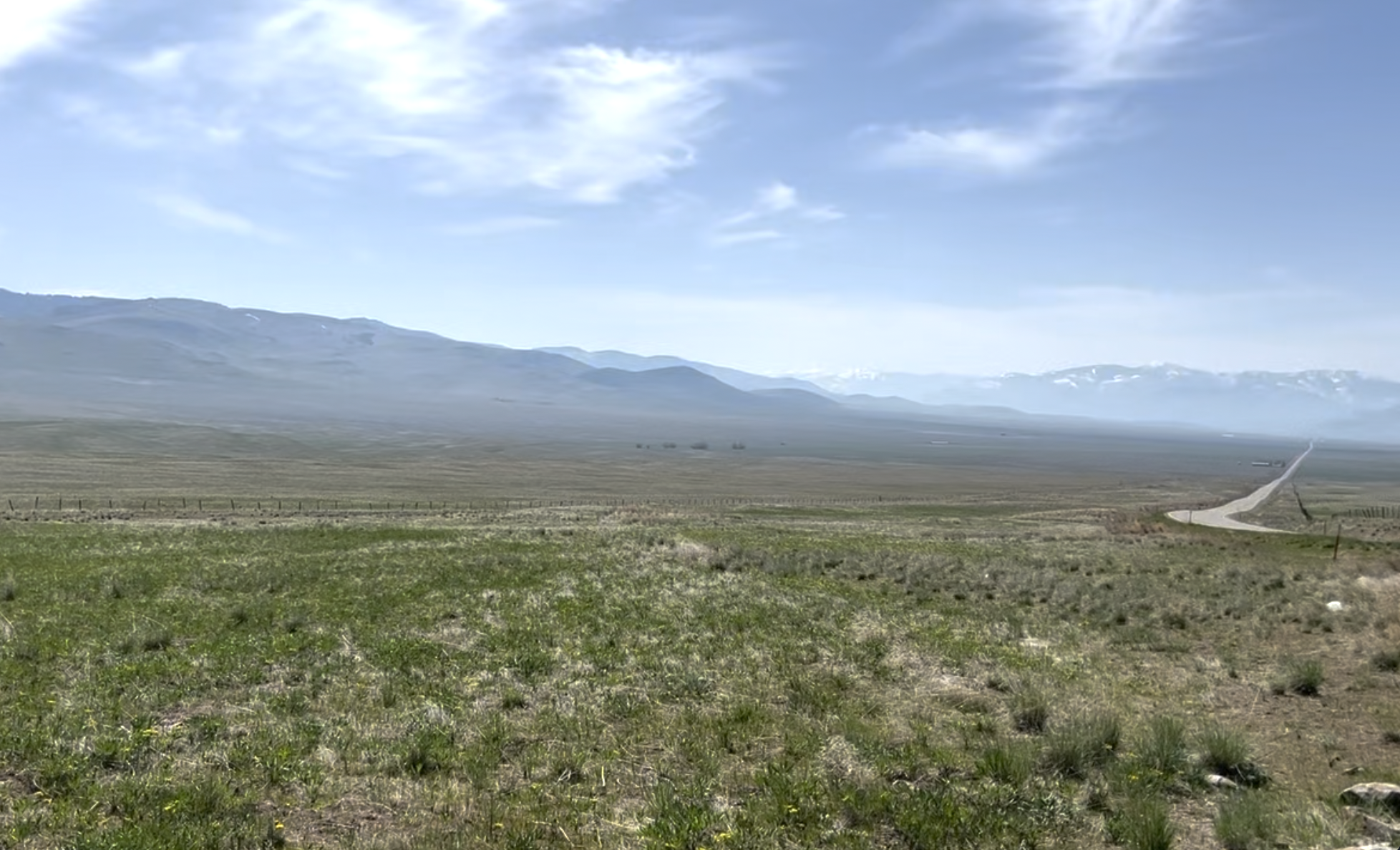
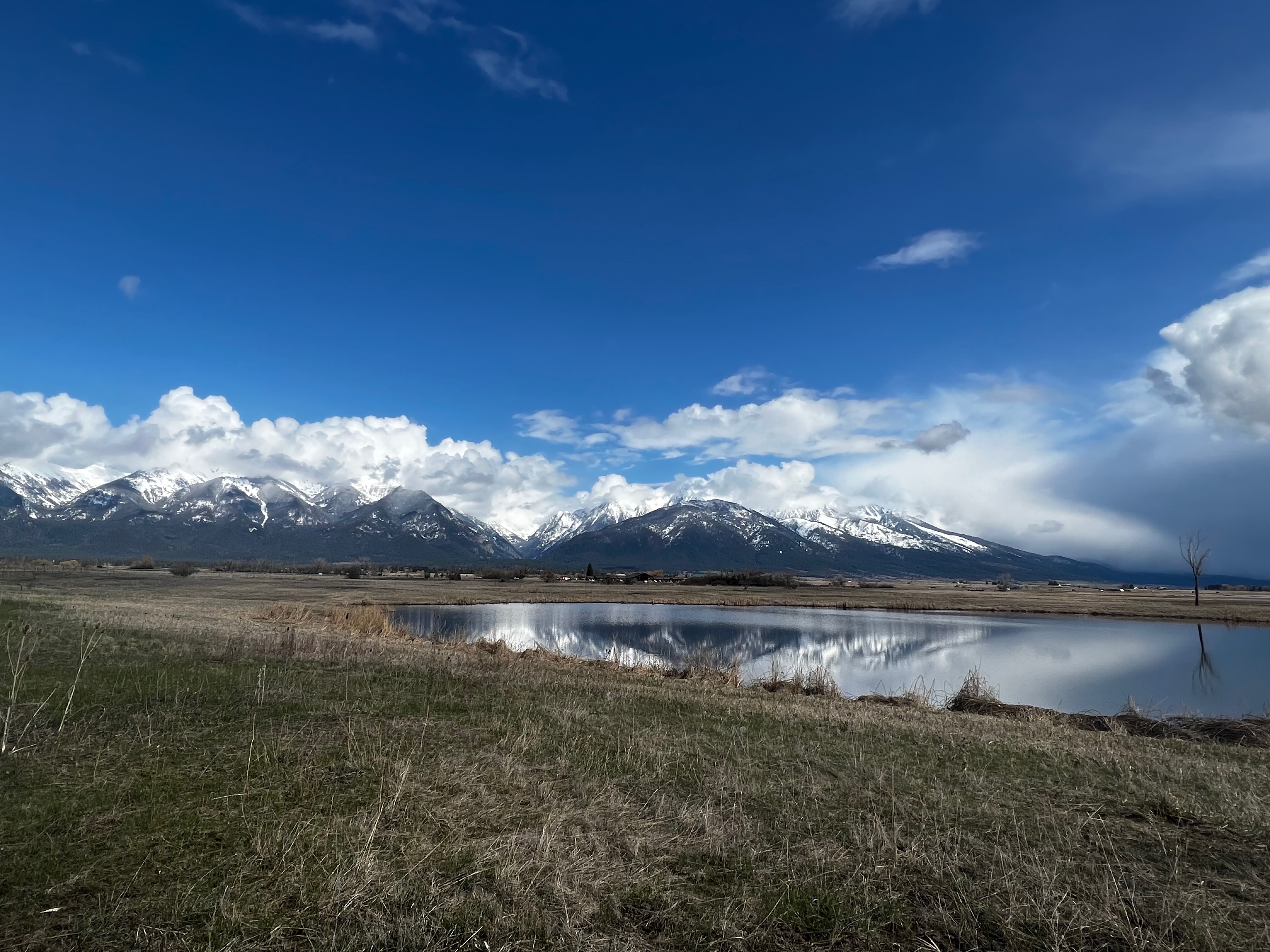
This isn’t technically a walking photo. I stopped by the side of the road an hour and a half’s drive southwest-ish from where I live. I turned off the car, stepped out, and found myself overrun with meadowlark song.
A particular thank you to everyone who commented last week. That was actually a tough one to write, and I also appreciate the thoughtful replies with regards to links. I originally wrote this week’s “list of things to read and listen to” without the hyperlinks, as I did last week, but as I was revising it I thought maybe it’s time to give it a pause entirely.
Every time the digital world feels like it tries to speed us up, my response is to try to go deeper underwater and see where we—or at least I—can slow down. We’re not always given a lot of choice in how we work or where our attention is dragged, but when that choice is there and it’s pushing me to do more, and more quickly, that’s when I dig my heels in, slow down, and then wonder if I can offer others a release from the pressure. I can’t do much about, say, Substack’s insistence on telling you how many minutes a post will take you to read rather than letting you judge if it’s worth your attention, but I can try to make spaces where they feel less like minutes and more like time.
Whether here or anywhere else—online or off—try checking in with your mind and breath, see what’s making you feel harried and rushed. Is there anything you can do about it? And do you have the space to help someone else who has fewer choices?
“You don’t waste no time at all. / Don’t hear the bell but you answer the call.” —“Hammer to Fall,” Queen
Last week I spent a few days at a Forest Service cabin near Holland Lake in Montana’s Swan Valley, an area that holds a lot of childhood memories for me. My family used to camp there a lot. Often enough that those memories are smeared together in my mind, like what a rainstorm does to the chalk drawings my kids and nieces and the neighbor kids make in our driveway.
This was a cabin I’d rented last January but ended up not using because it has an electronic lock—electricity! rare thing in these places and not something I actually want—and it was 15 degrees below zero (–26C) and the battery drained or the mechanism froze. Or something. Anyway, I couldn’t get inside. One of the things that makes me not completely despair over an anti-human digital future is how poorly all this stuff does in the cold. My phone always dies within an hour or so when I’m out hunting or skiing.
Electricity turned out not to be a boon this time, either. The cabin is at the edge of a packer campground. I wouldn’t have minded being surrounded by pack mule and horse corrals waiting for outfitter trips into the Bob Marshall Wilderness, especially as there was nobody there (I suppose the mountains are still too deep in winter for those trips), but stepping outside in the middle of the night to see Moon and the stars and being dazzled instead by street lights shining over every single (empty!) corral was an unpleasant surprise.
It didn’t deter the morning birds, but it was startling—bright lights right on the edge of the wilderness, ostensibly in preparation for heading into wilderness, reminded me of the countless stories I’ve seen about trash heaps at the bottom of Mount Everest, and the mistaken beliefs any of us might harbor about the impacts of our off-grid or wilderness or outdoorsy/nature-y activities.
Morning birdsong, during which you are free to imagine no brightly lit empty corrals in the forest.
And a loon . . . (one call at the very beginning of the recording and one right at the end with the background sound of the nearby running creek in between)
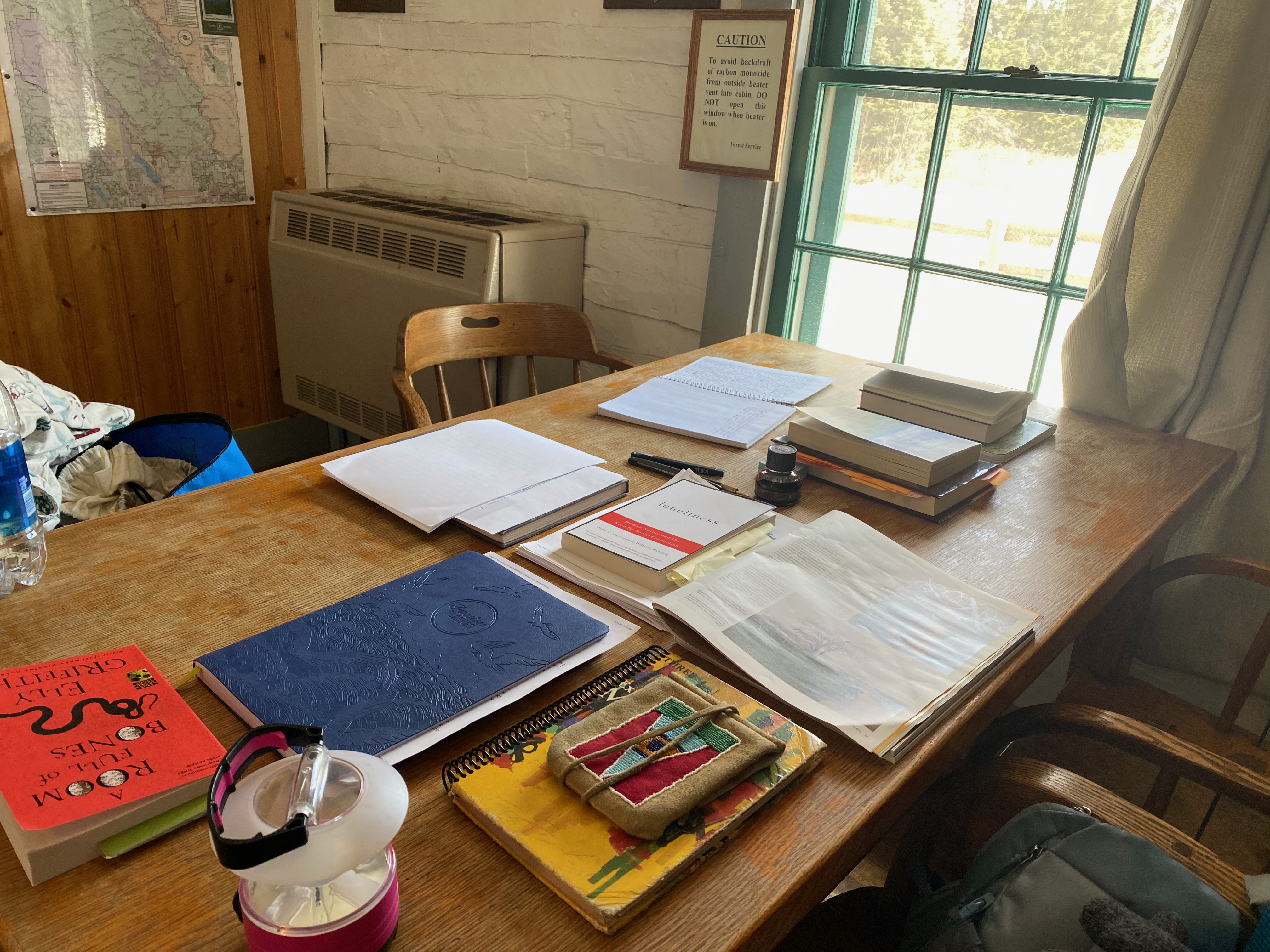
It wasn’t the best few cabin nights I’ve had. Along with a bunch of reading, I was focused on tackling an already overdue essay that proceeded to fall apart in my hands like some aged, friable fabric. And the cabin’s heat went out two hours after I got there. After poking around, I figured that the propane tank was likely empty after the demands of a bitterly cold winter and I was in for three nights much colder than I’d prepared for.
The first night, before I realized the heat was gone completely and wasn’t just being fussy, I delved further and further into my sleeping bag, waking up every hour, and had to talk myself into getting out of bed the next morning only to discover that it was almost ten degrees warmer outside than in.
I probably should have slept outside the whole time for that reason—though the corrals’ streetlights were a strong deterrent—but did spend pretty much all my waking hours outdoors, trying to find patches of sun and going inside only to switch reading material or make more tea. Being underslept and chilly left me without quite enough brain power to tackle the essay that fell apart; I was cold and very tired and a little annoyed at the all-night lighting. I was uncomfortable, in other words, and eventually wondered if that might be good for me. Humans only recently started spending most of their time indoors with access to constant temperature control, and even that’s only for a certain percentage of people. There’s a fair amount of research about what this does to our bodies and the planet, but what about other aspects of ourselves? Our doubts, our fears, our worries, our happiness, our capacity to deal with the problems of the everyday as well as the existential.
Among my favorite parts of The Lord of the Rings is Bilbo’s warning to Frodo: “It’s a dangerous business, Frodo, going out of your door. You step into the Road, and if you don’t keep your feet, there is no knowing where you might be swept off to.”
I always feel that when I start walking. Even in my hometown among familiar alleys and sidewalks and streets: if I just keep going, I could end up anywhere. Any of us could. If you weren’t stopped by fences and freeways or motorways and “no trespassing” signs and militarized borders, you could walk the planet, as long as you had access to a boat at some points. The entire world spills out from every footfall like it’s being remade as you walk. I still think that’s magical.
Looking at the basic trail map inside the cabin and knowing that this campground was an entry point into the Bob Marshall Wilderness complex made my feet tingle. I took a break from the essay that seemed to hate me and headed up the hiking trail. I only wanted to get a couple miles to the waterfall at the far end of the lake, but if I had brought better shoes and more food and some other things, I could have kept going for hours and hours until the snow got too deep and I pitched a tent against a snowdrift with only the stars for company.
I actually didn’t even make it to the waterfall that day, due to a relatively fresh bear track about a mile and a half up the trail. It made me rethink being a solitary, edible human roaming the woods. I wish I’d taken a photo of my hand in it for scale; it’s the kind of thing you can see often enough around here but it still thrills every time. It makes the bear spray I carry seem utterly inadequate, but also gifts me with that deep, ringing feeling of being alive. Bringing to awareness the smell of last year’s pine needles on the trail, the pitch dripping from a newly cut fallen tree, the robins and woodpeckers echoing through the woods, the chilly damp in the air and the acute knowledge of being surrounded by so much life that I can’t see. It’s good to be reminded that it’s not just the stars for company.
The evening I got home from that time away, I opened up one of the few newsletters that I’ve come to know as one that will always inform and surprise me, field biologist Bryan Pfeiffer’s Chasing Nature, to a post about the surge of nature photos uploaded to iNaturalist from people all over Ukraine, whether in active battle zones or not. “Nature inspires those who know how to see it even in the most difficult moments,” Pfeiffer shared from a zoologist colleague in Ukraine.
That essay came at an auspicious moment for me. Sitting outside the cabin wishing for more sunshine or that I’d remembered to bring a sweater, I’d been thinking a lot about a conversation I’d had with my father the previous week, about his recent trip to St. Petersburg in Russia during which he’d visited his family and all the old haunts that had formed the stories of his childhood. Places he’d walked—stories he’d walked, honestly—with my younger sister and me in 1991 after he was finally allowed back into the Soviet Union after 17 years of exile and could show us his homeland.
It’s an almost minuscule sorrow among all the griefs of this war, but it hit me both that my father was trying to face the possibility of never returning there again after he comes back to Montana this time, or at least not soon, and that I might never see most of my family in Russia again. My life changed drastically after meeting them when I was 14 years old. A grandmother I’d never met and whose language I didn’t speak. The only close cousins I have. Relatives who hiked hours in the woods on summer days to collect a year’s worth of berries and mushrooms and who showed me pictures of people I resembled.
It was a world, and people, I never expected to know growing up in Montana during the Cold War. My father was an exile and until I was almost ten years old we didn’t even have a telephone, much less money for overseas calls. I don’t know how much they cost in the 1980s but when we called more often in the early and mid-90s they ran about $10 a minute. Russia was a world completely foreign and yet when I finally went there it was deeply familiar, a feeling that remains inexplicable to this day and one I’m not sure I’ll have the chance to experience again.
I step out my door or onto a trail and imagine walking all the way to Alaska and waiting for a boat, the long trails in northern Russia that my cousins and aunts and uncle—and now stepbrother and nephew and nieces—walk to gather mushrooms in August connected like some kind of ley line to the ones beneath my own feet, kept apart only by the worst consequences that human imagination and greed can conjure up. To lose it, again, is a small loss among all the awful losses of the world, but it’s there all the same.
The second morning, still cold from a night in the cabin and thinking about the multi-dimensional yet fragile qualities of human languages (especially in the hands of someone whose essay is falling to pieces), I walked to the falls from a trailhead on the other side of the lake near the lodge. In summertime, it’s heavily populated but at the end of April I was the only person there for most of the afternoon. At one point before the waterfall I almost turned back because the undergrowth was getting thick and all I could think about was hiding places for mountain lions and—again—how edible humans are. Mountain lions don’t really care about bear spray, as far as I know. You never know where you might be swept off to once you step on a road, including as someone’s lunch. Even Bilbo Baggins narrowly escaped being eaten by trolls. And I don’t really want to get eaten by a mountain lion, but I especially don’t want one to get in trouble for eating me.
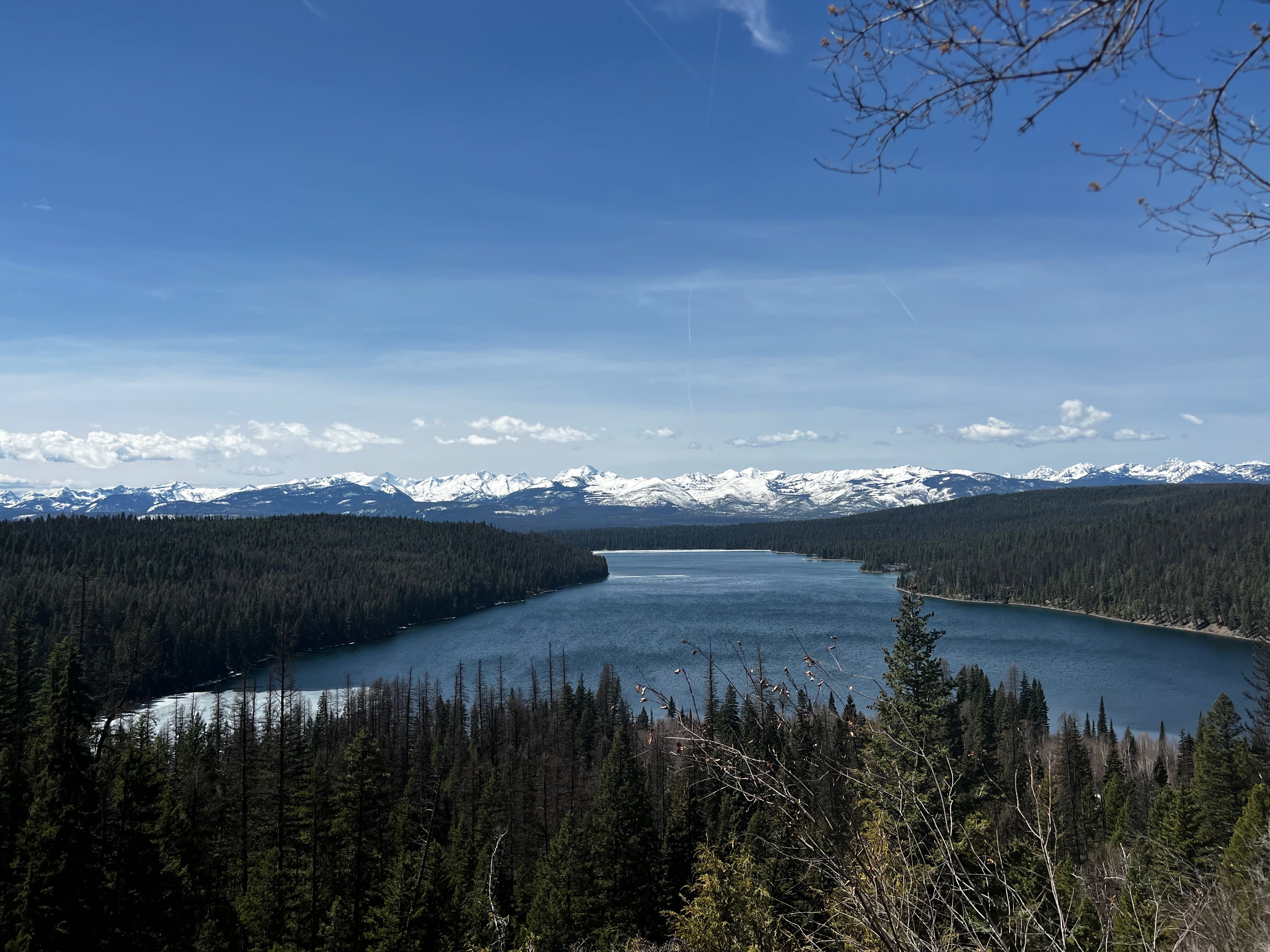
On my way back, I stopped in a sunny opening to look out at the view (that’s the photo up top), at this lake where my sisters and I had spent a notable number of hours jumping from the rope swing after our parents canoed over to it. A lot of memories of the Milky Way bursting with stars and energetic days of paddling and swimming, along with one memory so bad it gave me a panic attack when I drove here for a friend’s wedding some years ago, a reaction that had made me nervous about returning this time. But that, too, is part of a life: a bad experience isn’t discrete, packed away like some curiosity waiting to be dealt with and removed. It’s mixed in with all the good, as they are with it. I needed to come back, and on my own, to spend a little time with the smeared-together sketches of my life that happened here, some of the experiences that make me who I am. Holland Lake was the first place in my life I ever saw the Northern Lights, come to think of it, some summer night sitting outside of the tent as my mother pointed out the shimmer in the sky over the towering mountains.
I was trying to pick that memory out of all the others—how old was I? We camped here enough summers that I can’t remember—when a butterfly circled my head so close that it buzzed the hair that an earlier high wind had picked loose. I moved to take my phone out for a photo while it flew around, but the butterfly wasn’t having it. In fact, every single time I tried to slip my phone out, he disappeared.
I sat down on a rock at the edge of the trail and waited. He landed behind me, where I could just barely see him at the side of my vision. I turned slowly to look at him and he lifted off again. It happened a couple more times so I stopped. No photos, no direct eye contact, got it. I sat there for a long time as the wind died down and the sun got warm, talking in my head to the rocks and the butterfly until another woman came up the trail and the butterfly disappeared.
It seemed early to see butterflies—not to mention the poor confused bee stumbling around the snowbank outside the cabin that morning—but it was not my last butterfly encounter of this trip. I came across several more on the hike down the trail, and later that day as I sat on the steps of the cabin trying to salvage some essay paragraphs, another came to visit and hung out on my hand and in my hair for long enough that I wondered if I needed to invite him to share an early pot roast dinner with me.
“In nature we find our bearings,” wrote Pfeiffer last week, “even in the company of the solitary and prosaic: the ethereal song of a Hermit Thrush, the elegance of a Maidenhair Fern, the glitter of a River Jewelwing damselfly.” Isn’t that the truth? I love that I live among bears and mountain lions, and all the birds of all the seasons here, and the muskrats and otters and beavers on the river that used to be a Superfund site and still sometimes gets oil leakage from the train yard, but do you know what I really adore? Caddisflies. It’s one of the most fascinating things in the world to me to sit on a rocky stream bank on a summer day and spot tiny, gravel-encased caddisflies.
And butterflies, too. The one that kept me company on the trail was a mourning cloak. It’s thrilling to see a fresh bear print in the woods, but what will stick with me far longer are the various discomforts of those days, scouring away the layers insulating me from things I didn’t want to think about too closely, and those moments with the butterflies who wouldn’t leave me. Maybe they sensed that I was struggling with big things that I had been too busy or too comfortable to uncover. That I needed to find my bearings because when it comes to living, there’s no trail that’s going to point the way for us. We have to find our own ways, and we could be swept off anywhere.
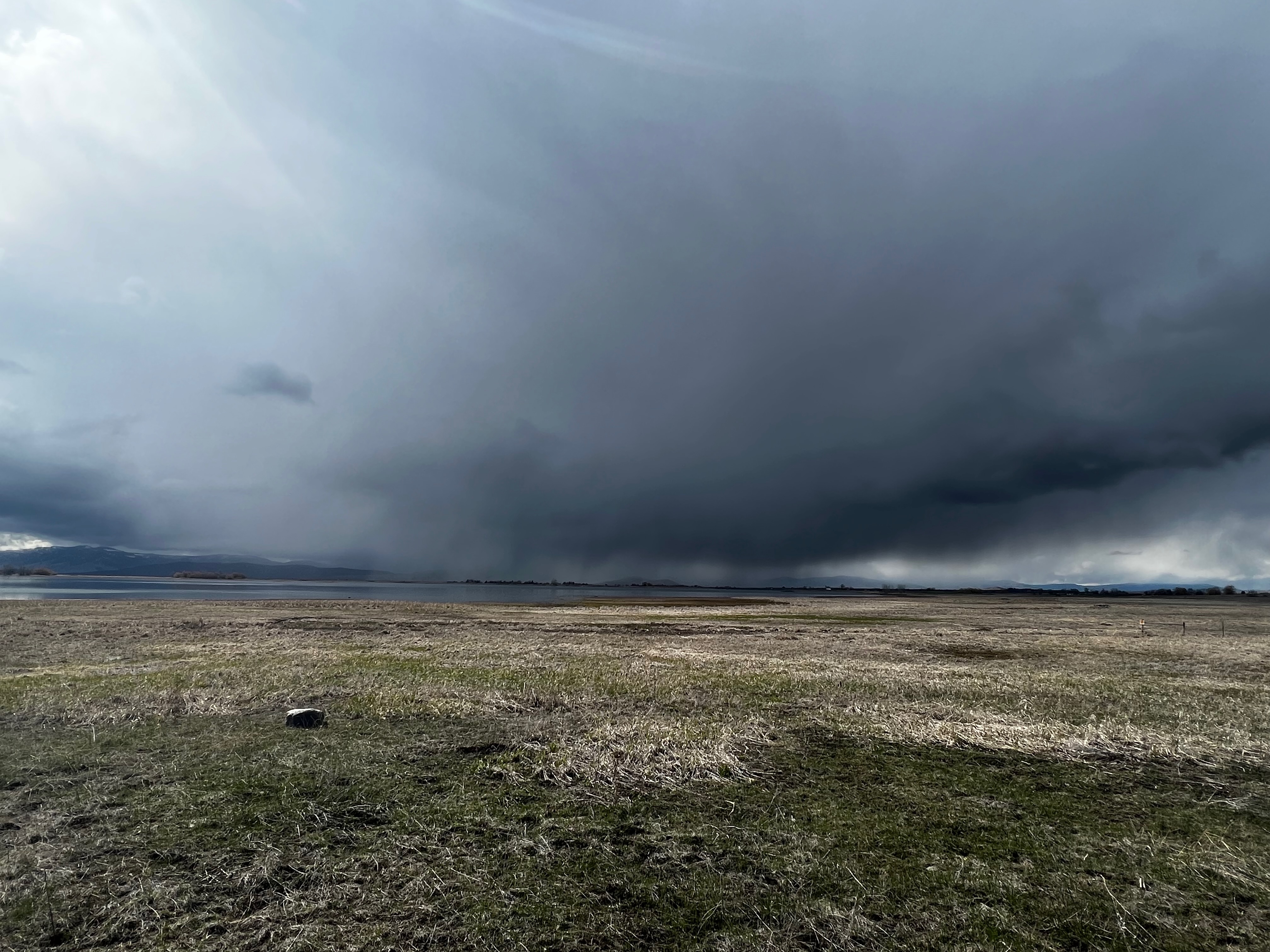
Yet another photo—along with caddisflies, I can’t ever get enough of the sky around here!
I had a conversation recently with someone about the onslaught of digital media that keeps getting harder to manage for everyone. I’ve been having this same conversation for at least ten years, and I haven’t even owned a smartphone for that long. It left me wondering about the psychology behind the pressure to click on links. I feel it, too; one of the things I do when I go offline somewhere is catch up on magazines. There are no hyperlinks in print magazines! And it’s always a relief to read something online that doesn’t have them. What is that psychological pressure about, to click on something when you see a hyperlink?
I think the overwhelm is related to the seamlessness of it all—and vaguely remember some articles to that point when hyperlinks first became a thing way back when—which is what makes Substack Notes so exasperating for me (and I’m sure for others), even though I don’t use it: It’s right there, eroding the very feeling that made Substack a bit of a mental and creative refuge in the first place. But the pressure also might be a symptom of a hyper-individualist culture, persuading many that each of us must be informed of and carry and understand all of the information we have access to. That we not only must do it all ourselves, but know it all ourselves, too.
This list was never intended to put pressure on others to read or listen, more of a map of where my own curiosity and research have led recently as well as a resource for people working in related areas (of which there are many here, from environmental law to systems change to urban planning). Would it feel different if I left the hyperlinks out? I’m giving it a try.
Some stuff I’ve read and listened to:
The Timber Wars podcast had Suzanne Simard, forest ecologist and author of The Mother Tree, on to talk about her early forestry work and her research into the “wood wide web.” (This was actually an episode from 2021 but for some reason only recently popped up in my podcast downloads. I haven’t yet read The Mother Tree but have heard good things about it from my science writer colleagues.)
Caroline Tracey writing in January’s High Country News about the role black walnut trees play in organizing for environmental protection and against gentrification in Los Angeles: “Realizing that the walnuts were more than a tool for litigation, they organized Coyotl + Macehualli community events, such as nature walks and ‘guerrilla gardening’ projects where they planted black walnuts in the nearby hills.”
I listened to several episodes of Stories for Action on recent drives and was particularly caught by the conversations with Timothy Ryan, Cultural Educator Mission Mountain Crew at Salish Kootenai College; and Jesse DesRosier, an artist and Blackfeet language teacher: “All these understandings and beliefs are useless unless they are lived. . . . I see our youth and our children adapting to these thinking systems and ways of knowing and really taking them on to the next level. . . . When they start to learn language, they gain their identity back.”
On the In Common podcast, Landon Yoder and Courtney Hammond Wagner, two co-authors of a paper on the commons-resource management design principles of Elinor Ostrom, talked about the large-scale cases—like agriculture and air pollution—that don’t lend themselves easily to Ostrom’s models of the commons. High-level government regulation is resisted and self-motivating limits don’t have enough enforcement, so how do you manage a larger commons?
There were some good articles in the spring issue of Montana Quarterly, including one by Nate Schweber about how McCarthyism and the Red Scare destroyed the life of a Montana range specialist: “In the late 1940s, associations of some of the West’s largest cattle and sheep barons hatched plans to dismantle America’s conservation agencies and . . . to back laws that would force the selloff of hundreds of millions of acres of public land. When that failed . . . the ranching cartels targeted individual Forest Service employees, insisting that they be transferred or fired.”
On Medicine for the Resistance, Patty Krawec talked with astronomer Hilding Neilson about astronomy, stargazing, and colonialism: “The problem is that this was designed solely to erase Indigenous cultures and Indigenous knowledges. And for me, like the Mi’kmaq, for many Indigenous peoples in what is today Canada, you know, what is in the sky, it’s kind of a reflection of the land below; your knowledge is localized. And so if we basically say that constellation is Ursa Major, and your knowledge doesn’t count, that’s all about removing us, removing us from the land, just as much of that—maybe not as much as actually literally removing us from the land, but it’s, it’s part of that disconnection.” (Krawec said she was prompted to do the interview after reading the book The Disordered Cosmos, by theoretical physicist Chanda Prescod-Weinstein, and it looks really interesting so I ordered it after listening.)
I had to interview with City Council this week to reapply for my position on the Board of Parks, and after talking to them about the beaver activity I’ve been seeing along the river paths, I came across some articles about how beaver dams have been beneficial to Ukraine’s war resistance. Because of beavers, the land between Ukraine and Belarus has evidently become too swampy for invasion: “‘On your own land, everything will help you to defend it—the landscape, lots of rivers, which have burst their banks this year.’”
For the record, refraining from linking to these was really hard for me! I listen to podcasts almost purely for research, and to find stories and work that mostly don’t make their way into mainstream or corporate media. Same goes for most of the article reading. I spend about an hour or two a day—while driving around for errands or doing household chores like sorting laundry—looking for those undercurrents instead of listening to NPR or the BBC or more high-profile podcasts or reading TheNew York Times or The Guardian or absorbing any regular news, really, except my local paper and ICT. I rarely listen to audiobooks—Stephanie Foo’s recent and excellent What My Bones Know was the first one in maybe four or five years? Except for the Upside-Down Magic books that the kids like to listen to on car trips and they have such a great reader they’re a lot of fun, highly recommended—mostly because if it’s for research I take a lot of notes on the page, and if it’s for pleasure, curling up with a paper book and losing myself in an author’s world is how I want to spend that time. (I’ve never read an ebook—no judgment of those; it’s just that I work on screens wearing my eyes out with excruciating attention to detail as a copy editor and want no more screen time than I’m required.)
Crediting people for their thinking and ideas and labor is almost unspeakably important to me; linking to things might be partly my way of crediting people who are doing the work. It drives me nuts when people aren’t credited, even or maybe especially for ideas, and in particular people who are unlikely to get credit or compensation otherwise, which is almost everyone who works outside of academia or accredited professions or who isn’t famous or at least well-known. Using ideas without credit feels like a form of resource hoarding to me—I had a conversation with an historian a few years ago about Yuval Noah Harari’s book Sapiens and how upset many historians were with Harari because he took decades of research and thinking by many people in that field and got famous by presenting it all as his own novel idea with no credit to others. That kind of thing happens more than most people would like to know. The majority of the people and organizations whose work and ideas I look for are unlikely to ever write books of their own—they’re busy doing the work! and/or don’t have entry into the publishing industry, a vast problem all on its own—and I can’t include every single story or bit of research within the narratives I myself write (maintaining a balance of narrative and research is a tricky thing to learn, and more than one editor has had to rein in my desire to quote others). Finding interviews with or articles about them is almost the only way to share their work more widely.
But hyperlinks aren’t credit so maybe this one twitch is just a “me” problem. I might put the links back in next time but haven’t decided yet. And you can always ask me for the source!
Threadable readings (science fiction, immigration, class) + land ownership resources
Just a short post here to gather together a few loose ends:
I put together a post, pinned to the top of this newsletter’s home page, that has links to all of the Threadable-related posts on Land Ownership, as well as the resources for learning about Land Back, which came up during one of those discussions. I didn’t email it out but it’s there if you want to share or refer to it. I’ll probably add to it as time goes on, as I do for walking resources on my website.
The Threadable reading circle on The Commons & Belonging in Science Fiction & Fantasy has started, beginning with Hao Jingfang’s short story “Folding Beijing” and her companion essay “I Want to Write a History of Inequality.” Clicking this linkshould take you to the reading circle if you have the app installed (still for iOS only; you can download it here), though my history with that isn’t spectacular! But it should at least take you to the app, where you can find the reading circle. The second reading will be Rebecca Roanhorse’s “Welcome to Your Authentic Indian Experience” followed by Octavia Butler’s story “Bloodchild” (print only) and Nnedi Okorafor’s “The Book of Phoenix.”
I think this one’s going to be a lot of fun. I’m not planning on doing individual Substack posts for each reading as I did for land ownership because talking about fiction is very different from summarizing nonfiction research and I’m allergic to reading or writing literary criticism, but I will talk about these stories and make sure to tell you what we’re reading. They will, I think, integrate naturally into discussions of and writing about the commons and how we each envision sharing a world, and our own place in it. There are a lot of fantastic science fiction writers working right now whose stories I’m excited to talk about with people.
There are also two other Threadable circles I’ve joined and am reading in: Immigration, run by Julie Schwietert Collazo; and The Viral Underclass, run by Dr. Elise Mitchell. Dr. Mitchell is an historian of health and healing in the Black Atlantic and her first reading, from Steven Thrasher’s book The Viral Underclass, was eye-opening for me. I love the way she (and Thrasher) are thinking about pandemics and public health. I think of Julie Schwietert Collazo as a comrade. We’ve known each other online for years, and she long ago became someone I looked up to for her talent, strength, and generosity, including to other writers like me. She’s written several books and also co-founded Immigrant Families Together. She’s just an incredible human and I love having her as a guide reading books like Undocumented Motherhood.
The international science + literature Reclaiming the Commons conference in Portland, Oregon, July 9-12. If you are around and interested in this subject, the conference looks amazing. There are hundreds of sessions with speakers and presenters from all over the world, on subjects from fisheries commons to narrative (that’s my panel) to ecopoetics to fire
This is unlikely to be a conference I can make it to, but I really hope one of you out there can: The Religious Origins of White Supremacy: Johnson v. M’Intosh and the Doctrine of Christian Discovery, hosted by the Indigenous Values Initiative and Syracuse University, December 8-10. They are currently calling for panel proposals and will soon be calling for art proposals, so please share with interested students, artists, and researchers.
Been getting outside a bit more without snow boots on! I wear those things day in and day out for about six months of the year. My feet feel much lighter now and I can venture to places where the bald eagles evidently hang out.
Links to essays and readings from the Threadable reading circle on land ownership
These are all of the posts related to the Threadable land ownership reading circle in one place. If you’re interested in exploring these readings, they’re all open and free to share. They run from questions about the legal rights actually attained when owning private property, to enclosures of the commons in 1500s England, to the Doctrine of Discovery articulated in the 1823 U.S. Supreme Court case Johnson v. M’Intosh and the destruction it spread across the world.
I’ll add to this post whenever I come across something new (though won’t send it out; it’s just a living resource), and will leave it open to share and read.
Threadable reading circle selections:
Owning the Earth, by Andro Linklater (enclosures of the commons and resistance in 1500s England)
The Land We Share, by Erik. T. Freyfogle (law is a story that evolves; private property rights can’t be and have never been absolute)
The Charter of the Forest (signed in 1217) and “The Charter of the Forest: Evolving Human Rights in Nature” law article (commons rights to land, food, water, etc., that were once known and defended throughout Britain)
The three 15th-century papal bulls that comprise the Doctrine of Discovery (the documents showing how the Catholic Church and the 15th-century monarchs of Spain and Portugal justified theft of land, resources, and enslavement of non-Christian people across the world)
Our History Is the Future: Standing Rock versus the Dakota Access Pipeline, and the Long Tradition of Indigenous Resistance, by Nick Estes (the theft of the Black Hills, and how the hunger for private property and commodification destroy both rights and relationships)
Progress & Poverty, by Henry George (1879) (private land ownership is unjust, and that injustice compounds over time)
Commentaries on the Laws of England in Four Books, by William Blackstone (1753) (one of the foundational texts justifying private property rights, but he still can’t find the basis of private ownership in land)
Second Treatise of Government, by John Locke (1690) (pretty much the same as Blackstone—doesn’t really know why we have private land ownership but is going to defend it anyway!)
The Book of Trespass, by Nick Hayes (documenting the injustices behind privately owned estates in England)
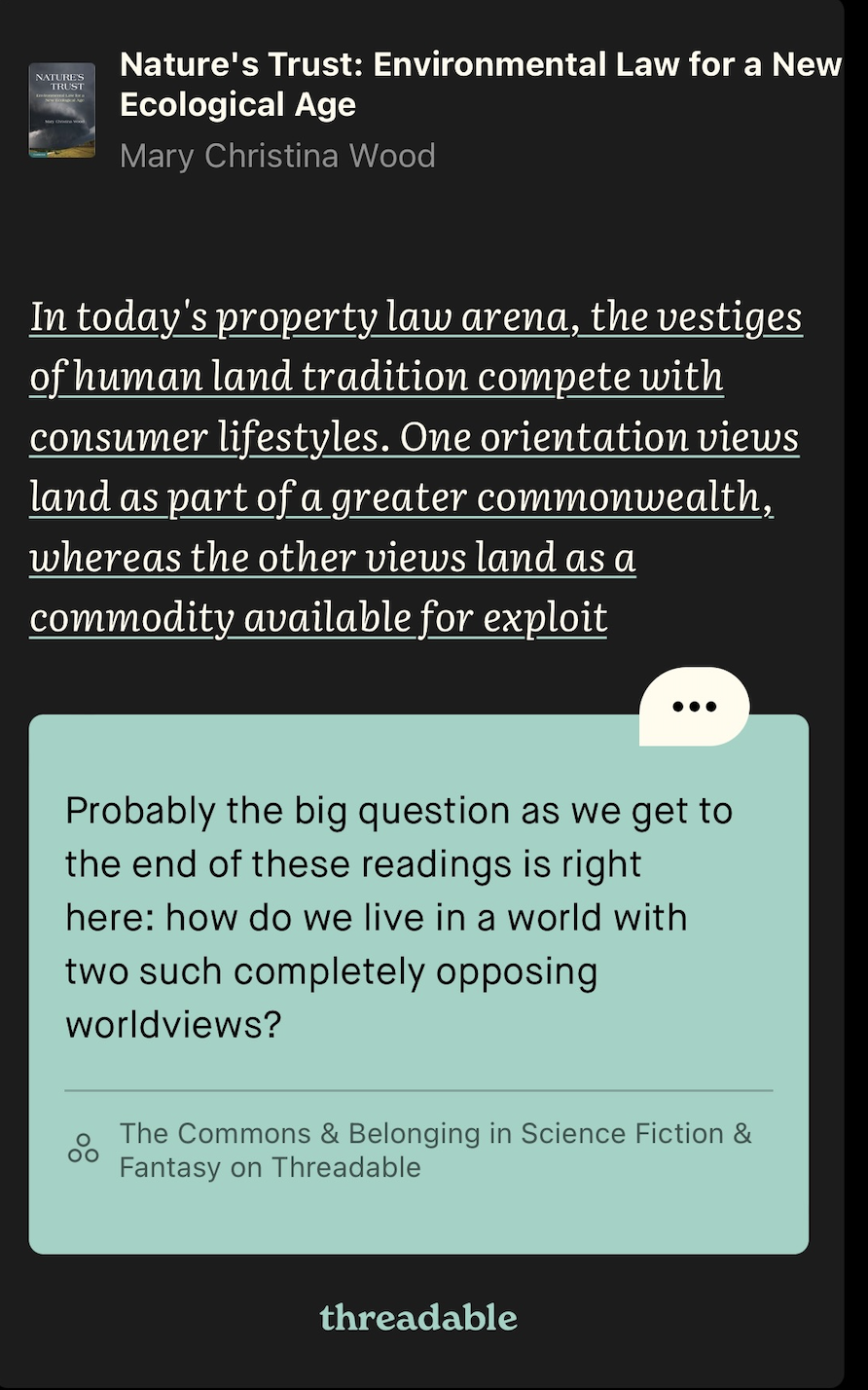
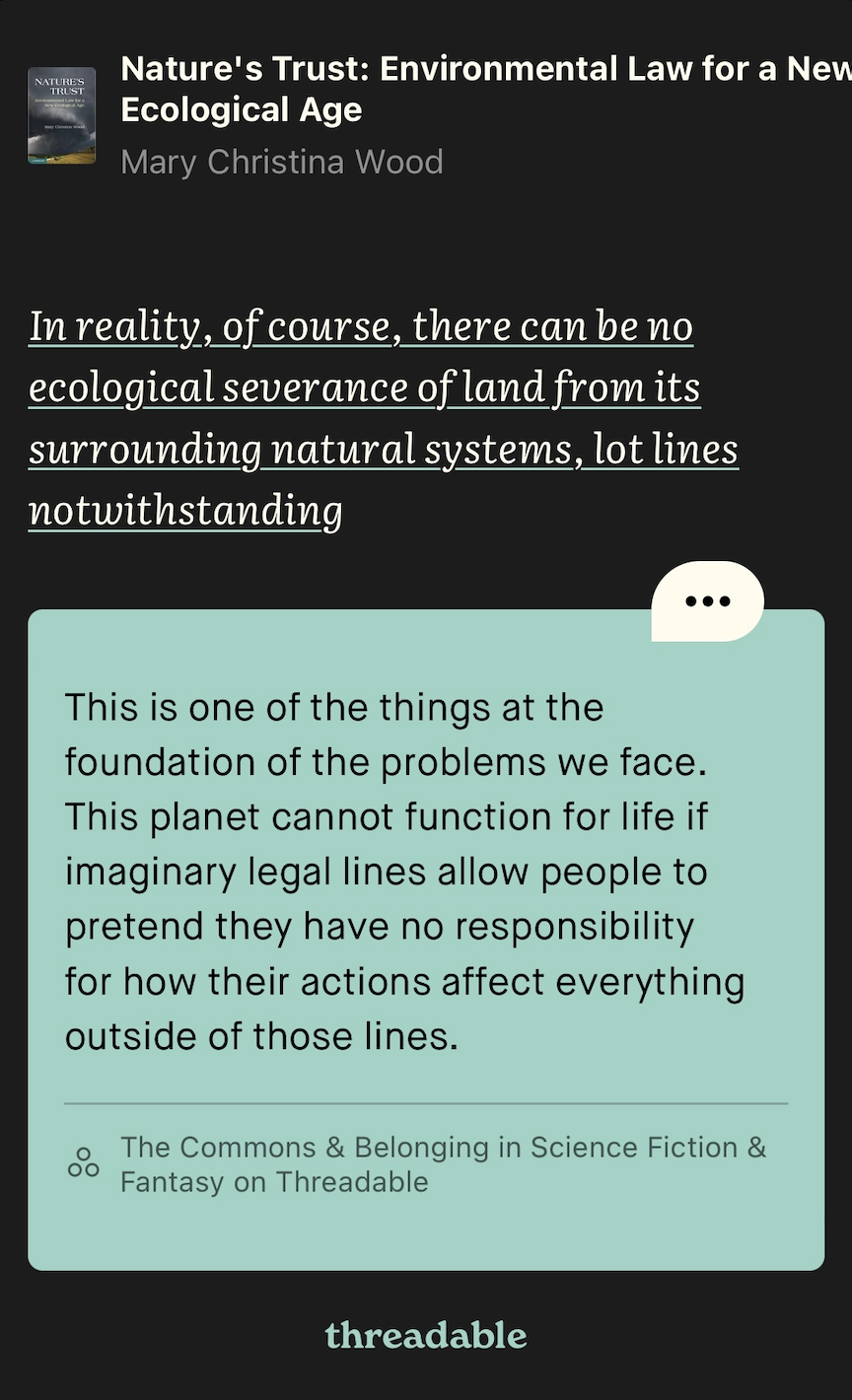
Nature’s Trust: Environmental Law for a New Ecological Age, by Mary Christina Wood (treating land as a commodity is unsustainable in the long run; seeing it as a commonwealth and reinvigorating the idea of the public trust might be a better way forward)
“All things are peaceful and kind on the other planet beyond this Earth. But still I hesitate to go alone.” —from “Another Planet,” by Dunya Mikhail
Last weekend, I went for a walk in the woods with some friends on a trail none of us had been on before. Nothing spectacular. I couldn’t even seem to take a photo that demonstrated more than that the area looked to have been logged or thinned long enough ago that you couldn’t see much evidence of it. While we walked I thought about how the clearings around us would be populated by little larch trees in about twenty years. And though I won’t see them for decades, the thought made me smile because there is nothing like watching sunlight flicker across a wide, quiet grove of toddler larches turning yellow, while a raven calls overhead.
1-minute audio from a different walk along the local river. Red-winged blackbirds, and I could have sworn I heard a Swainson’s thrush in there? Maybe you knowledgable-about-birds people will know.
I didn’t have time for a walk. Really didn’t have time. I had a bunch of work things due and a volunteer commitment that was looming over me like a small, burning galaxy that wants me to feel the immensity of its mass. I’d been trying to keep panic attacks at bay for three days straight. Unsuccessfully. Which meant that, while I didn’t have time for a long walk, I also didn’t have time to not go on a long walk when it was offered.
In the midst of it all was Substack’s hard piling into some kind of social media engagement, which you’ve probably read about elsewhere so I won’t go into it, but it’s aggravating to keep digging through my settings to figure out how to turn off notifications that simply refuse to be turned off. It’s like one of my most regular recurring dreams, where I’m waiting tables and getting people’s orders wrong or trying to handle too many water glasses; or the one where there’s a huge house full of clutter that I have to somehow figure out how to clean up. (One of my many household chores growing up was dusting, which is probably reflected in my low tolerance for clutter wherever I live.)
There are all sorts of things to be annoyed at with this, but as with so many other things it comes down to lack of control over our choices. I hate that, for anyone. Notifications online aren’t on par with breathing polluted air because you couldn’t shut down a medical waste facility or someone decided to put a 16-lane freeway in front of your school; or finding yourself without a home because an absentee landlord bought your apartment building and jacked up your rent; but it probably comes from a similar rootstock, which is that someone with more power decided that they get to make your decisions for you.
There are a lot of things I’m thinking about with Substack and what kinds of choices people do or don’t have control over because some tech-bro dude decided they know what’s best for all of us. Even as I type that I realize that I’m repeating things I’ve said many times before, like in this post about why I originally left Twitter years ago and lack of choice (content warning for anti-Semitism). If you want to pay for this newsletter and would rather bypass giving Substack itself money, or if you just want to write a letter for other reasons, a mailing address is always on my website. It won’t help with the notifications, and I’m not sure leaving the platform to print and mail out essays is a viable option, nor would that disentangle anyone from the wider systems of injustices we’re forced to participate in. I don’t have any answers and don’t really trust anyone who says they do. But if you want to talk about it, I’ll willingly listen. There’s something insidious about others’ priorities being intentionally crashed into our time and attention from every angle possible, though the world is full of choices being imposed on those who have little say.
Of the eighty ownership-related books remaining in my to-read pile, there are only sixteen by women. Something that became apparent early on in this project is that almost all books on property are written by men, almost all of them white men, and almost all of them increasingly irritating. Stuart Banner’s American Property in particular is one I’ve started three times and returned to the shelf within an hour.
Unless the writing is explicitly anti-capitalist, it’s also particularly noticeable that the tone of the book carries a kind of March of Progress whiff about it. Even Andro Linklater’s Owning the Earth, which I really like, has this flavor. As in: The atrocities and losses that can be laid at the feet of this worldview and its enforcement are regrettable, but such is the way of progress and look at what we get in return.
To which my response is always, “Who is the ‘we’ you’re referring to here?”
When it comes to “progress,” the question that sits with me is: who is making sacrifices for others’ comfort or ease or security, and did they have a choice in the matter? Every time I turn on my car, I think of it as participating in a war on Bangladesh, which might seem extreme, but that land isn’t choosing to sink under sea level rise on its own. And my dependence on an internal combustion engine isn’t something I have much of a choice about in North American society. I don’t drive it every day, but even that choice is a luxury born of living in a walkable community whose affordability has rapidly become nonexistent.
There are very few mainstream books on property and ownership that spend any time facing these kinds of realities; those that do ask readers to imagine a completely different paradigm than the one we’re generally told is fixed and inevitable.
I’m slowly making my way through Elinor Ostrom’s Governing the Commons. Ostrom was an economist who won the Nobel Prize in 2009 for her research on commons-based shared resource management systems, fisheries being a prime example. Her book is meticulously researched and referenced and so tedious that I can barely get through a page at a time. I’ve read a lot of painfully dull books that grew out of Ph.D. theses, but it’s been a long time since I’ve read one that felt exactly like a Ph.D. thesis. It’s important work, though, and she’s probably not to be blamed for trying to make it as scrupulously academic as possible. Considering how badly the dominant culture wants to believe that private, individual ownership (or, as Ostrom also addressed, complete state control) is the only safe way to structure a society, anyone countering that view probably feels that their case has to be almost unassailable. Even I feel that pressure, which is probably why I’m reading too many books on the subject.
A lot of those books end up referring to one another. In the current case, it’s Amitav Ghosh’s The Nutmeg’s Curse, which I finally removed from the shelf and sat down with yesterday and read in a few hours because it’s not boring, and it also has a long section talking about Ostrom’s work. It’s not exactly the book I expected. It seems to have grown out of The Great Derangement, which in the end I like more. Both of them are about narrative, which is—I think—an overlooked element in why the solutions to so many of the massive problems our world faces have trouble gaining traction. The narratives that get promoted and believed are those that undergird the dominant culture that benefits from them.
Ghosh’s contention is not only that writers and artists of all kinds need to show some responsibility to narrative, and to writing ones that counter the dominant culture beliefs—that was in essence also what The Great Derangement was about—but that part of what the dominant narrative has buried is Earth’s and all its entities’ abilities to tell their own narratives. Use their own voices.
The question is, who among us has the time and attention, much less uses the time and attention, to listen? I don’t know that I’ll ever truly understand these voices, so it feel more important to listen to people who can. Which is probably why I keep putting Stuart Banner back on the shelf. His voice is everywhere, even if it’s not his. That story is dinned into us all the time. I want to hear other ones.
One of the minor volunteer things I do is run a school board candidate forum every year. This was my fifth year doing it, and the regular moderator who also helps me with a bit of organizing had too much going on to participate. I’ve been overwhelmed with other commitments and got a late start on the organizing and frankly just felt a mess about the whole thing. Organizing events of any kind isn’t something I’m good at and I also don’t enjoy it. I can barely manage to make my kids’ birthdays feel special. But there was nobody else to do it. And by “nobody else” I don’t mean “Nobody can do this but me because I’m unique;” I mean that I’d spent the previous three weeks asking literally anyone I could think of if they could take it over and nobody had said yes and it was too late to cancel it.
I explained this all to my three friends on our long walk, and in return one of them offered to make the flyers, which is always one of my sticking points (I also am not good at designing things). My friends then pointed out ways in which I made the forum harder than it needed to be by trying to accommodate everyone’s time restrictions.
My one friend’s offer, and talking through it all, helped unwind the anxiety and proved to me once again that a walk is never a wrong answer. It made the forum feel manageable. I went home, scheduled the Zoom webinar because I couldn’t find a night that everyone could participate in person, sent the old flyer to my friend to update, emailed the candidates, did all the fiddly things I usually have to do to get this thing ready, and felt somewhat more prepared to handle what was going to be a very busy week.
The next day, I came down with food poisoning and was in bed for two days straight. Having, for some reason, repetitive dreams about waiting tables and cleaning cluttered houses.
The night of the forum saw me feebly crawl into clothes and apologize to candidates and attendees for my brain losing the plot as the forum meandered on. At one point I forgot everyone’s names and forgot that Zoom had their names displayed right in front of me. These are people I’ve known for years, mind you. It wasn’t like we’d just met.
Having that long walk in the woods—in what I hope is a baby larch nursery—behind me and a few good friends at my back made me mind all that less. (Kind of. Food poisoning sucks. Never recommended.)
It hasn’t given me a good answer to the tangledness of online life. I’m not sure it ever will except that the more the digital world is pressed upon me, the more offline and outside I go. All I know is that I want all of us to have choices about these things. I also want us to be aware that our choices affect others, especially others we might never see or know about, and also to remember that many of the choices we hold ourselves responsible for are not necessarily ones we have a lot of control over. But the digital world is still new, and the more we insist on having real choices now, the more will be available to people in the future. (How to achieve this I have no idea but I think we have a responsibility to try.)
I chose to open a window today while I worked, now that it’s finally not snowing and freezing, and listen to the robins and chickadees instead of music, and to space out gazing at the near-bursting buds on the caragana bush, and to wonder if I should get my seed potatoes going or if we’ll have another blast of winter. And if I’m doing the right things, and what parts of my life I’ve wasted, and if I have time for a walk before making dinner, and how much choice I, or you, have in any of it, and what our responsibilities are to ourselves, our communities, and the world.
The choices, the responsibilities, the lack of both and awareness of both—they lace in and out of one another in a world whose narratives and self-perceptions have been knotted up and obscured for a very long time. Maybe one of the best things we can do, or if not the best at least a first thing, is to go for a walk, try to find some clarity, and listen for stories that might be trying to reach us through other mediums. Like larches, or birdsong, or friends, or a sky that wants us to know all of its moods.
Speaking of the book-in-progress, No Trespassing, I am currently revising the Introduction and will be sending it to beta readers in May, hoping to share it here with all of you in June. The first chapter, on land ownership, will be my main project while at the Dear Butte residency June 5-15. The overview of that book project is here.
Some stuff to read (r) or listen (l) to:
(r) Vivek V. Venkataraman writing in Aeon with one of the more thoughtful essays on work, leisure, and being a hunter-gatherer that I’ve read in a long time: “Today, many of us are doing the wrong kind of work, one that rejects sociality, craft and meaning, turning people into machines. In contrast, the physical, mental and social are inextricably linked in hunter-gatherer work.”
(l) A fun if daunting interview on Building Local Power about managing rats in cities that’s probably best described by its title: “Rats Aren’t the Problem in Cities. We Are.”
(l) From Future Natures, a conversation with agronomist Almendra Cremaschi on open-source seeds in Argentina and the implications of enclosing the seed commons: “The development of the terminator trait is a metaphor for what patents do to knowledge.” (The sound quality of this one is a bit in and out. I had to use headphones to catch it all.)
(l) On Frontiers of Commoning, a conversation with the authors of Co-Cities about building on Elinor Ostrom’s work to apply commons thinking to cities, with their mixed public and private ownerships and conflicting jurisdictions.
(l) Thanks to Jake for sending me this episode of How to Fix the Internet (from EFF, the Electronic Frontier Foundation) with science fiction writer Annalee Newitz, who really got to the heart of what I think science fiction can do for our understanding of the present: “Story gives us the access to seeing how a struggle that might last generations plays out over time.”
(r) Black farmers in Tennessee are fighting to be fairly compensated for land taken via eminent domain for a Ford plant: “For the sake of his four children and grandchildren, he welcomes development to the area. But, like the other Black families who spoke to the Tennessee Lookout about eminent domain lawsuits filed against them, Sanderlin drew a direct line from the state’s current efforts to take his land to the struggles in every preceding generation of his family to hold onto what they owned. ‘It’s not the first time we’ve had to fight,’ Sanderlin said.” (It can never be said enough that even private ownership of land will not provide security of it.)
(l) Otters and beaver, plastic waste, wool, and re-envisioning urban community land on the Scotland Outdoors podcast. (The portion about turning an old railway line into a bike and pedestrian path starts at about 12 minutes in.)
(r) “The Difference Between Love and Time,” a science fiction short story by Catherynne M. Valente, was just pure fun: “I took the continuum to that little Eritrean restaurant down on Oak. It ordered tsebhi derho with extra injera and ate like food had only just been invented, which, given the nature of this story, I feel I should stress it had not. I just had the yellow lentil soup. The space/time continuum cried in my arms. It thought it had lost track of me. I didn’t answer its text messages. If it was a commercial cereal brand it would be Cap’n Crunch Oops All Genders.”
Note: I am starting a new commons-related Threadable reading circle this week, titled The Commons & Belonging in Science Fiction & Fantasy. This link should take you to the app’s home page if you would like to read and participate (still for iOS/Apple devices only, and for me it works best on a phone or iPad—the link has been a touch glitchy the past day or so, but if you have the app you can navigate to any of the circles). The reading selections are all science fiction, fantasy, and speculative fiction short stories, starting with Hao Jingfang’s Hugo-nominated “Folding Beijing.” Super big thanks to everyone here and elsewhere online who’ve passed on reading suggestions, most particularly On the Commons subscriber Stefanie, who has given me a big pile of excellent authors and stories to read! There is some great new SFF out there by a much wider variety of voices than I grew up with and I’m excited to read it all.
(If you want to download the app, you can do so through the Threadable site.)
Does the theme of science fiction and fantasy seem drastically different from land ownership? As I wrote in Threadable’s community circle,
“I ask us to reconsider that dichotomy. Enclosures of land commons and land privatization in both Europe and North America forced an enormous rift in people’s sense of security and belonging. (This is true all over the world, obviously, but the circle’s readings focused mostly on those regions.) And in placemaking, it’s often said that where you are is who you are.
Science fiction, fantasy, and speculative fiction allow us to imagine variations on belonging and identity that envision all possible futures while interrogating the past.”
And the present, I should have written. Science fiction in particular has ways of showing us the realities of our present by framing them in stories about the future. I’m a big fan of Martha Wells’s Murderbot Diaries, for example, because underneath the great storytelling and characters are important questions about how a “person” is defined and who gets to define them, what that means for individual freedom, and what kind of world we get when it’s completely controlled by competing corporations with no oversight. We won’t be reading Murderbot because Threadable readings are shorter selections, which is why I’m sticking to short stories, but I hope you get the idea. (Also I hope you read Murderbot.)
Anyway, for one more post, back to land ownership.*
5% of this quarter’s On the Commons paid subscriber earnings will be given to All Nations Health Center in Missoula, Montana.
I chose two excerpts from Nature’s Trust, both from chapter 14: pp. 312 (starting with the section heading “Land as Commonwealth or Commodity?”) – 320 (stopping before the heading “Public Trust Property and Restraints on Privatization”); and pp. 328 (starting at the section heading “‘The Earth Belongs in Usufruct to the Living’: Trust Easements and Servitudes on Private Property”) – 334 (end of chapter).
Unfortunately, I could not find any free versions of this book or sections of it online. It’s more of an academic book but I wouldn’t say it’s excessively challenging if this is a subject you’re interested in. It was recommended to me years ago by an environmental lawyer friend when I first got interested in the commons and land ownership, and Wood has a lot of insight and knowledge, and a compelling writing voice.
Mary Christina Wood is a law professor at the University of Oregon, where she heads the Environmental and Natural Resources Law Center. Not to get too deep into the weeds, Nature’s Trust is about what’s called the “public trust doctrine,” the legal principle saying that certain resources are held in trust for public (human) benefit. It applies to wildlife in the U.S., to legal water rights in many places, to public lands in the U.S., and to many other entities that are collected under the concept of “resources.” It’s what opponents of public lands specifically get wrong (on purpose, I’m pretty sure) when they say those lands are “owned” by the federal or state government. They’re not. Legally, they’re “owned” by the people and held in trust for the people by the government.
There are obviously a lot of pitfalls even in this concept. How do you talk about public trust and ownership by, of, and for the people when all the water and land and everything else in question was stolen in the first place and when many if not all of the treaties they were taken under were forged or broken? And what does this legal worldview still assume about the human relationship with the rest of life, or what’s often called the natural world? And even assuming you accept the precept of public ownership and the public trust, there’s still the question of how you hold the government accountable for managing “resources” belonging to the people and doing it in the public’s interest. (The absurdity of the U.S.’s still-active 1872 Mining Law, which heavily subsidizes mining of “public resources” for private interests, with little or no recourse for stopping or mitigating the attendant enormous destruction and pollution, comes to mind.)
Wood’s focus is on the loss of the public trust doctrine in favor of environmental law and entities such as the U.S. Environmental Protection Agency, which was created in 1970. When these agencies and laws replaced the public trust doctrine, protection of public resources and environmental regulations became far weaker. Entities like the EPA are easy prey for industry regulatory capture—rather than fight deforestation laws, for example, timber company lobbyists and executives can get friendly enough with regulators to help write favorable or weak forestry laws with no teeth.
“The field of environmental law stands as a failed legal experiment. The administrative state vests agencies with breathtaking power that came justified by one simple assumption: officials will deploy public resources and invoke their technical expertise on behalf of the public interest. Instead, too many environmental agencies today use their power to carry out profit agendas set by corporations and singular interests. As Part I of this book explained, environmental agencies have fallen captive to the industries they regulate. Consequently, they use the laws’ permit provisions to legalize the very damage the statutes were designed to prevent. Nearly across the board, environmental statutory processes do not prohibit harm: they permit it.”
The concept of a Nature’s Trust, wrote Wood,
“calls forth an ancient duty embodied in the public trust doctrine, a legal principle that has flowed through countless forms of government through the ages. At its core, the doctrine declares public property rights originally and inherently reserved through the peoples’ social contract with their sovereign governments.”
In the later part of the book excerpted for the Threadable reading, Wood has some thoughts on reviving the public trust doctrine by treating land as a commonwealth rather than a commodity. In this, Nature’s Trust circles back to some of the other readings in this series, including Erik T. Freyfogle’s The Land We Share. Private land ownership, wrote both Freyfogle and Wood, cannot be sustained in the long run if private property rights are considered absolute, with no responsibility to a surrounding community or ecosystem. “In today’s property law arena,” wrote Wood,
“the vestiges of human land tradition compete with consumer lifestyles. One orientation views land as part of a greater commonwealth, whereas the other views land as a commodity available for exploit.”
As I wrote in the comments for this section, this gets to the big question at the heart of the Land Ownership reading circle—and really at the heart of this newsletter and the whole concept of the commons: how do we share a world, manage our lives and honor the needs of all other life in it, with two such completely opposing worldviews? We don’t really have a choice, so how do we do it?
Like Freyfogle, Wood reaches back to some of the earlier history of the United States and how land ownership was viewed, a perspective that had a much looser and less absolutist view of property rights. “Rights to destroy the landscape did not enter into the liberty equation back then,” she wrote. But they do now, and the consequences have long since become unbearable for too much of life, humans included.
Wood’s idea of a commonwealth attitude toward land is not a commons approach, though how she describes commonwealth and land tacks pretty closely to a lot of Elinor Ostrom’s ideas about commons resource management systems. Wood reiterates repeatedly the idea that property rights must only be granted as subservient to and respectful toward the larger community and ecological needs. Owning land, she writes, forces a person or corporation into ecological and community relationships.
Which I agree with, but as I repeatedly wondered when reading John Locke’s and William Blackstone’s much older claims of the same, saying that this responsibility exists, or that people won’t claim or take or use more than they need, doesn’t provide for any enforcement mechanism. To use an extreme example, I live in Montana within an hour’s drive of a lake that is being increasingly polluted by selenium coming downstream from coal mining in British Columbia in Canada. There is no way for people where I live to force a sense of responsibility to waterways and human communities on Teck Resources, which is doing the mining.
In advocating for a commonwealth idea of property rights, Wood points to several specific examples that she sees as embodying the commonwealth approach throughout the United States, including community gardens, inner-city farms, and urban homesteads; food-not-lawns, conservation easements, and rethinking how stormwater is managed in cities. Not bad examples, if not really up to the scale of cross-international-border coal mining pollution.
While hopeful, I found that a lot of these suggestions, and indeed the concept of a commonwealth approach, still depend a little too much on landowners and the landowning class. It neglects the ways in which land ownership translates into power—political power as well as power over others in the form of landlord status. And it neglects the ways in which not having ownership precludes many of these choices without massive political, social, and clear legal change. What if you rent, or even if you own your home but not the land it sits on? Are you allowed to plant peas and tomatoes instead of maintaining a grass lawn? For too many people, the answer is “no.”
In other words, focusing on the responsibilities of landowners can repair some issues, but it bypasses a lot of the ways in which owning itself can damage communities and lock the majority of people out of decisions about how the commons—all the commons, in all their forms—are managed. And it’s not just about what you can do with where you live, if you even have somewhere to live. I’ve brought this up before, but I think it’s far too often overlooked that voting rights were reserved for the landowning class only—not just white and male, but owners of property—until relatively recently in democratic history. If you can’t vote, you also get far less of a say in how your own life and, say, the water you rely on to survive, are controlled. The possibility of that history returning is too real to ignore. Very few of the readings in this project—with the exception maybe of Henry George’s Progress & Poverty—have directly addressed the reality that more abstract human rights are also dependent on rights of survival.
But a commonwealth framework is somewhere to start. Again, it goes back to Freyfogle’s writing about the landowner’s responsibility to the surrounding community. As a reminder, the excerpt from his book was about a private landowner having to sue their county over a zoning change that allowed a neighboring property to operate a concentrated animal feeding operation (CAFO; a feedlot). The harms caused to neighbors by the CAFO translated into degraded air and water, and reduced property values. Absolute private property rights are a recipe for disaster, including to those property rights themselves. It’s the true tragedy of the commons.
To get to a commonwealth framework or back to a public trust understanding of land, though, is going to require an enormous amount of attention, energy, interest, and understanding from the wider public. The idea that the right to profit from what one owns is absolute, with no limitations from government entities, environmental concerns, or any other interests including neighboring humans, rivers, or wildlife, has laced itself throughout the dominant culture’s psyche and made its way across the world. (To be clear, this treatment of the world isn’t unique to private land ownership regimes; it seems to be far more about an ideology that says humans can be completely separate from and dominant over nature and treat her accordingly. The Soviet Union was a living, breathing environmental disaster for decades. But Wood’s book is mostly about the U.S. and corporate as well as individual property rights, and this reading circle has been specifically about private ownership of land.)
It’s going to take a lot of work to untangle that kind of thinking. It will require knowledge and information and a whole world of incredibly compelling narratives.
Which is really what we’ve been doing here. And it’s only just a beginning of understanding some of the roots of the problems our world faces.
Thank you all for exploring land ownership with me, and for putting up with things like having to look up swanimote when reading The Charter of the Forest, and my irritable review of Simon Winchester’s Land, which I’m still mad about. You’ve been patient and curious, and I’m really glad we went on this journey together. It’s been a long one.
Let’s all go for a walk. And then let’s see if we can start to change some things.
Rainstorm approaching over the Missouri River bordering the American Prairie Reserve in eastern Montana, a curious mix of private land and public access that I’m still not sure how I feel about. But it lacks fences and “No Trespassing” signs and feels like . . . possibility.
“I’ve been locked inside your heart-shaped box for weeks.” —Nirvana, “Heart-Shaped Box”
Two quick notes before we go to a Taylor Swift concert: 1. Hard to miss the launch of Substack Notes around here, but I’m not likely to be there much anytime soon. That’s not a judgment of it or anyone using it. I just know what that style of social media does to me. My brain falls apart and my writing voice decays. (Social media was a whole section I cut from last week’s essay on where I find wholeness in time, attention, and silence. It was all about cultivating what’s less frenetic, not inviting in more.) 2. The Threadable reading circle on Land Ownership is wrapping up and I’ll post the last linked essay this week on Mary Christina Wood’s Nature’s Trust. I’ll be starting a new commons-related reading circle there next week on science fiction, fantasy, identity, and belonging. (To all the new people here [hi!], this post is a brief overview of the land ownership reading project and Threadable.)
Usually, the photos I use for walking composition posts are ones I take while I’m walking around, wherever I happen to be and mostly of northwest Montana. Today’s is an exception—it’s where I was walking to: a Taylor Swift concert in Las Vegas. I have an entirely different essay in the works about sidewalks because my daughter and I walked an hour to the venue from an airport hotel (which by the way was nowhere near the airport) and took a public bus back after midnight—her idea! I’m so proud of her—and it made me get all excited again about sidewalks and public transit. Writing a book about walking and walkability instilled a deep love of public bus systems in me.
Today, I want to linger a bit on the music and experience of that concert, and more on how we carry senses of identity and how those do or do not translate into agency. How much people can yearn for self-ownership—what some call sovereignty, though I’m not sure that it means what they think it means—and what people might do to achieve it.
Also, it’s an excuse to share a terrible photo that I took from my daughter’s and my flight to Las Vegas out of Minneapolis, Minnesota. We finally saw the northern lights! It’s been an off-and-on few months of attempts driving up to Glacier National Park at night, and here they were dazzling away outside as we left the Twin Cities’ skyline. The camera of course makes the colors appear brighter than they were to us, but they were truly, visibly green with just the naked eye.
So, last year on that day when Ticketmaster made a hash of selling tickets to Taylor Swift’s Eras Tour (and not a good hash, like the kind of hash even Tabasco can’t rescue), my younger sister managed to get six tickets in the upper stadium cheap seats.
Before signing up for the chance to purchase them, she’d asked me if my daughter and I wanted to go with her family. I really didn’t think she had a chance of getting tickets, but I enjoy having fun with my sister and her life has been through a meat grinder the past couple years and also I do like Taylor Swift, so I said yes. A few months later, bewilderingly to me, there we all were in Las Vegas. My nieces had had outfits picked out for weeks, and the six-year-old persuaded me to paint my nails with black and glitter by offering several times to do it for me.
I’ve been to concerts before—Pearl Jam, the Ramones, Bob Dylan—but not for many years and truly nothing like this. And I might never attend something like it again, so “epic” feels like an apt description. (If Nine Inch Nails shows up anywhere nearby, though, I’m in. And I’m totally a fan of Chris La Tray’s band American Falcon, which he wrote about this week. Maybe I’ll drag a friend or two to see them in Great Falls someday.) Aside from the immersive spectacle of the whole thing—three hours! so many costume changes I lost count! SO LOUD and I loved it—it’s difficult to be in a stadium of 69,000 people who, even amidst three hours of incredible volume, managed to make lines like “Shade never made anybody less gay” and “No deal, the 1950s shit they want from me” noticeably, fiercely louder.
I couldn’t help being there, listening, singing along, feeling exhilarated at the thought of 69,000 people—a crowd dominated by young women—having a glorious time and getting dressed to the nines and carrying heads full of 17 years’ worth of Taylor Swift lyrics, and still reserving enough energy to get riled up about the oppressions that they know are happening.
Even immersed in the music and the volume and the crowd and the mesmerizing light show, I also couldn’t help wondering how so many people can have this—this clear knowledge of values and what we want the world to look like—and yet somehow, so far, not seem to be able to draw on that massive energy enough to overthrow agencies of the dominant yet minoritarian culture that seeks to strip it all away.
A weekend or two before the concert, I was up on the local ski mountain with my older local niece giving her her second ski lesson out of the two I’d promised her for her birthday. It was a beautiful day after bitter cold most of the week, the sun shining and the skiing nearing that sticky softness of spring snow.
We got in line at one of the beginner lifts for our last run, and in front of us were a man and a woman, maybe in their mid-20s. The man was wearing only a T-shirt (it was getting warm out): gold-yellow, with a large “Don’t Tread on Me” Gadsden flag on the back. On his right tricep “Proud Boy” was tattooed in large Gothic letters, all capitals. I glanced around his hips to see if he might be armed (I live in northwest Montana not to mention the United States in general; this is a concern all the time), but unless he had something tucked into his snow pants (always a possibility), he could fall while skiing down the bunny slope with minimal harm.
After that run, we skied over to the lodge parking lot where we’d eventually catch our ride home. On the way, we passed a ski instructor helping a woman who was clearly struggling. It looked like she’d possibly never been on skis before. Skiing is hard! Getting on those things the first few times is always going to feel weird and uncontrollable, and it’s a lot worse when you’re not a tiny kid with that lower center of gravity. I’ve been skiing since I was two years old and it still freaks me out sometimes.
Which is why it felt so disconcerting to look at her, clearly near tears and needing help, wearing a T-shirt that said, “F— Your Feelings,” only it was one of those that didn’t have the word, just a stick figure doing the f—ing.
Why, I wondered, would you choose to wear that shirt on a day you’re going to be somewhat helpless and dependent on someone else? Especially when you’d need that someone to specifically not f— your feelings?
Subscribe to continue reading
Subscribe to get access to the rest of this post and other subscriber-only content.
Essay (about time and silence that turned into one about caregiving that turned into something about capitalism that turned into time and silence again . . . apologies for the inconvenience)
5% of last quarter’s revenue from On the Commons went to FAST Blackfeet. Next quarter’s 5% will go to All Nations Health Center. I encourage everyone to support similar organizations and initiatives, however you can, wherever you are.
During my most recent stay at a Forest Service cabin in early March, I thought off and on about time and silence. Most of the cabins I stay at are out of cell phone range, have no electricity (some do, but otherwise are heated and lit by propane), no internet, are limited to a stay of three nights, and are out of the way of people and traffic and most other noise. When I’m there, the silence is tangible and my sense of time changes drastically.
I go to these cabins partly because I continuously crave being alone, and partly (mostly) because I’m able to get so much more work done there. At home, the amount of work time available on a daily basis is almost laughably limited. Most of my days end up dissipated by dust devils of commitments. I’m constantly paring them back, but something always comes in to replace them, even if it’s just a stomach bug or bad head cold my kids brought home from school.
These time-ravenous commitments aren’t new, though they wax and wane. When I was writing my book about walking, my kids were very little and my younger sister’s family, including a toddler and a newborn, were living with us in a small house. My work space was a desk in the short, open hallway outside of my kids’ shared room. Some months into the project, I broke down and spent several days hiding myself away in tears. I had a book contract, a comparatively decent advance, and a great editor, but there was simply no way I had the time or space to do the kind of deep thinking and writing the book needed and deserved. Caregivers don’t get to write books, I thought over and over. I got through it, but couldn’t stop thinking that if writing a book was that difficult for me, it would be so much harder for many other people.
The daily circumstances that led to that minor breakdown paralleled how I’d told my publisher I wanted to approach the subject of walking. It’s how I approach a lot of issues and struggles, whether they’re mine or my community’s or the world’s, by asking one question: What are the barriers? What I lacked was something I’d craved ever since having a baby but really most of my life: time and mental quiet.
I started reserving myself U.S. Forest Service cabins once or twice a year only a couple of years ago. The weeks-long writing residencies I’d been to were productive and even fun, but expensive, and I found that almost inescapable socializing swallowed a lot of residency hours I couldn’t afford to lose. (There is a hilarious passage about this seemingly universal aspect of writing residencies in Martha Grimes’s novel Foul Matter. It makes me laugh hard every time I read it.) I just needed time, and my mind to myself. A place where hours and attention weren’t chopped into little pieces.
That first cabin stay, which was only for two nights, I was astonished at how much I got done. Same for the second. The third reservation I gave up because of a copy editing deadline. That was in Covid’s second autumn, when I was trying not to be bitter about humanity, and was so ground down by homeschooling for the second school year in a row, my days looking a lot like they had when my kids were tiny—dictated by meals and cleanup and meltdowns and a momentary rhythm of math and reading and music practice in the mornings—that I’d become less a thinking person than a mass of rage and despair fed by potato chips, beer, and gummy bears.
None of these getaways have been easy. Without intending to, I somehow started out motherhood as a full-time stay-at-home parent who worked late at night and early in the morning and spent all day caregiving. I’d never wanted to be a stay-at-home mom (and have also come to loathe the word “mom”; a friend said recently it feels loaded with societal expectations of a narrow, fixed identity that disallows any other sense of self, and I feel that very much), but fell into it due to a number of factors, including our first baby’s nearly eight-week prematurity and month-long stay in the hospital’s Neonatal Intensive Care Unit, the fact that I’d worked freelance from home for years, and my spouse’s job, which required him to travel more than half the time. And the reality that childcare in the U.S. is outrageously, horrifyingly expensive.
So when I needed to travel somewhere to research my book, or wanted to go away to a writing residency or conference, the logistical maneuvering was intense and exhausting. When my spouse travels for work, he packs, picks up his passport, and goes. But I’m the primary caregiver. When I go away, I put in days of arranging or rearranging appointments, checking on homework or long-term projects and other activities, making sure rides to anywhere needed are taken care of, touching base with everyone’s mental health, making sure everyone’s caught up on laundry and has showered recently . . . I won’t go on. If you know this routine, and its reverse when you return home, I bet you feel it in your bones. If you don’t know it, I’m not sure I can help you feel it. It was something my spouse and I fell into rather than consciously chose, but restructuring it has proven more difficult than I’d imagined. Covid brought an immediate stop to the business travel and it mostly hasn’t returned, which helps.
Last summer was the first time I went away somewhere offline and out of service and just . . . went. It was August, so there was no school to worry about, but my kids are also getting old enough to not need me so much. So when I got a week’s notice that I was off the waitlist for a two-day wilderness trail crew, I filled up the gargantuan gas tank of my ancient truck and watched the gauge visibly drop as I drove to a trailhead near the Continental Divide.
A few weeks later, I packed the piles and piles of research papers and articles waiting to be organized, a few books, food, coffee, sleeping bag, and went to a Forest Service cabin. I went again last month and have already reserved next fall’s stay. It’s getting a little easier on everyone. Kind of. A little.
Which is a relief because I desperately need this time. You’d think with my kids in school there’d be enough hours in the day to work, but between everyone’s appointments and errands and other commitments, school holidays, sick days, volunteer work that I try really hard to constrain, giving occasional walking-related presentations, and a variety of personal obligations, there is rarely a week where I can look forward to a full day’s work. A full day being defined as completely uninterrupted hours from 9 to 3.
When I’m away, by myself and offline, all that time is inverted. Open, ample, unspoken for. It’s luxurious. I get up at five or six and make coffee. Depending on the time of year, the first or second cup comes down to the river with me while I watch the sunrise. I stay there as long as I feel like, listening to whatever the river has to say and watching the peaks brighten in the sunlight. Then I walk back to the cabin and get some homemade granola, yogurt, and a couple of the peaches I skinned and froze last summer out of the cooler. Eat in no hurry, brush my teeth in no hurry, make some mint tea with the leaves I dried last fall in no hurry, and sit down to read and write. In no hurry. Through every moment the silence feels saturating, the relief of it tangible.
The first full day this last trip, after visiting the ice-slushed river for sunrise and then eating breakfast, I wrote for what felt like hours, read a chapter of a book for research, felt sleepy, took a short nap, made tea, made revisions on a printed draft of an essay; realized it was sunny and maybe warmer out, so took some personal letters out to the porch and wrote to people with more tea and a bare aspen tree and the sunshine for company (if you got a letter from me recently, I meant but forgot to tell you where I was writing from), read another chapter and thought surely it’s nearing late afternoon, I’ve gotten so much done. It wasn’t even eleven in the morning.
Not having to parent and run a household isn’t the only factor here. Being offline and away from phone service matters a lot. I once said to one of my mentors—who doesn’t have a cell phone or even a car—that being online felt like spending the day with a baby or toddler, which an acquaintance once wonderfully characterized as, “It really only does take half your time, but the problem is it takes 30 seconds out of every minute.”
Even if I’m not looking at the internet, even if I have Wi-Fi turned off, it feels similar. Just knowing it’s there is a constant draw on attention that drains away energy and focus, but also intrudes on attentiveness to the world. As I’ve said before, I really do enjoy the dialogues we have here, the shared ideas and comments. But I can’t do the kind of writing I do without making time for immersive attention in the world.
Letting the places I love pull me into themselves—the rivers, the starry nights, the moonrise over Glacier, the birdsong in a campground on early summer mornings, the snap of cold on a winter walk—and to not have to talk for days, even online, lets me be as much my full, authentic writer-self as possible. As a human being, that’s probably as good as I get.
Not everybody has these opportunities, or whatever their equivalent might be. When I first started my walking book, I spent a lot of time thinking about what mattered to me about it. I was tired to death of walking stories about philosophers and poets, the Wordsworth siblings and Henry David Thoreau. I wanted to write about walking that meant something to everyday people, which meant never losing sight of the question of barriers. If I believe that walking is a human right and fundamental to our evolution and health and well-being, what does that mean for places without sidewalks, for disability access and universal design, for all the ways in which walking is unsafe or inaccessible for far too many people? The question I pinned above my desk and carried with me was Who has the right to walk and where?
The kind of time and silence I treasure—alone, offline—to work or to think or to just be, the liquid feel of it, the expansiveness and luxury, feels similar. I know this time makes me feel whole, and my writing equally so. I think it—or whatever else helps people feel that kind of expansiveness, which might be something entirely different for you—can do the same for many of us. But who has access to it? Who gets to spend hours wandering in the woods, or days offline sitting by a river and reading books? I do, at least sometimes. Do you? Are there places to go and can you get to them? What about friends and family members and all the other people you know or don’t know? What are the barriers and in how many different ways do they manifest?
Thanks to subscriber Stefanie’s recommendation, I recently finished reading Nancy Fraser’s Cannibal Capitalism. I had trouble at first wrapping my head around the differentiation she makes between exploitation and expropriation, but the idea finally clicked, along with Fraser’s repeated point that capitalism will never stop devouring the world, even including the systems it needs for its own survival (like stable governments that enforce contracts and property rights). And including all of us—our work and our health and our relationships and our time.
The “What We Can Do about It” line in the subtitle is something I’d bet money Fraser’s publisher made her put in. “People need some hope” is something authors of books like these are often told, but Fraser’s only answer to “what we can do about it” is to completely uproot cannibal capitalism from our lives—from everyone’s lives.
The barriers of dictated time and schedules, and the single-family structures (absurdly patriarchal, still) and decades-long loss of wages that together create such immense pressures on caregivers, as well as everyone else, are some of the reasons why everyone can’t all go sit by rivers or get offline or hang out at a beach or go for a walk with a friend or take more naps or spend more time with your kids or whatever it is that feels most fulfilling to you. Underpinning all of that are the demands of capital itself.
I like working. I could spend pretty much all day every day at one of those cabins, reading and writing and wandering and listening to the river and the silence and interacting with almost no people and writing some more. I love it, actually. I feel restored and fulfilled and rested afterward.
I like other kinds of work, too, like chopping wood and digging in the garden and pulling knapweed and spending whole days hunting in the freezing rain, or hiking miles to spend a couple hours picking berries and then processing whatever I’ve brought home or gathered from the garden, thinking about what’s needed to get my family through the winter and early spring.
I do those things because I enjoy them and can make the time for them, but the reality is that as long as a few people at the top of the capital pyramid keep sucking up the richness of the world, including human labor and time and ingenuity as well as land and what are called “resources,” none of those activities will ever amount to much more than hobbies, even for me. Writing aside, I’d rather exclusively feed my family by spending time getting to know the lands we live among than by sitting in front of Google Docs and Word and Adobe for a copy editing job, even though I like copy editing, but the hourly tradeoff doesn’t add up to enough. My spouse would like more time to build bicycles and go hiking with friends and do things with the kids during the day, but his job is unlikely to ever release its need for people to be online and looking productive the bulk of the daytime hours.
That doesn’t mean it’s hopeless to do these things, or not worth it. In fact, I think it makes them more essential. Anything we can each do to throw grit in the system’s gears, to undermine it and erode it and remind ourselves that the barriers are mostly imposed and that we all have a right to be full, living, thriving, loving and joyful beings—it’s more than worth it, for all our sakes.
My spouse and I have to work—in fields that respectively interest us, fortunately—to eat and feed our children, as well as pay the mortgage for the house and the land it sits on. I make a lot of choices to scale back commitments, but not everyone even has that option. In the first two years of my son’s life he was hospitalized twice for severe asthma. We didn’t know if he might have major health care needs forever (he’s fine now), and I know too many people with that kind of responsibility, for themselves or for someone else. You can’t easily walk away from the system we’re in when the lives of those you love are at stake.
Instead of prevalent narratives that focus on these barriers, we find ourselves with books and podcasts on productivity or self-help or life-hacking that pretend we can find all the time and freedom we need by changing ourselves.
I know these tips and hacks work for a lot of people, but thinking about how many weeks or hours I have left in a day or a life to be productive or be healthy or be creative has never gotten me anywhere. I could get squashed by someone driving one of those idiotically enormous pickup trucks with lifted tires and a completely unnecessary Iron Cross bumper guard tomorrow. And writers of productivity and life-hacking books rarely address the very real structural and systemic barriers that most people face to making any of those changes. It’s depressing to think about, like being instructed on eating fresh, whole foods when you live in a food desert. Given the realities of my own life, too little of it is applicable. I once spent a whole school year running out to start the car and scraping ice off of the windshield while simultaneously brushing my teeth, and it wasn’t because I’m disorganized. You can’t really life-hack your way out of that. Whenever I read about someone who says they have, I usually assume there’s someone else—or a lot of someones, capitalism’s entire expropriated world at a minimum—doing some pretty heavy lifting behind them.
Escaping somewhere offline, by myself, makes it easier to see this disconnect. When I came back from my three nights alone and offline last fall, my sisters commented on my abnormal level of energy and happiness. I get to work. I get to sleep. I get to walk and think—and not think!—and sometimes just lie there on the bed of my truck staring up at an aspen tree rustling in the wind. I almost never have to talk to or listen to any people. In front of me are silence and time, silence and time. What if we all had something like that?
When I finished writing letters that one sunny day last month and started to feel cold and hungry, I visited the partly frozen creek for a little bit and then went back inside to heat up some pot roast. I read while eating. Made more tea. Took another nap and it wasn’t even 2 in the afternoon. Read some more. Wrote some more. Felt like I was wallowing in time. Like it and the quietness were alive. Like they were animate and present with me in a way I couldn’t describe.
Before sunset, I walked back down to the river in a cold wind that had sharpened over the last few hours. I stood there on the banks in knee-deep snow, my hands numb in my mittens, watching the alpenglow brighten and then fade on the mountains. Then I went back to the cabin in fast-growing dark, aiming for the little window shining with candle-like warmth from the single propane light. I put my feet on the heater and worked on an embroidery thing I was making for a friend while watching out the window for the full moon to rise.
I stitched away for an hour, lost in very few thoughts and only minor irritation at the stitches that refused to do what I wanted and had to be taken out and redone. And then glanced up to see one of the peaks bright in the darkness, light from an unseen source making all its snowy sides and ridges glow. I went out to the porch and watched for what felt like ages for the first strip of actual Moon to appear behind the mountains, arriving behind her light, and then for the minutes it took her to fully emerge above the mountains. Feeling awed and chilled and thrillingly reminded that what I was seeing was the result of reflected sunlight, and the planet we share life with spinning through space. I love that feeling so much, the slow sunrises and sunsets, how perceived movement of the stars brings to life the planet’s motion and gifts.
It was a day that lasted only about fourteen hours, but also forever. Containing more time, more living, than I feel almost anywhere else.
I went to sleep, moonlight streaming through the window, and woke up after midnight for a while. I went outside again into the animate silence, and there she was, high overhead, reflecting off beads of ice on a bare aspen tree. It felt like we had all the time in the world together. Like everything was going to be okay, even when it wasn’t.