A world without barbed wire

Welcome, commons-ers! For those new here, On the Commons explores the ancient roots and ongoing consequences of private property and commodification—from the Doctrine of Discovery to ancient enclosures of the commons, and more—along with love for this world and being human in the middle of systems that often make such “being” difficult.

Pre-orders are open for Elementals, a new anthology from the Center for Humans & Nature: “The Elementals series asks: What can the vital forces of Earth, Air, Water, and Fire teach us about being human in a more-than-human world?” 

I have an essay titled “Trespassing” in Air, alongside some writers I admire so much I stalled out writing my own draft for months, like Báyò Akómoláfé, Ross Gay, and Roy Scranton. Other volumes include writing from Robin Wall Kimmerer, Tyson Yunkaporta, Joy Harjo, and many more. As with their previous series Kinship, I know this anthology will bring healing and guidance to a world sorely in need of both. Elementals is published September 3, 2024. Pre-orders help get the word out

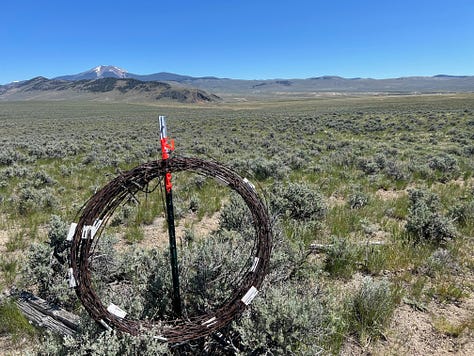
“It feels healing,” I told the guy pointing a camera at me, every joint and muscle aching and my forearms scored with cuts. “For the land, I mean. Trail work is harder, but taking down all this barbed wire? It feels like it’s healing something.”

I feel like a dork saying such things, even when I know they’re true, and even when I know my words, if I can find the right ones for honest sentiment, might persuade a few more people to sign up for volunteer work like this, spending two full days in the sagebrush terrain of southwest Montana removing miles of barbed wire fencing for the purposes of easing pronghorn migration corridors. To wake up to birdsong and near-freezing temperatures and gather just past 7 in the morning to carpool (or truck-pool; even my sturdy Subaru couldn’t handle the two-track dirt ruts we had to drive) to the work site and don work gloves heavy enough to withstand the fierce jabs of old barbed wire.

The cameraperson asked me about my bleeding arms and I said I should have worn a long-sleeved shirt. “This is called poor choices in safety equipment,” I said.

I was desperately tired at that point, as well as bleeding. We were nearing the end of the 2.3 miles (about 3.7 km) of fencing, and I’d spent most of my time rolling up reams of 5-strand wire after others on the crew had gone ahead clipping it from fenceposts and those behind were using a hydraulic jack to remove stubborn T-posts (those are metal fenceposts, as opposed to the wooden ones, many of which came out easily or were broken from rot). It didn’t seem like much, walking through tough sagebrush while winding springy, cantankerous barbed wire around itself, but the hours and miles piled up. 

While my own body wanted to rebel against the work and the eventual heat of the day, wanted to jump into the rushing creek and rest under the aspens growing alongside it, watch the camas grow and the water flow, it did, still, feel healing. While we worked, a couple pronghorn in the distance slipped under barbed wire fencing. Pronghorn, as I wrote about when I first did this kind of work three years ago, won’t jump fences. They slip underneath, and that bottom strand of sharp barbed wire often results in injury. Taking out the fencing, or replacing that one strand with smooth wire, removes a barrier in their migration corridor that they’d never asked for and hadn’t agreed to.

It felt good to know that after over a century of damage and abuse of this land, we were doing something, even a small thing, to improve the lives of those who live on it. I can’t think of many better ways to spend my not-quite-free time.

Earlier in the spring, before what I’m starting to think of as my personal “grueling volunteer labor season” began, I was at a Montana Master Naturalist gathering, with short classes on botany, geology, and meteorology (which is where I finally learned how graupel—a hail-like snow that’s always intrigued me—is formed). During a walk with a professional botanist, we smelled the butterscotch scent of Ponderosa pine’s bark and came across young camas not quite in bloom, and I got distracted by varieties of forget-me-nots, a flower I have a special, very personal, affection for.

The botanist didn’t make a lot of commentary, but while we were focused on the camas leaves, he told us about how nearby Blackfoot Valley had once been covered in camas. Entire peoples could gather there, he said, and be fed. 

“Then Europeans came and turned that entire valley into cow food.”

Much as this story isn’t new or surprising, that line still hit like a blow. I’ve driven through that beautiful valley more times than I can count, tried to rein in grief and anger at the ubiquitous fencing, the “No Trespassing” signs, the dammed river, the cattle. Imagining it without said fencing, signs, dam, and cows. Imagining it, now, covered in purple camas spread widely enough for nobody who comes there to go hungry. As a place of gathering, celebration, community harvesting and cooking, sharing, and safety.

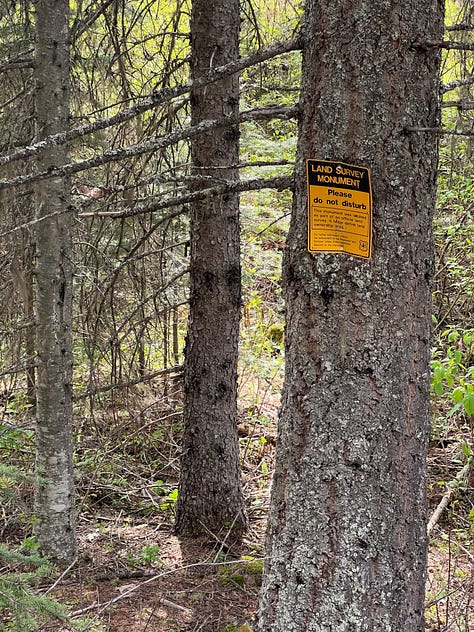
On the trail maintenance crew I worked on in designated wilderness a few weeks later, the crew leader and I came across abandoned wire—smooth, not barbed. I tripped over it. “Telephone wire,” he told me as we gathered some of it up. “The Forest Service used to be responsible for maintaining a phone line all the way from here to Ovando.” I thought of the vast mountains between Ovando and where we were, our long, harsh winters, and the seeming insanity and waste of trying to keep an operational phone line between the two. 

This society we live in operates on such insanity. Survey markers, fences, hard borders, and laws separate life, and technologies like phone lines and highways reconnect, but only in the narrowest, and often most destructive, ways. As if we keep trying to meet some innate, unavoidable need but using all the wrong methods. I can’t reconcile the theft and conversion of the Blackfoot Valley from shared camas to private cow food, with the fact Ovando, which is in that valley, was for a few decades connected by telephone across a mountain range.

Sarah Augustine, a Pueblo (Tewa) descendant and cofounder of the Coalition to Dismantle the Doctrine of Discovery, wrote about private land ownership’s multi-generational destruction of community and survival in her book The Land Is Not Empty:

“Private property is an erosion of community and collective identity, survival strategies core and fundamental to humanity. Private property is divisive for all people. Private property disconnects us from each other and from responsibility for each other. This is true for all people groups, not just for the Yakama, not just for Indigenous peoples.”

The answers are right in front of us, if only the barriers in our minds, barriers forwarded and maintained by power and insatiable want, could find ways to dissolve. Make their ways back to seeing generosity and care, and shared responsibility, over manufactured scarcity and perceived fear as not only preferable, but perfectly possible.

It was hard not to think of that line about camas and cow food during my weekend removing fencing. We removed two different sections of fence, and near both of them I saw camas in bloom, most of it on private land. Which means that this beautiful little purple flower, this source of nutrition, sustenance, and ceremony for many, is all too often and through no choice of her own, barricaded behind legal and physical lines of private property—property most often used to raise cattle.

I wrote a piece about borders a few months ago that probably had more and longer comments than nearly anything I’ve written here. For those who have been around this conversation-heavy newsletter a while, you know that’s saying a lot. Borders are physical, but they are also emotional, social, psychological, and cultural. And legal. The strongest borders of all might be in our own imaginations, in the belief that any of us have a right to own anything at all, especially other forms of life, and especially that any of us have the right to deny access to life, to survival, to anybody else. 

How do you get a culture that believes in barbed wire fencing and private property rights but not in a right to survival? This question has come up in this newsletter more times than I can count, and I doubt that will change. It’s an ancient struggle fed by an ability to accumulate power and resources, and resistance against the same.

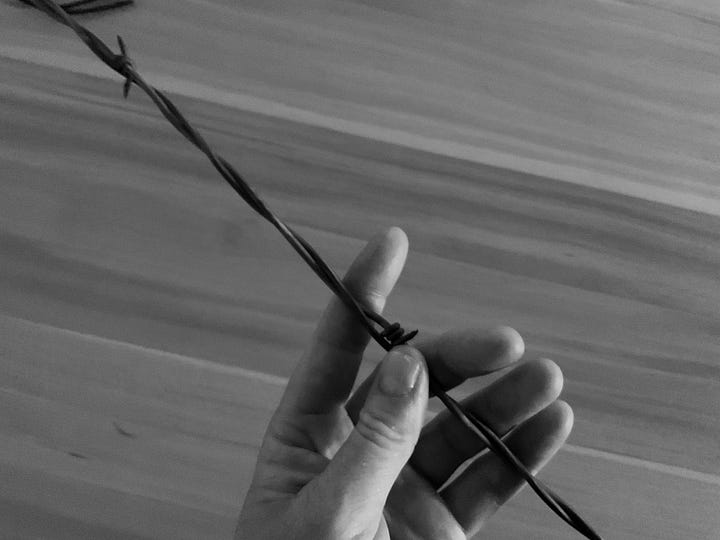
I brought home a short cut of barbed wire and put it on my desk to remind me of the purpose of this work: to find ways of helping us all see a world where that kind of technology has no place. 

Wander, Lost

Welcome! For those new here, On the Commons explores the deep roots and ongoing consequences of private property and commodification—from the Doctrine of Discovery to ancient enclosures of the commons, and more—along with love for this world and being human in the middle of systems that often make such “being” difficult.

Book update: Apologies for the continued “wow it’s been many months since I intended to have this chapter out” delay. I have taken apart Chapter 1 of No Trespassing for the fourth time, but this time because, when I was describing my difficulties with it to a friend, she gave a piece of advice that showed me what I’d been missing. It’s finally coming together as it was meant to.

New podcast interview: “Land, democracy, identity” with UK-based Future Natures.The path from writing about walking to private property and ownership, how they each intertwine and conflict with freedom and senses of identity, and how craving for land relationship can drive both love and extremism . This has been one of my favorite podcast listens over the past couple years, and the larger projects of Future Natures have become a go-to resource.

5% of this quarter’s On the Commons revenue will be given to the Flathead Warming Center, the only low-barrier houseless shelter in my general region.

There’s a place I’ve been taking my family camping for nearly ten years. It’s a campground around an hour’s drive from where I live, on the far side of a reservoir whose waters hold some fond decades-old memories of lingering with boyfriends, along with a couple regrettable memories involving fire and the irresponsibility of teenagers. (The fact that nobody was hurt aside from lost eyebrows was sheer luck.)

To get to this campground, we have to drive to the far end of the reservoir and then thirty miles along a gravel forest service road. It’s a place where every summer my and my friends’ kids stuff themselves with huckleberries and spend hours in the water and nobody can access text messages or online games, much less email. For four days or so I wake up hours before everyone else and sit with coffee and the calls of Swainson’s thrushes as Sun makes his slow way up from behind mountains so tall and close they almost feel looming (isn’t that a great word? looming), but in a comforting way, like a protective uncle.

The surrounding forest backs against the Great Bear Wilderness to the east, with Glacier National Park a little ways north. When I’m there, I manually direct my brain to these facts because for some reason I’ve never been able to understand, I feel very turned around for the days I’m there, as if I don’t know where I am in the world. It’s not uncommon for me to get lost, especially when in a city and nearly always when driving somewhere for the first time, but in non-city areas I usually have a pretty good sense of place, if not direction. It’s one of the things that makes maps so delightful, being able to trace a finger along terrain or position and feel the embodied reality of one’s own self within that represented space, feel the feet tingle in the knowing of here I am. I have a hard time feeling that sense at this campground.

For years I’ve wondered if my place-confusion there might have something to do with being on a huge reservoir. When we’re on the water, paddleboarding or kayaking or just swimming, there’s an eeriness that is unrelated to my phobia of deep waterThis is a drowned river, is what comes to mind as I try to ignore the growing conviction that deep-water monsters are going to pull me under.

A drowned river. It sounds nonsensical. It’s all water. But rivers have spirit and shape and purposes of their own, all of which is smothered when a dam is built to stop their flow and extract their energy. 

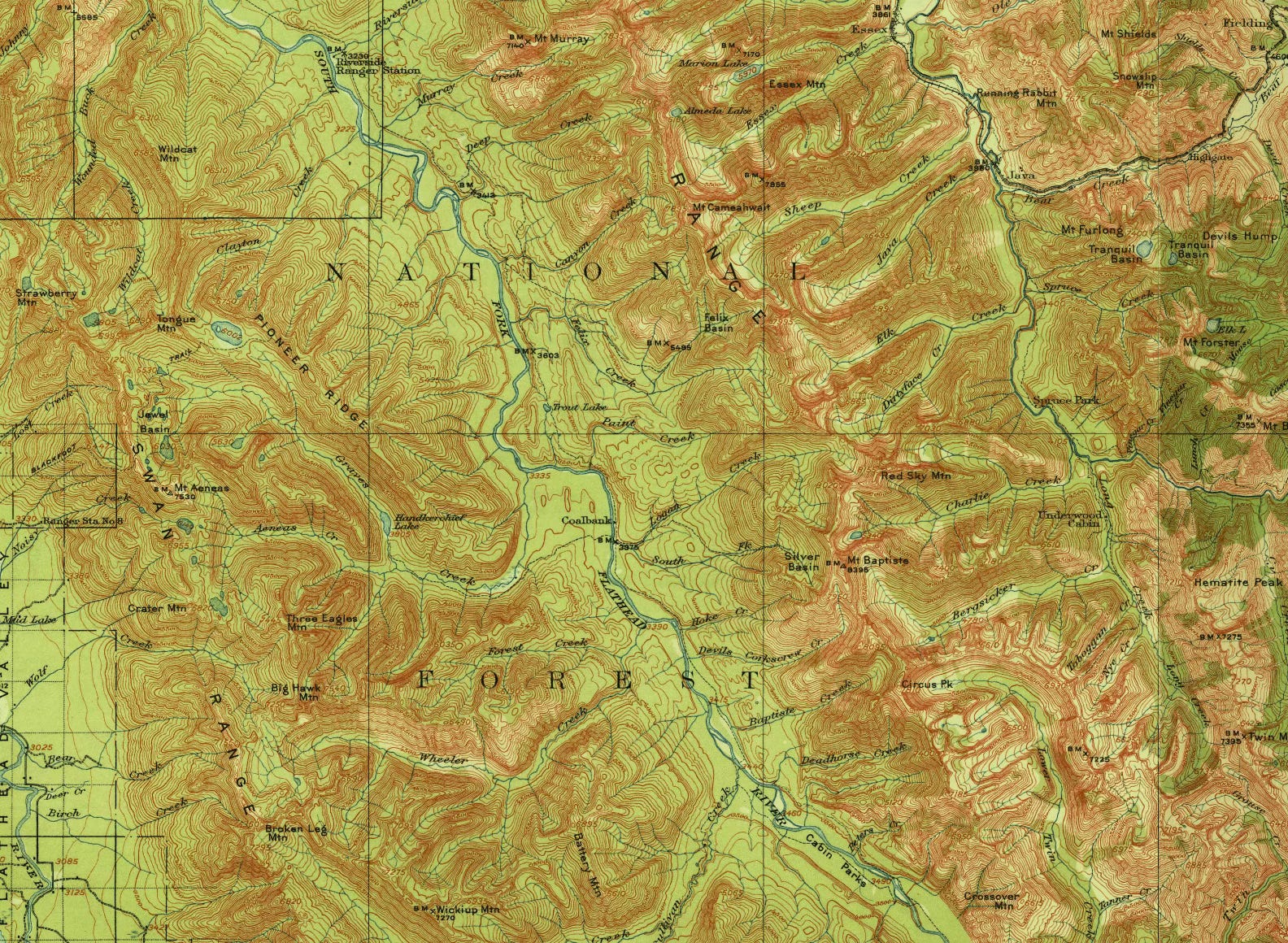
A friend reminded me recently that I’d been meaning to look for old maps of this area from before the dam was completed in 1953, to see where the river, the South Fork of the Flathead, flowed when she was free. So earlier this week on our way north on a day of sleet, snow, and fierce wind, my younger kid and I stopped in at the forest service’s ranger station, where there turned out to be no old maps or any idea where I might find them. But it was a slow day and someone’s interest was sparked enough to spend time poking into CalTopo online for historical maps until she found what I’d been looking for. 

And there she was, the South Fork, undulating through a narrow valley as mountains spilled streams and creeks into her, receiving snowmelt and rainfall as she headed down to Flathead Lake. Next to her, the modern reservoir looks less like an expansive lake we play on every summer, less like a monumental feat of engineering, and more like many technological outputs of modern humans: a little grandiose. And temporary. The reservoir is fun—and of course it’s still water, with its own voice and energy—but it doesn’t have quite the same sense of wholeness, the this-lifeness, of the river. I look at that old map and feel oddly relieved. Like I finally know where I stand.

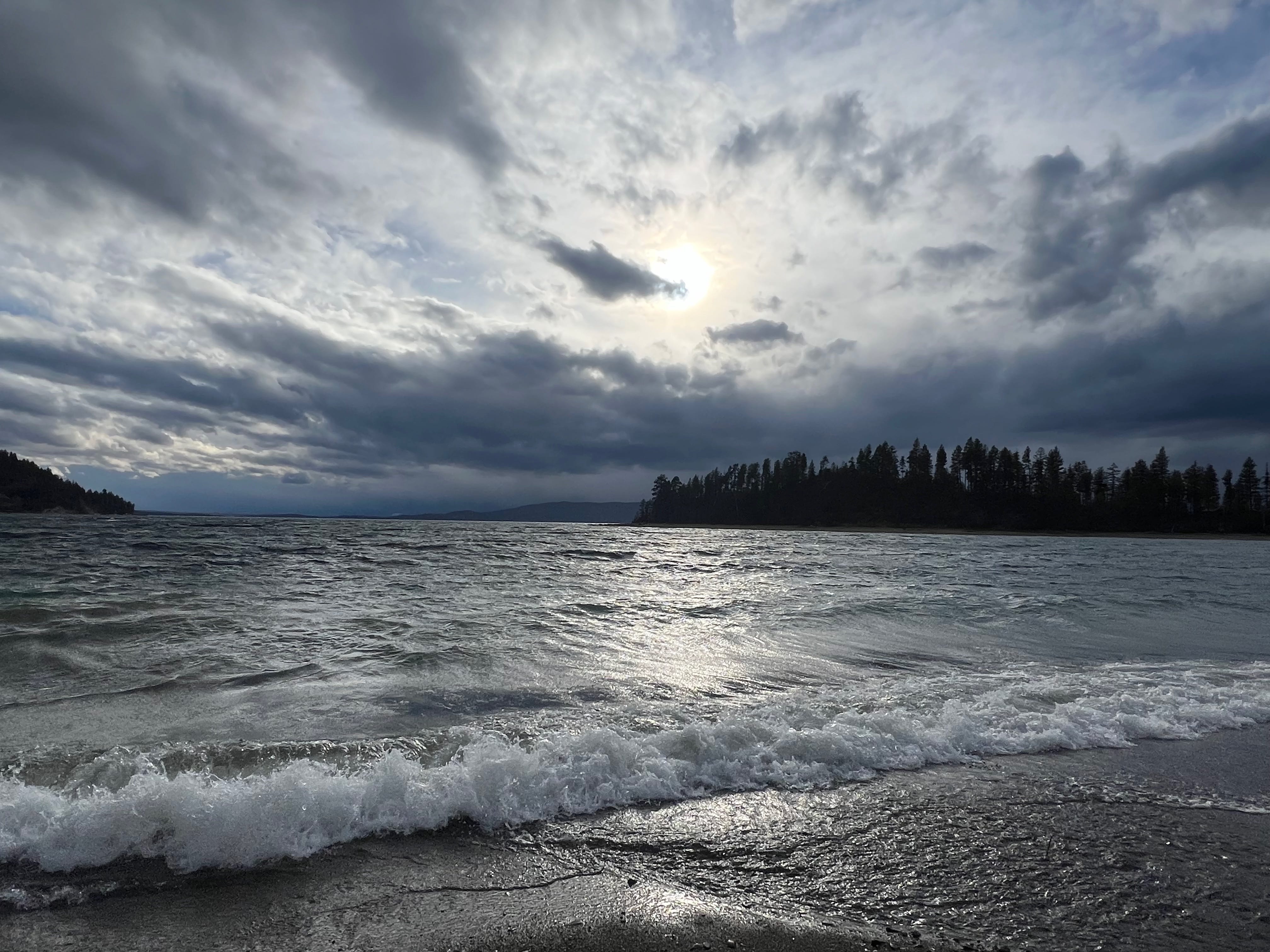
On the left, the modern landscape of Hungry Horse Reservoir. On the right, the South Fork of the Flathead River before it was dammed.

During the Q&A session after a recent online presentation, someone asked me about the chapter titles in my book A Walking Life—nine iterations of “Stumble,” “Lurch,” “Stride,” and so on. I don’t think anyone’s ever asked me that before, and it took me a minute to remember that I had originally used similar section headings—variations on “walk” and ideas related to it—for the first essay I ever wrote on walking, years ago, for the small literary journal Lunch Ticket, titled “Wander, Lost.”

It was in that essay that I first linked freedom of movement with freedom of thought. It was also, as far as I can remember, the first time I thought of both as, tangentially, related to the movement and constraint of rivers.

“As our freedom to walk becomes ever more constrained, as air quality and housing developments and busy roads force us to spend more time in our homes and cars, we might lose even the words of movement that reflect every land-tethered animal’s most basic motion. Ramblemeanderroveroamwanderdeviatedigress—will they slip into disuse, become arcane ideas? As we forget that they ever applied to our physical bodies, to our ability to get from here to there or from here to nowhere in particular, will our minds lose the ability to do the same? What happens to our ideas and bodies when neither can wander aimlessly, get stuck in the mud, backtrack, reconsider, keep moving until we find ourselves in a place beyond our knowledge? . . .

. . . like a river that’s been straightened and reinforced with concrete, exploding every now and then in an anger of floodwaters but never again allowed to meander. My mind has begun to feel the same.”

I think constantly about the relationship between freedom of movement and freedom of the mind. I have an unpublished essay on the subject lurking in my files that might or might not ever see the light of day, structured around the movie WALL-E, which I’ve watched about twenty times, and it came to mind again recently when reading Thomas Pluck’s novel Vyx Starts the Mythpocalypse, as Vyx’s parents are taken by the government’s Ice Men who then stalk their path as they travel the land in search of safety, running into awakened mythological beings along the way. Control of thought—including the freedom to live as our true selves—and control of movement go hand in hand. 

“Wander, Lost” also provided the seeds for the sections of A Walking Life about my father’s life in the Soviet Union and the ways in which interpersonal and public trust can make or break a society, especially when it comes to government suppression of speech and protest, and how personal relationships are weaponized in its enforcement. 

Trust is, like the freedom to wander, an invisible force whose degradation can make visible the erosion of liberties to those who had always thought themselves free. What one once might have thought endless and inviolable is revealed to be that which can be taken, and lost. Kind of how degradation of a river ecosystem can’t help but be reflected in the health of every single life touched by its waters.


I’ll probably never get to meet the river buried under the reservoir we camp at. Hungry Horse Dam is one of the largest in the country, and seen as essential in a network of electricity-generating hydropower dams along the Columbia River watershed. But there’s something about seeing a map of where she was, the free river, that might help orient me next time I’m up there. 

At the very least, when the kids race down to the little peninsula where they watch the sunset, I can remember that while the placidity of the water is a human-made artifice, the beauty remains wild and free, and something of the river reaches up to meet that evening glow, to say the river is not gone—her stillness won’t be forever. It might be generations in the future, but she will one day find her familiar curves, playgrounds, and resting spots again, running her way through the mountains as she was meant to. Free to roam. 

If we’re lucky, someday our freedom to wander, too, will be un-lost. 

To walk a prayer to the world

Imagine yourself in a cabin, curled up on a beaten couch in the corner of the small room shared by a couple of bunk beds, a table, a counter and stove, and you. It’s night out, and an almost-full Moon was rising in the south when you went out earlier, a boreal owl barely audible from the woods.

The propane-fueled fireplace is warm but doesn’t give off quite enough light to read by. But you sink into the pages anyway, take them slowly because you’re in that kind of mood. You watched a whole flock of bluebirds for an hour earlier, and as you drove up to the cabin, a bald eagle flew overhead. There are no people nearby. You are fed and tired and ready for bed; to slip into it via firelit poetry feels perfect.

As you turn the pages, something happens, a quiet internal earthquake. It’s not one particular poem or line or turn of phrase, but the accumulated effect of their weight: quiet and light, like snowflakes, carrying that same balance of power and delicate beauty. The poems each strip away a layer of something, you’re not even sure what, and by the end of it you look up at the flames slightly irritating in their gas-powered sameness and think, That’s where I’ve been hiding


A few hours earlier, I’d been standing by the side of the road watching bluebirds. I have never seen so many bluebirds in one place. At most I see one or two of them a year, their impossible bright colors a flash of delight. There were at least ten, maybe fifteen, flying among last year’s grasses, barely pausing on the dry branches waving in the wind. I truly could not believe my eyes. At the far end of the field, a couple of elk romped together among their herd, and snow-clung mountain peaks stopped up the horizon like a postcard for Montana.

My feet ached to wander into that field, wiggle toes into the soil that could draw so many bluebirds. 

My friend 

Amanda B. Hinton and I were talking recently about the ease I feel when letting my feet rest in running water, the concept another friend had proposed of feeling “grounded in flow.” Maybe, Amanda wondered to me, you pray through your feet. That idea tasted like a fresh wild huckleberry on a hot hike when I’ve run out of water, reminding me of something 

Chris La Tray has often quoted from Eddie Benton-Banai, that “to live an Anishinaabe life is to live one where every footstep is a prayer” and the fact I sometimes forget, that I’ve spent years now devoting my professional and personal life to walking this world and relating to it as deeply as possible. The more I do it, the more I want to do it.

Which is how I ended up writing about ownership, private property, and the commons in the first place. Because too many places I yearn to walk, like that field of bluebirds and elk, are inaccessible not due to terrain or danger, but to the simple fiction of ownership.

It’s a friendly No Trespassing sign, the orange almost cheerful, the font relatively friendly, and no hint of being shot at—far too common in Montana—for crossing the barrier, but it’s a barrier nevertheless.

In his book Enlivenment, the German philosopher Andreas Weber writes of the enclosures of the commons throughout Europe as not just a denial of physical sustenance and survival, but of a spiritual severing. Enclosures and the rise of the market economy 

“not only governed the allocation of land, but also redistributed the spaces of our consciousness. In reality, the forced separation between that which gave life (the biosphere) and those who were gifted by life (the commoners) was an act of violence on the part of the landlord, who excluded members of the ecosystem from their rightful positions and thereby damaged these participants, the ecosystem itself, and the unifying experience of self-organizing coherence.”

Commons, Weber had written earlier, is a system in which there are no users or resources, “but only diverse participants in a fertile system, which they treat in accordance with a higher goal: that it continue to give life.”

When the land was no longer commoned, when it was stolen for the purposes of private ownership, it could also no longer be related to. People were denied access to that most fundamental yearning, to relate to the land we live with. Their minds were bent, by force—the number of bloody rebellions against enclosures of the commons might be surprising to those who assume private property came about naturally—to see themselves as separate from nature, disconnected from land and a living world, and able to survive only by working for someone else—the genesis, commons scholar Peter Linebaugh has said, “of the j-o-b.”

We know how well all of that has turned out.

Dismantling the story behind private land ownership, and exposing the lack of foundation for laws defending it, is necessary to finding a way out of it. But so is restoring a shared relationship with all of life. I wanted to walk that field because I am alive and the field is alive and the bluebirds were so beautiful I wanted to cry and it means something to know that, and to know it’s true and right to feel that way, even if the No Trespassing signs stop me acting on it.


The book I read that first night at the cabin (for those who’ve been around a while, this is the same cabin I stayed at about a year ago where the heat didn’t work and I turned around on a hike after coming across a fresh grizzly bear track) was by someone I was fortunate to meet recently, poet, essayist, and woodworker Charles Finn. He’d generously given me a copy of each of his books: Wild Delicate Seconds, a book of short essays, and On a Benediction of Wind, a collaboration between Finn’s poetry and the black and white photography of Barbara Michelman. 

It’s tempting to spend the rest of this space quoting numerous lines that I keep going back to, like

“Above the geese the soft colors of the afternoon deepen into a tremendous wound and a gibbous moon is birthed, shadows crawling over the snow to dissolve into the river”

from Wild Delicate Seconds, but like most reading for pleasure and insight, how anyone receives those passages will be personal to them. There’s a quiet reverence for the world that invites rather than demands the reader’s attention, both to the writing and to the lives it honors. I read On a Benediction of Wind all in one sitting that first night, which I don’t think I’ve ever done with a book of poetry, and at the end I closed it and stared at the fire and went out to visit with Moon and felt, for the first time in a long time, a steadied feeling of being at home—in the world, and in myself.

The next day I chose a trailhead at random and walked barefoot for two miles on dry pine needles along a waterlogged trail, the nearby river free to stretch herself over the ground. I spent hours by the lake after gasping into its snowmelt cold, watching the waterfall far across the valley, crashing snow from its mountains’ embrace through a ravine and brushing into my dripping hair snowmelt and sunshine, a wolf’s nose nudging a track, a wolverine’s strand of fur, the promise of berries still sleeping, and the call of the loon diving under spring’s early waves.

“Conspires,” from  On a Benediction of Wind

What gets delivered with the compost

Welcome! For those new here, On the Commons explores the deep roots and ongoing consequences of private property and commodification—from the Doctrine of Discovery to ancient enclosures of the commons, and more—along with love for this world and being human in the middle of systems that often make such “being” difficult. 

If you’d spent most of your life under skies like this, might gray be your favorite color, too?

In a week or two, a few yards of compost will get dumped on the edge of my garden. This is arguably one of the events I look forward to most all year. The ground is still too cold to work in it much—it snowed again yesterday and nights are back below freezing. (I accidentally typed “freezling” there and I like it so much better. Freezling has delightful possibilities.) At this point in the year, the garden’s emerging green prompts only eager possibility, before the pressure of weeding quack grass and thistles gets to me, before we head into when my year truly starts, the hot days of August when I’m strategizing huckleberry-picking days and tomato-canning sessions and keeping an eye on when the chokecherries are ripe. 

Compost delivery speaks of warm mornings watching tree swallows in the nesting box while I pick strawberries and snack on peas, talk with sweetgrass, which I checked on as soon as the snow mostly melted, and was taken aback by how many new plants are peeking up. Some of them are undoubtedly quack grass, but there are plenty of telltale red-tinged tips. I cannot wait to smell her in the warmth of June, gently coax her strands into braids. 

Our local compost service is one of the best understated things about where I live. Every week my five-gallon bucket gets picked up, more or less full of cucumber ends, pizza crusts, moldy cheese, steak bones, coffee grounds, overripe avocados. It gets taken to bear-proofed land not far from here and joins similar bucketsfull from households all over the valley, along with larger bins from local restaurants, to heat up to the point when a variety of bacteria begin to break all of it down and turn it into dirt, helped by viruses, fungi, and of course worms, slugs, nematodes, and all the other tiny creatures less immediately attractive than, say, apex predators, but no less vital to keeping a living planet alive.

Every year, when those yards of compost slide out of a truck in my garden, I get a little thrill thinking of how contained it all feels, how efficient, to see consumption turned back into something fertile and full of life instead of tied up in a plastic bag and added to the mountainous landfill just outside of town. That growing mountain of trash, and the fact that when I was a teenager thirty years ago the landfill was not a mountain, but a pit in the same location, makes me want to try harder to live close to home, to take more responsibility for this place I love so much and all those who depend on its vitality. To eat more huckleberries and spruce tips gathered from the surrounding mountains and far fewer avocados shipped thousands of miles from places whose dire water situations I’m too well aware of to pretend ignorance. 

Putting my hands in compost prods me to make fewer choices that make other communities’ lives harder, but what I like about it is that it does so by reminding me how much joy there is to be found in loving and taking responsibility for the life I live among.


There’s something I learned years ago that often haunts me in the hours of darkness when sleep is elusive: when the Three Gorges Dam in China was completed, controlling the flood cycle of the Yangtze River, it altered Earth’s rotation enough to add 0.06 milliseconds of daylight hours to the planet.

I read something similar, though not as drastic, about depletion of the aquifer under California’s agricultural region, one of the things that contributed to my mostly giving up almonds. 

You only have to read a handful of scientific papers to start seeing how vast the planet-wide relocation of water is, from ubiquitous and often unnecessary dams, to water-intensive alfalfa grown in Arizona to feed cows in arid Saudi Arabia, to the thirsty avocados grown in Chile or Mexico that end up in my compost bin.

Trade and exchange have been around essentially forever. How much is too much, though? How far is too far? How do the critical quantities of phosphate mined in the Western Sahara and sent to fertilize farms all over the world compare with peat moss harvested fifty miles from me and used to feed gardens like mine? What keeps my sleepless hours company isn’t some nightmare scenario where humans screw things up enough to throw the planet completely off her orbit; it’s more of a philosophical question. One at the core of most of what I write: how do we live together? Not just humans, but all of life. 

If there’s a balance, it’s one that shifts constantly over time but one thing I think is certain: if that balance is to be in service of life, it must be determined by kinship and care, not by what one region wants that another happens to have. It must be determined by a deep sense of right relationship, not by who has the power to take and who lacks the power to say no.

It’s hard to undo built-in consumption practices, much less to escape the systems that enable them. The meat my family eats is almost all local and a lot of it is wild, brought home through my own efforts and the generous gifts of the land I try to live with. But the bags of lemons I bring home from Costco aren’t. I grow the strawberries we eat, but not the frozen blueberries in winter. Knowing too much about the environmental and social costs of the floral industry, I rarely buy cut flowers for people, but I still use coconut oil for my homemade lotion.

All of these end up in my compost in one form or another. I like that I can think of food eaten in my home cycling into dirt and transforming into food again, but as much as it helps decrease the growth of that landfill outside of town, how much weight has it also shifted from other places on this planet I might never see but that are beloved by those who live among them? How much of the soil I use to grow strawberries and potatoes carries with it the gravity of others’ hardships?


The compost will be delivered, and I’ll ask the driver about her now-toddler while we rake it out of the truck, and she’ll leave and I’ll stand in my muck boots and stare at the pile and think of what will grow from it. I’ll wish, as I do every year, that a strong friend or two would come by and help me shovel it all onto the garden beds in time to get the potatoes in.

That would be a gathering, wouldn’t it? Skip all the writerly readings and presentations and workshops and you all could come over and help get the garden started or just hang out watching flickers and tree swallows, and I’d cook big pots of things for every variation of eater and we’d lay wood in the fire pit and sit around muscle-weary and well-fed, and drink water from the aquifer my well draws from, and tell stories while the sky slowly melts to dark and the stars come out and the air turns freezling and Moon comes out to join the party. 

A gathering like that would be something like compost, where there are no hierarchies or leaders, no unnecessary suffering, no waste, and everyone has a part to play, a contribution to make, simply by existing. We could create our own human ground where the potential still remains for so much to grow.

Building Local Power had a nice overview last year of small compost businesses and the barriers they face—from land access to funding—as well as their benefits.

Evening Moon

The East India Company and the power of corporate stories

Welcome back to On the Commons! For those of you who are new here, On the Commons is a newsletter exploring ownership and its inevitable injustices, investigating centuries of philosophical and legal arguments made in defense of private property for a much simpler explanation: theft. Or in other words, “I took it; now it’s mine,” and the consequences both large and small for our shared world. 

This is an updated, slightly revised version of a post first published on 31 December 2021. This is the third in a series of essays republished from earlier years. The previous one was on the Doctrine of Discovery.

Both top and bottom photos are of No Trespassing signs on the fence of land owned in my town by the Burlington Northern-Santa Fe railway company.


The Boston Tea Party is one of the defining stories of America’s founding as a nation. I remember learning about it year after year in school in the 1980s. Probably every American kid does. What was never said in those scrappy little classrooms across Montana is that the story of the Boston Tea Party is also one of the sharpest tools wielded in defense of the mythologies that make up the American ideal. The fact that it was an illegal riot that destroyed private property doesn’t just get glossed over; it’s never presented that way, not in the U.S. anyway. To present it that way would fly in the face of the American ideology that private property is bedrock. Instead, the story is presented as noble: the little nation that could refusing injustice imposed by a far-off monarchy. 

What also gets glossed over is that the impetus for the riot wasn’t simply taxes; it was taxes imposed by government in order to benefit a private corporation.

The struggle over taxes in the British colonies of North America had been ongoing for years. The tax on tea, however, had a second purpose besides enriching King George III: the British Parliament wanted to keep the tea tax as a symbolic acknowledgment that the government maintained its right to tax the colonies, but they also wanted to help the East India Company claw its way out of debt. The story of the Boston Tea Party, the real one, points to the longer history of government enabling corporate power and profit until it essentially becomes an arm of the corporation itself.

The East India Company had its own private army. It in effect controlled all of India at one point, nominally representing Britain’s interests but serving its own. 

Swarnali Mukherjee has written extensively in Berkana about what the British Crown and the East India Company’s actions meant for the economy of India. I encourage you to read the entirety of her essay on this subject, to understand the importance of the point she makes:

“The construction of railways was funded by Indian taxpayers, and the economic benefits often flowed back to Britain in the form of profits pocketed by British shareholders. The total wealth drain of India under British rule, in today’s value is an estimated $45 trillion.”

As with many of our modern corporate-government revolving doors and mutual back-scratching habits, the interests of the corporation often enveloped, or became, those of the state, as noted in this Financial Times article on the East India Company and its implications for modern capitalism

“The EIC remains history’s most ominous warning about the potential for the abuse of corporate power — and the insidious means by which the interests of shareholders can seemingly become those of the state. . . .

For just as the lobbying of the Anglo-Persian Oil Company was able to bring down the government in Iran and United Fruit that of Guatemala in the 1950s; just as ITT lobbied to bring down Salvador Allende’s Chile in the 1970s and just as ExxonMobil has lobbied the US more recently to protect its interests in Indonesia, Iraq and Afghanistan, so the EIC was able to call in the British navy to enhance its power in India in the 18th century. And just as Facebook today can employ Nick Clegg, the former UK deputy prime minister, so the EIC was able to buy the services of Lord Cornwallis, who surrendered Yorktown to Washington.”

It’s a long but excellent article (and unfortunately I think now paywalled), detailing the Company’s permission to wage war, and instances of forced privatization across the world at the Company’s behest. It also points to England having isolated itself from the rest of Europe due to wars over religion (I assume the author was referring to the abandonment of Catholicism and establishment of the Church of England) as a factor prompting the country to look for markets outside of Europe, a vital ingredient for colonialism: 

“The English were forced to scour the globe for new markets and commercial openings further afield, and to do so they had no compunction but to use, for the first time in history, unbridled corporate violence.” 

One of the questions I keep asking myself is if government, of almost any form but particularly of the nation-state, has always existed to serve private interests. Its main claim to enforcement of law is a monopoly on state violence, most often employed in the name of protecting private property, rather than protecting citizens from harm.

This is obvious when you look at laws and police actions against something like constructing an oil pipeline. The pipeline is private property built in pursuit of profit; therefore, it qualifies for legal protection from the state even though it threatens clean air, water, and soil—even if it takes others’ private property in turn. The U.S. government’s power of eminent domain, after all, was first used for private gain when railroads were being built across the continent, and has continued to be wielded in the name of private profit ever since—the Supreme Court decision in Kelo v. City of New London (2005) and the Pennsylvania District Court case granting eminent domain to a pipeline builder over the objections of a family of maple tree farmers in 2016 are only very recent examples of a longstanding pattern.

What to do about it is another question. Even democratically elected representatives are eager, as we see all too clearly every day, to promote corporate interests over that of their constituents if it assures them a safer and longer place in a seat of power. We need democracy and the right to vote, but those tools aren’t enough to assure a livable planet and lives of dignity. They are necessary conditions, but not sufficient.

There’s a tendency to just say, f— it, burn it all down and start over. But that’s been done more than once throughout history, in several places within living memory, and all it results in is a lot of suffering and the same cycles starting over again. It’s as if there’s something broken at the center of humanity, or at least a sizable portion of humanity, and we’re never going to find a better way to live together until we clearly define the shape and scope of that brokenness. As long as we* accept structures that prioritize private profits over life and health, pollution and structural injustice is all we’ll get. 

If I believed in the devil, it would be someone in a sharp suit promising me two or three generations of decent jobs in exchange for the water, soil, and air I depend on, with the added bonus of sacrificing my kids’ health and senses of themselves as free human beings. It is the purest kind of evil to smile and hand out some cash while snipping the threads that link us to life.

The stories we tell and accept about ourselves and others have tremendous power. If we can change the stories, maybe we can begin to change something about our lives.

Instead of trying to burn it all down, plenty of people focus on building from the ground up—better systems, better ways of doing and being and living: this profile of a local food and farm co-op in Washington is a reminder that even when things feel like they’re falling apart, there are people and networks all over the world trying to piece them back together. Montana’s Alternative Energy Resource Organization (AERO) has been working against corporate agriculture for decades, from lobbying for a different kind of Farm Bill that works for people and food rather than commodities, to producing the bulk of the country’s organic lentils and heirloom grains like kamut. Oakland’s Unity Council has also been working for decades on affordable housing, higher-quality food access, and integrated public transportation in Fruitvale, one of the city’s poorest areas.

There are plenty more. I’m reminded of these organizations and people every time I work on a story about urban planning, affordable housing, or pedestrian advocacy. They are everywhere. They just never get featured on cable news or the podcasts of so-called “thought leaders.”

Changing our systems to serve people involves all of these efforts. And they don’t have to be scaled up—they have most power and efficacy when they stay connected to a particular place and community. Instead of scaling up small, workable, place-based systems, we need to take out the support systems that keep oppressive conglomerations afloat, from tax subsidies to weak interpretation of anti-monopoly laws (which should always include what monopolies truly cost life). And of course to change the way a large percentage of human beings see themselves as co-existing with the rest of life, which is no small task after millennia of negating and oppressing this reality.

During a recent U.S. election cycle, my state elected a governor who ran on the tired trope of lowering taxes, “creating jobs,” and being a successful businessman. People in my state are actually very good at “creating jobs.” Small business owners sometimes feel as common as pine trees. Many of those jobs—upwards of 70,000—are dependent on a healthy commons in the form of clean rivers full of fish and public lands that provide the kind of solace and clean air that no job could touch. 

It’s often hard to get people to acknowledge the existence of these jobs and the kind of healthy shared commons that make them possible because our idea of a “job” is so starved of meaning and hamstrung by identity and self-perception. (Journalism jobs have fallen by 65% in the last 20 years, for example, while coal jobs have fallen by 61%, but we don’t hear much about the former.) Working in a lumber mill is a job; working as a fishing guide is, too, but also somehow isn’t the kind of job you’re talking about when you’re voting for “job creators.” Real jobs means lumber mills, slaughterhouses, car factories, oil pipelines, tech engineers. It means hundreds of people, massive profits for the bosses, and a no-holds-barred attitude when it comes to environmental destruction. Maybe it’s the type of job or maybe it’s the number of people employed at each operation, but there are plenty of small businesses that somehow don’t count when it comes to political rhetoric.

This is just a story we’ve been told, one that people then tell one another. But we are capable of telling different stories. We just need more people doing so, and then acting on them. 

The East India Company and various colonial governments were very effective at telling stories. They’ve left legacies of imperial pride that still resonate and warp people’s thinking today, and blind us to the dangers of corporate power. As that Financial Times article pointed out:

“We still talk about the British conquering India, but that phrase disguises a more sinister reality. For it was not the British government that began seizing chunks of India in the mid-18th century, but a dangerously unregulated private company headquartered in one small office, five windows wide, in London.”

The company did so with the support of the British Crown, and when the EIC was facing further debts from their activities and obligations worldwide, the Crown stepped in once again to help them recoup losses through a monopoly and tax on tea in what they saw as their “possessions” in America. To quote from the Boston Tea Party’s own museum:

“The British East India Company was suffering from massive amounts of debts incurred primarily from annual contractual payments due to the British government totaling £400,000 per year. Additionally, the British East India Company was suffering financially as a result of unstable political and economic issues in India, and European markets were weak due to debts from the French and Indian War among other things. Besides the tax on tea which had been in place since 1767, what fundamentally angered the American colonists about the Tea Act was the British East India Company’s government sanctioned monopoly on tea.”

The East India Company is one of many lessons throughout history of the dangers inherent in encouraging the mutual support of corporate and state power. There are countless examples to explore, like the land stolen throughout North America and given by the U.S. government to railway companies, with profits for the railway and timber industries continuing even to the present day. The timber company Weyerhaeuser, for example, first bought 900,000 acres from the Northern Pacific Railway in 1900, and now profits off of not just the trees grown on land they own, but on the land itself, which the combination of state and corporate power has turned into “real estate.” 

Phrases like that—“real estate”—carry their own stories, their own burials of what land has been, could be, and is. 

We can change what we believe, starting with what we think we know about history and the real, live world around us. We can tell better stories about what is possible and what we’re capable of. We need to, because corporate growth and greed will not stop taking and commodifying and destroying all that makes life worthwhile, nor will it stop fabricating stories that make vast numbers of people believe it’s inevitable, unstoppable, and probably for the best. We need more stories, better stories, and we need them everywhere in hopes that those stories can, over time, change what is.

Change takes a lot of time and a lot of work. We can start by finding and amplifying as many instances as possible of people doing real work in real communities to make their worlds better. We can commit to finding, and believing in, different stories—the ones that make us realize a different world is possible, and then making it probable.

*“We” is a word I frequently stumble over and have begun to specify more clearly since this piece was first published. Fundamentally, I think English just needs a different word, or a few different words, to bring about more nuance when talking about societal thinking that shouldn’t be characterized as “us vs. them” while also finding ways to make it clear who is meant by every varied instance of “we.”

Let the flow of time take you

On the Commons explores the deep roots and ongoing consequences of private property, commodification—from the Doctrine of Discovery to ancient enclosures of the commons, and more—along with love for this world and being human in the middle of systems that often make such “being” difficult.

Alpenglow-lit clouds at sunset, above the western peaks of Glacier National Park.

Last August I wrote about my time on a volunteer trail crew in the Bob Marshall Wilderness here in northwest Montana, about the river we camped next to and the trail we worked along, what it means to serve land and try to build a relationship with both river and Earth, and how, when I’m in areas where I have no phone or internet access, time itself becomes fluid.

“To sit on a charred log eating trail mix and hearing nothing but air in the foliage-less trees and a persistent woodpecker somewhere out of sight. To watch the light shift along those mountainsides. To spot snowberries and poke at the masses of Oregon grape, and to watch a river that slips through the valley like time itself.

Or it might be that time is slipping through us like the river. That’s what being out there does for me: it turns time into water.”

I felt that again last week, during my three nights at a U.S. Forest Service cabin I like to stay at by myself a couple times a year. This cabin is near the North Fork of the Flathead River, and ever since I started staying there a few years ago, I’ve found myself spending less and less time working and much more time hanging out with the river.

This trip, I intentionally brought very little work with me: Chapter 1 of No Trespassing, which I’m sorry to say I’m unsatisfied with, a couple of books to read, a raw essay draft I’ve been sitting on for over a year, and some half-baked ideas.

I touched almost none of it until the day I had to leave, and was okay with that. Instead, I devoted chunks of the afternoons to sitting by a fire, and otherwise spent hours by the river. A couple of hours before and after sunrise, coffee in hand, another hour in the evening to catch the alpenglow, and at least a couple hours in the middle of each day, when the sun was just hot enough to keep me from going hypothermic after (probably stupidly but I can’t help it) dipping in the freezing water.

A boulder under my head, I lay there listening to the water and an occasional robin, blinking at a dusky daytime crescent Moon in the northeast and Sun at a complementary angle, both high in the sky. Sometimes Canada geese flew over. Sometimes a thought passed through my head that I could, or should, go back inside the cabin and do a little work. I told the thought to gently carry itself off downstream.

To be completely at peace with that spot, occasionally asking the river a question, makes me wonder if it’s something of what place-time and space-time feel like if we could ever fully shake off imposed structures of time, deadlines, progress, and profit enough to find these moments of simply being. I feel like I got a hint of it there during those hours by the river, what it might be like to be wholly alive in a world that itself also feels whole, and there was—and is—nothing I want more than to stay within that awareness. 


For a few hours last week I was able to fully release anxieties about being productive, getting work done, earning a living. Bundled up against the temperatures near freezing, lying on a bed of river rocks, listening to water flow—it was like a recuperation regimen for the mind. It didn’t feel lazy. It felt necessary. 

In their book The Prehistory of Private Property, authors Karl Widerquist and Grant S. McCall repeatedly go back to the main difference that they see in a private property society versus one where private ownership of, say, land, much less water and food, is unknown: freedom to leave. That is, if you want to walk away from your people, or your place, can you do so and still support yourself? Can you walk away and find or make food, shelter, and clothing? In non-private property societies, the freedom to walk away and still live just fine is the norm. In private property societies, it’s almost nonexistent. You have to work to make rent. Land-rent, you might call it. Someone else owns the land, and you have to pay to live on it. 

The extent to which this reality runs counter to most of our existence, even if we’re just counting the few hundred thousand years that Homo sapiens have been here and not the millions of years of hominin evolution before that, is mind-bending. There have been territories and civilizations and controlling empires for thousands of years all over the world, but for most of our species’ existence, most humans had some kind of freedom to live on, with, and from land without needing to pay someone else for the privilege of existing. Until relatively recently.

We can’t all spend our time as we would wish not just because capitalism allows a few humans to hoard an increasing amount of money and power, but because the planet’s dominant societies force land to be privately owned, and make access to food and clean water something we have to pay for.  Priscilla Stuckey wrote a beautiful and very informative piece about the bizarre concept of land ownership recently:

“It’s a strange idea if you think about it, the idea that we can own land. Because land is not like, say, a shirt or a table or other objects we own. Land is something else altogether. Land provides the material that makes the shirt. Land grows the trees that make the table. Land brings forth everything—all our food, all plants and animals, all the forests and creeks. And us! Land has brought us forth too!

So it’s absurd to think that we could ‘own’ land.”

Around a year ago, I wrote about this same cabin, and explorations of time and attention, and how much I truly like working, how I could spend hours losing myself every single day in writing and research, and even copy editing work. 

“I like other kinds of work, too, like chopping wood and digging in the garden and pulling knapweed and spending whole days hunting in the freezing rain, or hiking miles to spend a couple hours picking berries and then processing whatever I’ve brought home or gathered from the garden, thinking about what’s needed to get my family through the winter and early spring. 

I do those things because I enjoy them and can make the time for them, but the reality is that as long as a few people at the top of the capital pyramid keep sucking up the richness of the world, including human labor and time and ingenuity as well as land and what are called ‘resources,’ none of those activities will ever amount to much more than hobbies, even for me.”

Add to that the question of land access. We have to pay to live on land, and at the same time people with far more money and resources can buy and cut off access to the lands where berries, roots, animals, free-flowing water, and trees exist. Can you walk away and survive has become, for me, a key question of freedom. In a world where you have to pay rent for your footsteps, freedom isn’t possible.


During these times when I run away from the online world and my domestic obligations, I’ve become accustomed to waking up in the middle of the night and spending some time with the stars. They were at their brightest this last week. Nights so clear it was like I was breathing a poem of air, and, with Moon setting earlier, the starscape hovered low, rich and full, our galaxy’s path clearly visible and the sky so transformed I wondered if, if every human could see the sky like this every night, smothered in starlight, we could all remember what it is like to walk among a living spirit world.

I met up with a friend a few months ago who has been through significant trauma, and now runs trauma workshops and mindfulness training. We were talking about grounding, and I told her I’d realized recently that when I feel out of whack and need grounding, the only thing that works is to put my bare feet in running water, no matter what the weather. “So you find grounding in flow,” she said.

I love that. Flow is where I ground myself, and it’s this river that has taught me that lesson most often. We should all have access to food, shelter, air, water, and medicines, but we need this, too: the freedom to find what brings us closest to home, to our selves.

I take gifts to the river when I go, and to the creek that lies hidden behind the cabin. No matter what I bring them, or how much of my coffee I share in the mornings, it never feels like enough for what I walk away with. All those hours by the river being reminded: you are alive, with all that could possibly entail if we had both the courage and freedom to embrace it, draw it into ourselves and walk out into the flow of existence we live in, remembering that time, and this water, are one and the same.

Sometimes it’s a fight to feel alive

From Yellow Bay State Park, Flathead Lake, Montana

I desperately want quiet. That kind of quiet you get in the midst of a forest where even the pervasive whine of traffic is too distant to penetrate. I’ve spent all week wanting nothing but quiet, as I attended meetings and bought fidgets for someone’s birthday and cooked dinner and did dishes and woke up so, so early and hugged the quiet, candlelit hours to myself like an infant who’s finally drifting off to sleep.

In those hours, the need for quiet crashes in. Sometimes—often—the online world is so noisy that I feel like I need ear plugs. Mind plugs? Even without social media, the nudges for attention from online fracture my thoughts and focus and capabilities. I told someone once that being online reminded me of parenting toddlers, with every minute broken by some version of “mom, MOM, Mom.”

I grew up without television service, without even a telephone in the house until I was almost ten. I didn’t have a regular email address until my late twenties (one of my brothers-in-law worked at Google at the time, which is why I’ve had the same email address since Gmail was in beta—20 years now) and staved off switching to a smartphone for nearly a decade after they were released to feast on people’s time and attention. And yet here I am, 47 years old, with one kid nudging adulthood, metaphorically whimpering in a dark corner to get some mental space away from my devices and the needs of online.

Not everyone has these problems. I keep having this conversation with people, who often recommend turning off notifications—I did that in 2017 and never turned them back on; it’s been years since I allowed anything but texts and phone calls to nudge me—and don’t always seem to understand that the addictive design of these devices is all too effective for some of us. It doesn’t matter how many apps we delete.

I spent too much money purchasing a dumb phone last month, the only one I could find that works only in grayscale and doesn’t accommodate any apps. As I’m slowly weaning myself off of turning on my smartphone (the camera is still an issue), I remind myself of what my mornings were like when I didn’t feel its tug. For years I’ve turned my phone completely off at night, as I do the WiFi on my laptop, so that I can get up in the early hours and do all the little things that make me feel whole and connected without staring into the face of that bright screen first, but I can still feel its presence stalking me around the house.

It’s more than the smartphone. Online communication and interaction manages to completely drain me on a regular basis. This was one of those weeks, where I couldn’t get offline because that’s where my work is and increasingly felt like I was at a loud party full of flashing lights, bad music, terrible drinks, feeling desperately tired and thirsty because the water fountain was broken, but I wasn’t allowed to leave.

Next week I have three nights alone at my favorite forest service cabin, offline and away from electricity, and all I can think about is not how much work I might or might not get done, but an almost desperate need to sit by the river and not think or do anything. To watch the long, slow shifts of light at sunrise and sunset. To spend the middle of the night awake hour staring at the stars and Moon if She’s visible. 

I have all sorts of strategies to manage my relationship with digital technology, put in place years ago for my sanity, creativity, and, as I’ve written about before, because my humanity is more important to me than finding conventional writing success, and I don’t like the human I am when interacting with social media. 

None of those strategies are really enough, or maybe recently I’ve been feeling the press of it all more. I had a wonderful, long conversation earlier this week with a good friend and colleague about this particular platform, and ended up realizing how much more difficult I find to use ever since Notes was rolled out and the social media-ness of it has increased. That doesn’t mean I’m leaving it (I tried setting something up elsewhere a couple months ago but simply don’t have the technical expertise), but figuring out how to open a tab on my browser and look at it, even to read other newsletters I like, without feeling instantly disheartened and drained, has been difficult. I’m bolstered by writers like Amanda B. Hinton writing about which newsletters she reads for nourishment, and all the tremendously good writing and research and interesting ideas I’ve seen, and even friends I’ve made, that I never would have without this platform existing. There are ways to be in this particular space without feeling like it’s taking more than it’s giving. At least, I hope there is. I just need to figure out my own balance.

But it’s also important, I think, to keep in mind that no technology is value-neutral. How it’s created, built, deployed, used, and discarded matters. I saw a comment elsewhere recently that said we’ll learn to live with and benefit from digital technology “just like we learned to live with and benefit from cars” and I refrained from answering that comment only because at this point it makes me very tired. I wrote a whole book about what we’ve lost to cars and car-centric infrastructure, how much damage we live with because of cars and the loss of walkability. It’s a very good book, and I think an important one. 

Funnily enough, when I sat down with my notebook to draft this, my intention was to mention my fractured attention and communication overload, and not write much at all but to share some photos of recent activities that keep me feeling alive and engaged with the world as I want to be in the world

In a way, that’s the crux of humans’ evolving relationship with technology—all technology, but digital in particular. In what ways can we manage to function with what’s demanded of us—and I use those words intentionally, because some people might succeed and even thrive in relationship with technologies, but there are always vast consequences unseen or unacknowledged or unimportant to people who benefit from them; most of life is simply trying to survive it—while being alive? Completely alive. Aware, conscious, attentive.

Every time I go to one of these cabins for days offline, or spend time in the wilderness, or go for a long walk along the river after school drop-off and before checking email, or spend wonderful, attentive time with a friend or few, it’s a fight not just for my own life, but for all of life. 

Aside from sharing research and ideas on private property, ownership, and the commons, I guess that’s what I’m trying to do here: share with you a love of life. The hilarious turkeys I can hear outside right now, and the very noisy magpie staring at me through the window, the way sunset last night melted its way through rumples of gray and blue-silver clouds, how the Milky Way has been visible the last three nights. The way the air doesn’t yet quite smell of spring and I’m holding on a little longer to my favorite season of cold and dark, the hours we’ve spent together in quiet aliveness. So maybe I’ll just be quiet for a bit and share some of that.


My brother-in-law and I recently took a wildlife tracking course together through Swan Valley Connections. As we approached the meeting spot, we slowed down for the awesome sight of a juvenile bald eagle feeding on a deer right by the side of the road. No photos of that (we were driving and he flew off), but we got to watch some bald eagle shenanigans for a few minutes before meeting up to go track wolves, mountain lions, mink, muskrat, and a ridiculous number of squirrel feeding sites (mounds of shredded pine cones), which I was so entertained by I neglected to take photos.

That same day, one of my college roommates, who happens to be one of my favorite people in the world and whom I haven’t seen or even talked with in about eight years, came to town with her boyfriend for a week, so I took some time off to drive them down to the Bison Range and around the entirety of Flathead Lake, which is gorgeous at all angles.

Doing things like these keeps me in touch with how I want to be spending my time. Not as an aspirational goal or some kind of self-improvement resolution, but because that’s what makes me feel alive. And isn’t that what life wants of us, really? To live with this world like we care about it.

Moon halo

We are marvelous

Graffiti Pier, Philadelphia, Pennsylvania


Several people have asked how No Trespassing, this book I’m writing, is coming along. It is, it’s coming along, I promise! Many months later than I’d planned, but given that I have a job (for those who don’t know, I work as a copy editor for K-12 textbook publishers) and am the primary caregiver in my household, I should have planned more flexibly. I thought tinkering out this first chapter on land ownership would be straightforward, since it’s what I’ve researched most, but that might be part of the problem. It keeps sprawling, with always another book to read, on top dealing with of a number of personal situations over the last couple months. You know, weeks of scrambling around some half-emergency but also doesn’t everyone want to know just a little more about how much John Locke tailored his philosophy to justify colonial land theft? 

I can research forever, it’s a problem. 

I’m finally feeling like it’s taken form enough to get back in touch with my generous beta readers about their timelines and availability. The second chapter, on water, was written for my original book proposal, so it should take far less time to get in shape (famous last words). Thank you for your patience and interest in this work! I think it’s important, and I’m grateful that you do, too.

A couple of weeks ago I met someone I’ve revered for years: Lucy, named Dink’inesh in Amharic, meaning “you are marvelous.” Dink’inesh is of the species Australopithecus afarensis, one of Homo sapiens’ many hominin ancestors, and lived approximately 3.2 million years ago. Paleoanthropologist Jerry DeSilva, whom I interviewed about bipedalism for A Walking Life and who invited me to Dartmouth College to talk with students recently, showed me around his lab and there she was—a replica; Lucy herself is safely in Ethiopia, her home—resting on a foam bed sculpted to fit her bones. 

It’s hard to describe how thrilling this kind of meeting is for me. I wrote about the feeling in A Walking Life, when Nick Ashton at the British Museum handed me a cast of fossilized footprints found on the Norfolk coast and estimated to be between 800,000 and 900,000 years old; it’s the depth of time that gets me, that immense geological knowing of planetary life. 

Thrill is the best word I can think of to describe these encounters. A shiver down the spine, the sense of being in the presence of wonder and mystery, life that puts every one of my own existential worries into the context of time so vast that it’s a miracle we’re even aware of our own existence.


On that same trip, I got to meet up and walk with several people whose conversation and company put those same existential worries into a different kind of context, the one brought by reminders of our interconnections and relationships. The contexts that make human life beautiful and worthwhile for me and remind me what I learned while researching A Walking Life: most people want the best for others. Sometimes it can feel like that “most” barely scrapes 50% of humanity, but it’s there nevertheless. I’ve learned it over and over, probably because I’ve had to learn it over and over. It’s too easy for me to believe the opposite.

I got to meet, in person for the first time ever, two women I’ve been in a writing group with for well over a decade. We were meeting over Google Hangouts once a month long before online gatherings became the norm! To be able to hug them both, walk through Mount Auburn cemetery in Cambridge, Massachusetts, while we talked, and share food and more hugs, meant more to me than I realized it would. These people have been special to me through half of my writing life and almost my entire parenting life, and I’m grateful, even, for all the hard times we’ve shared together.

Before I met with Jerry DeSilva and his students, field biologist Bryan Pfeiffer, who writes the excellent nature-focused newsletter Chasing Nature, went farther out of his way than he should have so that we could go for a walk together on part of the Appalachian Trail and into an ice-covered hemlock forest, looking for mosses and lichens and talking about writing, books, the trials and tribulations of digital media platforms, and what I could use to take better pictures of Moon if I give up my smartphone (something I’m thinking about). I’ve learned so much about birds, dragonflies, buds, and photography from Bryan’s writing, it’d be hard to describe it all, but it doesn’t come close to hanging out in person for a few hours.

From there I had a fly-through visit with an old friend from graduate school, and then took a bus and then a train to Philadelphia, where JJ Tiziou let me stay at his place so I could participate in his Walk Around Philadelphia, which is in its third year. I was really looking forward to this walk because I love that kind of thing but even more so because writers Thomas Pluck and Chad O live in the region and had told me they signed up for it. 

I wrote a whole book about walking, I might have mentioned a few times, and I wholeheartedly believe in its gifts for us as individuals, for our communities, for nature and our sense of belonging in this world. But I feel like I’m always relearning those same lessons. I was looking forward to talking with Chad about his 

Scientific Animism work, and meeting Tom and telling him how much I enjoyed his posts about the New Jersey Pine Barrens, and his thriller The Boy from County Hell, which I’d read on the plane (as I said to him, I don’t usually read thrillers because I don’t handle violence well, but I fell for the characters immediately and it made a welcome break from forcing myself through chapters of Ellen Meiksins Wood’s The Origin of Capitalism), and when we were all gathered at the meeting spot I met reader Caroline (hi!), who’d come up from Washington, D.C., and whose work in Kazakhstan I still want to know more about.

It was in walking with these people and having these conversations that I remembered all the things I believe about walking, that it connects us to one another and to ourselves, that it reminds us that we’re animals evolved on a living planet, that it makes our interactions richer, that it brings us face to face with a world that our species has been co-evolving with even before Lucy and her people lived what I’m certain were loving, fraught, rich lives on the land that is now called Ethiopia. 

Tom has a great post on his newsletter about this walk, which has more and better photos—including a selfie of the two of us—and Chad found me an almost completely faded “No Trespassing” sign that I’d overlooked while wondering if I should crawl through a hole in the fencing. 

When A Walking Life was being published, I told the marketing people that I’d wanted to write a book for the “everywalker.” I was tired of reading about philosophers and writers wandering through pristine woods and up remote mountain peaks. This is our world, I’ve said. We have the right to walk it, in all its glory and grit.

Being reminded of these realities matters to me. These connections and relationships matter to me. All of it: walking with old friends I’d never met in person, walking with a friend and colleague in a gorgeous frozen forest, walking with new friends and acquaintances along the sometimes ragged-looking borders of a city beloved (hopefully) by a million and a half people. 


I carried Lucy with me that day, walking the border of Philadelphia. In his descriptions of the walk, JJ asks participants to consider borders and boundaries, including within ourselves. Where are our own mental and physical limitations? How do we negotiate decisions, like which half-formed path to take in a woods unknown to any of us, or when to stop at the end of the day?

After miles of walking through woods and on concrete, my left knee let me know how much it disapproved of all this motion. The group tried unsuccessfully to find a place for a cold drink and possibly hot food; Tom and I lingered back, talking and, in my case, wondering when I could give my knee a rest. 

When paleoanthropologist Donald Johanson first found Lucy in 1974, he found her left knee crushed beyond repair, destroying a key piece of evidence about her bipedalism.* But her spine, pelvis, and foot bones, along with other evidence from nearby fossils of her species, confirm that she walked upright on two legs. If I remember correctly what Jerry DeSilva has told me, signs in her vertebra also point to the possibility that she lived with pain.

Lucy tells us a tremendous amount about how we came to be what we are. One of the reasons I find the presence of her kind of deep time so thrilling is that these details of evolution tell us just as much about who we are, if we let them. Lucy likely experienced pain, just like I did walking miles around Philadelphia. Did she ever ask her group to slow down, take a break, as I perhaps should have?

Walking with a group, especially when I’m tired or hungry or need a bathroom or am in pain, reminds me of something else I learned when researching walking: the hominin fossil record has many examples of people with various disabilities, whether from injury or birth, being valued and fully equal members of their communities. The weight of scientific evidence points to the reality that we evolved to be interdependent, and to care for one another—a reality innate to our development, not an offshoot of it. The more recent proposition that humans evolved to be individualistic and competitive is contradicted by millions of years of hominin history.

I was more than happy to come back home, catch up on sleep (and a backlog of laundry, homework, and decaying food in the fridge), go for a walk with a couple of close friends and another longer walk by myself, and coddle my aggrieved knee. But getting out and meeting people, slowing down and walking with them instead of corresponding over texts and emails, brought me back to what this is all about, the writing, the walking, the living, the multi-dimensional relating, the negotiating of physical and emotional needs: it’s about one another, and how we manage to live, and walk, together.

We exist. It’s a miracle. Time is vast, our lives are brief. Remember: you are marvelous.

*There is a particular angle the knee develops in upright walking, called a bicondylar angle, a tilt in the femur caused by downward pressure as babies start to walk. Jerry DeSilva wrote about these details, and his work with Lucy and many other hominin fossils, in his excellent book First Steps: How Upright Walking Made Us Human


This sky! Philly, you beauty.

This counts

The chickadees have been singing again and it’s time to order seed potatoes and onion starts. The year has barely had time to rub sleep from her eyes, and the frozen peaches are not even dented by my hunger for their winter warmth, and I feel like I just got the potatoes stored away in the paper bags and moderate temperature that seems to have—mostly—succeeded in keeping them edible through the winter.

How can it already be time to think of choosing carrot and lettuce seeds, of where to plant beets and how to make more room for green beans, of the soil’s stirrings and the young yawns of growing things in my garden? It might be months, still, before I can visit the sweetgrass and turn the soil, but it is time, already, in the midst of this winter, to be planning for the next.

I was away most of last week committed to what I’lll broadly call parental duties, long hours of chaperoning, most of which took place in the confines of a hotel my kid and I rarely left. By the time the commitment was done, my body felt stunned from lack of movement. I spent two hours on Monday walking through town and along the river trails, relieved at the sight of water, the freedom to wander, the flurry of chickadee-company, and the surprise of what might be a new construction along the riverbank.

The drive home had been painstakingly slow, through hours of fog that seems to mark most of this winter’s personality. I hadn’t seen Moon at all for what feels like weeks until three nights ago, moonglow through the fog, Her bright self mostly hidden from the skies I live under until the dark, dreamy hours of this morning.

I watched Her there for an hour, remembering what moonfall feels like and ignoring my usual routines. A few hours later, on our way to school, She was cast slight pink in the pre-dawn sunlight that crept out from behind the mountains. 

Who else, I wondered, might be watching that alpenglow wrap itself around Moon?


Why put all those words and observations on a page, why share them with you? What is this human urge to story? To shape the narratives we see around us, to call attention to beauty and comprehend grief? Why write? 

I’ve seen this question lobbed about since I was old enough to understand the concept of philosophy, if not philosophy itself. What is the compulsion to create? Why do we care so much? 

I don’t have any better answers than anyone else. All I know is that I become a grumpy, unpleasant person when I don’t write. It’s a compulsion. It’s joyous and beautiful, to be lost in a narrative, but it’s also demanding and ruthless. Writing left me once for a few months, just flat walked out the door. I had thought that if that ever happened, if I couldn’t create, I would feel bereft. I thought I wouldn’t know myself. But what I felt was free. I kept thinking of all the things I could do with my life now that I weren’t driven to shape them into narrative of some kind.

Writing came back after about three months of that release, as if wandering through the door after an argument: “I just went for a walk. Needed some air.” And there we were again, back in a lifelong need to story, to do whatever it is that happens between my interaction with the world I exist in and the way my mind—or whatever it is—decides those experiences and thoughts should sound, feel, taste.

Writing is very, very weird. 

The novelist Elif Shafak wrote recently of a 16-year-old girl in Afghanistan who loved to read, who dreamed of libraries and pizza and of meeting Shafak herself after reading one of her novels, and who was killed by a suicide bomber. 

“I am tired of being attacked and stigmatised and labelled by fanatics and zealots and ultranationalists only because I am a writer,” wrote Shafak.

“But when I feel so down and despondent, I think of Marzia and I think of every other aspiring novelist and aspiring poet in the world who were never given even half the chances that were provided to me throughout my life: books, bicycle, pizza, electricity . . . I will never belittle any of these. 

I have no doubt that Marzia would have become an amazing storyteller if only she had been encouraged and if only her life had not been brutally taken away from her. I feel like all of us in the writing community owe something deep and precious to all the Marzias on this planet. We owe them a sincere commitment to literature.”

Writing is weird but it’s also necessary and it exists far beyond any arbitrary measures of success and failure. I’ve written before of my stepmother’s great-aunt, the Russian poet Marina Tsvetaeva, and her life that knew little but hardship and brutal loss, and how throughout it she wrote poetry so meaningful and beloved that to this day there are museums dedicated to her all across the country.

At the end of my life, all I can ask for is that I’ve done the best work possible and used whatever skills and talents I’m fortunate enough to have to create something of beauty and meaning. Maybe one book, one essay, one single line, might reach the one person who really needs it.

“It is as simple and as powerful as that,” wrote Shafak. 

“The love of books and libraries and the joy of reading. This is all we need. This is why we keep on writing.”

There’s something more, too: that delight and spark that Marzia knew reading and writing held for her, the world-opening potential of stories that I remember feeling at her age. 

I think many of us write because we can’t help it, because it’s a jealous lover or a hunger that can’t be sated or whatever metaphor works for you. When that leaves us, even if it’s only for a while, we still have what’s left: we write for one another. And what a gift that is. Stories can break empires; they can tell our hearts we’re not alone. They make us laugh. They make us grateful to be alive.


It’s been foggy and somewhat rainy for days and days, but today the cold was biting again. I didn’t dress warmly enough and my fingers were numb by the time I dropped off my kid at school. 

As I was turning away from the building, blowing on my hands, I saw a cluster of ten-year-olds, their pom-pom hats wobbling as they turned, ignoring the school bell to send frosty breath up toward a bald eagle soaring low overhead. 

The crossing guard watched, and me, too, and we smiled at each other, and I held close the gratitude I always feel at the sight, at watching children hold their breath because they see a bald eagle and they know. You pause for such birds. The soul bows. And I hold the knowledge I wish these kids never to have, that my gratitude is weighted with the knowledge that bald eagles were almost extinct when I was growing up.

High on the mountainsides just outside of town, the first light of dawn brushed the snow, the same light that was coaxing alpenglow from Moon. A flurry of snow rose in the light, over three thousand feet above me, and I wondered which of those sunshot flakes will be the first to meet spring’s young strawberries.

I received a surprise care package this week from a friend who knew I’d been going through some difficult personal things recently. Among tea and a kind note were two books of poetry. This poem, titled “Not This,” by Olena Kalytiak Davis, appears in one of them, The World Has Need of You: Poems for Connection, and I keep rereading it, finding something new to catch my thoughts each time.

Border, unruly

I used to love crossing borders. When I was young, they smelled of adventure and exploration, of languages I hadn’t learned and could tune my ear to, of foods like a book to be tasted instead of read. I still remember the first time I managed to say “thank you” correctly in a small town in Turkey; and plunging my wrists one summer day under freezing cold fountain water on a hill outside of Budapest, where the heat felt like it might crush me and our friends woke us daily with tiny glasses of espresso and brandy.

To hand my passport over to a border agent once brought a tiny thrill. To a person brought up in a small Montana town where daily rhythms were determined by the train howling nightly as it passed by the Con Agra grain tower and the church bells I sometimes got to pull after Sunday school, borders were to enter a world unknown, a world made large.

Borders haven’t felt like that in a long time. When my spouse and I prepared to move to Australia from Austria, I was 22 years old. We spent exhausting hours at the Australian embassy in Vienna filling out forms and answering questions and submitting to lung X-rays to check for tuberculosis and compiling massive customs forms in two languages for our scant two boxes of belongings. We flew out on my 23rd birthday, which in Australia time had already passed. My spouse had a job in Sydney, which was why we were moving; my first three months in the country were a slog of employment applications and residency requirements and trying to find out how to get a birth control prescription. Living there had its wonderful moments—most of them spent in the ocean—but they were despite the border and residency struggles, not because of them.

I have just spent the last few days in Canada, where some longtime friends and I cross-country skied and cooked for one another. I have lived in proximity to this border, between America and Canada, for almost the whole of my life. The closest crossing to me is an hour’s drive from my home, and I’ve driven over it so many times it’s as familiar as the footbridge I usually take to walk into town. It wasn’t that long ago—only decades, and what is that in geological time? not even a fingernail’s worth—that other friends and I would get the idea to go to Canada at some stupid hour of the night just to jump into a lake we liked visiting. We didn’t need passports back then, and the border guards were mostly bored.

Going to and coming back from Canada last week involved little stress. We presented our passports or passport cards. I as the driver answered questions about alcohol, drugs, tobacco, and weapons in the negative or semi-negative as not all of us are non-smokers. Our carful of white mothers in their forties was waved through easily. 

And yet even to me, there was nothing about this interaction that didn’t put me on edge, nothing about it that didn’t remind me of threat, of what can be denied. If not denied to me personally, to plenty of other people who have just as much right to traverse this man-made barrier just as much as I do. 

The entire interaction of crossing the border, beginning with the slowdown to the border gates and the scramble of finding passports, and through the questioning that brings up vivid memories of previous border crossings involving full-on stripped-out car searches and quizzes split between me and college boyfriends about what color our toothbrushes were, makes obvious the crushing power of borders. These are arbitrary yet all-powerful creations of nation-states, creations that have no recognition from water, air, rock, or wildlife, yet maintain the say of life, death, or the birthright of wandering that belongs to every human being even if it’s denied—they have the power to strangle our travel, our relationships, our communities, and our work. They impart the conviction that anyone on one side of a border or another has the power to judge, to condemn, to dispense death. 

My friends and I were just going cross-country skiing as part of a tradition to celebrate one person’s birthday. What if we’d been fleeing genocide? What if our entire personhood were suddenly made illegal? 

My paternal grandparents were Jewish people in the Russian empire, subject to strict rules about religious and cultural practices, limited work opportunities, male children’s compulsory conscription into the military (as young as the age of 9 depending on the tsar), and, like in much of Europe, forbidden from owning land. Not to mention being confined to living in shtetls within the borders of what was called the Pale of Settlement. My immediate family history is defined by who is allowed to live, work, travel, and wander, where

To show my passport and be waved through a border says everything about the kinds of freedoms I have, and how easily they could be taken.


Borders are psychological, emotional, and physical. I don’t publish fiction because I attended a hyper-competitive MFA program where other students and at least one professor persuaded me I had no talent for fiction. I know this is an idiotic way to let my life be determined, but I haven’t had the time to counteract the effects of the snobbery and need to tear people down that were pervasive in those fiction writing workshops. This is a border I mostly created and maintain myself. I will dismantle it when I have time.

Borders are social and cultural. When I enter a mosque or a Russian Orthodox Church, I cover my hair. When certain people come into my home, I take down and hide the sign above the coffee grinder that reads “Keep Your Fucking Shit Together” because I know it would offend them. I don’t walk through other people’s yards even though I don’t believe that private property boundaries should exist. 

My views on the importance of free speech are boundaried by the reality of its lack for the half of my family living in Russia, but also by an understanding that words can cause just as much harm as physical violence, a perspective that puts me strongly at odds with an absolutist view of free speech. (I wrote about my town’s experience with neo-Nazi troll storms, including some of the messages I received personally and what effect it had on me, here. I wouldn’t usually urge people to go read something like that, but in this case, if you haven’t, I actually think it’s important.) 

I am, for some masochistic reason, a moderator on my local NextDoor, which is peppered with decisions and behind-the-scenes debates often determined by my own borders about what should be allowed, and what should be removed.

My stepbrother and his family weren’t able to come camping with us this last summer because they are Russian and can’t readily leave a country that’s been waging war on a neighboring one. They can disagree with the war all they want, but the border created by geopolitics doesn’t care what they think, or desire, and it’s illegal for them to say anything about it publicly. These are very different kinds of borders with vastly different consequences. Not all of them require a passport; many of them still require a form of passing, or of shaping oneself to accepted expectations.

One of the books that I’ve learned most from over the past few years is Harsha Walia’s Border & Rule. Since reading it, I’ve watched several of her online presentations and webinars, and am often inspired by her expansive view of what borders are, what they do to us, and how dismantling them requires also dismantling the systems of oppression that they enable, as she wrote about in this interview:

“A no border politics is expansive. It includes the freedom to stay and the freedom to move, meaning that no one should be forcibly displaced from their homes and lands, and that people should have the freedom to move with safety and dignity. Those two freedoms may seem contradictory, but actually they are necessary corollaries. The crux of a no border politics is nestled in the broader politics of home. How do we create a world where we all have a home?”

It’s an answer to something brought up repeatedly in Karl Widerquist and Grant S. McCall’s book The Prehistory of Private Property. The essence of freedom is contained in the answer to one question: Can you leave?

Can you? Can I? Could I just pick up and walk north until I reach the border and then, like the rivers that run down from Canada full of selenium pollution from coal mining, ignore it? The answer is no, obviously, and it might serve us all to ask more frequently why not.


When I lived in Austria, I had to apply for a meldetzetl, a residency visa for foreigners. To get it, I had to go to a special foreigners’ police station. I had lived in the country for two months and had been taking intensive German lessons for two weeks. I arrived in good time for my appointment, only to find that nobody there spoke English, or in fact any language other than German. At the foreigners’ police station. The officers ridiculed and belittled me in words I barely grasped, and told me to come back with a translator.

I wasn’t a middle-class, middle-aged white woman at the time. I was 22 years old and had used my last speck of savings from waiting tables to pay for a root canal at the dentist. But I was still a white woman in a country that at the time was extremely racist toward anyone not obviously white. I was scared and sad, but had a multi-lingual friend, also a white woman, who worked for the BBC and came back with me to translate and also threaten the police with press exposure if they didn’t follow their own damn rules. I got my residency visa purely because of her.

Within a couple years after the September 11th, 2001, attacks in New York City and elsewhere, my spouse and I were stopped about 70 miles from the Canadian border. My spouse, who only applied for U.S. citizenship a few years ago, is English. Our friends who were going hiking with us were also stopped. The wife was American, while the spouse—one of my husband’s oldest friends—was from Northern Ireland. We were taken to an immigration center, sat down with a whole lot of other people, and told in no uncertain terms that the males of our parties, the non-American spouses, could be deported immediately because they weren’t carrying their identification and green card papers.

The border agents were dead serious and it was scary as hell. Close to that time period, a colleague of my spouse’s avoided her own husband’s deportation by moving back to her country of birth—she was Japanese and her spouse was Italian; the renewal of his U.S. residency visa had been denied and for neither of them, suddenly, was it easy to live and work on land where cranberries grow and turkeys roam wild and where they had employment. The land had no judgment of them, but the political regime most certainly did.

I look back on all of these interactions, and more, like the innumerable run-ins I’ve had with the police in Moscow trying to get a bribe out of me or the stories I’ve heard from a local border patrol agent we used to be friendly with, and see a world laced with borders. Borders that are not, as Harsha Walia wrote, “fixed lines simply demarcating territory. They are productive regimes firmly embedded in global imperialism, and border controls exist far beyond the territorial border itself.”

Coming back from Canada, my friends and I passed several herds of grazing bighorn sheep, and slowed for a flock of pine grosbeaks (I think) reluctant to leave the road. We got through border security easily, drove forward, and then paused to debate if we were allowed to go back and ask the guard about using the bathroom. We were allowed, but sat there for a minute literally asking one another, “Do you think we’re allowed to go back and ask him?” with an undercurrent of uncertainty and fear created on purpose by the psychological architecture of the place. 

Borders are physical, social, cultural, and emotional, but what they are most is a form of power. When I hand my passport over, it’s with the knowledge that my freedom to go, to wander this Earth and love it freely, can always be denied. 

A world of boundaries and respect, but no borders, could truly be one where traveling smells of freedom, a world that can be read and known through our footsteps, the only true book, one to be experienced rather than read, and whose air shifts like poetry as we traverse every curve of her spine.