For the love of winter

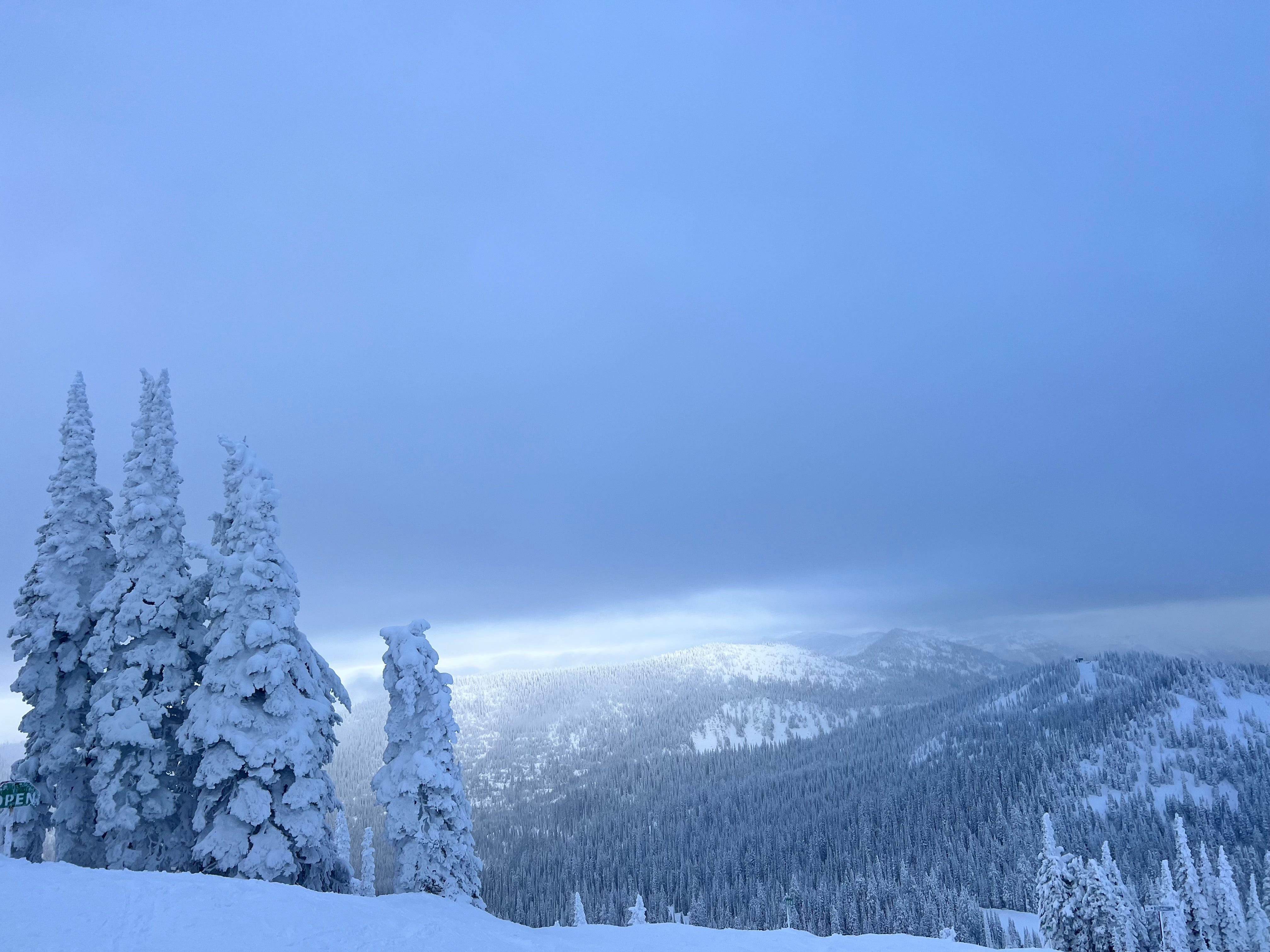
These snowghosts! I like to think of them watching over the winter-quiet ranges all the way to Glacier National Park (the peaks of which you can see from here on a clear day) and beyond.

Winter is my most joyful time. It came late this year. We didn’t get significant snow and it was barely what I’d call cold until a little over a week ago, when usually we’d have feet of snow by December, or at least mid-December. 

Winter is being driven out of much of our lives. Being aware of the shift in temperatures and the decreasing snow packs and number of snow days breaks my heart; trying to pretend it’s reversible at this point would break my brain. Maybe we find our sharpest, brightest shards of humanity in loving most fiercely what we know will be lost.

Last Sunday I shortened my usual early-morning routines involving coffee, greeting the morning air and sky and ground, writing by candlelight, and some other rituals, and threw my ski gear into the car to meet my sister and father up on the downhill ski hill just outside of town. It had been dumping snow for over twenty-four hours after weeks of winter being just out of reach and, while everywhere was still gray and foggy, my spirits were soaring. The Ramones’ “I Wanna Be Sedated” blasted too-loud in the car as I joined the line crawling uphill to chase a powder day.

By the time I’d finished making coffee, my phone had already gone off with texts from friends with ideas for the day. “Anyone want to join for a ski around Loon Lake?” “Snowshoeing in Glacier?” “Good day for a bonfire! We’re going to hike up the forest service road and roast brats.”

Not everyone where I live is a winter-lover. By March, many minor exchanges are guaranteed to have a complaint about wishing the snow would stop, or the inversion layers would lift and Sun make an appearance. But aside from difficulties that many have with the near-perpetual gray skies, which can bring on an undeniable depression (not for me but for many people), I’m fortunate to feel surrounded by people who, like me, seem to come alive in winter.

I love the cold and snow of these months, and mourn their passing even while delighting in spring. The long, dark nights are like a blanket to wrap up in. The overcast skies for weeks on end don’t bother me much, though I do find a surge of energy overtakes me that one day in February when Sun comes out, and the three nights I’ve seen Moon in the past month—I’m looking at Her right now!—have brought me pure, intense joy. The beauties of winter, which Freya Rohn portrayed lovingly in poems and photo-poems in The Ariadne Archive, work their fractal way through my imagination and attention like so much flower-frost on an old window. The magic of winter is unparalleled, from the fox tracks my niece and I part-followed on our route to school last week, to the sun halos that burst out every few years on the ski mountain.

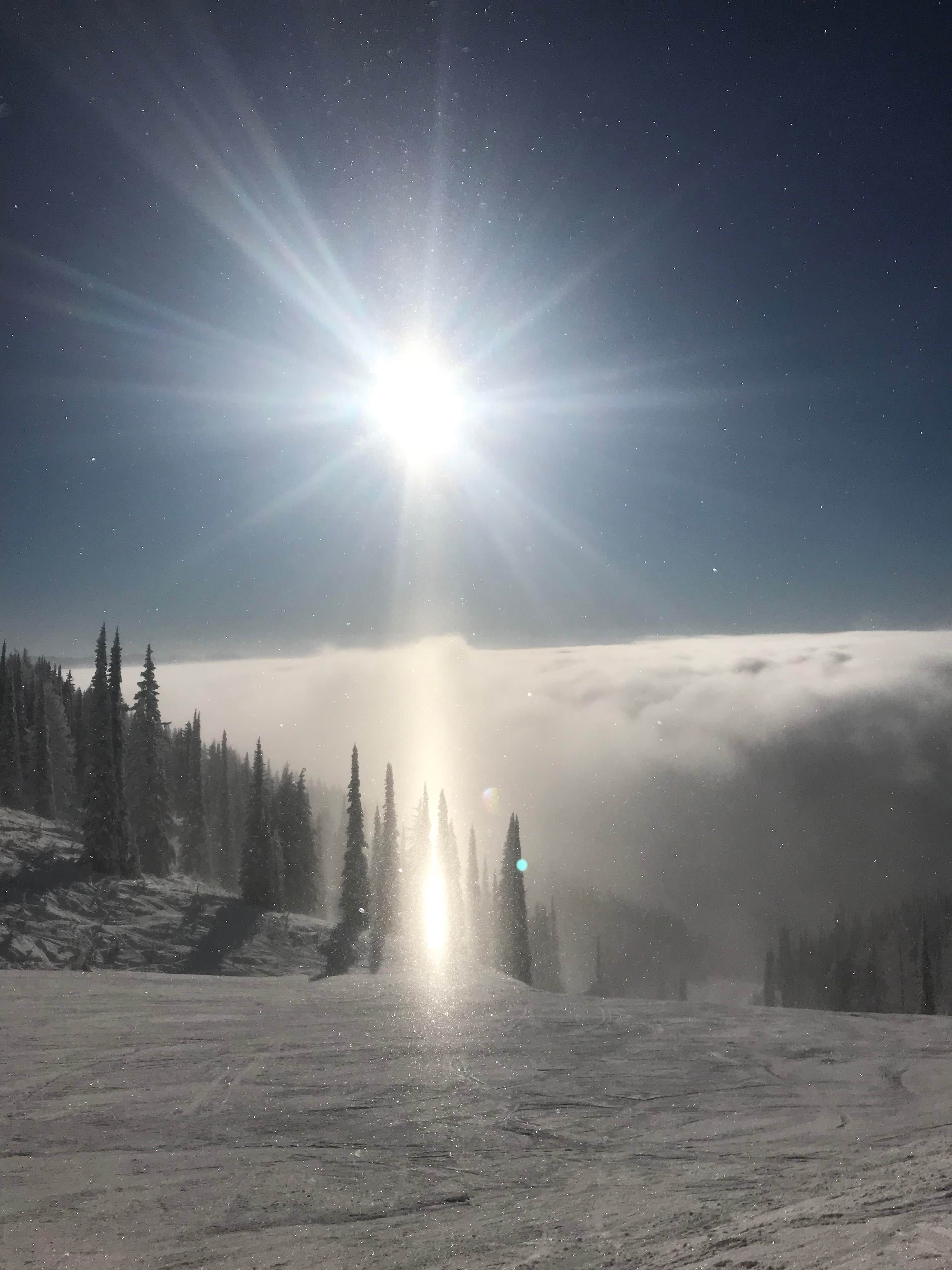
Sun halo and sun dogs, from 2021

Nothing makes me believe more in something more about our existence than Nature herself, Earth herself, Moon, Sun, trees, rivers, ice rime on a ponderosa pine, coming across a snow-covered bear den or snowshoe hare tracks when out hunting, a glorious sundog following me all day around a ski mountain—all of it, themselves. No matter where we originated in this world, there have always been forces and delights and entities to remind us that what we call creation or life is always in the process of becoming, and astonishing us. To feel humble before it all, and love for it all, might be our greatest calling.

This weekend has been bitterly, unbelievably cold. I’ve experienced this kind of cold before but not often. Thursday and Friday nights were around -58°F (-50°C) with wind chill, and it was very windy. Saturday morning dawned with -31°F (-35°C) even without the wind, but there was no wind, and with Sun making a rare appearance it was one of the more beautiful days I’d seen in a while.

Frostbite is a real issue, as is hypothermia. So are cabin fever and depression. I take all of it seriously. After spending Friday mostly crawling out of my mind with near-claustrophobic irritability from staying inside, on Saturday I dragged a heavily bundled and face-wrapped kid out for a walk, and then spent an hour by myself sliding around the neighborhood on cross-country skis a friend had lent me for a couple of weeks.

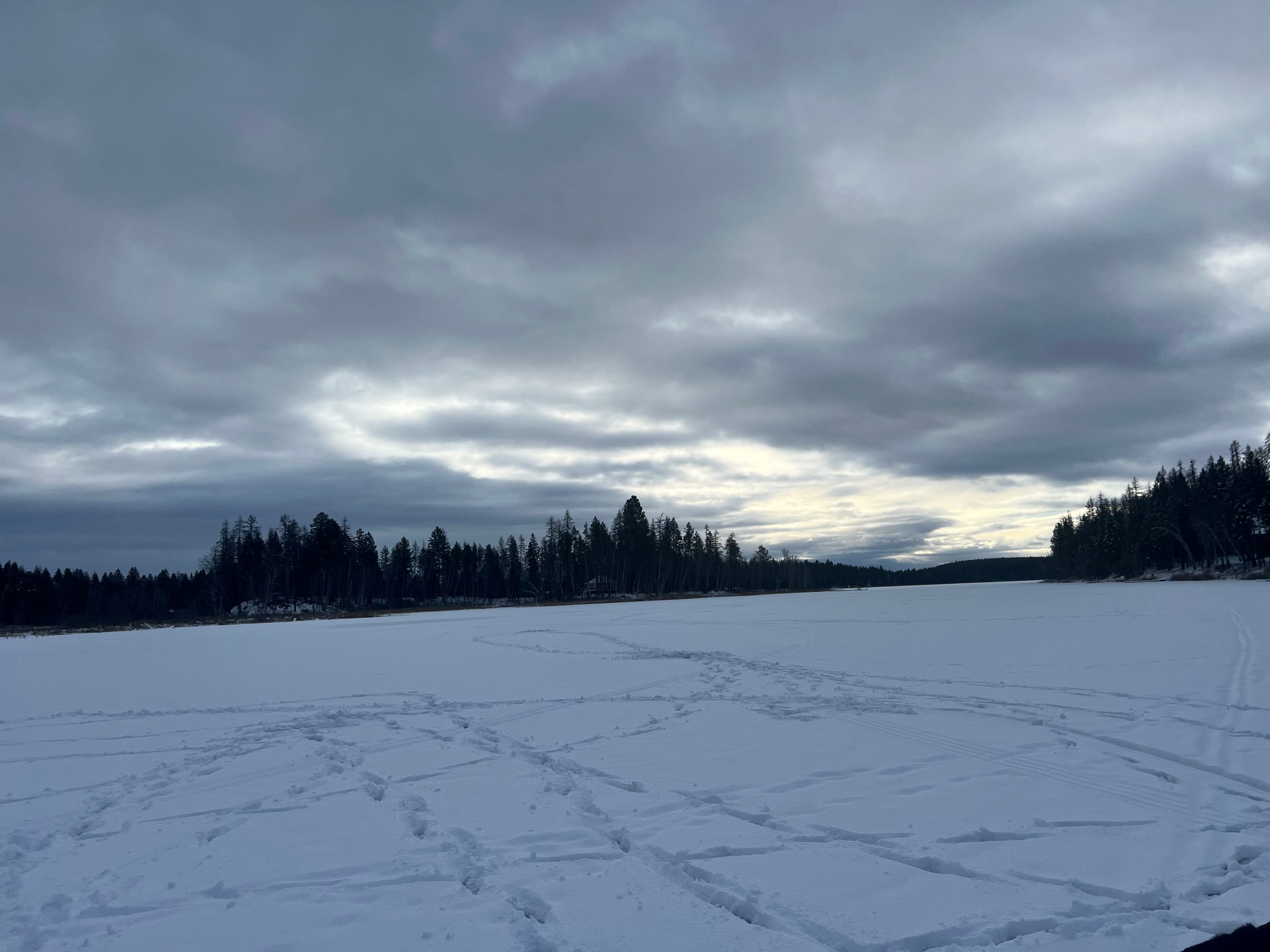
This friend and I had gone cross-country skiing on a nearby lake before the cold front came in. Her dog romping free across the ice and snow, we sh-slshed among silent woods under a rumpled silver sky for a little over an hour, sometimes talking, sometimes just skiing. I haven’t felt that good in a long time, like I was convalescing from a severe illness and was rediscovering what it was like to move my body through the world.

I’ve been meaning to get back into cross-country skiing since moving back to Montana nearly ten years ago, but with kids and work and life in general, haven’t managed much of it. Luckily, most of my close friends are avid cross-country skiers and started getting me out last year. Skiing is one of my favorite things to do, whether downhill or cross-country, but the environmental impact of downhill skiing, which I started doing at the age of two and enjoy more than almost any other activity, has been weighing on me for years. From energy consumption to broken wildlife habitat to the economic inequalities that tend to explode in ski resort towns like mine, it’s a lifelong pleasure whose real-life impacts are impossible to ignore. Even most ski wax contains endocrine-disrupting PFAS chemicals.

Cross-country skiing brings similar joys without nearly the impact (not to mention cost), and is something people have been doing without chairlifts and heavy-duty boots for centuries. Some of my favorite scenes from Sigrid Unset’s trilogy of novels Kristin Lavransdatter, set in 14th-century Norway, involve Kristin strapping on a pair of skis and heading off into the woods alone. 

There are bigger changes to make than giving up downhill skiing, but I’m looking forward to shifting more of that time toward those quieter snow-graced days. For however many years we continue to have snow to treasure, I hope to spend more days sliding quietly across land and water untouched by grooming machines.

Silent lake-skiing under a rumpled sky
Who knows how many true winters my part of the world has. All I know is that I’ll welcome every one of them, every hour toward Solstice added to beloved darkness and starry nights, visible or not, every flake of snow that makes it from the clouds to land on laden spruce trees, every story told in an animal’s tracks, every footstep or glide of skis, every frosty breath and peek of Moon from overcast skies, every ice crystal refracting light to result in a sun halo, every single moment of creation that persists in living and creating despite the worst that humanity tries to throw at it. Every bit of it that reminds me I am an evolved animal capable of living joyously on a planet very much alive, and that I intend to do so.
Competence Lost


Competence Lost

9 a.m.

            The tires slipped, eager for the ditch that hugged this steep, curvy section of road. I twiddled the steering wheel, resisted tapping the brake pedal. The car made its way to the flat without heading for either the languid, half-frozen river or the snow-crusted cornfield, and my hand shook as I finally shifted down to first.

            “Mommy, mommy, mommy?” The o’s drawn out long, nearing a whine, ma-AWmy. My son watched the snowfall from the back seat.

            “Can you sing ‘Twinkle, Twinkle’ for me, honey?” The shakiness had migrated to my voice. We reached the end of our road, pitched at an inconvenient incline where it met the hill of the highway. The stop sign was irrelevant. There was no way I was stopping, not until I pulled up in front of our garage. The bald tires of the station wagon protested every time I steered them anywhere but straight, the road so slippery that brakes had become a danger.

            It hadn’t looked that bad from the house, when I’d decided to run out for coffee before the snowstorm started in earnest. If the car slid off the road, I’d never be able to explain that idiotic decision to my husband, safe in Toronto on a business trip.

            “Twinkle, twinkle, little star,” my son sang. The car waggled its rear end along the highway, eeking as slowly as possible. A plow, its blade raised, passed us going the other direction and the driver shook his head at me.

            A journey that should have taken fifteen minutes lasted an hour; we never stopped for coffee. I didn’t dare. My heart thumped in time with attempts to move ever slower; I threw silent apologies at the red light in town where I turned right without pausing. When we got home, I wanted nothing more than to drink something warm and alcoholic, and to curl up in bed, reliving the number of times the car should have slid off the road. But there was my three-year-old son, eager to play, and the five-months-along fetus inside me, not allowed booze.

            By afternoon the shakiness had begun to disappear, but it refused to leave completely. Growing up in Montana, I’d spun our rusted-out Suburban around empty parking lots to get the feel of driving on ice. I’d rocked and dug countless cars out of snowdrifts. I’d driven through blizzards so thick that daylight had no effect on visibility. Now I was living in upstate New York, where the difference lay not in the texture of the snow but in the advent of motherhood. Doubt had crept in and stayed, invited during that drive by the constant worry of landing in the ditch and injuring the child in the back seat. The snowstorm felt like a live thing, come to haunt me, to lay its cold fingers on my child and strip away my sense of self.

7 p.m.

            The snow came down in thick, fat flakes all day long. My son and I built towers with his blocks, ate scrambled eggs, read Goodnight Moon ten times or maybe twenty. I measured the snow line rising against the deck door and wondered if whisky was healthier for the fetus than stress. I finally put my son to bed and drank a hot cup of chamomile tea before bundling up to wrestle with the snowblower. I’d come to hate chamomile tea during my second pregnancy, but with a little honey it was better than plain hot water.

            By the time I got the snowblower started and forded the drift outside the garage, the night was already pitch, the darkness made eerie by continuing heavy snowfall. It piled two feet high and was cemented at the bottom with six inches of freezing rain and sleet that had fallen the day before. It usually took me two hours to clear our five-hundred-foot-long driveway, which cut to our house built in a former cornfield. I could barely see the driveway markers in the snowblower’s headlight, and there was nothing I wanted to be doing less right then than wrangling the gas-guzzling machine with its spinning blades down the driveway—nothing, that is, until twenty feet from the door, the blower sheared a pin. Our route to the outside world was closed off.

            When I came back inside, the emotional moorings that had been weakening all day finally broke loose. The lights flickered and flickered again, responding to the outages in the main transformer a few miles away, and I started crying, picturing myself trying to keep my son warm before a fading fire while outside the snow kept falling. Dramatic scenarios that would never come to pass but I couldn’t stop impaling myself on. I sat on the couch wrapped in three blankets, checking the power company’s website every few minutes and crying harder every time the lights wavered.

            Buried somewhere in my squishy body and unskilled self are the genes of more resourceful ancestors. Growing up, I learned to embroider using my great-grandmother’s thread, pickled cucumbers in another’s massive crock-pot. When I started learning to ride a horse, I inherited a great-aunt’s saddle. It once seemed to me that if I were to time travel and land at my ancestors’ dugout on the Montana prairie, I’d have no problem contributing something to daily life, being useful. I’d haul water and hew wood, cheerfully clear a trail through snowdrifts to the barn.

            I no longer think that self exists. Maybe I’d just freak out, and sit by the fireside rocking my babies, waiting for the loneliness and wind to drive me insane.

            After the snowblower gave out, I sat inside staring at the gathering whiteness of the yard and surrounding field, steeped in panic, fighting the bone-tiredness that had possessed me my entire second pregnancy. I wanted to reach back to my ancestors and shake them. Where are my lessons, my skills? Why didn’t you leave anything for me? What happens when the apocalyptic post-oil climate-change future finally heads our way? If it all falls apart, how do I keep my children alive?

            Those ancestors of mine didn’t leave much record of themselves. Some photos. A solid barn in eastern Montana that is still intact and in use over a hundred years later. No diaries, no precious letters. Sometimes I browse through the sparse journal excerpts of other women from that time period, looking for the winters, the loneliness, the lost babies. Those who mythologize the earlier histories of those lands both erase the violence inherent in every family with a personal history like mine, and romanticize what life would have been like for them. But there was no romance. There was just life, and hard work. A lot of loneliness, a lot of scraping for survival, frozen cattle, locust-riddled wheat crops, sickened children.

            These days, city-dwellers and land-seekers looking for a bit of space, a bit of privacy, air to breathe, are searching, often without realizing it, for what those romanticized histories seem to promise. But we haven’t cut the umbilical cord to modern conveniences and the security they offer: electricity (meaning light and warmth), roads (meaning both escape and connection), and supply lines (meaning food and fuel).

            All of which, as demonstrated by the storm that stripped away my self-respect, are easily made inaccessible. The storm left in its wake collapsed barns—four of them within a few miles of us, each standing for a hundred years or more, finally sighing to the ground under the weight of that thirty-six hours of wet, constant snow. It left truck engines blown out, and several communities aching for electricity for nearly a week. At times like these our plump houses set on their own, away from other people, planted in former cornfields, take on an unnerving aspect. They come to represent the past rather than the future.

            Overnight three feet of snow, a little more, made the car sitting in front of the garage pointless. What I needed to traverse those five hundred feet were snowshoes and I didn’t own any. In fact, right then, I owned little that was useful. The weather was oppressive, there was no shaking it. The storm’s repeated excitement of panic and worry, its irritation as the snow continued to fall in thick, quiet flakes, was torturous. It seemed almost intentional.

            Instinct is to gather oneself in, to fold one’s children into one’s arms and bow one’s head over them. Hoping the storm—whatever storm—will pass over us without notice. Despite my grandmother’s pickle crock and an ability to chop firewood, my upbringing was mostly books and escapism and stories and emotional survival. Nobody ever taught me to do anything truly useful except bake snickerdoodles. Everything else is self-taught and it’s not enough, never enough. To be more, to do more, to grab competence by the tail and swallow it, maybe raw, maybe dripping with blood, that’s what we need to survive what might come, or what we might lose. To tell the elements we see them, and respect them, and are not afraid.

10 p.m.

            Before I curled up in bed, I turned the heat way up. Just in case. In case it all fell apart and the residual heat was all we had. I filled up pots of water. In case our option was to die of thirst or freeze to death from trying to eat snow. I mapped out a route to drag my son by sled to a friend’s house a couple miles away. In case the driveway wasn’t clear until spring.

            All of which, given the facts, were just plain silly. Even if the driveway stayed blocked, there was no thought of starving, or freezing. Not this time. The fridge was plump with produce, the pantry wedged tight with rice, pasta, beans, and oatmeal, and there was half a deer chopped up and packaged sitting in the deep-freeze. If the electricity went out, it was cold enough in the garage to keep most food, and I didn’t need electricity to light our propane-fueled stove. The basement was stocked with enough canned peaches, tomatoes, jam, and salsa to last a month. And the woodpile outside would have kept us warm enough for a solid week, at which point there was plenty of pre-broken hand-me-down furniture to put under the ax. If I could find the ax and remember how to use it.

            But I’d become like an old wheat rancher, rigid in my beliefs, with obsolete fears. That night reminded me that I was tethered not only to the fierce, energetic child sleeping upstairs, but to the incubating little person in the womb who did and did not yet exist. A woman at night, pregnant, is reminded constantly by the discomfort of rearranged organs, by the aches in her back, by the pesky insomnia when sleep is needed most, that her body has been pressed into service.  

11 p.m.

            Just before I turned off the bedroom light, I opened the blinds. There, lining the driveway parallel to ours, were our neighbor’s big, bright lampposts. I’d been making fun of them for the last two years. Like many of the locals, our neighbors moved out there from New Jersey saying they liked “living in the country,” and immediately turned it into a close approximation of suburbia. They dug a pond, put in a phallic fountain, stripped down their field to achieve a four-acre lawn, and then planted iron lampposts all down the driveway leading up to their spotlit house. It was the lamps I found most irritating. “Drowning out the stars,” I said. “So obnoxious.”

            That night, I opened the blinds so I could see them as I fell asleep, their electric filaments burning in the snowstorm. Before daybreak, I woke up several times and searched immediately for the lights leading to the road like they were a signal from the rest of the world. Were they still burning? Were we still here? Had it all fallen apart? But there they were, an anchor to the civilization I never learned to live without.

            Twinkle, twinkle.