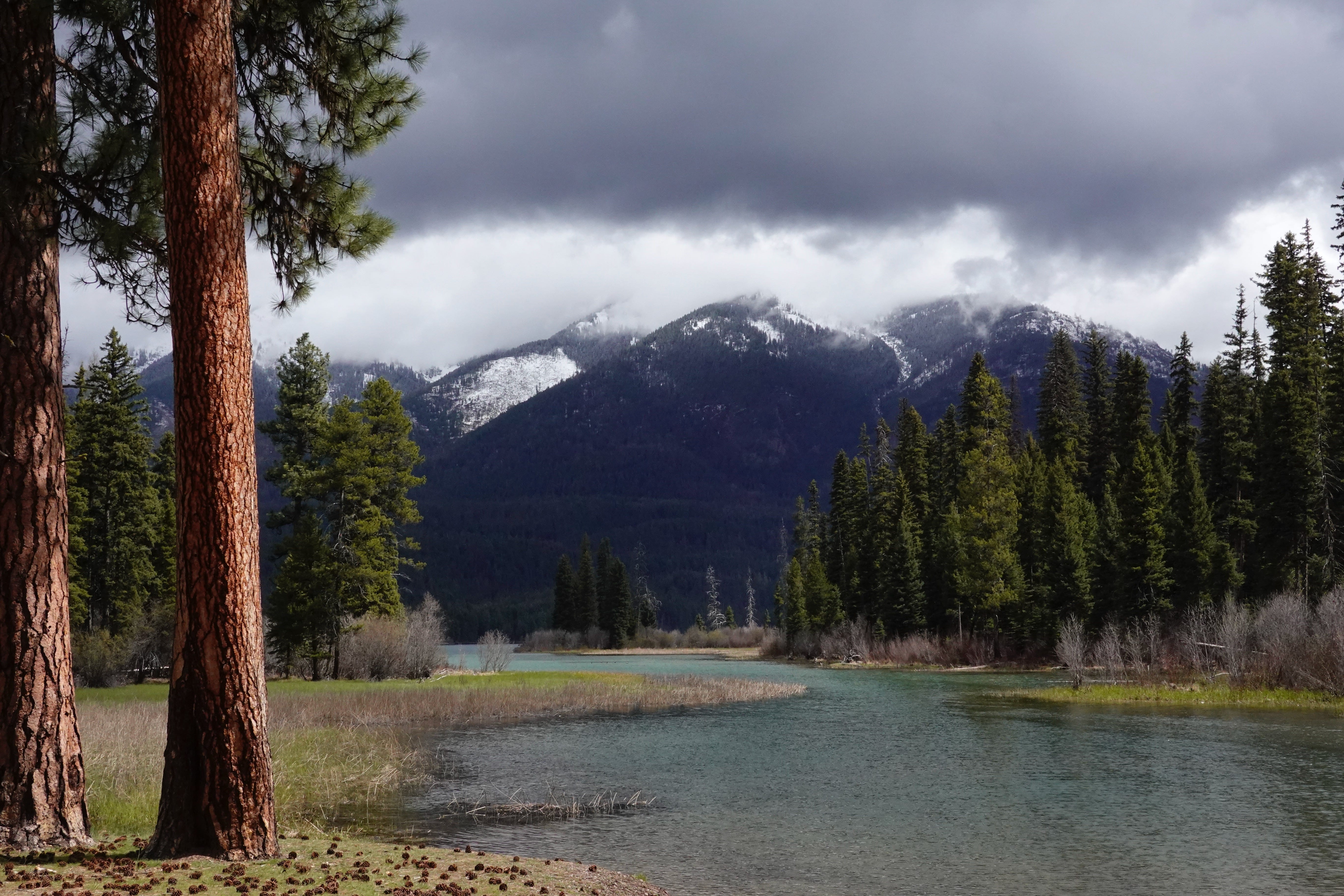
All wild waters have a different flavor. The North Fork of the Flathead River, the river near the off-grid cabin I stay at most often, is wide, and fast enough I wouldn’t risk trying to swim across it. Its headwaters are in Canada, and it has so far been saved from toxic selenium levels by an international agreement that turned its sister rivers, the Elk and then Fording Rivers, into a sacrifice zone for the waste of mountaintop removal coal mining in British Columbia.
The saved river tastes of snow and rock, a little pine and something of the young otters I once watched playing in the rapids just off the opposite bank. The uncanny warmth of ice.
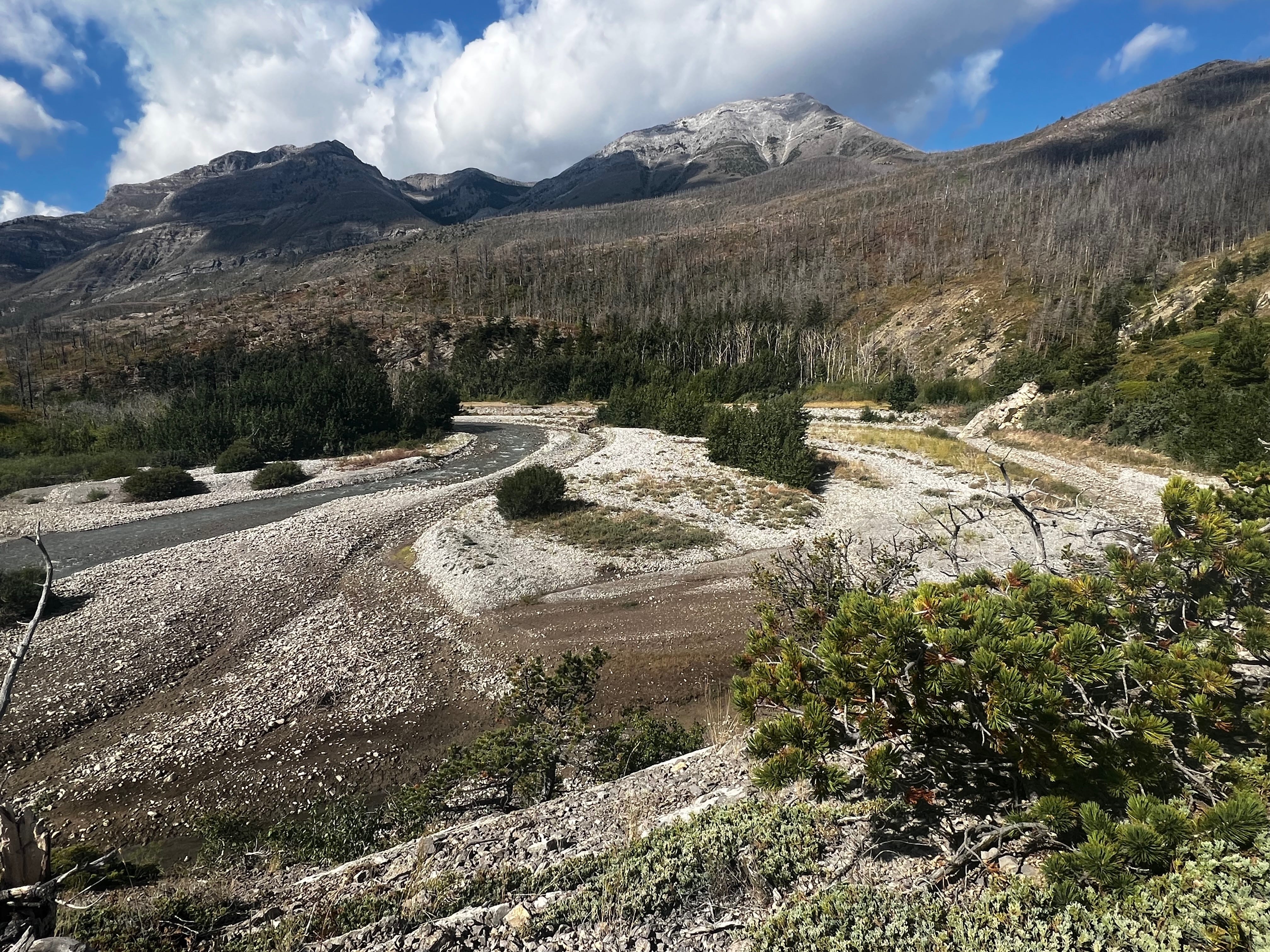
A little-visited creek on the other side of the mountains where I search for caddisfly casings in late summer tastes of dirt, like fresh-planted geraniums, and the fireweed and kinnikinnick where its waters gather high up in the eastern portion of the Bob Marshall Wilderness.
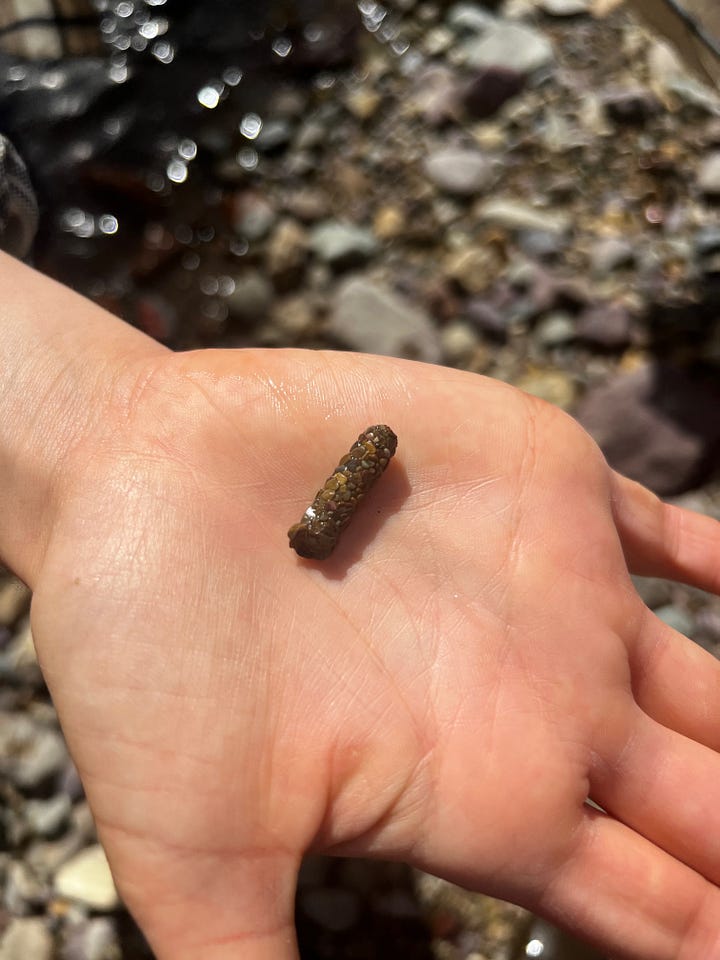
Caddisflies, like many macroinvertebrates, are a sign of a water’s health. They need water that runs, chortling and burbling along rocks and moss, well-aerated and low in pollution. Caddisfly larvae build tiny, nearly perfectly cylindrical casings out of various materials, usually gravel. They’re hard to spot, bits of washed-bright gravel clinging to similarly colored rocks under rushing water.
I fell in love with caddisflies during my son’s fifth-grade field trip to a local wetland, less than 10 years ago. Although I grew up fishing Montana’s waters, and my mother is an expert fly fisherman, the kind of fishing I did involved worms rather than flies, and I was never taught much about the waters themselves, much less the tiny creatures that make up their vast ecosystems. I’d never seen a caddisfly before that hot spring day with my son’s class, learning about rescue birds of prey and macroinvertebrates at a hidden wetland sanctuary in the shadow of the ski mountain on the edge of town.
Caddisflies fascinate me. Miniscule creatures! Maneuvering miniscule bits of rock to form perfect little temporary homes! What more does one need to be awed by creation?
Learning about them and other macroinvertebrates from scientists near where I live, I learned about rivers, too—the level of cleanliness they need for health, the way their ecosystems spread underground, far beyond the borders of their visible shores.
Architect and planner Dilip Da Cunha wrote a book I haven’t yet read called The Invention of Rivers. He wrote in the book’s introduction, of Alexander the Great’s military campaigns, that they were not just empire building projects, but “more fundamentally and necessarily to articulate an earth’s surface with a line separating land from water.”
“. . . to articulate an earth’s surface with a line separating land from water.”
I bought the book after hearing an interview with Cunha, floored by his obvious but revolutionary argument that of course rivers don’t have solid boundaries. How could they? Maps of rivers’ flow, length, shape, and course are deceptive. Rivers are living, breathing creatures. Expecting one to adhere to a mapped route is like expecting a toddler to fall in line with your expectations of behavior just because you read a seemingly smart book about parenting your spirited child.
I was recently able to turn back to No Trespassing, the book I’ve been promising readers here for far too long, and came across a passage in Chapter 2—the chapter on water—that I ended up repurposing in an essay for the “Air” volume of The Center for Humans & Nature’s Elementals anthology:
“Trespass is fluid. It’s a transgression. In the case of pollution, trespass is far more physical than simply breaking through somebody’s property line. If I sneak through my neighbor’s yard to get to the nature preserve on the other side I might annoy them, but if my neighbor burns a pile of tires in that same yard and I don’t go near it, his waste will trespass into my family’s bodies just the same. This form of trespass, though, is exactly what the law currently allows.”
In the published essay, this passage is about what is carried through the air and into all living beings, contrasted with barbed wire fencing and No Trespassing signs that keep our physical bodies from wandering.
In the unpublished chapter, though, it follows a section I wrote about Justice Neil Gorsuch’s dissent in a 2020 U.S. Supreme Court case involving decades of pollution from a mining company layered in the soil of Anaconda, Montana. The court’s opinion leaned on lack of jurisdiction, but Gorsuch’s dissent went straight to the issues residing deeper within legal history: the plaintiffs’ arguments, he wrote, relied on “ancient common law causes of action like nuisance and trespass.”
The majority decision, he wrote,
“strips away ancient common law rights from innocent landowners and forces them to suffer toxic waste in their backyards, playgrounds, and farms.”
This wasn’t what the law was written to do, Gorsuch claimed, “it was what it was written to prevent.”
(For my American readers: Gorsuch, right? I know. He can surprise, as in he did in McGirt v. Oklahoma.)
The most commented on essay I have ever published here was about borders, particularly the violence that borders perpetuate by their very existence. The most read essay remains one I wrote about my Russian-Jewish grandparents in the Soviet Union, of their time during dictator Josef Stalin’s violent political purges, which killed millions. It’s an essay about moral codes that might not defeat the face of evil, but will withstand the wreckage of history. The second most read essay is about an early American court case involving a fox, a hunter, and a landowner, and provokes the question of ownership contrasted with a right to exist.
The commons, I believe, is all of this and more. It is all that is shared, cared for, carefully managed and husbanded. Enclosures of the commons sought to wall in land’s abundance for a privileged few. For nearly 800 years those enclosures were fought by commoners in England and elsewhere, often in bloody battles that killed thousands. Those people knew what was at stake when the commons were stolen. Their thriving, livelihoods, and even survival were trespassed against. And so they trespassed back—against unjust laws, in defense of life and freedom.
I firmly believe that just about everything imaginable and unimaginable is connected to a commons—air, water, ideas, food, soil, stories. Survival. Thriving. Liberty. A person’s right to determine their own identity. But I am aware that my writing here strays in and out of a strict scholarship definition of the commons as a subject. Because of that, the title of this newsletter has been bugging me for a while. The concept of trespass is more fitting for what happens in this space. It is, after all, what sparked rebellions against theft of the commons in the first place. Who gets to define what is trespass, and what is law?
The answer, as is always true of hardened borders and hardened ideas: they are defined by those in power.
A river embodies trespass. It refuses to remain where it’s told. It lives not simply according to its needs, but also the needs of all the beings that rely on its unique ecology. When circumstances demand that a river change its borders, it does not hesitate, even when human expectations have relied on it staying put. A river can be dammed, drained, poisoned, siphoned off for agriculture or hydro-fracking for fossil fuels, built against so heavily that its banks erode, but it cannot, in the end, be conquered. In whatever form, its waters refuse to stop living.
Like wild waters, every form of trespass in every fold of Earth has its own flavor, its own unique ecology. Trespassing, really, is what this newsletter is about.
I am writing this at a cabin near a lake where my family used to camp regularly when I was growing up. I have many memories of this place. Most of them are not great—my childhood was defined by fear, violence, and poverty—but the ones that involve the water itself feel so lively, so embedded as small sparks of joy, that by now, in my fourth year staying here alone as an adult, I feel welcome.
This lake knows me. And I her—the pounding falls at the far end, pouring out of the western half of the Bob Marshall Wilderness, the mountains still covered in snow at the end of April. The Loon that called this morning (stupid Canadian wolf-bird for you fellow Heated Rivalry fans; shout-out to my younger sister for getting me hooked on that show), the Eagle that soared for hours yesterday, the Red-breasted Nuthatch I spent some time watching clear out a nest cavity, and the Ruby-crowned Kinglets who will not shut up.
The Grizzly Bear whose very fresh, very large pawprint on the trail turned me right around a couple years ago. The memories of my sisters and me jumping from the rope swing you could only, in those days, reach by canoe. The laughter of children and murmurs of lovers echoing across the water for hundreds of generations before colonialism sought to dominate these places.
Caddisfly casings, like rivers, aren’t built like nuclear bunkers. If you watch them for long enough, you can see the insects crawl partway out the end now and then, gather more material and wiggle back inside. Their boundaries are fluid, like water. Like life.
Waters trespass against the demands of a world that asks too much, gives too little, and yet somehow is still granted so much life, so much abundance, that nature’s generosity is almost a trespass itself. Against capitalism’s need for scarcity. Against the desire of a few to own everything. And against our own fear that we’ll never survive it all.


