Trespass against

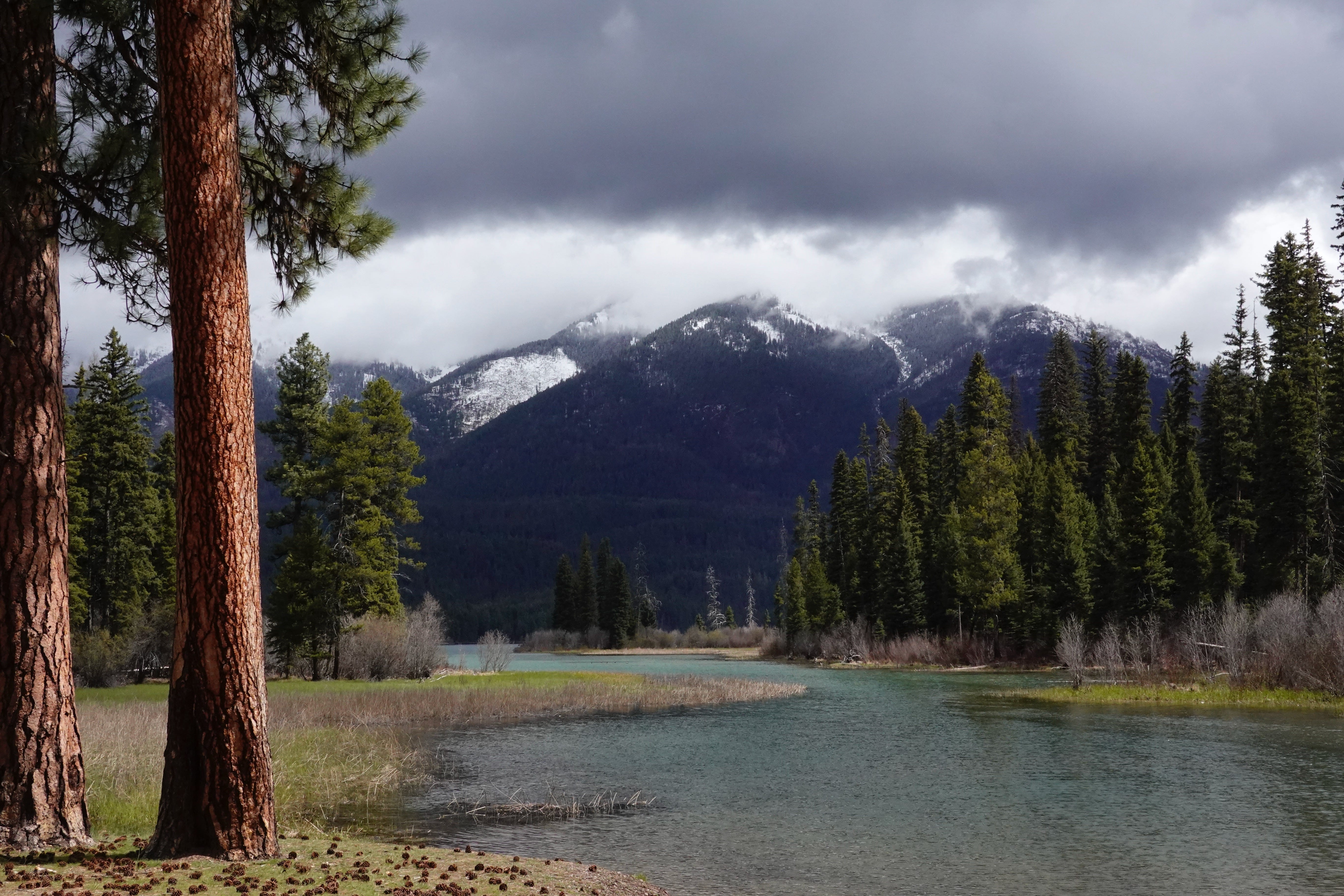
Holland Creek running out of Holland Lake, Montana

All wild waters have a different flavor. The North Fork of the Flathead River, the river near the off-grid cabin I stay at most often, is wide, and fast enough I wouldn’t risk trying to swim across it. Its headwaters are in Canada, and it has so far been saved from toxic selenium levels by an international agreement that turned its sister rivers, the Elk and then Fording Rivers, into a sacrifice zone for the waste of mountaintop removal coal mining in British Columbia.

The saved river tastes of snow and rock, a little pine and something of the young otters I once watched playing in the rapids just off the opposite bank. The uncanny warmth of ice.

A little-visited creek on the other side of the mountains where I search for caddisfly casings in late summer tastes of dirt, like fresh-planted geraniums, and the fireweed and kinnikinnick where its waters gather high up in the eastern portion of the Bob Marshall Wilderness.

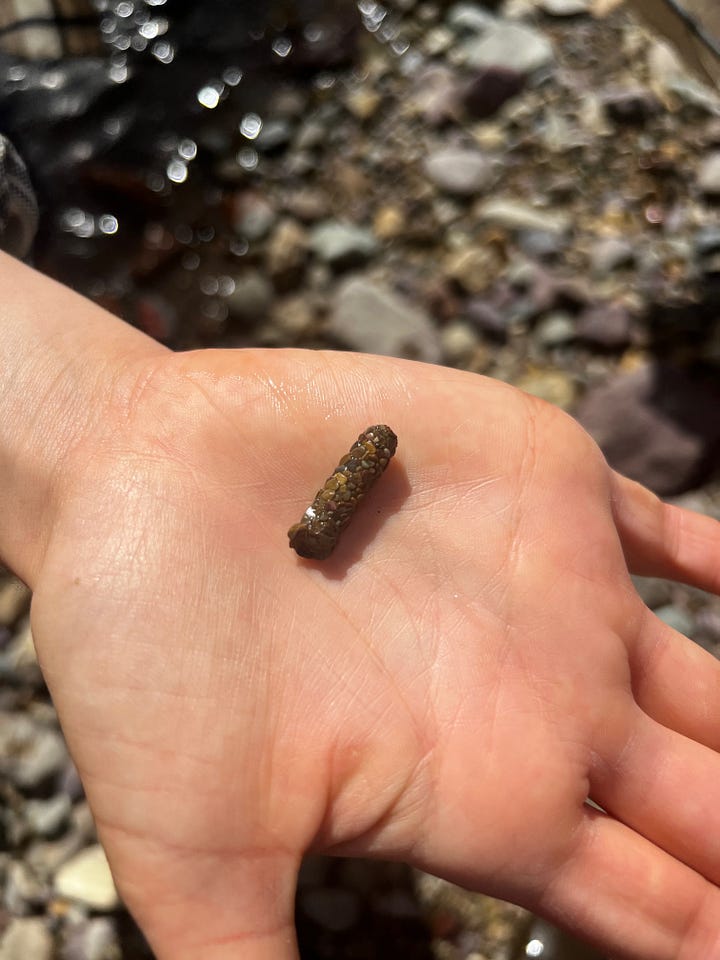
Caddisflies, like many macroinvertebrates, are a sign of a water’s health. They need water that runs, chortling and burbling along rocks and moss, well-aerated and low in pollution. Caddisfly larvae build tiny, nearly perfectly cylindrical casings out of various materials, usually gravel. They’re hard to spot, bits of washed-bright gravel clinging to similarly colored rocks under rushing water.

I fell in love with caddisflies during my son’s fifth-grade field trip to a local wetland, less than 10 years ago. Although I grew up fishing Montana’s waters, and my mother is an expert fly fisherman, the kind of fishing I did involved worms rather than flies, and I was never taught much about the waters themselves, much less the tiny creatures that make up their vast ecosystems. I’d never seen a caddisfly before that hot spring day with my son’s class, learning about rescue birds of prey and macroinvertebrates at a hidden wetland sanctuary in the shadow of the ski mountain on the edge of town.

Caddisflies fascinate me. Miniscule creatures! Maneuvering miniscule bits of rock to form perfect little temporary homes! What more does one need to be awed by creation?

Caddisfly casing

Learning about them and other macroinvertebrates from scientists near where I live, I learned about rivers, too—the level of cleanliness they need for health, the way their ecosystems spread underground, far beyond the borders of their visible shores.

Architect and planner Dilip Da Cunha wrote a book I haven’t yet read called The Invention of Rivers. He wrote in the book’s introduction, of Alexander the Great’s military campaigns, that they were not just empire building projects, but “more fundamentally and necessarily to articulate an earth’s surface with a line separating land from water.”

“. . . to articulate an earth’s surface with a line separating land from water.”

I bought the book after hearing an interview with Cunha, floored by his obvious but revolutionary argument that of course rivers don’t have solid boundaries. How could they? Maps of rivers’ flow, length, shape, and course are deceptive. Rivers are living, breathing creatures. Expecting one to adhere to a mapped route is like expecting a toddler to fall in line with your expectations of behavior just because you read a seemingly smart book about parenting your spirited child.

I was recently able to turn back to No Trespassing, the book I’ve been promising readers here for far too long, and came across a passage in Chapter 2—the chapter on water—that I ended up repurposing in an essay for the “Air” volume of The Center for Humans & Nature’s Elementals anthology:

“Trespass is fluid. It’s a transgression. In the case of pollution, trespass is far more physical than simply breaking through somebody’s property line. If I sneak through my neighbor’s yard to get to the nature preserve on the other side I might annoy them, but if my neighbor burns a pile of tires in that same yard and I don’t go near it, his waste will trespass into my family’s bodies just the same. This form of trespass, though, is exactly what the law currently allows.”

In the published essay, this passage is about what is carried through the air and into all living beings, contrasted with barbed wire fencing and No Trespassing signs that keep our physical bodies from wandering.

In the unpublished chapter, though, it follows a section I wrote about Justice Neil Gorsuch’s dissent in a 2020 U.S. Supreme Court case involving decades of pollution from a mining company layered in the soil of Anaconda, Montana. The court’s opinion leaned on lack of jurisdiction, but Gorsuch’s dissent went straight to the issues residing deeper within legal history: the plaintiffs’ arguments, he wrote, relied on “ancient common law causes of action like nuisance and trespass.”

The majority decision, he wrote,

“strips away ancient common law rights from innocent landowners and forces them to suffer toxic waste in their backyards, playgrounds, and farms.”

This wasn’t what the law was written to do, Gorsuch claimed, “it was what it was written to prevent.”

(For my American readers: Gorsuch, right? I know. He can surprise, as in he did in McGirt v. Oklahoma.)

The most commented on essay I have ever published here was about borders, particularly the violence that borders perpetuate by their very existence. The most read essay remains one I wrote about my Russian-Jewish grandparents in the Soviet Union, of their time during dictator Josef Stalin’s violent political purges, which killed millions. It’s an essay about moral codes that might not defeat the face of evil, but will withstand the wreckage of history. The second most read essay is about an early American court case involving a fox, a hunter, and a landowner, and provokes the question of ownership contrasted with a right to exist.

The commons, I believe, is all of this and more. It is all that is shared, cared for, carefully managed and husbanded. Enclosures of the commons sought to wall in land’s abundance for a privileged few. For nearly 800 years those enclosures were fought by commoners in England and elsewhere, often in bloody battles that killed thousands. Those people knew what was at stake when the commons were stolen. Their thriving, livelihoods, and even survival were trespassed against. And so they trespassed back—against unjust laws, in defense of life and freedom.

I firmly believe that just about everything imaginable and unimaginable is connected to a commons—air, water, ideas, food, soil, stories. Survival. Thriving. Liberty. A person’s right to determine their own identity. But I am aware that my writing here strays in and out of a strict scholarship definition of the commons as a subject. Because of that, the title of this newsletter has been bugging me for a while. The concept of trespass is more fitting for what happens in this space. It is, after all, what sparked rebellions against theft of the commons in the first place. Who gets to define what is trespass, and what is law?

The answer, as is always true of hardened borders and hardened ideas: they are defined by those in power.

A river embodies trespass. It refuses to remain where it’s told. It lives not simply according to its needs, but also the needs of all the beings that rely on its unique ecology. When circumstances demand that a river change its borders, it does not hesitate, even when human expectations have relied on it staying put. A river can be dammed, drained, poisoned, siphoned off for agriculture or hydro-fracking for fossil fuels, built against so heavily that its banks erode, but it cannot, in the end, be conquered. In whatever form, its waters refuse to stop living.

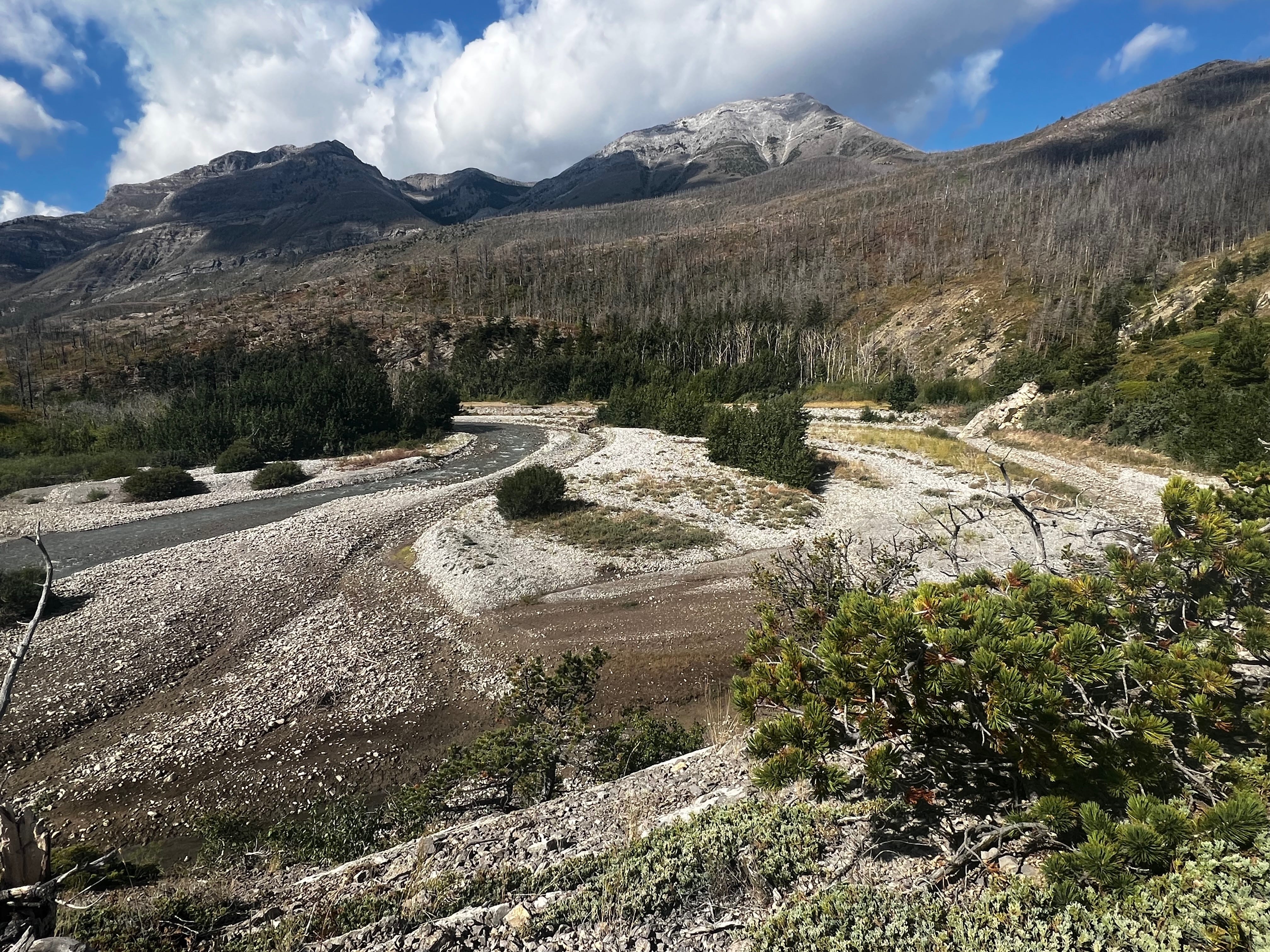
Braided river coming out of the Bob Marshall Wilderness, eastern portion

Like wild waters, every form of trespass in every fold of Earth has its own flavor, its own unique ecology. Trespassing, really, is what this newsletter is about.

I am writing this at a cabin near a lake where my family used to camp regularly when I was growing up. I have many memories of this place. Most of them are not great—my childhood was defined by fear, violence, and poverty—but the ones that involve the water itself feel so lively, so embedded as small sparks of joy, that by now, in my fourth year staying here alone as an adult, I feel welcome.

This lake knows me. And I her—the pounding falls at the far end, pouring out of the western half of the Bob Marshall Wilderness, the mountains still covered in snow at the end of April. The Loon that called this morning (stupid Canadian wolf-bird for you fellow Heated Rivalry fans; shout-out to my younger sister for getting me hooked on that show), the Eagle that soared for hours yesterday, the Red-breasted Nuthatch I spent some time watching clear out a nest cavity, and the Ruby-crowned Kinglets who will not shut up.

The Grizzly Bear whose very fresh, very large pawprint on the trail turned me right around a couple years ago. The memories of my sisters and me jumping from the rope swing you could only, in those days, reach by canoe. The laughter of children and murmurs of lovers echoing across the water for hundreds of generations before colonialism sought to dominate these places.

Caddisfly casings, like rivers, aren’t built like nuclear bunkers. If you watch them for long enough, you can see the insects crawl partway out the end now and then, gather more material and wiggle back inside. Their boundaries are fluid, like water. Like life.

Waters trespass against the demands of a world that asks too much, gives too little, and yet somehow is still granted so much life, so much abundance, that nature’s generosity is almost a trespass itself. Against capitalism’s need for scarcity. Against the desire of a few to own everything. And against our own fear that we’ll never survive it all.

Trespassing, or air that smells of home

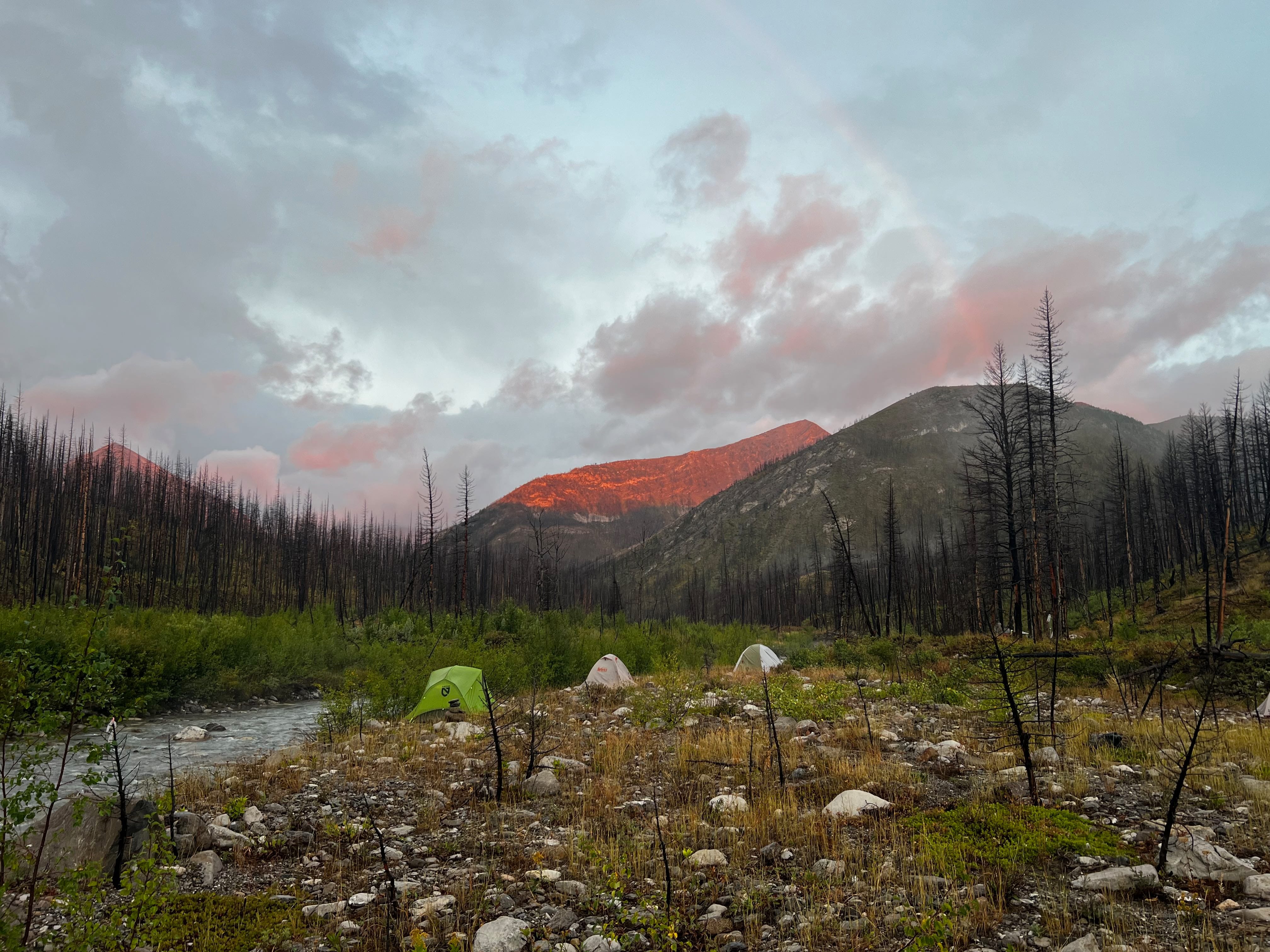
Early morning after nearly 36 hours of rain at North Birch Creek in the Bob Marshall Wilderness near the Badger-Two Medicine, trail crew camp, August 2023 (my tent is the green one)

The following is a reprint of my essay “Trespassing,” published in the Air volume of Elementals, a new anthology from the Center for Humans & Nature.

You can read other republished selections from the anthology by Eiren Caffall in OrionAndrew S. Yang in BioneersRobin Wall Kimmerer also in Bioneers, and register to join the second of five virtual book clubs, with contributors to Air, Vol. 2, Wednesday, February 19th, 6 p.m. Pacific Standard Time, hosted by Point Reyes Books.


It was late September, and the aspen trees were just beginning to yellow. They grew thick on the hillside, a broad grove giving way to small meadows that sloped upward, transitioning after less than a mile to heavy stands of spruce and pine. The group I was with rambled along an old logging road just south of the eastern side of Glacier National Park while a biologist among us talked about the ecotone we were walking through: a mingling of prairie and forest that stretched all down along the Rocky Mountain Front, the eastern-facing slope of the Rockies, where the mountains spill onto the prairie. A light wind blew constantly.

As we left the aspens and walked into evergreens, the wind became a whispering—psithurism, a sound that’s like a rustle and a shush at the same time. That sound characterized almost my entire Montana childhood, but I never consciously noticed it until a few years ago, shortly after moving back to my hometown. One day, a few months into my return, I was walking home through town and stopped to listen to the wind blowing through a stand of tall lodgepole pines bordering the path. That sound, I thought, remembering its company in the Rockies on many a family hike that I had dragged my feet on as a child, and later on treks as a teenager with friends. That sound is home.

***

The place along the Rocky Mountain Front I was hiking that late September day is a two-hour drive east from the valley where I grew up. In another region, it might not be considered anywhere near my home. But this is the American West: expanses are vast, yet their very vastness and sparse human population are part of the intimate familiarity that welcomes those of us who live here. Montana is often called a “small town with very long streets.” The psychological network of what I think of as my homeland encompasses the Rocky Mountain Front. For a white settler like me, a fifth-generation descendant of Montana homesteaders, the question of homeland and belonging is constantly shifting. But there is one constant: wherever my feet happen to be, my heart has always longed to be right here, among the cold mountains and prairie grasses.

Hiking along the prairie-forest ecotone, every aspect of the air felt like home—the smell of pine, the sound of wind in the evergreens, the way the sun was almost warm enough but the air kept me chilled. That same air had wound itself eastward from the valley I live in through a pass in the Rockies and unfurled here, to race down the foothills and speed its way across the prairie and farmland to the little agricultural town of barely two hundred people where my mother is from.

Although I never lived in my mother’s hometown, or even on the kind of spread-out farmland she knows so well, the air of her childhood landscape calls to me almost as insistently as that of the stream-saturated peaks I was raised in: I can smell it now, sitting at my desk on the other side of the Rockies in a mountain valley with its different kind of big sky. I love the way virga strolls across the miles of prairie and farmland like it’s got all the time in the world, how I can watch it for hours, how my skin tightens slightly at the drop in temperature, and how I can still smell the ozone of rain’s promise, with its dust-tang, months later in the back of my nose. I can’t understand why that air also smells like home to me, why I can look at those houses surrounded by thousands of acres of wheat and feel in my gut what it is to be a child growing up with your eyes on that far horizon, nothing between you and the rainstorm but the air and wind who make constant companions. Companions who can issue either invitation or warning, for those who listen closely enough.

There is one stark difference between these places, a difference that I too often take for granted and that most people might not notice: where I live, I’m not far from access to millions of acres of designated wilderness and national forest areas and a national park, places where my feet are as free to roam as the air itself. However, when I go out to eastern Montana, my mother’s home ground, everywhere I turn is blocked by fences. You can drive for hours and see little else but weather-beaten houses huddled together on the prairie, their siding bitten with winter and the fierce, scorching sun of August. These vast counties, where you can drive past more visible wheat silos than homes and only the occasional hawk or pronghorn, are squared out and fenced off with countless miles of forbidding barbed wire.

My body can’t pass through these fences without permission, but the air has no such limitations. It’s a freedom that has an underacknowledged impact: No Trespassing signs are ubiquitous in America (in Montana, Trespassers Will Be Shot is a threat I always take seriously), yet at the same time, air pollution trespasses into our bodies every moment of the day. When I walk around my hometown, it’s impossible not to breathe in vehicle exhaust, especially on days when an inversion layer holds it close to the ground. Out where my mother’s from, on those expanses that feel like they host some of the cleanest, most unadulterated air on the planet, on any given visit I might see a crop-dusting plane emptying loads of pesticide or herbicide over the fields and still smell the strange, metallic tang in the back of my nose the next morning.

Trespass can be turned back on us. With bodies and lungs and circulatory systems porous to the air, neither humans nor the rest of life have much defense against the kinds of airborne attacks that other people have unleashed upon us. And I don’t use the word attacks lightly. Air pollution from vehicle traffic can decrease children’s lung capacity by 20 percent and significantly affect cognition in their growing brains; recently, it has been found that carbon pollution from car exhaust crosses the placental barrier and affects fetal development and even ovarian egg production in women. Living near a landfill raises a person’s risk of lung cancer due to the hydrogen sulfide that’s released from decaying trash. Fully 95 percent of the world’s human population lives with levels of air pollution considered unsafe. Air pollution is one of the leading causes of premature death worldwide.

Without clean air, humans are denied an inherent right to health and flourishing. If billionaires’ dreams of colonizing Mars were ever to be realized, the first mission, the second mission, the millionth mission, the missions for generations far beyond our imaginations would be to secure water and breathable air. Air is so vital that a common right to it was recognized in legal code as far back as the Roman Empire. “The following things are by natural law common [to] all—the air, running water, the sea and consequently the sea-shore,” declared the Institutes of Justinian in 535 CE.1 In 1972, after decades of relentless air and water pollution, aided by political corruption paid for by the powerful men of industry known as the Copper Kings, Montana’s legislature passed a new state constitution that guaranteed a “clean and healthful environment” as an inalienable right, including the right to clean air.

Air is a shared commons: it’s an entity we all rely on for survival, and it moves freely across the world. The air I breathe that smells of dry pine needles and early snow was somewhere else a few hours ago, a few days ago, a few weeks ago. Maybe it was bringing some other hikers the smell of their own woods, or picking up sulfur dioxide, nitrous oxides, and soot from a coal-fired power plant, whose particulates are now seeping into my lungs, unasked for and unwanted on a cool September day. We all depend on and all share the air, and yet the ability to pollute it is treated as a private property right. Legal systems around the world make air the recipient of industrial waste; in turn, that means that all of us are, too. Air knows no international boundaries, and neither does the pollution it carries.

When I think of trespass, what first comes to mind is the Lord’s Prayer, which I recited with my parents and sisters Sunday after Sunday in Episcopal and Lutheran churches, and often around the dinner table, throughout my childhood. The lines “And forgive us our trespasses, as we forgive those who trespass against us” refer not to who crosses whose property lines but to committing sins that the deity has forbidden. The word trespass occurs many times in the New Testament. In some translations it’s replaced with sin or debt.

Trespass, in other words, is a transgression. In the case of pollution, trespass is far more invasive than simply breaking through a property line. If I sneak through my neighbor’s yard to get to the public nature preserve on the other side, I might annoy him, but there’s no actual harm done. If my neighbor burns a pile of tires in that same yard and I don’t go near it, his waste will trespass into my family’s bodies just the same, pouring itself into my children’s lungs with the law’s consent. The polluted air has trespassed into us, but it wasn’t by choice. The first crime of trespass was against air itself. When air has been violated, it is forced to violate in turn.

***

I was hiking along the Rocky Mountain Front in late September 2022 with a group working to stop oil leases in what is known as the Badger-Two Medicine. It’s an area bordered by Glacier National Park to the north, the Bob Marshall and Great Bear Wildernesses to the west and south, and the Blackfeet Reservation to the east. The Badger-Two Med is sacred to the Blackfeet Nation. Under laws written and enforced by the federal government, it’s legally part of the US National Forest Service, but it was carved off of Blackfeet land in 1895, along with the eastern part of Glacier Park, in yet another land seizure accomplished with a deceptive treaty signed under duress, one in a long history of betrayals.

I hadn’t been to the Badger-Two Med before, although I’d been following the oil lease situation—which has been ongoing for nearly forty years—since before moving back to Montana. This was the first time I’d managed to visit it, on a hike sponsored by the Glacier-Two Medicine Alliance, which was founded in the 1980s to fight oil leases granted in the area by the Reagan administration. Most of the leases have been successfully canceled over the years, but in late September 2022, one oil company had just won a court appeal to keep its lease.2

Emerging from the aspen groves and into pines and spruce, my group walked a path that ran parallel to a buried natural gas pipeline; the organizers pointed out where a road to the remaining proposed site of the oil well would be built if the lease were upheld. A few miles further in, we would see a hillside already scarred by preparatory clearing.

It’s hard to imagine a place that feels more like the white European settler’s idea of pristine wilderness. Pristine wilderness and its ideals of unchanging purity have never really existed, of course, but perhaps places like this offer something better: I felt whole on that hillside. The air’s movement and scent felt like a welcome. And even though I know that there is no clean air, really, anywhere in the world—everything from dioxins to Chernobyl radiation has been found in polar ice, carried by the air and dropped even on places where few humans have ever stepped—I felt an extra surge of resentment at the thought of the trespass that would come not just from the physical invasion of an oil well but from the particulate matter, carbon monoxide, nitrous oxide, and volatile organic compounds that have been found in the air around and downwind of oil-drilling operations. At what the air would be forced to carry through no choice of its own.

***

As we walked to the top of a hillside where we could see out toward the plains of eastern Montana, the air shifted from a gentle breeze to a wind traveling east—stiff, but not quite the hard-blowing kind that is almost a constant presence on the wheat and cattle ranches that cover what’s known as the Golden Triangle, the wheat farming region my mother grew up in.

The wind blew the smells of encroaching autumn in my face, dried grasses underfoot and fecund soil under bear-claw-scarred aspen trees. The tiny bit of late-September chill reminded me that snow would be coming soon. There is nothing that smells more alive to me than that air. It feels conscious: the warm pine in summer, the tang of ice in winter, traveling down from these mountains to kick prairie and dirt-road dust in the faces of children growing up in the same tiny town my mother had over seventy years before. The heart that has always insisted on calling this place home, even during the twenty years I lived elsewhere, tells me, quietly, that this air I love in all its moods and seasons is conscious. It has a life of its own and a right to live it unviolated.

The crime of trespass goes both ways—what happens when we require the very source of life to carry sickness instead? Is this not a violation of the gods of life, of home, and of air’s own right to exist?

Acquiescence to the abuse and neglect of air is a trespass against humanity—against all of life, even against the air itself, for its own sake. Every living being has a common right to air that not only allows us to live the healthiest lives we can but also smells like pine and snowmelt, desert dust and prairie flowers, swamp grasses and moss. Air that feels like home.


1

Institutes of Justinian, bk. II, title I, “Of the Different Kinds of Things,” trans. J. B. Moyle (Oxford, 1911), available at https://amesfoundation.law.harvard.edu/digital/CJCiv/JInst.pdf.

2

Almost a year later, in September 2023 just before this went to print, that lease—the last in the Badger-Two Medicine—was bought out and was in the process of finally being retired.

To walk a prayer to the world

Imagine yourself in a cabin, curled up on a beaten couch in the corner of the small room shared by a couple of bunk beds, a table, a counter and stove, and you. It’s night out, and an almost-full Moon was rising in the south when you went out earlier, a boreal owl barely audible from the woods.

The propane-fueled fireplace is warm but doesn’t give off quite enough light to read by. But you sink into the pages anyway, take them slowly because you’re in that kind of mood. You watched a whole flock of bluebirds for an hour earlier, and as you drove up to the cabin, a bald eagle flew overhead. There are no people nearby. You are fed and tired and ready for bed; to slip into it via firelit poetry feels perfect.

As you turn the pages, something happens, a quiet internal earthquake. It’s not one particular poem or line or turn of phrase, but the accumulated effect of their weight: quiet and light, like snowflakes, carrying that same balance of power and delicate beauty. The poems each strip away a layer of something, you’re not even sure what, and by the end of it you look up at the flames slightly irritating in their gas-powered sameness and think, That’s where I’ve been hiding


A few hours earlier, I’d been standing by the side of the road watching bluebirds. I have never seen so many bluebirds in one place. At most I see one or two of them a year, their impossible bright colors a flash of delight. There were at least ten, maybe fifteen, flying among last year’s grasses, barely pausing on the dry branches waving in the wind. I truly could not believe my eyes. At the far end of the field, a couple of elk romped together among their herd, and snow-clung mountain peaks stopped up the horizon like a postcard for Montana.

My feet ached to wander into that field, wiggle toes into the soil that could draw so many bluebirds. 

My friend 

Amanda B. Hinton and I were talking recently about the ease I feel when letting my feet rest in running water, the concept another friend had proposed of feeling “grounded in flow.” Maybe, Amanda wondered to me, you pray through your feet. That idea tasted like a fresh wild huckleberry on a hot hike when I’ve run out of water, reminding me of something 

Chris La Tray has often quoted from Eddie Benton-Banai, that “to live an Anishinaabe life is to live one where every footstep is a prayer” and the fact I sometimes forget, that I’ve spent years now devoting my professional and personal life to walking this world and relating to it as deeply as possible. The more I do it, the more I want to do it.

Which is how I ended up writing about ownership, private property, and the commons in the first place. Because too many places I yearn to walk, like that field of bluebirds and elk, are inaccessible not due to terrain or danger, but to the simple fiction of ownership.

It’s a friendly No Trespassing sign, the orange almost cheerful, the font relatively friendly, and no hint of being shot at—far too common in Montana—for crossing the barrier, but it’s a barrier nevertheless.

In his book Enlivenment, the German philosopher Andreas Weber writes of the enclosures of the commons throughout Europe as not just a denial of physical sustenance and survival, but of a spiritual severing. Enclosures and the rise of the market economy 

“not only governed the allocation of land, but also redistributed the spaces of our consciousness. In reality, the forced separation between that which gave life (the biosphere) and those who were gifted by life (the commoners) was an act of violence on the part of the landlord, who excluded members of the ecosystem from their rightful positions and thereby damaged these participants, the ecosystem itself, and the unifying experience of self-organizing coherence.”

Commons, Weber had written earlier, is a system in which there are no users or resources, “but only diverse participants in a fertile system, which they treat in accordance with a higher goal: that it continue to give life.”

When the land was no longer commoned, when it was stolen for the purposes of private ownership, it could also no longer be related to. People were denied access to that most fundamental yearning, to relate to the land we live with. Their minds were bent, by force—the number of bloody rebellions against enclosures of the commons might be surprising to those who assume private property came about naturally—to see themselves as separate from nature, disconnected from land and a living world, and able to survive only by working for someone else—the genesis, commons scholar Peter Linebaugh has said, “of the j-o-b.”

We know how well all of that has turned out.

Dismantling the story behind private land ownership, and exposing the lack of foundation for laws defending it, is necessary to finding a way out of it. But so is restoring a shared relationship with all of life. I wanted to walk that field because I am alive and the field is alive and the bluebirds were so beautiful I wanted to cry and it means something to know that, and to know it’s true and right to feel that way, even if the No Trespassing signs stop me acting on it.


The book I read that first night at the cabin (for those who’ve been around a while, this is the same cabin I stayed at about a year ago where the heat didn’t work and I turned around on a hike after coming across a fresh grizzly bear track) was by someone I was fortunate to meet recently, poet, essayist, and woodworker Charles Finn. He’d generously given me a copy of each of his books: Wild Delicate Seconds, a book of short essays, and On a Benediction of Wind, a collaboration between Finn’s poetry and the black and white photography of Barbara Michelman. 

It’s tempting to spend the rest of this space quoting numerous lines that I keep going back to, like

“Above the geese the soft colors of the afternoon deepen into a tremendous wound and a gibbous moon is birthed, shadows crawling over the snow to dissolve into the river”

from Wild Delicate Seconds, but like most reading for pleasure and insight, how anyone receives those passages will be personal to them. There’s a quiet reverence for the world that invites rather than demands the reader’s attention, both to the writing and to the lives it honors. I read On a Benediction of Wind all in one sitting that first night, which I don’t think I’ve ever done with a book of poetry, and at the end I closed it and stared at the fire and went out to visit with Moon and felt, for the first time in a long time, a steadied feeling of being at home—in the world, and in myself.

The next day I chose a trailhead at random and walked barefoot for two miles on dry pine needles along a waterlogged trail, the nearby river free to stretch herself over the ground. I spent hours by the lake after gasping into its snowmelt cold, watching the waterfall far across the valley, crashing snow from its mountains’ embrace through a ravine and brushing into my dripping hair snowmelt and sunshine, a wolf’s nose nudging a track, a wolverine’s strand of fur, the promise of berries still sleeping, and the call of the loon diving under spring’s early waves.

“Conspires,” from  On a Benediction of Wind