There were wolves in the woods – and we both belonged

Welcome (or welcome back!) to On the CommonsHere, we explore questions as varied (but related) as: Why are 3 little-known 15th-century papal bulls still being weaponized against Indigenous sovereignty today? How is the right to forage for food related to the Magna Carta, and freedom? How can a night of firelit poetry and some barefoot walking bring a person back to herself?
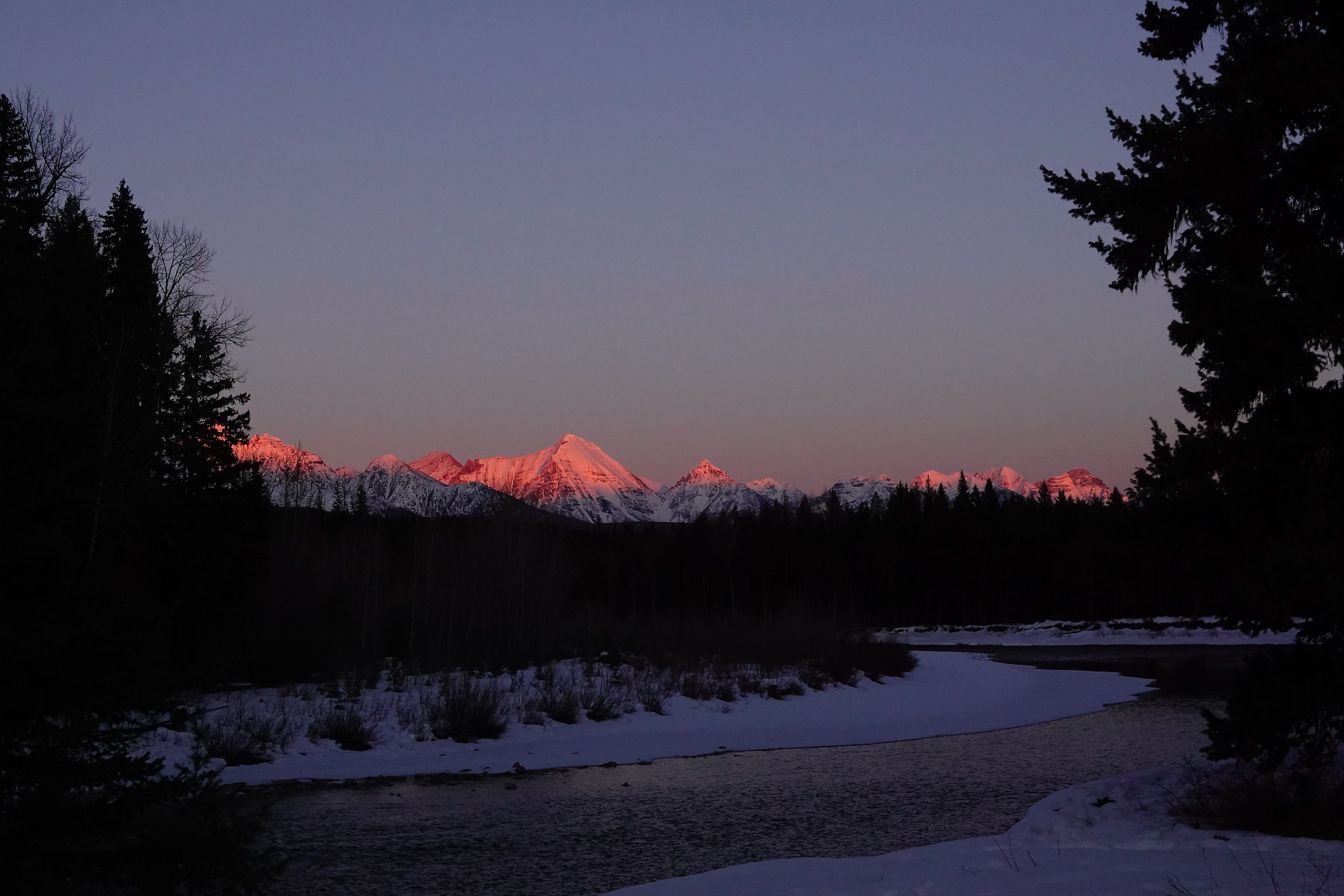
Alpenglow on the peaks of Glacier National Park above the North Fork of the Flathead River, March 6, 2025, 7:27 p.m.

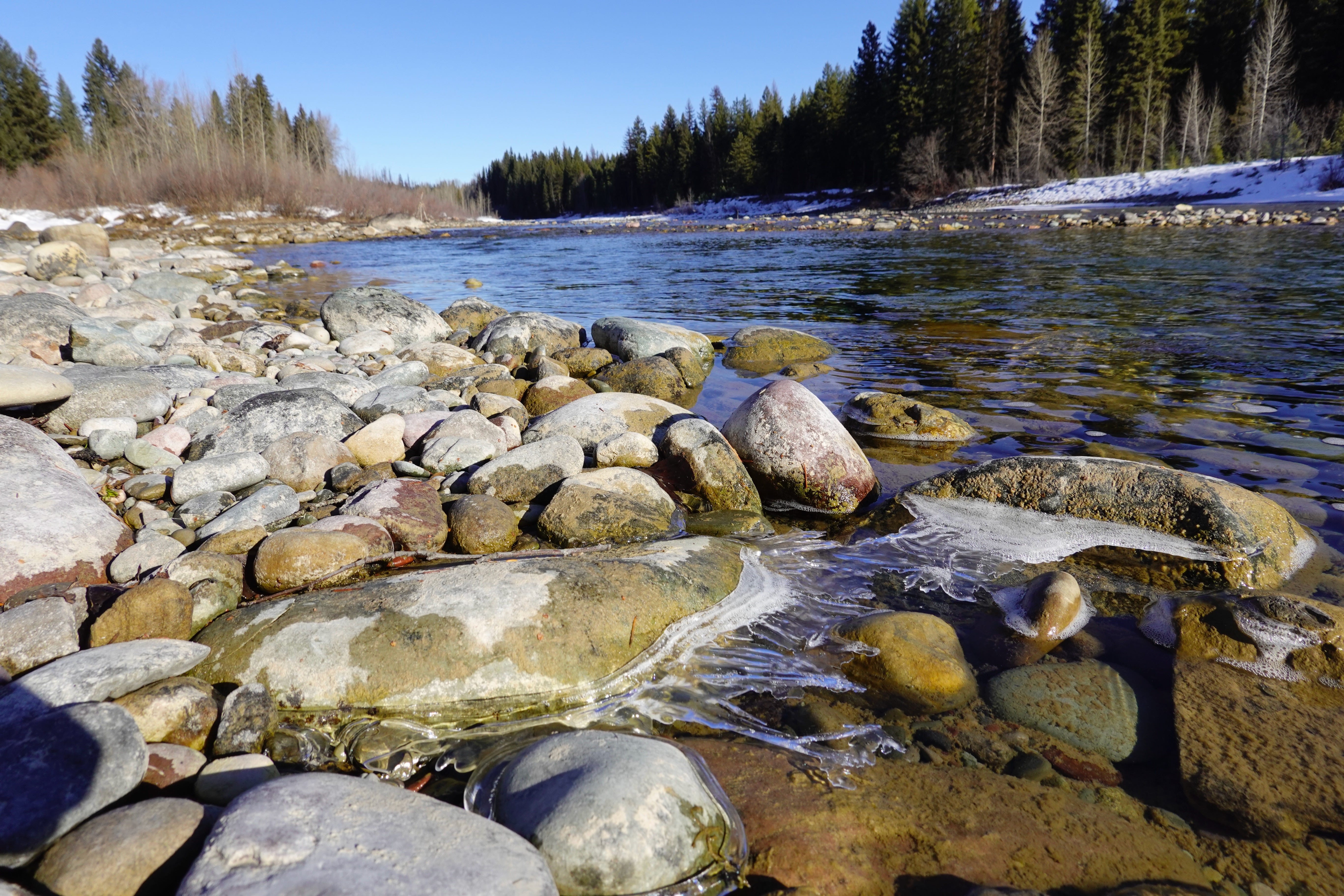
I’ve taken so many pictures of this particular curve of this particular river I couldn’t begin to count them. Pictures of sunrise from behind those mountains, of the rocks and ice where I sit to watch that sunlight grow hour by hour before finally flashing above the peaks, my scorching coffee pouring heat back into what a frozen early-morning river dip has snatched away.

Pictures of alpenglow, that rose quartz soaking the snow and rock, the late-struck sunlight from the west slipping slowly up and off the mountains as the sky behind turns purple, then indigo, then something dark and rich that takes hours to reach anything like true black, drizzled with stars and blanked by the light of a half-full Moon high in the western sky.

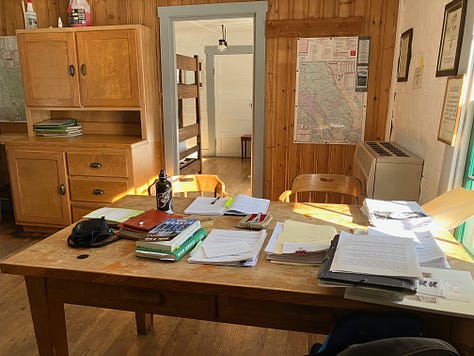
The last two years, I was there this same time but over a full Moon, watching Her rise slowly from the same spot in the east where Sun comes up hours later. I still have a four-minute video of one of those nights, when I sat in the Forest Service cabin embroidering under the single propane-powered light and listening to mice run around the walls.
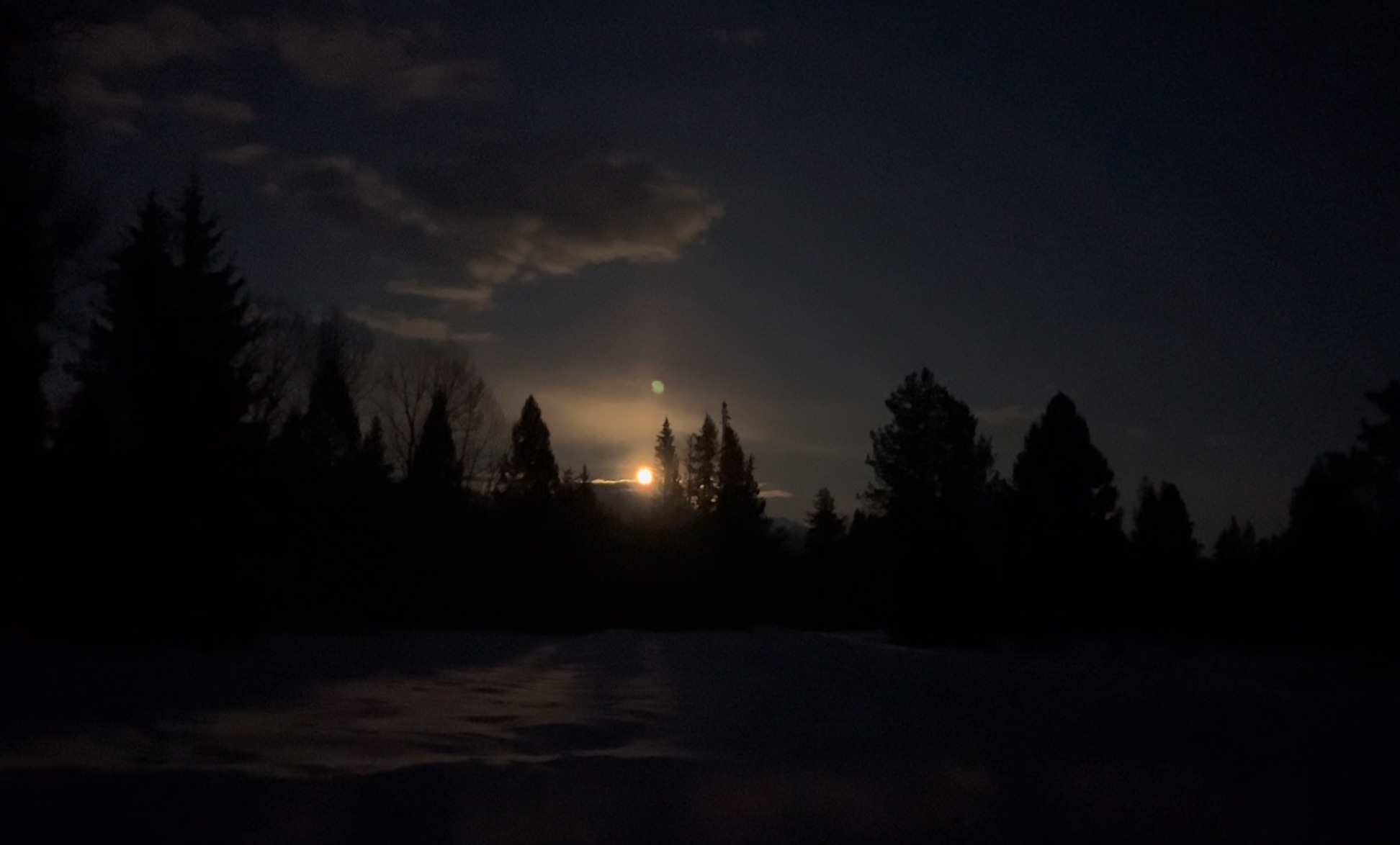
Full Moon rising over the peaks of Glacier National Park, March 7, 2023, 7:25 p.m.

During my Master Naturalist course a couple years ago, we learned about phenology journals, a way of tracking sightings, behaviors, noticings, and movements of the natural world over the seasons and years. To be able to compare Moon phases and birds, temperature and river’s ice coverage even over three or four years is a little thrilling—for a modern person. For the vast span of human history, in any part of the planet, it would have been expected and shared knowledge, a matter of survival as well as of culture. Such a short time of industrialization, and in that time how much has been lost, how much there is to relearn.

There is something about reminding myself of the Moon phases and bird encounters from last year, and the year before, that has begun to give me a settled sense of belonging to this place where I’ve spent most of my life. A sense of responsibility, even, that I’ve been quietly working on ever since moving back home to Montana in 2014—serving the land and lives I live among starts with knowing them.

While at this most recent offline, off-grid cabin visit, I reread a couple of books I read last fall: How Wealth Rules the World by Ben G. Price (more about that in a future essay), and Wild Service: Why Nature Needs You, edited by Nick Hayes (of The Book of Trespass) and Jon Moses and written by people involved in England’s Right to Roam movement.

Wild Service takes its ethos from the serviceberry tree, an intersection of both worldview and metaphor with Robin Wall Kimmerer’s The Serviceberry—the service is native to both England and North America, and is similarly under-valued by modern industrial culture.

In the introduction to Wild Service, Nick Hayes speaks to the concepts of kinship and belonging, and the book’s overriding theme that there is no “saving nature” (however one interprets that) by placing it in some sort of walled garden never touched by humans. Humans need to re-relationship with nature, re-kin, reconnect. Recommon.

“Recommoning is how we can change this. Recommoning is the idea that all humans can and should have the collective responsibility to care for nature.”

To learn the lands and waters of one’s home, ask permission and feel one’s way into a sense of welcome and belonging, is one of the best antidotes I can think of to a culture and power structures that seem intent on destroying every single bit of good and beauty in the world.

I started going to these forest service cabins, and often camping by myself in the woods, to, frankly, get work done. The life of a caregiver is, as anyone who does it knows, even in the best circumstances characterized by nearly nonstop interruption. When I’m somewhere alone, and especially without internet or phone access, I suddenly have time to read a book, sort through research, brainstorm ideas. Write, edit, revise, edit other people’s work for my copy editing job. Write again.
But over the last couple of years I’ve started to let myself spend that time—usually two or three nights—to just be. The last two times I was at that cabin, I lay by the river for up to four hours a day doing nothing but listening to the water run and watching the shift of Sun through the spruce and pine trees. Catching an occasional glimpse of raven or bald eagle, northern flicker or chickadee.

This time, all four were present, along with a pair of Canada geese and some Canada jays (Canada seemed to be in the air, go Canada).

And one day, there was a wolf.

I had lingered by the river at sunset, as usual, and that night it snowed. The next day, toward sunset again, at that same spot, I almost walked right over fresh wolf tracks in the fresh snow. Struck still in amazement—we must have been there within hours of each other, if not minutes—I followed them down to the river, where the wolf had probably taken a drink of water not twenty feet from where I’d been sitting much of the chilly afternoon.
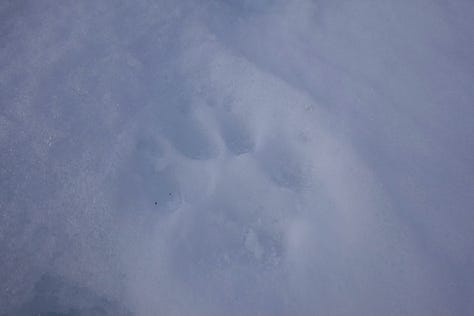
The next morning, I followed the tracks a little way back into the forest, toward a spot I’d camped above the river one hot weekend the previous August. I didn’t go very far, not wanting to disturb or stress the wolf or wolves, since they prefer to keep their distance from humans when given the choice.

I’ve been going to that cabin and river for years and though I know wolves live in the area—the packs there originally repopulated those mountains from Canada over 40 years ago, as local wildlife biologist Diane K. Boyd writes about in her recent memoir A Woman Among Wolves—it’s a vast, mostly unpeopled, region and I’ve never seen tracks anywhere near that cabin.

A wolf came by. Being a brief part of a wolf’s story is the most thrilling thing that’s ever happened to me there, even counting full Moonrises over Glacier and the time one of the packrats ran off with my best tea strainer.

There is something about these experiences to bring back home, something that eases the chew of guilt at even having the privilege of time itself to go sleep by a river alone for a couple of nights. Of having two flexible freelance careers, a reliable co-parent and an able-enough body and kids who don’t need round-the-clock care. These times make me whole, they keep me human. But due to a combination of early training against any hint of selfishness, and a tradition of service to others from both sides of my family, it nags at me to luxuriate in them.

I tell myself I can do my work more effectively by spending these times away, by having hours and days where influences and rhythms are given by starlight and free-flowing water rather than clocks and news cycles and dinnertimes and the finicky washing machine. I tell myself that, because it helps me feel better about simply doing and being what I want to do and how I want to be for a few days.

I recently read Pico Iyer’s new book Aflame, about the monastery in California he’s been spending time at for decades, and found much to connect with in the conversations he had with people over the years, their struggles with mortality and service, how we live with one another and the world. I keep going back to one line toward the beginning, about the writing Iyer does while staying there:

“The point of being here is not to get anything done; only to see what might be worth doing.”

Which reflects the shift over the years in how I, too, spend my time in these places. There’s a lot I stop caring about or stressing over. Priorities are shaken loose and values realigned. I’ve got one life. How do I care for, and even treasure, the stardust that makes up each of its days, each of its moments? Where is the balance between attending to oneself and attending to the world?
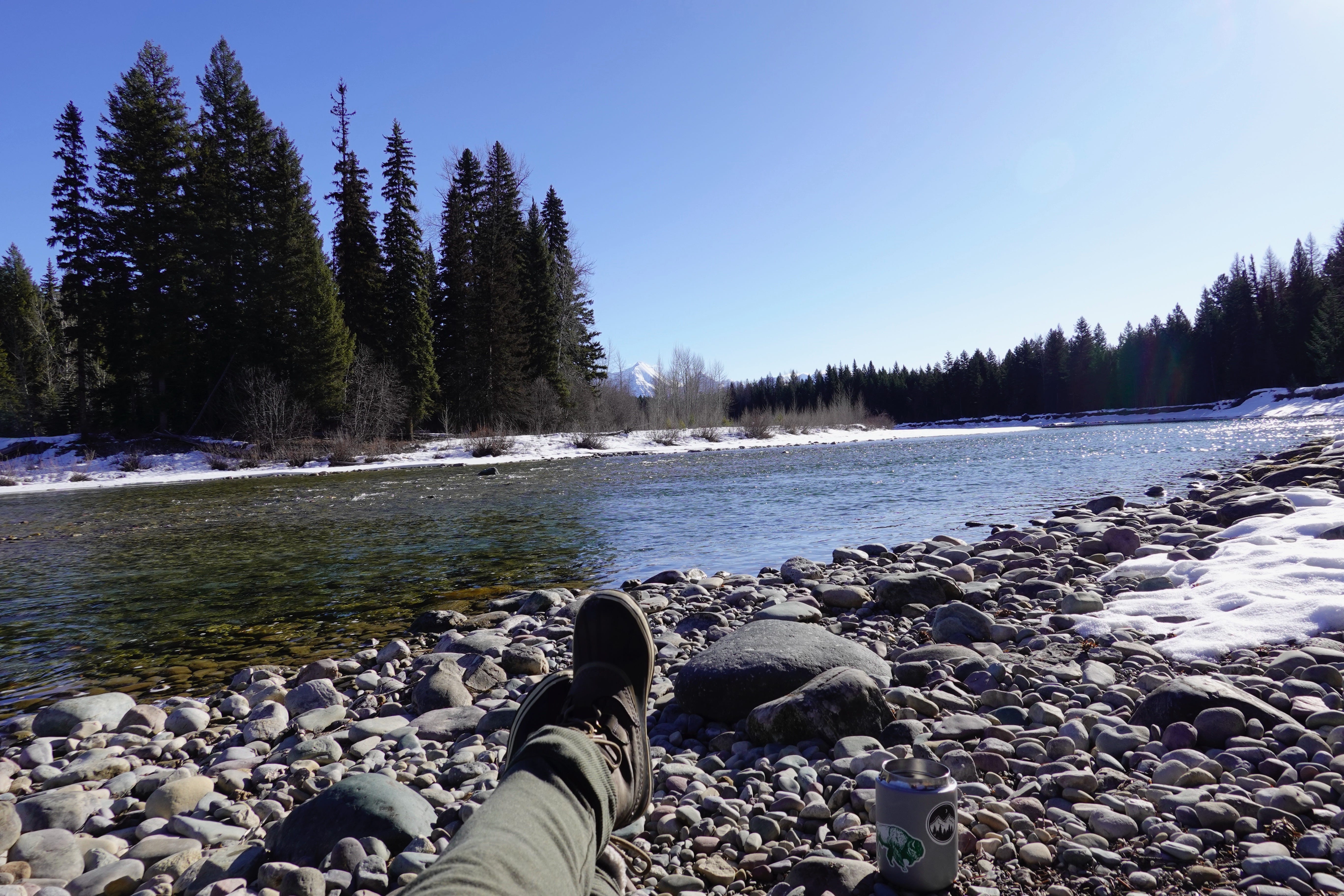
What I often come to on these trips is that anything approaching balance is found in accepting that those two things are often one and the same—a tricky idea with many complications, not least of which is a warping of “attending to oneself” into a wellness culture that too often encourages our own personal little walled gardens and No Trespassing signs.

“Protect your peace” is vital advice, and at the same time a slippery slope. When does self-care turn into selfishness? Yet how much giving or service is too much? At what point does providing support turn into taking away others’ agency? When does focusing on “internal stability” rather than “external security”—which is another way of phrasing Nazi concentration camp survivor Viktor Frankl’s insight that the final freedom is in choosing one’s attitude to external circumstances—turn into accepting injustice? The very real value of self-sovereignty can be weaponized against societal and cultural change the way the idea of “grit” has been in education.

Do any of us have any idea what we’re doing here?

Probably not.

Many times over the years, people have told me that they would not want to imitate these trips, because the prospect of being that alone for that long is too daunting. As someone who’s always been most comfortable in the company of only herself and nature, I try to sympathize, to enter into what it feels like to not crave this alone time as badly as I crave sleep, as I crave gulps of water taken straight from the river, as I crave quiet. I’ve got some frustrating issues going on that have limited more far-flung ventures recently, but in general it’s no feat for me to do this, go to the woods and be alone for a few days, barely a hardship. I sleep best far away from other humans.

Which always leads back into a circular wondering of how selfish taking this time is. I know that coming to these places, holding this time sacred for whatever relationships exist between me and the river, me and the trees, me and the ravens, me and myself, me and that wolf, makes me somehow more human, more real, more alive, and much more capable of managing all the obligations and cares in my life. But I need it, and isn’t it selfish, to take time for what we need?

I know most everyone reading this is generally kind and sympathetic and will say of course not—at least, those of you who comment and email—but it’s a haunting question, embedded in my psyche, that I’ll probably never be fully rid of, and I’m sure I’m not alone in that.
Wild Service refocuses these questions, forcing readers to ask how much we can truly do for the world, or even love the world, if we don’t understand it, don’t know it. While it’s true that over a century of car-centrism and living indoors and, now, digital lives have increasingly disconnected humans from nature, private property and private land ownership did so centuries before, by removing people from their relationship with lands. Recommoning means re-belonging.

“Service is the foundation stone of belonging. While ownership imposes a simplistic, one-way relationship with the land, easily transferable in the passing of deeds, legal spells that confer dominion, belonging takes more work. . . . Belonging is the democratic antidote to despotic ownership, and it requires active engagement with the land, lived experience, knowledge and shared stories.”

If the only answer I can ever find to my own personal quandary is not in words, but in actions—in spending time with family and friends, in laughing and struggling together—and a great deal more in simply learning to belong, letting myself belong, with rivers and starlight, wolves and ravens, basking in Moonfall in the middle of the night under a bare-branched cottonwood tree shaking ice shards and Orion’s Belt off her fingers, in learning to serve the world, and especially the place I live and love, as it is, then I can’t imagine, when I get to the end of my life, I’ll regret having done so, having spent some time to see what, in each of those moments, was worth doing.

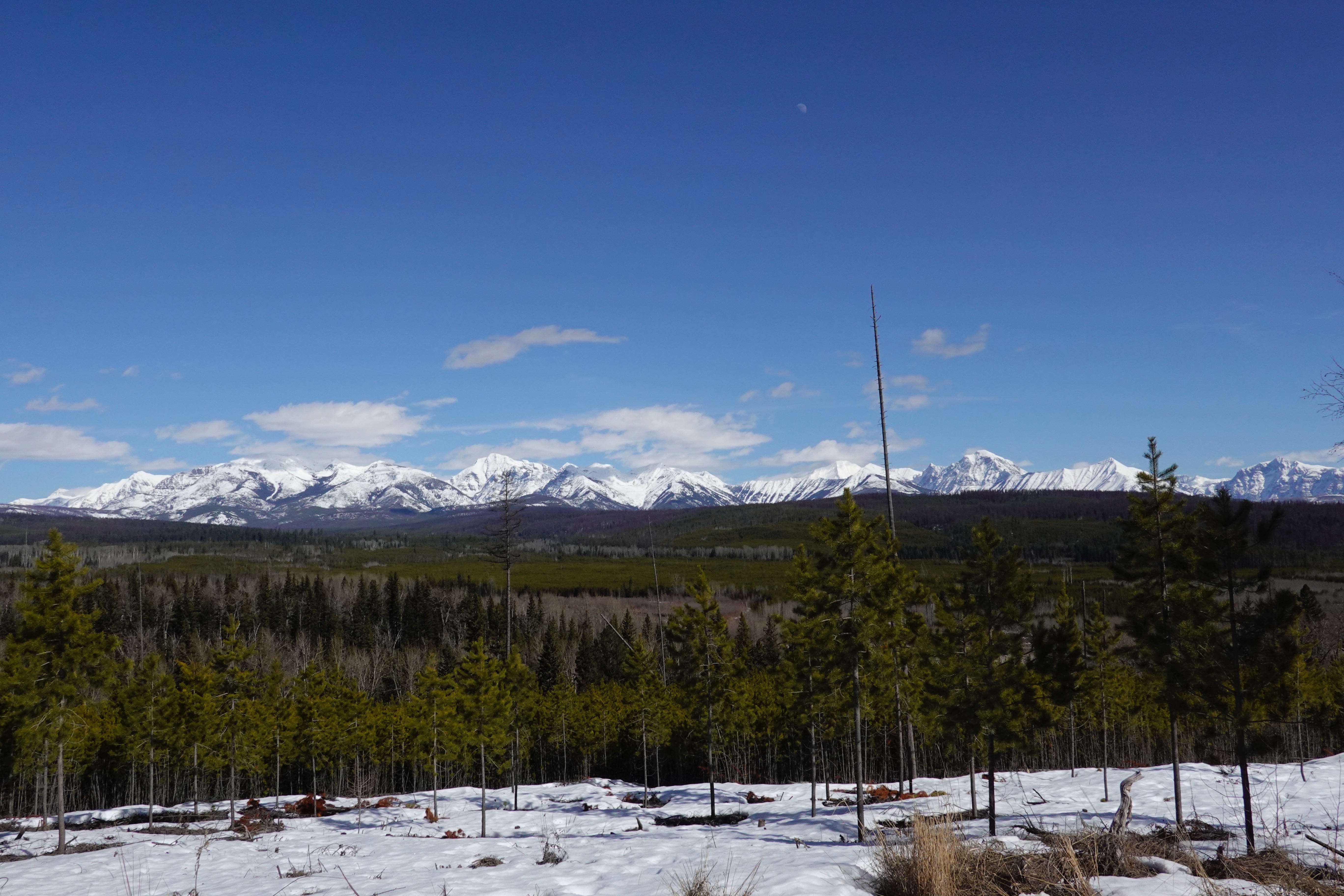
Half-Moon barely visible high over Glacier National Park, where I stopped to watch a bald eagle soar for a long time on my drive out of the North Fork.
Nothing in Excess

I recently spoke with a class at Michigan State University about walking, health, and cultural views of wellness. As happens during most of my talks with college students, at least one came prepared with a question that left me scrambling for an answer.

Undergraduates consistently show up with a broader range of interests than I find elsewhere—when I spoke at Dartmouth earlier this year, I stopped in the middle of our two hours just to comment that I had never spoken with a group that had such persistent interest in bus systems. It gave me hope, I said, because public transit might seem boring to many people but it’s central to finding ourselves in a cleaner, more just, and less extractive world. At the University of Montana a couple years ago, it was one about propaganda and Mikhail Bulgakov’s The Master and Margarita, which I hadn’t read in years.

During this most recent talk, among several excellent questions was one about the architecture of prisons.

Incarceration and abolition matter to me, but, as I told the student, those subjects are well outside my areas of expertise.

The moment I said that, I paused, remembering a study I’d read very early on in my walking research about psychology, mental health, and architecture. I’d wanted to make more use of that study than I did—my editor was, rightfully, constantly reining in my enthusiasm for straying into research that was, at best, adjacent to walking. In the end, that study only informed one sentence.

I couldn’t remember the details of the study, but managed to scrape a memory that it had said something about how the designs of prisons and schools affect people’s self-perception, along with something that has stuck with me from Jane Brox’s book Silence about the design of a near-silent early prison in America.

What does it do to people, I asked the students, to have every aspect of your life controlled as a constant message that you aren’t to be trusted? Which related to the student’s secondary question about neighborhoods—if you live in a neighborhood that doesn’t have sidewalks or parks, or shade or access to green spaces, or is cut through by a 4- or 5- or 6-lane road and there’s no way for kids to walk to school safely—much less if you live in a region under constant oppression and surveillance, ripped from freedom by razor wire and armed patrols—that’s a pretty strong message about whose neighborhoods and lives are valued, whether by your own city officials or a colonizing imperial power.

Extend that to the criminalization of anyone who can’t afford a home at all, and the message about who matters couldn’t be clearer.

When my literary agent and I were first sending around the book proposal for A Walking Life to publishers, I had phone calls with a number of editors. On one of them, with a publisher that leaned more literary, the editor said, “I could see you know your subject, but I didn’t realize you were a policy wonk.”

It wasn’t a compliment.

That editor wanted the book but wanted me to restructure it as a kind of international intellectual and literary stroll, which was the kind of writing about walking I explicitly wrote my book to move away from. I was tired, and still am, of walking literature being by and about people, largely people of great privilege, wandering the world in their heads. Maybe that’s why I’ve been walking barefoot so much in the last year. I want to feel the ground, not just think about it.

His comment stumped me in the moment because I’m not really a policy wonk. What I thought of—a week after our conversation, of course; I’m a slow thinker—is that there is a difference between being into policy, and knowing your subject well enough to be able to talk about it as knowledgably as possible.

That aspect of writing nonfiction is important to me. I over-research nearly everything I write. It’s absurd. But it matters to me because, when someone has taken the time to read my book or one of these essays or shown up for a talk, I want to be able to respect their—your—time and attention in return. I do that by being as thorough as I possibly can for each aspect of a subject that captures my interest.

When editing my recent piece for High Country News, my focus on centuries of violent rebellions against enclosures of the commons in England came after back and forth with the editors about the current-day relevance of enclosures: when nobility and other landowners enclosed what had been commonly shared and carefully managed land, eviction of tenants, often entire villages of people, was usually part of the process. The Highland Clearances in Scotland is one of the best-known mass evictions in Britain’s history, but millions of acres were stolen and hundreds of thousands of people evicted throughout England before landowners turned their full attention to Scotland.

Mass homelessness inevitably followed, and in the wake of enclosure acts, the government pursued criminalization of being without work and/or a place to live: the Vagrancy (or Vagabonds) Act of 1547, for example, in which any “able-bodied” person who was found to be out of work for three days was to be branded with a V and sold into slavery for two years; or the Vagabonds and Beggars Act of 1494, in which “vagabonds, idle and suspected persons” were to be put in stocks for three days and nights and given nothing but bread and water and then evicted from the town.

“Evicted to go where exactly?” is just as relevant today as it was then. The fact that the Vagrancy Act turned out to be impractical to enforce isn’t the point.

The city of Kalispell, Montana, just a few miles from me and where my father and stepmother live, recently stopped short of pulling the operating permit for my region’s only low-barrier houseless shelter after years of complaints by those who seek to criminalize being without a home; while Missoula, Montana, followed in the steps of many municipalities to make it illegal to camp in city limits overnight.

During a discussion on land ownership and enclosure acts last year, one commenter noted on a section about anti-homeless laws in 1500s England—relating them to the U.S.’s current affordable housing crisis—that, “‘Skin in the game’ counts, while skin itself doesn’t.” People’s lives, in other words, matter less than property values. It matters that this was true during centuries of the theft of the commons, because it’s not new. Like most injustices, it takes different forms, but we’re still living with it.

I’ve read more books than I care to count at this point on land theft and the commons alone for this book I keep promising you all. In every one I learn something new, most of which will never make it into narrative. But I know by now that there’s always a chance that some fact or story that I can pull out of my bedraggled brain will be useful to someone someday, and while I don’t think that makes me a policy wonk, it does give me a lot of satisfaction.

But policy knowledge doesn’t hurt, either. Holding knowledge about walking’s gifts and potential along with knowing about the systems, legacy infrastructure, and ongoing policies—like road designs that are mandated (not just suggested) to optimize traffic flow, even at the expense of healthy ecosystems and human lives—helps me, and I hope helps everyone I share it with. It can be easy to see that a road is unsafe for anyone walking, but you can’t change that reality if you don’t know that federal requirements determine its design. We have to know where the barriers are in order to dismantle them.

Similarly for land ownership and private property: knowing the history of enclosure and rebellions, and the lack of any true foundation for, say, exclusive private property rights in land, matters for how we perceive the paradigms and stories we function within.

Changing a paradigm is hard, involving as it does a massive upheaval of perception and possibility, and especially hard if you can’t see it for what it is. The ancient Greek maxim to “know thyself”—inscribed on the Temple of Apollo—applies equally to knowing the structures that shape our world and our expectations of it. If we want life to count more than skin in the game, more than profit, we have to know what we’re fighting.

Also inscribed on the Temple was the maxim “Nothing in excess,” which, when it comes to research, I’m not very good at adhering to. But then, who defines “excess”? I’ve been reading Guy Standing’s Plunder of the Commons, which turns out to have very little information I need, but even if I never write about the Lauderdale Paradox of 1801, in which James Maitland, the eighth earl of Lauderdale, showed how public wealth decreases as private wealth increases, someday it might be exactly the historical link that someone out there needs.

I don’t generally wonder if the research I do is excessive—I assume it is—but it feels like the excesses of nature: the way I can walk around town right now and eat handfuls of serviceberries, or how there are so many ripe raspberries coming out of the garden that three families can’t eat them all, which means I had enough to make a batch of seedless raspberry jam last week.

The research I do is frequently boring, written as it is for academic expectations and requirements, but it is rarely without some kind of gift, some spillover of story or insight or simple information that makes me feel like I’ve been rewarded. It leaves a richness, and like all true gifts, the greatest pleasure is in being able to share it.

To walk a prayer to the world

Imagine yourself in a cabin, curled up on a beaten couch in the corner of the small room shared by a couple of bunk beds, a table, a counter and stove, and you. It’s night out, and an almost-full Moon was rising in the south when you went out earlier, a boreal owl barely audible from the woods.

The propane-fueled fireplace is warm but doesn’t give off quite enough light to read by. But you sink into the pages anyway, take them slowly because you’re in that kind of mood. You watched a whole flock of bluebirds for an hour earlier, and as you drove up to the cabin, a bald eagle flew overhead. There are no people nearby. You are fed and tired and ready for bed; to slip into it via firelit poetry feels perfect.

As you turn the pages, something happens, a quiet internal earthquake. It’s not one particular poem or line or turn of phrase, but the accumulated effect of their weight: quiet and light, like snowflakes, carrying that same balance of power and delicate beauty. The poems each strip away a layer of something, you’re not even sure what, and by the end of it you look up at the flames slightly irritating in their gas-powered sameness and think, That’s where I’ve been hiding


A few hours earlier, I’d been standing by the side of the road watching bluebirds. I have never seen so many bluebirds in one place. At most I see one or two of them a year, their impossible bright colors a flash of delight. There were at least ten, maybe fifteen, flying among last year’s grasses, barely pausing on the dry branches waving in the wind. I truly could not believe my eyes. At the far end of the field, a couple of elk romped together among their herd, and snow-clung mountain peaks stopped up the horizon like a postcard for Montana.

My feet ached to wander into that field, wiggle toes into the soil that could draw so many bluebirds. 

My friend 

Amanda B. Hinton and I were talking recently about the ease I feel when letting my feet rest in running water, the concept another friend had proposed of feeling “grounded in flow.” Maybe, Amanda wondered to me, you pray through your feet. That idea tasted like a fresh wild huckleberry on a hot hike when I’ve run out of water, reminding me of something 

Chris La Tray has often quoted from Eddie Benton-Banai, that “to live an Anishinaabe life is to live one where every footstep is a prayer” and the fact I sometimes forget, that I’ve spent years now devoting my professional and personal life to walking this world and relating to it as deeply as possible. The more I do it, the more I want to do it.

Which is how I ended up writing about ownership, private property, and the commons in the first place. Because too many places I yearn to walk, like that field of bluebirds and elk, are inaccessible not due to terrain or danger, but to the simple fiction of ownership.

It’s a friendly No Trespassing sign, the orange almost cheerful, the font relatively friendly, and no hint of being shot at—far too common in Montana—for crossing the barrier, but it’s a barrier nevertheless.

In his book Enlivenment, the German philosopher Andreas Weber writes of the enclosures of the commons throughout Europe as not just a denial of physical sustenance and survival, but of a spiritual severing. Enclosures and the rise of the market economy 

“not only governed the allocation of land, but also redistributed the spaces of our consciousness. In reality, the forced separation between that which gave life (the biosphere) and those who were gifted by life (the commoners) was an act of violence on the part of the landlord, who excluded members of the ecosystem from their rightful positions and thereby damaged these participants, the ecosystem itself, and the unifying experience of self-organizing coherence.”

Commons, Weber had written earlier, is a system in which there are no users or resources, “but only diverse participants in a fertile system, which they treat in accordance with a higher goal: that it continue to give life.”

When the land was no longer commoned, when it was stolen for the purposes of private ownership, it could also no longer be related to. People were denied access to that most fundamental yearning, to relate to the land we live with. Their minds were bent, by force—the number of bloody rebellions against enclosures of the commons might be surprising to those who assume private property came about naturally—to see themselves as separate from nature, disconnected from land and a living world, and able to survive only by working for someone else—the genesis, commons scholar Peter Linebaugh has said, “of the j-o-b.”

We know how well all of that has turned out.

Dismantling the story behind private land ownership, and exposing the lack of foundation for laws defending it, is necessary to finding a way out of it. But so is restoring a shared relationship with all of life. I wanted to walk that field because I am alive and the field is alive and the bluebirds were so beautiful I wanted to cry and it means something to know that, and to know it’s true and right to feel that way, even if the No Trespassing signs stop me acting on it.


The book I read that first night at the cabin (for those who’ve been around a while, this is the same cabin I stayed at about a year ago where the heat didn’t work and I turned around on a hike after coming across a fresh grizzly bear track) was by someone I was fortunate to meet recently, poet, essayist, and woodworker Charles Finn. He’d generously given me a copy of each of his books: Wild Delicate Seconds, a book of short essays, and On a Benediction of Wind, a collaboration between Finn’s poetry and the black and white photography of Barbara Michelman. 

It’s tempting to spend the rest of this space quoting numerous lines that I keep going back to, like

“Above the geese the soft colors of the afternoon deepen into a tremendous wound and a gibbous moon is birthed, shadows crawling over the snow to dissolve into the river”

from Wild Delicate Seconds, but like most reading for pleasure and insight, how anyone receives those passages will be personal to them. There’s a quiet reverence for the world that invites rather than demands the reader’s attention, both to the writing and to the lives it honors. I read On a Benediction of Wind all in one sitting that first night, which I don’t think I’ve ever done with a book of poetry, and at the end I closed it and stared at the fire and went out to visit with Moon and felt, for the first time in a long time, a steadied feeling of being at home—in the world, and in myself.

The next day I chose a trailhead at random and walked barefoot for two miles on dry pine needles along a waterlogged trail, the nearby river free to stretch herself over the ground. I spent hours by the lake after gasping into its snowmelt cold, watching the waterfall far across the valley, crashing snow from its mountains’ embrace through a ravine and brushing into my dripping hair snowmelt and sunshine, a wolf’s nose nudging a track, a wolverine’s strand of fur, the promise of berries still sleeping, and the call of the loon diving under spring’s early waves.

“Conspires,” from  On a Benediction of Wind