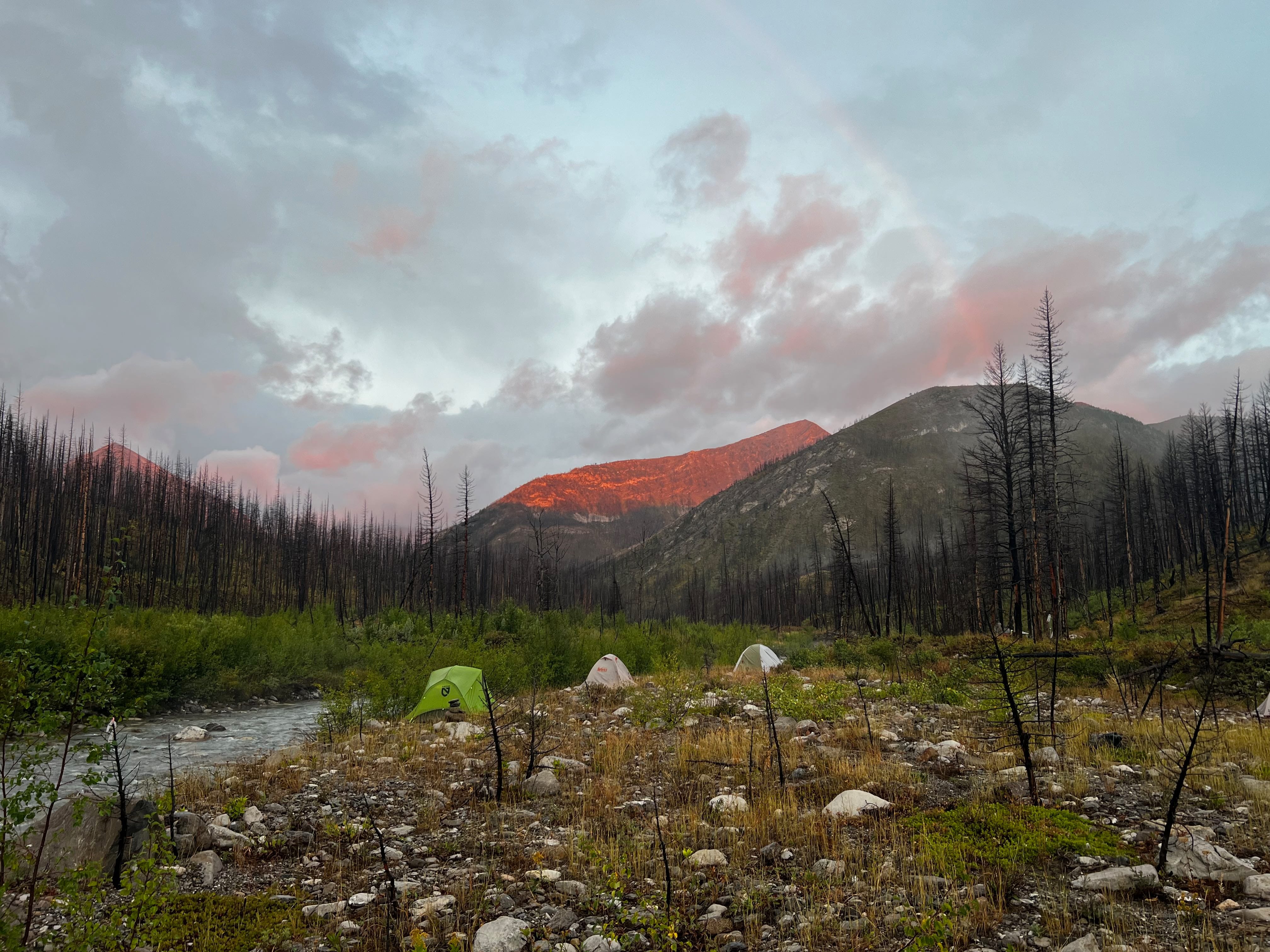
The following is a reprint of my essay “Trespassing,” published in the Air volume of Elementals, a new anthology from the Center for Humans & Nature.
You can read other republished selections from the anthology by Eiren Caffall in Orion, Andrew S. Yang in Bioneers, Robin Wall Kimmerer also in Bioneers, and register to join the second of five virtual book clubs, with contributors to Air, Vol. 2, Wednesday, February 19th, 6 p.m. Pacific Standard Time, hosted by Point Reyes Books.
It was late September, and the aspen trees were just beginning to yellow. They grew thick on the hillside, a broad grove giving way to small meadows that sloped upward, transitioning after less than a mile to heavy stands of spruce and pine. The group I was with rambled along an old logging road just south of the eastern side of Glacier National Park while a biologist among us talked about the ecotone we were walking through: a mingling of prairie and forest that stretched all down along the Rocky Mountain Front, the eastern-facing slope of the Rockies, where the mountains spill onto the prairie. A light wind blew constantly.
As we left the aspens and walked into evergreens, the wind became a whispering—psithurism, a sound that’s like a rustle and a shush at the same time. That sound characterized almost my entire Montana childhood, but I never consciously noticed it until a few years ago, shortly after moving back to my hometown. One day, a few months into my return, I was walking home through town and stopped to listen to the wind blowing through a stand of tall lodgepole pines bordering the path. That sound, I thought, remembering its company in the Rockies on many a family hike that I had dragged my feet on as a child, and later on treks as a teenager with friends. That sound is home.
***
The place along the Rocky Mountain Front I was hiking that late September day is a two-hour drive east from the valley where I grew up. In another region, it might not be considered anywhere near my home. But this is the American West: expanses are vast, yet their very vastness and sparse human population are part of the intimate familiarity that welcomes those of us who live here. Montana is often called a “small town with very long streets.” The psychological network of what I think of as my homeland encompasses the Rocky Mountain Front. For a white settler like me, a fifth-generation descendant of Montana homesteaders, the question of homeland and belonging is constantly shifting. But there is one constant: wherever my feet happen to be, my heart has always longed to be right here, among the cold mountains and prairie grasses.
Hiking along the prairie-forest ecotone, every aspect of the air felt like home—the smell of pine, the sound of wind in the evergreens, the way the sun was almost warm enough but the air kept me chilled. That same air had wound itself eastward from the valley I live in through a pass in the Rockies and unfurled here, to race down the foothills and speed its way across the prairie and farmland to the little agricultural town of barely two hundred people where my mother is from.
Although I never lived in my mother’s hometown, or even on the kind of spread-out farmland she knows so well, the air of her childhood landscape calls to me almost as insistently as that of the stream-saturated peaks I was raised in: I can smell it now, sitting at my desk on the other side of the Rockies in a mountain valley with its different kind of big sky. I love the way virga strolls across the miles of prairie and farmland like it’s got all the time in the world, how I can watch it for hours, how my skin tightens slightly at the drop in temperature, and how I can still smell the ozone of rain’s promise, with its dust-tang, months later in the back of my nose. I can’t understand why that air also smells like home to me, why I can look at those houses surrounded by thousands of acres of wheat and feel in my gut what it is to be a child growing up with your eyes on that far horizon, nothing between you and the rainstorm but the air and wind who make constant companions. Companions who can issue either invitation or warning, for those who listen closely enough.
There is one stark difference between these places, a difference that I too often take for granted and that most people might not notice: where I live, I’m not far from access to millions of acres of designated wilderness and national forest areas and a national park, places where my feet are as free to roam as the air itself. However, when I go out to eastern Montana, my mother’s home ground, everywhere I turn is blocked by fences. You can drive for hours and see little else but weather-beaten houses huddled together on the prairie, their siding bitten with winter and the fierce, scorching sun of August. These vast counties, where you can drive past more visible wheat silos than homes and only the occasional hawk or pronghorn, are squared out and fenced off with countless miles of forbidding barbed wire.
My body can’t pass through these fences without permission, but the air has no such limitations. It’s a freedom that has an underacknowledged impact: No Trespassing signs are ubiquitous in America (in Montana, Trespassers Will Be Shot is a threat I always take seriously), yet at the same time, air pollution trespasses into our bodies every moment of the day. When I walk around my hometown, it’s impossible not to breathe in vehicle exhaust, especially on days when an inversion layer holds it close to the ground. Out where my mother’s from, on those expanses that feel like they host some of the cleanest, most unadulterated air on the planet, on any given visit I might see a crop-dusting plane emptying loads of pesticide or herbicide over the fields and still smell the strange, metallic tang in the back of my nose the next morning.
Trespass can be turned back on us. With bodies and lungs and circulatory systems porous to the air, neither humans nor the rest of life have much defense against the kinds of airborne attacks that other people have unleashed upon us. And I don’t use the word attacks lightly. Air pollution from vehicle traffic can decrease children’s lung capacity by 20 percent and significantly affect cognition in their growing brains; recently, it has been found that carbon pollution from car exhaust crosses the placental barrier and affects fetal development and even ovarian egg production in women. Living near a landfill raises a person’s risk of lung cancer due to the hydrogen sulfide that’s released from decaying trash. Fully 95 percent of the world’s human population lives with levels of air pollution considered unsafe. Air pollution is one of the leading causes of premature death worldwide.
Without clean air, humans are denied an inherent right to health and flourishing. If billionaires’ dreams of colonizing Mars were ever to be realized, the first mission, the second mission, the millionth mission, the missions for generations far beyond our imaginations would be to secure water and breathable air. Air is so vital that a common right to it was recognized in legal code as far back as the Roman Empire. “The following things are by natural law common [to] all—the air, running water, the sea and consequently the sea-shore,” declared the Institutes of Justinian in 535 CE.1 In 1972, after decades of relentless air and water pollution, aided by political corruption paid for by the powerful men of industry known as the Copper Kings, Montana’s legislature passed a new state constitution that guaranteed a “clean and healthful environment” as an inalienable right, including the right to clean air.
Air is a shared commons: it’s an entity we all rely on for survival, and it moves freely across the world. The air I breathe that smells of dry pine needles and early snow was somewhere else a few hours ago, a few days ago, a few weeks ago. Maybe it was bringing some other hikers the smell of their own woods, or picking up sulfur dioxide, nitrous oxides, and soot from a coal-fired power plant, whose particulates are now seeping into my lungs, unasked for and unwanted on a cool September day. We all depend on and all share the air, and yet the ability to pollute it is treated as a private property right. Legal systems around the world make air the recipient of industrial waste; in turn, that means that all of us are, too. Air knows no international boundaries, and neither does the pollution it carries.
When I think of trespass, what first comes to mind is the Lord’s Prayer, which I recited with my parents and sisters Sunday after Sunday in Episcopal and Lutheran churches, and often around the dinner table, throughout my childhood. The lines “And forgive us our trespasses, as we forgive those who trespass against us” refer not to who crosses whose property lines but to committing sins that the deity has forbidden. The word trespass occurs many times in the New Testament. In some translations it’s replaced with sin or debt.
Trespass, in other words, is a transgression. In the case of pollution, trespass is far more invasive than simply breaking through a property line. If I sneak through my neighbor’s yard to get to the public nature preserve on the other side, I might annoy him, but there’s no actual harm done. If my neighbor burns a pile of tires in that same yard and I don’t go near it, his waste will trespass into my family’s bodies just the same, pouring itself into my children’s lungs with the law’s consent. The polluted air has trespassed into us, but it wasn’t by choice. The first crime of trespass was against air itself. When air has been violated, it is forced to violate in turn.
***
I was hiking along the Rocky Mountain Front in late September 2022 with a group working to stop oil leases in what is known as the Badger-Two Medicine. It’s an area bordered by Glacier National Park to the north, the Bob Marshall and Great Bear Wildernesses to the west and south, and the Blackfeet Reservation to the east. The Badger-Two Med is sacred to the Blackfeet Nation. Under laws written and enforced by the federal government, it’s legally part of the US National Forest Service, but it was carved off of Blackfeet land in 1895, along with the eastern part of Glacier Park, in yet another land seizure accomplished with a deceptive treaty signed under duress, one in a long history of betrayals.
I hadn’t been to the Badger-Two Med before, although I’d been following the oil lease situation—which has been ongoing for nearly forty years—since before moving back to Montana. This was the first time I’d managed to visit it, on a hike sponsored by the Glacier-Two Medicine Alliance, which was founded in the 1980s to fight oil leases granted in the area by the Reagan administration. Most of the leases have been successfully canceled over the years, but in late September 2022, one oil company had just won a court appeal to keep its lease.2
Emerging from the aspen groves and into pines and spruce, my group walked a path that ran parallel to a buried natural gas pipeline; the organizers pointed out where a road to the remaining proposed site of the oil well would be built if the lease were upheld. A few miles further in, we would see a hillside already scarred by preparatory clearing.
It’s hard to imagine a place that feels more like the white European settler’s idea of pristine wilderness. Pristine wilderness and its ideals of unchanging purity have never really existed, of course, but perhaps places like this offer something better: I felt whole on that hillside. The air’s movement and scent felt like a welcome. And even though I know that there is no clean air, really, anywhere in the world—everything from dioxins to Chernobyl radiation has been found in polar ice, carried by the air and dropped even on places where few humans have ever stepped—I felt an extra surge of resentment at the thought of the trespass that would come not just from the physical invasion of an oil well but from the particulate matter, carbon monoxide, nitrous oxide, and volatile organic compounds that have been found in the air around and downwind of oil-drilling operations. At what the air would be forced to carry through no choice of its own.
***
As we walked to the top of a hillside where we could see out toward the plains of eastern Montana, the air shifted from a gentle breeze to a wind traveling east—stiff, but not quite the hard-blowing kind that is almost a constant presence on the wheat and cattle ranches that cover what’s known as the Golden Triangle, the wheat farming region my mother grew up in.
The wind blew the smells of encroaching autumn in my face, dried grasses underfoot and fecund soil under bear-claw-scarred aspen trees. The tiny bit of late-September chill reminded me that snow would be coming soon. There is nothing that smells more alive to me than that air. It feels conscious: the warm pine in summer, the tang of ice in winter, traveling down from these mountains to kick prairie and dirt-road dust in the faces of children growing up in the same tiny town my mother had over seventy years before. The heart that has always insisted on calling this place home, even during the twenty years I lived elsewhere, tells me, quietly, that this air I love in all its moods and seasons is conscious. It has a life of its own and a right to live it unviolated.
The crime of trespass goes both ways—what happens when we require the very source of life to carry sickness instead? Is this not a violation of the gods of life, of home, and of air’s own right to exist?
Acquiescence to the abuse and neglect of air is a trespass against humanity—against all of life, even against the air itself, for its own sake. Every living being has a common right to air that not only allows us to live the healthiest lives we can but also smells like pine and snowmelt, desert dust and prairie flowers, swamp grasses and moss. Air that feels like home.
Institutes of Justinian, bk. II, title I, “Of the Different Kinds of Things,” trans. J. B. Moyle (Oxford, 1911), available at https://amesfoundation.law.harvard.edu/digital/CJCiv/JInst.pdf.
Almost a year later, in September 2023 just before this went to print, that lease—the last in the Badger-Two Medicine—was bought out and was in the process of finally being retired.


 Antonia Malchik