Repair: of rivers and relationships

To new subscribers—welcome to On the Commons! To those of you who’ve been around a while, welcome back!

I recently wrote an essay for Psyche/Aeon’s “one thing that changed me” series that’s probably the most personal thing I’ve ever published. If you came here from that essay, I’m very glad to see you here. This newsletter is generally not the space for that kind of personal essay, but I hope you’ll give it a try and explore what it means to be part of a commons—including our relationships with one another.
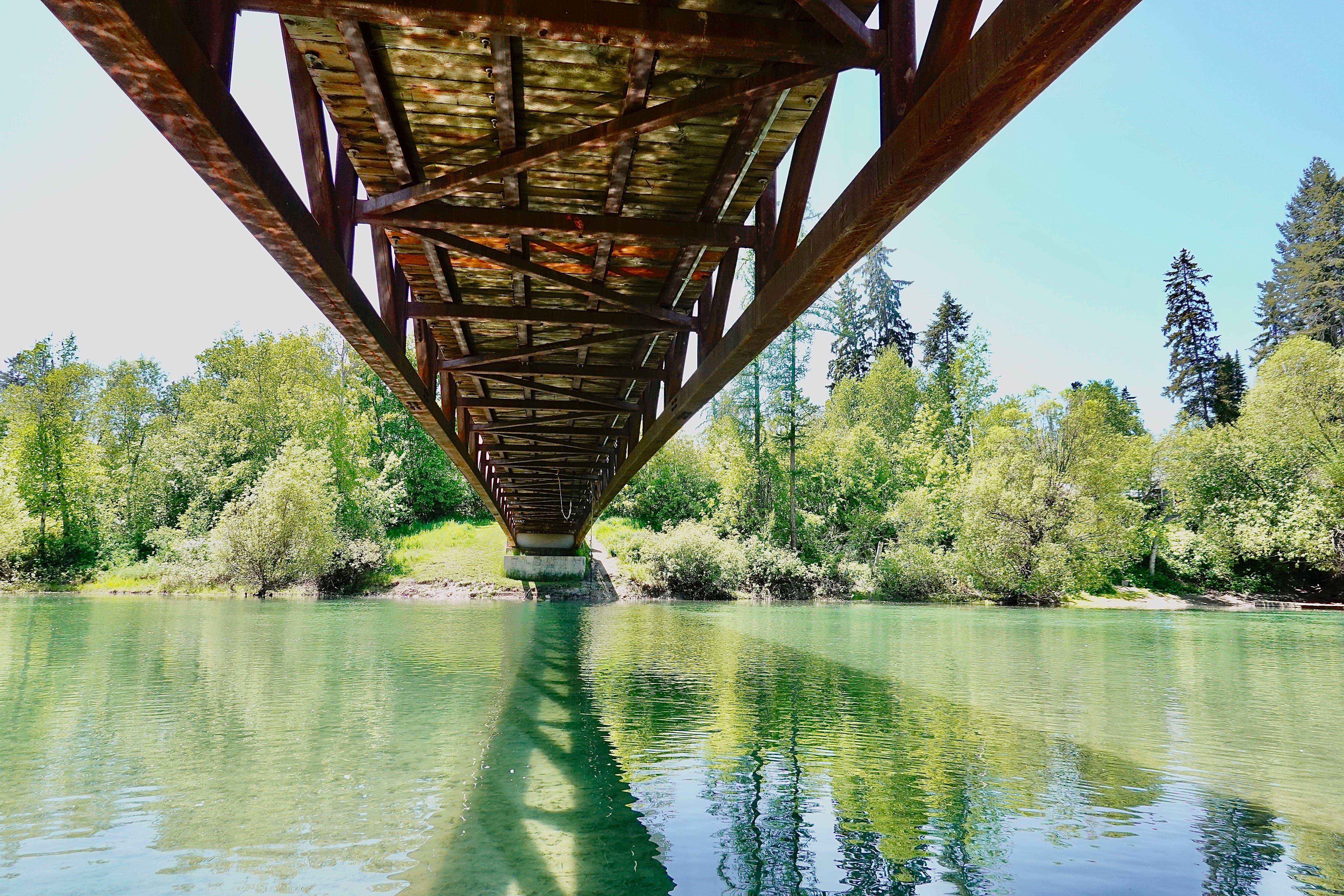
From the steps under the footbridge. People have also installed rope swings below the bridge’s jumping-off point. This bridge, this river, the way people relate to it with joy — to me it’s the epitome of the commons.

“Ma’am, watch this.”

Two teenage boys stopped me on the footbridge, right where they’d been jumping into the river. One of them was about to attempt a backflip off the railing, and the other was betting it would turn into a belly flop.

I stopped, and thought briefly of my father’s childhood stories—growing up in Leningrad (now called St. Petersburg) in the Soviet Union, he and his friends jumping (illegally) from a bridge into the Neva, near the Peter & Paul Fortress. Living under a dictator, a life structured around fear, rigid rules, almost nonexistent interpersonal trust, and waiting in hours-long lines for bread. And still, laughing, challenging one another, unwilling to resist the lure of the water.
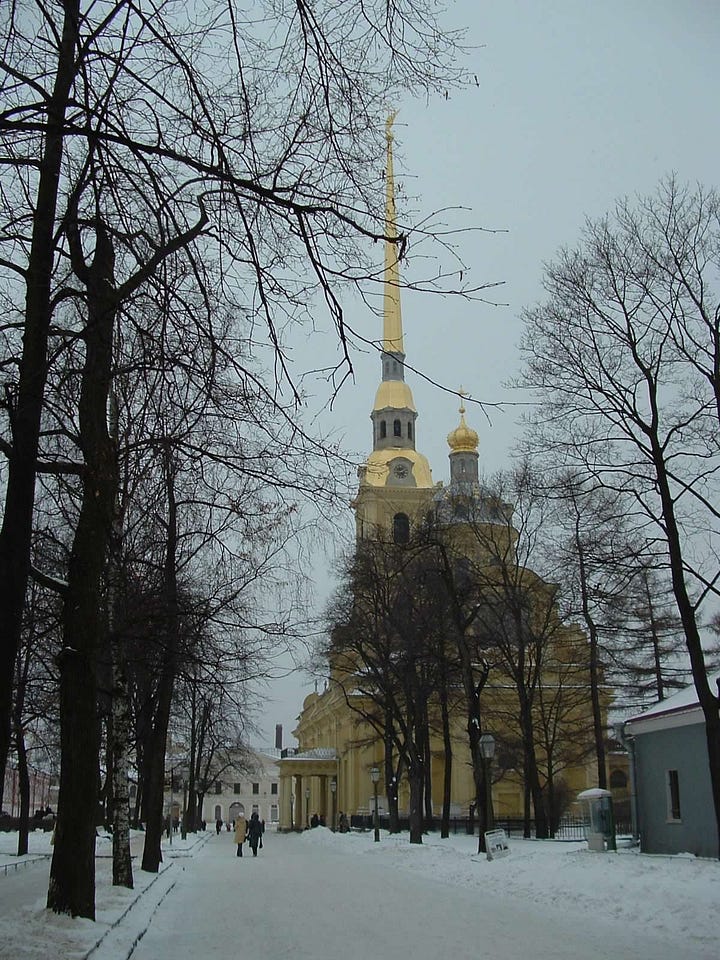
The cathedral at St. Petersburg’s Peter & Paul Fortress; my father and his friends on the banks of the Neva.

The boy jumped, did not belly flop. “That was actually pretty cool,” I agreed with the other kid, and went on my way.

I’d been sitting at the other end of the footbridge for a while, on new stone steps that the city had just had put in to make access to the river at that spot easier, and to repair the worrying degree of erosion from years of people walking up and down the slope. Although there are easier access points and several public docks all along the river, the ends of the footbridge see heavy use, people drawn down to the water with dogs, with kids, with themselves.

But it was a steep slope and slippery from time-ground dirt eroding away from the bank. In ten years I’ve gone down to the water at that spot maybe two or three times. In the week since the steps were finished, I’ve been down them, walking into the water, sitting on the lowest steps doing nothing, almost every day. The steps didn’t change how I relate to the river—I visit it at plenty of other points that have gentler slopes and docks to sit on—but they did transform my relationship to it at that particular point. I feel invited now to sit with the water, drawn to greet it. From what I’ve seen, a lot of other people do, too.

When I was a teenager—over thirty years ago now; I’ll be fifty in less than a year—this river was not one people swam in. My younger sister says she used to go in, but it wasn’t common. It was so polluted, so contaminated from nearly a century of pollution leeching from the rail yard’s containment ponds, that in decades past it used to catch fire.

In 2009 a years-long Superfund cleanup began on the river, which runs wide and slow right through our town from its outlet at the lake, eventually down to Flathead Lake, all the water collected in this basin eventually funneling out to the massive Columbia River watershed. Superfund, for those outside the U.S., is a designation implying a degree of pollution that might take decades, more likely centuries, to repair.

The first time I visited the new steps was with a friend who was in charge of that Superfund cleanup. Like many of my friends, her work —cleaning up oil spills in rivers for the railways—is far more interesting and important than mine.

To remedy the extensive contamination, the river was drained completely. Blocked at its outlet from the lake and the water removed. I’ve seen pictures but hadn’t moved back home by then. It’s hard to wrap my head around the enormity of the project.
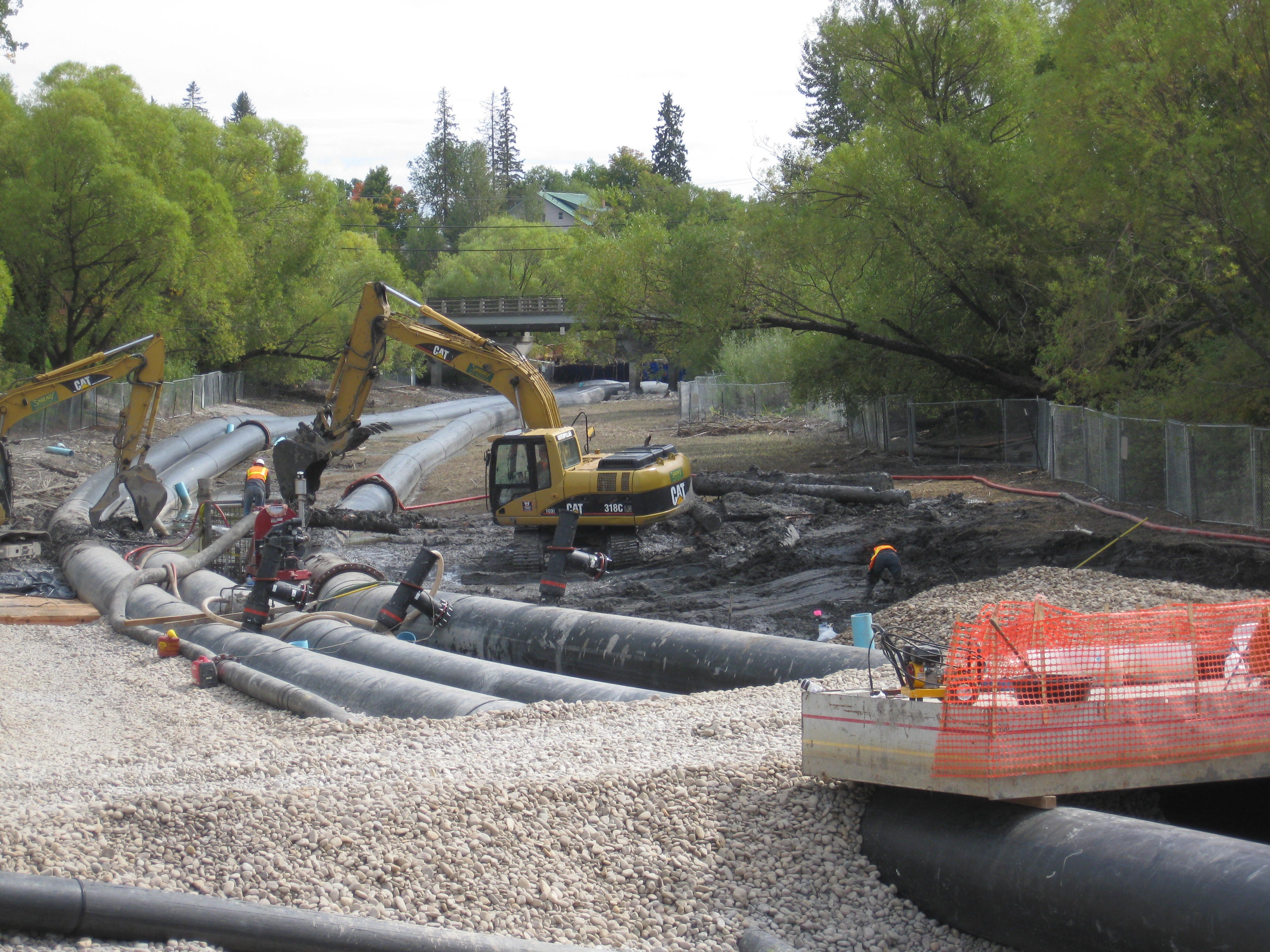
Location of this river cleanup photo is approximately from where the same footbridge is located, dated 2010.

In late 2014, the year after the initial cleanup completed (there have been small leakages and spills since then; the rail yard area remains a Superfund site and the river will likely always be at risk), a several-mile stretch of the river was designated non-motorized. Now, as soon as winter begins to loosen, the water is popular for paddleboarding, kayaking, swimming, jumping off the footbridge at that one spot where the water’s deep enough to do it safely for most of the summer, and now, with the new steps down to the water, for those of us who simply want to sit by it, let it welcome our feet and our thoughts. An invitation to rest.

The river will never be the same as it was before the rail yard was built and contamination started to seep into the water, at least not for generations beyond count. Not everything can be fixed. But that doesn’t mean it’s impossible to repair.
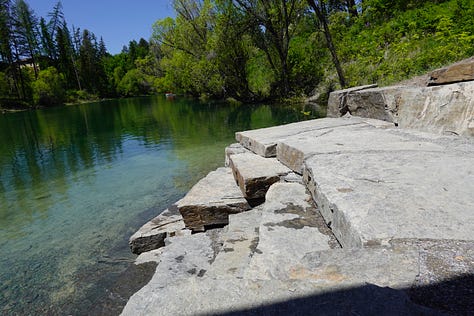
The new steps, like someone’s opened a door wide into a world that was always there. (This slope was too steep to make wheelchair-friendly, but other public access points along the river are more accessible.)

Recently, the novelist and physician Abraham Verghese came to give a talk at our local community college. The region I live in is not, to put it mildly, a place where people of that stature and renown come to speak. We might never get to listen to someone like him again in person, but the hospital sponsored the talk (a friend quipped, I’m sure rightly, that it was probably cheaper than doing what they needed to be doing, hiring more nurses), and it was close to sold out.

Verghese was a generous and thoughtful speaker, full of compassion and insight. Before answering questions from the audience—packed with people who worked at the local hospital or their relatives, including some of the friends I’d gone with—talked about his childhood in Ethiopia and the books that shaped who he became as a writer as well as a doctor.

And then he spoke about being a doctor serving HIV/AIDS patients in Tennessee in the early 1980s, when HIV was terrifying and unknown—it hadn’t even been labeled human immunodeficiency virus (HIV) yet—and had no treatment.

It was at that time, he said, when he began to understand that, for all the medical profession’s fixation on curing illnesses, there is an equal or perhaps even greater need to understand what “healing” means. There was no cure for his HIV patients at the time. The end was known and usually not far off and involved a great deal of suffering. But that didn’t mean he couldn’t work with healing, for them and their families.

I’ve been thinking about that ever since—curing versus healing, along with Verghese’s calm, generous presence with this tired audience tucked into an often huffy, even angry, and stunning little corner of Montana.

I think it’s what I want to say when I talk so often in this space about compassion and caregiving, whether it’s in our interpersonal, private relationships, or with the world at large. Why the ethos of “burn it all down” makes me chafe, knowing as I do—and most of us should—that when worlds fall apart, those who suffer most are those who are already suffering most, those who always have suffered most.

Dismantling structures of oppression and violence requires building and repairing alongside collapse, lest we simply allow the same harms to grow in the ruins. Not easy. Still necessary.

It made me think of Chloe Hope’s work—as an end-of-life doula and carer of baby birds at a wildlife sanctuary—and her writing at Death & Birds. What is at the core of life in the end but death, and the compassion and care that is its cosmic twin? But also of Sarah C Swett’s regular journeys with milkweed and mending on The Gussett, which fascinate me, as if her foraging, spinning, and weaving represent a life I was meant to live, the ways that nature can be literally woven into our lives if we learn how, and allow her to do her work.

Heal. Mend. Repair. So many words we have to acknowledge damage, and what we might attempt to soothe the harms that linger.


As a handful of people here already know, I’m in the midst of a marriage dissolution that is almost finding its way to an ending, which of course for both me and my spouse will be another beginning. It’s been a slow, painstaking process focused on prioritizing our two teenage kids, and repairing of friendship and a different kind of partnership after 26 years of marriage. It surprises me with a shock of gratitude on a regular basis that we’re able to do this with a focus on mending, rather than rending one another apart. (That’s probably the last thing I’ll ever say on this subject except that it’s amazing to be able to make a legally binding commitment essentially as a child that requires a career in accounting and a PhD in psychology to undo.)

To be surrounded in life with people who heal, whether rivers or relations, animals or animosities, is a kind of magic. I’ve learned the hard way that not all those who speak with reverence of the importance of relationships think it’s equally important to live by it, and am all the more grateful for people who live true to those expressed values.

The first time I sat on the new river steps by myself, one warm evening after a busy day, there were no other people nearby. I allowed myself a tiny proprietary twinge because, although I recently gave up my seat on the town’s Board of Parks, I was there for the years of planning and permitting of these steps and it felt good to know I’d been a tiny part of something built for the good of the public, a miniscule contribution to repairing our local commons.

A yellow warbler sang from a willow tree draped over the water a little upstream. The particular psithurism that comes from a breeze catching on the branches of lodgepole pines and larches drifted from the opposite bank.

I wish I could bottle that sound for people, or record it effectively. It fills me with a feeling that change is coming. It always has, ever since childhood. There is something about the way the needles of those trees shatter the air, maybe, that gives it a different sense than wind among aspen leaves, or old oaks. Something . . . impending.

Sometimes—or in times like our own, often—it feels like forces of destruction, greed, hate, and even evil are insurmountable. That nothing good can be saved, nothing can be repaired.

But my town, my wider region, is full of people doing their utmost to repair the commons. People dedicated to affordable housing efforts, to the seemingly neverending struggle for a county-wide bike and pedestrian trail system, to building places for homeless people to rest and feeding the hungry, to cleaning up rivers and lakes and restoring wildlife habitat, to helping refugees find homes and settle into this winter-shaped, sometimes strange place.

There are so many people everywhere working to fix the wounds of the world, knowing that pain and scars will remain.

The river that I’m now spending a lot more time in has a long way to go in repair. Though it’s designated endangered bull trout habitat, there are almost no fish in it except for a few bottom feeders. I like watching them; they’re a reminder of how far the water has come from the damage inflicted on her slow current.

Not all can be cured. Maybe nothing can. But the potential for healing is infinite.
Trespassing, or air that smells of home

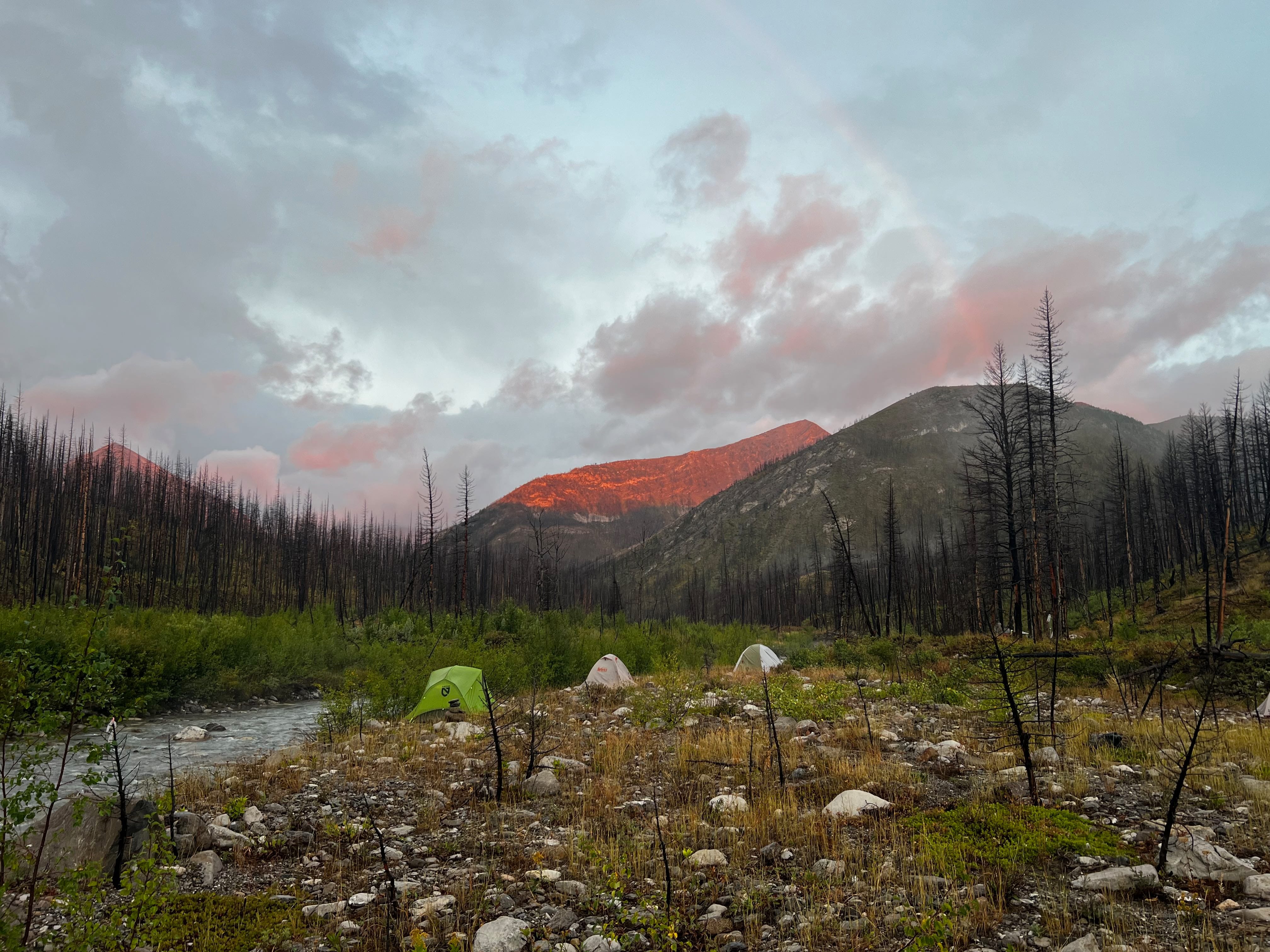
Early morning after nearly 36 hours of rain at North Birch Creek in the Bob Marshall Wilderness near the Badger-Two Medicine, trail crew camp, August 2023 (my tent is the green one)

The following is a reprint of my essay “Trespassing,” published in the Air volume of Elementals, a new anthology from the Center for Humans & Nature.

You can read other republished selections from the anthology by Eiren Caffall in OrionAndrew S. Yang in BioneersRobin Wall Kimmerer also in Bioneers, and register to join the second of five virtual book clubs, with contributors to Air, Vol. 2, Wednesday, February 19th, 6 p.m. Pacific Standard Time, hosted by Point Reyes Books.


It was late September, and the aspen trees were just beginning to yellow. They grew thick on the hillside, a broad grove giving way to small meadows that sloped upward, transitioning after less than a mile to heavy stands of spruce and pine. The group I was with rambled along an old logging road just south of the eastern side of Glacier National Park while a biologist among us talked about the ecotone we were walking through: a mingling of prairie and forest that stretched all down along the Rocky Mountain Front, the eastern-facing slope of the Rockies, where the mountains spill onto the prairie. A light wind blew constantly.

As we left the aspens and walked into evergreens, the wind became a whispering—psithurism, a sound that’s like a rustle and a shush at the same time. That sound characterized almost my entire Montana childhood, but I never consciously noticed it until a few years ago, shortly after moving back to my hometown. One day, a few months into my return, I was walking home through town and stopped to listen to the wind blowing through a stand of tall lodgepole pines bordering the path. That sound, I thought, remembering its company in the Rockies on many a family hike that I had dragged my feet on as a child, and later on treks as a teenager with friends. That sound is home.

***

The place along the Rocky Mountain Front I was hiking that late September day is a two-hour drive east from the valley where I grew up. In another region, it might not be considered anywhere near my home. But this is the American West: expanses are vast, yet their very vastness and sparse human population are part of the intimate familiarity that welcomes those of us who live here. Montana is often called a “small town with very long streets.” The psychological network of what I think of as my homeland encompasses the Rocky Mountain Front. For a white settler like me, a fifth-generation descendant of Montana homesteaders, the question of homeland and belonging is constantly shifting. But there is one constant: wherever my feet happen to be, my heart has always longed to be right here, among the cold mountains and prairie grasses.

Hiking along the prairie-forest ecotone, every aspect of the air felt like home—the smell of pine, the sound of wind in the evergreens, the way the sun was almost warm enough but the air kept me chilled. That same air had wound itself eastward from the valley I live in through a pass in the Rockies and unfurled here, to race down the foothills and speed its way across the prairie and farmland to the little agricultural town of barely two hundred people where my mother is from.

Although I never lived in my mother’s hometown, or even on the kind of spread-out farmland she knows so well, the air of her childhood landscape calls to me almost as insistently as that of the stream-saturated peaks I was raised in: I can smell it now, sitting at my desk on the other side of the Rockies in a mountain valley with its different kind of big sky. I love the way virga strolls across the miles of prairie and farmland like it’s got all the time in the world, how I can watch it for hours, how my skin tightens slightly at the drop in temperature, and how I can still smell the ozone of rain’s promise, with its dust-tang, months later in the back of my nose. I can’t understand why that air also smells like home to me, why I can look at those houses surrounded by thousands of acres of wheat and feel in my gut what it is to be a child growing up with your eyes on that far horizon, nothing between you and the rainstorm but the air and wind who make constant companions. Companions who can issue either invitation or warning, for those who listen closely enough.

There is one stark difference between these places, a difference that I too often take for granted and that most people might not notice: where I live, I’m not far from access to millions of acres of designated wilderness and national forest areas and a national park, places where my feet are as free to roam as the air itself. However, when I go out to eastern Montana, my mother’s home ground, everywhere I turn is blocked by fences. You can drive for hours and see little else but weather-beaten houses huddled together on the prairie, their siding bitten with winter and the fierce, scorching sun of August. These vast counties, where you can drive past more visible wheat silos than homes and only the occasional hawk or pronghorn, are squared out and fenced off with countless miles of forbidding barbed wire.

My body can’t pass through these fences without permission, but the air has no such limitations. It’s a freedom that has an underacknowledged impact: No Trespassing signs are ubiquitous in America (in Montana, Trespassers Will Be Shot is a threat I always take seriously), yet at the same time, air pollution trespasses into our bodies every moment of the day. When I walk around my hometown, it’s impossible not to breathe in vehicle exhaust, especially on days when an inversion layer holds it close to the ground. Out where my mother’s from, on those expanses that feel like they host some of the cleanest, most unadulterated air on the planet, on any given visit I might see a crop-dusting plane emptying loads of pesticide or herbicide over the fields and still smell the strange, metallic tang in the back of my nose the next morning.

Trespass can be turned back on us. With bodies and lungs and circulatory systems porous to the air, neither humans nor the rest of life have much defense against the kinds of airborne attacks that other people have unleashed upon us. And I don’t use the word attacks lightly. Air pollution from vehicle traffic can decrease children’s lung capacity by 20 percent and significantly affect cognition in their growing brains; recently, it has been found that carbon pollution from car exhaust crosses the placental barrier and affects fetal development and even ovarian egg production in women. Living near a landfill raises a person’s risk of lung cancer due to the hydrogen sulfide that’s released from decaying trash. Fully 95 percent of the world’s human population lives with levels of air pollution considered unsafe. Air pollution is one of the leading causes of premature death worldwide.

Without clean air, humans are denied an inherent right to health and flourishing. If billionaires’ dreams of colonizing Mars were ever to be realized, the first mission, the second mission, the millionth mission, the missions for generations far beyond our imaginations would be to secure water and breathable air. Air is so vital that a common right to it was recognized in legal code as far back as the Roman Empire. “The following things are by natural law common [to] all—the air, running water, the sea and consequently the sea-shore,” declared the Institutes of Justinian in 535 CE.1 In 1972, after decades of relentless air and water pollution, aided by political corruption paid for by the powerful men of industry known as the Copper Kings, Montana’s legislature passed a new state constitution that guaranteed a “clean and healthful environment” as an inalienable right, including the right to clean air.

Air is a shared commons: it’s an entity we all rely on for survival, and it moves freely across the world. The air I breathe that smells of dry pine needles and early snow was somewhere else a few hours ago, a few days ago, a few weeks ago. Maybe it was bringing some other hikers the smell of their own woods, or picking up sulfur dioxide, nitrous oxides, and soot from a coal-fired power plant, whose particulates are now seeping into my lungs, unasked for and unwanted on a cool September day. We all depend on and all share the air, and yet the ability to pollute it is treated as a private property right. Legal systems around the world make air the recipient of industrial waste; in turn, that means that all of us are, too. Air knows no international boundaries, and neither does the pollution it carries.

When I think of trespass, what first comes to mind is the Lord’s Prayer, which I recited with my parents and sisters Sunday after Sunday in Episcopal and Lutheran churches, and often around the dinner table, throughout my childhood. The lines “And forgive us our trespasses, as we forgive those who trespass against us” refer not to who crosses whose property lines but to committing sins that the deity has forbidden. The word trespass occurs many times in the New Testament. In some translations it’s replaced with sin or debt.

Trespass, in other words, is a transgression. In the case of pollution, trespass is far more invasive than simply breaking through a property line. If I sneak through my neighbor’s yard to get to the public nature preserve on the other side, I might annoy him, but there’s no actual harm done. If my neighbor burns a pile of tires in that same yard and I don’t go near it, his waste will trespass into my family’s bodies just the same, pouring itself into my children’s lungs with the law’s consent. The polluted air has trespassed into us, but it wasn’t by choice. The first crime of trespass was against air itself. When air has been violated, it is forced to violate in turn.

***

I was hiking along the Rocky Mountain Front in late September 2022 with a group working to stop oil leases in what is known as the Badger-Two Medicine. It’s an area bordered by Glacier National Park to the north, the Bob Marshall and Great Bear Wildernesses to the west and south, and the Blackfeet Reservation to the east. The Badger-Two Med is sacred to the Blackfeet Nation. Under laws written and enforced by the federal government, it’s legally part of the US National Forest Service, but it was carved off of Blackfeet land in 1895, along with the eastern part of Glacier Park, in yet another land seizure accomplished with a deceptive treaty signed under duress, one in a long history of betrayals.

I hadn’t been to the Badger-Two Med before, although I’d been following the oil lease situation—which has been ongoing for nearly forty years—since before moving back to Montana. This was the first time I’d managed to visit it, on a hike sponsored by the Glacier-Two Medicine Alliance, which was founded in the 1980s to fight oil leases granted in the area by the Reagan administration. Most of the leases have been successfully canceled over the years, but in late September 2022, one oil company had just won a court appeal to keep its lease.2

Emerging from the aspen groves and into pines and spruce, my group walked a path that ran parallel to a buried natural gas pipeline; the organizers pointed out where a road to the remaining proposed site of the oil well would be built if the lease were upheld. A few miles further in, we would see a hillside already scarred by preparatory clearing.

It’s hard to imagine a place that feels more like the white European settler’s idea of pristine wilderness. Pristine wilderness and its ideals of unchanging purity have never really existed, of course, but perhaps places like this offer something better: I felt whole on that hillside. The air’s movement and scent felt like a welcome. And even though I know that there is no clean air, really, anywhere in the world—everything from dioxins to Chernobyl radiation has been found in polar ice, carried by the air and dropped even on places where few humans have ever stepped—I felt an extra surge of resentment at the thought of the trespass that would come not just from the physical invasion of an oil well but from the particulate matter, carbon monoxide, nitrous oxide, and volatile organic compounds that have been found in the air around and downwind of oil-drilling operations. At what the air would be forced to carry through no choice of its own.

***

As we walked to the top of a hillside where we could see out toward the plains of eastern Montana, the air shifted from a gentle breeze to a wind traveling east—stiff, but not quite the hard-blowing kind that is almost a constant presence on the wheat and cattle ranches that cover what’s known as the Golden Triangle, the wheat farming region my mother grew up in.

The wind blew the smells of encroaching autumn in my face, dried grasses underfoot and fecund soil under bear-claw-scarred aspen trees. The tiny bit of late-September chill reminded me that snow would be coming soon. There is nothing that smells more alive to me than that air. It feels conscious: the warm pine in summer, the tang of ice in winter, traveling down from these mountains to kick prairie and dirt-road dust in the faces of children growing up in the same tiny town my mother had over seventy years before. The heart that has always insisted on calling this place home, even during the twenty years I lived elsewhere, tells me, quietly, that this air I love in all its moods and seasons is conscious. It has a life of its own and a right to live it unviolated.

The crime of trespass goes both ways—what happens when we require the very source of life to carry sickness instead? Is this not a violation of the gods of life, of home, and of air’s own right to exist?

Acquiescence to the abuse and neglect of air is a trespass against humanity—against all of life, even against the air itself, for its own sake. Every living being has a common right to air that not only allows us to live the healthiest lives we can but also smells like pine and snowmelt, desert dust and prairie flowers, swamp grasses and moss. Air that feels like home.


1

Institutes of Justinian, bk. II, title I, “Of the Different Kinds of Things,” trans. J. B. Moyle (Oxford, 1911), available at https://amesfoundation.law.harvard.edu/digital/CJCiv/JInst.pdf.

2

Almost a year later, in September 2023 just before this went to print, that lease—the last in the Badger-Two Medicine—was bought out and was in the process of finally being retired.

Wander, Lost

Welcome! For those new here, On the Commons explores the deep roots and ongoing consequences of private property and commodification—from the Doctrine of Discovery to ancient enclosures of the commons, and more—along with love for this world and being human in the middle of systems that often make such “being” difficult.

Book update: Apologies for the continued “wow it’s been many months since I intended to have this chapter out” delay. I have taken apart Chapter 1 of No Trespassing for the fourth time, but this time because, when I was describing my difficulties with it to a friend, she gave a piece of advice that showed me what I’d been missing. It’s finally coming together as it was meant to.

New podcast interview: “Land, democracy, identity” with UK-based Future Natures.The path from writing about walking to private property and ownership, how they each intertwine and conflict with freedom and senses of identity, and how craving for land relationship can drive both love and extremism . This has been one of my favorite podcast listens over the past couple years, and the larger projects of Future Natures have become a go-to resource.

5% of this quarter’s On the Commons revenue will be given to the Flathead Warming Center, the only low-barrier houseless shelter in my general region.

There’s a place I’ve been taking my family camping for nearly ten years. It’s a campground around an hour’s drive from where I live, on the far side of a reservoir whose waters hold some fond decades-old memories of lingering with boyfriends, along with a couple regrettable memories involving fire and the irresponsibility of teenagers. (The fact that nobody was hurt aside from lost eyebrows was sheer luck.)

To get to this campground, we have to drive to the far end of the reservoir and then thirty miles along a gravel forest service road. It’s a place where every summer my and my friends’ kids stuff themselves with huckleberries and spend hours in the water and nobody can access text messages or online games, much less email. For four days or so I wake up hours before everyone else and sit with coffee and the calls of Swainson’s thrushes as Sun makes his slow way up from behind mountains so tall and close they almost feel looming (isn’t that a great word? looming), but in a comforting way, like a protective uncle.

The surrounding forest backs against the Great Bear Wilderness to the east, with Glacier National Park a little ways north. When I’m there, I manually direct my brain to these facts because for some reason I’ve never been able to understand, I feel very turned around for the days I’m there, as if I don’t know where I am in the world. It’s not uncommon for me to get lost, especially when in a city and nearly always when driving somewhere for the first time, but in non-city areas I usually have a pretty good sense of place, if not direction. It’s one of the things that makes maps so delightful, being able to trace a finger along terrain or position and feel the embodied reality of one’s own self within that represented space, feel the feet tingle in the knowing of here I am. I have a hard time feeling that sense at this campground.

For years I’ve wondered if my place-confusion there might have something to do with being on a huge reservoir. When we’re on the water, paddleboarding or kayaking or just swimming, there’s an eeriness that is unrelated to my phobia of deep waterThis is a drowned river, is what comes to mind as I try to ignore the growing conviction that deep-water monsters are going to pull me under.

A drowned river. It sounds nonsensical. It’s all water. But rivers have spirit and shape and purposes of their own, all of which is smothered when a dam is built to stop their flow and extract their energy. 

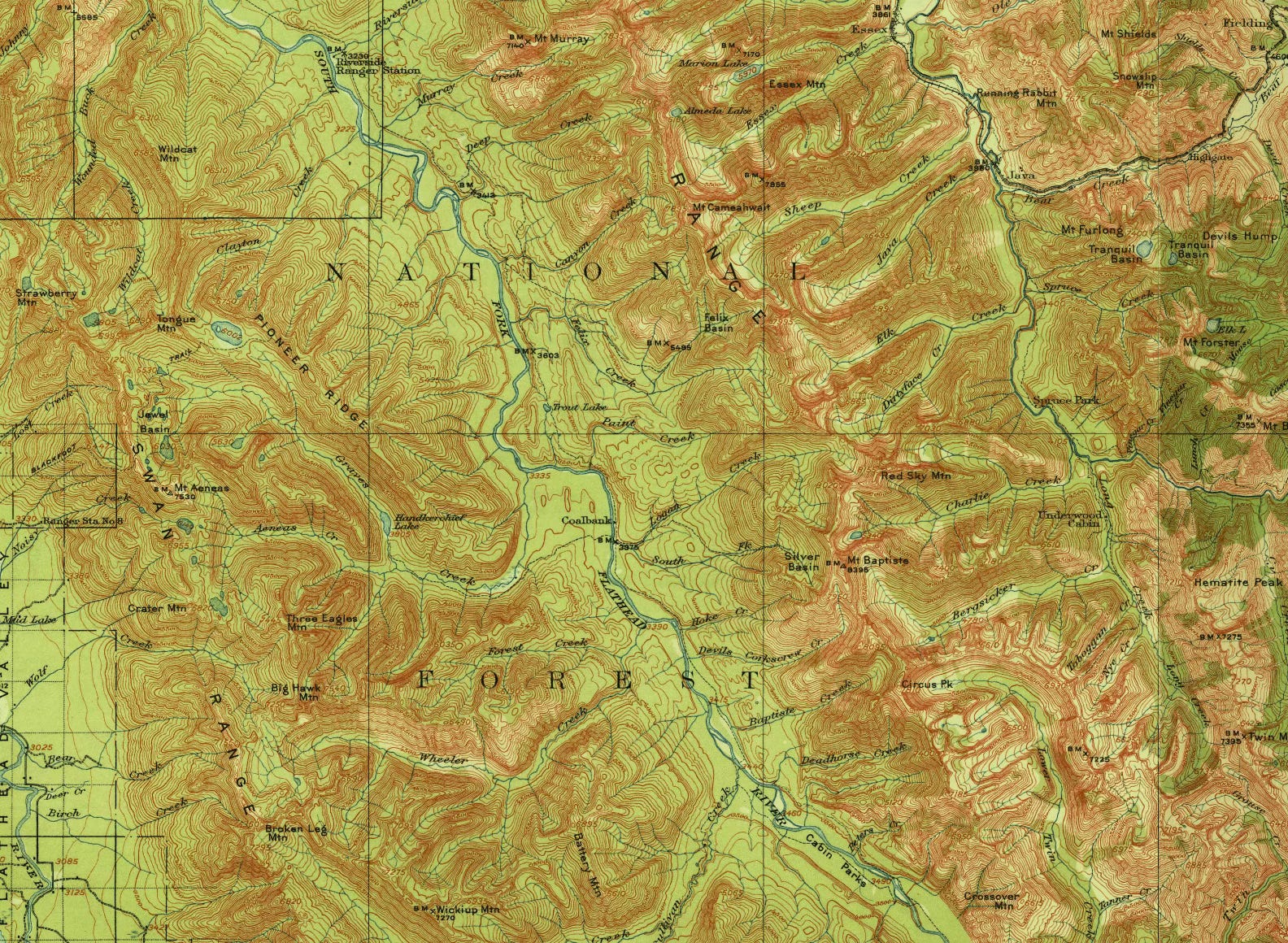
A friend reminded me recently that I’d been meaning to look for old maps of this area from before the dam was completed in 1953, to see where the river, the South Fork of the Flathead, flowed when she was free. So earlier this week on our way north on a day of sleet, snow, and fierce wind, my younger kid and I stopped in at the forest service’s ranger station, where there turned out to be no old maps or any idea where I might find them. But it was a slow day and someone’s interest was sparked enough to spend time poking into CalTopo online for historical maps until she found what I’d been looking for. 

And there she was, the South Fork, undulating through a narrow valley as mountains spilled streams and creeks into her, receiving snowmelt and rainfall as she headed down to Flathead Lake. Next to her, the modern reservoir looks less like an expansive lake we play on every summer, less like a monumental feat of engineering, and more like many technological outputs of modern humans: a little grandiose. And temporary. The reservoir is fun—and of course it’s still water, with its own voice and energy—but it doesn’t have quite the same sense of wholeness, the this-lifeness, of the river. I look at that old map and feel oddly relieved. Like I finally know where I stand.

On the left, the modern landscape of Hungry Horse Reservoir. On the right, the South Fork of the Flathead River before it was dammed.

During the Q&A session after a recent online presentation, someone asked me about the chapter titles in my book A Walking Life—nine iterations of “Stumble,” “Lurch,” “Stride,” and so on. I don’t think anyone’s ever asked me that before, and it took me a minute to remember that I had originally used similar section headings—variations on “walk” and ideas related to it—for the first essay I ever wrote on walking, years ago, for the small literary journal Lunch Ticket, titled “Wander, Lost.”

It was in that essay that I first linked freedom of movement with freedom of thought. It was also, as far as I can remember, the first time I thought of both as, tangentially, related to the movement and constraint of rivers.

“As our freedom to walk becomes ever more constrained, as air quality and housing developments and busy roads force us to spend more time in our homes and cars, we might lose even the words of movement that reflect every land-tethered animal’s most basic motion. Ramblemeanderroveroamwanderdeviatedigress—will they slip into disuse, become arcane ideas? As we forget that they ever applied to our physical bodies, to our ability to get from here to there or from here to nowhere in particular, will our minds lose the ability to do the same? What happens to our ideas and bodies when neither can wander aimlessly, get stuck in the mud, backtrack, reconsider, keep moving until we find ourselves in a place beyond our knowledge? . . .

. . . like a river that’s been straightened and reinforced with concrete, exploding every now and then in an anger of floodwaters but never again allowed to meander. My mind has begun to feel the same.”

I think constantly about the relationship between freedom of movement and freedom of the mind. I have an unpublished essay on the subject lurking in my files that might or might not ever see the light of day, structured around the movie WALL-E, which I’ve watched about twenty times, and it came to mind again recently when reading Thomas Pluck’s novel Vyx Starts the Mythpocalypse, as Vyx’s parents are taken by the government’s Ice Men who then stalk their path as they travel the land in search of safety, running into awakened mythological beings along the way. Control of thought—including the freedom to live as our true selves—and control of movement go hand in hand. 

“Wander, Lost” also provided the seeds for the sections of A Walking Life about my father’s life in the Soviet Union and the ways in which interpersonal and public trust can make or break a society, especially when it comes to government suppression of speech and protest, and how personal relationships are weaponized in its enforcement. 

Trust is, like the freedom to wander, an invisible force whose degradation can make visible the erosion of liberties to those who had always thought themselves free. What one once might have thought endless and inviolable is revealed to be that which can be taken, and lost. Kind of how degradation of a river ecosystem can’t help but be reflected in the health of every single life touched by its waters.


I’ll probably never get to meet the river buried under the reservoir we camp at. Hungry Horse Dam is one of the largest in the country, and seen as essential in a network of electricity-generating hydropower dams along the Columbia River watershed. But there’s something about seeing a map of where she was, the free river, that might help orient me next time I’m up there. 

At the very least, when the kids race down to the little peninsula where they watch the sunset, I can remember that while the placidity of the water is a human-made artifice, the beauty remains wild and free, and something of the river reaches up to meet that evening glow, to say the river is not gone—her stillness won’t be forever. It might be generations in the future, but she will one day find her familiar curves, playgrounds, and resting spots again, running her way through the mountains as she was meant to. Free to roam. 

If we’re lucky, someday our freedom to wander, too, will be un-lost.