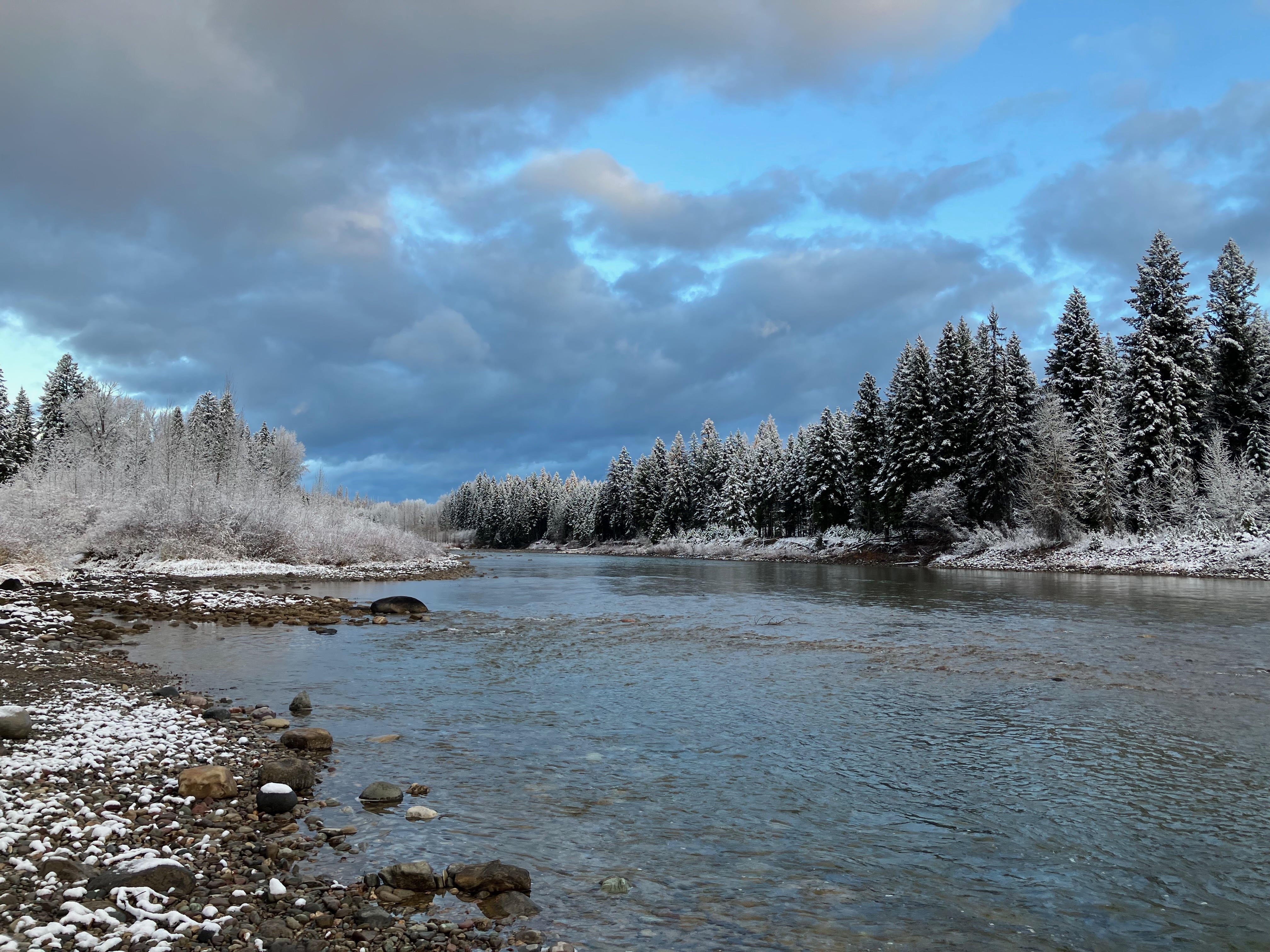
A few days ago, I was sitting by this river, near a U.S. Forest Service cabin where I went recently for a sorely needed offline, off-grid, off-network recalibration. It’s been too long since I sat in the woods by myself for a few days.
Late October, the larch trees have yellowed, turning mountainsides bright and the woods full of unexpected sunshine even on gloomy days. Larch in autumn is a spirit-lifter, an anti-demon spell, a joyous shaft of light when the world is shifting dark.
It snowed the first night I was at the cabin. I trekked down to the river carrying my coffee the next morning before sunrise, happy despite knowing that in my rush to pack water, food, sleeping bag, and books, I’d grabbed a coat too thin and decided against snow boots—a mistake and I knew it, as the hole in the sole of the thin canvas shoes I’ve been intending to replace reminded me.
Ravens flew down the river and high above the trees, more than I usually see at this place. I could hear more further off in the woods and wondered what was keeping them so social. I wondered that for the next three days and never got an answer. They sounded not anxious exactly, but somewhat like me getting my stuff ready to stay in the woods and my kid packed up to stay at their dad’s: busy, harried, organized but frazzled.
The river at that spot is wide, its rapids gentle but the rushing tumble of water strong enough to be heard a long way off.
I watched some rapids tumbling around opposite bank from where I sat, the burble and leap over hidden rocks tricking my mind into thinking they looked like two otters playing in the water.
Wait, I thought. Those are two otters playing in the water.
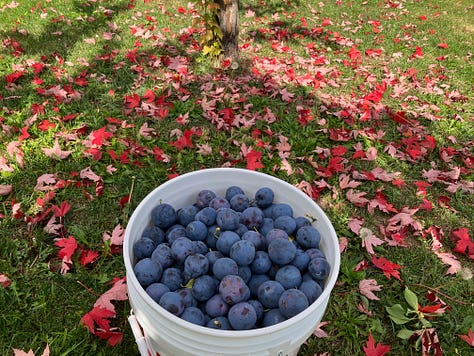
I recently spent several days pitting, pureeing, and dehydrating a vast amount of plums picked from a friend’s trees—trees so heavy with fruit that after an hour of filling my bucket, the branches looked untouched. My friend had already picked and dehydrated his own many batches of fruit leather from his other trees, which ripen earlier, but I’d been too busy with the rest-of-life, the crises and plans and bureaucracies and commitments that translate into too little time in the garden and out foraging.
But this one bucket made it into my home, my fingers purpled dry by the slicing and pitting and feeding to the blender—a many bladed monster that, as I texted to the friend I’m renting a furnished house from, looks like something from a horror movie.
In the kitchen now is enough fruit leather and dried apples—from another friend’s August generosity—to see my kid and me through the winter if we’re not too greedy.
How does one get that way? Too greedy. Or perhaps the question is, how does a human, or a whole society of humans, lose perspective on what is enough?
I recently finished Caroline Dodds Pennock’s book On Savage Shores: How Indigenous Americans Discovered Europe, and in it Pennock described briefly the value of cacao beans in Mesoamerica in the late 1400s and early 1500s, which were a form of wealth: a turkey egg or avocado could cost three beans, a small rabbit thirty.
Only the very wealthy could feast with gourds of cacao to drink; when resource-hungry European people came, claimed, and took, they took so much that even just reading about it felt like watching land being actively drained of life: gold, emeralds, brazilwood, cacao, people.
And yet, as many Indigenous people of the time noted after having spent time in the “noble” houses of Seville and Lisbon, no matter how much wealth was siphoned from their homelands, it did nothing to change the circumstances of ordinary European peoples. The poverty of the majority of people’s lives was often remarked on, especially when contrasted with the opulence of royalty and their hangers-on.
How much is enough?
What breaks a belief in kinship and reciprocity—how does one lose the knowledge that it is mutual care, not taking more for ourselves, that gives the best assurance of security?
I’d like to have a functional health care system that doesn’t bankrupt people, and to not worry about food and housing, but beyond a certain point can’t imagine an amount of money that would replace the kinds of relationships woven among people, and between humans and ecosystems, inherent in nature sharing gifts so wealthy that even multiple families can’t use them all—like my friends’ plum and apple trees, or the potatoes and strawberries I grow, or the wild huckleberries throughout the nearby mountains—and in people sharing them with one another.
Maybe “enough” is forever undefinable, guided only by that clear thread of relationship and reciprocity, of what keeps life life-ing.
There were in fact two otters in the river. I watched them for a long time, absolutely filled with delight. They tumbled and rolled upstream, all along the far shore, their sleek bodies and tiny whiskered heads popping out of the water every few seconds, their slim tails flying up to dive back down.
I wanted to step into my real skin, like a Selkie, and swim across the freezing water to join them. I wanted to not feel the frozen ground so acutely through my thin-soled shoes, to be indifferent to the bite of chill wind through my inadequate coat. I wanted to dance a song to Moon that night and to know each Raven by name, and to soar with the Bald Eagle who circled over the river downstream, toward the new-snowed mountains.
I wanted these minutes to be my entire life. I was, in fact, greedy for them to last forever.
 Antonia Malchik