Repair: of rivers and relationships

To new subscribers—welcome to On the Commons! To those of you who’ve been around a while, welcome back!

I recently wrote an essay for Psyche/Aeon’s “one thing that changed me” series that’s probably the most personal thing I’ve ever published. If you came here from that essay, I’m very glad to see you here. This newsletter is generally not the space for that kind of personal essay, but I hope you’ll give it a try and explore what it means to be part of a commons—including our relationships with one another.
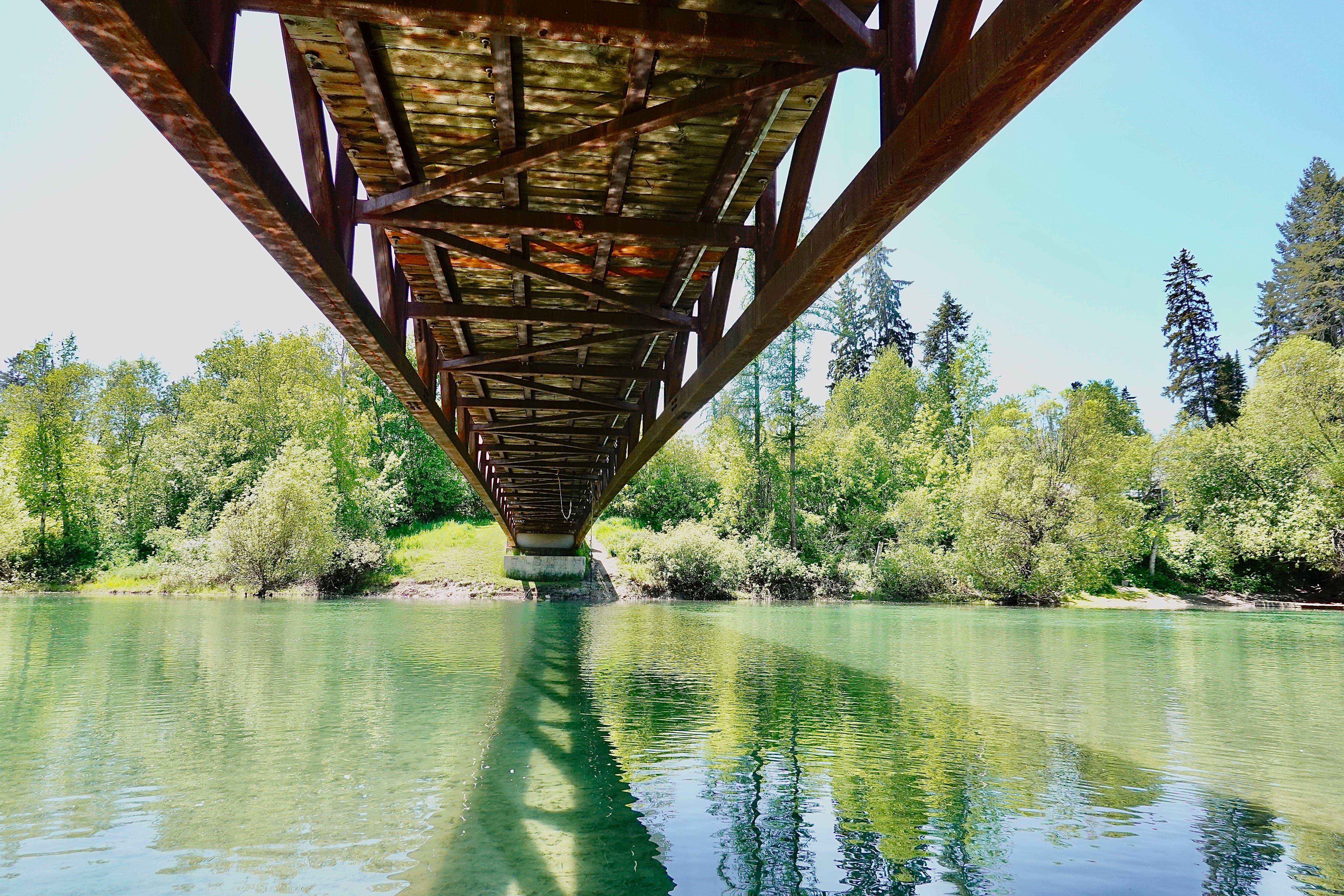
From the steps under the footbridge. People have also installed rope swings below the bridge’s jumping-off point. This bridge, this river, the way people relate to it with joy — to me it’s the epitome of the commons.

“Ma’am, watch this.”

Two teenage boys stopped me on the footbridge, right where they’d been jumping into the river. One of them was about to attempt a backflip off the railing, and the other was betting it would turn into a belly flop.

I stopped, and thought briefly of my father’s childhood stories—growing up in Leningrad (now called St. Petersburg) in the Soviet Union, he and his friends jumping (illegally) from a bridge into the Neva, near the Peter & Paul Fortress. Living under a dictator, a life structured around fear, rigid rules, almost nonexistent interpersonal trust, and waiting in hours-long lines for bread. And still, laughing, challenging one another, unwilling to resist the lure of the water.
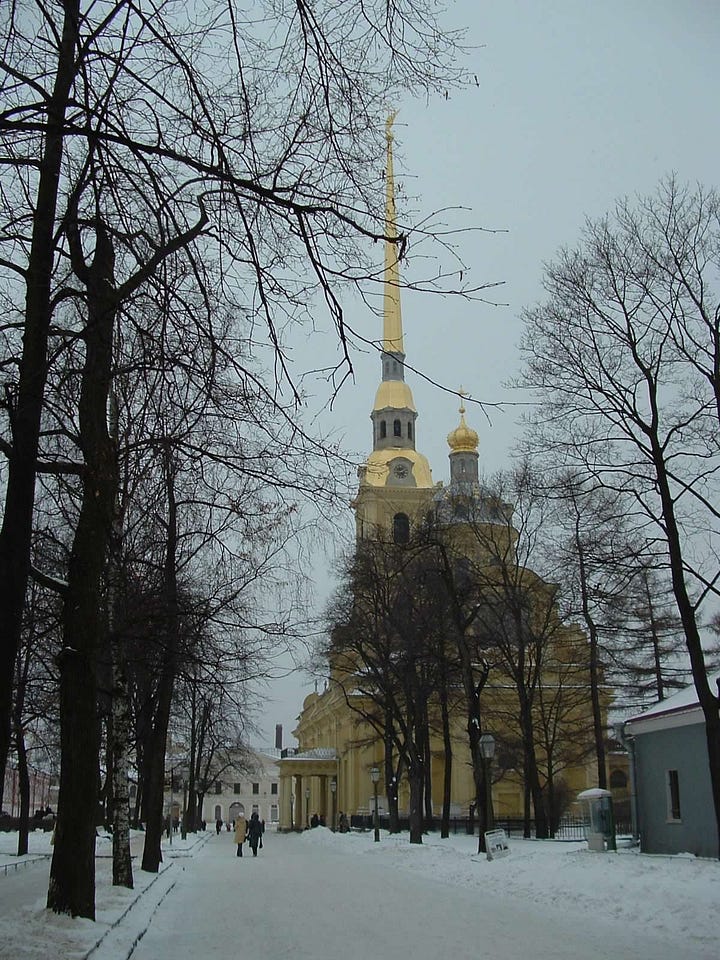
The cathedral at St. Petersburg’s Peter & Paul Fortress; my father and his friends on the banks of the Neva.

The boy jumped, did not belly flop. “That was actually pretty cool,” I agreed with the other kid, and went on my way.

I’d been sitting at the other end of the footbridge for a while, on new stone steps that the city had just had put in to make access to the river at that spot easier, and to repair the worrying degree of erosion from years of people walking up and down the slope. Although there are easier access points and several public docks all along the river, the ends of the footbridge see heavy use, people drawn down to the water with dogs, with kids, with themselves.

But it was a steep slope and slippery from time-ground dirt eroding away from the bank. In ten years I’ve gone down to the water at that spot maybe two or three times. In the week since the steps were finished, I’ve been down them, walking into the water, sitting on the lowest steps doing nothing, almost every day. The steps didn’t change how I relate to the river—I visit it at plenty of other points that have gentler slopes and docks to sit on—but they did transform my relationship to it at that particular point. I feel invited now to sit with the water, drawn to greet it. From what I’ve seen, a lot of other people do, too.

When I was a teenager—over thirty years ago now; I’ll be fifty in less than a year—this river was not one people swam in. My younger sister says she used to go in, but it wasn’t common. It was so polluted, so contaminated from nearly a century of pollution leeching from the rail yard’s containment ponds, that in decades past it used to catch fire.

In 2009 a years-long Superfund cleanup began on the river, which runs wide and slow right through our town from its outlet at the lake, eventually down to Flathead Lake, all the water collected in this basin eventually funneling out to the massive Columbia River watershed. Superfund, for those outside the U.S., is a designation implying a degree of pollution that might take decades, more likely centuries, to repair.

The first time I visited the new steps was with a friend who was in charge of that Superfund cleanup. Like many of my friends, her work —cleaning up oil spills in rivers for the railways—is far more interesting and important than mine.

To remedy the extensive contamination, the river was drained completely. Blocked at its outlet from the lake and the water removed. I’ve seen pictures but hadn’t moved back home by then. It’s hard to wrap my head around the enormity of the project.
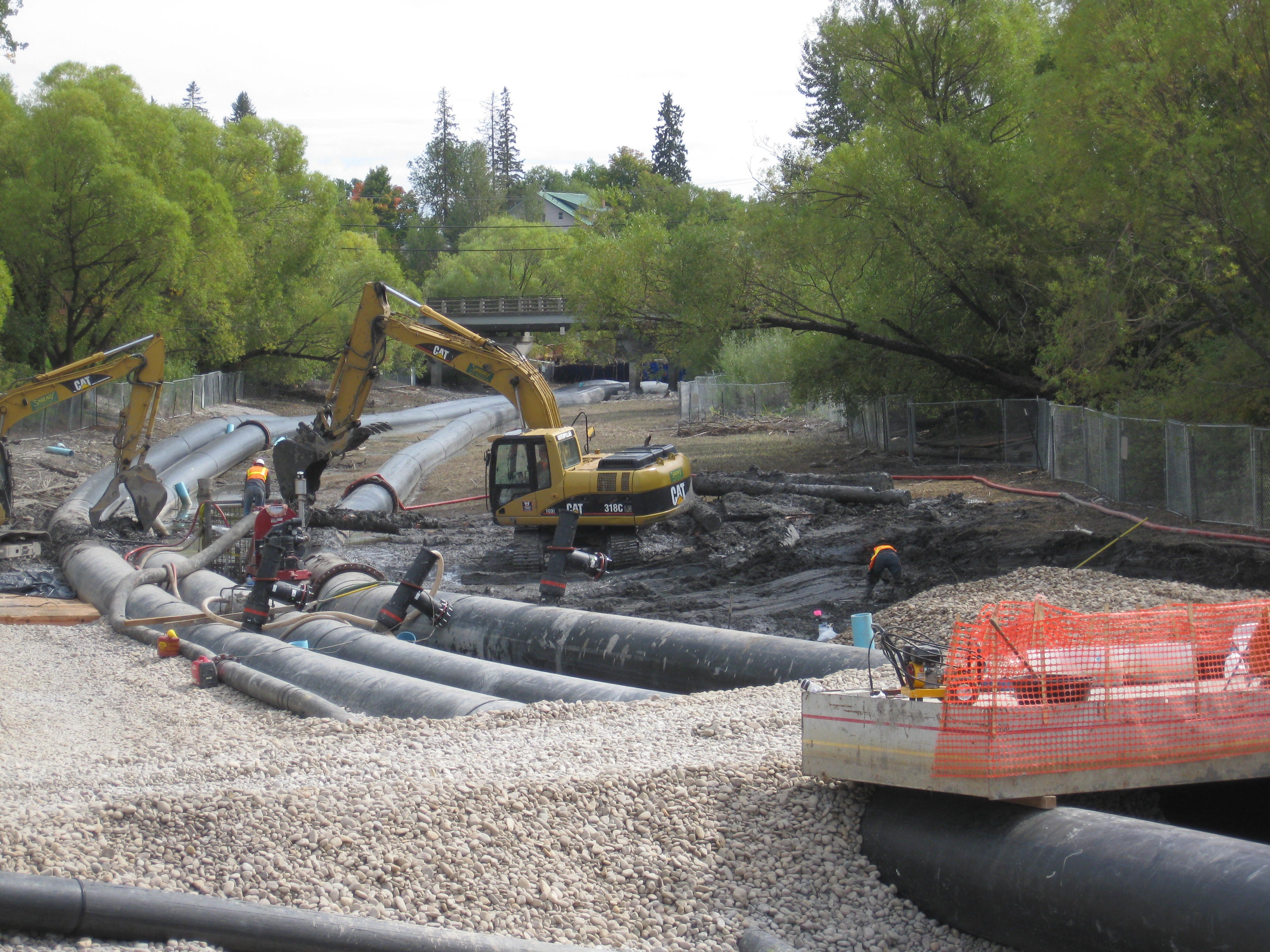
Location of this river cleanup photo is approximately from where the same footbridge is located, dated 2010.

In late 2014, the year after the initial cleanup completed (there have been small leakages and spills since then; the rail yard area remains a Superfund site and the river will likely always be at risk), a several-mile stretch of the river was designated non-motorized. Now, as soon as winter begins to loosen, the water is popular for paddleboarding, kayaking, swimming, jumping off the footbridge at that one spot where the water’s deep enough to do it safely for most of the summer, and now, with the new steps down to the water, for those of us who simply want to sit by it, let it welcome our feet and our thoughts. An invitation to rest.

The river will never be the same as it was before the rail yard was built and contamination started to seep into the water, at least not for generations beyond count. Not everything can be fixed. But that doesn’t mean it’s impossible to repair.
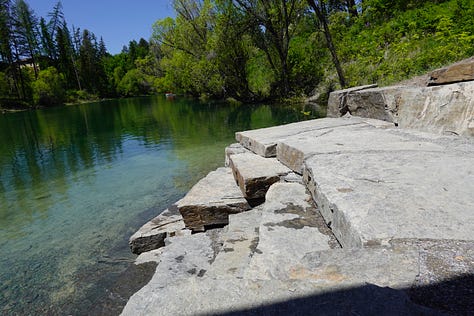
The new steps, like someone’s opened a door wide into a world that was always there. (This slope was too steep to make wheelchair-friendly, but other public access points along the river are more accessible.)

Recently, the novelist and physician Abraham Verghese came to give a talk at our local community college. The region I live in is not, to put it mildly, a place where people of that stature and renown come to speak. We might never get to listen to someone like him again in person, but the hospital sponsored the talk (a friend quipped, I’m sure rightly, that it was probably cheaper than doing what they needed to be doing, hiring more nurses), and it was close to sold out.

Verghese was a generous and thoughtful speaker, full of compassion and insight. Before answering questions from the audience—packed with people who worked at the local hospital or their relatives, including some of the friends I’d gone with—talked about his childhood in Ethiopia and the books that shaped who he became as a writer as well as a doctor.

And then he spoke about being a doctor serving HIV/AIDS patients in Tennessee in the early 1980s, when HIV was terrifying and unknown—it hadn’t even been labeled human immunodeficiency virus (HIV) yet—and had no treatment.

It was at that time, he said, when he began to understand that, for all the medical profession’s fixation on curing illnesses, there is an equal or perhaps even greater need to understand what “healing” means. There was no cure for his HIV patients at the time. The end was known and usually not far off and involved a great deal of suffering. But that didn’t mean he couldn’t work with healing, for them and their families.

I’ve been thinking about that ever since—curing versus healing, along with Verghese’s calm, generous presence with this tired audience tucked into an often huffy, even angry, and stunning little corner of Montana.

I think it’s what I want to say when I talk so often in this space about compassion and caregiving, whether it’s in our interpersonal, private relationships, or with the world at large. Why the ethos of “burn it all down” makes me chafe, knowing as I do—and most of us should—that when worlds fall apart, those who suffer most are those who are already suffering most, those who always have suffered most.

Dismantling structures of oppression and violence requires building and repairing alongside collapse, lest we simply allow the same harms to grow in the ruins. Not easy. Still necessary.

It made me think of Chloe Hope’s work—as an end-of-life doula and carer of baby birds at a wildlife sanctuary—and her writing at Death & Birds. What is at the core of life in the end but death, and the compassion and care that is its cosmic twin? But also of Sarah C Swett’s regular journeys with milkweed and mending on The Gussett, which fascinate me, as if her foraging, spinning, and weaving represent a life I was meant to live, the ways that nature can be literally woven into our lives if we learn how, and allow her to do her work.

Heal. Mend. Repair. So many words we have to acknowledge damage, and what we might attempt to soothe the harms that linger.


As a handful of people here already know, I’m in the midst of a marriage dissolution that is almost finding its way to an ending, which of course for both me and my spouse will be another beginning. It’s been a slow, painstaking process focused on prioritizing our two teenage kids, and repairing of friendship and a different kind of partnership after 26 years of marriage. It surprises me with a shock of gratitude on a regular basis that we’re able to do this with a focus on mending, rather than rending one another apart. (That’s probably the last thing I’ll ever say on this subject except that it’s amazing to be able to make a legally binding commitment essentially as a child that requires a career in accounting and a PhD in psychology to undo.)

To be surrounded in life with people who heal, whether rivers or relations, animals or animosities, is a kind of magic. I’ve learned the hard way that not all those who speak with reverence of the importance of relationships think it’s equally important to live by it, and am all the more grateful for people who live true to those expressed values.

The first time I sat on the new river steps by myself, one warm evening after a busy day, there were no other people nearby. I allowed myself a tiny proprietary twinge because, although I recently gave up my seat on the town’s Board of Parks, I was there for the years of planning and permitting of these steps and it felt good to know I’d been a tiny part of something built for the good of the public, a miniscule contribution to repairing our local commons.

A yellow warbler sang from a willow tree draped over the water a little upstream. The particular psithurism that comes from a breeze catching on the branches of lodgepole pines and larches drifted from the opposite bank.

I wish I could bottle that sound for people, or record it effectively. It fills me with a feeling that change is coming. It always has, ever since childhood. There is something about the way the needles of those trees shatter the air, maybe, that gives it a different sense than wind among aspen leaves, or old oaks. Something . . . impending.

Sometimes—or in times like our own, often—it feels like forces of destruction, greed, hate, and even evil are insurmountable. That nothing good can be saved, nothing can be repaired.

But my town, my wider region, is full of people doing their utmost to repair the commons. People dedicated to affordable housing efforts, to the seemingly neverending struggle for a county-wide bike and pedestrian trail system, to building places for homeless people to rest and feeding the hungry, to cleaning up rivers and lakes and restoring wildlife habitat, to helping refugees find homes and settle into this winter-shaped, sometimes strange place.

There are so many people everywhere working to fix the wounds of the world, knowing that pain and scars will remain.

The river that I’m now spending a lot more time in has a long way to go in repair. Though it’s designated endangered bull trout habitat, there are almost no fish in it except for a few bottom feeders. I like watching them; they’re a reminder of how far the water has come from the damage inflicted on her slow current.

Not all can be cured. Maybe nothing can. But the potential for healing is infinite.
Wander, Lost

Welcome! For those new here, On the Commons explores the deep roots and ongoing consequences of private property and commodification—from the Doctrine of Discovery to ancient enclosures of the commons, and more—along with love for this world and being human in the middle of systems that often make such “being” difficult.

Book update: Apologies for the continued “wow it’s been many months since I intended to have this chapter out” delay. I have taken apart Chapter 1 of No Trespassing for the fourth time, but this time because, when I was describing my difficulties with it to a friend, she gave a piece of advice that showed me what I’d been missing. It’s finally coming together as it was meant to.

New podcast interview: “Land, democracy, identity” with UK-based Future Natures.The path from writing about walking to private property and ownership, how they each intertwine and conflict with freedom and senses of identity, and how craving for land relationship can drive both love and extremism . This has been one of my favorite podcast listens over the past couple years, and the larger projects of Future Natures have become a go-to resource.

5% of this quarter’s On the Commons revenue will be given to the Flathead Warming Center, the only low-barrier houseless shelter in my general region.

There’s a place I’ve been taking my family camping for nearly ten years. It’s a campground around an hour’s drive from where I live, on the far side of a reservoir whose waters hold some fond decades-old memories of lingering with boyfriends, along with a couple regrettable memories involving fire and the irresponsibility of teenagers. (The fact that nobody was hurt aside from lost eyebrows was sheer luck.)

To get to this campground, we have to drive to the far end of the reservoir and then thirty miles along a gravel forest service road. It’s a place where every summer my and my friends’ kids stuff themselves with huckleberries and spend hours in the water and nobody can access text messages or online games, much less email. For four days or so I wake up hours before everyone else and sit with coffee and the calls of Swainson’s thrushes as Sun makes his slow way up from behind mountains so tall and close they almost feel looming (isn’t that a great word? looming), but in a comforting way, like a protective uncle.

The surrounding forest backs against the Great Bear Wilderness to the east, with Glacier National Park a little ways north. When I’m there, I manually direct my brain to these facts because for some reason I’ve never been able to understand, I feel very turned around for the days I’m there, as if I don’t know where I am in the world. It’s not uncommon for me to get lost, especially when in a city and nearly always when driving somewhere for the first time, but in non-city areas I usually have a pretty good sense of place, if not direction. It’s one of the things that makes maps so delightful, being able to trace a finger along terrain or position and feel the embodied reality of one’s own self within that represented space, feel the feet tingle in the knowing of here I am. I have a hard time feeling that sense at this campground.

For years I’ve wondered if my place-confusion there might have something to do with being on a huge reservoir. When we’re on the water, paddleboarding or kayaking or just swimming, there’s an eeriness that is unrelated to my phobia of deep waterThis is a drowned river, is what comes to mind as I try to ignore the growing conviction that deep-water monsters are going to pull me under.

A drowned river. It sounds nonsensical. It’s all water. But rivers have spirit and shape and purposes of their own, all of which is smothered when a dam is built to stop their flow and extract their energy. 

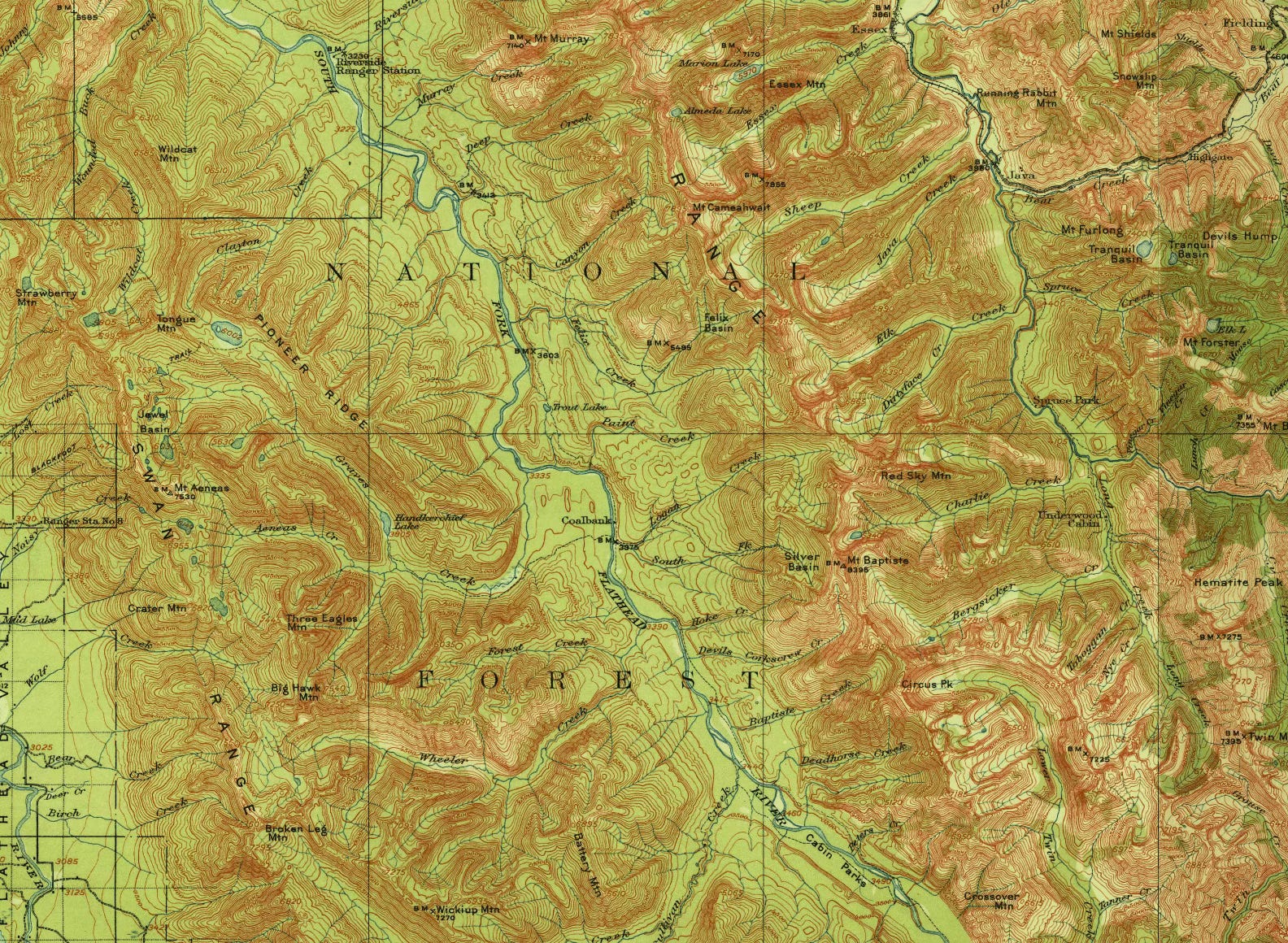
A friend reminded me recently that I’d been meaning to look for old maps of this area from before the dam was completed in 1953, to see where the river, the South Fork of the Flathead, flowed when she was free. So earlier this week on our way north on a day of sleet, snow, and fierce wind, my younger kid and I stopped in at the forest service’s ranger station, where there turned out to be no old maps or any idea where I might find them. But it was a slow day and someone’s interest was sparked enough to spend time poking into CalTopo online for historical maps until she found what I’d been looking for. 

And there she was, the South Fork, undulating through a narrow valley as mountains spilled streams and creeks into her, receiving snowmelt and rainfall as she headed down to Flathead Lake. Next to her, the modern reservoir looks less like an expansive lake we play on every summer, less like a monumental feat of engineering, and more like many technological outputs of modern humans: a little grandiose. And temporary. The reservoir is fun—and of course it’s still water, with its own voice and energy—but it doesn’t have quite the same sense of wholeness, the this-lifeness, of the river. I look at that old map and feel oddly relieved. Like I finally know where I stand.

On the left, the modern landscape of Hungry Horse Reservoir. On the right, the South Fork of the Flathead River before it was dammed.

During the Q&A session after a recent online presentation, someone asked me about the chapter titles in my book A Walking Life—nine iterations of “Stumble,” “Lurch,” “Stride,” and so on. I don’t think anyone’s ever asked me that before, and it took me a minute to remember that I had originally used similar section headings—variations on “walk” and ideas related to it—for the first essay I ever wrote on walking, years ago, for the small literary journal Lunch Ticket, titled “Wander, Lost.”

It was in that essay that I first linked freedom of movement with freedom of thought. It was also, as far as I can remember, the first time I thought of both as, tangentially, related to the movement and constraint of rivers.

“As our freedom to walk becomes ever more constrained, as air quality and housing developments and busy roads force us to spend more time in our homes and cars, we might lose even the words of movement that reflect every land-tethered animal’s most basic motion. Ramblemeanderroveroamwanderdeviatedigress—will they slip into disuse, become arcane ideas? As we forget that they ever applied to our physical bodies, to our ability to get from here to there or from here to nowhere in particular, will our minds lose the ability to do the same? What happens to our ideas and bodies when neither can wander aimlessly, get stuck in the mud, backtrack, reconsider, keep moving until we find ourselves in a place beyond our knowledge? . . .

. . . like a river that’s been straightened and reinforced with concrete, exploding every now and then in an anger of floodwaters but never again allowed to meander. My mind has begun to feel the same.”

I think constantly about the relationship between freedom of movement and freedom of the mind. I have an unpublished essay on the subject lurking in my files that might or might not ever see the light of day, structured around the movie WALL-E, which I’ve watched about twenty times, and it came to mind again recently when reading Thomas Pluck’s novel Vyx Starts the Mythpocalypse, as Vyx’s parents are taken by the government’s Ice Men who then stalk their path as they travel the land in search of safety, running into awakened mythological beings along the way. Control of thought—including the freedom to live as our true selves—and control of movement go hand in hand. 

“Wander, Lost” also provided the seeds for the sections of A Walking Life about my father’s life in the Soviet Union and the ways in which interpersonal and public trust can make or break a society, especially when it comes to government suppression of speech and protest, and how personal relationships are weaponized in its enforcement. 

Trust is, like the freedom to wander, an invisible force whose degradation can make visible the erosion of liberties to those who had always thought themselves free. What one once might have thought endless and inviolable is revealed to be that which can be taken, and lost. Kind of how degradation of a river ecosystem can’t help but be reflected in the health of every single life touched by its waters.


I’ll probably never get to meet the river buried under the reservoir we camp at. Hungry Horse Dam is one of the largest in the country, and seen as essential in a network of electricity-generating hydropower dams along the Columbia River watershed. But there’s something about seeing a map of where she was, the free river, that might help orient me next time I’m up there. 

At the very least, when the kids race down to the little peninsula where they watch the sunset, I can remember that while the placidity of the water is a human-made artifice, the beauty remains wild and free, and something of the river reaches up to meet that evening glow, to say the river is not gone—her stillness won’t be forever. It might be generations in the future, but she will one day find her familiar curves, playgrounds, and resting spots again, running her way through the mountains as she was meant to. Free to roam. 

If we’re lucky, someday our freedom to wander, too, will be un-lost. 

Let the flow of time take you

On the Commons explores the deep roots and ongoing consequences of private property, commodification—from the Doctrine of Discovery to ancient enclosures of the commons, and more—along with love for this world and being human in the middle of systems that often make such “being” difficult.

Alpenglow-lit clouds at sunset, above the western peaks of Glacier National Park.

Last August I wrote about my time on a volunteer trail crew in the Bob Marshall Wilderness here in northwest Montana, about the river we camped next to and the trail we worked along, what it means to serve land and try to build a relationship with both river and Earth, and how, when I’m in areas where I have no phone or internet access, time itself becomes fluid.

“To sit on a charred log eating trail mix and hearing nothing but air in the foliage-less trees and a persistent woodpecker somewhere out of sight. To watch the light shift along those mountainsides. To spot snowberries and poke at the masses of Oregon grape, and to watch a river that slips through the valley like time itself.

Or it might be that time is slipping through us like the river. That’s what being out there does for me: it turns time into water.”

I felt that again last week, during my three nights at a U.S. Forest Service cabin I like to stay at by myself a couple times a year. This cabin is near the North Fork of the Flathead River, and ever since I started staying there a few years ago, I’ve found myself spending less and less time working and much more time hanging out with the river.

This trip, I intentionally brought very little work with me: Chapter 1 of No Trespassing, which I’m sorry to say I’m unsatisfied with, a couple of books to read, a raw essay draft I’ve been sitting on for over a year, and some half-baked ideas.

I touched almost none of it until the day I had to leave, and was okay with that. Instead, I devoted chunks of the afternoons to sitting by a fire, and otherwise spent hours by the river. A couple of hours before and after sunrise, coffee in hand, another hour in the evening to catch the alpenglow, and at least a couple hours in the middle of each day, when the sun was just hot enough to keep me from going hypothermic after (probably stupidly but I can’t help it) dipping in the freezing water.

A boulder under my head, I lay there listening to the water and an occasional robin, blinking at a dusky daytime crescent Moon in the northeast and Sun at a complementary angle, both high in the sky. Sometimes Canada geese flew over. Sometimes a thought passed through my head that I could, or should, go back inside the cabin and do a little work. I told the thought to gently carry itself off downstream.

To be completely at peace with that spot, occasionally asking the river a question, makes me wonder if it’s something of what place-time and space-time feel like if we could ever fully shake off imposed structures of time, deadlines, progress, and profit enough to find these moments of simply being. I feel like I got a hint of it there during those hours by the river, what it might be like to be wholly alive in a world that itself also feels whole, and there was—and is—nothing I want more than to stay within that awareness. 


For a few hours last week I was able to fully release anxieties about being productive, getting work done, earning a living. Bundled up against the temperatures near freezing, lying on a bed of river rocks, listening to water flow—it was like a recuperation regimen for the mind. It didn’t feel lazy. It felt necessary. 

In their book The Prehistory of Private Property, authors Karl Widerquist and Grant S. McCall repeatedly go back to the main difference that they see in a private property society versus one where private ownership of, say, land, much less water and food, is unknown: freedom to leave. That is, if you want to walk away from your people, or your place, can you do so and still support yourself? Can you walk away and find or make food, shelter, and clothing? In non-private property societies, the freedom to walk away and still live just fine is the norm. In private property societies, it’s almost nonexistent. You have to work to make rent. Land-rent, you might call it. Someone else owns the land, and you have to pay to live on it. 

The extent to which this reality runs counter to most of our existence, even if we’re just counting the few hundred thousand years that Homo sapiens have been here and not the millions of years of hominin evolution before that, is mind-bending. There have been territories and civilizations and controlling empires for thousands of years all over the world, but for most of our species’ existence, most humans had some kind of freedom to live on, with, and from land without needing to pay someone else for the privilege of existing. Until relatively recently.

We can’t all spend our time as we would wish not just because capitalism allows a few humans to hoard an increasing amount of money and power, but because the planet’s dominant societies force land to be privately owned, and make access to food and clean water something we have to pay for.  Priscilla Stuckey wrote a beautiful and very informative piece about the bizarre concept of land ownership recently:

“It’s a strange idea if you think about it, the idea that we can own land. Because land is not like, say, a shirt or a table or other objects we own. Land is something else altogether. Land provides the material that makes the shirt. Land grows the trees that make the table. Land brings forth everything—all our food, all plants and animals, all the forests and creeks. And us! Land has brought us forth too!

So it’s absurd to think that we could ‘own’ land.”

Around a year ago, I wrote about this same cabin, and explorations of time and attention, and how much I truly like working, how I could spend hours losing myself every single day in writing and research, and even copy editing work. 

“I like other kinds of work, too, like chopping wood and digging in the garden and pulling knapweed and spending whole days hunting in the freezing rain, or hiking miles to spend a couple hours picking berries and then processing whatever I’ve brought home or gathered from the garden, thinking about what’s needed to get my family through the winter and early spring. 

I do those things because I enjoy them and can make the time for them, but the reality is that as long as a few people at the top of the capital pyramid keep sucking up the richness of the world, including human labor and time and ingenuity as well as land and what are called ‘resources,’ none of those activities will ever amount to much more than hobbies, even for me.”

Add to that the question of land access. We have to pay to live on land, and at the same time people with far more money and resources can buy and cut off access to the lands where berries, roots, animals, free-flowing water, and trees exist. Can you walk away and survive has become, for me, a key question of freedom. In a world where you have to pay rent for your footsteps, freedom isn’t possible.


During these times when I run away from the online world and my domestic obligations, I’ve become accustomed to waking up in the middle of the night and spending some time with the stars. They were at their brightest this last week. Nights so clear it was like I was breathing a poem of air, and, with Moon setting earlier, the starscape hovered low, rich and full, our galaxy’s path clearly visible and the sky so transformed I wondered if, if every human could see the sky like this every night, smothered in starlight, we could all remember what it is like to walk among a living spirit world.

I met up with a friend a few months ago who has been through significant trauma, and now runs trauma workshops and mindfulness training. We were talking about grounding, and I told her I’d realized recently that when I feel out of whack and need grounding, the only thing that works is to put my bare feet in running water, no matter what the weather. “So you find grounding in flow,” she said.

I love that. Flow is where I ground myself, and it’s this river that has taught me that lesson most often. We should all have access to food, shelter, air, water, and medicines, but we need this, too: the freedom to find what brings us closest to home, to our selves.

I take gifts to the river when I go, and to the creek that lies hidden behind the cabin. No matter what I bring them, or how much of my coffee I share in the mornings, it never feels like enough for what I walk away with. All those hours by the river being reminded: you are alive, with all that could possibly entail if we had both the courage and freedom to embrace it, draw it into ourselves and walk out into the flow of existence we live in, remembering that time, and this water, are one and the same.