When I was in sixth grade, ten years old, my family moved briefly to Chico, California. My father, then an electrical engineer, had gotten a job there after being laid off from his firm near my hometown—Belgrade, Montana.
I was only in school in Chico for two months, but my teacher, Mr. Davis, made a lasting impression on me. Even at that age it was obvious how hard he worked to give everyone in the class an education tailored to their needs and strengths. Nearly forty years later, I still have my Davis Dollars, which he used as a reward system with which we could purchase certain classroom privileges, and I still remember his kindness, energy, ability to connect with kids, and his creative, innovative lessons.
One of those lessons was to write instructions for how to make a peanut butter and jelly sandwich. For an alien.
That is, imagine an alien is visiting Earth for the first time and wants to know how to make a peanut butter and jelly sandwich, and you undertake to teach them.
It sounds simple, but anyone with some experience of algorithms, coding, and perhaps teaching will know where I’m going with this. How do you explain bread, or peanut butter? What about “knife,” “slice,” or “spread”? How do you make the instructions comprehensible to an alien, who has no concept of objects, actions, or ideas you might consider basic?
The lesson was a very early one in computer programming—this was in 1986—and would haunt me in college. My undergraduate degree was in mathematics, which required me to take and pass one computer science course. I dropped the class twice before barely passing it a third time, and each time was reminded of the difficulty I had as a ten-year-old breaking sandwich-making instructions down into granular, specific enough steps that an alien could follow them.
Though mathematics and propositional logic were always difficult for me, they were still far more accessible than computer programming. Programming, counterintuitive as it might seem, has something of the narrative about it. How do you break human relations, actions, and expectations into specific, step by tiny step instructions usable for a computer system?
The peanut butter and jelly sandwich has its corollary in one of the most referenced episodes of Star Trek: The Next Generation, “Darmok,” in which Captain Picard must learn how to talk with a species of people who communicate only in metaphor and allegory, using references to stories and myths specific to their own culture.
It is remarkably difficult to understand another human being’s thoughts, motivations, and ideas even amongst people who share a common language. We each carry our own vast experiences into every interaction, mapping our own needs, wants, fears, expectations, and unacknowledged trauma responses onto others.
As someone who writes about complex ideas that counter dominant narratives, particularly regarding private ownership, and perhaps even more as a longtime editor a little obsessed with the worlds and histories contained in every choice of word, this idea of comprehension, and its relationship with compassion, is something I think about all the time. When is compassion enough? When is comprehension necessary?
It’s fascinating, and disheartening, to consider how different, even oppositional, people’s information bubbles are, and how impossible to reach any kind of shared understanding if one’s own comprehension of reality is completely different than another’s.
But there is power, too, in spending time with that difference. I don’t just mean for empathy and understanding, though there is that. I mean for clarity and where to focus one’s energies.
I, for example, live in a small, politically progressive-leaning town in a northwest part of Montana dominated by hard right-wing beliefs, particularly Christian nationalism and anti-government extremism. I pay a lot of attention to local news and issues, far more than I do to national. Doing so is important for many reasons, one of which is that I know which battles I’m not going to win, and why.
Our right-wing county commissioners, for example, do not believe in zoning regulations or in spending government money (except, evidently, on their own salaries). If I want to see a county-wide bike and pedestrian system and actual regional public transportation someday, which I do, it helps to know I shouldn’t waste my energies on arguments focused on good uses of government funds, not with people who believe government funds shouldn’t exist.
And there is no point using arguments for tax policy, universal preschool, bodily autonomy, health care, and other issues that focus on how they affect me as an independent female trying to make a living and support her kids, with locally elected state officials who believe that I should do nothing more than raise those kids and keep house for the husband I never should have left.
If I want to make any headway with those legislators, or more to the point with the people who vote for them, I have to understand that they don’t see me as human, as worthy of equal rights and freedoms, and act accordingly.
The reality that women have been treated as subhuman, disposable, and ownable for at least five thousand years makes this galling, but for the purposes of making any kind of change, at least at the local and regional level, my rage and disgust are only useful if they’re aimed in the right direction, or at least framing the right narratives.
You can’t teach someone how to make a peanut butter and jelly sandwich if you don’t know how concepts like “peanut butter” or “sandwich” appear in their own minds.
Likewise “freedom,” or “humanity.”
One of the books I read over the last few years that became a touchstone for me was James P. Carse’s Finite and Infinite Games. In it, he plays with many ideas I find intriguing, all circling around the concept of how to live, framed as being a player of games. Of Storytelling, he wrote,
“Storytellers do not convert their listeners; they do not move them into the territory of a superior truth. Ignoring the issue of truth and falsehood altogether, they offer only vision. Storytelling is therefore not combative; it does not succeed or fail. A story cannot be obeyed.”
And while there are an infinite number of finite games,
“There is but one infinite game.”
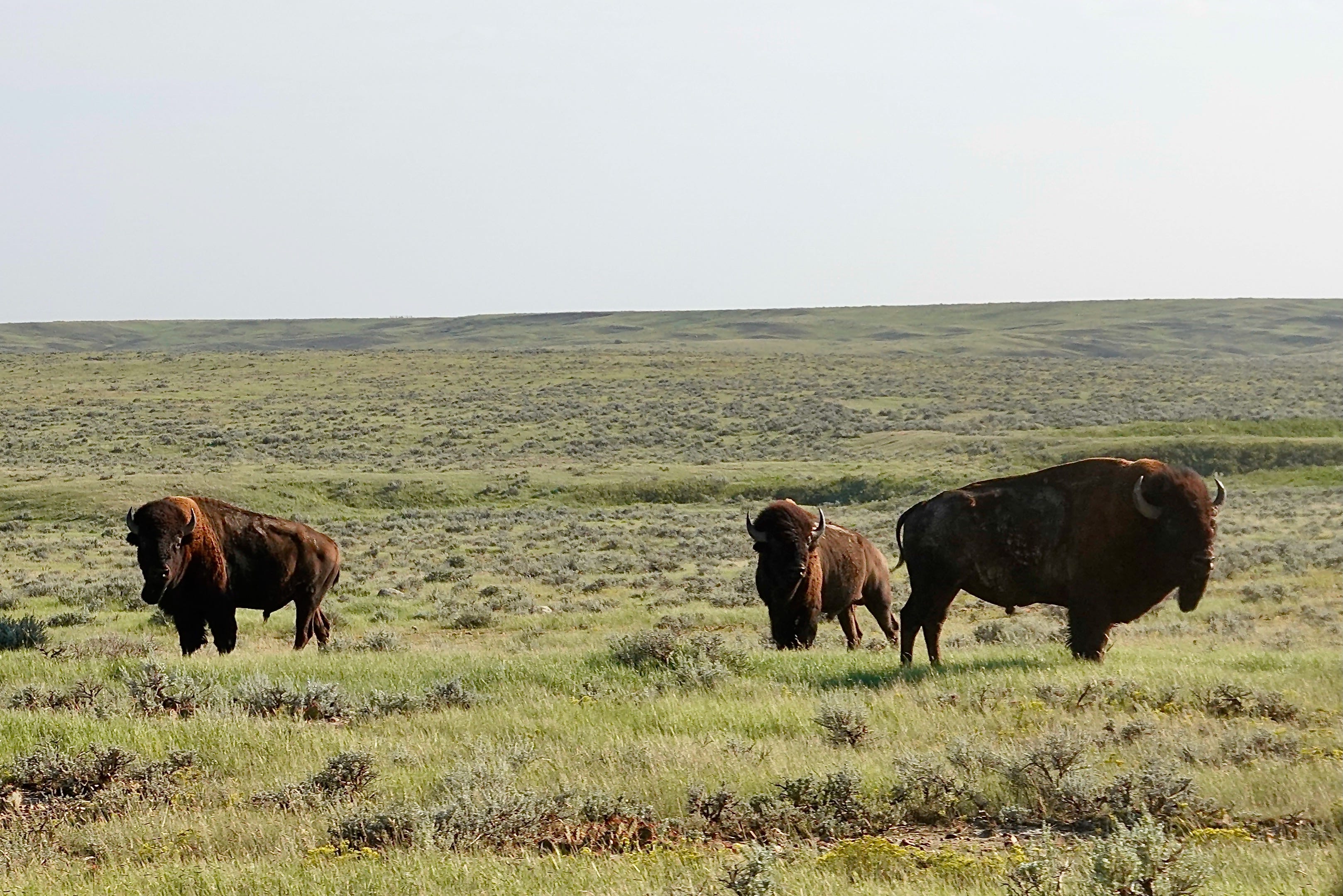
The photo at the top of this essay was taken on American Prairie land about 400 miles—around 640 kilometers—east of my home. I drove out there to spend a week, for a writing assignment, and spent most of my time thinking about relationships, between people, between humans and animals, between animals and ecosystems, between myself and that place.
It was a place, and time, where I got to linger in the concept of what it feels like when energies are given to relationships and repair, when they’re given to life and how it interconnects, including with humans.
I don’t think of life or society or culture as a game—the phrasing feels to tech-bro-ish maybe, or maybe game theory was, like computer science, a subject I was never much good at—but I still like Carse’s idea of finite and infinite games as a clarifier for living.
For me, and something he alluded to throughout the book, the only game worth winning is the one that enables life to keep living. Teaching an alien to make a peanut butter and jelly sandwich is a finite game that might or might not be worth doing. Working toward a world in which everyone has enough to eat, not limited to peanut butter-and-anything sandwiches, or even just to sandwiches, is a larger finite game that almost always supports the infinite one. And understanding? What seeks to comprehend, to know another, to soften toward their heart and their suffering? Maybe that’s the infinite game, one we only see glimpses of.
The infinite game sees a world whose laws are relational and life-supportive, where we are all kin with all of creation. And act accordingly.
Thanks to B. Lorraine Smith for a prompt tthat reminded me of that peanut butter and jelly sandwich assignment!
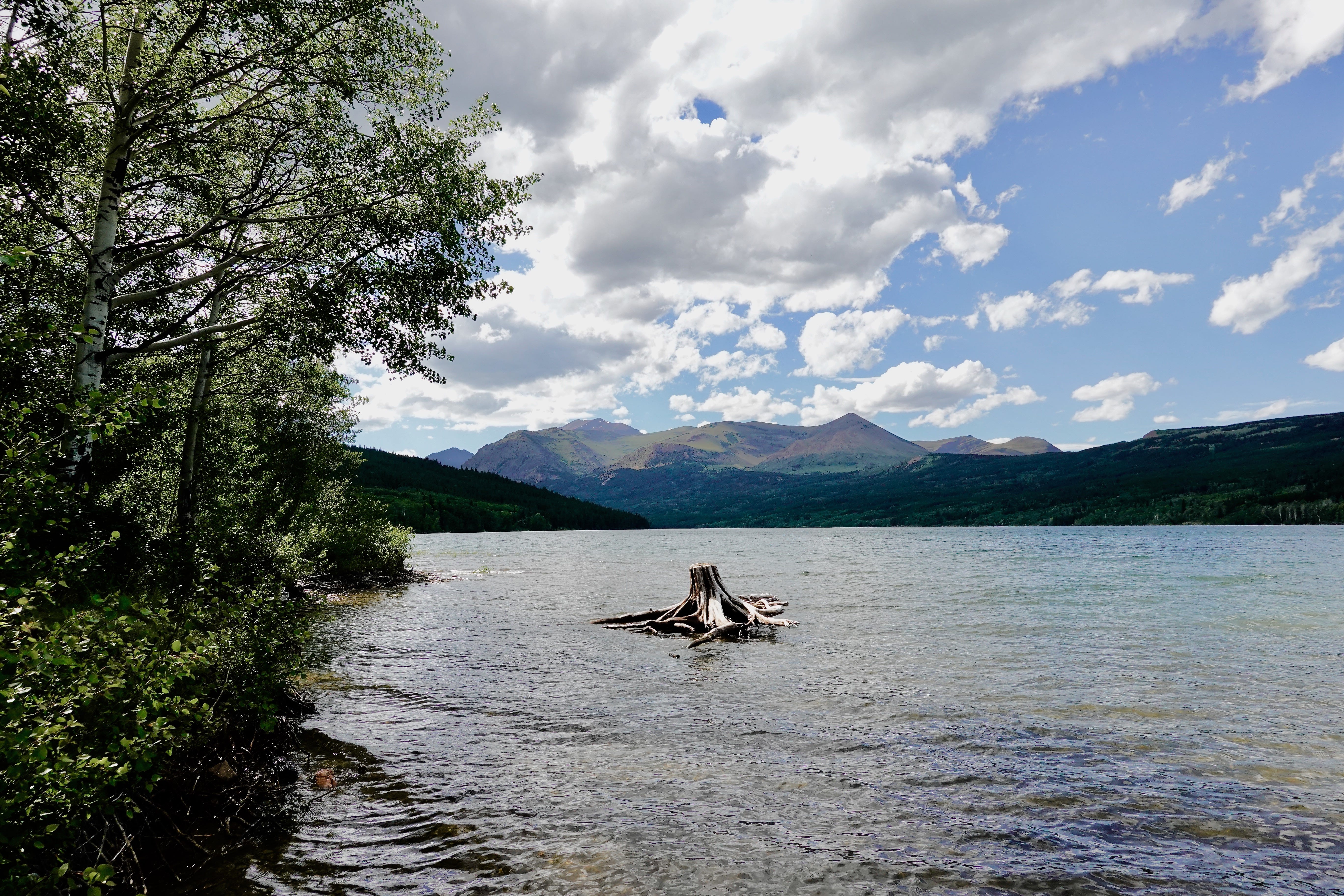
Lower Two Medicine Lake, Blackfeet Nation, Montana, host of the 2025 black/death metal music festival Fire in the Mountains
Some years ago when I still lived I upstate New York, I began working at a sawmill. I had two very small children at the time, and had never intended nor desired to be a full-time stay-at-home mom, not to mention be one and working at the same time (due to the full-time stay-at-home mom reality, most of my work happened in the middle of the night, a capacity I no longer have). But I was doing exactly that, and rapidly dying inside because staying at home with children all day is not, to put it mildly, my calling in life.
One of my kids went to part-time preschool twice a week at a nature museum, which also offered adult classes like beekeeping and wild foraging, both of which I took—out of curiosity but also to stay sane—along with rustic woodworking, an activity I’d never imagined myself doing. I am the kind of person who can’t be trusted with a table saw or even, frankly, a spirit level. The rustic woodworking artist who taught the class introduced me to New York Heartwoods, a micro-mill run by a woman (coincidentally, also from Montana) who’d bought a Wood-Mizer LT40 and specialized in milling wood from downed and diseased trees on public and private land.
Working at the sawmill a couple days a week—interning, really, since I was there to learn and wasn’t being paid—helped keep me from going completely numb, from depression and dissociation from life, and it got me into research on embodied learning, but I was also intrigued by the mill’s mission: the owner only worked with fallen or scavenged trees. The point of the mill was to introduce circularity within the wood milling system, which fit right in with efforts I’d been making toward supporting local food systems and fending off long-term despair over single-use plastics.
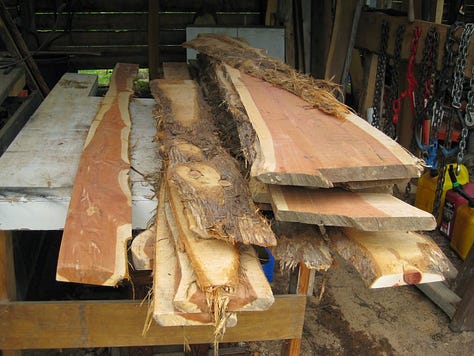
We worked with a lot of city Ash trees felled by emerald ash borer, and Cedar that had been cleared from farm fields. I spent one entire day planing Cedar planks for someone who’d rescued them, already milled, from her family’s farm and was making an art installation out of them.
Rescued Cedar planks, before planing down to their gorgeous hearts
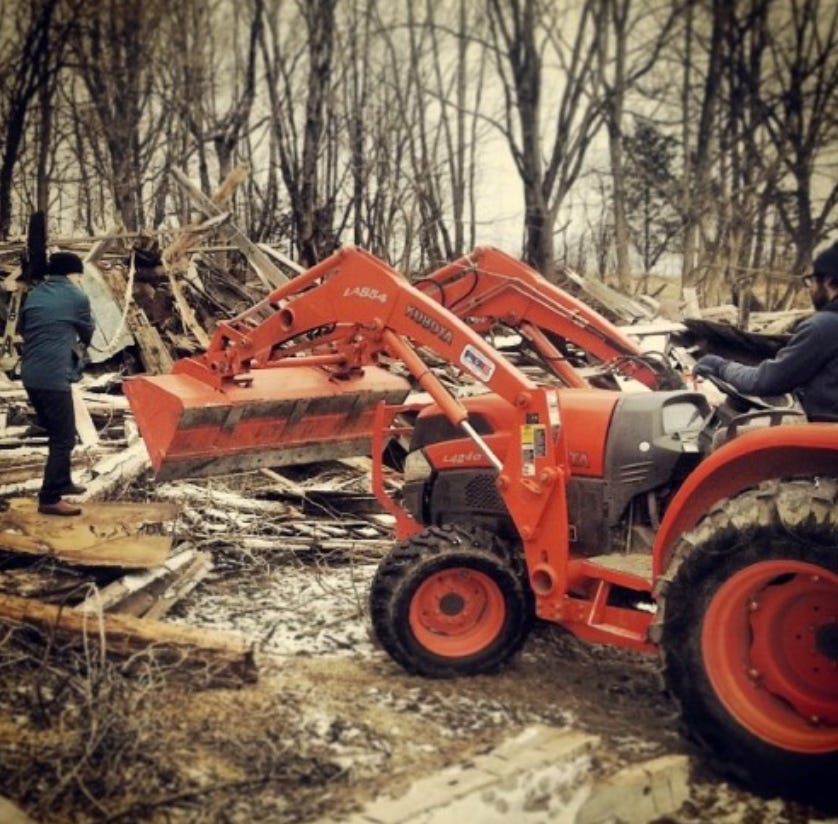
Another time we spent most of a cold, snowy day dragging out enormous old beams from a fallen barn, taking them back to the mill to be sawn into boards that would be lightly sanded and used to make shelves.
Reclaiming beams from a fallen barn. That’s me in the blue coat and black hat, sometime right before or after I punctured my leg with a 100-year-old nail and went to get a tetanus shot. Photo credit: New York Heartwoods.
The mill’s shady, forested yard was full of beauties, every one of them cared for, whether already milled and kiln-dried or not. I don’t ever plan on moving away from Montana, whose forests are full of soft-wooded Pine and Fir, Aspen and Spruce, but do sometimes miss working with hardwood.
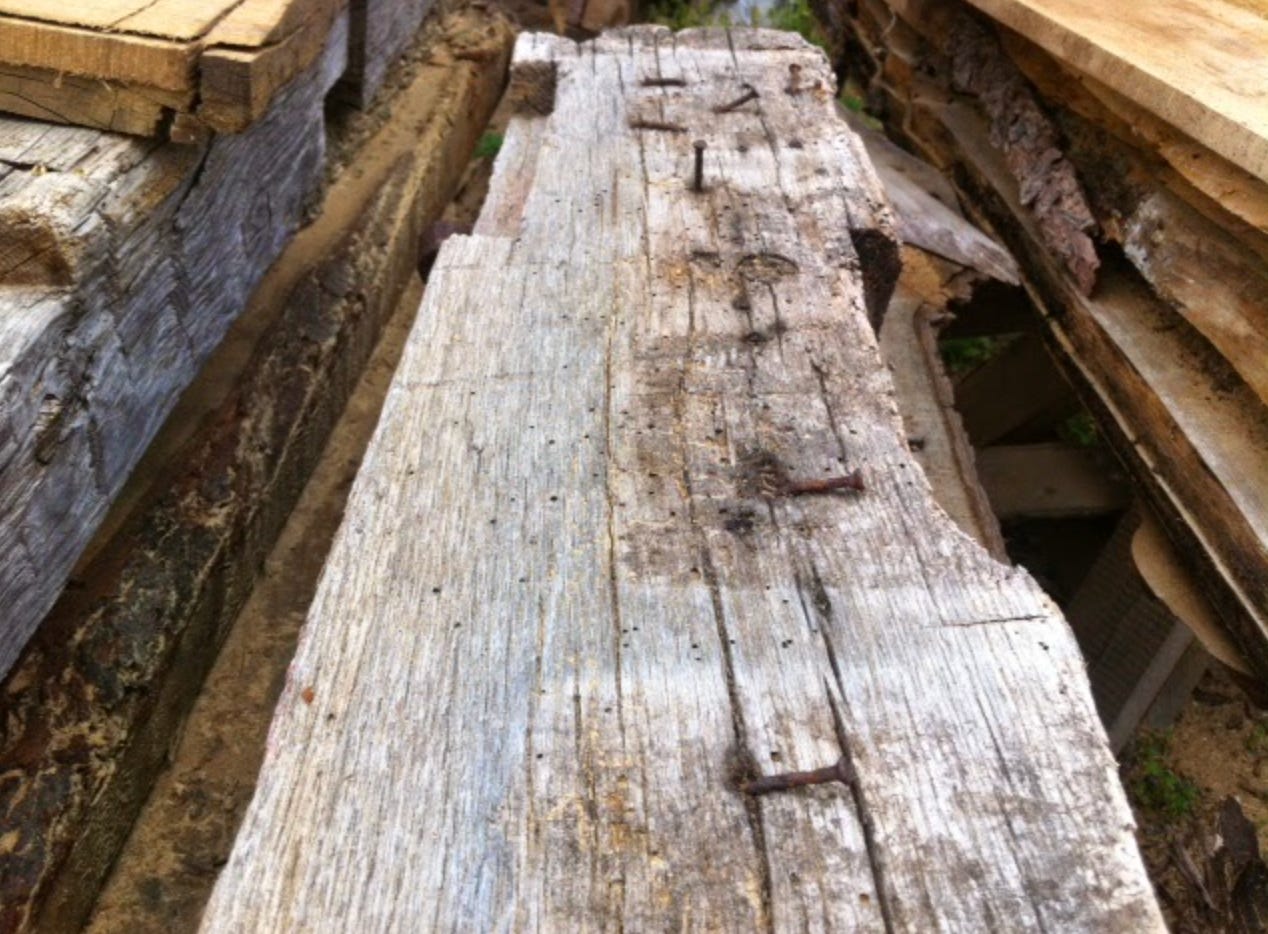
One day, we were milling reclaimed beams from an old barn for a client. Old barn beams are a pain because they’re often full of nails—long, heavy, rusted nails that are hard to spot. We ruined a few blades as hidden nails made it through and wrecked the metal, and finally gave up. That barn beam went back to its owner, or maybe to a scrap pile, joining the piles of beautiful wood resting around the property, testimony to one woman’s commitment to making sure their lives continued.
Barn beams can be a nemesis, too
It only occurred to me later to wonder why we hadn’t taken the time to look for and remove the nails ahead of time, why we sacrificed several saw blades and in the end the beam itself rather than take the time to remove as many nails as we could find and make the wood workable again. It obviously would have been a waste of time, but then again, the entire endeavor could be classified a waste of time, if all we use for measurement are the standards of capital and efficiency.
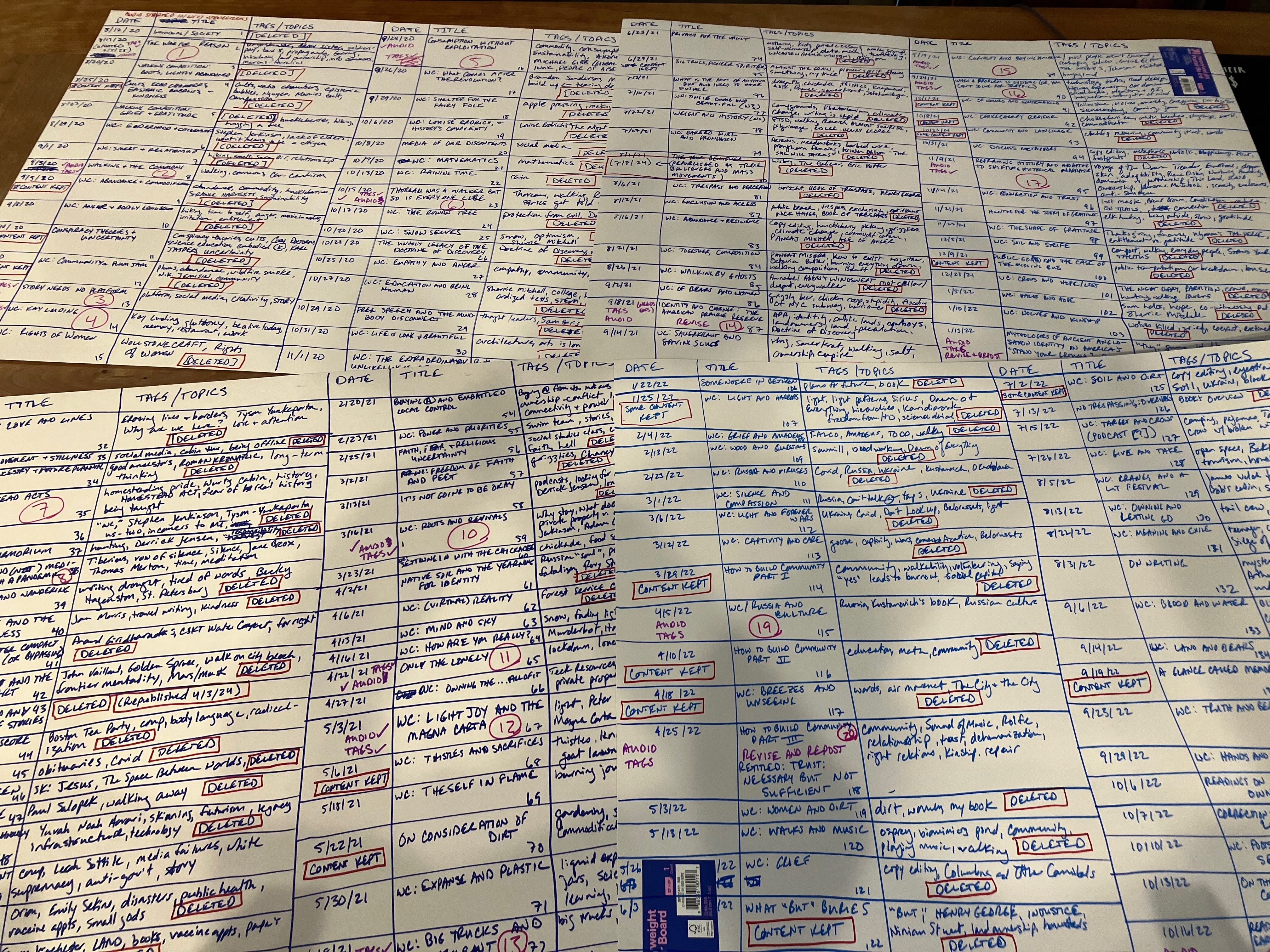
A couple months ago I succumbed to the urge to crawl through all the essays and posts in this newsletter, starting from the very first essay in late summer 2020, about Marcus Aurelius and my own cognitive disconnects around the U.S. invasion of Iraq, when my older sister was still in the military.
I ended up deleting almost 200 out of nearly 300 essays and posts. Some were from before Substack launched its Twitter-like Notes platform, and were brief photo + quote + sentence or two “walking compositions,” a practice I’d migrated over from my deleted Instagram. Many posts I thought were pointless, and others need more revision work. The ones I kept, I’m slowly revising and recording audio for, since I only started doing audio versions in late 2023 (I’ve made my way through nearly 20, starting from the beginning).
This was actually a super fun process. I played around with my work, scrawling all over posterboard with Sharpie markers, in a way I haven’t in years.
Many of the posts and essays I deleted, I saved in offline Word documents, collecting them by theme. By far, the largest of these collections is one I’ve labeled “Abundance and Commodification,” with over 40 pages of text. Some of what I’ve rewritten here about my time working at a sawmill are lines scavenged from that document.
Out of all the writing I do on the commons, the complementary topics of abundance and commodification—of food and seeds in particular, but of everything in general, including labor, creativity, and ideas—overwhelms the amount I have written about land ownership, which surprised me because I feel like I never shut up about land ownership, and repeat myself to a tiresome degree.
Something about rereading all of those words and stories, and collecting together the ones that I felt needed more editing, or perhaps shaping into a larger, more cohesive project, reminded me of my faith in storytelling, how deeply I believe in its power, and in the world’s need for it. For more stories, stories with heart and truth, as many as possible from as many different perspectives as possible, especially from voices, people, and places who’ve been heard the least. Every iteration, not for the purpose of telling anyone else how to feel or what to think, but sharing the unique experience of what it is to live one’s own individual life. The joy, the pain, the traumas, the grief, the love, the visions and losses and hope.
I don’t think we can ever have enough ways to help ourselves feel what it’s like to live in someone else’s experience.
Yet it often feels like the world is awash in stories. Good stories, important stories. Stories we need to hear and stories we need to tell. Fantastic fiction that opens up possibilities for imagining different ways of living; investigative reporting that unfolds the truth of the world. I have been floored by the work of brilliant documentary filmmakers, by novelists who are bona fide geniuses, many of them personal friends.
And what changes?
It is very easy for the path opened up by that question to lead to despair. I’ve been there myself more than once—I’m there myself more than once on any given day, and I don’t think it’s solely a genetic half-Russian Jewish fatalism. It’s looking at the world, and humans, as clear-eyed as possible. It’s seeing people I believed in and trusted coopt genuine need and good causes for their own benefit; it’s seeing the hard work of millions crash against the walls of capital and power.
But down that path is also possibility. My father used to say, and still does, that the biggest problem in the world is lack of imagination. He meant a capacity to place ourselves in other people’s lives and experiences, a capacity for empathy. It’s both true and bigger than that.
Every story shared is a chip in the systems and structures that seem unbreakable and insurmountable. Most of the time we don’t see what’s changed until long after the fact. Real life isn’t a Hollywood apocalypse movie with sudden shocks to the system and people screaming for the walls. We’ll never know what cracks it all open. But those stories, that work, looking at life slant and seeing what can change, that’s how the light gets in.
After taking my first rustic woodworking class, I couldn’t get enough of working with the diversity of hardwoods that grow and fall in the U.S.’s northeast. I learned about the different high-end uses of varieties of Maple, and how bad Black Locust smells—there is no other way to say it but that Black Locust smells like ass—but also how useful it is. Black Locust is so hard that it can be used in decking. It’s like cement board.
I learned how bacteria and fungi cause spalting and how beautiful its black lines are lacing through decaying stumps or sawn boards. In midwinter, the mill’s owner sent me on a day-long chainsaw safety course, where, after several hours of learning to care for chainsaws and safety equipment and looking at photos of people who’d had horrifying accidents, I stood in knee-deep snow and cut down a Pin Oak. I decided I never wanted to use a chainsaw again because I am clumsy and it was terrifying.
The entire project of New York Heartwoods was at core anti-capital. It was inefficient, time-consuming, space-consuming. Slow. Laborious.
It was an enormous amount of work simply to find markets for the wood products, much less retrieve the trees and logs and mill and kiln-dry and shape and sand it all. That entire day one employee and I spent planing someone’s recovered stack of Cedar planks? The client probably could have bought something similar from IKEA for far less money than that day’s labor cost. Even though I was working at that sawmill for free, nobody else was.
But that’s the point. The work was slow and laborious. And smelled heavenly. I could eat my winter-cold sandwich on a stump of spalted Sugar Maple and smell the melt-snow damp of coming spring. I could peek into the kiln and its stacks of Ash boards. I could do work, and feel alive while doing it.
What does efficiency in our lives get us? The question sits like an invisible monster in the center of capitalism: if “the economy” isn’t there to serve human and ecological well-being, what is the point?
If working with wood by hand gave me and others pleasure and satisfaction, and gave clients connection to their ecosystem and its cycles, why not engage in that kind of work? And why are we prevented from doing that work simply because it doesn’t provide enough income to feed our families?
It’s the reason I recommend reading Wengrow and Graeber’s book The Dawn of Everything as a balm for despair. Or at least listening to interviews about it, or reading summaries. Whatever works. It’s an enormous book and what’s important is the message behind it: there have been countless ways of forming human societies over the past several thousand years. Just because our current industrialized culture feels like some kind of inevitable endpoint doesn’t mean it’s true. Those endlessly varied histories remind us what might be at the core of true freedom.
It also gives an opening into that question, “What changes?” Well, a lot can change. We never know how, not completely. Working toward change for the better doesn’t guarantee success, nor does it guarantee lack of pushback, but without stories we don’t even know how to imagine something different.
I heard someone recently—one of the tarot readers I follow on YouTube—talk about leaning into fear with curiosity. Despair, too, I suppose. That’s where we can find self-empowerment, and perhaps an entirely different way of perceiving both problems and possibilities.
Like in K-Pop Demon Hunters: perhaps a failure to seal the Golden Honmoon isn’t a failure at all. Maybe it’s a way to discover something more powerful and more honest, with a capacity to connect us all.
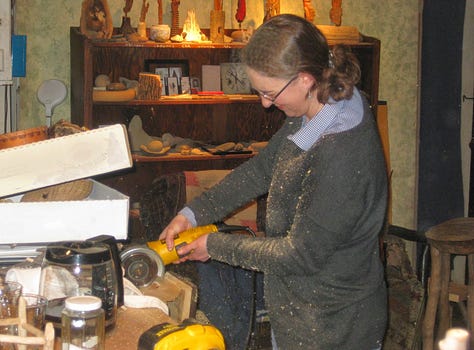
Me making a bowl out of discarded Maple and an axle grinder in the workshop of Dan Mack, rustic woodworking artist, where I found something akin to hope, by working with my hands at one of the lowest points of my life.
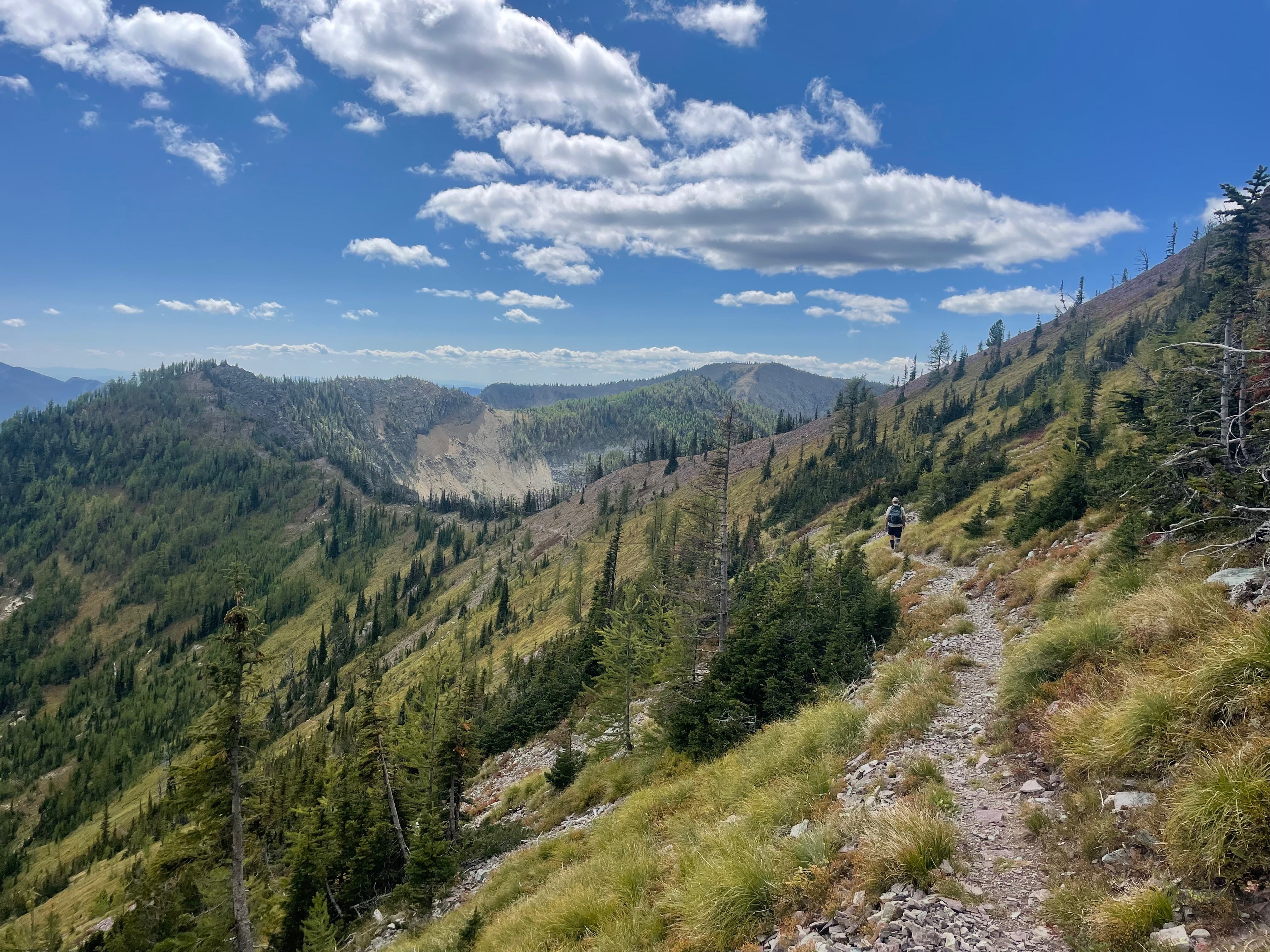
True wealth lies in the freedom to roam, and the freedom to leave—and survive. (Hike down from Nasukoin, near my home in northwest Montana)
“Oligarchy is based on the notion that those who are unequal in one respect are in all respects unequal; being unequal, that is, in property, they suppose themselves to be unequal absolutely.” –Aristotle, Politics, 350 BCE
My last year of college, I applied for a coveted internship at a relatively prestigious literary magazine in St. Paul, Minnesota. When the acceptance arrived, I was excited for all of a few hours.
Then it came home to me that the internship—as is the case for most internships—was unpaid. The editor who’d interviewed me seemed surprised when I called later to ask about the possibility of even a small stipend.
It was the final semester of my final undergraduate year. I’d taken the previous semester off of university and moved back to Montana to be an adult around for my younger sister, who, at fifteen, was in high school and living for the most part alone (long story). Before that, I’d been working up to five different jobs at a time to support myself through college.
The week I was offered the internship, I went for a long walk with someone I’d been friends with since our first confused, heady days of freshman year. He bought me a sandwich and listened to me angst about whether or not I could afford the money—and the time—to work at a job I’d probably enjoy but for which I wouldn’t be paid.
It wasn’t possible, I already knew that, and at the end of our walk we parted at the door of the family diner where I’d been working as a waitress the previous year—a job I took because making tips got me a lot more rent and grocery money than the coffee shop I’d worked at my first two years of college.
So I turned down the internship and waited tables instead. Every now and then another waitress and I got together at her apartment to paint our nails and watch Xena: Warrior Princess and I tried not to think about who got the assistant editing position I’d been so excited to be offered.
The advantages of wealth and privilege get mentioned a lot but not usually with much substance. I’m not sure how many of us truly understand how wealth accumulation turns into power, influence, and status—the literary world is only one small example of how the financial freedom to work for free gives a person entry and connections in all directions, from publishing opportunities to awards and grants to the strange situation that’s evolved in the past couple decades where “writer” is in many places equated with teaching workshops almost more than it is with publishing, or even with the act of writing itself.
But this isn’t only about the writing world. It’s about money, and power, and their feedback loop.
It took me months to even sit down to write a first draft of this essay because the subject bumps against one of my own failures of imagination: it’s very hard for me to understand how millions, or even billions, of people don’t understand how accumulation of wealth leads to accumulation of power, and how the combination leads inevitably to large-scale human oppressions, environmental degradation, and almost every kind of injustice and inequality.
The combination of power and wealth has always led to the failure of societies, and in their current iteration are leading quickly to the failure of the human species.
In the month or two before the November 2024 U.S. presidential election, I picked up David Herszenhorn’s book The Dissident: Alexei Navalny: Profile of a Political Prisoner, about the Russian dissident and anti-corruption activist Alexei Navalny.
Navalny became internationally known after surviving an attempted poisoning, likely ordered by Russia’s top leadership, and then running for president of Russia against Vladimir Putin. But the core of his work was always about corruption. His investigations and fiercely productive blogging activity focused on business deals that benefited government officials, their families, their friends, their friends’ families . . . almost always at the expense of the Russian people and Russian land, whose natural resource wealth of oil, timber, and minerals was not-so-quietly but very quickly privatized by those already in power, for their own gain, in the years following the 1991 collapse of the Soviet Union. Those who benefited most from the privatization were, largely, either those who had held power in the Soviet Union, or people connected to them.
Vladimir Zelensky, an actor and comedian who was elected president of Ukraine after starring in a very successful comedy show about a teacher whose anti-corruption rant went viral, resulting in him unintentionally becoming president, came to fight internal corruption and the influence of Russian wealth and power as the real-life leader of Ukraine.
Navalny was most likely murdered for his anti-corruption work. Zelensky’s country was invaded in 2022 and continues to battle an army of Putin’s soldiers, many of whom were forced into fighting. I’ve heard plenty of stories of disobedience turning into forced conscription that I can’t even share publicly.
And in January 2025, the U.S. government faced, and quickly folded to, a hostile corporate takeover in which the wealthiest person in the world for months wielded the power to fire anyone employed by the government, from wilderness trail crew workers, to people monitoring clean drinking water, to core staff running the power grid of the entire Pacific Northwest.
Everywhere you look, a combination of wealth and power seems to be battling to control more of the same—and winning.
Of course I want to burn it all down. Don’t you?
The problem with that is, as I’ve written here several times before, whenever entire systems and structures are burnt down, it is nearly always those most at risk, those who’ve suffered most, who end up suffering more.
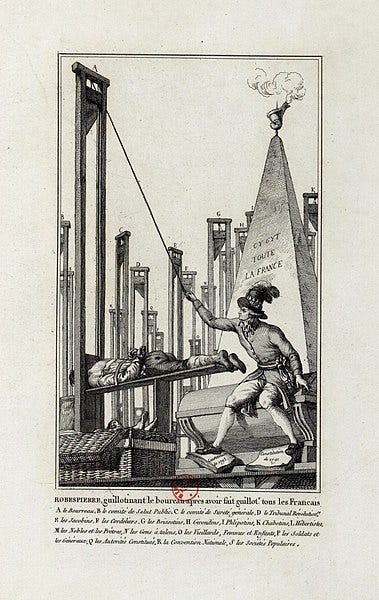
The accumulation of wealth leads to rule by oligarchy, but it also provides those with power the means to protect themselves from inevitable resistance, even mass violence, the French Revolution notwithstanding.
A political cartoon showing Maximilien Robespierre guillotining the executioner after having already guillotined everyone else in France. A commentary on the Reign of Terror. Unknown author, c. 1794, care of Bibliothèque nationale de France.
Whatever system arises from the rubble, those who’ve previously accumulated wealth usually have the means to maintain their power structures, or rebuild them all over again.
In his book Black Sea, Neal Acherson described the strange self-protective quality of wealth through the behavior of Polish nobles whose resistance to reform led to the Third Partition in the late 18th century and the dissolving of Poland as a country for 123 years:
“To the end of their lives, many of these Targowican barons failed to understand what they had done. They kept their vast estates, travelling now to St. Petersburg and Odessa rather than to Warsaw and Krakow. They had lost the political influence they had enjoyed in the old commonwealth, but to be appointed Marshal of Nobility in some Ukrainian county was not a bad substitute. . . . The fact that they themselves were secure and prospering could only mean that all was well with Poland too.”
To put it in more familiar terms: in the 18th century, the Polish nobles fucked around and everybody else got to find out.
In The Sociology of Freedom, co-founder of the Kurdistan Workers’ Party (PKK) Abdullah Öcalan—who has been incarcerated in a Turkish prison since 1999, many of those years in isolation—tracked the question of power back at least 5,000 years, to the beginning of people’s ability to begin controlling and accumulating surplus “product”—food for the most part, but also other people’s labor.
Wealth, in his writing, is the ability to accumulate and hoard the resources that people need to survive, including food and work. Power comes from control over that wealth:
“The fundamental characteristics that have marked the central civilization from its very beginning and determined its character have remained essentially unchanged for five thousand years. . . . One characteristic that remains stable whatever the differences or forms adopted is the monopoly’s hegemonic control of surplus product. . . . We must take care to understand the monopoly. It is neither purely capital nor purely power. It is not the economy, either. It is the power to use organizations, technology, and violence to secure its extortion in the economic area.”
Much of the power in wealth is about who owns what, which translates into who controls and dominates what, especially land, water, food, and the right to pollute the commons we all need for survival. Vandana Shiva—who’s been working on seed and food sovereignty in India for decades—has in recent years reiterated what can never be said enough: “If you control food, you control people.”
The U.S. government’s determination to wipe out buffalo and destroy land relationships through iterations of theft so as to force people and Native Nations into dependence in recent history is proof enough of this (its goals in this respect are explicit and well documented); and if you read about enclosures of the commons over the past 800 years of British history, you’ll also run into plenty of examples of entire villages of people evicted and starving and forced into “jobs” for the first time because a few already-rich people wanted to get wealthier by raising sheep on land that was previously used and lived with in common.
To give just one example, Andro Linklater, in his sections on England’s enclosures of the commons in Owning the Earth, wrote:
“In a single day in 1567, Sir Thomas Gray of Chillingham in the north of England cleared off his manor no fewer than 340 villeins, cottagers, and laborers whose right to work their plots of land existed simply by tradition. Whole villages and townships were soon emptied—in Shakespeare’s county of Warwickshire alone, sixty-one villages were wiped out before the year 1500.”
These land thefts and evictions led to starvation and mass homelessness and criminalization of the same through anti-vagrancy laws and the right to enslave people found to be in violation. Those who were already wealthy had the power to take what they wanted, call it theirs, and justify the theft through philosophies and laws that placed rights of property—no matter how it was acquired—over the rights of people, and of life in general.
The long-term impacts of wealth—whether of land or wealth in other forms—accumulate intergenerationally, for far longer than most of us realize. A research paper co-authored by scholars with the Bank of Italy and the University of Bologna that tracked intergenerational wealth in family dynasties in Florence, Italy, from 1427 to 2011 challenged a common misconception that family wealth is usually wiped out within three generations. They found instead that the top earners of today are most often descendants of those “at the top of the socioeconomic ladder six centuries ago,” families who had been lawyers or members of elite trade guilds in the year 1427:
“Intergenerational real wealth elasticity is significant too and the magnitude of its implied effect is even larger: the 10th-90th exercise entails more than a 10% difference today. Looking for non-linearities, we find, in particular, some evidence of the existence of a glass floorthat protects the descendants of the upper class from falling down the economic ladder.
These results are new and remarkable and suggest that socioeconomic persistence is significant over six centuries.”
The authors pointed out that the results are particularly remarkable when you consider the enormous social, economic, and political upheavals that took place in that region over those centuries, “and that were not able to untie the Gordian knot of socioeconomic inheritance,” a reality that they felt comfortable extending to similar countries in western Europe.
Ownership and wealth are far stickier and more resilient over time, even over collapsing societies, than most of us would like to believe.
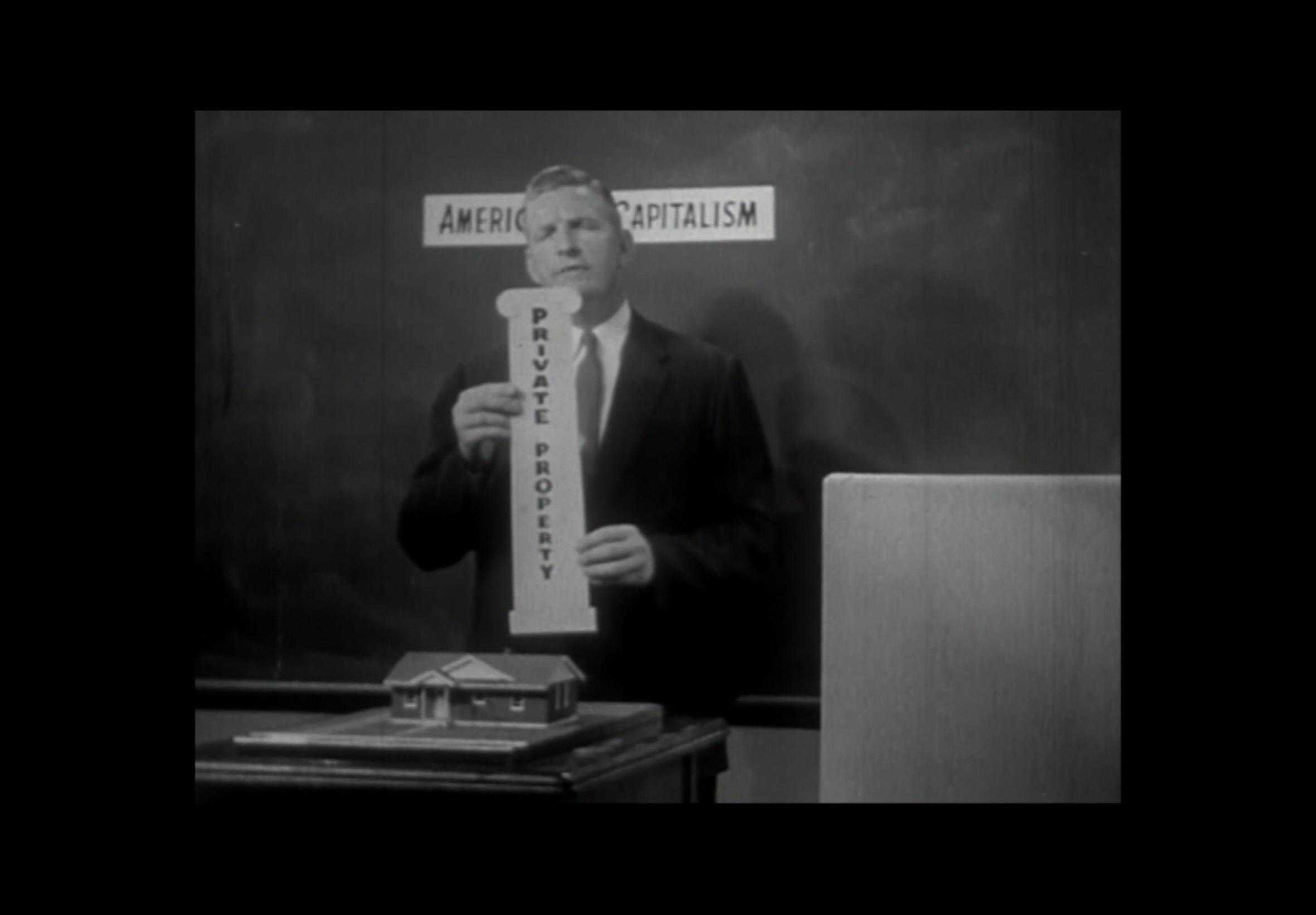
And of course what security of wealth both comes from and translates into, along with power, is ownership of property—land in particular.
A screenshot from a webinar I attended on the Doctrine of Discovery and its relation to capitalism’s entanglement with private property.
The weight of wealth and power is enormous. It sucks up life and resources, and seeks more of the same; it crushes people and feeds off their labor, and seeks more of the same. When it faces resistance, it responds by protecting itself. Maybe firing someone. Maybe abusing or even murdering them. Maybe invading an entire land.
The Roman Empire is one of the most well-known cases in point. “Empires entail ongoing costs,” political economist John Rapley wrote in Aeon about the Roman Empire. “The richer an empire becomes, the more it must spend to preserve that wealth,” spending more money on ever-shakier military campaigns and using up public funds to protect the security—and property—of the wealthy and powerful within its borders.
“Power,” wrote Abdullah Öcallan, “is not simply accumulated like capital; it is the most homogenous, refined, and historically accumulated form of capital.”
Power, in other words, is a manifestation of wealth itself. It is what wealth is for.
Given the resilience of wealth, the protective quality it gives to those who have it, what are we meant to do about the power it wields, power that causes an immense amount of damage and limits everyone else’s freedoms? What’s the answer, the solution?
There are two that I can see: the first and most urgent is to tax wealth, obviously. Prevent the kinds of massive accumulation of resources that lead to accumulation of power. Pretending that one doesn’t lead to the other, and that their combined strength don’t lead to oppression of most of the human population as well as destruction of much of the rest of the living world, is a fairy tale.
David Wengrow and David Graeber’s book The Dawn of Everything is partly directed at this problem, detailing societies across the planet over several thousand years and how they rose and fell and shaped themselves—or didn’t—around an awareness of the dangers of wealth and property accumulation. Those shapings, the authors wrote, determine everyday people’s security of three essential freedoms: “the freedom to move, the freedom to disobey and the freedom to create or transform social relationships.” Wealth accumulation—especially in landed property over the last near-millenium—leads to the kind of power accumulation that erodes or outright prohibits these freedoms.
“The freedom to move, the freedom to disobey and the freedom to create or transform social relationships.”
“Progress” is never a clear path; it’s a messy, tangled walk through an overgrown forest that often leads in circles. The benefits of whatever we call progress are only fully realized when they come hand in hand with an awareness of wealth’s downfalls.
The second response is to pay serious attention to building parallel systems that not only show the viability of, for example, commons management of land and life, water and work, but have the resilience to keep going even when shit does hit the fan—which systems run by and for wealth and power are generally too fragile to withstand.
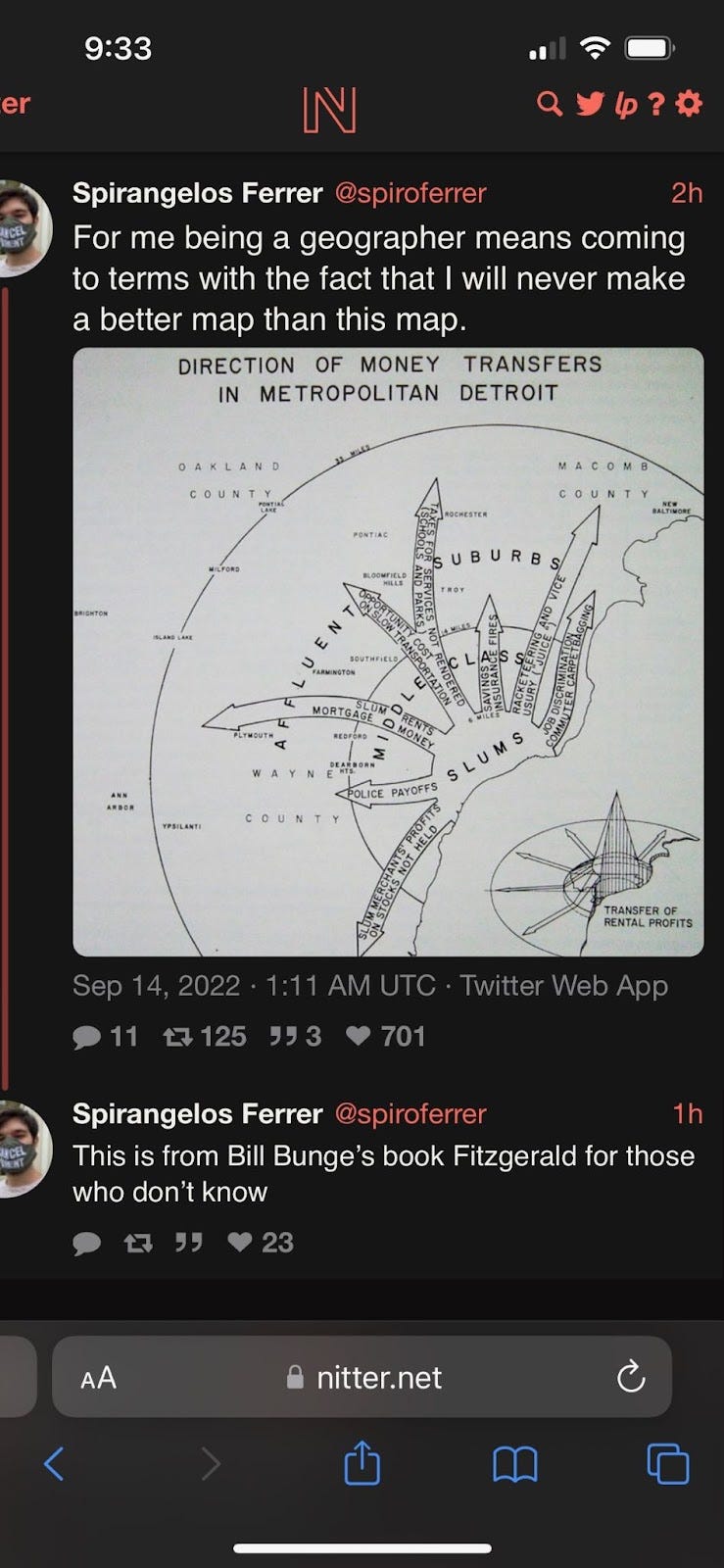
The more a society is designed to crush you, though, the harder it can be to make these efforts successful. In my book A Walking Life, I wrote about the St. Paul, Minnesota, area of Rondo, a majority Black community of thriving businesses and neighborhoods, which was largely destroyed, losing over 700 homes and 300 businesses and the community split in half, to build a now 8-lane freeway during the U.S.’s highway-building craze in the middle decades of the 1900s. It’s a far too typical story. Most of the U.S.’s major highways, where they run through cities, were built by destroying mostly majority-Black and poor communities, along with any equity they’d built in those businesses and homes, and largely to serve more affluent suburbs.
Wealth gets its resources, including power, by extracting from everyone else in any way legally possible and many illegal.
Screenshot of a Twitter account with a map from Bill Bunge’s 1971 book Fitzgerald: Geography of a Revolution, showing how equity is extracted from poverty and precarity to benefit wealth
You can’t separate injustices from one another without power weaponizing that separation to eradicate resistance—or attempting to.
The right to vote, for example, has long been entwined with wealth, specifically wealth of land. In 1819, a peaceful rally of nearly 60,000 unarmed working class people in Manchester, England, was organized to advocate for the right to vote for those who did not own property (the U.S. Constitution, too, originally limited voting rights to property owners in addition to requiring that they be male, white, and over the age of 21). Land enclosures—theft of the commons—going back as early as the 13th century meant that very few people owned land, but laws they had no opportunity to participate in writing affected them anyway.
Government forces attacked the peaceful rally, resulting in 18 dead and over 650 injured in what is called the Peterloo massacre. Those who didn’t own property wouldn’t get the right to vote until the late 1800s.
Self-taught American economist Henry George spent most of his 1879 book Progress & Poverty writing about the ways that land ownership leads to wealth inequality and accumulation of political power by a few, and resistance to the same:
“Absolute political equality does not in itself prevent the tendency to inequality involved in the private ownership of land, and it is further evident that political equality, coexisting with an increasing tendency to the unequal distribution of wealth, must ultimately beget either the despotism of organized tyranny or the worst despotism of anarchy.”
If normal, everyday people understood the reality that all wealth comes from land, from nature, as well as from the labor of others, human and non-human alike, they wouldn’t vote for a system that gives yet more wealth and power to those who already have it, that hands power to those who control land and are therefore able to accumulate wealth.
But as should be painfully obvious by a simple glance at the daily news, mass understanding of that reality requires more than education; it requires imagination and insight. It requires that those who do the storytelling—journalists, reporters, novelists, and poets—share experience with the bulk of humanity, at least enough to access some empathy, to be able to put themselves in other people’s shoes. To understand that what they’re being told by those in power might simply be a story benefiting and protecting the same—power, and wealth.
It takes a lot of imagination and intention to see where our own privileges have blinkered our vision. If I had come from a family with even middle-class income, if my parents or grandparents had money and I weren’t working more than one job at a time just to support myself and be able to finish college, I could have taken that internship with a prestigious literary journal. I could have started climbing some kind of literary ladder, become an editor at an equally prestigious publisher maybe. And I maybe would have assumed that it was only my hard work and talent that got me there, not seeing the ways the trail was cleared and the path smoothed before I ever stepped on it.
We all need self-awareness to be able to see how power is actually structured, how it is shaped around the interests of wealth and property. That there is no “trickle-down,” that enormous accumulation of wealth is detrimental, actually, to life and freedom at every level you can think of, including the individual lives shaped and softened by wealth itself. All of this requires an understanding of propaganda and Story and how deep attachment to identity—both individual and shared—runs through every human being.
It requires a shift in consciousness, you might say, as well as changes in tax codes and societal priorities.
Or there’s a third option, which is to wait for the incompetence and nepotism inherent in oligarchy to eat their own power structures from the inside out.
The philosopher Aristotle, who made an extensive study of the rise and fall of city-states, rulers, and power structures in his book Politics, written over 2300 years ago, warned that oligarchies are inherently unstable. They can’t meet the needs of the regular population, they can’t abide competition in business or culture, and they can’t be bothered to follow the laws they write, even those that benefit themselves.
In a video summation of oligarchies, how to fight them, and Aristotle’s Politics, the narrators of the YouTube channel Legendary Lore1 said that,
“Aristotle observed that while a state can handle many types of protest, the real danger comes when people stop believing the state serves its proper end: the good life and virtue of its citizens,” resulting in an erosion of legitimacy.
“Aristotle warned against the wealthy treating common things as their own, like when public spaces become effectively private, when shared infrastructure serves only elite interests, when common goods like water and, in our times airwaves and digital networks, become de facto personal property of the economic political class.”
Oligarchies tend toward nepotism and its ruling members live openly in opposition to the laws imposed on the rest of the population. Their networks become brittle, and the systems often succumb to infighting among oligarchs themselves.
“Many oligarchies,” Aristotle wrote in Politics, “have been destroyed by some members of the ruling class taking offense at their excessive despotism; for example, the oligarchy at Cnidus and at Chios.”
We can wait it out, knowing that not only does everyone else suffer in the process—and it’s a long process; some form of oligarchy has been in charge of Russia going on decades now, culminating in the theft of Crimea in 2014 and the invasion of Ukraine in 2022—but the reality of wealth will likely, in the long run, still protect many of those who caused the damage. And then the cycle can start all over again.
One of the biggest things I learned while writing my book about walking was that connection, care, and community are just as core to our evolution, just as ancient if not more so, as any of our worst tendencies. If humans were all despotic, greedy, and evil, our species wouldn’t still be around. There are hundreds of thousands of years of archaeological evidence showing us capable of greed but even more of cooperation, and we have the opportunity, in every generation, to choose which of those tendencies we reward, strengthen, and build societies upon. Likewise, that reality inevitably gives something to build hope upon.
“If mutual aid,” wrote Wengrow and Graeber in The Dawn of Everything,
“social co-operation, civic activism, hospitality or simply caring for others are the kinds of things that really go to make civilizations, then this true history of civilization is only just starting to be written.”
My own energies tend toward helping to build, support, and research and write about those parallel systems, usually hyperlocal, that go under the radar but that provide examples for lifeways that make societies life-supportive, locally adaptable, self-aware, and achievable. St. Paul’s Rondo, for example, has never stopped working to repair the damage done by the building of a freeway, and restore its community.
It’s not sexy or loud or charismatic, and it’s not going to topple globally powerful and corrupt international criminals hell-bent on making everyone else suffer. It certainly won’t make me or anyone else whose attention is directed that way famous or rich, nor will it save us all from authoritarians and murderous dictators next week or feed all the children tomorrow.
But it’s still work that’s needed, and in the long run, with enough people, its own power might surprise us.
The law locks up the man or woman Who steals the goose from off the common But leaves the greater villain loose Who steals the common from off the goose
The law demands that we atone When we take things we do not own But leaves the lords and ladies fine Who take things that are yours and mine.
—from 17th-century protests against English enclosures
 Antonia Malchik