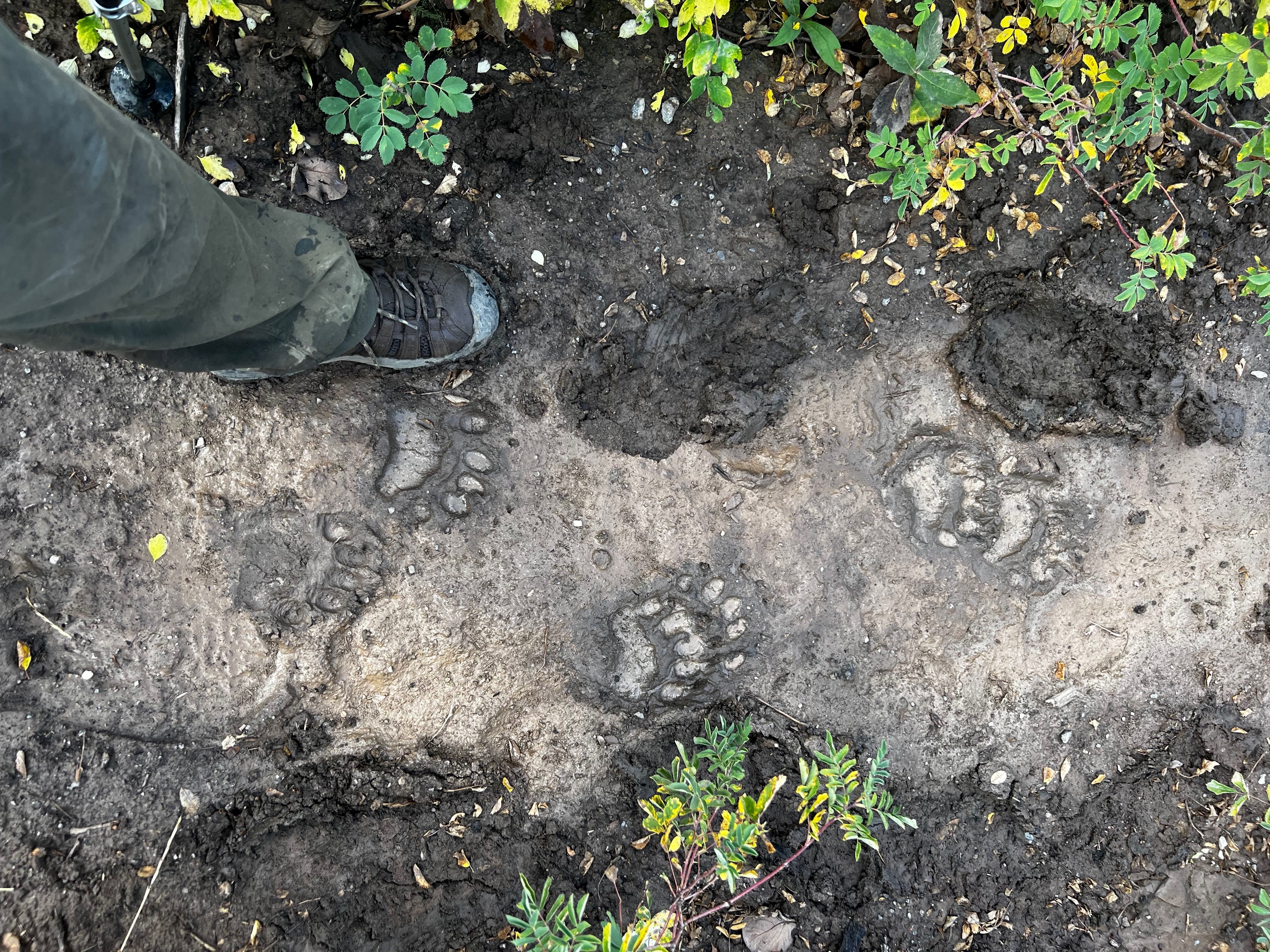
Somewhere between 112,000 and 121,000 years ago, a person walked along the muddy residue of a lake that today is so long gone it might be found only in myth. And maybe not even there—the oldest known story of humankind reaches back only 100,000 years.
Whoever walked those shores, whoever it was who pressed their toes in the mud of an area that has recently been called Alathar, left a ghost of their own life behind: seven of their footprints were fossilized and remained long after the land turned to desert and became known as Saudi Arabia. Left alone, the fossilized footprints could remain long after even the memory of that country—of all the nation-states we know now—disappears.
In my book A Walking Life, I wrote about another set of fossilized footprints, left by another species of hominin (likely Homo antecessor) between 850,000 and 900,000 years ago, on the coast of what is now Norfolk in England. Those footprints included children—an indication that the people were living in that relatively inhospitable climate, not just a group passing through in search of food.
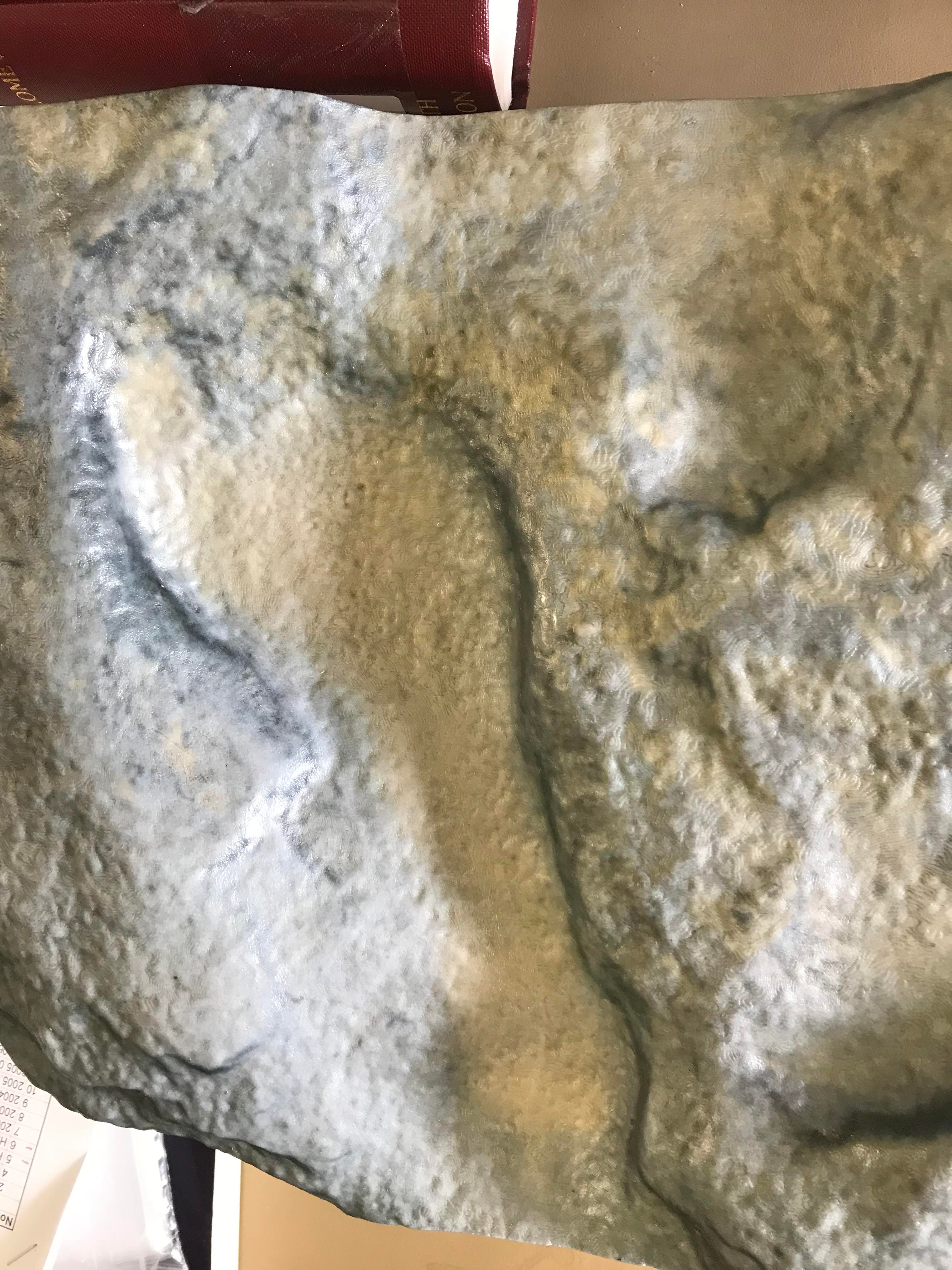
In reports of findings like these, timeframes are given casually: “between 112,000 and 121,000 years ago”; “between 850,000 and 900,000 years ago.” In the case of Dink’inesh’s people—Australopithecus afarensis, of which Dink’inesh, popularly known as “Lucy,” was one—it’s 3.2 million years ago, such a vast reach of time it’s usually not even given a range.
Can you imagine how many lives, worlds, stories, are folded into even one decade of those hundred thousand- or million-year time ranges? Eyes reflecting the starscape and watching every rise of Sun, following the phases of Moon, ears tuned to the rustle and brush of trees, feet wandering in search of food or some other urge of the heart or mind familiar to us, leaving a ghost of story on the shores of Alathar.
Lingering on the life of just one person in that vast stretch of years can make time feel infinite. It often makes me wonder: How have we survived this long?
The first year or two of Covid have come up in conversation frequently over the last several months. Quiet, muttered exchanges with women I meet briefly or barely know, mentioning how Covid broke them. Mothers especially, and people working in the health care industry, anyone with a disability or long-term illness, caregivers, and many working in the service industry. It has always stuck in my head that, at least for the first year of the pandemic, the cohort with the highest death rate were line cooks. When I think of my own years dishwashing, prep cooking, and waiting tables to make ends meet, and the chronic exhaustion and lack of health care access combined with poor ventilation and the heat and steam of a commercial kitchen, it makes sense.
When I’m in conversation with other mothers in particular, all I can say in response is that Covid broke me, too.
Six years ago, the world shut down. That’s what we say. Though heaven forbid anyone in a caring or serving profession shut down.
Six years ago, the world shut down. But during that shutting down, much of the world re-enlivened, like the water and air overstressed by billions of people dependent on fossil fuels.
And for a brief time, care and mutual aid were considered governmental priorities. For a brief time, before such community and public-minded thinking was considered too risky to economic growth.
Even before governments large and small ditched that modicum of responsibility, the amount of effort required simply to hold a family together was crushing. And afterward? The only comparison I can think of is the final book of Liu Cixin’s The Three-Body Problem, in which a weapon called Dual-Vector Foil is deployed, curving spacetime to flatten entire solar systems and all the life within them from three dimensions into two. My life felt like that, crushed under immense gravity and flattened beyond repair.
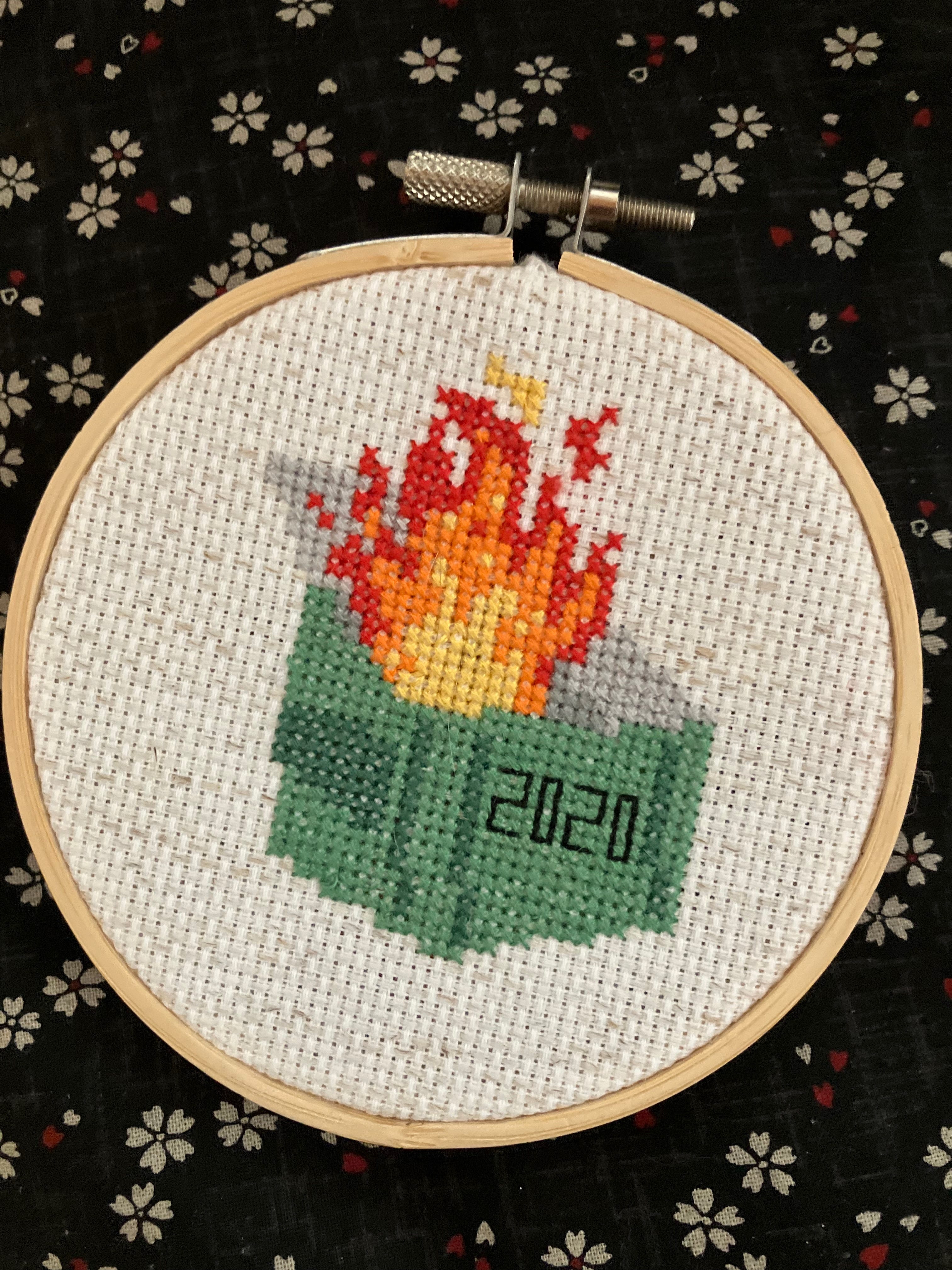
Six years we’ve been living not only with the virus and its continuing risk, but also with that whisper of a promise—what a society could be if care, kinship, and an ethos of community were our priorities.
Despite persistent Long Covid effects in many aspects of my own health, the beginning of that six years feels like a lifetime ago.
Somewhere between 112,000 and 121,000 years ago, a hominin person walking along the shores of a lake was having their own six years. In that timespan, hundreds of generations of peoples had six years that to us, to now, feels so inconsequential that we mention 9,000 years as if it’s nothing. A brief period. One in which entire civilizations could rise and fall and be forgotten. Entire creation stories shared and spread and handed down from so many ancestors that their beginnings can only be found in rock itself.
The persons walking the Norfolk coast that 850 or 900 thousand years ago had children with them. Their footsteps are scattered and energetic, like those of any kid intent on the world around them. I wonder sometimes if it was their parents with them, or aunties and uncles, grandparents, other relatives, all of the above. Human infants are uniquely helpless among mammals; we evolved to work in community to care for our young and help one another survive. There’s a reason our species is described as being obligatorily social. Hominin brains evolved to be interdependent.
That is, humans are wired to respond to one another, to rely on and trust one another. We might also have learned how to manipulate, dehumanize, and reject one another, but that reality can’t change billions of years of evolution.
I recently finished editing an incredible book that will be published next year, by the neuroscientist Dr. Ruth Feldman. Our ability to love and care for one another, to treat all life as relations, goes back, I learned from Dr. Feldman, to the earliest evolution of life on this planet, before hominins or any other mammals even walked this Earth—before there was even much Earth to walk.
Our own species, Homo sapiens, is estimated to be around 300,000 years old, give or take. Barely a hairsbreadth on Earth’s timeline. And yet we’re still the inheritors of evolution’s incredible gifts—of the ability to walk upright and use our clever hands, but also of the highest intelligence of all: how to care for one another. How to love and be loved. How to value life.
Thousands of years of “civilization” have never yet broken that inheritance, though it has tried repeatedly. The determination to keep wealth and power flowing to a few needs a different kind of shut down, that of our stronger evolutionary instincts, the ones that allow us to simply care for one another.
The continued press and violence of domination societies leave us with a choice each of us makes every day, consciously or not: Do you give up, or do you stand by your values and what you know to be moral and just? What are you willing to compromise, or to risk, so that the world might become welcoming to all, so that future generations might have a chance for a fully realized life?
Before my father returned to Russia most recently, we had lunch together, and I got him to tell me again the story of a family relative, his Uncle Oskar, who came home from World War I in 1918 to find German soldiers occupying his village in Ukraine, a German captain living in his mother’s house and treating her as a servant. “He expressed his displeasure in a very aggressive way,” as my father describes it, and fled through a window when the captain took out his gun. Oskar then had to escape, secretly and on foot, to Romania, where he worked as a doctor in the next war.
We meandered to more recent history, my father’s 30 years running a small coffee roasting company in Moscow, Russia, and his regret at not having made better use of the contacts and connections he made during those decades.
Aleksandr (Sasha) Malchik: “If you’re a businessperson, you have to use this.”
Me: “As much as you wanted to be successful, and to be visible, and public, and seen, in my experience of you as my dad—for my entire life—I have never known you to want a relationship to be transactional.
And as far as I’ve seen of people who use it the way you’re ‘meant’ to, the ‘right’ way, those relationships are always transactional. Always. Even the personal ones. . . .
Anybody who doesn’t treat those relationships as transactional is shifting the paradigm, even if it feels like those opportunities slipped away. . . . That’s huge.”
Even when it feels like we’re losing, if we’re living relationally, there’s a chance that in the long run we might be winning.
I would bet a jar of chokecherry jelly that the person walking the shore of Alathar 100,000-some years ago dealt with manipulators and abusive people, greedy leaders and selfish relatives. I would also bet that there were plenty of others who weren’t. That maybe, even, the manipulators and abusers and selfish people became outcasts from the community. As David Wengrow and David Graeber covered comprehensively in their book The Dawn of Everything, humans have formed pro-social and community-minded societies, as well as destructive power-rewarding ones, all over the world, many, many times over the past few thousand years.
Depending on who you are and what kind of agency you have, there is an element of choice in these formations. An enslaved person in 4000 BCE Uruk—6,000 years ago—had almost no choices. But the middle class and elites probably did. And so do many of us.
How and where to take action, what to do in the fact of injustice and violence, are questions constantly in the ether. They follow a deeper question, one that asks us to sink into our evolutionary inheritance and decide at every moment, in every encounter, whether with humans or not: am I being relational, or am I being transactional?
And likewise, to have the discernment to know when we ourselves, or others, are being treated transactionally rather than in relationship. This second aspect can be more difficult: it can be easy to excuse how someone treats people in their personal life when we perceive their public actions as beneficial, without realizing the interpersonal and even soul-level harm that’s perpetuated by private cruelty and lack of personal accountability.
One of the gifts of the work I do, whether when editing, or research and writing, is being constantly reminded of the vast timeframes of human existence, and the even vaster ones of life itself. One of the fossils I wrote about in A Walking Life is of Sahelanthropus tchadensis, dated to around six or seven million years ago.
There is nothing that has made me believe in miracles and magic more than getting grounded in the millions of years and countless tiny shifts of evolutionary biology that somehow resulted in our own lives, in today. Excuse my language, but it’s fucking awesome. It really is.
Somewhere in that biological history we evolved a capacity for partnership, interdependence, and caring, and it’s been far more influential in our continuing evolution than traits for domination and competition. I don’t know how the latter started to become predominant in human societies reaching back nearly 10,000 years ago—there are theories related to a shift from hunter-gather to settled agricultural societies and the subsequent rise of city-states—nor do I know fully how to make the former the expected norm again.
But I think we can begin by each strengthening our own innate capacity for relationship. By slowing down, observing and being part of the lives we exist within; by getting to know people well enough to see them clearly, and ourselves well enough to see us clearly.
We all have the right, and the capacity, to shape a world around relationship.
Billions of feet are wandering Earth right now. Each of them leaves a story, whether it’s fossilized for the study of scientists and poets 100,000 years from now or not. Whether those stories will show future generations our time’s shift from harm to care, from extraction to kinship, rests partly on obvious and visible choices our societies make now, but also on the thousands of imperceptibly small steps each of us takes next.