Oligarchy: the power of wealth

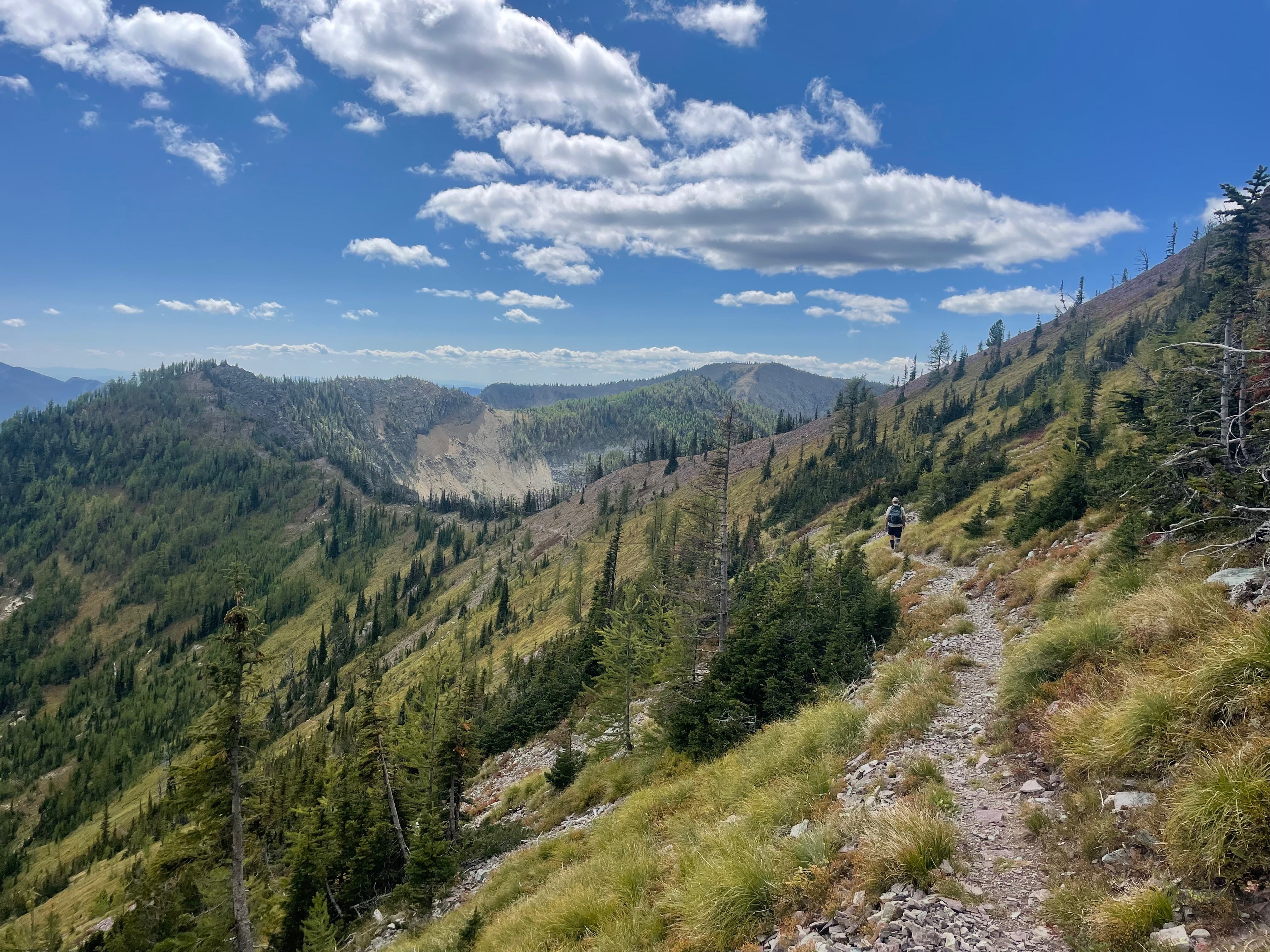
True wealth lies in the freedom to roam, and the freedom to leave—and survive. (Hike down from Nasukoin, near my home in northwest Montana)

“Oligarchy is based on the notion that those who are unequal in one respect are in all respects unequal; being unequal, that is, in property, they suppose themselves to be unequal absolutely.” –Aristotle, Politics, 350 BCE


My last year of college, I applied for a coveted internship at a relatively prestigious literary magazine in St. Paul, Minnesota. When the acceptance arrived, I was excited for all of a few hours.

Then it came home to me that the internship—as is the case for most internships—was unpaid. The editor who’d interviewed me seemed surprised when I called later to ask about the possibility of even a small stipend.

It was the final semester of my final undergraduate year. I’d taken the previous semester off of university and moved back to Montana to be an adult around for my younger sister, who, at fifteen, was in high school and living for the most part alone (long story). Before that, I’d been working up to five different jobs at a time to support myself through college.

The week I was offered the internship, I went for a long walk with someone I’d been friends with since our first confused, heady days of freshman year. He bought me a sandwich and listened to me angst about whether or not I could afford the money—and the time—to work at a job I’d probably enjoy but for which I wouldn’t be paid.

It wasn’t possible, I already knew that, and at the end of our walk we parted at the door of the family diner where I’d been working as a waitress the previous year—a job I took because making tips got me a lot more rent and grocery money than the coffee shop I’d worked at my first two years of college.

So I turned down the internship and waited tables instead. Every now and then another waitress and I got together at her apartment to paint our nails and watch Xena: Warrior Princess and I tried not to think about who got the assistant editing position I’d been so excited to be offered.

The advantages of wealth and privilege get mentioned a lot but not usually with much substance. I’m not sure how many of us truly understand how wealth accumulation turns into power, influence, and status—the literary world is only one small example of how the financial freedom to work for free gives a person entry and connections in all directions, from publishing opportunities to awards and grants to the strange situation that’s evolved in the past couple decades where “writer” is in many places equated with teaching workshops almost more than it is with publishing, or even with the act of writing itself.

But this isn’t only about the writing world. It’s about money, and power, and their feedback loop.

It took me months to even sit down to write a first draft of this essay because the subject bumps against one of my own failures of imagination: it’s very hard for me to understand how millions, or even billions, of people don’t understand how accumulation of wealth leads to accumulation of power, and how the combination leads inevitably to large-scale human oppressions, environmental degradation, and almost every kind of injustice and inequality.

The combination of power and wealth has always led to the failure of societies, and in their current iteration are leading quickly to the failure of the human species.

In the month or two before the November 2024 U.S. presidential election, I picked up David Herszenhorn’s book The Dissident: Alexei Navalny: Profile of a Political Prisoner, about the Russian dissident and anti-corruption activist Alexei Navalny.

Navalny became internationally known after surviving an attempted poisoning, likely ordered by Russia’s top leadership, and then running for president of Russia against Vladimir Putin. But the core of his work was always about corruption. His investigations and fiercely productive blogging activity focused on business deals that benefited government officials, their families, their friends, their friends’ families . . . almost always at the expense of the Russian people and Russian land, whose natural resource wealth of oil, timber, and minerals was not-so-quietly but very quickly privatized by those already in power, for their own gain, in the years following the 1991 collapse of the Soviet Union. Those who benefited most from the privatization were, largely, either those who had held power in the Soviet Union, or people connected to them.

Vladimir Zelensky, an actor and comedian who was elected president of Ukraine after starring in a very successful comedy show about a teacher whose anti-corruption rant went viral, resulting in him unintentionally becoming president, came to fight internal corruption and the influence of Russian wealth and power as the real-life leader of Ukraine.

Navalny was most likely murdered for his anti-corruption work. Zelensky’s country was invaded in 2022 and continues to battle an army of Putin’s soldiers, many of whom were forced into fighting. I’ve heard plenty of stories of disobedience turning into forced conscription that I can’t even share publicly.

And in January 2025, the U.S. government faced, and quickly folded to, a hostile corporate takeover in which the wealthiest person in the world for months wielded the power to fire anyone employed by the government, from wilderness trail crew workers, to people monitoring clean drinking water, to core staff running the power grid of the entire Pacific Northwest.

Everywhere you look, a combination of wealth and power seems to be battling to control more of the same—and winning.

Of course I want to burn it all down. Don’t you?

The problem with that is, as I’ve written here several times before, whenever entire systems and structures are burnt down, it is nearly always those most at risk, those who’ve suffered most, who end up suffering more.

The accumulation of wealth leads to rule by oligarchy, but it also provides those with power the means to protect themselves from inevitable resistance, even mass violence, the French Revolution notwithstanding.
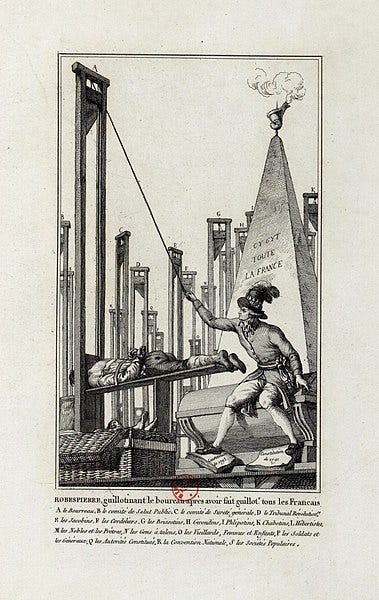
A political cartoon showing Maximilien Robespierre guillotining the executioner after having already guillotined everyone else in France. A commentary on the Reign of Terror. Unknown author, c. 1794, care of Bibliothèque nationale de France.

Whatever system arises from the rubble, those who’ve previously accumulated wealth usually have the means to maintain their power structures, or rebuild them all over again.

In his book Black Sea, Neal Acherson described the strange self-protective quality of wealth through the behavior of Polish nobles whose resistance to reform led to the Third Partition in the late 18th century and the dissolving of Poland as a country for 123 years:

“To the end of their lives, many of these Targowican barons failed to understand what they had done. They kept their vast estates, travelling now to St. Petersburg and Odessa rather than to Warsaw and Krakow. They had lost the political influence they had enjoyed in the old commonwealth, but to be appointed Marshal of Nobility in some Ukrainian county was not a bad substitute. . . . The fact that they themselves were secure and prospering could only mean that all was well with Poland too.”

To put it in more familiar terms: in the 18th century, the Polish nobles fucked around and everybody else got to find out.

In The Sociology of Freedom, co-founder of the Kurdistan Workers’ Party (PKK) Abdullah Öcalan—who has been incarcerated in a Turkish prison since 1999, many of those years in isolation—tracked the question of power back at least 5,000 years, to the beginning of people’s ability to begin controlling and accumulating surplus “product”—food for the most part, but also other people’s labor.

Wealth, in his writing, is the ability to accumulate and hoard the resources that people need to survive, including food and work. Power comes from control over that wealth:

“The fundamental characteristics that have marked the central civilization from its very beginning and determined its character have remained essentially unchanged for five thousand years. . . . One characteristic that remains stable whatever the differences or forms adopted is the monopoly’s hegemonic control of surplus product. . . . We must take care to understand the monopoly. It is neither purely capital nor purely power. It is not the economy, either. It is the power to use organizations, technology, and violence to secure its extortion in the economic area.

Much of the power in wealth is about who owns what, which translates into who controls and dominates what, especially land, water, food, and the right to pollute the commons we all need for survival. Vandana Shiva—who’s been working on seed and food sovereignty in India for decades—has in recent years reiterated what can never be said enough: “If you control food, you control people.”

The U.S. government’s determination to wipe out buffalo and destroy land relationships through iterations of theft so as to force people and Native Nations into dependence in recent history is proof enough of this (its goals in this respect are explicit and well documented); and if you read about enclosures of the commons over the past 800 years of British history, you’ll also run into plenty of examples of entire villages of people evicted and starving and forced into “jobs” for the first time because a few already-rich people wanted to get wealthier by raising sheep on land that was previously used and lived with in common.

To give just one example, Andro Linklater, in his sections on England’s enclosures of the commons in Owning the Earth, wrote:

“In a single day in 1567, Sir Thomas Gray of Chillingham in the north of England cleared off his manor no fewer than 340 villeins, cottagers, and laborers whose right to work their plots of land existed simply by tradition. Whole villages and townships were soon emptied—in Shakespeare’s county of Warwickshire alone, sixty-one villages were wiped out before the year 1500.”

These land thefts and evictions led to starvation and mass homelessness and criminalization of the same through anti-vagrancy laws and the right to enslave people found to be in violation. Those who were already wealthy had the power to take what they wanted, call it theirs, and justify the theft through philosophies and laws that placed rights of property—no matter how it was acquired—over the rights of people, and of life in general.

The long-term impacts of wealth—whether of land or wealth in other forms—accumulate intergenerationally, for far longer than most of us realize. A research paper co-authored by scholars with the Bank of Italy and the University of Bologna that tracked intergenerational wealth in family dynasties in Florence, Italy, from 1427 to 2011 challenged a common misconception that family wealth is usually wiped out within three generations. They found instead that the top earners of today are most often descendants of those “at the top of the socioeconomic ladder six centuries ago,” families who had been lawyers or members of elite trade guilds in the year 1427:

“Intergenerational real wealth elasticity is significant too and the magnitude of its implied effect is even larger: the 10th-90th exercise entails more than a 10% difference today. Looking for non-linearities, we find, in particular, some evidence of the existence of a glass floor that protects the descendants of the upper class from falling down the economic ladder.

These results are new and remarkable and suggest that socioeconomic persistence is significant over six centuries.”

The authors pointed out that the results are particularly remarkable when you consider the enormous social, economic, and political upheavals that took place in that region over those centuries, “and that were not able to untie the Gordian knot of socioeconomic inheritance,” a reality that they felt comfortable extending to similar countries in western Europe.

Ownership and wealth are far stickier and more resilient over time, even over collapsing societies, than most of us would like to believe.

And of course what security of wealth both comes from and translates into, along with power, is ownership of property—land in particular.
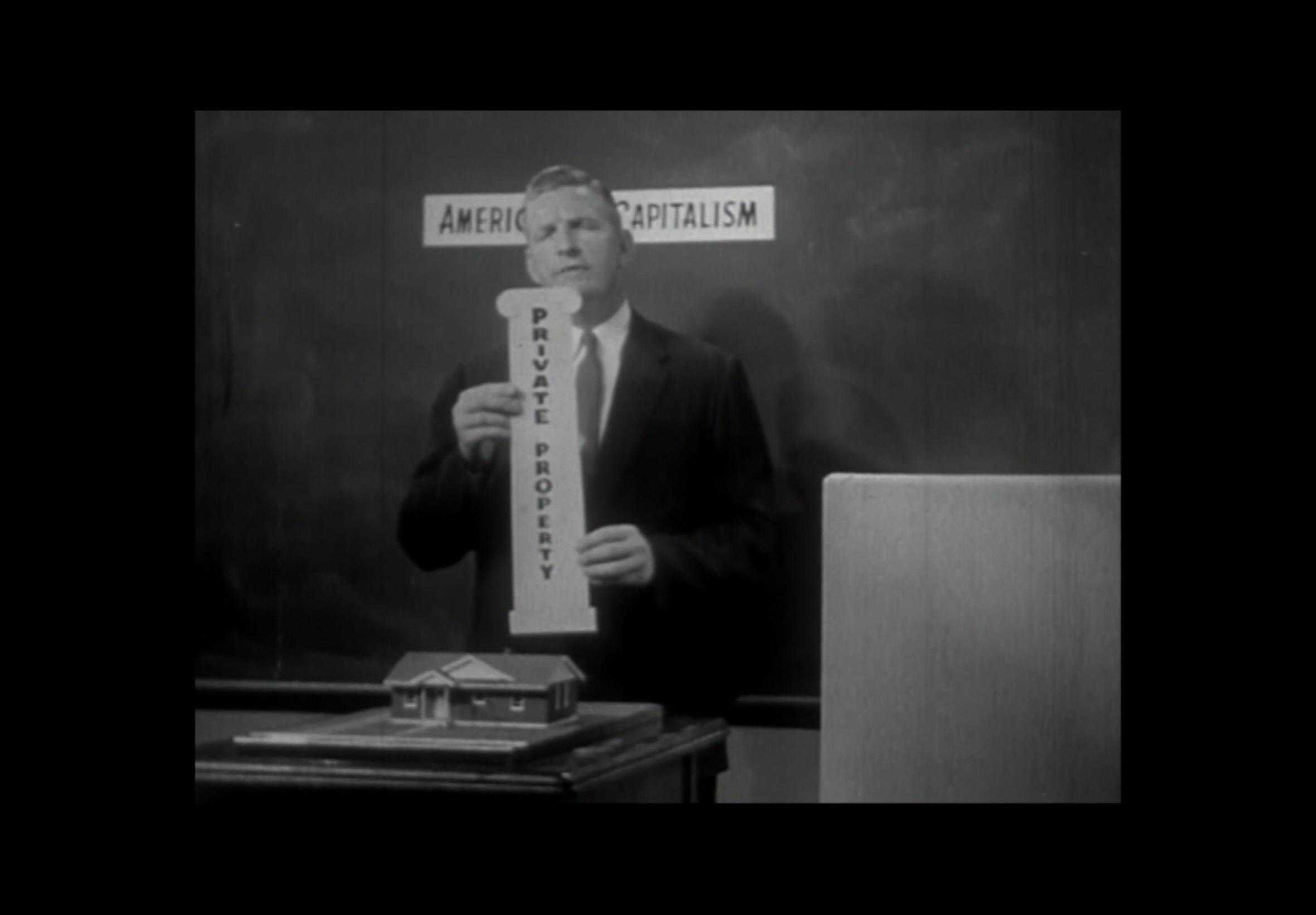
A screenshot from a webinar I attended on the Doctrine of Discovery and its relation to capitalism’s entanglement with private property.

The weight of wealth and power is enormous. It sucks up life and resources, and seeks more of the same; it crushes people and feeds off their labor, and seeks more of the same. When it faces resistance, it responds by protecting itself. Maybe firing someone. Maybe abusing or even murdering them. Maybe invading an entire land.

The Roman Empire is one of the most well-known cases in point. “Empires entail ongoing costs,” political economist John Rapley wrote in Aeon about the Roman Empire. “The richer an empire becomes, the more it must spend to preserve that wealth,” spending more money on ever-shakier military campaigns and using up public funds to protect the security—and property—of the wealthy and powerful within its borders.

“Power,” wrote Abdullah Öcallan, “is not simply accumulated like capital; it is the most homogenous, refined, and historically accumulated form of capital.”

Power, in other words, is a manifestation of wealth itself. It is what wealth is for.

Given the resilience of wealth, the protective quality it gives to those who have it, what are we meant to do about the power it wields, power that causes an immense amount of damage and limits everyone else’s freedoms? What’s the answer, the solution?

There are two that I can see: the first and most urgent is to tax wealth, obviously. Prevent the kinds of massive accumulation of resources that lead to accumulation of power. Pretending that one doesn’t lead to the other, and that their combined strength don’t lead to oppression of most of the human population as well as destruction of much of the rest of the living world, is a fairy tale.

David Wengrow and David Graeber’s book The Dawn of Everything is partly directed at this problem, detailing societies across the planet over several thousand years and how they rose and fell and shaped themselves—or didn’t—around an awareness of the dangers of wealth and property accumulation. Those shapings, the authors wrote, determine everyday people’s security of three essential freedoms: “the freedom to move, the freedom to disobey and the freedom to create or transform social relationships.” Wealth accumulation—especially in landed property over the last near-millenium—leads to the kind of power accumulation that erodes or outright prohibits these freedoms.

“The freedom to move, the freedom to disobey and the freedom to create or transform social relationships.”

“Progress” is never a clear path; it’s a messy, tangled walk through an overgrown forest that often leads in circles. The benefits of whatever we call progress are only fully realized when they come hand in hand with an awareness of wealth’s downfalls.

The second response is to pay serious attention to building parallel systems that not only show the viability of, for example, commons management of land and life, water and work, but have the resilience to keep going even when shit does hit the fan—which systems run by and for wealth and power are generally too fragile to withstand.

There are plenty of examples of these systems being built right now, probably all around each of us, that we might be unaware of because they aren’t the stories that grab national and international headlines. But the podcasts Frontiers of Commoning and Building Local Power, for example, both focus on efforts around cooperative farmscommunity broadbandwatershed citizenship and bioregional activismRights of Naturetenants’ rightscomposting and food security, and more.

The more a society is designed to crush you, though, the harder it can be to make these efforts successful. In my book A Walking Life, I wrote about the St. Paul, Minnesota, area of Rondo, a majority Black community of thriving businesses and neighborhoods, which was largely destroyed, losing over 700 homes and 300 businesses and the community split in half, to build a now 8-lane freeway during the U.S.’s highway-building craze in the middle decades of the 1900s. It’s a far too typical story. Most of the U.S.’s major highways, where they run through cities, were built by destroying mostly majority-Black and poor communities, along with any equity they’d built in those businesses and homes, and largely to serve more affluent suburbs.

Wealth gets its resources, including power, by extracting from everyone else in any way legally possible and many illegal.
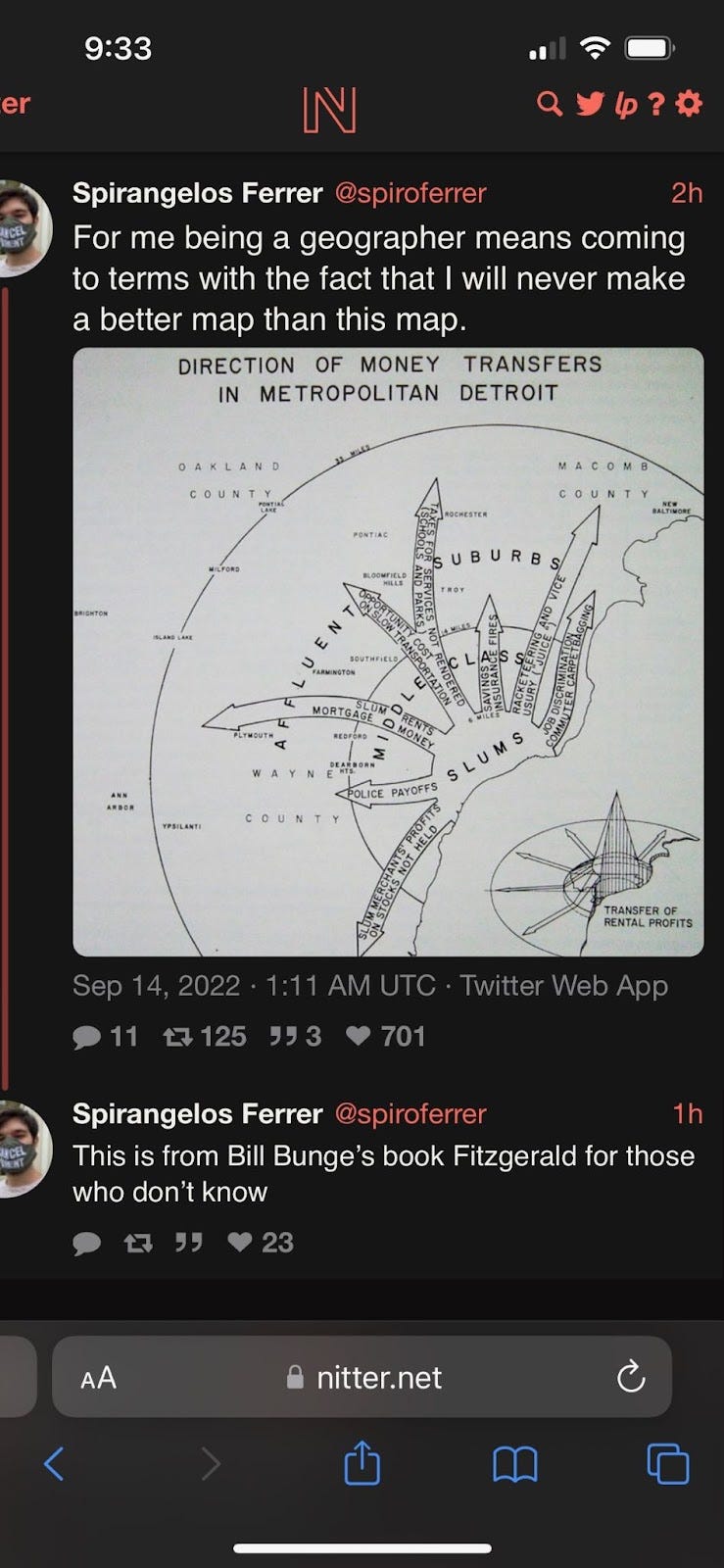
Screenshot of a Twitter account with a map from Bill Bunge’s 1971 book Fitzgerald: Geography of a Revolution, showing how equity is extracted from poverty and precarity to benefit wealth

You can’t separate injustices from one another without power weaponizing that separation to eradicate resistance—or attempting to.

The right to vote, for example, has long been entwined with wealth, specifically wealth of land. In 1819, a peaceful rally of nearly 60,000 unarmed working class people in Manchester, England, was organized to advocate for the right to vote for those who did not own property (the U.S. Constitution, too, originally limited voting rights to property owners in addition to requiring that they be male, white, and over the age of 21). Land enclosures—theft of the commons—going back as early as the 13th century meant that very few people owned land, but laws they had no opportunity to participate in writing affected them anyway.

Government forces attacked the peaceful rally, resulting in 18 dead and over 650 injured in what is called the Peterloo massacre. Those who didn’t own property wouldn’t get the right to vote until the late 1800s.

Self-taught American economist Henry George spent most of his 1879 book Progress & Poverty writing about the ways that land ownership leads to wealth inequality and accumulation of political power by a few, and resistance to the same:

“Absolute political equality does not in itself prevent the tendency to inequality involved in the private ownership of land, and it is further evident that political equality, coexisting with an increasing tendency to the unequal distribution of wealth, must ultimately beget either the despotism of organized tyranny or the worst despotism of anarchy.”

If normal, everyday people understood the reality that all wealth comes from land, from nature, as well as from the labor of others, human and non-human alike, they wouldn’t vote for a system that gives yet more wealth and power to those who already have it, that hands power to those who control land and are therefore able to accumulate wealth.

But as should be painfully obvious by a simple glance at the daily news, mass understanding of that reality requires more than education; it requires imagination and insight. It requires that those who do the storytelling—journalists, reporters, novelists, and poets—share experience with the bulk of humanity, at least enough to access some empathy, to be able to put themselves in other people’s shoes. To understand that what they’re being told by those in power might simply be a story benefiting and protecting the same—power, and wealth.

It takes a lot of imagination and intention to see where our own privileges have blinkered our vision. If I had come from a family with even middle-class income, if my parents or grandparents had money and I weren’t working more than one job at a time just to support myself and be able to finish college, I could have taken that internship with a prestigious literary journal. I could have started climbing some kind of literary ladder, become an editor at an equally prestigious publisher maybe. And I maybe would have assumed that it was only my hard work and talent that got me there, not seeing the ways the trail was cleared and the path smoothed before I ever stepped on it.

We all need self-awareness to be able to see how power is actually structured, how it is shaped around the interests of wealth and property. That there is no “trickle-down,” that enormous accumulation of wealth is detrimental, actually, to life and freedom at every level you can think of, including the individual lives shaped and softened by wealth itself. All of this requires an understanding of propaganda and Story and how deep attachment to identity—both individual and shared—runs through every human being.

It requires a shift in consciousness, you might say, as well as changes in tax codes and societal priorities.

Or there’s a third option, which is to wait for the incompetence and nepotism inherent in oligarchy to eat their own power structures from the inside out.

The philosopher Aristotle, who made an extensive study of the rise and fall of city-states, rulers, and power structures in his book Politics, written over 2300 years ago, warned that oligarchies are inherently unstable. They can’t meet the needs of the regular population, they can’t abide competition in business or culture, and they can’t be bothered to follow the laws they write, even those that benefit themselves.

In a video summation of oligarchies, how to fight them, and Aristotle’s Politics, the narrators of the YouTube channel Legendary Lore1 said that,

“Aristotle observed that while a state can handle many types of protest, the real danger comes when people stop believing the state serves its proper end: the good life and virtue of its citizens,” resulting in an erosion of legitimacy.

“Aristotle warned against the wealthy treating common things as their own, like when public spaces become effectively private, when shared infrastructure serves only elite interests, when common goods like water and, in our times airwaves and digital networks, become de facto personal property of the economic political class.”

Oligarchies tend toward nepotism and its ruling members live openly in opposition to the laws imposed on the rest of the population. Their networks become brittle, and the systems often succumb to infighting among oligarchs themselves.

“Many oligarchies,” Aristotle wrote in Politics, “have been destroyed by some members of the ruling class taking offense at their excessive despotism; for example, the oligarchy at Cnidus and at Chios.”

We can wait it out, knowing that not only does everyone else suffer in the process—and it’s a long process; some form of oligarchy has been in charge of Russia going on decades now, culminating in the theft of Crimea in 2014 and the invasion of Ukraine in 2022—but the reality of wealth will likely, in the long run, still protect many of those who caused the damage. And then the cycle can start all over again.

One of the biggest things I learned while writing my book about walking was that connection, care, and community are just as core to our evolution, just as ancient if not more so, as any of our worst tendencies. If humans were all despotic, greedy, and evil, our species wouldn’t still be around. There are hundreds of thousands of years of archaeological evidence showing us capable of greed but even more of cooperation, and we have the opportunity, in every generation, to choose which of those tendencies we reward, strengthen, and build societies upon. Likewise, that reality inevitably gives something to build hope upon.

“If mutual aid,” wrote Wengrow and Graeber in The Dawn of Everything,

“social co-operation, civic activism, hospitality or simply caring for others are the kinds of things that really go to make civilizations, then this true history of civilization is only just starting to be written.”

My own energies tend toward helping to build, support, and research and write about those parallel systems, usually hyperlocal, that go under the radar but that provide examples for lifeways that make societies life-supportive, locally adaptable, self-aware, and achievable. St. Paul’s Rondo, for example, has never stopped working to repair the damage done by the building of a freeway, and restore its community.

It’s not sexy or loud or charismatic, and it’s not going to topple globally powerful and corrupt international criminals hell-bent on making everyone else suffer. It certainly won’t make me or anyone else whose attention is directed that way famous or rich, nor will it save us all from authoritarians and murderous dictators next week or feed all the children tomorrow.

But it’s still work that’s needed, and in the long run, with enough people, its own power might surprise us.


The law locks up the man or woman
Who steals the goose from off the common
But leaves the greater villain loose
Who steals the common from off the goose

The law demands that we atone
When we take things we do not own
But leaves the lords and ladies fine
Who take things that are yours and mine.

—from 17th-century protests against English enclosures
Trespassing, or air that smells of home

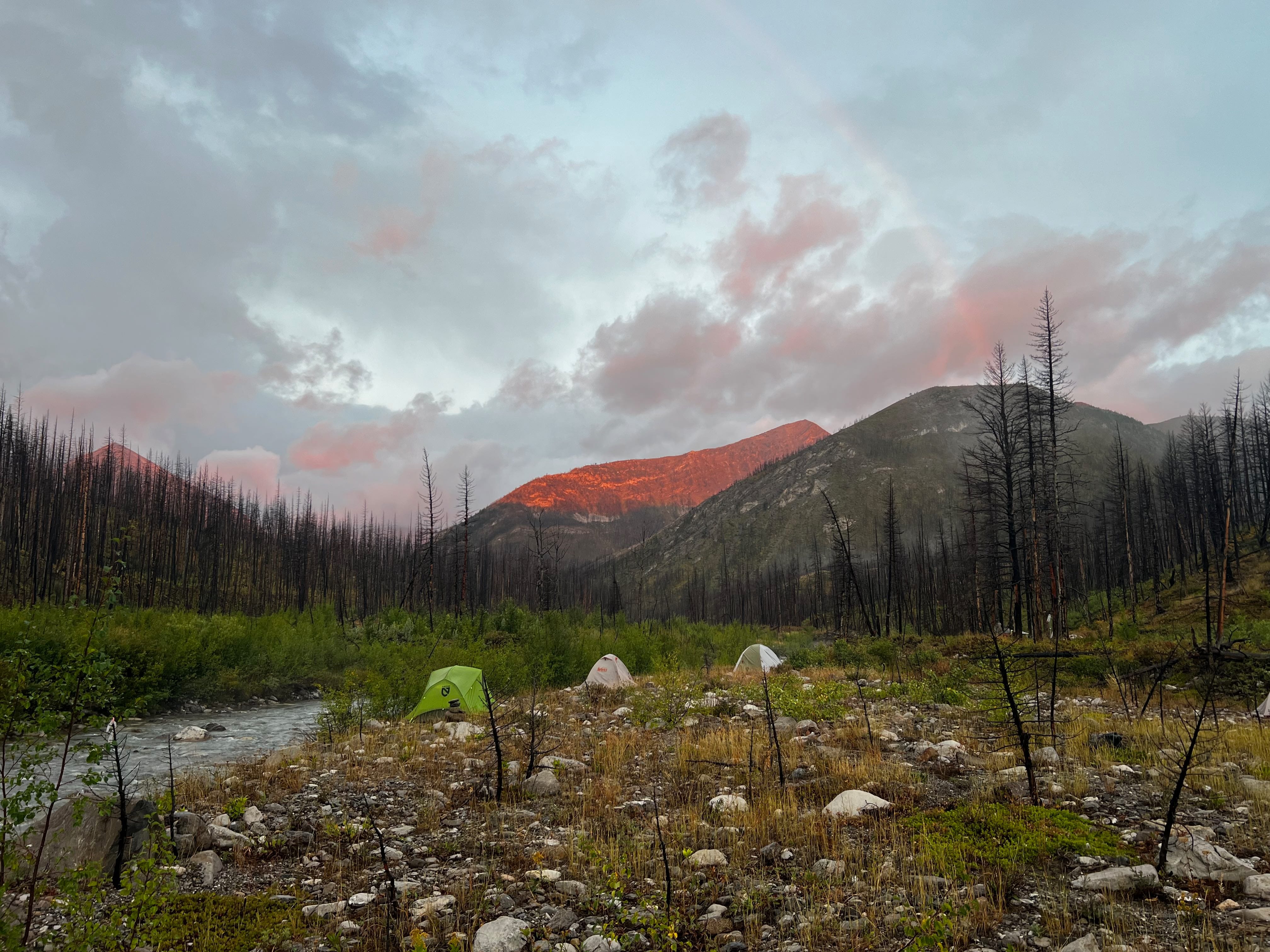
Early morning after nearly 36 hours of rain at North Birch Creek in the Bob Marshall Wilderness near the Badger-Two Medicine, trail crew camp, August 2023 (my tent is the green one)

The following is a reprint of my essay “Trespassing,” published in the Air volume of Elementals, a new anthology from the Center for Humans & Nature.

You can read other republished selections from the anthology by Eiren Caffall in OrionAndrew S. Yang in BioneersRobin Wall Kimmerer also in Bioneers, and register to join the second of five virtual book clubs, with contributors to Air, Vol. 2, Wednesday, February 19th, 6 p.m. Pacific Standard Time, hosted by Point Reyes Books.


It was late September, and the aspen trees were just beginning to yellow. They grew thick on the hillside, a broad grove giving way to small meadows that sloped upward, transitioning after less than a mile to heavy stands of spruce and pine. The group I was with rambled along an old logging road just south of the eastern side of Glacier National Park while a biologist among us talked about the ecotone we were walking through: a mingling of prairie and forest that stretched all down along the Rocky Mountain Front, the eastern-facing slope of the Rockies, where the mountains spill onto the prairie. A light wind blew constantly.

As we left the aspens and walked into evergreens, the wind became a whispering—psithurism, a sound that’s like a rustle and a shush at the same time. That sound characterized almost my entire Montana childhood, but I never consciously noticed it until a few years ago, shortly after moving back to my hometown. One day, a few months into my return, I was walking home through town and stopped to listen to the wind blowing through a stand of tall lodgepole pines bordering the path. That sound, I thought, remembering its company in the Rockies on many a family hike that I had dragged my feet on as a child, and later on treks as a teenager with friends. That sound is home.

***

The place along the Rocky Mountain Front I was hiking that late September day is a two-hour drive east from the valley where I grew up. In another region, it might not be considered anywhere near my home. But this is the American West: expanses are vast, yet their very vastness and sparse human population are part of the intimate familiarity that welcomes those of us who live here. Montana is often called a “small town with very long streets.” The psychological network of what I think of as my homeland encompasses the Rocky Mountain Front. For a white settler like me, a fifth-generation descendant of Montana homesteaders, the question of homeland and belonging is constantly shifting. But there is one constant: wherever my feet happen to be, my heart has always longed to be right here, among the cold mountains and prairie grasses.

Hiking along the prairie-forest ecotone, every aspect of the air felt like home—the smell of pine, the sound of wind in the evergreens, the way the sun was almost warm enough but the air kept me chilled. That same air had wound itself eastward from the valley I live in through a pass in the Rockies and unfurled here, to race down the foothills and speed its way across the prairie and farmland to the little agricultural town of barely two hundred people where my mother is from.

Although I never lived in my mother’s hometown, or even on the kind of spread-out farmland she knows so well, the air of her childhood landscape calls to me almost as insistently as that of the stream-saturated peaks I was raised in: I can smell it now, sitting at my desk on the other side of the Rockies in a mountain valley with its different kind of big sky. I love the way virga strolls across the miles of prairie and farmland like it’s got all the time in the world, how I can watch it for hours, how my skin tightens slightly at the drop in temperature, and how I can still smell the ozone of rain’s promise, with its dust-tang, months later in the back of my nose. I can’t understand why that air also smells like home to me, why I can look at those houses surrounded by thousands of acres of wheat and feel in my gut what it is to be a child growing up with your eyes on that far horizon, nothing between you and the rainstorm but the air and wind who make constant companions. Companions who can issue either invitation or warning, for those who listen closely enough.

There is one stark difference between these places, a difference that I too often take for granted and that most people might not notice: where I live, I’m not far from access to millions of acres of designated wilderness and national forest areas and a national park, places where my feet are as free to roam as the air itself. However, when I go out to eastern Montana, my mother’s home ground, everywhere I turn is blocked by fences. You can drive for hours and see little else but weather-beaten houses huddled together on the prairie, their siding bitten with winter and the fierce, scorching sun of August. These vast counties, where you can drive past more visible wheat silos than homes and only the occasional hawk or pronghorn, are squared out and fenced off with countless miles of forbidding barbed wire.

My body can’t pass through these fences without permission, but the air has no such limitations. It’s a freedom that has an underacknowledged impact: No Trespassing signs are ubiquitous in America (in Montana, Trespassers Will Be Shot is a threat I always take seriously), yet at the same time, air pollution trespasses into our bodies every moment of the day. When I walk around my hometown, it’s impossible not to breathe in vehicle exhaust, especially on days when an inversion layer holds it close to the ground. Out where my mother’s from, on those expanses that feel like they host some of the cleanest, most unadulterated air on the planet, on any given visit I might see a crop-dusting plane emptying loads of pesticide or herbicide over the fields and still smell the strange, metallic tang in the back of my nose the next morning.

Trespass can be turned back on us. With bodies and lungs and circulatory systems porous to the air, neither humans nor the rest of life have much defense against the kinds of airborne attacks that other people have unleashed upon us. And I don’t use the word attacks lightly. Air pollution from vehicle traffic can decrease children’s lung capacity by 20 percent and significantly affect cognition in their growing brains; recently, it has been found that carbon pollution from car exhaust crosses the placental barrier and affects fetal development and even ovarian egg production in women. Living near a landfill raises a person’s risk of lung cancer due to the hydrogen sulfide that’s released from decaying trash. Fully 95 percent of the world’s human population lives with levels of air pollution considered unsafe. Air pollution is one of the leading causes of premature death worldwide.

Without clean air, humans are denied an inherent right to health and flourishing. If billionaires’ dreams of colonizing Mars were ever to be realized, the first mission, the second mission, the millionth mission, the missions for generations far beyond our imaginations would be to secure water and breathable air. Air is so vital that a common right to it was recognized in legal code as far back as the Roman Empire. “The following things are by natural law common [to] all—the air, running water, the sea and consequently the sea-shore,” declared the Institutes of Justinian in 535 CE.1 In 1972, after decades of relentless air and water pollution, aided by political corruption paid for by the powerful men of industry known as the Copper Kings, Montana’s legislature passed a new state constitution that guaranteed a “clean and healthful environment” as an inalienable right, including the right to clean air.

Air is a shared commons: it’s an entity we all rely on for survival, and it moves freely across the world. The air I breathe that smells of dry pine needles and early snow was somewhere else a few hours ago, a few days ago, a few weeks ago. Maybe it was bringing some other hikers the smell of their own woods, or picking up sulfur dioxide, nitrous oxides, and soot from a coal-fired power plant, whose particulates are now seeping into my lungs, unasked for and unwanted on a cool September day. We all depend on and all share the air, and yet the ability to pollute it is treated as a private property right. Legal systems around the world make air the recipient of industrial waste; in turn, that means that all of us are, too. Air knows no international boundaries, and neither does the pollution it carries.

When I think of trespass, what first comes to mind is the Lord’s Prayer, which I recited with my parents and sisters Sunday after Sunday in Episcopal and Lutheran churches, and often around the dinner table, throughout my childhood. The lines “And forgive us our trespasses, as we forgive those who trespass against us” refer not to who crosses whose property lines but to committing sins that the deity has forbidden. The word trespass occurs many times in the New Testament. In some translations it’s replaced with sin or debt.

Trespass, in other words, is a transgression. In the case of pollution, trespass is far more invasive than simply breaking through a property line. If I sneak through my neighbor’s yard to get to the public nature preserve on the other side, I might annoy him, but there’s no actual harm done. If my neighbor burns a pile of tires in that same yard and I don’t go near it, his waste will trespass into my family’s bodies just the same, pouring itself into my children’s lungs with the law’s consent. The polluted air has trespassed into us, but it wasn’t by choice. The first crime of trespass was against air itself. When air has been violated, it is forced to violate in turn.

***

I was hiking along the Rocky Mountain Front in late September 2022 with a group working to stop oil leases in what is known as the Badger-Two Medicine. It’s an area bordered by Glacier National Park to the north, the Bob Marshall and Great Bear Wildernesses to the west and south, and the Blackfeet Reservation to the east. The Badger-Two Med is sacred to the Blackfeet Nation. Under laws written and enforced by the federal government, it’s legally part of the US National Forest Service, but it was carved off of Blackfeet land in 1895, along with the eastern part of Glacier Park, in yet another land seizure accomplished with a deceptive treaty signed under duress, one in a long history of betrayals.

I hadn’t been to the Badger-Two Med before, although I’d been following the oil lease situation—which has been ongoing for nearly forty years—since before moving back to Montana. This was the first time I’d managed to visit it, on a hike sponsored by the Glacier-Two Medicine Alliance, which was founded in the 1980s to fight oil leases granted in the area by the Reagan administration. Most of the leases have been successfully canceled over the years, but in late September 2022, one oil company had just won a court appeal to keep its lease.2

Emerging from the aspen groves and into pines and spruce, my group walked a path that ran parallel to a buried natural gas pipeline; the organizers pointed out where a road to the remaining proposed site of the oil well would be built if the lease were upheld. A few miles further in, we would see a hillside already scarred by preparatory clearing.

It’s hard to imagine a place that feels more like the white European settler’s idea of pristine wilderness. Pristine wilderness and its ideals of unchanging purity have never really existed, of course, but perhaps places like this offer something better: I felt whole on that hillside. The air’s movement and scent felt like a welcome. And even though I know that there is no clean air, really, anywhere in the world—everything from dioxins to Chernobyl radiation has been found in polar ice, carried by the air and dropped even on places where few humans have ever stepped—I felt an extra surge of resentment at the thought of the trespass that would come not just from the physical invasion of an oil well but from the particulate matter, carbon monoxide, nitrous oxide, and volatile organic compounds that have been found in the air around and downwind of oil-drilling operations. At what the air would be forced to carry through no choice of its own.

***

As we walked to the top of a hillside where we could see out toward the plains of eastern Montana, the air shifted from a gentle breeze to a wind traveling east—stiff, but not quite the hard-blowing kind that is almost a constant presence on the wheat and cattle ranches that cover what’s known as the Golden Triangle, the wheat farming region my mother grew up in.

The wind blew the smells of encroaching autumn in my face, dried grasses underfoot and fecund soil under bear-claw-scarred aspen trees. The tiny bit of late-September chill reminded me that snow would be coming soon. There is nothing that smells more alive to me than that air. It feels conscious: the warm pine in summer, the tang of ice in winter, traveling down from these mountains to kick prairie and dirt-road dust in the faces of children growing up in the same tiny town my mother had over seventy years before. The heart that has always insisted on calling this place home, even during the twenty years I lived elsewhere, tells me, quietly, that this air I love in all its moods and seasons is conscious. It has a life of its own and a right to live it unviolated.

The crime of trespass goes both ways—what happens when we require the very source of life to carry sickness instead? Is this not a violation of the gods of life, of home, and of air’s own right to exist?

Acquiescence to the abuse and neglect of air is a trespass against humanity—against all of life, even against the air itself, for its own sake. Every living being has a common right to air that not only allows us to live the healthiest lives we can but also smells like pine and snowmelt, desert dust and prairie flowers, swamp grasses and moss. Air that feels like home.


1

Institutes of Justinian, bk. II, title I, “Of the Different Kinds of Things,” trans. J. B. Moyle (Oxford, 1911), available at https://amesfoundation.law.harvard.edu/digital/CJCiv/JInst.pdf.

2

Almost a year later, in September 2023 just before this went to print, that lease—the last in the Badger-Two Medicine—was bought out and was in the process of finally being retired.

Nothing in Excess

I recently spoke with a class at Michigan State University about walking, health, and cultural views of wellness. As happens during most of my talks with college students, at least one came prepared with a question that left me scrambling for an answer.

Undergraduates consistently show up with a broader range of interests than I find elsewhere—when I spoke at Dartmouth earlier this year, I stopped in the middle of our two hours just to comment that I had never spoken with a group that had such persistent interest in bus systems. It gave me hope, I said, because public transit might seem boring to many people but it’s central to finding ourselves in a cleaner, more just, and less extractive world. At the University of Montana a couple years ago, it was one about propaganda and Mikhail Bulgakov’s The Master and Margarita, which I hadn’t read in years.

During this most recent talk, among several excellent questions was one about the architecture of prisons.

Incarceration and abolition matter to me, but, as I told the student, those subjects are well outside my areas of expertise.

The moment I said that, I paused, remembering a study I’d read very early on in my walking research about psychology, mental health, and architecture. I’d wanted to make more use of that study than I did—my editor was, rightfully, constantly reining in my enthusiasm for straying into research that was, at best, adjacent to walking. In the end, that study only informed one sentence.

I couldn’t remember the details of the study, but managed to scrape a memory that it had said something about how the designs of prisons and schools affect people’s self-perception, along with something that has stuck with me from Jane Brox’s book Silence about the design of a near-silent early prison in America.

What does it do to people, I asked the students, to have every aspect of your life controlled as a constant message that you aren’t to be trusted? Which related to the student’s secondary question about neighborhoods—if you live in a neighborhood that doesn’t have sidewalks or parks, or shade or access to green spaces, or is cut through by a 4- or 5- or 6-lane road and there’s no way for kids to walk to school safely—much less if you live in a region under constant oppression and surveillance, ripped from freedom by razor wire and armed patrols—that’s a pretty strong message about whose neighborhoods and lives are valued, whether by your own city officials or a colonizing imperial power.

Extend that to the criminalization of anyone who can’t afford a home at all, and the message about who matters couldn’t be clearer.

When my literary agent and I were first sending around the book proposal for A Walking Life to publishers, I had phone calls with a number of editors. On one of them, with a publisher that leaned more literary, the editor said, “I could see you know your subject, but I didn’t realize you were a policy wonk.”

It wasn’t a compliment.

That editor wanted the book but wanted me to restructure it as a kind of international intellectual and literary stroll, which was the kind of writing about walking I explicitly wrote my book to move away from. I was tired, and still am, of walking literature being by and about people, largely people of great privilege, wandering the world in their heads. Maybe that’s why I’ve been walking barefoot so much in the last year. I want to feel the ground, not just think about it.

His comment stumped me in the moment because I’m not really a policy wonk. What I thought of—a week after our conversation, of course; I’m a slow thinker—is that there is a difference between being into policy, and knowing your subject well enough to be able to talk about it as knowledgably as possible.

That aspect of writing nonfiction is important to me. I over-research nearly everything I write. It’s absurd. But it matters to me because, when someone has taken the time to read my book or one of these essays or shown up for a talk, I want to be able to respect their—your—time and attention in return. I do that by being as thorough as I possibly can for each aspect of a subject that captures my interest.

When editing my recent piece for High Country News, my focus on centuries of violent rebellions against enclosures of the commons in England came after back and forth with the editors about the current-day relevance of enclosures: when nobility and other landowners enclosed what had been commonly shared and carefully managed land, eviction of tenants, often entire villages of people, was usually part of the process. The Highland Clearances in Scotland is one of the best-known mass evictions in Britain’s history, but millions of acres were stolen and hundreds of thousands of people evicted throughout England before landowners turned their full attention to Scotland.

Mass homelessness inevitably followed, and in the wake of enclosure acts, the government pursued criminalization of being without work and/or a place to live: the Vagrancy (or Vagabonds) Act of 1547, for example, in which any “able-bodied” person who was found to be out of work for three days was to be branded with a V and sold into slavery for two years; or the Vagabonds and Beggars Act of 1494, in which “vagabonds, idle and suspected persons” were to be put in stocks for three days and nights and given nothing but bread and water and then evicted from the town.

“Evicted to go where exactly?” is just as relevant today as it was then. The fact that the Vagrancy Act turned out to be impractical to enforce isn’t the point.

The city of Kalispell, Montana, just a few miles from me and where my father and stepmother live, recently stopped short of pulling the operating permit for my region’s only low-barrier houseless shelter after years of complaints by those who seek to criminalize being without a home; while Missoula, Montana, followed in the steps of many municipalities to make it illegal to camp in city limits overnight.

During a discussion on land ownership and enclosure acts last year, one commenter noted on a section about anti-homeless laws in 1500s England—relating them to the U.S.’s current affordable housing crisis—that, “‘Skin in the game’ counts, while skin itself doesn’t.” People’s lives, in other words, matter less than property values. It matters that this was true during centuries of the theft of the commons, because it’s not new. Like most injustices, it takes different forms, but we’re still living with it.

I’ve read more books than I care to count at this point on land theft and the commons alone for this book I keep promising you all. In every one I learn something new, most of which will never make it into narrative. But I know by now that there’s always a chance that some fact or story that I can pull out of my bedraggled brain will be useful to someone someday, and while I don’t think that makes me a policy wonk, it does give me a lot of satisfaction.

But policy knowledge doesn’t hurt, either. Holding knowledge about walking’s gifts and potential along with knowing about the systems, legacy infrastructure, and ongoing policies—like road designs that are mandated (not just suggested) to optimize traffic flow, even at the expense of healthy ecosystems and human lives—helps me, and I hope helps everyone I share it with. It can be easy to see that a road is unsafe for anyone walking, but you can’t change that reality if you don’t know that federal requirements determine its design. We have to know where the barriers are in order to dismantle them.

Similarly for land ownership and private property: knowing the history of enclosure and rebellions, and the lack of any true foundation for, say, exclusive private property rights in land, matters for how we perceive the paradigms and stories we function within.

Changing a paradigm is hard, involving as it does a massive upheaval of perception and possibility, and especially hard if you can’t see it for what it is. The ancient Greek maxim to “know thyself”—inscribed on the Temple of Apollo—applies equally to knowing the structures that shape our world and our expectations of it. If we want life to count more than skin in the game, more than profit, we have to know what we’re fighting.

Also inscribed on the Temple was the maxim “Nothing in excess,” which, when it comes to research, I’m not very good at adhering to. But then, who defines “excess”? I’ve been reading Guy Standing’s Plunder of the Commons, which turns out to have very little information I need, but even if I never write about the Lauderdale Paradox of 1801, in which James Maitland, the eighth earl of Lauderdale, showed how public wealth decreases as private wealth increases, someday it might be exactly the historical link that someone out there needs.

I don’t generally wonder if the research I do is excessive—I assume it is—but it feels like the excesses of nature: the way I can walk around town right now and eat handfuls of serviceberries, or how there are so many ripe raspberries coming out of the garden that three families can’t eat them all, which means I had enough to make a batch of seedless raspberry jam last week.

The research I do is frequently boring, written as it is for academic expectations and requirements, but it is rarely without some kind of gift, some spillover of story or insight or simple information that makes me feel like I’ve been rewarded. It leaves a richness, and like all true gifts, the greatest pleasure is in being able to share it.

Border, unruly

I used to love crossing borders. When I was young, they smelled of adventure and exploration, of languages I hadn’t learned and could tune my ear to, of foods like a book to be tasted instead of read. I still remember the first time I managed to say “thank you” correctly in a small town in Turkey; and plunging my wrists one summer day under freezing cold fountain water on a hill outside of Budapest, where the heat felt like it might crush me and our friends woke us daily with tiny glasses of espresso and brandy.

To hand my passport over to a border agent once brought a tiny thrill. To a person brought up in a small Montana town where daily rhythms were determined by the train howling nightly as it passed by the Con Agra grain tower and the church bells I sometimes got to pull after Sunday school, borders were to enter a world unknown, a world made large.

Borders haven’t felt like that in a long time. When my spouse and I prepared to move to Australia from Austria, I was 22 years old. We spent exhausting hours at the Australian embassy in Vienna filling out forms and answering questions and submitting to lung X-rays to check for tuberculosis and compiling massive customs forms in two languages for our scant two boxes of belongings. We flew out on my 23rd birthday, which in Australia time had already passed. My spouse had a job in Sydney, which was why we were moving; my first three months in the country were a slog of employment applications and residency requirements and trying to find out how to get a birth control prescription. Living there had its wonderful moments—most of them spent in the ocean—but they were despite the border and residency struggles, not because of them.

I have just spent the last few days in Canada, where some longtime friends and I cross-country skied and cooked for one another. I have lived in proximity to this border, between America and Canada, for almost the whole of my life. The closest crossing to me is an hour’s drive from my home, and I’ve driven over it so many times it’s as familiar as the footbridge I usually take to walk into town. It wasn’t that long ago—only decades, and what is that in geological time? not even a fingernail’s worth—that other friends and I would get the idea to go to Canada at some stupid hour of the night just to jump into a lake we liked visiting. We didn’t need passports back then, and the border guards were mostly bored.

Going to and coming back from Canada last week involved little stress. We presented our passports or passport cards. I as the driver answered questions about alcohol, drugs, tobacco, and weapons in the negative or semi-negative as not all of us are non-smokers. Our carful of white mothers in their forties was waved through easily. 

And yet even to me, there was nothing about this interaction that didn’t put me on edge, nothing about it that didn’t remind me of threat, of what can be denied. If not denied to me personally, to plenty of other people who have just as much right to traverse this man-made barrier just as much as I do. 

The entire interaction of crossing the border, beginning with the slowdown to the border gates and the scramble of finding passports, and through the questioning that brings up vivid memories of previous border crossings involving full-on stripped-out car searches and quizzes split between me and college boyfriends about what color our toothbrushes were, makes obvious the crushing power of borders. These are arbitrary yet all-powerful creations of nation-states, creations that have no recognition from water, air, rock, or wildlife, yet maintain the say of life, death, or the birthright of wandering that belongs to every human being even if it’s denied—they have the power to strangle our travel, our relationships, our communities, and our work. They impart the conviction that anyone on one side of a border or another has the power to judge, to condemn, to dispense death. 

My friends and I were just going cross-country skiing as part of a tradition to celebrate one person’s birthday. What if we’d been fleeing genocide? What if our entire personhood were suddenly made illegal? 

My paternal grandparents were Jewish people in the Russian empire, subject to strict rules about religious and cultural practices, limited work opportunities, male children’s compulsory conscription into the military (as young as the age of 9 depending on the tsar), and, like in much of Europe, forbidden from owning land. Not to mention being confined to living in shtetls within the borders of what was called the Pale of Settlement. My immediate family history is defined by who is allowed to live, work, travel, and wander, where

To show my passport and be waved through a border says everything about the kinds of freedoms I have, and how easily they could be taken.


Borders are psychological, emotional, and physical. I don’t publish fiction because I attended a hyper-competitive MFA program where other students and at least one professor persuaded me I had no talent for fiction. I know this is an idiotic way to let my life be determined, but I haven’t had the time to counteract the effects of the snobbery and need to tear people down that were pervasive in those fiction writing workshops. This is a border I mostly created and maintain myself. I will dismantle it when I have time.

Borders are social and cultural. When I enter a mosque or a Russian Orthodox Church, I cover my hair. When certain people come into my home, I take down and hide the sign above the coffee grinder that reads “Keep Your Fucking Shit Together” because I know it would offend them. I don’t walk through other people’s yards even though I don’t believe that private property boundaries should exist. 

My views on the importance of free speech are boundaried by the reality of its lack for the half of my family living in Russia, but also by an understanding that words can cause just as much harm as physical violence, a perspective that puts me strongly at odds with an absolutist view of free speech. (I wrote about my town’s experience with neo-Nazi troll storms, including some of the messages I received personally and what effect it had on me, here. I wouldn’t usually urge people to go read something like that, but in this case, if you haven’t, I actually think it’s important.) 

I am, for some masochistic reason, a moderator on my local NextDoor, which is peppered with decisions and behind-the-scenes debates often determined by my own borders about what should be allowed, and what should be removed.

My stepbrother and his family weren’t able to come camping with us this last summer because they are Russian and can’t readily leave a country that’s been waging war on a neighboring one. They can disagree with the war all they want, but the border created by geopolitics doesn’t care what they think, or desire, and it’s illegal for them to say anything about it publicly. These are very different kinds of borders with vastly different consequences. Not all of them require a passport; many of them still require a form of passing, or of shaping oneself to accepted expectations.

One of the books that I’ve learned most from over the past few years is Harsha Walia’s Border & Rule. Since reading it, I’ve watched several of her online presentations and webinars, and am often inspired by her expansive view of what borders are, what they do to us, and how dismantling them requires also dismantling the systems of oppression that they enable, as she wrote about in this interview:

“A no border politics is expansive. It includes the freedom to stay and the freedom to move, meaning that no one should be forcibly displaced from their homes and lands, and that people should have the freedom to move with safety and dignity. Those two freedoms may seem contradictory, but actually they are necessary corollaries. The crux of a no border politics is nestled in the broader politics of home. How do we create a world where we all have a home?”

It’s an answer to something brought up repeatedly in Karl Widerquist and Grant S. McCall’s book The Prehistory of Private Property. The essence of freedom is contained in the answer to one question: Can you leave?

Can you? Can I? Could I just pick up and walk north until I reach the border and then, like the rivers that run down from Canada full of selenium pollution from coal mining, ignore it? The answer is no, obviously, and it might serve us all to ask more frequently why not.


When I lived in Austria, I had to apply for a meldetzetl, a residency visa for foreigners. To get it, I had to go to a special foreigners’ police station. I had lived in the country for two months and had been taking intensive German lessons for two weeks. I arrived in good time for my appointment, only to find that nobody there spoke English, or in fact any language other than German. At the foreigners’ police station. The officers ridiculed and belittled me in words I barely grasped, and told me to come back with a translator.

I wasn’t a middle-class, middle-aged white woman at the time. I was 22 years old and had used my last speck of savings from waiting tables to pay for a root canal at the dentist. But I was still a white woman in a country that at the time was extremely racist toward anyone not obviously white. I was scared and sad, but had a multi-lingual friend, also a white woman, who worked for the BBC and came back with me to translate and also threaten the police with press exposure if they didn’t follow their own damn rules. I got my residency visa purely because of her.

Within a couple years after the September 11th, 2001, attacks in New York City and elsewhere, my spouse and I were stopped about 70 miles from the Canadian border. My spouse, who only applied for U.S. citizenship a few years ago, is English. Our friends who were going hiking with us were also stopped. The wife was American, while the spouse—one of my husband’s oldest friends—was from Northern Ireland. We were taken to an immigration center, sat down with a whole lot of other people, and told in no uncertain terms that the males of our parties, the non-American spouses, could be deported immediately because they weren’t carrying their identification and green card papers.

The border agents were dead serious and it was scary as hell. Close to that time period, a colleague of my spouse’s avoided her own husband’s deportation by moving back to her country of birth—she was Japanese and her spouse was Italian; the renewal of his U.S. residency visa had been denied and for neither of them, suddenly, was it easy to live and work on land where cranberries grow and turkeys roam wild and where they had employment. The land had no judgment of them, but the political regime most certainly did.

I look back on all of these interactions, and more, like the innumerable run-ins I’ve had with the police in Moscow trying to get a bribe out of me or the stories I’ve heard from a local border patrol agent we used to be friendly with, and see a world laced with borders. Borders that are not, as Harsha Walia wrote, “fixed lines simply demarcating territory. They are productive regimes firmly embedded in global imperialism, and border controls exist far beyond the territorial border itself.”

Coming back from Canada, my friends and I passed several herds of grazing bighorn sheep, and slowed for a flock of pine grosbeaks (I think) reluctant to leave the road. We got through border security easily, drove forward, and then paused to debate if we were allowed to go back and ask the guard about using the bathroom. We were allowed, but sat there for a minute literally asking one another, “Do you think we’re allowed to go back and ask him?” with an undercurrent of uncertainty and fear created on purpose by the psychological architecture of the place. 

Borders are physical, social, cultural, and emotional, but what they are most is a form of power. When I hand my passport over, it’s with the knowledge that my freedom to go, to wander this Earth and love it freely, can always be denied. 

A world of boundaries and respect, but no borders, could truly be one where traveling smells of freedom, a world that can be read and known through our footsteps, the only true book, one to be experienced rather than read, and whose air shifts like poetry as we traverse every curve of her spine.


The Doctrine of Discovery’s Disastrous Legacy

If you don’t know much about the Doctrine of Discovery and want to learn one thing of true importance this year, I’d make it that. You can start with any one of the resources linked to below, or Mark Charles’s powerful TEDx talk on the doctrine and the false message in “We the people.” 

The doctrine is not ancient history. It’s a subtly hidden 500-year-old idea with tremendous and lasting global power. It takes the “I took it; now it’s mine” underpinnings of ownership further to “I saw it; now it’s mine.”

You can also read two of the original papal bulls (translated from Latin) comprising the doctrine for yourself, as well as a translation of Bull Inter Caetera of 1493 with introductory commentary from the Doctrine of Discovery organization:


“The captivity of individualism in the West leads many to reject the possibility of institutions and systems inflicting social harm that requires a social response.” 
Unsettling Truths: The Ongoing, Dehumanizing Legacy of the Doctrine of Discovery, by Mark Charles and Soong-Chan Rah

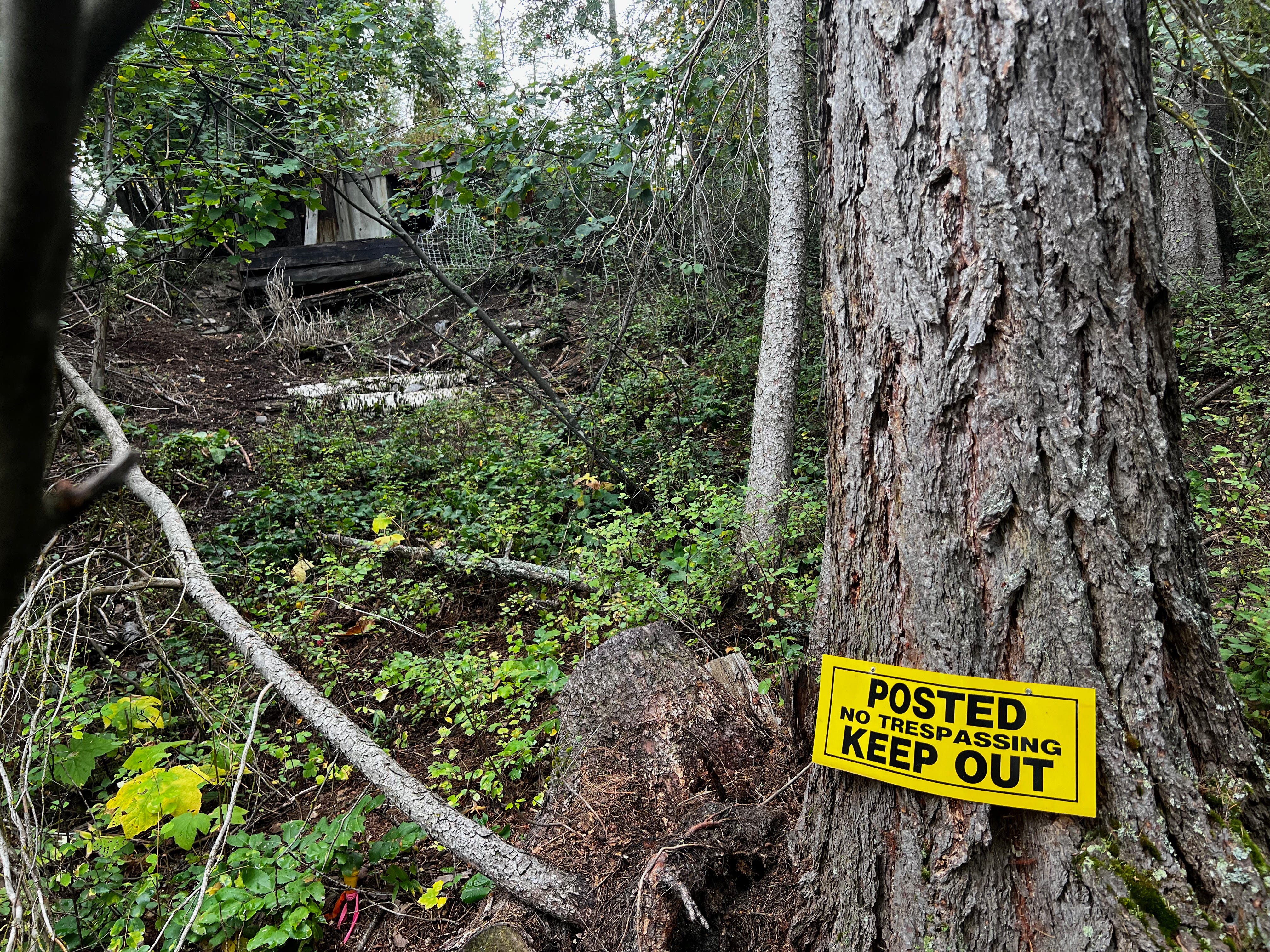
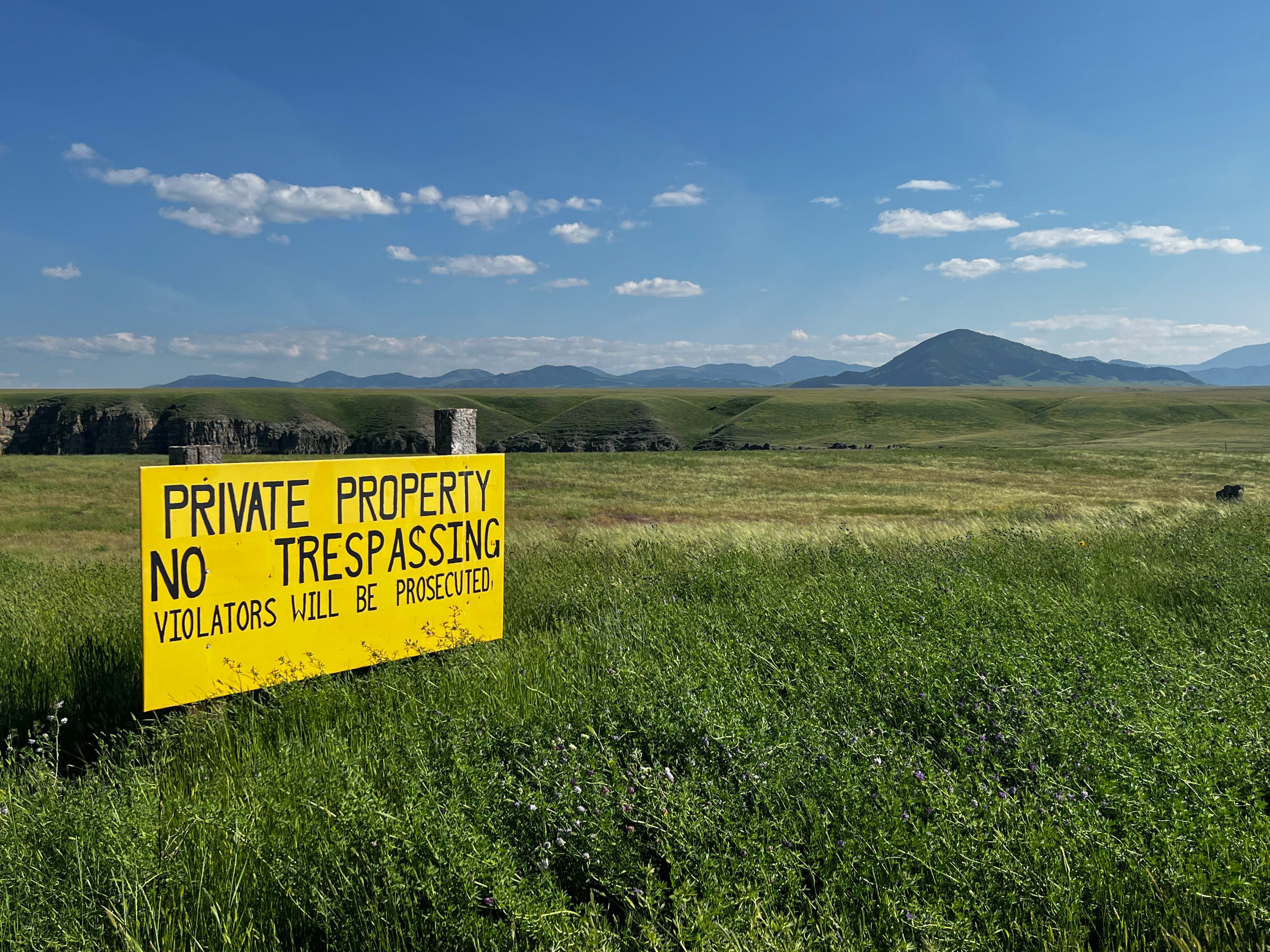
Do you ever wonder how land comes to be privately owned? I wonder all the time. It’s the whole reason for this newsletter. I’m interested in other forms of ownership, too, but it’s land ownership that gnaws at me day in and day out. How can you wander at will, let your feet roam, if your path is constricted by roads built to serve cars on one side, and “No Trespassing” or “Private Property” signs backed by laws made to serve landowning classes on the other?

Living in North America in particular, both the sense of entitlement that comes with owning land, or property in general, and the recency of those ownership titles make the question of “How did this land get turned into real estate?” a sharp one. Considering the shape and flavor that predominant American history narratives tend to take, it’s curious that very few people who live on this continent, in this country, have any idea of the answer.

The Doctrine of Discovery, which was articulated and hardened into U.S. law through the 1823 Supreme Court case Johnson v. McIntosh, is not the basis for all private land ownership, which began centuries, if not millennia, earlier. I’m writing No Trespassingbecause I’m interested in that older, deeper question of ownership. But the doctrine has been adapted to enable colonial land theft throughout the world over the past 500 years, and continues to form the basis for injustices related to land and resource rights—putting the desires of an oil pipeline company over the health of a river, for example.

Sarah Augustine, author of The Land Is Not Empty and co-founder of the Coalition to Dismantle the Doctrine of Discovery, summed up the doctrine as having “legalized the theft of land, labor and resources from Indigenous peoples across the world and systematically denied their human rights” for over five centuries.

The “doctrine of discovery” is a set of papal bulls issued in the 1400s, in which the then-pope gave official Catholic blessing to Portuguese and Spanish monarchs wishing to claim land they’d “discovered,” as well as all of that land’s resources and people. A pope issues a declaration or bull today in the 2000s and much of the world might not notice, but in the late 1400s the Catholic Church in Europe was nearly all powerful. These documents gave express permission for the thefts, oppressions, and genocides that the monarchs of Spain and Portugal were already eager to pursue. Bull Romanus Pontifex, wrote the introducers to the Papal Encyclicals translation,

“is an important example of the Papacy’s claim to spiritual lordship of the whole world and of its role in regulating relations among Christian princes and between Christians and ‘unbelievers’ (‘heathens’ and ‘infidels’). This bull became the basis for Portugal’s later claim to lands in the ‘new world,’ a claim which was countered by Castile and the bull Inter Caetera in 1493.”

The first bull was Dum Diversas, issued by Pope Nicholas V in 1452 on behalf of King Alfonso of Portugal. The second, also for Portugal, was Romanus Pontifex of 1455, granting King Alfonso the right

“to invade, search out, capture, vanquish, and subdue all Saracens [the word used for Muslim people at that time] and pagans whatsoever, and other enemies of Christ . . . and the kingdoms, . . . possessions, and all movable goods whatsoever held and possessed by them and to reduce their persons to perpetual slavery.” 

In other words, it granted the king of Portugal the right to appropriate all said kingdoms, possessions, etc., that Alfonso’s representatives happened to come across, and convert them to the crown’s own use and profit, including people. 

Bull Inter Caetera was issued in 1493, using similar language to grant the monarchs of Spain ownership of around half the world. No matter who was already living in lands they came across, the representatives of Spanish and Portuguese monarchs had official church license to claim them—and the military backing of their respective countries—on behalf of their kings and queens.

It’s vital to understand the Doctrine of Discovery’s impacts—not just the bulls’ contents or their contemporary effects at the time, but the way the doctrine shapes our world today. In the introductory episode of the Mapping the Doctrine of Discoverypodcast (created by Indigenous Values Initiative), the hosts said that,

“The Doctrine of Christian Discovery is essentially the key to understanding so much of what ails us today in the world. The Doctrine of Discovery is quite simply the Doctrine of Christian Discovery—that is, the relationship between how religion justified and encouraged the taking of lands by European monarchs and the Vatican from Indigenous peoples around the world,”

along with the claiming of resources and permission to extract, and carte blanche to commit genocide of and enslavement over any non-Christian peoples, as long as said lands weren’t already “owned” by a Christian prince. 

Inter Caetera was issued shortly after Spanish (formerly Aragon and Castile) monarchs Ferdinand and Isabella had funded the heavily indebted merchant Christopher Columbus’s explorative journey across the Atlantic Ocean. By all accounts deeply devout Catholics, Ferdinand and Isabella had only just reclaimed the kingdom of Granada from the Muslim empire, and in 1492 had ordered the expulsion of all Jewish people from Spain following the edict known as the Alhambra Decree. (I recommend Patrick Wyman’s book The Verge for an in-depth and readable history of this time period.) Their rule was a project of brutal conquest and Christianization at almost any cost, a project and brutality Columbus was heavily involved in.

The power granted and emboldened by these documents cannot be overstated. As I said above, land ownership and land theft didn’t start with the doctrine, nor were they limited to Portugal and Spain—the Charter of the Forest pertained to English land enclosures and rights of the English commons starting in the 1200s—but they empowered a hyper-driven and even more violent colonialism through holy decree. With the pope’s bulls in hand, the representatives of Spain and Portugal undoubtedly felt that their god was on their side.

The “Doctrine of Discovery” found its name through references in later centuries’ legal cases—most famously Johnson v. McIntosh, in which Chief Justice John Marshall slipped in “civilized” to equate with “Christian” and wrote that discovery of land was equivalent to ownership of it. For European nations embarking on a project of discovery and conquering, he wrote,

“it was necessary, in order to avoid conflicting settlements and consequent war with each other, to establish a principle which all should acknowledge as the law by which the right of acquisition, which they all asserted, should be regulated as between themselves. This principle was that discovery gave title to the government by whose subjects or by whose authority it was made against all other European governments, which title might be consummated by possession. . . . 

the rights of the original inhabitants were in no instance entirely disregarded, but were necessarily to a considerable extent impaired. They were admitted to be the rightful occupants of the soil, with a legal as well as just claim to retain possession of it, and to use it according to their own discretion; but their rights to complete sovereignty as independent nations were necessarily diminished, and their power to dispose of the soil at their own will to whomsoever they pleased was denied by the original fundamental principle that discovery gave exclusive title to those who made it.”

“Discovery gave exclusive title to those who made it.” Therein lies the Doctrine of Discovery’s origin story, and that entire passage will break your brain if you think about it too much. 

It should break your brain. If you got on a boat tomorrow and sailed around on whatever ocean is closest to you, and came across an inhabited island you’d personally never heard of, you might be able to tell yourself you’d discovered it. If by “discover” you simply mean you saw or observed or found something new to you, by all means, go ahead and say you discovered something.

Does your sight of that land, your “discovery,” go further? Does it give you rights of ownership over the island and its people? Why wouldn’t you say they discovered it first, since they’re living there? 

But maybe there’s gold, or timber, or cinnamon trees—something you want to make money off of, which you can only do if you claim the island and everything and everyone on it as yours to control. You have to come up with some reason why you, and not the people already living on the island, have the right to benefit from what it offers. “Discovery” must be mangled to mean something more than it does. It must equate to possession. 

So you make a ruling that you’re more “civilized” than the people of the island and therefore your discovery has weight while their being there, their existence on the island, doesn’t. You come up with a doctrine that gives rights of ownership not to the people inhabiting a place but to the most recent person to come across it: you. And you back that ruling with military force. 

This precedent is still being used. It was referenced in a U.S. Supreme Court decision denying sovereignty to the Oneida Nation in 2005, which was defended on the basis that invasion and colonialism were part of history—done with, in the past, supposedly—while at the same time referencing a doctrine that continues to do harm through legal opinions like this:

“Under the ‘doctrine of discovery,’ . . . ‘fee title to the lands occupied by Indians when the colonists arrived became vested in the sovereign—first the discovering European nation and later the original States and the United States.’ . . . 

standards of federal Indian law and federal equity practice preclude the Tribe from rekindling embers of sovereignty that long ago grew cold.”

In other words, the “discoverer” of land retains the ownership right to it, no matter who was there first, or whether or not land ownership existed as a system before the “discoverer” landed there, or even how extensively and violently the Oneida Nation’s sovereignty rights had been suppressed over the last 200 years. 

That’s a legal opinion not even 20 years old that relies on the idea that “I saw it; now it’s mine” is a justification for ownership but that already being there isn’t. In his TEDx talk on the Doctrine of Discovery, Mark Charles said that it was “quite possibly the most white supremacist Supreme Court decision written in my lifetime. And it was written and delivered by Ruth Bader Ginsburg.”

Johnson v. McIntosh stated outright that Native Nations could not own land; only European nations—and after them the United States—could. Part of that 1823 opinion contains the following baffling language: 

“It has never been contended that the Indian title amounted to nothing. Their right of possession has never been questioned. The claim of government extends to the complete ultimate title, charged with this right of possession and to the exclusive power of acquiring that right.”

That language is all the more baffling because there is a long history of treaties defining coexistence, and even of land purchase transactions of a kind in some places, during the centuries of European presence in North America before the United States existed. Though it’s not so baffling when you consider that John Marshall, who authored the opinion in the case, was himself a well-known land speculator. He and his father owned vast tracts of land, and anything the Supreme Court decided about land ownership rights would directly affect Marshall’s own fortunes.

Legal cases like this one are a reminder that, just because a law exists and can be enforced, doesn’t mean it’s just. If the right of possession had never been questioned, as Marshall claimed, then why was it overthrown simply because a European happened to land on a continent they’d never seen before? 

The role of Christianity, and the power of Christian nations, can’t be ignored in the doctrine’s formation. Johnson v. McIntosh didn’t refer directly to the papal bulls giving rights of ownership to discovering Catholic nations, though as legal scholar Peter d’Errico has written, Marshall “was undoubtedly aware of them.” Those bulls never applied to England (which hadn’t been a Catholic country since the 1530s), but England’s rights of ownership were fused with its own Anglican brand of “civilized Christianity.” In 1578, Sir Humphrey Gilbert was granted a charter from the English crown authorizing him to 

“discover and take possession of such remote, heathen, and barbarous lands, as were not actually possessed by any Christian prince or people,” 

and the Cabots were granted a similar charter in the decades after that. 

The first episode of Mapping the Doctrine of Discovery laid out the entanglement of missionary Christianity with the belief in entitlement when it comes to Christian (and eventually white, European, etc.) claiming of resources:

“The Johnson v. McIntosh decision, in which the doctrine of discovery was essentially moved from this Catholic principle of land-taking, conquest, and domination, into a Protestant state-building contest. . . . At the time, Catholics and Protestants literally hated one another. They were killing one another. But on this issue of Christians appropriating everything non-Christians had, they agreed on that principle. After it becomes this principle of law, of property, then this becomes literally the law of the land in U.S. property law. Every law student during their studies is introduced to the Doctrine of Discovery.”

The Christian foundation of the doctrine is why the Coalition to Dismantle the Doctrine of Discovery, whose founders are Mennonite,

“calls on the Christian Church to address the extinction, enslavement, and extraction done in the name of Christ on Indigenous lands,”

and it’s why the authors of Unsettling Truths do the same. Co-author Mark Charles is Navajo and a Christian pastor, both of which are central to his values and worldview. 

Last spring I attended a day-long webinar on the international consequences of the Doctrine of Discovery, with presenters from the U.S., Finland, South Africa, India, and New Zealand, among other lands. Steve Newcomb, author of Pagans in the Promised Land, showed how almost every current battle in the U.S. between resource extraction and rights of land and ecosystems, such as Standing Rock, can be threaded through legal precedent to end up back at Johnson v. McIntosh

Former Chairman of the Yakama Nation JoDe Goudy shared the Nation’s statement that

“. . . the religious, racist, genocidal, fabricated doctrine of Christian discovery . . . the legal fiction that Christian Europeans immediately and automatically acquired legally recognized property rights in our lands upon reaching the Americas . . .

This doctrine of domination and dehumanization—Christian discovery—is not welcome within Yakama Territory, and should no longer be tolerated in United States law.”

The doctrine’s effects are vast. Johnson v. McIntosh gave justifying language to anyone in the world who wished to perpetuate the project of colonialism: take the land, claim ownership over it, and profit from the gifts it holds, no matter what the consequences to anyone else.

These documents are important. They’re important historically because of what they set in motion as European empires spread out across the planet. They’re important because, through the U.S. Supreme Court, they gave license to ever more ravenous land theft in 19th- and 20th-century North America, and were then referenced for similar ambitions throughout the world. 

And they’re important because their influence still defines relationships of colonialism today. They’re one of the bases for nearly every claim of absolute land ownership or property right—gold or lithium mining in a place where people have relied on a healthy ecosystem for millennia, for example—and are much of the reason that it’s so difficult to defend the rights of life and well-being over the right to extract and profit. 

I’m reminded of a recent interview with physician and sometime-activist Gabor Maté, in which he said to his interviewer, 

“You know what [the Canadian government] hasn’t apologized for yet? We have not apologized to Indigenous people for taking their lands and their resources and their forests and their rivers and their oceans. Why haven’t they apologized? Because they’re still taking it.”

“I saw it; now it’s mine,” backed by the violence of state power, justified that taking, and with it came sets of values over how land, food, water, and everything else is used, shared (or not), and cared for (or not). The doctrine carries within it a hunger for profit and a near-obsession with the right to wring dry every drop of life itself in the pursuit of wealth. Along with more ancient systems of power and hierarchies, it defines how humans are allowed to survive in and relate with our world. We still live under that rule, and while a few benefit from it, none of us can be protected from its effects in the long run. 

Prosecuted under whose authority?

Co-imagine the future

We had fresh snowfall recently, which was sadly washed out by rain for the next several days, but before it went I took a long walk around town to soak it all in. Look at that light! The photo brings out the blues, but in person it was more shades of gray with blue tint, and this light is precisely why gray is my favorite color. The clouds, the river, the flat light on the snow, the rocks in the riverbank. The way a splash of indirect sunlight gives all of it depth.

It’s hard to believe this river was a Superfund site not that long ago, that its waters were siphoned off and temporarily drained to allow a massive cleanup from a century of contamination from the rail yard. A friend of mine says that when her parents were growing up, the river used to catch fire.

I spend a lot of time thinking about that kind of contamination, what property rights allow and what they steal from the rest of life. But just as often, the beauty of this river snags me, pulls me to pause and sit alongside, dangle my feet in her gentle current. When there’s yet another leak from the rail yard that requires quick containment and a warning to people to stay clear of that area, it’s a reminder of how precious it all is, how easily these gifts are used up and discarded. Yet with a change in perception and a clarification of what we value, it’s just as easy to respect and care for them. The more people I listen to, the more it’s clear how many yearn for a reality that reflects those values. They just want to know how to get there.

For the next few weeks, I’m going to be republishing some older essays. There are many more people subscribing than when I started this newsletter over three years ago, and I wanted to share revised and updated essays that directly speak to what this whole project is about: ownership, private property, the commons, and the book I’m working on. These essays will go out as emails and comments won’t be enabled, but you’re always welcome to email me. I’ll try to continue adding an audio version to each post.

So far I’ve chosen essays from 2020 and 2021 on the East India Company and the dangers of corporate monopoly combined with state military power, the Doctrine of Discovery, an essay on loneliness that feels somehow timely again, and one on dirt, soil, and commodification. Anyone who’s been reading a while, if there’s one that stuck in your mind, feel free to make a recommendation. 

I’m going to start with an essay that was in the winter 2014 issue of the small literary journal The Jabberwock Review. It’s never been published online. It’s a personal essay about a snowstorm in 2010 that brought home my own dependence on fossil fuels and roads, and was probably what got me started thinking about both car-dependence, and therefore walking, and private property. 

Last week I attended a webinar recommended by subscriber Chad, who writes the newsletter Scientific Animism. It was given by designer David Dylan Thomas and was titled “No, Seriously, F*ck Engagement: Building a More Human Web.” It was billed as being for designers, which I am not, but it was really about capitalism, the insanity and injustices of the systems we live under and the stories that perpetuate them, and what people can do within their own work to forward a more humane world. It was uplifting, challenging, refreshing, and left me with more tangible optimism than I’ve had since attending the Reclaiming the Commons conference last summer. 

Thomas ended with some advice about identifying our own values as well as identifying and challenging our assumptions—which reminded me of what one of my mentors told me over a long phone call after I got my first book contract: identify your biggest assumption (about walking in my case) and push at it from every direction you can think of. 

Thomas went one step further from that, and I want to leave you for now with his words, one of the more solid pieces of advice I’ve heard in a long time:

“Co-imagine the future with the people hurt by the present.”

I imagine each of us walks with that idea very differently. What do those words mean in your own life?

May you and the weather find peace with each other, wherever you are.

This light!