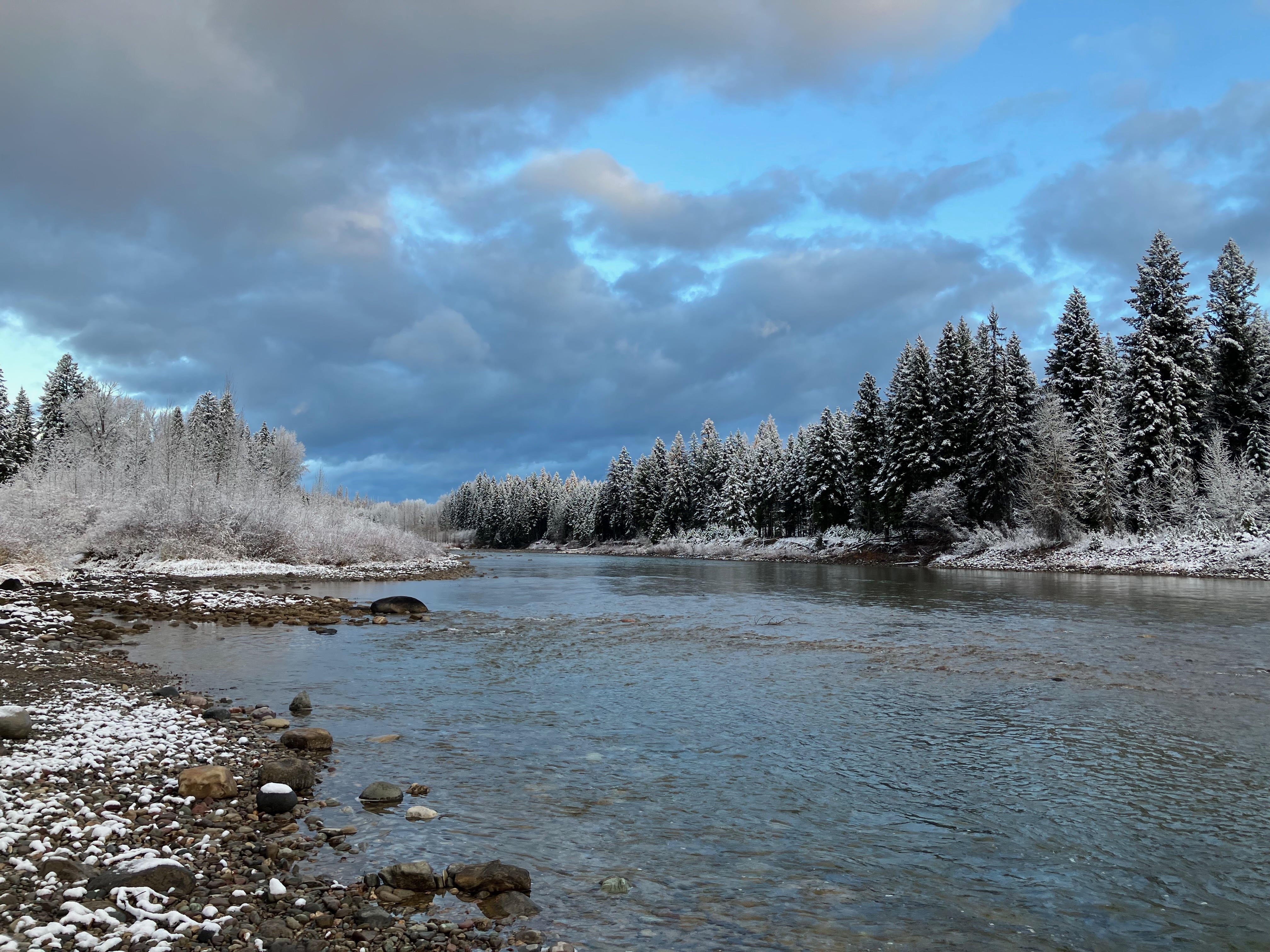
The North Fork of the Flathead River, northwest Montana.
A few days ago, I was sitting by this river, near a U.S. Forest Service cabin where I went recently for a sorely needed offline, off-grid, off-network recalibration. It’s been too long since I sat in the woods by myself for a few days.
Late October, the larch trees have yellowed, turning mountainsides bright and the woods full of unexpected sunshine even on gloomy days. Larch in autumn is a spirit-lifter, an anti-demon spell, a joyous shaft of light when the world is shifting dark.
It snowed the first night I was at the cabin. I trekked down to the river carrying my coffee the next morning before sunrise, happy despite knowing that in my rush to pack water, food, sleeping bag, and books, I’d grabbed a coat too thin and decided against snow boots—a mistake and I knew it, as the hole in the sole of the thin canvas shoes I’ve been intending to replace reminded me.
Ravens flew down the river and high above the trees, more than I usually see at this place. I could hear more further off in the woods and wondered what was keeping them so social. I wondered that for the next three days and never got an answer. They sounded not anxious exactly, but somewhat like me getting my stuff ready to stay in the woods and my kid packed up to stay at their dad’s: busy, harried, organized but frazzled.
The river at that spot is wide, its rapids gentle but the rushing tumble of water strong enough to be heard a long way off.
I watched some rapids tumbling around opposite bank from where I sat, the burble and leap over hidden rocks tricking my mind into thinking they looked like two otters playing in the water.
Wait, I thought. Those are two otters playing in the water.
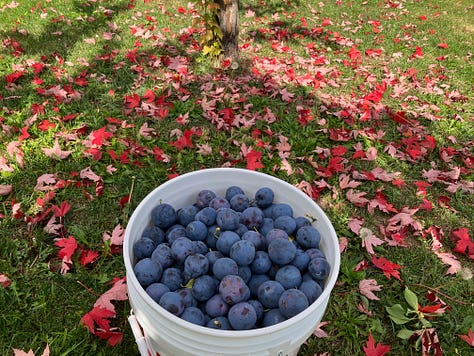
I recently spent several days pitting, pureeing, and dehydrating a vast amount of plums picked from a friend’s trees—trees so heavy with fruit that after an hour of filling my bucket, the branches looked untouched. My friend had already picked and dehydrated his own many batches of fruit leather from his other trees, which ripen earlier, but I’d been too busy with the rest-of-life, the crises and plans and bureaucracies and commitments that translate into too little time in the garden and out foraging.
But this one bucket made it into my home, my fingers purpled dry by the slicing and pitting and feeding to the blender—a many bladed monster that, as I texted to the friend I’m renting a furnished house from, looks like something from a horror movie.
In the kitchen now is enough fruit leather and dried apples—from another friend’s August generosity—to see my kid and me through the winter if we’re not too greedy.
How does one get that way? Too greedy. Or perhaps the question is, how does a human, or a whole society of humans, lose perspective on what is enough?
From fruit to food
I recently finished Caroline Dodds Pennock’s book On Savage Shores: How Indigenous Americans Discovered Europe, and in it Pennock described briefly the value of cacao beans in Mesoamerica in the late 1400s and early 1500s, which were a form of wealth: a turkey egg or avocado could cost three beans, a small rabbit thirty.
Only the very wealthy could feast with gourds of cacao to drink; when resource-hungry European people came, claimed, and took, they took so much that even just reading about it felt like watching land being actively drained of life: gold, emeralds, brazilwood, cacao, people.
And yet, as many Indigenous people of the time noted after having spent time in the “noble” houses of Seville and Lisbon, no matter how much wealth was siphoned from their homelands, it did nothing to change the circumstances of ordinary European peoples. The poverty of the majority of people’s lives was often remarked on, especially when contrasted with the opulence of royalty and their hangers-on.
How much is enough?
What breaks a belief in kinship and reciprocity—how does one lose the knowledge that it is mutual care, not taking more for ourselves, that gives the best assurance of security?
I’d like to have a functional health care system that doesn’t bankrupt people, and to not worry about food and housing, but beyond a certain point can’t imagine an amount of money that would replace the kinds of relationships woven among people, and between humans and ecosystems, inherent in nature sharing gifts so wealthy that even multiple families can’t use them all—like my friends’ plum and apple trees, or the potatoes and strawberries I grow, or the wild huckleberries throughout the nearby mountains—and in people sharing them with one another.
Maybe “enough” is forever undefinable, guided only by that clear thread of relationship and reciprocity, of what keeps life life-ing.
There were in fact two otters in the river. I watched them for a long time, absolutely filled with delight. They tumbled and rolled upstream, all along the far shore, their sleek bodies and tiny whiskered heads popping out of the water every few seconds, their slim tails flying up to dive back down.
I wanted to step into my real skin, like a Selkie, and swim across the freezing water to join them. I wanted to not feel the frozen ground so acutely through my thin-soled shoes, to be indifferent to the bite of chill wind through my inadequate coat. I wanted to dance a song to Moon that night and to know each Raven by name, and to soar with the Bald Eagle who circled over the river downstream, toward the new-snowed mountains.
I wanted these minutes to be my entire life. I was, in fact, greedy for them to last forever.
Welcome back to On the Commons! For those of you who are new here, On the Commons is a newsletter exploring ownership and its inevitable injustices, investigating centuries of philosophical and legal arguments made in defense of private property for a much simpler explanation: theft. Or in other words, “I took it; now it’s mine,” and the consequences both large and small for our shared world.
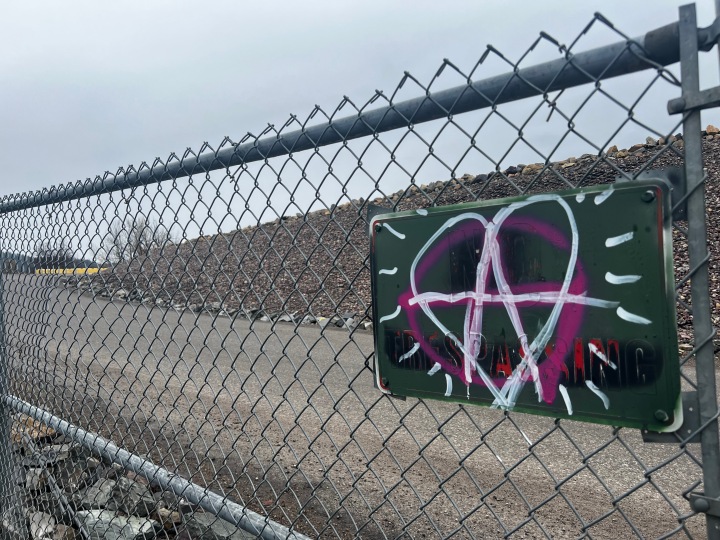
Both top and bottom photos are of No Trespassing signs on the fence of land owned in my town by the Burlington Northern-Santa Fe railway company.
The Boston Tea Party is one of the defining stories of America’s founding as a nation. I remember learning about it year after year in school in the 1980s. Probably every American kid does. What was never said in those scrappy little classrooms across Montana is that the story of the Boston Tea Party is also one of the sharpest tools wielded in defense of the mythologies that make up the American ideal. The fact that it was an illegal riot that destroyed private property doesn’t just get glossed over; it’s never presented that way, not in the U.S. anyway. To present it that way would fly in the face of the American ideology that private property is bedrock. Instead, the story is presented as noble: the little nation that could refusing injustice imposed by a far-off monarchy.
What also gets glossed over is that the impetus for the riot wasn’t simply taxes; it was taxes imposed by government in order to benefit a private corporation.
The struggle over taxes in the British colonies of North America had been ongoing for years. The tax on tea, however, had a second purpose besides enriching King George III: the British Parliament wanted to keep the tea tax as a symbolic acknowledgment that the government maintained its right to tax the colonies, but they also wanted to help the East India Company claw its way out of debt. The story of the Boston Tea Party, the real one, points to the longer history of government enabling corporate power and profit until it essentially becomes an arm of the corporation itself.
The East India Company had its own private army. It in effect controlled all of India at one point, nominally representing Britain’s interests but serving its own.
Swarnali Mukherjee has written extensively in Berkana about what the British Crown and the East India Company’s actions meant for the economy of India. I encourage you to read the entirety of her essay on this subject, to understand the importance of the point she makes:
“The construction of railways was funded by Indian taxpayers, and the economic benefits often flowed back to Britain in the form of profits pocketed by British shareholders. The total wealth drain of India under British rule, in today’s value is an estimated $45 trillion.”
“The EIC remains history’s most ominous warning about the potential for the abuse of corporate power — and the insidious means by which the interests of shareholders can seemingly become those of the state. . . .
For just as the lobbying of the Anglo-Persian Oil Company was able to bring down the government in Iran and United Fruit that of Guatemala in the 1950s; just as ITT lobbied to bring down Salvador Allende’s Chile in the 1970s and just as ExxonMobil has lobbied the US more recently to protect its interests in Indonesia, Iraq and Afghanistan, so the EIC was able to call in the British navy to enhance its power in India in the 18th century. And just as Facebook today can employ Nick Clegg, the former UK deputy prime minister, so the EIC was able to buy the services of Lord Cornwallis, who surrendered Yorktown to Washington.”
It’s a long but excellent article (and unfortunately I think now paywalled), detailing the Company’s permission to wage war, and instances of forced privatization across the world at the Company’s behest. It also points to England having isolated itself from the rest of Europe due to wars over religion (I assume the author was referring to the abandonment of Catholicism and establishment of the Church of England) as a factor prompting the country to look for markets outside of Europe, a vital ingredient for colonialism:
“The English were forced to scour the globe for new markets and commercial openings further afield, and to do so they had no compunction but to use, for the first time in history, unbridled corporate violence.”
One of the questions I keep asking myself is if government, of almost any form but particularly of the nation-state, has always existed to serve private interests. Its main claim to enforcement of law is a monopoly on state violence, most often employed in the name of protecting private property, rather than protecting citizens from harm.
This is obvious when you look at laws and police actions against something like constructing an oil pipeline. The pipeline is private property built in pursuit of profit; therefore, it qualifies for legal protection from the state even though it threatens clean air, water, and soil—even if it takes others’ private property in turn. The U.S. government’s power of eminent domain, after all, was first used for private gain when railroads were being built across the continent, and has continued to be wielded in the name of private profit ever since—the Supreme Court decision in Kelo v. City of New London (2005) and the Pennsylvania District Court case granting eminent domain to a pipeline builder over the objections of a family of maple tree farmers in 2016 are only very recent examples of a longstanding pattern.
What to do about it is another question. Even democratically elected representatives are eager, as we see all too clearly every day, to promote corporate interests over that of their constituents if it assures them a safer and longer place in a seat of power. We need democracy and the right to vote, but those tools aren’t enough to assure a livable planet and lives of dignity. They are necessary conditions, but not sufficient.
There’s a tendency to just say, f— it, burn it all down and start over. But that’s been done more than once throughout history, in several places within living memory, and all it results in is a lot of suffering and the same cycles starting over again. It’s as if there’s something broken at the center of humanity, or at least a sizable portion of humanity, and we’re never going to find a better way to live together until we clearly define the shape and scope of that brokenness. As long as we* accept structures that prioritize private profits over life and health, pollution and structural injustice is all we’ll get.
If I believed in the devil, it would be someone in a sharp suit promising me two or three generations of decent jobs in exchange for the water, soil, and air I depend on, with the added bonus of sacrificing my kids’ health and senses of themselves as free human beings. It is the purest kind of evil to smile and hand out some cash while snipping the threads that link us to life.
The stories we tell and accept about ourselves and others have tremendous power. If we can change the stories, maybe we can begin to change something about our lives.
Instead of trying to burn it all down, plenty of people focus on building from the ground up—better systems, better ways of doing and being and living: this profile of a local food and farm co-op in Washington is a reminder that even when things feel like they’re falling apart, there are people and networks all over the world trying to piece them back together. Montana’s Alternative Energy Resource Organization (AERO) has been working against corporate agriculture for decades, from lobbying for a different kind of Farm Bill that works for people and food rather than commodities, to producing the bulk of the country’s organic lentils and heirloom grains like kamut. Oakland’s Unity Council has also been working for decades on affordable housing, higher-quality food access, and integrated public transportation in Fruitvale, one of the city’s poorest areas.
There are plenty more. I’m reminded of these organizations and people every time I work on a story about urban planning, affordable housing, or pedestrian advocacy. They are everywhere. They just never get featured on cable news or the podcasts of so-called “thought leaders.”
Changing our systems to serve people involves all of these efforts. And they don’t have to be scaled up—they have most power and efficacy when they stay connected to a particular place and community. Instead of scaling up small, workable, place-based systems, we need to take out the support systems that keep oppressive conglomerations afloat, from tax subsidies to weak interpretation of anti-monopoly laws (which should always include what monopolies truly cost life). And of course to change the way a large percentage of human beings see themselves as co-existing with the rest of life, which is no small task after millennia of negating and oppressing this reality.
During a recent U.S. election cycle, my state elected a governor who ran on the tired trope of lowering taxes, “creating jobs,” and being a successful businessman. People in my state are actually very good at “creating jobs.” Small business owners sometimes feel as common as pine trees. Many of those jobs—upwards of 70,000—are dependent on a healthy commons in the form of clean rivers full of fish and public lands that provide the kind of solace and clean air that no job could touch.
It’s often hard to get people to acknowledge the existence of these jobs and the kind of healthy shared commons that make them possible because our idea of a “job” is so starved of meaning and hamstrung by identity and self-perception. (Journalism jobs have fallen by 65% in the last 20 years, for example, while coal jobs have fallen by 61%, but we don’t hear much about the former.) Working in a lumber mill is a job; working as a fishing guide is, too, but also somehow isn’t the kind of job you’re talking about when you’re voting for “job creators.” Real jobs means lumber mills, slaughterhouses, car factories, oil pipelines, tech engineers. It means hundreds of people, massive profits for the bosses, and a no-holds-barred attitude when it comes to environmental destruction. Maybe it’s the type of job or maybe it’s the number of people employed at each operation, but there are plenty of small businesses that somehow don’t count when it comes to political rhetoric.
This is just a story we’ve been told, one that people then tell one another. But we are capable of telling different stories. We just need more people doing so, and then acting on them.
The East India Company and various colonial governments were very effective at telling stories. They’ve left legacies of imperial pride that still resonate and warp people’s thinking today, and blind us to the dangers of corporate power. As that Financial Times article pointed out:
“We still talk about the British conquering India, but that phrase disguises a more sinister reality. For it was not the British government that began seizing chunks of India in the mid-18th century, but a dangerously unregulated private company headquartered in one small office, five windows wide, in London.”
The company did so with the support of the British Crown, and when the EIC was facing further debts from their activities and obligations worldwide, the Crown stepped in once again to help them recoup losses through a monopoly and tax on tea in what they saw as their “possessions” in America. To quote from the Boston Tea Party’s own museum:
“The British East India Company was suffering from massive amounts of debts incurred primarily from annual contractual payments due to the British government totaling £400,000 per year. Additionally, the British East India Company was suffering financially as a result of unstable political and economic issues in India, and European markets were weak due to debts from the French and Indian War among other things. Besides the tax on tea which had been in place since 1767, what fundamentally angered the American colonists about the Tea Act was the British East India Company’s government sanctioned monopoly on tea.”
The East India Company is one of many lessons throughout history of the dangers inherent in encouraging the mutual support of corporate and state power. There are countless examples to explore, like the land stolen throughout North America and given by the U.S. government to railway companies, with profits for the railway and timber industries continuing even to the present day. The timber company Weyerhaeuser, for example, first bought 900,000 acres from the Northern Pacific Railway in 1900, and now profits off of not just the trees grown on land they own, but on the land itself, which the combination of state and corporate power has turned into “real estate.”
Phrases like that—“real estate”—carry their own stories, their own burials of what land has been, could be, and is.
We can change what we believe, starting with what we think we know about history and the real, live world around us. We can tell better stories about what is possible and what we’re capable of. We need to, because corporate growth and greed will not stop taking and commodifying and destroying all that makes life worthwhile, nor will it stop fabricating stories that make vast numbers of people believe it’s inevitable, unstoppable, and probably for the best. We need more stories, better stories, and we need them everywhere in hopes that those stories can, over time, change what is.
Change takes a lot of time and a lot of work. We can start by finding and amplifying as many instances as possible of people doing real work in real communities to make their worlds better. We can commit to finding, and believing in, different stories—the ones that make us realize a different world is possible, and then making it probable.
*“We” is a word I frequently stumble over and have begun to specify more clearly since this piece was first published. Fundamentally, I think English just needs a different word, or a few different words, to bring about more nuance when talking about societal thinking that shouldn’t be characterized as “us vs. them” while also finding ways to make it clear who is meant by every varied instance of “we.”
On the Commons explores the deep roots and ongoing consequences of private property, commodification—from the Doctrine of Discovery to ancient enclosures of the commons, and more—along with love for this world and being human in the middle of systems that often make such “being” difficult.
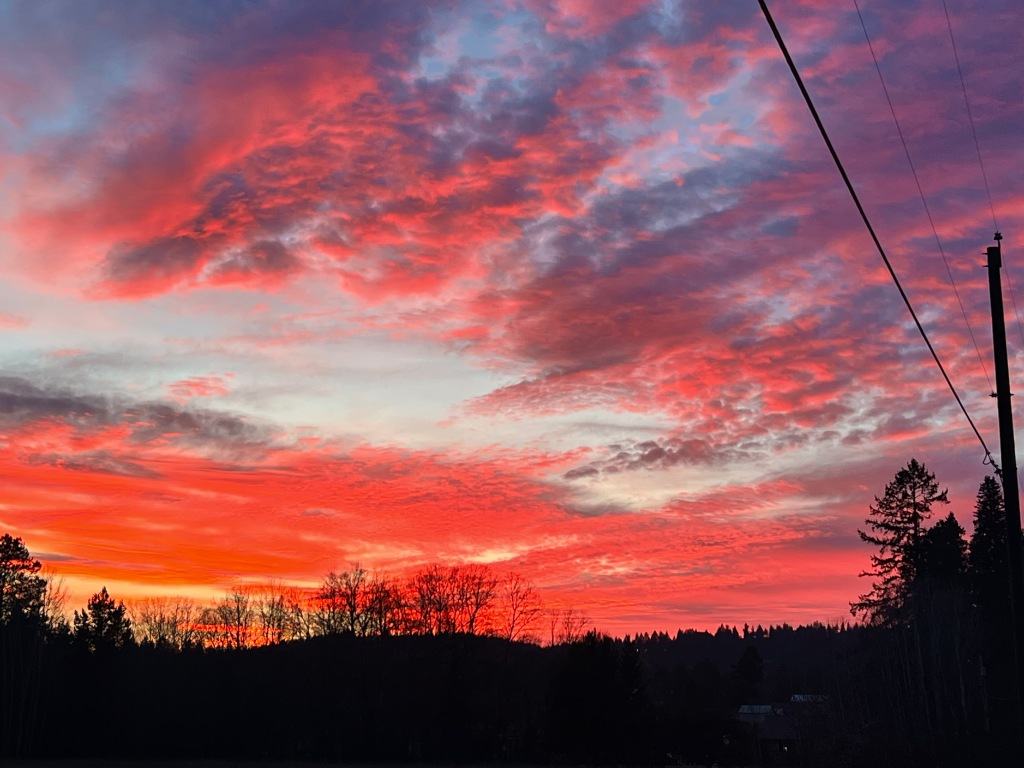
Alpenglow-lit clouds at sunset, above the western peaks of Glacier National Park.
Last August I wrote about my time on a volunteer trail crew in the Bob Marshall Wilderness here in northwest Montana, about the river we camped next to and the trail we worked along, what it means to serve land and try to build a relationship with both river and Earth, and how, when I’m in areas where I have no phone or internet access, time itself becomes fluid.
“To sit on a charred log eating trail mix and hearing nothing but air in the foliage-less trees and a persistent woodpecker somewhere out of sight. To watch the light shift along those mountainsides. To spot snowberries and poke at the masses of Oregon grape, and to watch a river that slips through the valley like time itself.
Or it might be that time is slipping through us like the river. That’s what being out there does for me: it turns time into water.”
I felt that again last week, during my three nights at a U.S. Forest Service cabin I like to stay at by myself a couple times a year. This cabin is near the North Fork of the Flathead River, and ever since I started staying there a few years ago, I’ve found myself spending less and less time working and much more time hanging out with the river.
This trip, I intentionally brought very little work with me: Chapter 1 of No Trespassing, which I’m sorry to say I’m unsatisfied with, a couple of books to read, a raw essay draft I’ve been sitting on for over a year, and some half-baked ideas.
I touched almost none of it until the day I had to leave, and was okay with that. Instead, I devoted chunks of the afternoons to sitting by a fire, and otherwise spent hours by the river. A couple of hours before and after sunrise, coffee in hand, another hour in the evening to catch the alpenglow, and at least a couple hours in the middle of each day, when the sun was just hot enough to keep me from going hypothermic after (probably stupidly but I can’t help it) dipping in the freezing water.
A boulder under my head, I lay there listening to the water and an occasional robin, blinking at a dusky daytime crescent Moon in the northeast and Sun at a complementary angle, both high in the sky. Sometimes Canada geese flew over. Sometimes a thought passed through my head that I could, or should, go back inside the cabin and do a little work. I told the thought to gently carry itself off downstream.
To be completely at peace with that spot, occasionally asking the river a question, makes me wonder if it’s something of what place-time and space-time feel like if we could ever fully shake off imposed structures of time, deadlines, progress, and profit enough to find these moments of simply being. I feel like I got a hint of it there during those hours by the river, what it might be like to be wholly alive in a world that itself also feels whole, and there was—and is—nothing I want more than to stay within that awareness.
For a few hours last week I was able to fully release anxieties about being productive, getting work done, earning a living. Bundled up against the temperatures near freezing, lying on a bed of river rocks, listening to water flow—it was like a recuperation regimen for the mind. It didn’t feel lazy. It felt necessary.
In their book The Prehistory of Private Property, authors Karl Widerquist and Grant S. McCall repeatedly go back to the main difference that they see in a private property society versus one where private ownership of, say, land, much less water and food, is unknown: freedom to leave. That is, if you want to walk away from your people, or your place, can you do so and still support yourself? Can you walk away and find or make food, shelter, and clothing? In non-private property societies, the freedom to walk away and still live just fine is the norm. In private property societies, it’s almost nonexistent. You have to work to make rent. Land-rent, you might call it. Someone else owns the land, and you have to pay to live on it.
The extent to which this reality runs counter to most of our existence, even if we’re just counting the few hundred thousand years that Homo sapiens have been here and not the millions of years of hominin evolution before that, is mind-bending. There have been territories and civilizations and controlling empires for thousands of years all over the world, but for most of our species’ existence, most humans had some kind of freedom to live on, with, and from land without needing to pay someone else for the privilege of existing. Until relatively recently.
We can’t all spend our time as we would wish not just because capitalism allows a few humans to hoard an increasing amount of money and power, but because the planet’s dominant societies force land to be privately owned, and make access to food and clean water something we have to pay for. Priscilla Stuckeywrote a beautiful and very informative piece about the bizarre concept of land ownership recently:
“It’s a strange idea if you think about it, the idea that we can own land. Because land is not like, say, a shirt or a table or other objects we own. Land is something else altogether. Land provides the material that makes the shirt. Land grows the trees that make the table. Land brings forth everything—all our food, all plants and animals, all the forests and creeks. And us! Land has brought us forth too!
So it’s absurd to think that we could ‘own’ land.”
Around a year ago, I wrote about this same cabin, and explorations of time and attention, and how much I truly like working, how I could spend hours losing myself every single day in writing and research, and even copy editing work.
“I like other kinds of work, too, like chopping wood and digging in the garden and pulling knapweed and spending whole days hunting in the freezing rain, or hiking miles to spend a couple hours picking berries and then processing whatever I’ve brought home or gathered from the garden, thinking about what’s needed to get my family through the winter and early spring.
I do those things because I enjoy them and can make the time for them, but the reality is that as long as a few people at the top of the capital pyramid keep sucking up the richness of the world, including human labor and time and ingenuity as well as land and what are called ‘resources,’ none of those activities will ever amount to much more than hobbies, even for me.”
Add to that the question of land access. We have to pay to live on land, and at the same time people with far more money and resources can buy and cut off access to the lands where berries, roots, animals, free-flowing water, and trees exist. Can you walk away and survive has become, for me, a key question of freedom. In a world where you have to pay rent for your footsteps, freedom isn’t possible.
During these times when I run away from the online world and my domestic obligations, I’ve become accustomed to waking up in the middle of the night and spending some time with the stars. They were at their brightest this last week. Nights so clear it was like I was breathing a poem of air, and, with Moon setting earlier, the starscape hovered low, rich and full, our galaxy’s path clearly visible and the sky so transformed I wondered if, if every human could see the sky like this every night, smothered in starlight, we could all remember what it is like to walk among a living spirit world.
I met up with a friend a few months ago who has been through significant trauma, and now runs trauma workshops and mindfulness training. We were talking about grounding, and I told her I’d realized recently that when I feel out of whack and need grounding, the only thing that works is to put my bare feet in running water, no matter what the weather. “So you find grounding in flow,” she said.
I love that. Flow is where I ground myself, and it’s this river that has taught me that lesson most often. We should all have access to food, shelter, air, water, and medicines, but we need this, too: the freedom to find what brings us closest to home, to our selves.
I take gifts to the river when I go, and to the creek that lies hidden behind the cabin. No matter what I bring them, or how much of my coffee I share in the mornings, it never feels like enough for what I walk away with. All those hours by the river being reminded: you are alive, with all that could possibly entail if we had both the courage and freedom to embrace it, draw it into ourselves and walk out into the flow of existence we live in, remembering that time, and this water, are one and the same.
A Walking Life starts with what mainstream news sources call a “refugee crisis.” I don’t like that term any more than I like the term “migrant”—I love the richness that words hold, the worlds they carry, but their ability to flatten is equally powerful. These are shorthands that limit how we think about one another: a crisis of refugees, or a crisis for people who’d been forced to become refugees?
The story was one that dominated news headlines in 2015: people fleeing war in Syria, on foot, stuck for a time in Hungary before being allowed to cross the Austrian border and on into Germany. Vienna, Austria-based BBC reporter Bethany Bell, an old friend of mine, was reporting from the border, where she sent me pictures of the piles of abandoned shoes “worn-out and inadequate to the monumental task they were being given,” I wrote. “In between interviewing refugees, Bell took pictures of bedraggled shoes and a prosthetic leg abandoned on the pavement. Another pile of donated shoes waited to be put to use.” In her interviews, she found an unexpected sense of hope, and, she told me,
“‘for me there was something deeply human in it. For all the things we create for ourselves, the homes we build, the lives, sometimes you just have to walk away.’
Walking is both our first step and last resort when fleeing war or persecution. A refugee doesn’t have the luxury of restraining his step with respect to political margins.”
Journalist Kathleen McLaughlin wrote recently about the line a lot of us living in . . . let’s say “politically challenging” places hear on a regular basis: why don’t you just leave? Which not only, as she points out, ignores financial and other constraints, but also, as she also points out, ignores the reality that harmful or violent politics don’t stop at borders.
The spectrum of who flees, who’s forced out, who’s being put at grave risk by staying, and who stays to fight no matter what the cost, is vast. It’s determined by factors that accumulate and pull on one another and is, in the end, beyond anyone else’s individual judgment. Not everyone can leave. Not everyone is allowed to stay.
All I can personally say is that the story of whether or not one leaves a home, and how, and what level of choice is or is not involved, is the story of humanity. It is in this particular story that my writing about walking and my interest in private property intersect most profoundly, and in ways that often surprise me.
A couple of weeks ago I came across an article some of you might have seen, about a database compiled by The Atlantic of the books used to train generative-AI systems. I figured my book had to have been used, along with the 20 years’ or so worth of writing I have online, since last winter my spouse put my name into ChatGPT and said, “Look! It can write an essay in your style!” (This conversation did not go well, though I think we eventually got to the point of me being able to explain why the last thing in the world I want is a machine to do my writing for me, especially one that’s stolen my work to do so.)
Sure enough, A Walking Life is in the database. It winded me a bit to see it verified.
To be clear, the copyright issue is the least of my concerns. If you want to go to a local library and photocopy every page of A Walking Life and pass it around to people who want to read it, I’d actually be thrilled. That is, after all, how my father and his family read Solzhenitsyn in the Soviet Union, though photocopiers were highly controlled and only in government offices and a bureaucrat risked his life to get those stories out into regular people’s hands. The more copies of my book are purchased, in whatever form, the happier (theoretically) my publisher is and the better chance I have of selling them or someone else on another one, but it’s far more important to me that people read it than that those reads show up in the graph provided for me in my publisher’s author portal.
It’s a completely different thing to have a multi-billion or -jillion or whatever-dollar company steal my work and then use it to both make more profit for itself, and to put other writers and artists out of work.
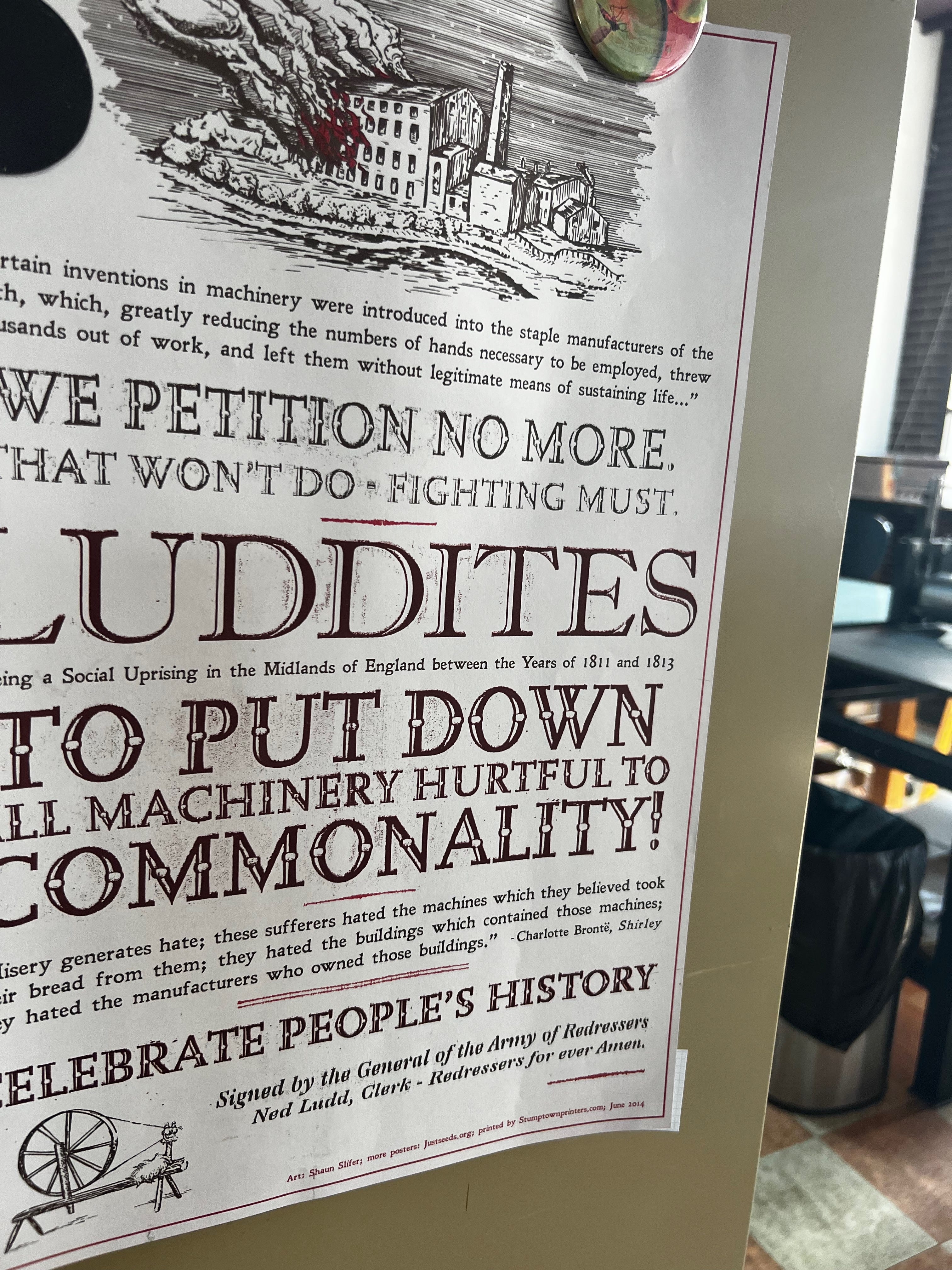
It’s also impossible to disentangle complaints about AI and other digital tech from the long history of technology being used to deliver more profits to a few, steal masses of people’s labor, and provide lower-quality services and products to people paying for them, along with building unjust and destructive structures that humanity and the rest of life simply have to live with going forward as best we can. Roads, highways, and automobiles are the examples I usually bring up but there are plenty of others. In A Walking Life I wrote about the Luddites, who are usually characterized as anti-technology but weren’t that at all. What they objected to was being forced out of their jobs—with no compensation or safety net—by machine adoption that made more money for the factory owner while also producing shoddier products.
It’s not about whether technology exists or not. It’s about how it’s used, its effects on people and ecosystems—the energy and water consumption of AI and data centers is absolutely staggering—and whether its role in the world is to contribute to life’s well-being or make it worse.
“The planning structure always fits well into the needs of the powerful,” said physicist and technology philosopher Ursula Franklin in a series of 80s-era lectures (undying gratitude to Jake for sending them to me; they’re amazing). “It rarely fits well into the needs of the powerless, and that is where the struggle sits.”
She gave that lecture long before talks of artificial intelligence became rampant, but whether we’re talking about AI, highway systems, railways, or the mills and machines that powered the Industrial Revolution, her questions hit home:
“Do people matter, or are people in the way? The technology will come once we make the decision whether indeed people matter or whether they are just in the way, and you design more and more stuff to make more and more people unnecessary, unneeded, and redundant. Don’t ask what benefits. Ask whose benefits, whose costs.”
The theft of my book, which took years of research and writing to produce, hasn’t done anything to improve my life, and I doubt it has anyone else’s, but it’s certainly contributed to someone acquiring just that bit more wealth, which can then be used, as wealth always has been, to tip the scales of injustice a little bit more in their favor. My cost, their benefit. That is what enclosure is, both historically and currently: taking that which was in use by all or already belonging to someone in one form or another, and making it your own for the purposes of private profit.
Neither I nor any other writer or artist has been given a choice in the matter, nor can we disentangle ourselves from the systems we’re being frog-marched into, not unless we give up creating entirely. And I can’t think of a single writer I know who would even consider that. We create because we can’t help it, because it brings us joy, because to not do so would be to flee one of the things that makes us feel most alive.
“There is no reason,” I wrote in A Walking Life,
“why our online lives can’t be used as a tool to enrich our restored communities, no reason why we can’t recover from the flu with some good friends bringing us soup and others bolstering our spirits through Instagram.”
Which, in my feverish and brain-fogged state when I came down with Covid last week—a week after getting a third booster shot!—I was delighted to notice was exactly what happened: A friend came by and left a jar of soup and some leftover huckleberry galette by my door. My brother-in-law offered to drop off more turkey broth. Another friend brought me groceries on her way home from work at the rail yard and included a bar of nice chocolate she knows I like.
And then a friend online, whose newsletter Berkana is one of the most beautiful and thoughtful on Substack, sent me a short video of someone making turmeric chai that was so soothing to listen to and watch I let it loop several times before realizing it was something I could actually do (the brain fog of this virus is very, very real for me). So I made some and drank it and did so again in the middle of the night when I couldn’t sleep, and you know what? I felt better the next day!
A Walking Life is about a lot of things, but at its core it’s about being fully alive beings on a fully alive planet. Walking leads us into every one of these subjects because walking is how we evolved. From the perspective of evolutionary biology, it’s what makes us human. And it’s what can shine a light most clearly on the barriers that have been placed to prevent our full exploration of that humanity.
The Authors Guild, of which I am a member, has filed a class-action lawsuit against several of the companies who’ve used published books to train AI. I gather some of the basis for the complaint is that the content was scraped from a site of pirated works. I’m curious where the lawsuit will lead, though it’s currently only for fiction and I’m not going to get too hung up on its potential. For nonfiction writers and others not immediately affected by the lawsuit but whose work is in the database, the Guild encourages us to write letters to the companies involved and provides a form for that purpose.
Which honestly made me laugh. I appreciate the thought but have better things to do with my day than beg any one of these enormously wealthy and powerful people to please not steal my work to make themselves richer. I can spend that time making more turmeric chai, for example. Or sewing up the hole in my kid’s blanket. Or writing a letter to my county commissioners about their gutting of the county library system, which I doubt they’ll care about but at least they’ll read (maybe). Or I could go for a walk.
These huge, systemic problems can’t be solved by piecemeal approaches, and in any case my focus is on the deeper structures that make the harms possible. Technology has been used both to improve human and non-human life for millennia, and it has been used to control and destroy it far more often. It depends on who benefits, who pays the costs, and who decides.
Perhaps most damaging of all, it’s been used to determine what we think we can imagine: a way of being in the world and living together that’s not determined by the control, power, and ownership of a very few. A world where food, shelter, health, soul-fulfillment, relationships, and even the joyful gifts of creativity are not dependent on tricking us into thinking we can only succeed in competition with one another.
I want us to unburden ourselves at the very least of restrictions around what we conceive as possible, and to contemplate a world where leaving means to wander freely, rather than being forced to flee—whether on foot or in the worlds of our own imaginations.
Someone’s been updating the No Trespassing signs on the fencing around the rail yard in town.



 Antonia Malchik