I am incredibly grateful to the Dear Butte board for granting me a residency with them this year. I’ll be in Butte, Montana, in June, working on No Trespassing. I’m mentioning this mostly because the residency requires a community engagement aspect (which is such a cool idea for a residency), and what I’m working on will be—I hope—a walk through Butte led by a local (not me), with discussion of how communities can center and frame their collective stories, and that’s something I’d love to see considered everywhere. This idea came from a middle school photography project presented a few years ago here in Whitefish. The essence is that national and international media usually tell one story about a place and people, often a misleading one. How, in contrast, would the people in that place themselves represent their stories? It’s not exactly a new idea, but it’s good to be reminded that those who don’t know your place and people don’t get to define who you are. Maybe you can run with it where you live. Or where you spend time. (How does this change in communities whose members are physically distant, or mostly online?)
July 9–12 the international Reclaiming the Commons conference (hosted jointly by the Association for the Study of Literature and Environment [ASLE] and The Association for Environmental Studies and Sciences [AESS]) will be held in Portland, Oregon, and I’ll be there giving a presentation on using narrative to reframe understanding of the commons. Not sure exactly what that will look like, but it will be similar to how I approach science and research-driven nonfiction writing. I am very, very excited about attending this conference. They haven’t even built the full schedule yet and it already looks amazing.
The Threadable reading circle on Land Ownership will be wrapping up soon, though the discussions are always ongoing.
I’ve agreed to do a second reading circle and am going for something still related to this commons/ownership work but from a different perspective: Science Fiction, Fantasy, & Belonging. We’ll be reading science fiction, fantasy, and speculative short stories that bring to life a sense of home, belonging, and identity. I haven’t chosen the readings yet, but the authors whose stories I’m tentatively choosing from include several of my favorites: N.K. Jemisin, Cherie Dimaline, Nnedi Okorafor, Hao Jingfang, Octavia Butler, Rebecca Roanhorse, and Anjali Sachdeva. I’ll provide links when the time comes!
It’s bitterly cold here in northwest Montana. I hope you’re adequately sheltered, wherever you are, and finding ways to take care of one another.
“Some things just ain’t easy to repair The person who came here was broken Can you fix it, can you care?” — “What They Call Us,” Fever Ray
Last month I pulled a very sad box out of the garage. Three sad boxes, actually, one of potatoes and two of apples, but the box of potatoes was the saddest because those came out of my garden. I spent most of a warm-enough autumn day last year sitting in a shady patch of grass brushing dirt off of each one, and here they were frozen and thawed and beginning to mold.
We got about halfway through the potatoes by January, but the bizarre weather pattern of deep, intense cold followed or preceded by days of warmth and rain were too much for my careful winter packing to contend with. Ditto for the really excellent apples I’d bought from the seasonal produce stand near the airport. Only managed to eat half a box of those and the rest had to go out to compost.
Which means that one of my projects this year has to be figuring out better storage for the potatoes, apples, and onions (most of the onions did okay, but I think that’s because we used them up before they thawed again after freezing). I was prioritizing building a small greenhouse, since the seedlings struggled so much last year due to lack of heat, but I’ve got to figure out some form of cold-but-not-freezing winter storage or there’s little point to much of the digging and growing and weeding and harvesting.
I was recently listening to an interview with Chris Smaje, author of A Small Farm Future, who talked about the brittleness of global supply chains and working on relocalizing food and teaching more people how to small-scale farm where he lives in England, and while he talked I thought of those lost potatoes and apples and then of the root cellar by the house I grew up in—a literal but good-sized dirt hole through a trapdoor and down some steps under the lean-to outside the kitchen—and the massive crock of pickles my mom used to keep on the kitchen floor, and all the other skills I’ve had to learn or rediscover when growing and gathering food. The variations in how to store carrots; why not to put onions and potatoes together; how to keep apples from freezing. All the canning and pickling that has to get done in the very hottest weeks of the year. How you end up with years’ worth of canned tomatoes because you never use as much as you think you will, and how the jam all gets given away as gifts because nobody in the house actually eats much of it. How you need a backup plan for all the frozen meat and fruit because the power will sometimes go out. (And why does freezing take so much plastic?) What is best dehydrated instead of frozen, and how to get fermentation to succeed when your kitchen is, like mine, rarely warm enough. (Still working on that one.)
And the flip side of it all, the inside-out systems most of us can’t escape depending on, the ones that mean I don’t really need to grow potatoes or onions or store apples and carrots through the winter. The ones that rely on damaged land and extracted labor elsewhere so that I don’t have to do these things. The ones that build dependence but still fail everyone: Why can’t I find my kids swimsuits in summer, when they actually grow out of them, but can easily buy my daughter fresh organic raspberries in January? Who’s picking those raspberries? Who’s packing them? Where is the plastic shell container made? Where are all the kids’ swimsuits in August? Why did the jeans I bought less than six months ago fall apart? Why do I need to special order a little connector to fix the toilet seat that’s been broken for months? (It’s a toilet seat! How does that have specialized parts?)
It makes no sense and it’s exhausting and deeply unjust and such a waste in so many ways. What are we all doing here?
Some time back, I wrote about being tired of metaphors. Not tired of metaphors exactly, but of the ways in which many of us use metaphors. How easy it is to turn almost anything into metaphor—in my case, it was thistles and knapweed into white supremacy and patriarchy, when really the thistles and knapweed are very real problems that need non-metaphorical solutions in the form of my labor. (You can eat thistles but only so many, and knapweed not at all. Nothing can except sheep.)
And yet, working as a copy editor involves a mindset in which every single word is filled with a rich, all-of-creation’s-worth world of metaphor.
(I probably spent more time considering that word “world” as I wrote this than almost anything else. Think of what it means! What your own meaning of it contains, and what it leaves out. Look it up in an English-language thesaurus and notice which adjacent words expand its meaning, and which limit it, and how. In Russian, the word for “world” is mir, which is also the word describing the traditional [pre-Soviet] shared-resource village commune, and is also the word for “peace.” The word “world” not only contains worlds; it contains different ones in different languages, even different ones within the same language.)
I’ve been thinking about this a lot recently, since realizing that most people—even most writers—have no idea what copy editors do. Sometimes my copy editing job does involve fixing commas, though rarely. Proofreading at that level isn’t something I do often anymore, or only incidentally as I’m working. Most of the time it’s handling language like it’s a live wire. Every word weighted with meaning, both from the writer and from the readers who will eventually absorb the text (and does the writer care about the reader’s reception? That question plays a role, too. Many do. Many don’t. Many who think they don’t actually do in the end). Every word full of promise and potential and tripwires.
In their now-classic book Metaphors We Live By, George Lakoff and Mark Johnson unraveled the idea that language is a fixed thing, that individual words have objective meaning. Even the framing we give to a sentence holds assumptions about the way we see the world. “Argument is war,” for example, is a metaphor reflected in the way our dominant culture talks about arguments, their examples being: “Your claims are indefensible; I demolished his argument; I’ve never won an argument with them.” Or take the implications of their contrasting statements “love is a collaborative work of art” versus “love is madness.”
“If love is madness, I do not concentrate on what I have to do to maintain it. But if it is work, then it requires activity, and if it is a work of art, it requires a very special kind of activity, and if it is collaborative, then it is even further restricted and specified. . . . the meaning a metaphor will have for me will be partly culturally determined and partly tied to my past experiences.”
Think of how easy it is to misunderstand someone in face-to-face conversation, or to be misunderstood, much less over text messages or email or community chat channels. I enjoy working with language, but I might have become a copy editor in large part because I so deeply dislike having my own words misconstrued or assumptions made about my meaning, and want to save other people that pain. How we handle language with one another, in whatever medium, is about more than just the words. It’s about what the words mean to each of us, individually and together. Those meanings in turn affect how we respond, how we treat one another. Full of tripwires, as I said, but also full of potential.
In politics and social spheres, the desperation to fix meaning in place—like Lord Business with the Kragle in TheLego Movie—is an attempt to freeze all of us, life itself, into a static form acceptable to those dictating the definitions. To keep each individual experience from bringing their own meanings to language and stories. Lakoff and Johnson noted this when they were writing Metaphors We Live By back in 1980:
“The fear of metaphor and rhetoric in the empiricist tradition is a fear of subjectivism—a fear of emotion and the imagination. Words are viewed as having ‘proper senses’ in terms of which truths can be expressed. To use words metaphorically is to use them in an improper sense, to stir the imagination and thereby the emotions and thus to lead us away from the truth and toward illusion.”
This kind of belief in an absolute, objective truth often seems to me a fear of the rambunctious, glorious nature of life itself, of the way that humans simply cannot get it under control, no matter how hard they try. People who are scared of this reality try to control what they can. They’ll always fail in the end, but that doesn’t prevent them from doing plenty of damage in the meantime.
Soil makes an incredibly versatile metaphor, but, as I’ve written about before, it’s also a very real substance necessary to life and subject to increasingly intense commodification. What kinds of metaphors would allow me to feel the weight of that reality, to help others feel it? To figure out ways to garden that allow food to grow and my hands to rummage happily in the ground, but don’t require extraction of the dirt and nutrients needed for life elsewhere? Where does metaphor turn into values and choices and practice, and vice versa?
Maybe I’m weary less of metaphors than of the easy ones threaded through mainstream English. Not because of anything detrimental it does to the language, but because there is such a desperate collective need to see the world and life and possibility differently than most of us have been taught to. Metaphors in mainstream language, like so much else, feel exhausted. I’m not even sure what “mainstream” means anymore, or what I mean by it.
I haven’t thought of a metaphor for the potatoes I had to drag out to the back yard last month. Maybe there doesn’t need to be one. I’m just a bit sad about it, and focused on doing better by them this year.
A society where few of us know how to store potatoes for winter, or can’t buy jeans that last a year before falling apart (honestly, come on, that’s absurd), but where I can easily find organic raspberries in January and order specialized parts for a broken toilet seat (talk about a metaphor for a dysfunctional culture)—that’s a society that needs a different way of envisioning its relationship to words as well as to life.
Some stuff to read, listen to, or watch:
Anoushka Zoo Carter with Future Natures on the history of and ongoing struggles over land enclosures and 3 examples of current, successful commons-based and cooperative land use systems: “When the concept of private land ownership dominates, so do certain values, beliefs, and assumptions of how land and life is structured in society. Owning land as a private good is often underpinned by the desire to commodify it, meaning its exchange value (usually monetary) is prized above all else.”
Evolutionary biologist David Sloane Wilson was on Your Undivided Attention talking about the success of evolution being in cooperation rather than competition. (If you prefer reading, Wilson had a great essay about this same topic in Nautilus a couple years ago titled, “I Have Come to Bury Ayn Rand.”)
Gary Juffa, governor for Oro Province in Papua New Guinea, was on the Planet: Critical podcast talking about illegal logging cartels, the capture of government, and how he came to see it all as a war on nature: “They came into Papua New Guinea in the 1980s and they kicked out legitimate timber companies. They’re entrenched, and they’ve taken so much control of the various state entities that are tasked with checks and balances. They’ve compromised all of them.” (The link is to Planet: Critical’s Substack page, but the podcast is on Apple, etc.)
Political science professor Mike Albertus on the In Common podcast discussed his research on agrarian reforms in Latin America and what happens when land is privately owned but property rights are neither well defined nor defended. What happens when you own land but your rights of ownership are vague? (This was a good challenge for me with regards to the importance of private property rights where land ownership is promoted, and clearly was for the host, too, who also noted that, on the other hand, owning land in common or collectively in the United States is purposefully very difficult.)
Kenneth sent me this interview in Quartz on the Amish relationship with technology that relates to a previous post about AI and technology in general—before adopting a technology, can we learn to first assess the damage it causes as well as the benefits it might bring? “It’s very clear there are two technologies that, as soon as the community accepts them, they are no longer Amish. Those technologies are the television and the automobile. They particularly see those two as having a fundamental impact on their society and daily lives. . . . A huge part is that they shape our relationships with other people.”
And Julie sent a great interview with Amitav Ghosh from Emergence magazine: “So what Black scholars and historians, especially, have been saying for a long time is now shown to be true without a doubt—that you don’t get capitalism without colonialism and slavery. The geopolitical framework for the emergence of capitalism was, I would say, temporally anterior to the emergence of capitalism, and it was essential.” (I’ve had Nutmeg’s Curse on my shelf for a while, but might read it sooner rather than later after listening to this.)
Aeon with a 6-minute video that does a good job explaining the Prisoner’s Dilemma and how it could play out infinitely. Prisoner’s Dilemma is a classic game theory scenario. It’s referenced all the time and I have never understood it. I get the math; I just don’t get the social aspect. It makes a bunch of assumptions about human behavior that are based on a very particular mindset, and I’ve never been able to imagine myself opting to so readily sacrifice someone else. It’s classic, but weird. Or, perhaps, WEIRD (Western, educated, industrialized, rich, and democratic).
Poetry isn’t something I usually search out to share on here, but I really loved this selection from Kimberly M. Blaeser, especially “Poem for a Tattered Planet: If the Measure is Life.” An excerpt:
Text within this block will maintain its original spacing when published
"Each splinter of language
bent    in complicated formulas of inference
of ownership
as fog forgets  then remembers         form.
But we find measure     in metaphor
vibration     earth     timbre."
Threadable-adjacent reading discussion on land ownership
The most recent Threadable reading* for Land Ownership was a selection from William Blackstone’s 1753 book Commentaries on the Laws of England in Four Books, Book II: Of the Rights of Things, Chapter I: Of Property, in General.
Blackstone’s Commentaries is in the public domain, and there are many different places online where you can read the text. Several of the sources retain the original text style, though, so you get those “s” letters that are shaped like “f” and it can make the reading a little difficult. The Google Books version is a 1979 publication, which is kind of fun to read. But given the factors of style and font, I found this one most accessible to my modern and tired eyes.
Note: There is one untranslated Latin line in the link above: erant omnia communia et indivisa omnibus, veluti unum cunctis patrimonium esset.Ballentine’s Law Dictionary gives the translation as, “All things were common and undivided, as if there were a single patrimony for all.”
There’s been a fair amount of dense reading in this project, and I want to make clear again that my interest in these texts is not academic. I really want to get to the roots and damaging effects (both historical and ongoing) of the current-day private property regime. Not just what it is but how a culture thinks about it, how people are trained and taught to think about it. What most of us assume is true about land ownership.
I doubt much about private property law will change in my lifetime, if ever, but I also think there’s more hope for change if we know the justifications and rationales that underlie beliefs about private property—beliefs that are intertwined with how the dominant culture views a relationship with nature, with the rest of life.
I’m not sure if it’s possible to overstate the influence of Blackstone and his Commentaries on legal thinking in general, as well as private property specifically. At the time he was writing, English common law was, from my understanding, a mess that even experts, much less lay people, had little hope of understanding. Blackstone took the mess and organized it, with lengthy explanation and legal philosophy. He is particularly known for his examinations of liberty, justice, and the role of government, and his Commentaries were very influential in the nascent United States, including with regards to property law.
Blackstone’s legal theories, and those of John Locke (which will be the next reading), seem to be baked into the foundation of how the dominant culture we live in thinks about private property in general and land ownership in particular. (Even though their theories disagreed, their utility for private property has been complementary.) It’s important, maybe even essential, to unearth the ideas and writings that exist in the law’s DNA.
Maybe more important than the law is the psychological DNA: the conscious and unconscious ways that most people—even many who question the dominant culture or don’t like it—think about land, ownership, and private property. The reason that so many can proclaim “private property is bedrock” without question.
Which makes it all the more interesting that Blackstone himself admits straight out that there is no actual basis for private land ownership.
“There is no foundation in nature or in natural law, why a set of words upon parchment should convey the dominion of land.” So why, then, do we have it? And why do we continue to defend it? It’s obvious that human societies of any size need a way of managing and sharing land, water, wildlife, etc.—but it’s not obvious why private, individual ownership needs to be the answer.
Blackstone engages in a long discussion of the right of occupancy—how occupying land originally gave a kind of temporary ownership over it in the form of exclusive use during a person’s lifetime, but it wasn’t something that could be passed on as an inheritance. Nor did occupancy necessarily grant adjacent rights that in places like the U.S. today are considered part of the “bundle of sticks” of land ownership, like the right to exclude others from the land. Trespassing laws are relatively recent inventions.
In one of a series of frustrating logical leaps, Blackstone then argues that occupancy did in fact give one permanent ownership of land, if you take into account the advent of agriculture and how a landowner/user had no incentive to cultivate their land, treat it well, and make it productive if their ownership of it were not absolute. The blithe phrase here, “it is agreed upon all hands that occupancy gave also the original right to the permanent property in the substance of the earth itself,” neglects not only his own failure to make any such case, but ignores England’s battles over enclosures of the commons, which had been ongoing for centuries by the time of his writing. There would have been no Kett’s Rebellion or other uprisings if “all hands” agreed that occupying the land by extension granted title to it.
The simple need of every human to eat, I suppose, didn’t qualify as an incentive to cultivate or care for land—an echo of the points in the last reading on Henry George about how “skin in the game” in the form of ownership somehow counts as “having a stake,” but skin itself, in the form of survival, doesn’t.
There are also a number of instances where Blackstone insists that chaos would ensue and civilization crumble without the security provided by private land ownership. A security that, as one reader pointed out, is a mirage.
Even if we pass over (and we shouldn’t) the incredible violence needed to make most of today’s private land ownership possible, it has not granted protection from tumults; it has not guaranteed “the good order of the world.” Blackstone, however, doubles down on this many times, arguing that private property is necessary for civilization to thrive.
His arguments neglect, again, England’s long and ancient history of commons systems of land use, not to mention Ireland’s Brehon laws that governed common land use, which would have been fairly recent history—Brehon laws were only fully dismantled in the face of English colonization crackdowns in the 1600s. It’s hard to imagine such an eminent jurist, someone who taught at Oxford and was for a time a Member of Parliament, would have been ignorant of these realities. He even, within the text, specifically pointed out the necessity of the commons themselves remaining in the commons—forests, “waste” grounds, wildlife, etc.—for civil society to exist.
This seems to be a central theme for Blackstone. Reading and rereading a long section explaining how inheritance of property came about, I was confused about a passage that seemed to reiterate that land ownership is made up, and therefore inheritance law is also made up, which led to a brief explanation in Threadable from a reader of private property’s codependency with the state.
The argument that property ownership is a “civilizational necessity,” goes back to a central problem I see with these legal philosophies, at least as related to property law: they often seem to be written and argued—not always well—in order to lay down justifications for a regime that already benefited only a few. Blackstone has been one of the most respected legal scholars in Western history, and his writing here still reads as grasping for straws. Are all these arguments in defense of private property simply about bolstering the integrity of the state and the privileges of its nobility and other elite landowning citizens?
Not to put too fine a point on it, part of the whole issue of colonization is that plenty of societies manage land and resources just fine before someone else comes in and imposes private land ownership and commodification on them. Who’s really causing all the tumult and disorder here?
In the end, Blackstone’s case for private property reads as pretty flimsy. He has only one answer to the genesis of human ownership of land, which is, of course, in Genesis, Chapter 1 Verse 26, of the Christian Bible, which reads (King James Version):
“And God said, Let us make man in our image, after our likeness: and let them have dominion over the fish of the sea, and over the fowl of the air, and over the cattle, and over all the earth, and over every creeping thing that creepeth upon the earth.”
Blackstone follows quotation of this passage with:
“This is the only true and solid foundation of man’s dominion over external things, whatever airy metaphysical notions may have been started by fanciful writers upon this subject. The earth, therefore, and all things herein, are the general property of all mankind, exclusive of other beings, from the immediate gift of the creator.”
This is hardly a basis for what a dominant culture might deem “civilized society.” Or maybe it is. Maybe it’s all there can be. Some amorphous fog of instruction from a few thousand years ago, a line that continues to play a defining role into how this culture treats environmental concerns—life concerns—like, say, clean water. Whether it was intended to be instruction to care for life on Earth or not, or to steward it, that isn’t for the most part how it’s been employed, at least not in modern times.
Except for perhaps the most devoted Christian dominionists, Blackstone’s explanation is simply not a persuasive justification for the kind of theft and dominion-based land grabbing that has defined colonizing societies for a thousand years if not longer. And far from a private property regime leading to civil society avoiding tumult, it in fact has led to land theft and hoarding, deep inequality and violent rebellions, and probably extensive environmental devastation even long before his own time. All of which continues in exacerbated forms to this day.
Blackstone contradicts himself on the subject of colonialism more than once, claiming that land ownership can only be of “unoccupied land”—that is, you can’t claim as your own land that other people are living on—but then finds a way to justify it (or at the very least fails to fully condemn it) on the basis of the “civilizing” impulse. Is he being sarcastic or serious? I can’t tell, but he doesn’t seem to have the courage to call out colonialism for the theft that it is.
He then, maddeningly, contradicts himself yet again—twice!—in the footnotes, first in trying to answer again where ownership originates:
“But how or when, does property commence? I conceive no better answer can be given than by occupancy, or when any thing is separated for private use from the common stores of nature.”
(Or, as I’ve come to put it and you’re probably tired of hearing from me, the first law of ownership: “I took it. Now it’s mine.”)
Followed in the next footnote with an acknowledgment that the land of North America did in fact belong to the people who were already living here, and also that similar types of shared property models used to be the norm throughout the European continent:
“Among the aboriginal inhabitants of North America there was no private property in land; but the territory or hunting-grounds belonged to the tribe, who alone had the power to dispose of them. . . . Something like this is discoverable in the earliest accounts we have of the laws of the savage inhabitants of ancient Europe. Property in land was first in the nation or tribe, and the right of the individual occupant was merely usufructuary and temporary.”
So Blackstone acknowledges that land all over the world he knew of was managed in various forms of collective ownership and use. And that the only right of ownership he sees is the right of occupancy. On what basis, then, is private, individual ownership of said land justified? He says it was “agreed on all hands” that agriculture and civil society made it a necessity, but makes no real effort to back it up, or to address the disagreement between this reasoning and his other statements regarding occupancy.
I call the contradiction “maddening” because, again, this thinking is baked into both the philosophy and the reality of our private property laws. It’s tangled up with the Doctrine of Discovery, which is still legal precedent in the U.S. and many other countries of the world, and with a narrow slice of Judeo-Christian ideas about humans’ relationship with the rest of nature and one another. (For further deep-diving into the entanglement of land beliefs, Christianity, colonialism, and white supremacist thinking, I recommend Kelly Brown Douglas’s 2015 book Stand Your Ground: Black Bodies and the Justice of God, which I wrote about last year.)
In other words, despite this document being kind of a mess and riddled with honest to goodness logical fallacies, its intent—to defend private property as something societies need so that they don’t crumble into chaos—has been successful.
The other side of that success is due in part, I think, to John Locke’s notion that ownership in land is validated by one’s labor on said land. Which Blackstone disagrees with, arguing, with surprising clarity that,
“for mixing labour with a thing can signify only to make an alteration in its shape or form; and if I had a right to the substance before any labour was bestowed upon it, that right still adheres to all that remains of the substance.”
But we’ll save that until we get to Locke himself. After that it’s just two more readings, Nick Hayes’s The Book of Trespass, which is a fun read; and law professor Mary Christina Wood’s Nature’s Trust, part of which lays out the legal basis for dismantling private property rights over nature.
At some point someone is going to ask me exactly what I expect societies to do to overturn or reform private property law if I think it’s so awful, and the answer is that I don’t know, but a combination of Land Back movements, Rights of Nature, recognizing the commons and our dependence on them, and Wood’s ideas regarding the public trust and limiting private property rights over nature (especially for corporations) seem like a good start.
If you made it this far, you definitely deserve this sunrise from my daughter’s and my walk to school the other day.
I finished my master’s degree in creative writing a couple of decades ago, when I was in my late twenties. With a few exceptions it was an off-putting experience: the program felt designed to promote competitive jealousy and a slash-and-burn attitude toward others’ work. I’m not sure why I stuck with it except that it was a ten-minute walk from my Boston apartment and at that age I still believed it was a necessary step toward becoming a writer (and that “becoming a writer” was itself necessary, rather than just writing). I’m still friends with two of the people I met there, so it wasn’t a total loss.
Everything I learned about writing came after that. I eventually met good editors at various publications who taught me how to pare down my wordiness (not a lesson that seems to have stuck) and to really think about what I was saying. To question myself and the conclusions I came to, to broaden my perspectives. Good writers might be rare, but good editors are far rarer. Those editors taught me to write.
More importantly, they taught me that writing a narrative with some meaning for readers is nearly always a collaborative process. This was not something that my master’s program ever highlighted, and not something that aspiring writers usually get advice about. It’s always “Get an agent,” “Get a book contract,” “Get your pitches accepted,” not “What allows me to do the best possible work?”
I can’t think of anything I’ve published, anything I think well of at least, that didn’t lean heavily on an editor’s input, and often also on that of a few particular colleagues whose judgment I trust. Feedback isn’t always easy to receive—writing is a weirdly personal thing, even if the subject matter itself isn’t all that personal—but it made all the difference for me. Having my own newsletter means I can follow where curiosity leads and explore ideas that aren’t trendy enough for bigger publications, but I do miss having editorial feedback from people who know what they’re doing. Enough so that, as was the case with this essay, I often send On the Commons pieces to my older sister for feedback and corrections before I post them.
There is a group of people involved in writing that came up even less often than editors did in my MFA, if they came up at all: readers.
The interaction between readers and writers is very different in the full-on internet age of today from what it was when I finished my degree in 2003, when print still dominated and readers didn’t have such easy access to writers. Even once writing started going online, for many years the hard rule was, “Don’t read the comments.” Because they were junk or abusive or both. (They really were.)
Things have changed. I’m not exactly sure when. I remember publishing my first essay for Aeon in 2015, and how thoughtful and well-moderated the comments were, and how I was surprised to enjoy the dialogue they fostered. That essay had tens of thousands of readers and hundreds of comments. Not one of them was a waste of my time to read, and in fact several led to further research that informed my first published book.
Something shifts when readers opt into someone’s writing, and it’s not just the tone or content of the comments. It’s the way readers’ ideas and enthusiasm and questions become, for me, part of the thinking and writing process itself.
What shows up here comes from me, the result of whatever happens in the strange internal process called creativity. But the content isn’t purely individual. It’s “my” work, but also “this” work, something that readers have a stake in. Or a voice. Or something I can’t find the words for, something collaborative but not collective, or maybe vice versa.
Many of you send me emails with thoughts on something I’ve written, or suggestions for videos or books or podcasts, or personal stories of your own. Some of you post comments, or simply open and read the posts enough to remind me that people are giving their attention to whatever happens here. This writing comes from me—it is my mind, in a way. But that mind isn’t working in a silent bubble, absorbing books and articles and contemplative walks and conversations and churning out finished ideas. I think about you as I write. My first drafts, almost always written longhand in a notebook, are for me alone, but they can’t help but be informed by anyone who’s been reading and responding to what’s come before. The revision process also happens silently in my head, but it’s still a conversation with this group of readers and the world in general.
Where does this put ownership of the writing itself? And what changed once I started placing part of what I write behind a paywall? Who owns this work? Legally, I do—that’s what Substack and copyright laws say and let me tell you there’s a rich and tangled history behind creative ownership and copyright law—but isn’t it all of us? Isn’t this an ideas commons, too? I can’t even claim full ownership of this essay idea. It was Mike Sowden of Everything Is Amazing who presented the idea of “narrative ownership” to me.
When I switched to the paid version of Substack, I decided to make these essays free and the walking compositions paid because the “some stuff to read/watch/listen to” lists represent about a quarter to a third of what I read/watch/listen to and take me a significant amount of time to compile. Obviously, all the writing I do here is also work,* but those lists are a particular type of work that feels more like easily identifiable labor. I offer the option of a paid-subscription-for-free-on-request** because I don’t want anyone to be shut out for lack of funds, but as time has gone on I’ve also realized that it’s partly because I want people to have the option of opting into something. I’ve personally unsubscribed from a lot of otherwise good writing (mostly on Medium) because I felt flooded with content I could never keep up with. I don’t want to do that to people.
*This is a different conversation, but artists of all kinds struggle with being paid for our work. I don’t think it’s a struggle that we’ll ever resolve, even within ourselves, but it’s always worthwhile acknowledging that it’s there. And that, without art being paid for, generally the only people who can afford to do it are the already well-off. “You’re commodifying art” vs. “Then only rich people get to write” was an argument we had repeatedly in my MFA program. Capitalism isn’t dead yet, and until it is we’re kind of stuck with the trade-off.
**Your regular reminder that if you want the paid version and can’t or don’t want to pay, just email me the code word “tribble” and I’ll set it up.
When I described to someone last spring what I was going to do with my book No Trespassing, publish it here as I slowly write it, he asked me what would happen if a publisher later approached me about publishing it in edited book form. I told him I’d thought about that a lot, especially after analyzing my own feelings when a couple of Substack writers I subscribed to moved to big-name publications. I didn’t begrudge them that—a steady paycheck is nice!—but there was a sense of loss after their announcements. A sense of, “Hey, you invited people to support your work; I was happy to help you build that and a lot of other people felt the same.” It felt weird, like some sort of rejection, especially as I didn’t want to follow them to the publications they landed at.
It’s an interesting feeling, not one I’m proud of or even fully understand, but one that did make me think carefully about what I was doing here. It feels akin to starting a relationship, I think, reaching out slow, tenuous tendrils that you can’t just retract on a whim if you change your mind, not without injuring both others and yourself. Whether you’re sharing writing or relationship, each tendril is made of trust, and you can’t impulsively walk away from those things without damaging that trust.
I told this person that I wouldn’t be averse to the idea, if a publisher were interested, but there’d have to be something in it for all the people who’d already been supporting this work, financially or otherwise. That I wouldn’t want to give a sense of “Thanks for your support, on to bigger and better things now.” What that would look like I don’t know and it’s purely theoretical at this point (and will probably remain so). Free copies? Acknowledgments? A promise to keep doing this work, here, together?
It’s not a simple question, but to rebuild the commons—all the commons—it and others like it have to be answered, in some form, eventually.
No matter what, though, I can’t think of this Substack as something I myself own, that I myself am creating and can be possessive of any more than it was solely me who created any other piece of published writing with my name on it. Copyright law tells me one thing, but what I’ve learned from working with good editors over the years; and how I feel about ownership; and what I envision as a better, more reciprocal, way of doing this collective thing called life could be, is quite another.
I don’t plan on doing guest posts here, or interviews—I can barely keep up with my life and work as it is, and really isn’t everyone already overwhelmed with material to read and listen to anyway?—but I do think of this entire project as a kind of commons. I might be sitting here alone at a desk shaping narrative as best I can, but copyright law aside, nobody really owns these stories, much less the ideas that seed them.
What that means I’m not sure. I do know that, if you’re here with me, then I am equally here. With you.
“‘Things have been going wrong for a lot longer than you think,’ Alden said. ‘It’s just that they’ve finally gone wrong enough for you to notice.’” —Caught in Crystal, Patricia C. Wrede
The other day someone was showing me one of those ChatGPT artificial intelligence things that can write a letter for you given a few simple parameters. I don’t need an AI to write a letter for me, but the point was how well it performed the task: AI is learning so fast.
I snapped a little bit at the person (unfairly; it’s not their fault that I saw streams of threads about this on Twitter a few weeks ago and got heartily sick of it) because my immediate response was irritation at the ubiquitous, fascinated, admiring glee with which many people are lauding these chat AIs’ effectiveness. “You know what would be awesome?” I said. “It would be awesome if all the people falling all over themselves about the potentials of AI would direct that energy for a while to the potentials of human beings. How many kids’ minds would outstrip ChatGPT in months if we directed all that research and investment money to making sure they’re fed and get enough sleep and have safe, secure homes and neighborhoods? What about human potential?”
It wasn’t the technology that got me; it was the attention. How much of it these developments get, as if yet another technology will completely change the paradigms of the dominant human society and how we relate to one another; whereas the actual relating we do, and the actual suffering that happens both separate from and caused by many of these same technologies, is ignored.
One of my favorite childhood books was Norton Juster’s The Phantom Tollbooth. I’m not sure it made its way out of the U.S., or even how many people in the U.S. have read it—though it was pretty popular—but if you haven’t, I think it holds up relatively well, with some caveats. Being both a math person and a word person (and someone who’s easily entertained), I enjoy the cities Dictionopolis and Digitopolis equally.
But my favorite city concept in the book is Reality, which became invisible because people stopped looking at it:
“One day someone discovered that if you walked as fast as possible and looked at nothing but your shoes you would arrive at your destination much more quickly. Soon everyone was doing it. They all rushed down the avenues and hurried along the boulevards seeing nothing of the wonders and beauties of their city as they went.”
Milo remembered the many times he’d done the very same thing; and, as hard as he tried, there were even things on his own street that he couldn’t remember. . . .
“Because nobody cared, the city slowly began to disappear. Day by day the buildings grew fainter and fainter, and the streets faded away, until at last it was entirely invisible. There was nothing to see at all.”
“Hasn’t anyone told them?” asked Milo.
“It doesn’t do any good,” Alec replied, “for they can never see what they’re in too much of a hurry to look for.”
Attention is a fascinating thing, and despite being frequently mentioned in criticisms of digital technology, I don’t think it gets nearly enough attention of its own. There’s a reason our attention plays such a big role in tech companies’ profits, and why news media dove so hard into clickbait (to get our attention). And why so many of us feel frequent urges to smash our smartphones with all their mental demands.
Attention means something. It’s not passive. Attention, and what we give ours to, has real-world effects.
The person showing me the AI’s letter-writing skill happened to be my spouse—who’s worked in cybersecurity and data protection for decades now; it’s part of his job to follow tech’s cutting edge and its inherent risks—so he took my brief annoyed digital tech rant in stride. He’s heard it before.
I’m not anti-tech. I wrote about this directly in A Walking Life. The fear that “we might become cyborgs someday” slightly exasperates me. We’ve been something like cyborgs since the first hominins picked up tools. Spoken language is a technology. So is visual art, and reading, and so are glasses and shoes and decorative jewelry and walking sticks. We interact with objects we find or make in ways that make them part of us all the time, and have done so probably since before Homo sapiens were even a species.
This doesn’t, though, mean that all technology is good for humans, much less the rest of life, or that every development serves to make our lives better. The Luddites, as I wrote about in the book, didn’t smash knitting frames because they hated technology. They smashed them because the owners of the factories were replacing skilled human operators with either machines or less-skilled operators of those machines because they could make far more profit, leaving the people without work and therefore without ways to feed and support themselves and their families. And churning out shoddy materials in the process.
I got into the subject of Luddites and technology because A Walking Life, being about walking, by extension was also about cars, car-centric culture, and how much destruction they’ve caused. The history of resistance to ceding our roads and streets to cars—which was immense in the early 1900s—has been wiped from our collective imaginations, convincing us that this is the world we wanted.
With digital technology, we’re in the very first steps of going down a similar path. I give attention to AI not because I think it’s cool, but because its development and implementation are integrated—often invisibly—with private property, ownership, and any hope of an equitable future.
Attention is not enough to control technology’s impact on our lives. It never was and never will be. But it is a necessary element, and we only have so much of it on any given day. What could change, what needs could be met, if a classroom of hungry kids and the beauty of every starlit night got the same attention given to every twitch of AI development? If every story about digital tech were centered first on the fact that no technology is going to solve our problems on its own?
Our attention plays a role in where we go from here, and where we end up. Giving attention to the wrong stories allows those in power to conceal a fundamental question: Does this technology serve us, or do we serve it?
Some stuff to read, listen to, or watch:
Speaking of attention and car-centric culture, this interview with the War on Cars podcast about a study by environmental psychologist Dr. Ian Walker on what car culture has done to us psychologically was really interesting. Especially when he pointed out that even people who don’t drive give “car behavior” a pass.
And speaking of tech, The Markup did an analysis of how tech companies largely gutted a Right to Repair bill in New York State: “These particular TechNet edits all have a common theme—ensuring that manufacturers retain control over the market for the repair of their products.” (I was thinking about the Right to Repair this morning as I pulled out a pair of jeans I bought less than six months ago that I already need to patch. What if I were only allowed to use fabric and thread and methods approved by the clothing company that made the jeans? Or had to send them to a certified technician?)
Kate Wagner writing in The Baffler about architecture firms’ complicity in the travesty that is NEOM, also known as “The Line,” the 105-mile-long completely enclosed and automated city being envisioned in the desert of Saudi Arabia: “The year-round ski resorts, indoor shopping malls, and bespoke manses of NEOM will be built on the backs of human suffering. They actively harm the world, not improve it. This is obvious to anyone with a conscience.”
This episode of Building Local Power, the podcast from the Institute for Local Self-Reliance, isn’t that long but packed in a lot of information about the role of monopolies in inflation: “In 2021 these markups skyrocketed, way beyond the cost of whatever a company might need to acquire in order to sell a thing. . . . It’s the highest level on record, and the largest one-year increase on record. . . . This is straight corporate profiteering.” (I particularly appreciated the few minutes of focus on the loss of pay and worker rights in the trucking industry starting in the 1980s.)
Iraq war veteran and author of Learning to Die in the Anthropocene Roy Scranton writing in Emergence magazine on what people mean when they say, “the end of the world.” “We can hardly make sense of it without attending to the realization that the world has already ended, over and over, for countless peoples and epochs.”
My head’s been lingering in bleak places recently, so I’m immensely grateful to Sherri Spelic for sending me this hour-long conversation between Ross Gay and Clint Smith about Gay’s recent book Inciting Joy: “You scratch a little bit and everyone’s broken-hearted.” (There was so much to love in this conversation. One thing that really stuck with me was his point that there’s a lot of discussion about epigenetic trauma, but none about epigenetic joy. That literally never occurred to me.)
“Being independent of Nature was considered one of the defining characteristics of freedom itself. Only those people who had thrown off the shackles of their environment were thought to be endowed with historical agency; they alone were believed to merit the attention of historians.” —The Great Derangement, Amitav Ghosh
It’s barely February, and my fingers are already itching to rummage through the box of seed packets I have stored away. I’ve been thinking of soil, and digging, and planting. Of the new bed of strawberries my stepmom and I planted last year, and the golden raspberry starts my mother gave my daughter that we planted by the fence. Of ordering compost for delivery in April, and of some new plant starts a neighbor’s promised to give me and teach me to care for and harvest that I’m very excited about.
It’s been snowing a lot this last week and the temperatures have stayed cold after easing up from another sub-zero dip, so it’s not a change in weather that’s got my mind turning to the garden. More light, maybe? Slightly longer days? I hadn’t thought of this possibility until reading Bryan Pfeiffer’s recent Chasing Nature post on longer days, birdsong, and squirrel sex. I’d always, without thinking much about it, assumed that life, humans included, responded to the warmer temperatures of spring, but now I’m thinking it’s the slow drips of added light that have me wanting to get my hands in the dirt.
I heavily over-ordered seeds the last couple of years, so don’t have the satisfaction of browsing through the seed catalogues to find new things. Except for potato and onion starts, which I get locally, there’s more than enough in my box to be going on with.
There is nothing like food and seeds to make me both hopeful and hopeless about how we relate to land, the planet, commons, and one another. The social and environmental challenges where I live feel enormous. Most days it’s hard to force myself to keep my energy and time directed at work, family, friends, and the few areas where I can make a difference.
But then seeds arrive while snow is still deep on the ground, and I look inside the little packets and think about the tiny specks that somehow turn into food enough to feed multitudes, how my own little garden more than fed three families last year. And am reminded that if we can somehow turn this damn thing around, dismantle this system, and start caring for one another and disable any incentives to hoard and take, that somehow, miraculously, most of what we need is right in front of us.
Yesterday I got a brief email update from a sawmill I once worked at in upstate New York, New York Heartwoods. Although I now haven’t lived there in nearly a decade, I stay subscribed because I can honestly say working there helped save my life once, not necessarily physically, but emotionally and mentally. I had two very small children at the time, and had never intended nor desired to be a stay-at-home mom, not to mention being one and working at the same time (most of which happened in the middle of the night, a capacity I no longer have). But there I was, rapidly dying inside, when I had the chance to take a rustic woodworking class at the nature museum* where one of my kids went to preschool twice a week, and from there to New York Heartwoods, which the rustic woodworking artist introduced me to. I learned to run a small Wood-Mizer mill and they sent me on a chainsaw safety course in midwinter. Which taught me that I never want to use a chainsaw again if I can help it. I can, but I don’t want to.
*(This one-minute video features that nature museum’s playground. The rustic woodworker I learned from designed it and built the amazing gate you can see at the beginning, and the preschool kids got to build the little bench stools with wooden mallets he’d made for each of them. It was an incredibly cool project, and it still makes me laugh to remember that with all of the fun rustic features that were built, the kids’ ever-favorite thing to do was to pound the sand pile with wooden mallets.)
Working at the sawmill a couple days a week—interning, really—helped keep me from going completely numb and got me into embodiment research, but I was also intrigued by their mission: they only worked with downed or scavenged trees. The point of the mill was to introduce circularity within a wood milling system, which fit right in with efforts I’d been making toward local food systems and a long-term despair over single-use plastics.
We worked with a lot of city ash trees felled by emerald ash borer, for example, and cedar that had to be cleared from farm fields. I spent one entire day planing cedar planks for someone who’d rescued them, already milled, from her family’s farm and was making an art installation out of them; and another day dragging enormous old barn beams out from a fallen building and taking them back to the mill to be sawn into boards that would be lightly sanded and used for shelves. The mill’s shady, forested yard was full of beauties, every one of them cared for, whether milled and kiln-dried or not. I don’t ever plan on moving away from Montana, but do sometimes miss working with hardwood.
The brief email update about New York Heartwoods reminded me of how much work needs to be done in bringing consumption, and responsibility for it, closer to home. And to make it accessible—though I admire the company’s mission and was happy to be learning from it for a while, the clientele tended to be art galleries and high-end clothing stores, not, say, the local public school district.
It maybe came through more forcefully to me because I’ve been reading Harsha Walia’s Border & Rule: Global Migration, Capitalism, and the Rise of Racist Nationalism (one of you suggested this book to me, and I’m sorry I’ve forgotten who!), and had just the night before read the chapter on garment workers in Bangladesh. If I needed a reminder of the interconnections between commodification, profit-making, poverty, climate-forced migration, and hardened militarization of borders, well, this book says it all, and very clearly. It’s not just “Who’s Your Farmer?” it’s who’s making everything. Whose labor is being exploited, whose water is being poisoned, whose home and land is being taken, whose forests are being razed, whose children are starving . . .
Who benefits from all of it. And how it might be possible to begin changing these dynamics and dependencies while serving the people who suffer from them rather than those who profit.
Only four corporations control more than half of the world’s seed supply, by which I mean they own patents on the seeds and prosecute anyone who even seems to violate those patents. It can be difficult to find seeds that are unrelated to those corporations or their control, even seeds that aren’t genetically modified—before I started watching for it, I’d sometimes come home with plant starts that I then noticed were labeled with “illegal to propagate.” How, I wondered, is it possible to make planting seeds illegal? But as the history of property ownership shows us, you can make almost anything legal or illegal, no matter how immoral or nonsensical.
The first year I moved back to Montana, I took my kids to an annual spring Free the Seeds event at the community college, which featured workshops on things like composting and growing microgreens but was mostly about encouraging people to bring and freely exchange seeds. Over a thousand people were there, and it was one of the most encouraging sights I’d seen in a long time.
There is a lot of research that traces privatization, commodification, and ownership back to two probable original subjects of purchase and control thousands of years ago: seeds, and women. The keys, in other words, to life.
Maybe that’s why the fingers itch to get in the soil, why planting seeds feels so satisfying and foraging berries and roots never feels as tiring as sitting at a desk. In doing these things, we can serve something bigger than a system designed to crush the life out of everything. At the very least, we can feed one another. But with a little extra effort, the seeds we share can be a subversion of the forces that desire to own and profit from all that makes life possible.
It’s been so persistently overcast lately that seeing fringes of sunset last night after days of heavy snowfall was just . . . words don’t do justice to how it made me feel, and neither does the photo I took.
Some stuff to read, listen to, or watch (this is a podcast-heavy one, so it’s mostly listen):
Stories for Action podcast with ethnobotanist Rose Bear Don’t Walk on Indigenous food sovereignty, native plants, and her “Recovering Our Roots” program: “Traditional plant knowledge has kind of been diminished in how we exercise our own food rights here. And it’s really interesting that that’s a piece of knowledge that’s decreased, because when we talk about our creation stories, for the Salish in particular, the animals and the plants were here long before the human, and they coexisted on the land to really understand how to live and how to have symbiotic relationships. When the humans arrived, the animals and the plants taught us everything that we know about being Salish.”
Also from Stories for Action, a conversation with Patrick Yawakie, founder of the People’s Food Sovereignty Program, about food sovereignty and his work with Billings, Montana-based, Indigenous Vote.
From The Conversation, a review of 7,000 studies on loneliness that looked at how infrastructure and design contribute to feelings of loneliness and isolation. (I particularly liked the tidbit about Dutch supermarkets that have introduced “slow checkouts” for people, especially older people, who like to chat and have a little connection while getting groceries.)
Two episodes about using AI to watch, forecast, and locate wildfires from MIT Technology Review’s podcast In Machines We Trust: “You know, if you get a big fire up here, you get all these people that are up here in VRBOs and who, you know, maybe got a taxi or an Uber, or they have these mountain shuttles that bring people up here. But that adds a whole new complexity to it cuz now they don’t have an avenue to get out. They don’t have a vehicle to get out and they, half of ’em don’t know how to get out or where to go.”
Rethinking clothing through considering “fibresheds”: the life cycle of fibers from soil health to raising sheep to spinning mills to dyes to designers to workers, to the end product itself, a three-part series from Farmerama: “Natural dying is something we’ve been doing for thousands of years. . . . There were some scraps of blue cotton died with indigo that was discovered by some archaeologists in Perus in 2016, and they’re estimated to be 6,500 years old. . . . right up until the mid-19th century, when synthetic dyes were developed. Just 170 years later, 99% of our clothes are colored with synthetic dyes, whether the clothes are made from natural fibers or from synthetic fibers. Synthetic dyes are made from crude oil.”
From Grist, a report on a study about how to drastically reduce lithium mining and its extremely toxic impacts. (This is kind of a no-brainer—massively build out public transportation options and convert cities to being walkable/bikeable, plus a reduction in vehicle battery size, which means a big reduction in average vehicle size—but so are most of the answers to this planet’s physical problems. At least, all the answers that will have any real effect are. We need to have infrastructure that makes using less even possible for most people.)
Threadable-adjacent reading discussion on land ownership
The most recent Threadable reading* for Land Ownership was a selection from Henry George’s 1879 book Progress & Poverty, Part VII: Justice of the Remedy, Chapter I: The Injustice of Private Property in Land (in my copy this is pages 333-346.)
For anyone new to On the Commons an overview of this project is here. These Substack posts are for anyone who doesn’t have iOS or doesn’t want to use Threadable but still wants to know about the readings; the subtitles are marked with “Threadable-adjacent reading discussion on land ownership.” Please feel free to comment or email me with any questions.)
Progress & Poverty is in the public domain (released from private enclosure!), and there are many different places online where you can read the text. On this archive.org link, the selection we are reading starts on page 333 and ends on page 346, the end of the chapter.
I put off writing this post because when I start talking about Henry George, I find myself unable to stop, and I don’t want to inflict all the passages I underlined in the entire book on everybody, no matter how compelling I think they are. It just gets hard for me to curtail a tendency to quote from his book because when it comes to land ownership, George says almost everything.
I first read George’s Progress & Poverty a couple of years ago, and was immediately taken with his ability to go straight to the heart of land ownership and its injustice. The section we read on Threadable prompted a lot of discussion about land, ownership, and, unexpectedly, the Puritan ideal of productivity and what it says about who has a right to live and participate in society. This was an important point because part of George’s argument takes off from John Locke’s philosophy that ownership is given by mixing land with labor. I think he’s partly using that philosophy to bolster his arguments rather than relying on Locke entirely, but would have to go back into earlier parts of the book more carefully.
Fundamentally, George maintains that land ownership is unjust, inexcusable, and the root of most of the wealth inequality he observed in his time. That inequality shocked him—the title of his book reflects his initial question regarding how land and people could have so much wealth and “progress,” and at the same time such immense poverty.
The quoted line below, from the beginning of the reading selection, states his perspective directly: “When it is proposed to abolish private property in land . . .”
That is George’s desire, to abolish private property in land, and he makes a strong case for it. The “justice” he speaks of is the vested interest that landowners already have in the land they have title to. But as I’ve quoted somewhere else in this newsletter previously, part of his case is that, the further back in time ownership goes—his example is closely tied to big landed estates and nobility in England—the more compounded the injustice of that ownership is and the more harm it has caused and will continue to cause in the future.
This came up briefly in the comments on the last On the Commons post, that once land is owned, it is much easier to control other aspects of people’s lives because you control their access to survival, something that George repeatedly addressed when it came to labor and ownership. I disagree with Locke’s idea that labor grants ownership, but George’s point was that when land is privately owned, many more people are prevented from laboring on it or for it at all, except at the behest or whim of the owner.
Even if you’re, as one reader said it seems that George was, a productivist and lean on the idea of labor and productivity to back up ownership, that doesn’t in fact give an answer as to the genesis or the morality of ownership itself. Thomas Paine wrote about this himself in his own theory of property rights:
“There could be no such thing as landed property originally. Man did not make the earth, and, though he had a natural right to occupy it, he had no right to locate as his property in perpetuity any part of it; neither did the Creator of the earth open a land-office, from whence the first title-deeds should issue.”
George, unlike other writes on land ownership, doesn’t shy away from the question at the base of it. There is no real answer given to the question of where ownership comes from. There are centuries of legal opinions and philosophical arguments, but go back far enough—or not even that far—and ownership comes down to one thing: “I took it; now it’s mine,” with all the power and dominance and entitlement that ownership entails. Extend that attitude to water, seeds, labor itself, data, air, attention, historical narrative, . . . all the things of the commons that comprise not just human life but all life, all of it can be enclosed and commodified. Not because it’s a law of nature, but because it was taken, and the taking was then justified.
Within Threadable, we had a discussion about how land ownership was until very recently—not even 150 years ago—bound up with a right to vote, even for white men, and what that says about how people think of having “skin in the game.” As one reader put it when I mentioned homelessness and affordable housing objections, we are still living with a legacy of property ownership somehow implying “skin in the game” while skin itself—being alive, fed, housed; the right to exist—doesn’t. When I hear current objections to affordable housing and renters and who has a “stake” in the community they live in, it differs very little from the kind of vicious language directed at people kicked out of their homes and villages during enclosures of the commons in England hundreds of years ago.
There is much more here and I could keep going, but if I do I probably won’t stop! George’s book is within the public domain, but there are also many Georgist economists quietly at work around the world. And there is a Substack devoted to George, Progress & Poverty, and how some of his ideas could be put into practice today.
It’s all wrapped up in the injustice of land ownership. As George points out toward the end of his book, those injustices have an effect on what are classified as more abstract human rights as well: equality, happiness, the freedom to speak, to be heard, to vote, to have a say in one’s society.
“These rights are denied when the equal right to land—on which and by which men alone can live—is denied.”
The next reading is from William Blackstone’s 1750s writing on property ownership. (Spoiler alert: he can’t find good grounds for land ownership, either, and ends up leaning on Genesis from the Christian Bible and dominionism.) After that it’s John Locke and his idea that labor creates property (Blackstone disagrees), followed by Nick Hayes’s The Book of Trespass and finally Mary Cristina Wood’s Nature’s Trust as the final reading.
I’ll be offline for a few days and will respond to comments and thoughts when I get back.
"I will not forget where
I come from. I
will craft my own drum. Gather my beloved
near and our chanting
will be dancing. I
will not be played. I
will not lend my name
nor my rhythm to your
beat."
—from "What I Will," Suheir Hammad
There’s a story my father’s told me that I’ve referred to many times, in essays, in my book, in tweets when I had a Twitter account, in conversation, in my mind. It wasn’t even a story, really. More of a line. A moment or an image, of him and his parents and his two older siblings sitting around their dining table in Leningrad in the 1960s, reading loose-leaf pages of Solzhenitsyn and passing each page on as they finished it.
Almost exactly twenty years ago, my older sister and I interviewed our father while we were visiting him in Moscow, and he told that story again. Or told the moment. The line. I’ve been trying to listen to some of those old tapes for parts to share here (my tape recorder is giving out, so the sound’s been wonky), and when that section was playing a few days ago, there was an undertone I had only vaguely remembered: how important literature was to ordinary Soviet citizens during those times. Essays, novels, short stories, poetry—the way my father describes it, whether it was his parents or him and his teenage friends, people couldn’t get enough.
This 10-minute recording is taken from hours of interviews done over several days in 2003. The excerpts I quoted here are from this recording. The shrill sound about 30 seconds in is the phone ringing. Apologies for that.
“Starting in early 60s, we started reading all underground literature that wasn’t published at all. It was just typed on typewriter and given from one to another. At that time started reading Solzhenitsyn’s novel, and we would get into loose leaves, like this folder, and we would go in our family around the table—we had a big dining room table, so we were sitting around this table and we would have this book, like Cancer Ward, for one night, and we would sit around the table and give each other leaf. After one read, we would give to next person, and we would go around the circle and read the whole novel in an evening. And that happens to a lot of underground literature. I loved a lot of Soviet literature, too. But I read, I read everything, so much stuff.”
Do you think literature was a big part of Soviet society? I asked him. I remember sitting there on the couch in his old apartment in the Frunzenskaya district, my sister trying not to fall sleep, the horrendous, shrill drill of his apartment phone interrupting us.
“Oh, during Soviet times specifically, but I think overall, I cannot vouch for whole population because I worked as a metal worker when I was going to the unique school, and workers in my—”
How old were you?
“Fifteen. I was fifteen, I went to work as a metal worker. There was a pretty substantial class of people, a layer of people, that were very much into literature. You know, if you’d go by tram or bus, like 80 percent of people were reading book. And some of them were reading detective stories, simple things, but most of them were reading literature. So to a degree it’s a pretty vast difference from what I saw in the United States. . . .
We had to stay the whole night in line to get subscription to like 18 volumes of Dostoevsky. Some books—when finally Pasternak volume was printed, you would have to go through hell to get the book, because it’s a very limited edition, and you would have to go through friends of friends, etc., pay tremendous amount of money, and etc. to get a book of Pasternak’s poetry. Same with Marina Tsvetaeva, small, small volume finally came out. . . . Chekhov, you would get a volume of Chekhov, and you would have to put a special effort to get the subscription for like 15 volumes of Chekhov’s. Same with just about any classic writer.”
Do you think—was it more important to people because it was Soviet times?
“It had something to do with it. It was, you know, outlet for ability to do creative thinking or enjoy something. But I don’t know. It’s a big, big discussion.”
The original epigraph I chose for my book on walking was a poem in the Coleman Barks version of Rumi, the one that goes:
“Today, like every other day, we wake up empty and frightened. Don’t open the door to the study and begin reading. Take down a musical instrument.
Let the beauty we love be what we do. There are a hundred ways to kneel and kiss the ground.”
I thought it was a lovely way to say what I meant by “walking,” a way of being as fully present in the world as is possible for each individual person.
Somewhere near the end of the writing process, I ran into a version of that poem that was slightly different. It would have been fine to stick with the version I had, but I always make an effort to double-check facts and quotes when it’s possible. So I emailed Coleman Barks, along with a couple of random Persian poetry professors for good measure. Barks wrote back a very nice, brief message saying that either version worked and I was welcome to use them for my book.
The professors were another story. One of them wrote me back and asked which translation I was looking at. I wrote back that it was the Barks version of Rumi and he answered something along the lines of, “Oh, if you’re using Barks then it doesn’t matter. His poetry has nothing to do with Rumi.” I thanked him for the correction and asked him if he knew of better translations, but he didn’t respond again.
So I did some research and found a version of the same poem, translated by a Persian speaker (which Barks is not), that had very little resemblance to the one I liked. And then some more browsing around online to wander into the rich world of conversation about how much Islam is in Rumi’s poetry and how completely it’s been erased for Western audiences (if you’re curious, this New Yorker article is comprehensive).
I looked around for something else to use as an epigraph and ended up with a stanza from “Walking,” by 17th-century English clergyman Thomas Traherne, a poem I like that was more suited to the book anyway:
“To walk is by a thought to go; To move in spirit to and fro; To mind the good we see; To taste the sweet; Observing all the things we meet How choice and rich they be.”
After that, I considered letting go of the copy of Rumi that’s on my shelves, which is, like most people’s in the English-speaking world, the version by Coleman Barks.
I left it because those poems are lovely and inspiring; it just seems that they should be sold as “poems by Coleman Barks inspired by Rumi” rather than Rumi himself. They mean something to people. They’ll continue to mean something. I’d like to become more acquainted with Rumi’s actual poetry, or as close to it as I can get without being fluent in his language and knowing his culture better, but I don’t want to take away what people have gotten from Barks’s work.
People use Barks to get through loss, through divorce, through angst, through pleasure, through the day. What does Rumi offer that can get through those things but also oppression and belonging and faith or lack thereof and the sheer, lonely pain and joy of being alive?
When my father was growing up in the Soviet Union, literature was of tremendous importance, as were music and art. These are the things that can hold people together when trust frays and authority is a threat. Stories have always had that power.
“People to some degree in many respects they couldn’t express themselves freely. They didn’t realize it,” my father said.
“I had a great time when I was young. I had great friends. I enjoyed life, I listened to music, I would go to see movies, I would go to museums, I read books, I walked the streets, I talked to friends about philosophy, literature, politics, everything. So I can’t say that I felt suppressed. But there was always boundaries. We knew that what you talk with friends about, you don’t talk to everybody. The official life was completely separate, and officially you would be somewhat a different person. And that’s what I call kind of schizophrenic society.
But we lived in it, and we were very angry in many respects at the Communist Party, at the actions, etc. But we didn’t quite realize how artificial the situation is, how completely wrong the situation where you have—where you live kind of free life at certain level, at another level you had to be a different person.”
Story, in all its forms, moves who we are. It constantly changes us. The way we perceive ourselves, the way we shape and tell and narrate and live and rearrange our own stories. The way we cope with situations we have no power to change.
People like those Barks poems, I think, because they—we, since I enjoy them, too—like who they see themselves as being through them. Like Barks-as-Rumi is a river of self-story moving through everyone who reads it, eroding banks, depositing sediment, changing the way we meander through life and the world. As all stories do.
Some stuff to read, listen to, or watch:
Without a Whisper, a not-quite-30-minute documentary on the influence of Haudenosaunee women on well-known American suffragists. Women’s rights in North America began long before the Seneca Falls convention in 1848: “My Grandma would say, ‘We’re not feminists. We’re the law.’” (Really worth watching this one.)
In her newsletter Feast for the Curious, botanist Erin Zimmerman gives a brief history of women’s role in developing botany as a science, and how they were eventually nudged out of the field: “Botany crossed socioeconomic lines, with working-class botany groups forming as well. In the mid-19th century, there was a push by a group of more academic botanists based in London to change botany’s image. They wanted it to be a more respected science, on par with the physical sciences.”
In Psyche, Sarah Boon explores the potentials of journaling—finding material in old journals for her book-in-progress about her time as an Arctic field researcher, and the question of how people use journals to explore and define themselves: “And as another American writer, Susan Sontag, said in ‘On Keeping a Journal’ (1957): ‘In the journal I do not just express myself more openly than I could do to any person; I create myself. The journal is a vehicle for my sense of selfhood. It represents me as emotionally and spiritually independent.’ Didion and Sontag saw journals as a respite from the everyday world, a place to revel in and reveal oneself – on the page, instead of in public.” (I like that “vehicle for my sense of selfhood.” That’s probably how I use mine, which, unlike the notebooks I draft essays in, are utterly private and destined for the fire pit when they’re done.)
On a recent copy editing project, I got hung up on a definition given to fifth-graders for the word civilization, which the textbook defined as “human society.” Wait a minute, I thought, and ended up dragging a handful of colleagues into the question with me. We pulled together some articles on the colonial intertwining of the word civilization itself to share with my client, and one colleague sent me this funny but also informative historian’s riposte to a 2018 reboot of the BBC’s show Civilizations: “The truth is, despite some good-willed attempts to make ‘civilization’ something universal, it was never stripped of its original, Eurocentric essence.”
I was listening to this episode of the Smarty Pants podcast while taking a long walk home from a meeting at school, and was so riveted that I walked straight into the bookstore and ordered the novel being discussed, by Uyghur novelist and poet Perhat Tursun. Tursun is currently serving a 16-year prison sentence in a Uyghur detention center. The interview is with one of his translators, Darren Byler.
Another gem from my copy editing job: A Marrakech Tale, a half-hour documentary on a Marrakech master storyteller’s work with younger people—particularly with novice storyteller Sara Mouhyeddine, who wants to perform in a square and art normally the realm of men—to revive the 1000-year-old tradition of storytelling in Morocco.
"Like eagle rounding out the morning
Inside us.
We pray that it will be done
In beauty.
In beauty."
—from "Eagle Poem," Joy Harjo
Last week I stood outside the middle school playground for a long time after dropping my daughter off, watching the sunrise, or what I could see of it. It tends to be overcast most of the time in winter where I live, but recently we’ve been getting some beautiful sunrise colors while rarely seeing the actual sun. It passes, somehow, from behind the mountains and into the clouds without showing itself, but still spreading its fiery colors and pastels across a sliver of sky.
While I was standing there, a friendly acquaintance drove by. (We really need a word for someone who’s more than an acquaintance, someone you’re generally happy to see, but neither you nor they feel any need to “get together.”) He told me he was headed up to the ski mountain to go skinning* with some people, and that it was a special skin because it was the anniversary of the death of the person the main skinning route, the Benny Up trail, is named after.
This person hadn’t been someone I’d known, but many of the people I’m close to did, and the whole county-wide community was affected when he died in an avalanche several years ago. My friendly acquaintance had known him well, and said he made everyone feel like their best self, that thousands would say he had been their best friend. He was just that kind of person.
One of my goals in life, this friendly acquaintance told me, is to be the person his friend thought he was. And then he left and I thought, damn. A heck of a goal, yes, but what a heck of a person to have that kind of effect in this world.
A short time after this acquaintance drove off, I was still standing there and was surprised by not one but two bald eagles flying overhead, on a direct path to somewhere.
One of the eagles aimed for the top of the trees in front of the train station a short distance away. He was hard to miss as I walked past, especially as he got ready to take off again. (I think this was a male? I can’t really tell but the wingspan looked about right.) I watched him until he was long out of sight, winging toward the mountains. I love those birds so much. Seeing one is always a gift, but two within moments of each other?
I thought about that morning for days afterward, both the conversation and the sight of the eagles. I’m still thinking about them.
How many of us have someone in our lives like my acquaintance’s friend? Someone who can see our best selves? Someone who knows our flaws and shortcomings and sees us for the fully alive human beings that we all are? How many of us ever manage to be that person for others, or even one other?
There’s a subtle difference here between someone who believes in your potential—like a parent, maybe, or a teacher, depending on the kinds of parents and teachers you had—and someone who sees what you already are, if you let yourself be that person. Like a complete inverse of how middle school feels, where you walk around raw and anxious, seeing all your flaws magnified by others’ judgment.
It’s rare to find a person like that. Who makes you think, “I want to be the person they think I am.” Who nudges us to grope past the bog-standard shame and self-doubt that come with simply being alive, and find our way to the self that was always there.
Who manages to accept all our damage and pain and failings and weaknesses and still gives us the confidence to like ourselves enough to find the best we’re capable of. Who balances out all that there is to be weary of and unhappy about in the world.
When we can’t find another human who reflects us as whole, nature can remind us of it, maybe with a flight overhead, or maybe just by being there. We are all of us limping through life in one way or another. Nature reminds us that we’re interconnected and interdependent, and also unique and miraculous. Like an eagle, or a sunrise.
*Skinning, for anyone who doesn’t know, involves sticking nylon fiber strips to the bottom of one’s skis and walking uphill, and then taking the skins off to ski down. “Are you having fun suffering?” is how my dad puts it.
Some stuff to read, listen to, or watch:
Related to last week’s Threadable-adjacent reading selection, Nick Estes’s Our History Is the Future, several people asked about Land Back in response to Estes’s writing about repatriation of land and the theft of the Black Hills in South Dakota.
This is, as I mentioned there, not something I’m an expert in. I do think it’s incredibly important. Even so, “barely informed” would be a more accurate description of my knowledge. But the question also came up in the Threadable app itself, so the list this week is devoted to starting points for anyone wanting to learn more about that subject. It is not at all comprehensive; I just want to point people to voices and groups and thoughts other than mine to learn more about land repatriation—or rematriation, which autocorrect refuses to admit is a word but I love as a way of thinking about this.
This webinar from the David Suzuki Foundation is long—about an hour and a half—but gives an overview of Land Back ideas from a variety of perspectives. Which is, as is pointed out early in the webinar, one of the commonly misunderstood points: there is no one way this looks. Nor should there be. In the U.S. alone there are 574 recognized Native Nations and many more the federal government doesn’t recognize (a problem all on its own). If this seems like too many different nations to make Land Back attempts tenable, a reminder that Scotland is geographically not even the size of South Carolina and was ruled by hundreds of distinct clans—there are 500 listed today—until the unfortunate Jacobite Rebellion in the mid-1700s.
Thanks to Julie for sending me the Nihizhí: Our Voices podcast, which has a couple of episodes (episodes 2 and 8) related to Land Back.
Also from Julie, a reminder of Estes’s own Red Nation podcast. I can’t seem to link to individual episodes, but there are several related to Land Back, including from October 4, 2020; June 28, 2021; and July 4, 2021. This last is titled “No Apologies, Land Back” and most of the episode is frank discussion of boarding schools and the Catholic Church: “The only thing that we need from the Catholic Church is the shit that they stole from us. . . . Give us our land back. All that land you took? Give that back. That’s it. No questions asked. Just give it back.”
David Treuer’s article in The Atlantic from last year making the case for returning U.S. National Parks to a consortium of Native Nations: “There is precedent for this kind of transfer. The indigenous peoples of Australia and New Zealand now control some of those countries’ most significant natural landmarks.”
Interviews and videos like Hesapa—A Landback Film from Landback via NDN Collective; and videos and papers from Yellowhead Institute: “The doctrine of discovery is fundamental to the existence of Crown Land in Canada. And Crown Land stands as a foundational roadblock to the possibility of land restitution. Even where Indigenous nations have proven in court the continuity of their occupation, use, and unceded title from pre-contact to the present, according to Canadian law, there is no legal pathway to resume full jurisdiction and governance authority over Indigenous lands.”
A short one from the Canadian Broadcasting Corporation about a teacher planning to return part of the 100 acres she owns (it doesn’t explain why not all of it) to the Alderville First Nation: “For me the question isn’t why, the question is how can I not do this? How can you not do everything in your power to bring about reconciliation in the best way that you can in your tiny corner of Turtle Island?”
High Country News has had a few stories related to LandBack, including this one from Wenatchee, Washington, by Manola Secaira, and B. ‘Toastie’ Oaster’s six questions about LandBack answered: “The LandBack movement is less about a mass real estate transaction than it is about sovereignty, recognition of treaties, and, ultimately, the abolition of the United States’ concept of real estate altogether. From many traditional Indigenous points of view, land ownership is an illusion, no more possible than ownership of a rainbow. Land ‘ownership’ is simply a legal concept — one that keeps wealth and power in white families.”
For anyone new to On the Commons an overview of this project is here. These Substack posts are for anyone who doesn’t have iOS or doesn’t want to use Threadable but still wants to know about the readings; the subtitles are marked with “Threadable-adjacent reading discussion on land ownership.” Please feel free to comment or email me with any questions.)
Unfortunately, I couldn’t find any excerpts of this section online. However, about 37 minutes into this talk, Estes reads a solid chunk of the final chapter. But I also think this is an important book, even a vital one, and if you can read the whole thing, I recommend it. (Credit to Chris La Tray for recommending ages ago that I move it up my TBR pile.)
“In 1980, the US Supreme Court confirmed the Oceti Sakowin’s claim that the Black Hills had indeed been stolen. ‘A more ripe and rank case of dishonorable dealing will never, in all probability, be found in our history,’ the ruling stated. As a result, the court awarded a $106 million settlement. The Oceti Sakowin responded nearly unanimously under a popular slogan: ‘The Black Hills are not for sale!’ In the spirit of Standing Rock and the Treaty Council’s original 1974 contention, they considered a full restoration of the illegal taken lands to be the only just solution. And this gets to the heart of the matter. The Oceti Sakowin’s struggle for is land is not about getting reparations, apologies, or reconciliation. It is about justice and ending the settler-colonial system.”
I started the Threadable reading selection at this passage in Chapter 6 because it immediately poses the question of justice, both when it comes to land theft and when it comes to land ownership. The Black Hills, like most other land in North America, were stolen. I personally cannot imagine having had that happen, and happily accepting cash as recompense. They’re not equivalent.
Which really, although Estes doesn’t directly address this often in the book, gets to part of the heart of the issue with land ownership. Forcing people into a market relationship with land steals away something that is bigger than money, more intangible and more important and impossible to restore without restoring the land itself.
Our History Is the Future was one of the first books I read that got straight to the point of the American project: acquisition and privatization of land. The section I chose for the Threadable reading is just one that addresses some of the consequences of these efforts, and what resistance might look like going forward and internationally, but many different sections could have taken its place. Estes writes incisively about the fundamental incompatibility between a collective-oriented form of land relationship, and the colonial project of privatization—one that will be familiar for those who read some of Andro Linklater’s Owning the Earth. It was an extension of same project that led to mass starvation, displacement, and civil unrest in Britain starting particularly in the 1400s with enclosures of the commons. Take that which is common to all, managed by all, relied on by all, and fence it off for one owner’s private profit.
In the Americas, this was combined with the government’s and settlers’ hunger for land that they saw as open to claim, except for the people they saw as being in the way, or as holding “progress” back:
“There is one essential reason why Indigenous people resist, refuse, and contest US rule: land. In fact, US history is all about land and the transformation of space, fundamentally driven by territorial expansion, the elimination of Indigenous peoples, and white settlement.”
In an hour-long presentation Estes gave on the book, he explained its structure as tracing four separate invasions into Indigenous land and life across North America: the fur trade, elimination of the buffalo, the 1944 Pick-Sloane Plan (a series of dams that forced relocation of many Native American communities; it was part of a project to continue forcing assimilation), and the recent North American oil boom. (I did wonder why the Dawes Act and forced allotment wasn’t considered a separate invasion as well, but he didn’t address it in that particular talk.)
The recent oil boom is particularly interesting to think of as an invasion because toward the end of Our History Is the Future Estes makes a point of noting whose property rights were protected at Standing Rock and elsewhere—the pipeline company’s. Which is a demonstration of obvious and ruthless injustice, but also, to me, of a truth that so many people try to ignore: private property rights depend on whose values and whose property is being defended at any given period in time, and they’re subject to change. There is nothing in fact reliable about property rights, no matter how immutable they might feel.
Which goes back to some of the legal history covered in particular in In the Courts of the Conqueror, a book covering ten legal cases, all of which demonstrate that property rights depend not on an abstract legal conception of those rights themselves, but on who holds them and how they benefit. When we’re talking about the colonization of North America, land—and who gets to live on it—were, and are, determined not by rights but by who wanted it and who has been willing to use power, dishonesty, subterfuge, and repeated violence to take possession of it.
“To carry out the land cessions, the US government needed settlers to hold private property in perpetuity. Private ownership (or “fee simple”) is seen, under US law, as the highest possible form of ownership, while Indigenous occupancy is seen as temporary; thus, collective Indigenous ownership and use could be dissolved for private ownership, but not the other way around. But because private property is exclusive, the two systems of land tenure fundamentally could not overlap.”
In that talk I linked to, Estes said that he thinks of “Standing Rock as a decolonization movement for North America.”
That project is going to require far more than acknowledgments or any other kind of easy nod to past and ongoing wrongs that leave the compounded injustices intact. Estes referred in the book to several instances of failures of imagination on the part of courts and settlers regarding how we could live without colonialism, especially in relation to land, failures that demonstrate “a limit to the project of settler justice,
which can extract an admission of wrongdoing, but cannot reorder the world or redistribute wealth, especially land, back to its rightful owners.”
But admissions of wrongdoing simply aren’t enough. “Under capitalism,” he wrote, “neither Democrat nor Republican can save Indigenous lands or Black and Indigenous lives.” The values prioritized by private property law and commodification, underpinned by a paradigm of ownership, won’t allow it, just as they won’t allow many other things that truly matter.
There is so much more in this book, and I highly recommend people pick it up and read it, or at a minimum look for more talks and papers from Estes. I really don’t think we can make progress on almost any front of justice without scraping down to the true bedrock of not just North America, but many continents: The land was stolen.
This will be the subject of the next reading, an excerpt from Henry George’s 1879 book Progress & Poverty, the section in which he makes the case that private land ownership is absolutely unjust, and in fact more so the longer it’s owned because its injustices are compounded.
“We are challenged not just to imagine, but to demand the emancipation of earth from capital,” wrote Estes.

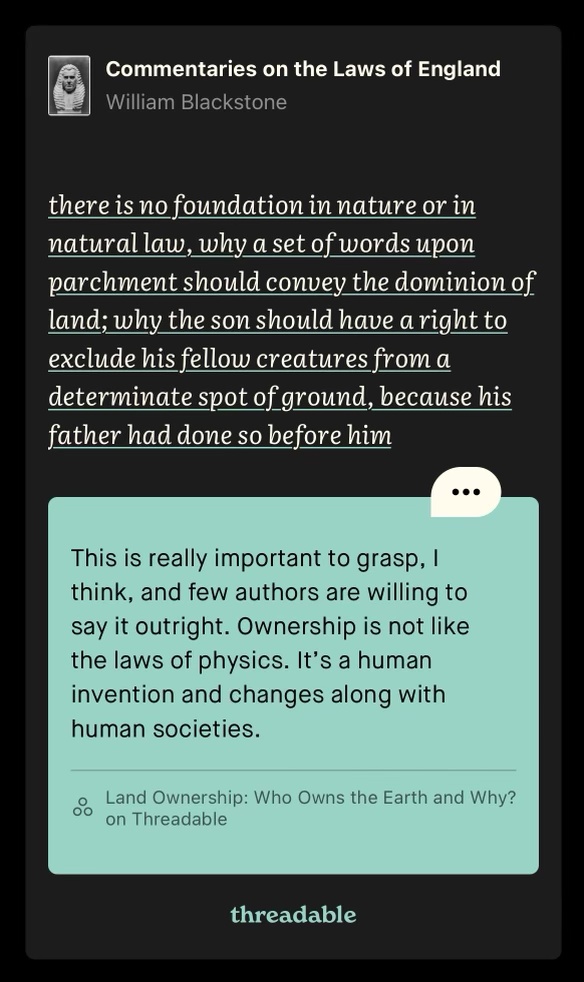
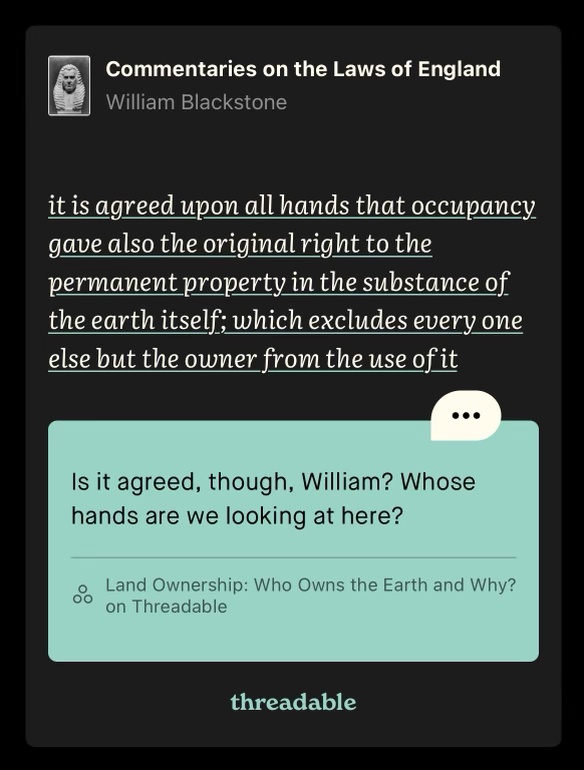
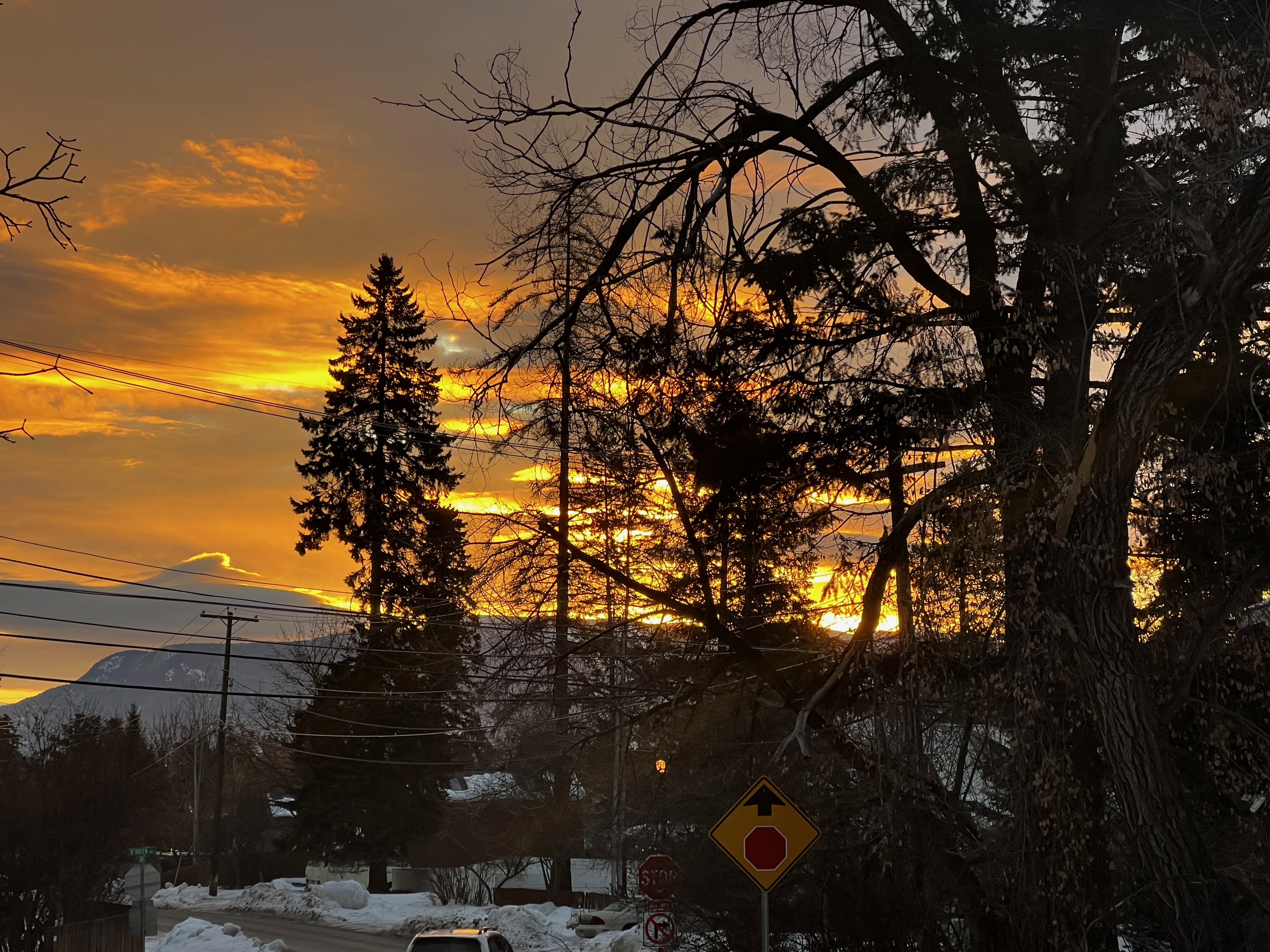


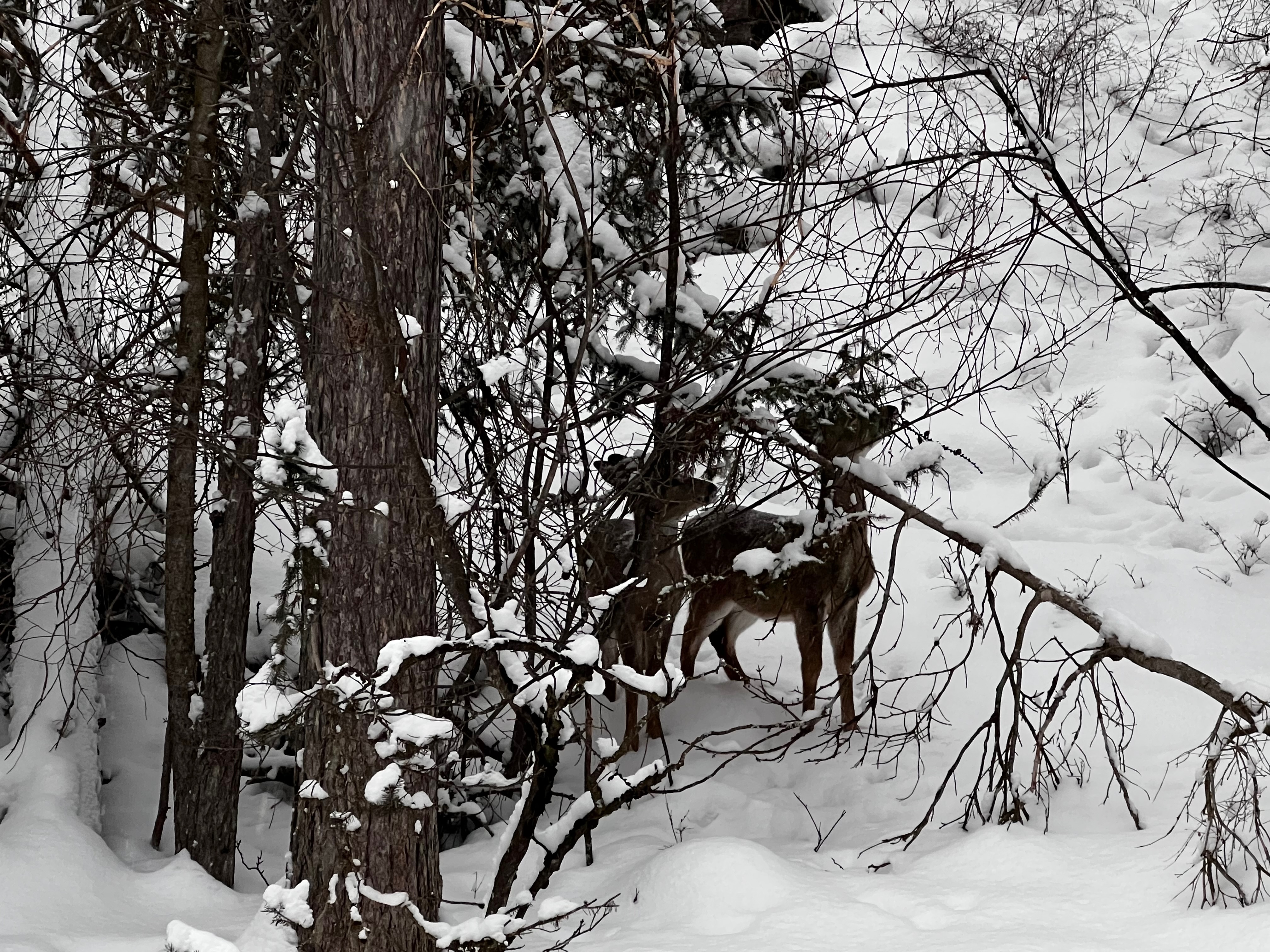
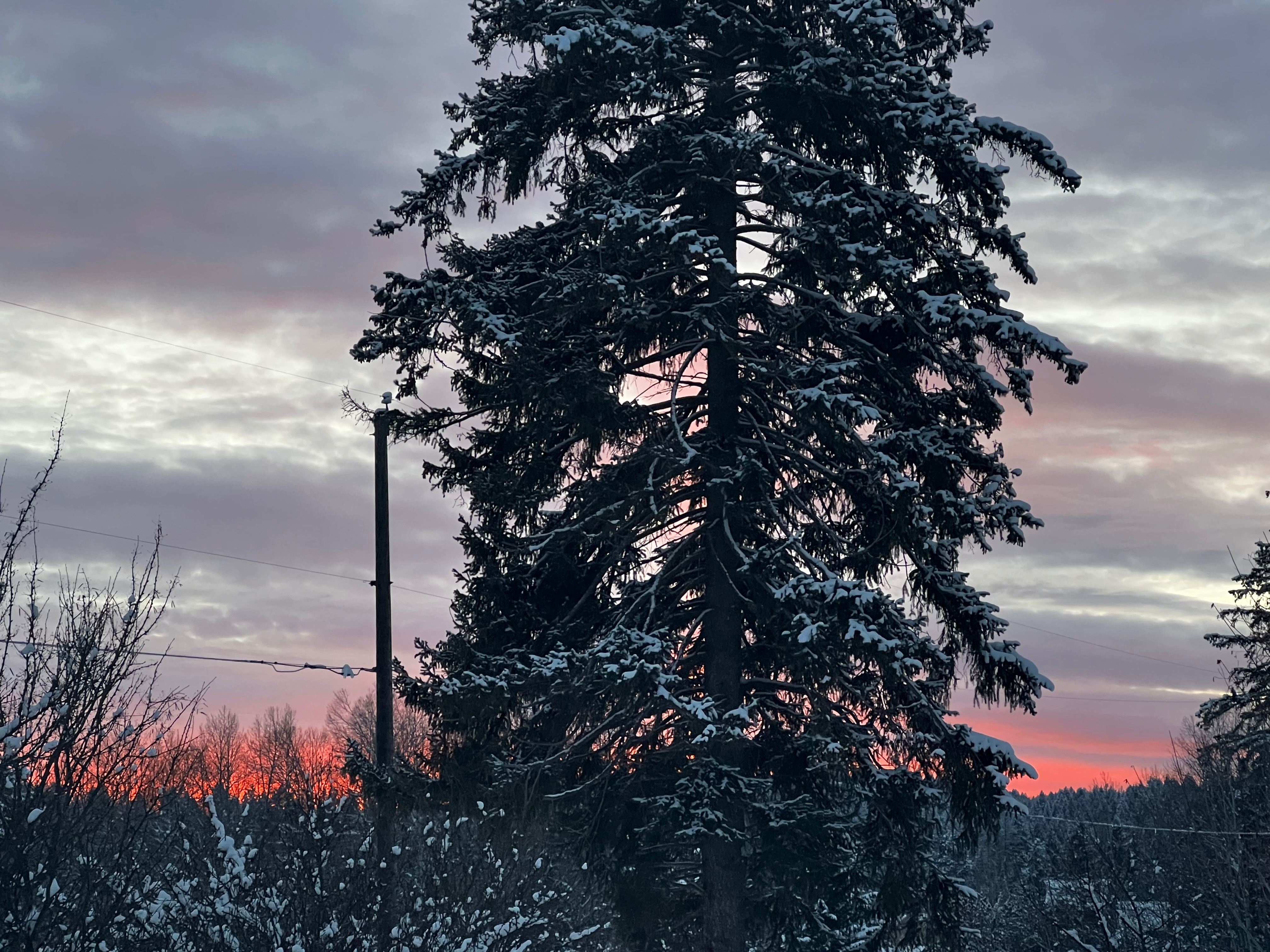
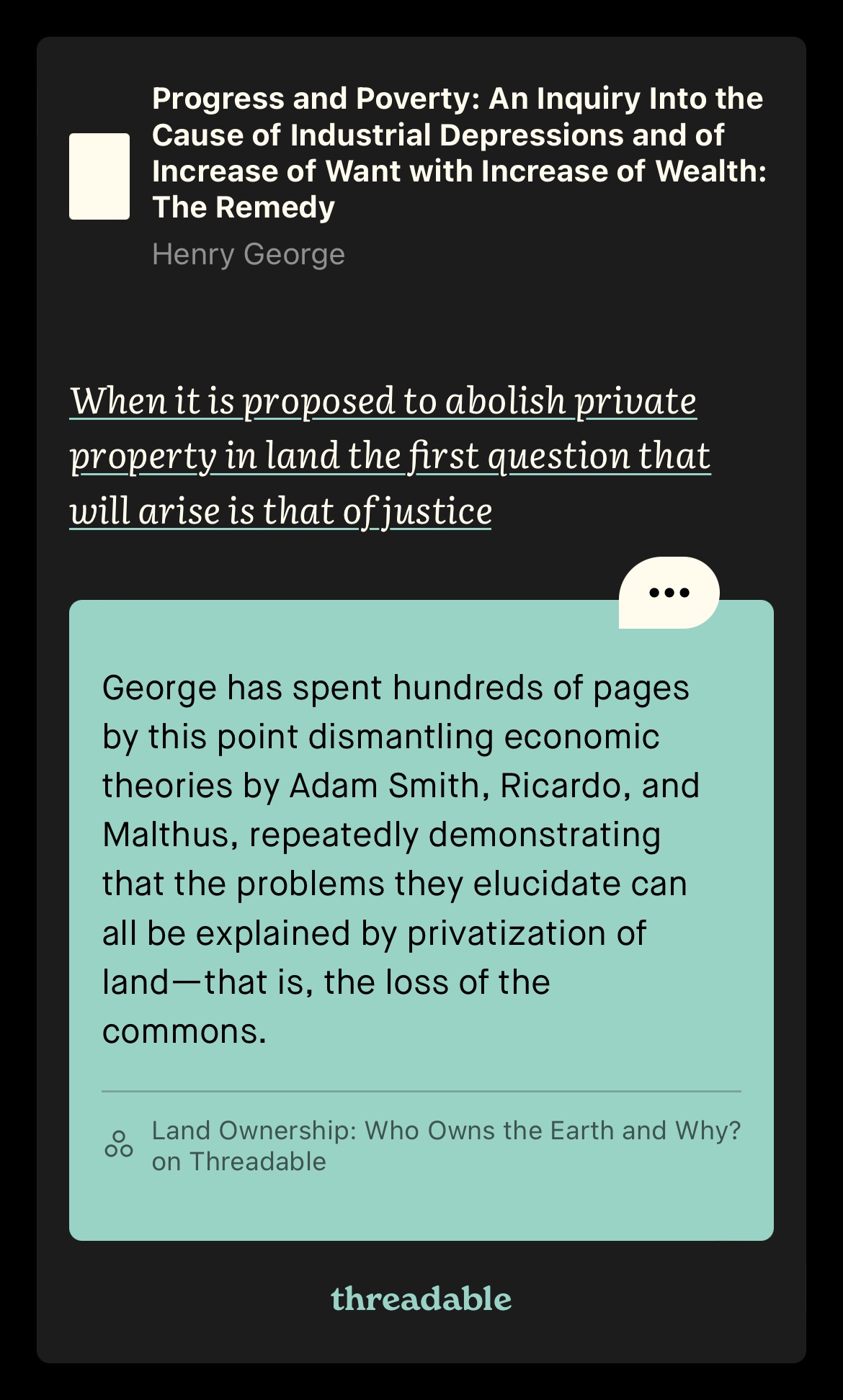
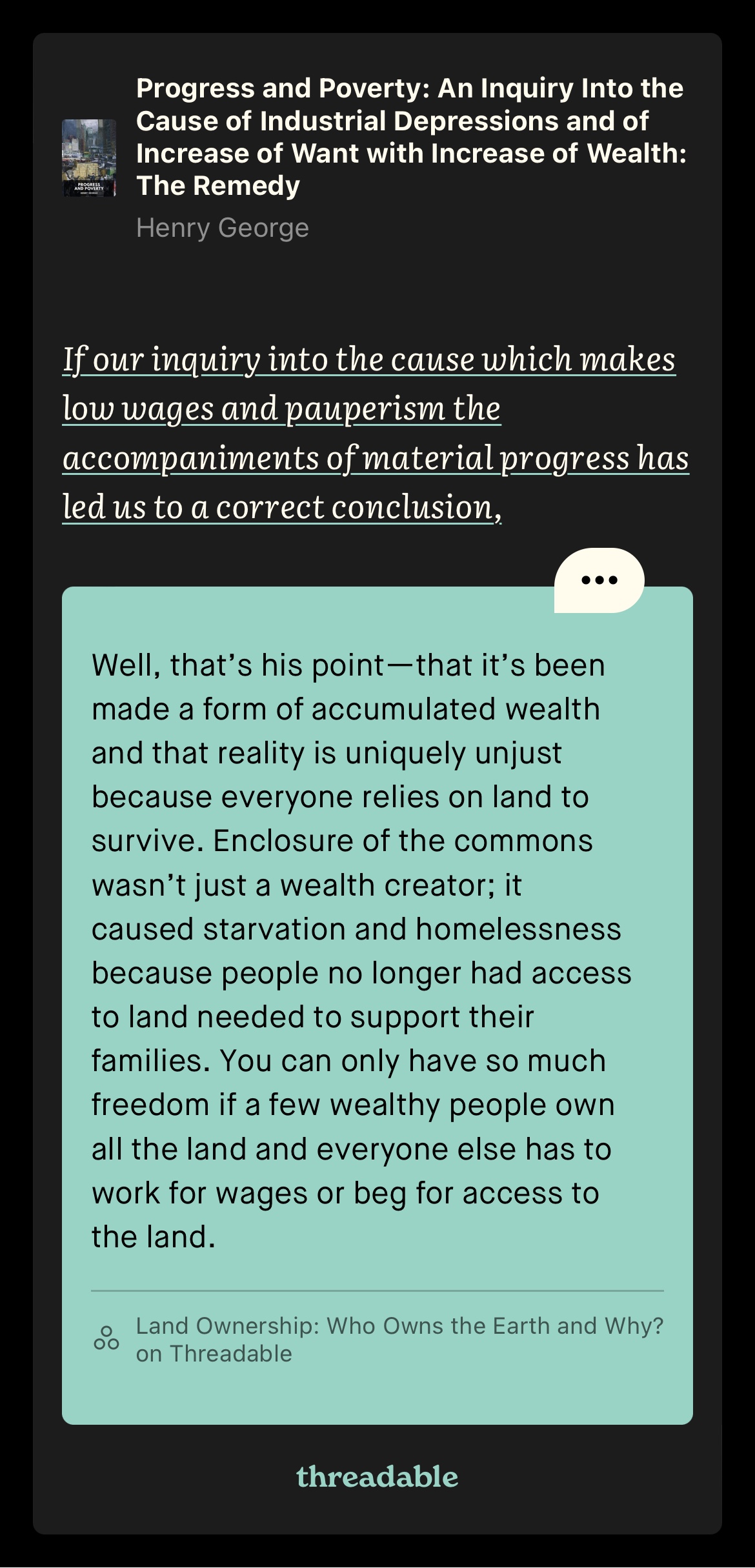

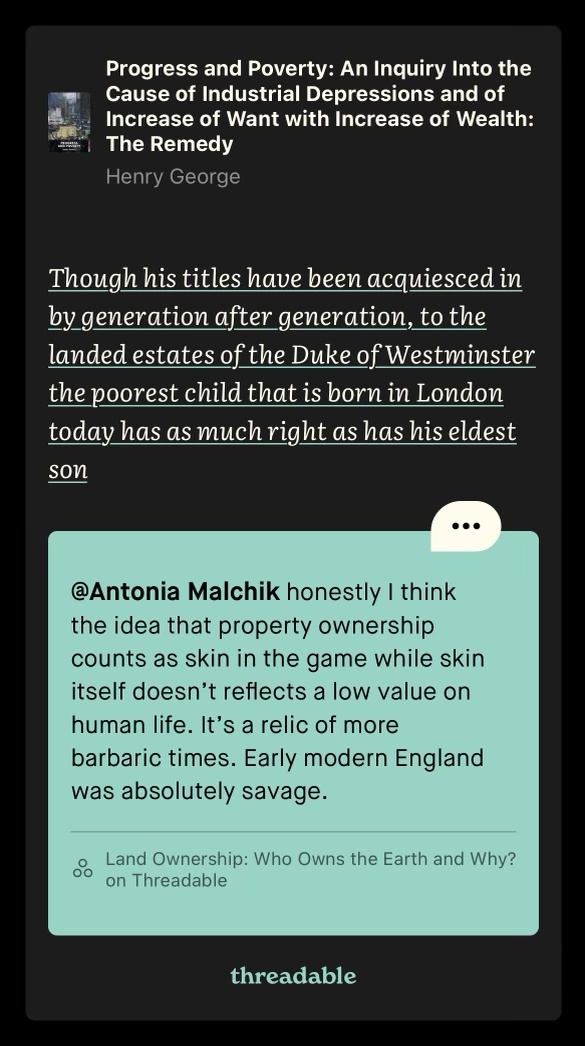

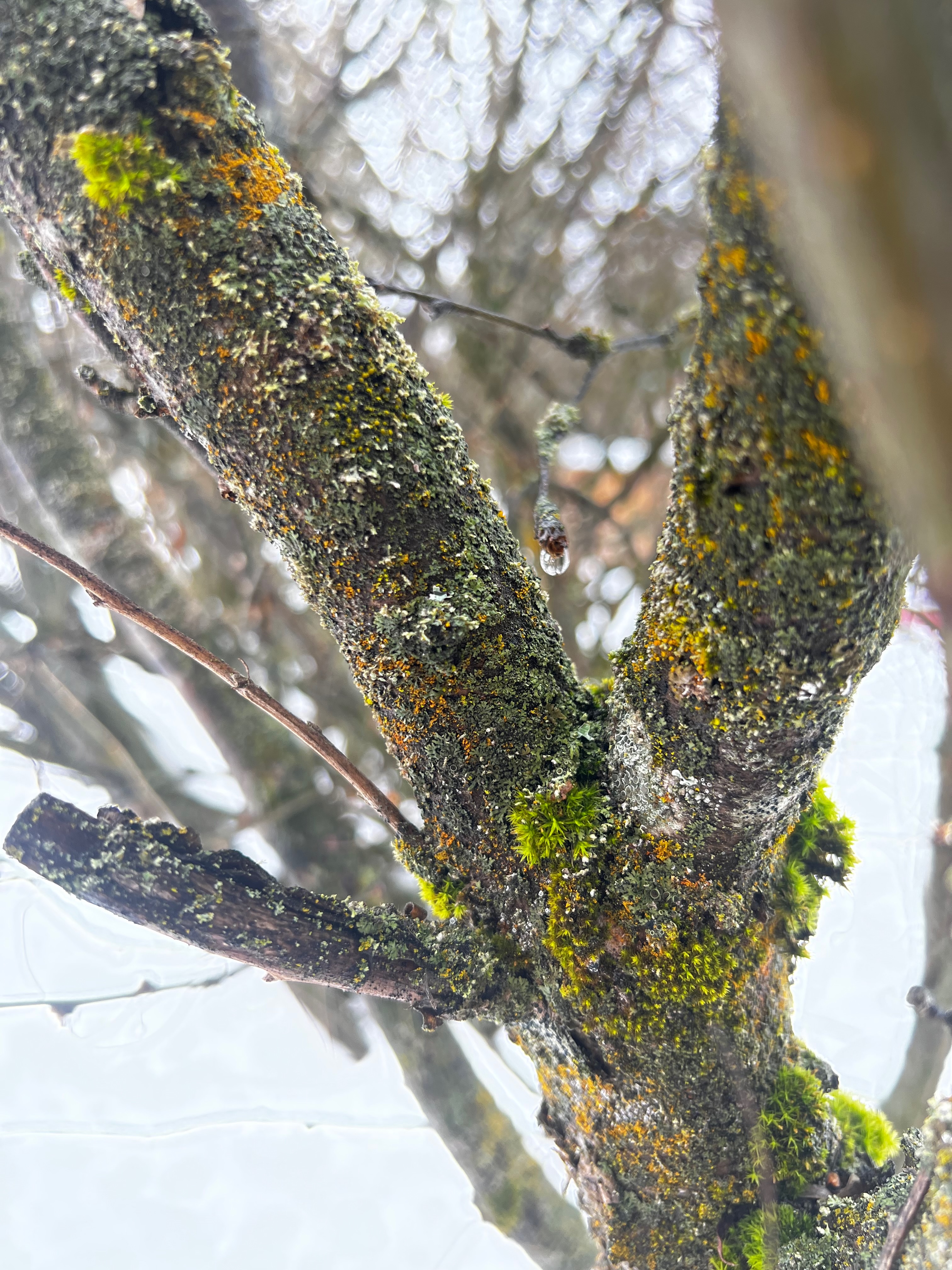
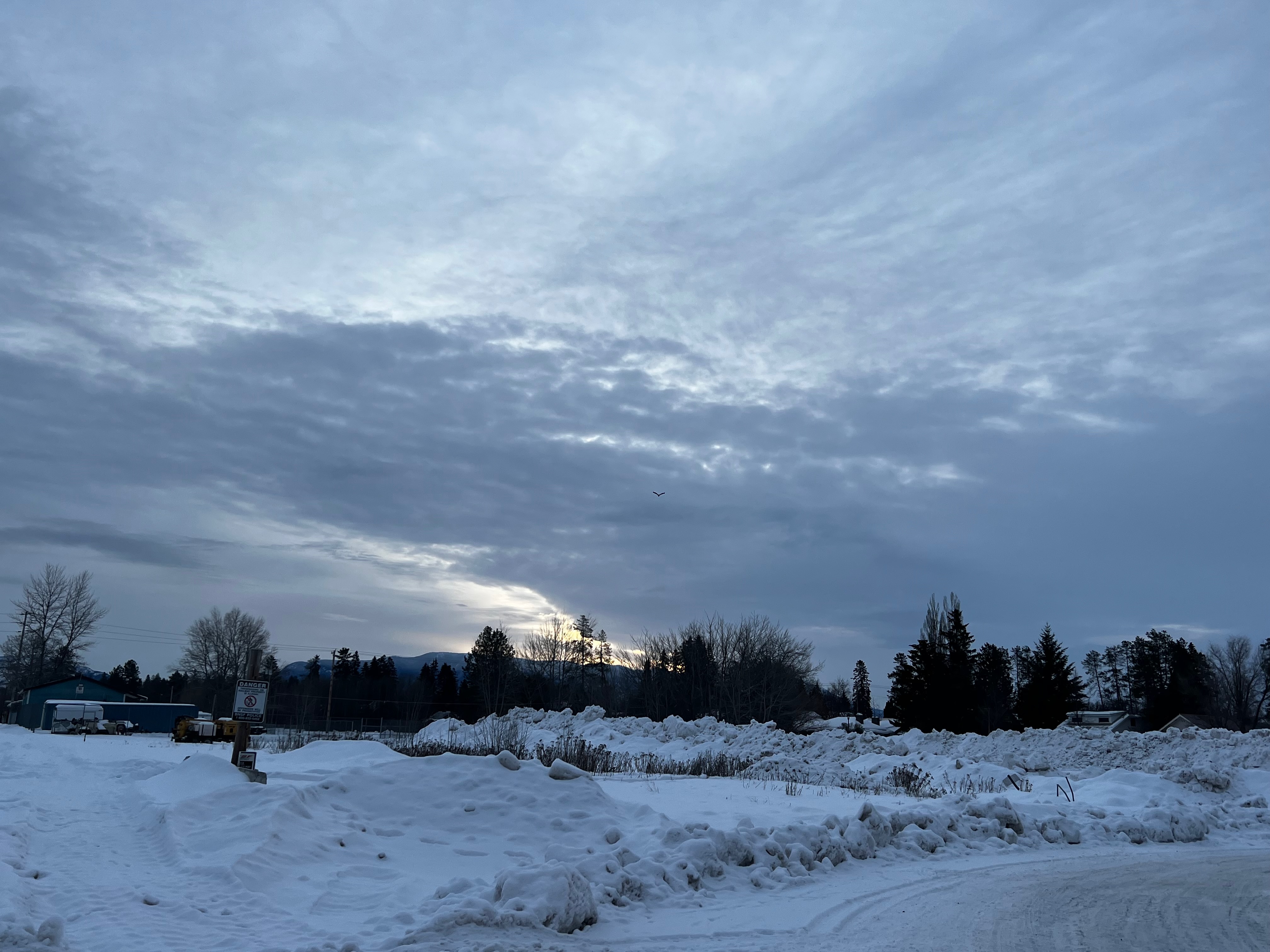


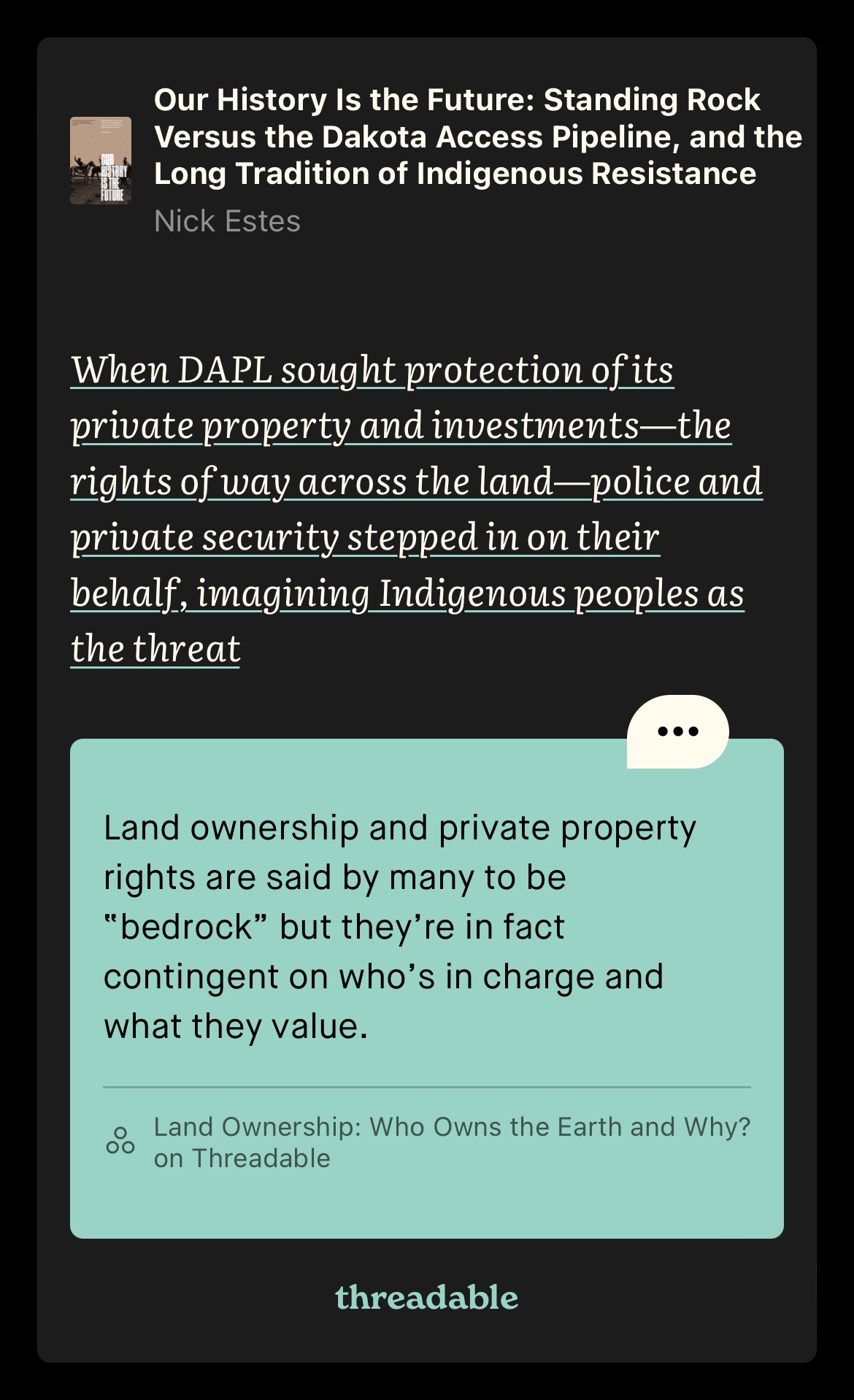
 Antonia Malchik