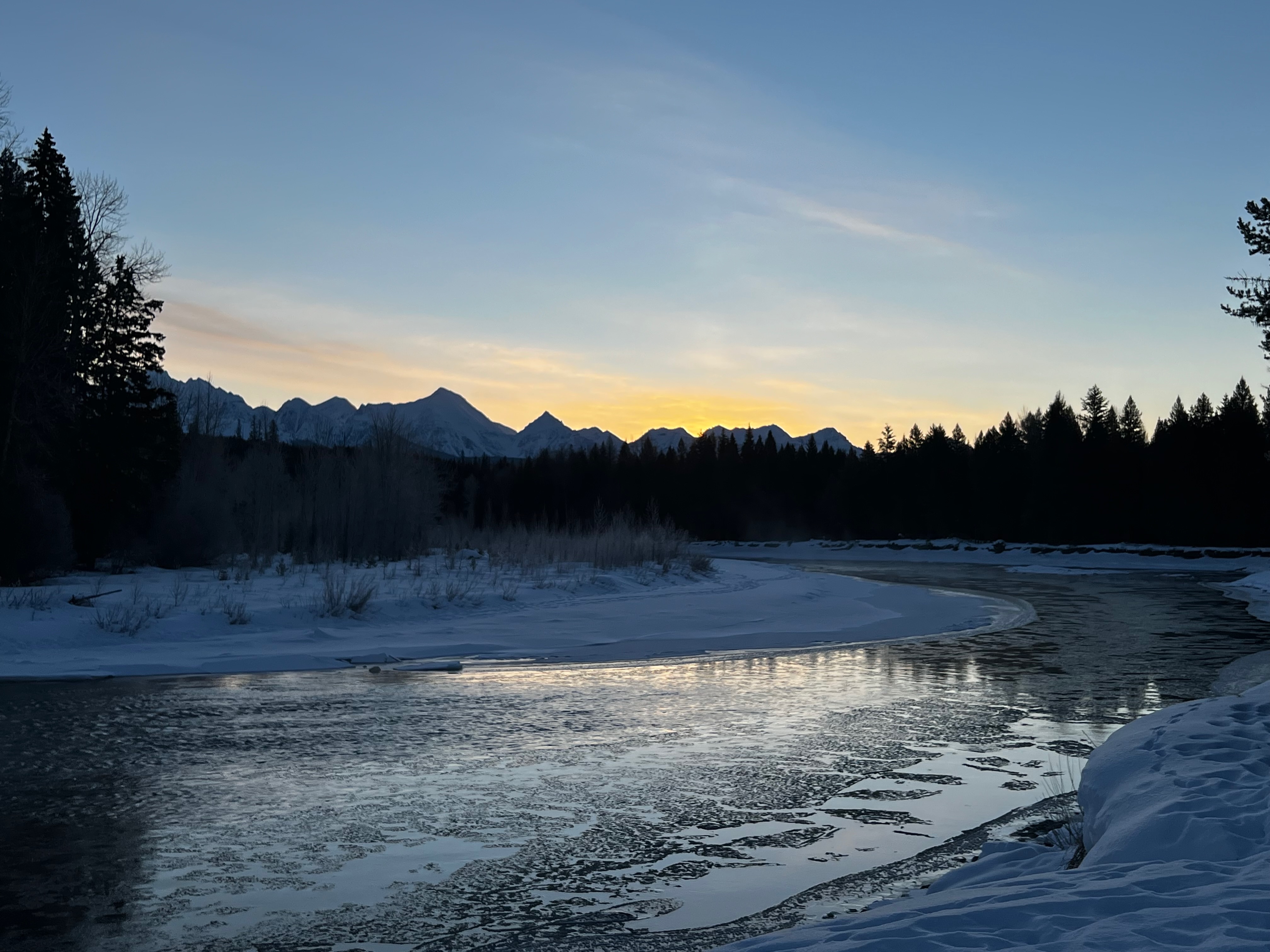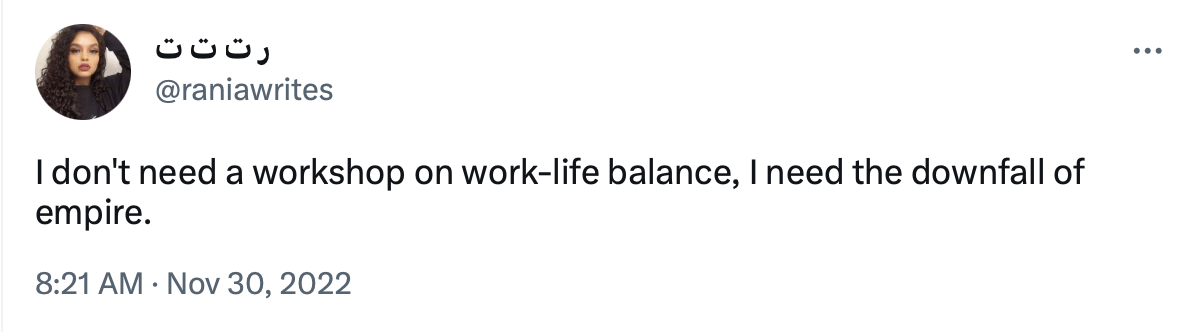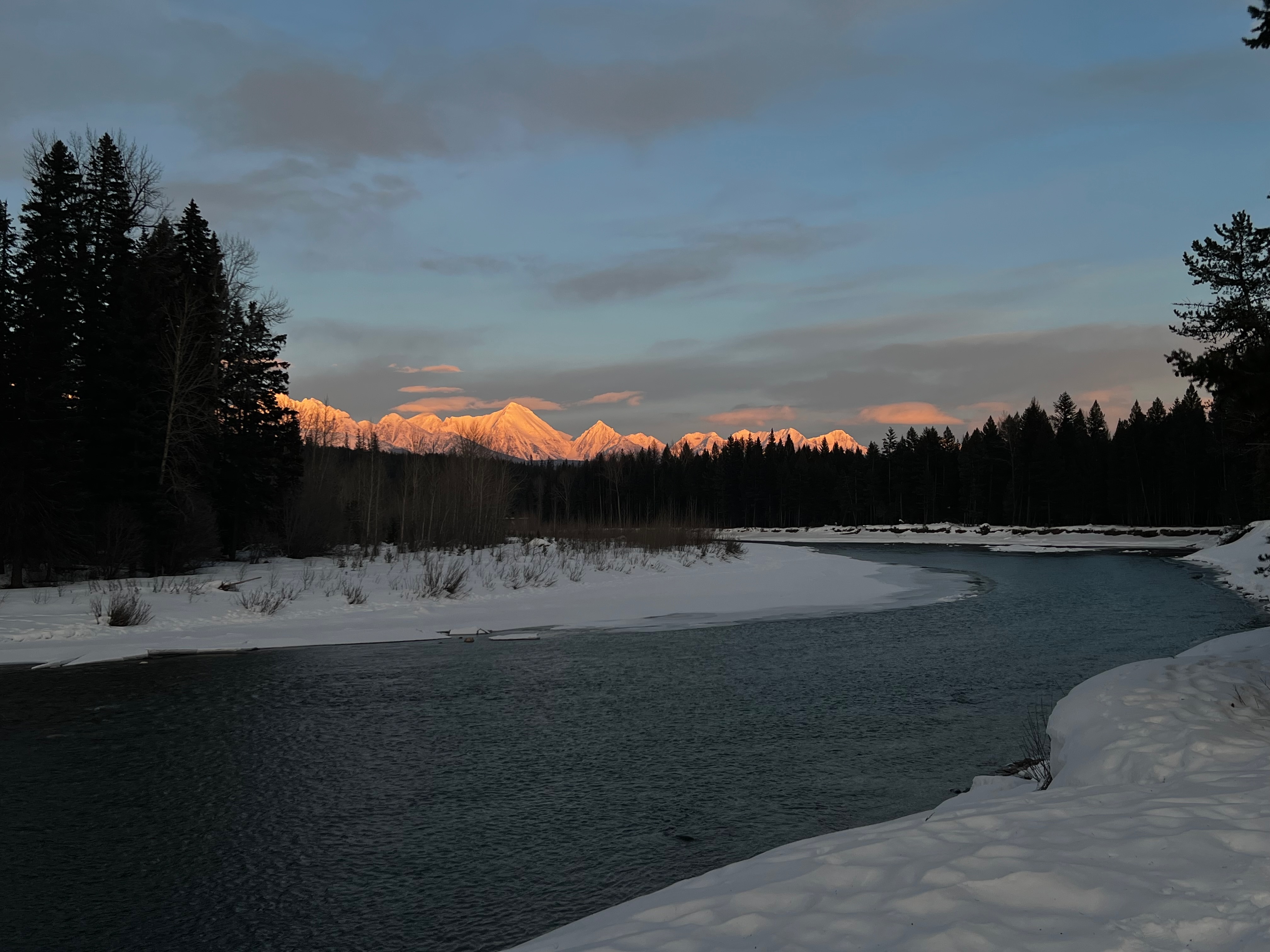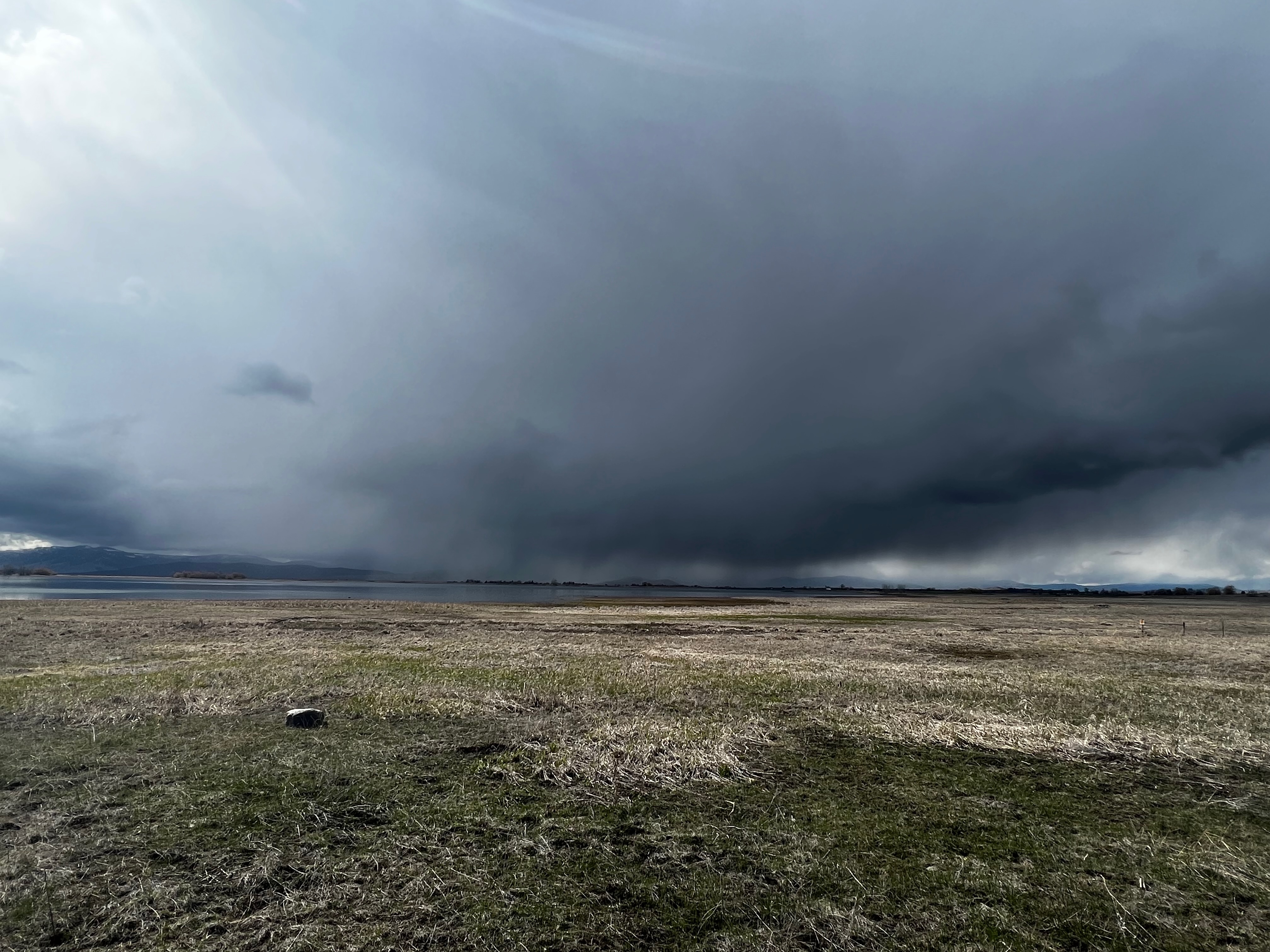
In the collisions of life, what choices do we have?

Walking composition

“All things
are peaceful
and kind
on the other planet
beyond this Earth.
But still I hesitate
to go alone.”
—from “Another Planet,” by Dunya Mikhail

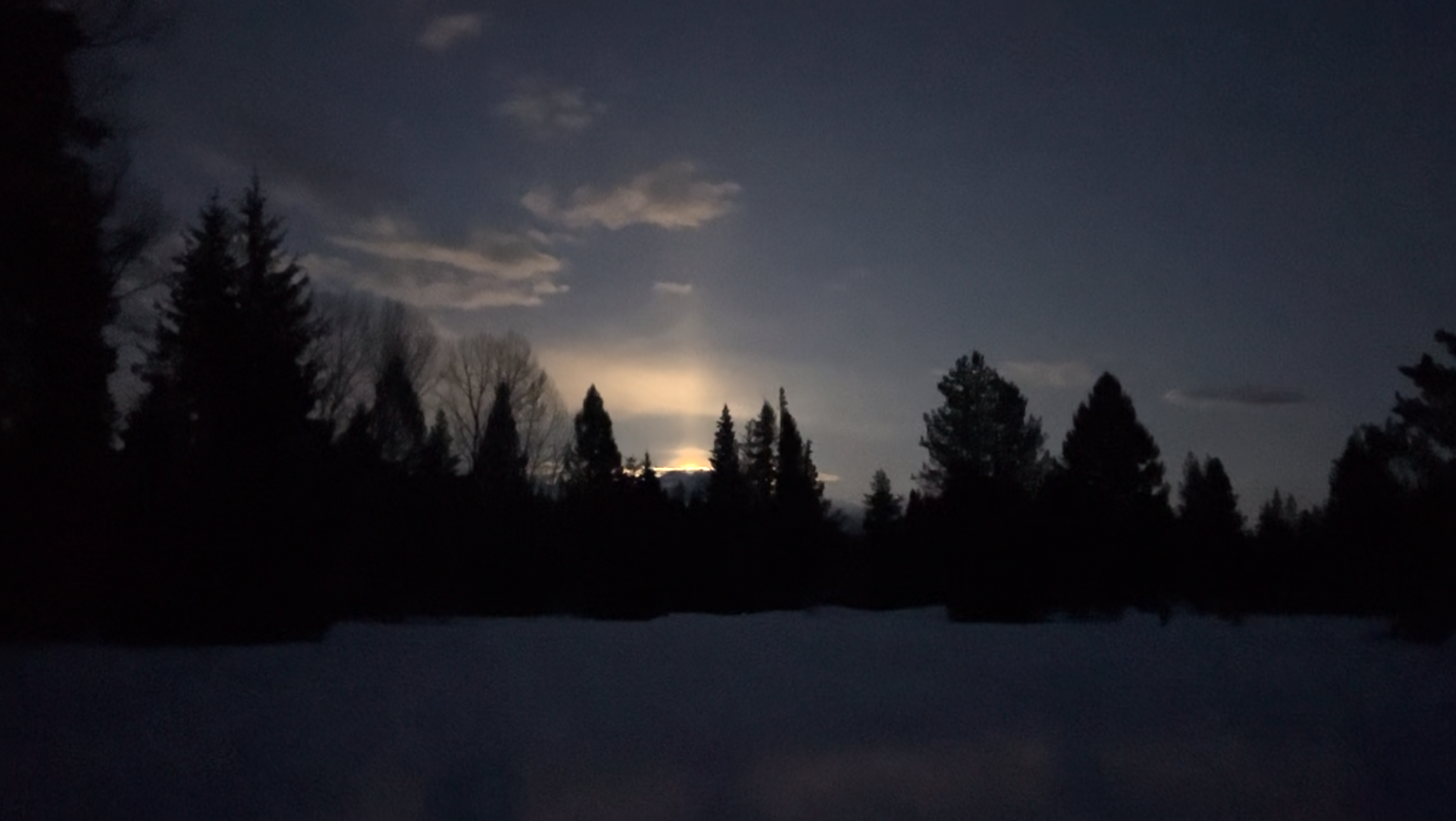
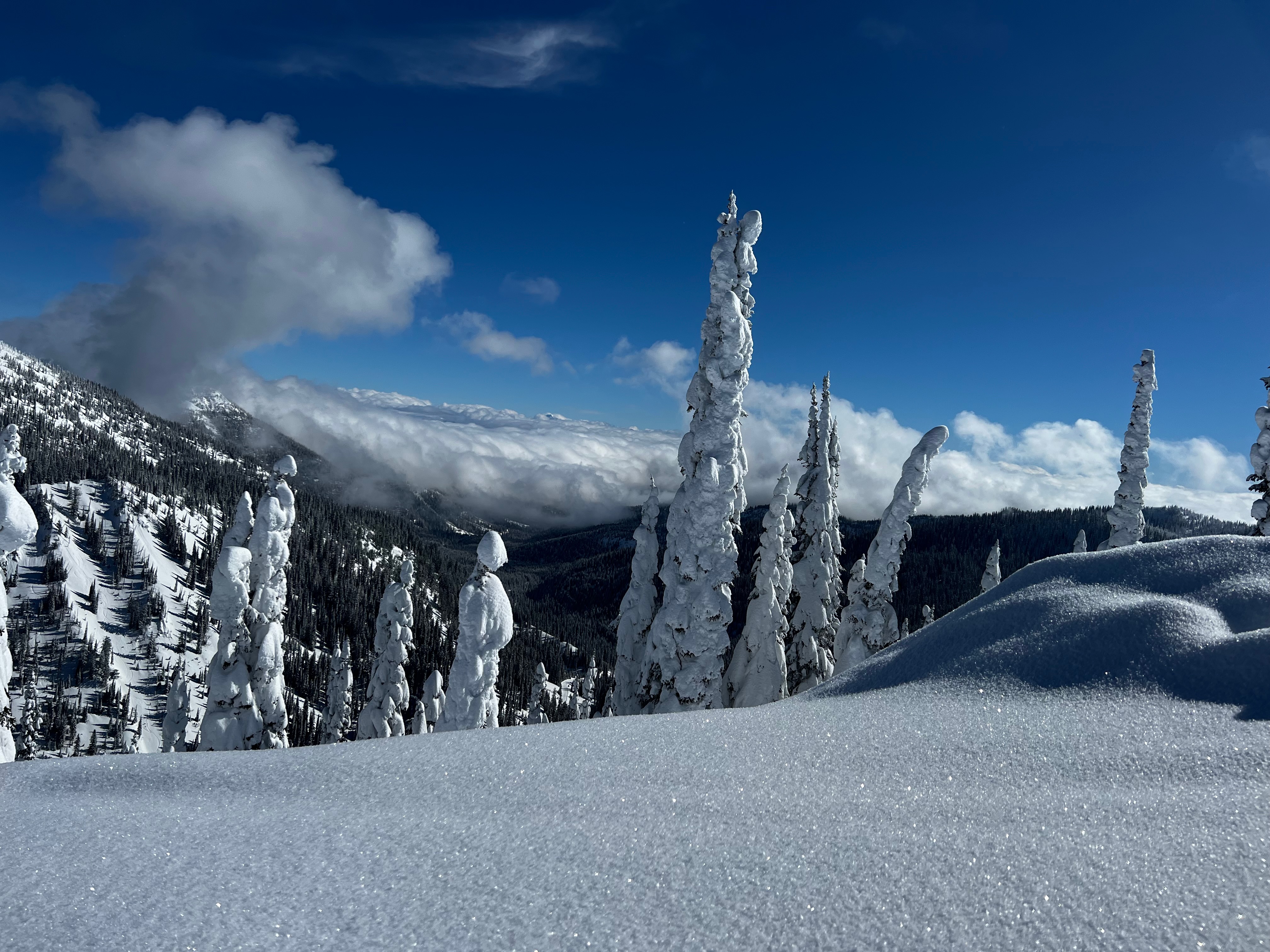
Last weekend, I went for a walk in the woods with some friends on a trail none of us had been on before. Nothing spectacular. I couldn’t even seem to take a photo that demonstrated more than that the area looked to have been logged or thinned long enough ago that you couldn’t see much evidence of it. While we walked I thought about how the clearings around us would be populated by little larch trees in about twenty years. And though I won’t see them for decades, the thought made me smile because there is nothing like watching sunlight flicker across a wide, quiet grove of toddler larches turning yellow, while a raven calls overhead.

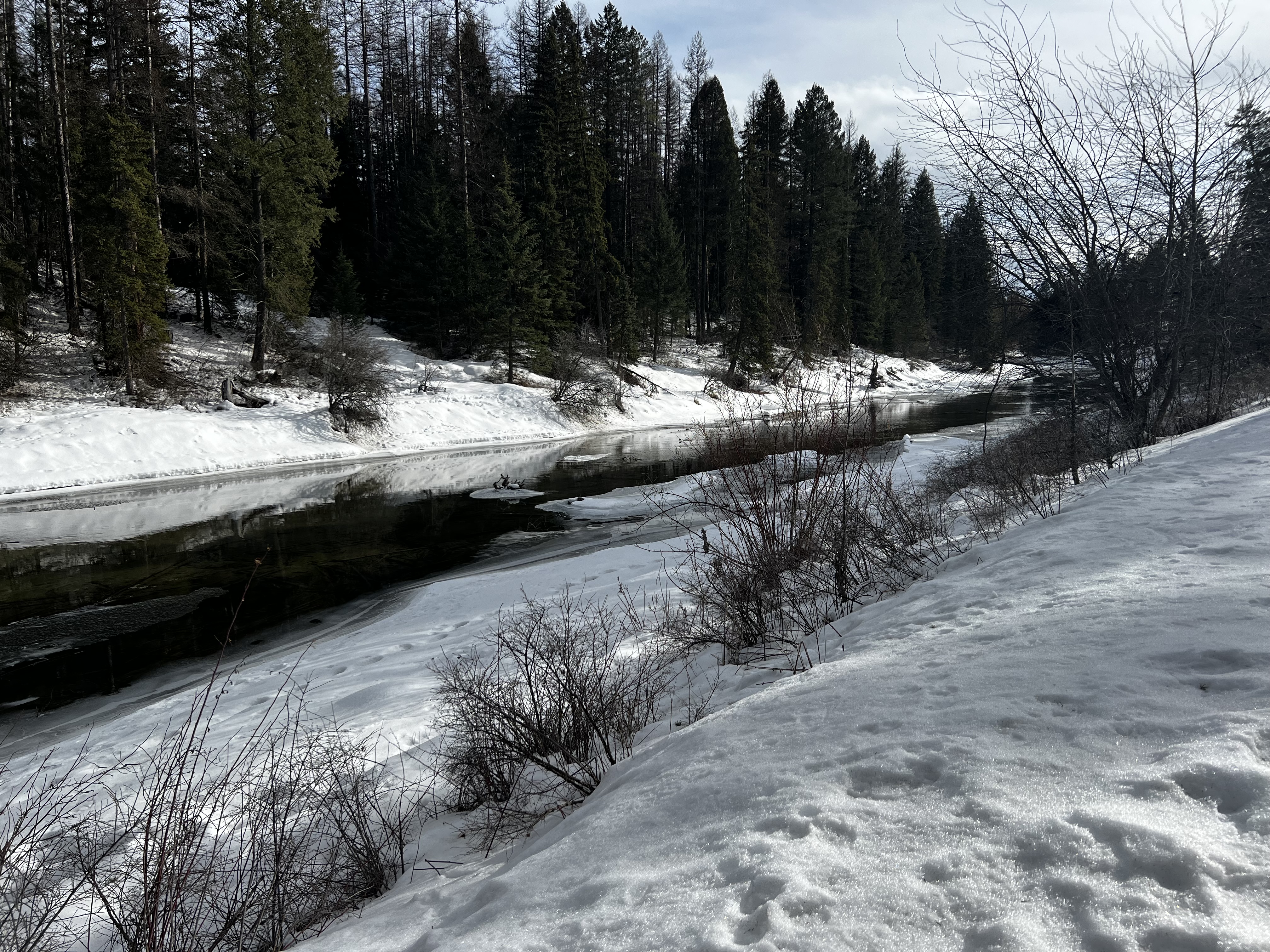
1-minute audio from a different walk along the local river. Red-winged blackbirds, and I could have sworn I heard a Swainson’s thrush in there? Maybe you knowledgable-about-birds people will know.

I didn’t have time for a walk. Really didn’t have time. I had a bunch of work things due and a volunteer commitment that was looming over me like a small, burning galaxy that wants me to feel the immensity of its mass. I’d been trying to keep panic attacks at bay for three days straight. Unsuccessfully. Which meant that, while I didn’t have time for a long walk, I also didn’t have time to not go on a long walk when it was offered.

In the midst of it all was Substack’s hard piling into some kind of social media engagement, which you’ve probably read about elsewhere so I won’t go into it, but it’s aggravating to keep digging through my settings to figure out how to turn off notifications that simply refuse to be turned off. It’s like one of my most regular recurring dreams, where I’m waiting tables and getting people’s orders wrong or trying to handle too many water glasses; or the one where there’s a huge house full of clutter that I have to somehow figure out how to clean up. (One of my many household chores growing up was dusting, which is probably reflected in my low tolerance for clutter wherever I live.)

There are all sorts of things to be annoyed at with this, but as with so many other things it comes down to lack of control over our choices. I hate that, for anyone. Notifications online aren’t on par with breathing polluted air because you couldn’t shut down a medical waste facility or someone decided to put a 16-lane freeway in front of your school; or finding yourself without a home because an absentee landlord bought your apartment building and jacked up your rent; but it probably comes from a similar rootstock, which is that someone with more power decided that they get to make your decisions for you.

There are a lot of things I’m thinking about with Substack and what kinds of choices people do or don’t have control over because some tech-bro dude decided they know what’s best for all of us. Even as I type that I realize that I’m repeating things I’ve said many times before, like in this post about why I originally left Twitter years ago and lack of choice (content warning for anti-Semitism). If you want to pay for this newsletter and would rather bypass giving Substack itself money, or if you just want to write a letter for other reasons, a mailing address is always on my website. It won’t help with the notifications, and I’m not sure leaving the platform to print and mail out essays is a viable option, nor would that disentangle anyone from the wider systems of injustices we’re forced to participate in. I don’t have any answers and don’t really trust anyone who says they do. But if you want to talk about it, I’ll willingly listen. There’s something insidious about others’ priorities being intentionally crashed into our time and attention from every angle possible, though the world is full of choices being imposed on those who have little say.


Of the eighty ownership-related books remaining in my to-read pile, there are only sixteen by women. Something that became apparent early on in this project is that almost all books on property are written by men, almost all of them white men, and almost all of them increasingly irritating. Stuart Banner’s American Property in particular is one I’ve started three times and returned to the shelf within an hour.

Unless the writing is explicitly anti-capitalist, it’s also particularly noticeable that the tone of the book carries a kind of March of Progress whiff about it. Even Andro Linklater’s Owning the Earth, which I really like, has this flavor. As in: The atrocities and losses that can be laid at the feet of this worldview and its enforcement are regrettable, but such is the way of progress and look at what we get in return.

To which my response is always, “Who is the ‘we’ you’re referring to here?”

When it comes to “progress,” the question that sits with me is: who is making sacrifices for others’ comfort or ease or security, and did they have a choice in the matter? Every time I turn on my car, I think of it as participating in a war on Bangladesh, which might seem extreme, but that land isn’t choosing to sink under sea level rise on its own. And my dependence on an internal combustion engine isn’t something I have much of a choice about in North American society. I don’t drive it every day, but even that choice is a luxury born of living in a walkable community whose affordability has rapidly become nonexistent.

There are very few mainstream books on property and ownership that spend any time facing these kinds of realities; those that do ask readers to imagine a completely different paradigm than the one we’re generally told is fixed and inevitable.
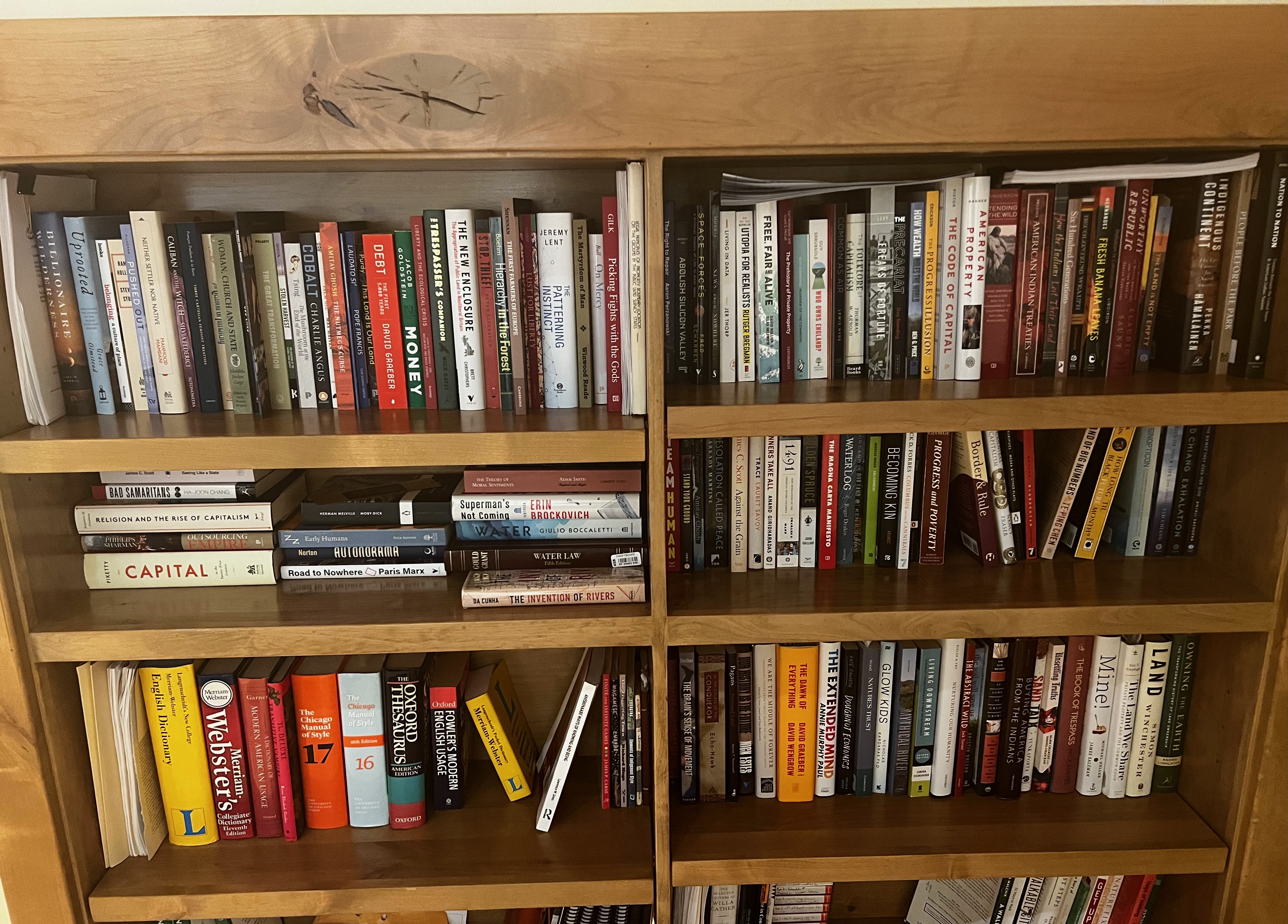
I’m slowly making my way through Elinor Ostrom’s Governing the Commons. Ostrom was an economist who won the Nobel Prize in 2009 for her research on commons-based shared resource management systems, fisheries being a prime example. Her book is meticulously researched and referenced and so tedious that I can barely get through a page at a time. I’ve read a lot of painfully dull books that grew out of Ph.D. theses, but it’s been a long time since I’ve read one that felt exactly like a Ph.D. thesis. It’s important work, though, and she’s probably not to be blamed for trying to make it as scrupulously academic as possible. Considering how badly the dominant culture wants to believe that private, individual ownership (or, as Ostrom also addressed, complete state control) is the only safe way to structure a society, anyone countering that view probably feels that their case has to be almost unassailable. Even I feel that pressure, which is probably why I’m reading too many books on the subject.

A lot of those books end up referring to one another. In the current case, it’s Amitav Ghosh’s The Nutmeg’s Curse, which I finally removed from the shelf and sat down with yesterday and read in a few hours because it’s not boring, and it also has a long section talking about Ostrom’s work. It’s not exactly the book I expected. It seems to have grown out of The Great Derangement, which in the end I like more. Both of them are about narrative, which is—I think—an overlooked element in why the solutions to so many of the massive problems our world faces have trouble gaining traction. The narratives that get promoted and believed are those that undergird the dominant culture that benefits from them.

Ghosh’s contention is not only that writers and artists of all kinds need to show some responsibility to narrative, and to writing ones that counter the dominant culture beliefs—that was in essence also what The Great Derangement was about—but that part of what the dominant narrative has buried is Earth’s and all its entities’ abilities to tell their own narratives. Use their own voices.

The question is, who among us has the time and attention, much less uses the time and attention, to listen? I don’t know that I’ll ever truly understand these voices, so it feel more important to listen to people who can. Which is probably why I keep putting Stuart Banner back on the shelf. His voice is everywhere, even if it’s not his. That story is dinned into us all the time. I want to hear other ones.


One of the minor volunteer things I do is run a school board candidate forum every year. This was my fifth year doing it, and the regular moderator who also helps me with a bit of organizing had too much going on to participate. I’ve been overwhelmed with other commitments and got a late start on the organizing and frankly just felt a mess about the whole thing. Organizing events of any kind isn’t something I’m good at and I also don’t enjoy it. I can barely manage to make my kids’ birthdays feel special. But there was nobody else to do it. And by “nobody else” I don’t mean “Nobody can do this but me because I’m unique;” I mean that I’d spent the previous three weeks asking literally anyone I could think of if they could take it over and nobody had said yes and it was too late to cancel it.

I explained this all to my three friends on our long walk, and in return one of them offered to make the flyers, which is always one of my sticking points (I also am not good at designing things). My friends then pointed out ways in which I made the forum harder than it needed to be by trying to accommodate everyone’s time restrictions.

My one friend’s offer, and talking through it all, helped unwind the anxiety and proved to me once again that a walk is never a wrong answer. It made the forum feel manageable. I went home, scheduled the Zoom webinar because I couldn’t find a night that everyone could participate in person, sent the old flyer to my friend to update, emailed the candidates, did all the fiddly things I usually have to do to get this thing ready, and felt somewhat more prepared to handle what was going to be a very busy week.

The next day, I came down with food poisoning and was in bed for two days straight. Having, for some reason, repetitive dreams about waiting tables and cleaning cluttered houses.

The night of the forum saw me feebly crawl into clothes and apologize to candidates and attendees for my brain losing the plot as the forum meandered on. At one point I forgot everyone’s names and forgot that Zoom had their names displayed right in front of me. These are people I’ve known for years, mind you. It wasn’t like we’d just met.

Having that long walk in the woods—in what I hope is a baby larch nursery—behind me and a few good friends at my back made me mind all that less. (Kind of. Food poisoning sucks. Never recommended.)

It hasn’t given me a good answer to the tangledness of online life. I’m not sure it ever will except that the more the digital world is pressed upon me, the more offline and outside I go. All I know is that I want all of us to have choices about these things. I also want us to be aware that our choices affect others, especially others we might never see or know about, and also to remember that many of the choices we hold ourselves responsible for are not necessarily ones we have a lot of control over. But the digital world is still new, and the more we insist on having real choices now, the more will be available to people in the future. (How to achieve this I have no idea but I think we have a responsibility to try.)

I chose to open a window today while I worked, now that it’s finally not snowing and freezing, and listen to the robins and chickadees instead of music, and to space out gazing at the near-bursting buds on the caragana bush, and to wonder if I should get my seed potatoes going or if we’ll have another blast of winter. And if I’m doing the right things, and what parts of my life I’ve wasted, and if I have time for a walk before making dinner, and how much choice I, or you, have in any of it, and what our responsibilities are to ourselves, our communities, and the world.

The choices, the responsibilities, the lack of both and awareness of both—they lace in and out of one another in a world whose narratives and self-perceptions have been knotted up and obscured for a very long time. Maybe one of the best things we can do, or if not the best at least a first thing, is to go for a walk, try to find some clarity, and listen for stories that might be trying to reach us through other mediums. Like larches, or birdsong, or friends, or a sky that wants us to know all of its moods.

Speaking of the book-in-progress, No Trespassing, I am currently revising the Introduction and will be sending it to beta readers in May, hoping to share it here with all of you in June. The first chapter, on land ownership, will be my main project while at the Dear Butte residency June 5-15. The overview of that book project is here.

Some stuff to read (r) or listen (l) to:

  • (r) Vivek V. Venkataraman writing in Aeon with one of the more thoughtful essays on work, leisure, and being a hunter-gatherer that I’ve read in a long time: “Today, many of us are doing the wrong kind of work, one that rejects sociality, craft and meaning, turning people into machines. In contrast, the physical, mental and social are inextricably linked in hunter-gatherer work.”

  • (l) A fun if daunting interview on Building Local Power about managing rats in cities that’s probably best described by its title: “Rats Aren’t the Problem in Cities. We Are.”

  • (l) From Future Natures, a conversation with agronomist Almendra Cremaschi on open-source seeds in Argentina and the implications of enclosing the seed commons: “The development of the terminator trait is a metaphor for what patents do to knowledge.” (The sound quality of this one is a bit in and out. I had to use headphones to catch it all.)

  • (l) On Frontiers of Commoning, a conversation with the authors of Co-Cities about building on Elinor Ostrom’s work to apply commons thinking to cities, with their mixed public and private ownerships and conflicting jurisdictions.

  • (l) Thanks to Jake for sending me this episode of How to Fix the Internet (from EFF, the Electronic Frontier Foundation) with science fiction writer Annalee Newitz, who really got to the heart of what I think science fiction can do for our understanding of the present: “Story gives us the access to seeing how a struggle that might last generations plays out over time.”

  • (r) Black farmers in Tennessee are fighting to be fairly compensated for land taken via eminent domain for a Ford plant: “For the sake of his four children and grandchildren, he welcomes development to the area. But, like the other Black families who spoke to the Tennessee Lookout about eminent domain lawsuits filed against them, Sanderlin drew a direct line from the state’s current efforts to take his land to the struggles in every preceding generation of his family to hold onto what they owned. ‘It’s not the first time we’ve had to fight,’ Sanderlin said.” (It can never be said enough that even private ownership of land will not provide security of it.)

  • (l) Otters and beaver, plastic waste, wool, and re-envisioning urban community land on the Scotland Outdoors podcast. (The portion about turning an old railway line into a bike and pedestrian path starts at about 12 minutes in.)

  • (r) “The Difference Between Love and Time,” a science fiction short story by Catherynne M. Valente, was just pure fun: “I took the continuum to that little Eritrean restaurant down on Oak. It ordered tsebhi derho with extra injera and ate like food had only just been invented, which, given the nature of this story, I feel I should stress it had not. I just had the yellow lentil soup. The space/time continuum cried in my arms. It thought it had lost track of me. I didn’t answer its text messages. If it was a commercial cereal brand it would be Cap’n Crunch Oops All Genders.”
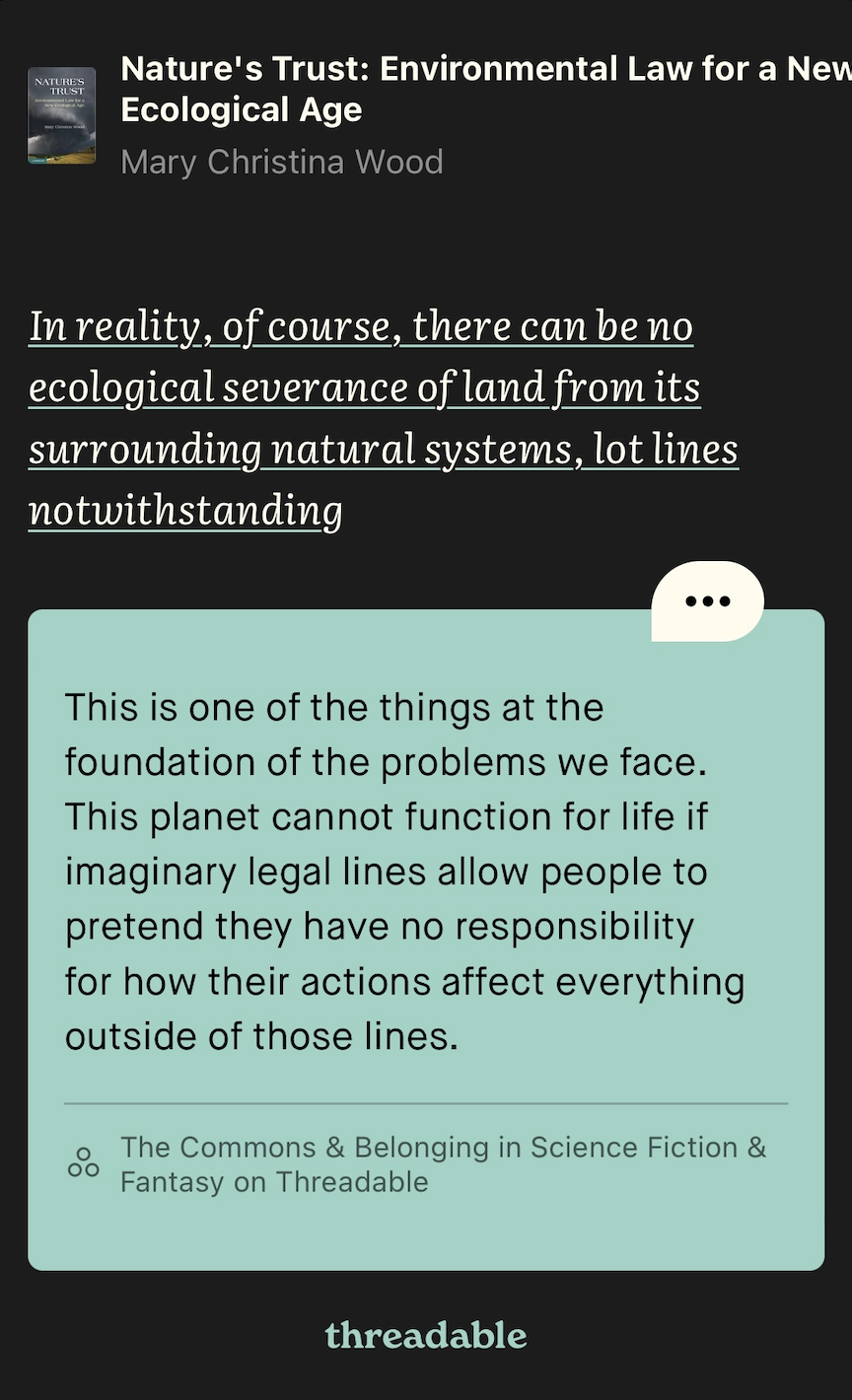
Reading "Nature's Trust: Environmental Law for a New Ecological Age," Mary Christina Wood

Threadable-adjacent reading discussion on land ownership

The most recent—and final!—Threadable reading for Land Ownership was a selection from Mary Christina Wood’s 2013 book Nature’s Trust: Environmental Law for a New Ecological Age.

*(For anyone new to On the Commons, an overview of this project is here. Please feel free to comment or email me with any questions.)

Note: I am starting a new commons-related Threadable reading circle this week, titled The Commons & Belonging in Science Fiction & Fantasy. This link should take you to the app’s home page if you would like to read and participate (still for iOS/Apple devices only, and for me it works best on a phone or iPad—the link has been a touch glitchy the past day or so, but if you have the app you can navigate to any of the circles). The reading selections are all science fiction, fantasy, and speculative fiction short stories, starting with Hao Jingfang’s Hugo-nominated “Folding Beijing.” Super big thanks to everyone here and elsewhere online who’ve passed on reading suggestions, most particularly On the Commons subscriber Stefanie, who has given me a big pile of excellent authors and stories to read! There is some great new SFF out there by a much wider variety of voices than I grew up with and I’m excited to read it all.

(If you want to download the app, you can do so through the Threadable site.)

Does the theme of science fiction and fantasy seem drastically different from land ownership? As I wrote in Threadable’s community circle,

“I ask us to reconsider that dichotomy. Enclosures of land commons and land privatization in both Europe and North America forced an enormous rift in people’s sense of security and belonging. (This is true all over the world, obviously, but the circle’s readings focused mostly on those regions.) And in placemaking, it’s often said that where you are is who you are.

Science fiction, fantasy, and speculative fiction allow us to imagine variations on belonging and identity that envision all possible futures while interrogating the past.”

And the present, I should have written. Science fiction in particular has ways of showing us the realities of our present by framing them in stories about the future. I’m a big fan of Martha Wells’s Murderbot Diaries, for example, because underneath the great storytelling and characters are important questions about how a “person” is defined and who gets to define them, what that means for individual freedom, and what kind of world we get when it’s completely controlled by competing corporations with no oversight. We won’t be reading Murderbot because Threadable readings are shorter selections, which is why I’m sticking to short stories, but I hope you get the idea. (Also I hope you read Murderbot.)

Anyway, for one more post, back to land ownership.*

5% of this quarter’s On the Commons paid subscriber earnings will be given to All Nations Health Center in Missoula, Montana.


I chose two excerpts from Nature’s Trust, both from chapter 14: pp. 312 (starting with the section heading “Land as Commonwealth or Commodity?”) – 320 (stopping before the heading “Public Trust Property and Restraints on Privatization”); and pp. 328 (starting at the section heading “‘The Earth Belongs in Usufruct to the Living’: Trust Easements and Servitudes on Private Property”) – 334 (end of chapter).

Unfortunately, I could not find any free versions of this book or sections of it online. It’s more of an academic book but I wouldn’t say it’s excessively challenging if this is a subject you’re interested in. It was recommended to me years ago by an environmental lawyer friend when I first got interested in the commons and land ownership, and Wood has a lot of insight and knowledge, and a compelling writing voice.


Mary Christina Wood is a law professor at the University of Oregon, where she heads the Environmental and Natural Resources Law Center. Not to get too deep into the weeds, Nature’s Trust is about what’s called the “public trust doctrine,” the legal principle saying that certain resources are held in trust for public (human) benefit. It applies to wildlife in the U.S., to legal water rights in many places, to public lands in the U.S., and to many other entities that are collected under the concept of “resources.” It’s what opponents of public lands specifically get wrong (on purpose, I’m pretty sure) when they say those lands are “owned” by the federal or state government. They’re not. Legally, they’re “owned” by the people and held in trust for the people by the government.

There are obviously a lot of pitfalls even in this concept. How do you talk about public trust and ownership by, of, and for the people when all the water and land and everything else in question was stolen in the first place and when many if not all of the treaties they were taken under were forged or broken? And what does this legal worldview still assume about the human relationship with the rest of life, or what’s often called the natural world? And even assuming you accept the precept of public ownership and the public trust, there’s still the question of how you hold the government accountable for managing “resources” belonging to the people and doing it in the public’s interest. (The absurdity of the U.S.’s still-active 1872 Mining Law, which heavily subsidizes mining of “public resources” for private interests, with little or no recourse for stopping or mitigating the attendant enormous destruction and pollution, comes to mind.)

Wood’s focus is on the loss of the public trust doctrine in favor of environmental law and entities such as the U.S. Environmental Protection Agency, which was created in 1970. When these agencies and laws replaced the public trust doctrine, protection of public resources and environmental regulations became far weaker. Entities like the EPA are easy prey for industry regulatory capture—rather than fight deforestation laws, for example, timber company lobbyists and executives can get friendly enough with regulators to help write favorable or weak forestry laws with no teeth.

Some of these ideas are outlined in an excerpt from an earlier part of the book that was republished on Bill Moyers’s now-archived website:

“The field of environmental law stands as a failed legal experiment. The administrative state vests agencies with breathtaking power that came justified by one simple assumption: officials will deploy public resources and invoke their technical expertise on behalf of the public interest. Instead, too many environmental agencies today use their power to carry out profit agendas set by corporations and singular interests. As Part I of this book explained, environmental agencies have fallen captive to the industries they regulate. Consequently, they use the laws’ permit provisions to legalize the very damage the statutes were designed to prevent. Nearly across the board, environmental statutory processes do not prohibit harm: they permit it.”

The concept of a Nature’s Trust, wrote Wood,

“calls forth an ancient duty embodied in the public trust doctrine, a legal principle that has flowed through countless forms of government through the ages. At its core, the doctrine declares public property rights originally and inherently reserved through the peoples’ social contract with their sovereign governments.”

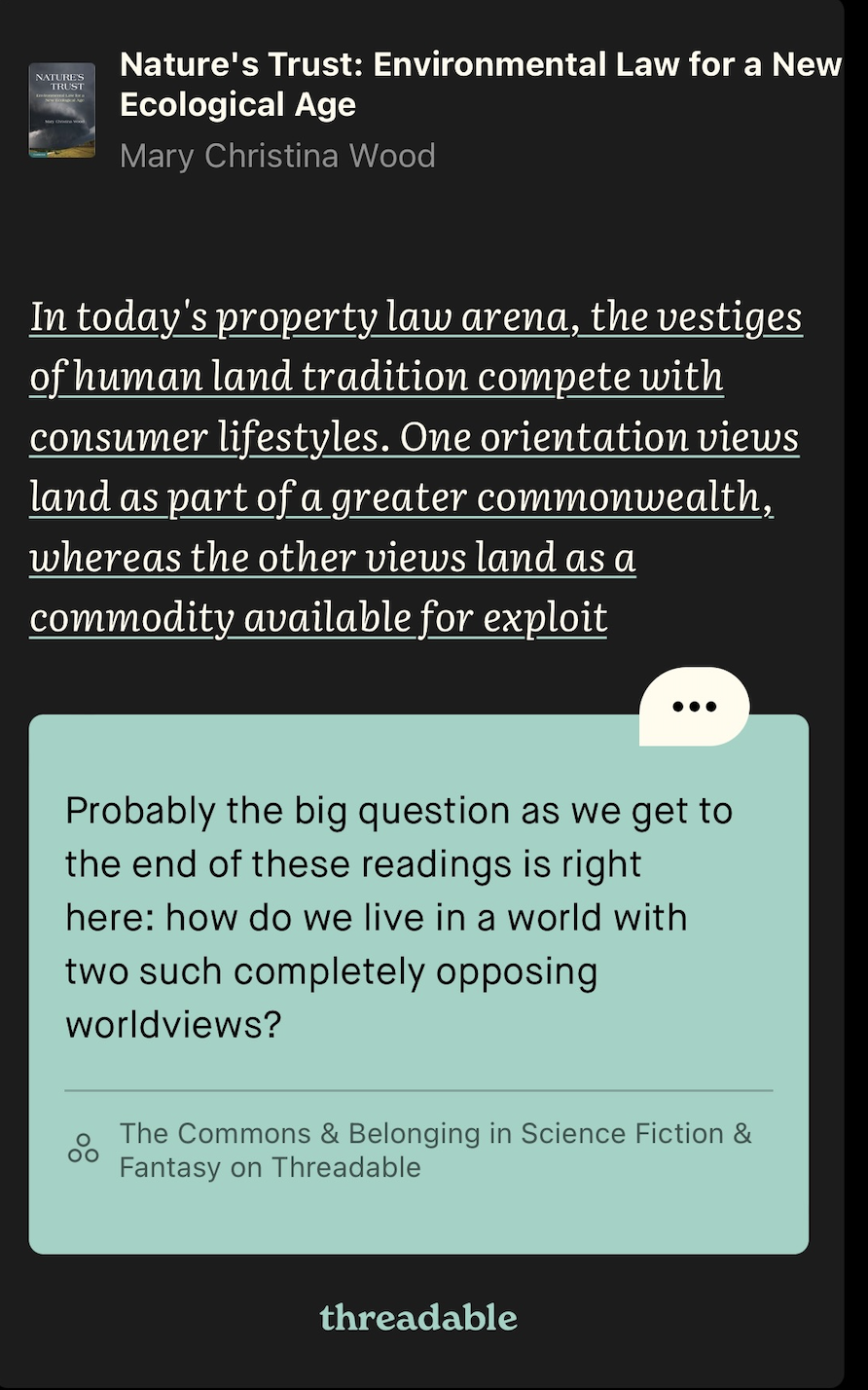
In the later part of the book excerpted for the Threadable reading, Wood has some thoughts on reviving the public trust doctrine by treating land as a commonwealth rather than a commodity. In this, Nature’s Trust circles back to some of the other readings in this series, including Erik T. Freyfogle’s The Land We Share. Private land ownership, wrote both Freyfogle and Wood, cannot be sustained in the long run if private property rights are considered absolute, with no responsibility to a surrounding community or ecosystem. “In today’s property law arena,” wrote Wood,

“the vestiges of human land tradition compete with consumer lifestyles. One orientation views land as part of a greater commonwealth, whereas the other views land as a commodity available for exploit.”

As I wrote in the comments for this section, this gets to the big question at the heart of the Land Ownership reading circle—and really at the heart of this newsletter and the whole concept of the commons: how do we share a world, manage our lives and honor the needs of all other life in it, with two such completely opposing worldviews? We don’t really have a choice, so how do we do it?

Like Freyfogle, Wood reaches back to some of the earlier history of the United States and how land ownership was viewed, a perspective that had a much looser and less absolutist view of property rights. “Rights to destroy the landscape did not enter into the liberty equation back then,” she wrote. But they do now, and the consequences have long since become unbearable for too much of life, humans included.

Wood’s idea of a commonwealth attitude toward land is not a commons approach, though how she describes commonwealth and land tacks pretty closely to a lot of Elinor Ostrom’s ideas about commons resource management systems. Wood reiterates repeatedly the idea that property rights must only be granted as subservient to and respectful toward the larger community and ecological needs. Owning land, she writes, forces a person or corporation into ecological and community relationships.

Which I agree with, but as I repeatedly wondered when reading John Locke’s and William Blackstone’s much older claims of the same, saying that this responsibility exists, or that people won’t claim or take or use more than they need, doesn’t provide for any enforcement mechanism. To use an extreme example, I live in Montana within an hour’s drive of a lake that is being increasingly polluted by selenium coming downstream from coal mining in British Columbia in Canada. There is no way for people where I live to force a sense of responsibility to waterways and human communities on Teck Resources, which is doing the mining.

In advocating for a commonwealth idea of property rights, Wood points to several specific examples that she sees as embodying the commonwealth approach throughout the United States, including community gardens, inner-city farms, and urban homesteads; food-not-lawns, conservation easements, and rethinking how stormwater is managed in cities. Not bad examples, if not really up to the scale of cross-international-border coal mining pollution.

While hopeful, I found that a lot of these suggestions, and indeed the concept of a commonwealth approach, still depend a little too much on landowners and the landowning class. It neglects the ways in which land ownership translates into power—political power as well as power over others in the form of landlord status. And it neglects the ways in which not having ownership precludes many of these choices without massive political, social, and clear legal change. What if you rent, or even if you own your home but not the land it sits on? Are you allowed to plant peas and tomatoes instead of maintaining a grass lawn? For too many people, the answer is “no.”

In other words, focusing on the responsibilities of landowners can repair some issues, but it bypasses a lot of the ways in which owning itself can damage communities and lock the majority of people out of decisions about how the commons—all the commons, in all their forms—are managed. And it’s not just about what you can do with where you live, if you even have somewhere to live. I’ve brought this up before, but I think it’s far too often overlooked that voting rights were reserved for the landowning class only—not just white and male, but owners of property—until relatively recently in democratic history. If you can’t vote, you also get far less of a say in how your own life and, say, the water you rely on to survive, are controlled. The possibility of that history returning is too real to ignore. Very few of the readings in this project—with the exception maybe of Henry George’s Progress & Poverty—have directly addressed the reality that more abstract human rights are also dependent on rights of survival.

But a commonwealth framework is somewhere to start. Again, it goes back to Freyfogle’s writing about the landowner’s responsibility to the surrounding community. As a reminder, the excerpt from his book was about a private landowner having to sue their county over a zoning change that allowed a neighboring property to operate a concentrated animal feeding operation (CAFO; a feedlot). The harms caused to neighbors by the CAFO translated into degraded air and water, and reduced property values. Absolute private property rights are a recipe for disaster, including to those property rights themselves. It’s the true tragedy of the commons.

To get to a commonwealth framework or back to a public trust understanding of land, though, is going to require an enormous amount of attention, energy, interest, and understanding from the wider public. The idea that the right to profit from what one owns is absolute, with no limitations from government entities, environmental concerns, or any other interests including neighboring humans, rivers, or wildlife, has laced itself throughout the dominant culture’s psyche and made its way across the world. (To be clear, this treatment of the world isn’t unique to private land ownership regimes; it seems to be far more about an ideology that says humans can be completely separate from and dominant over nature and treat her accordingly. The Soviet Union was a living, breathing environmental disaster for decades. But Wood’s book is mostly about the U.S. and corporate as well as individual property rights, and this reading circle has been specifically about private ownership of land.)

It’s going to take a lot of work to untangle that kind of thinking. It will require knowledge and information and a whole world of incredibly compelling narratives.

Which is really what we’ve been doing here. And it’s only just a beginning of understanding some of the roots of the problems our world faces.

Thank you all for exploring land ownership with me, and for putting up with things like having to look up swanimote when reading The Charter of the Forest, and my irritable review of Simon Winchester’s Land, which I’m still mad about. You’ve been patient and curious, and I’m really glad we went on this journey together. It’s been a long one.

Let’s all go for a walk. And then let’s see if we can start to change some things.

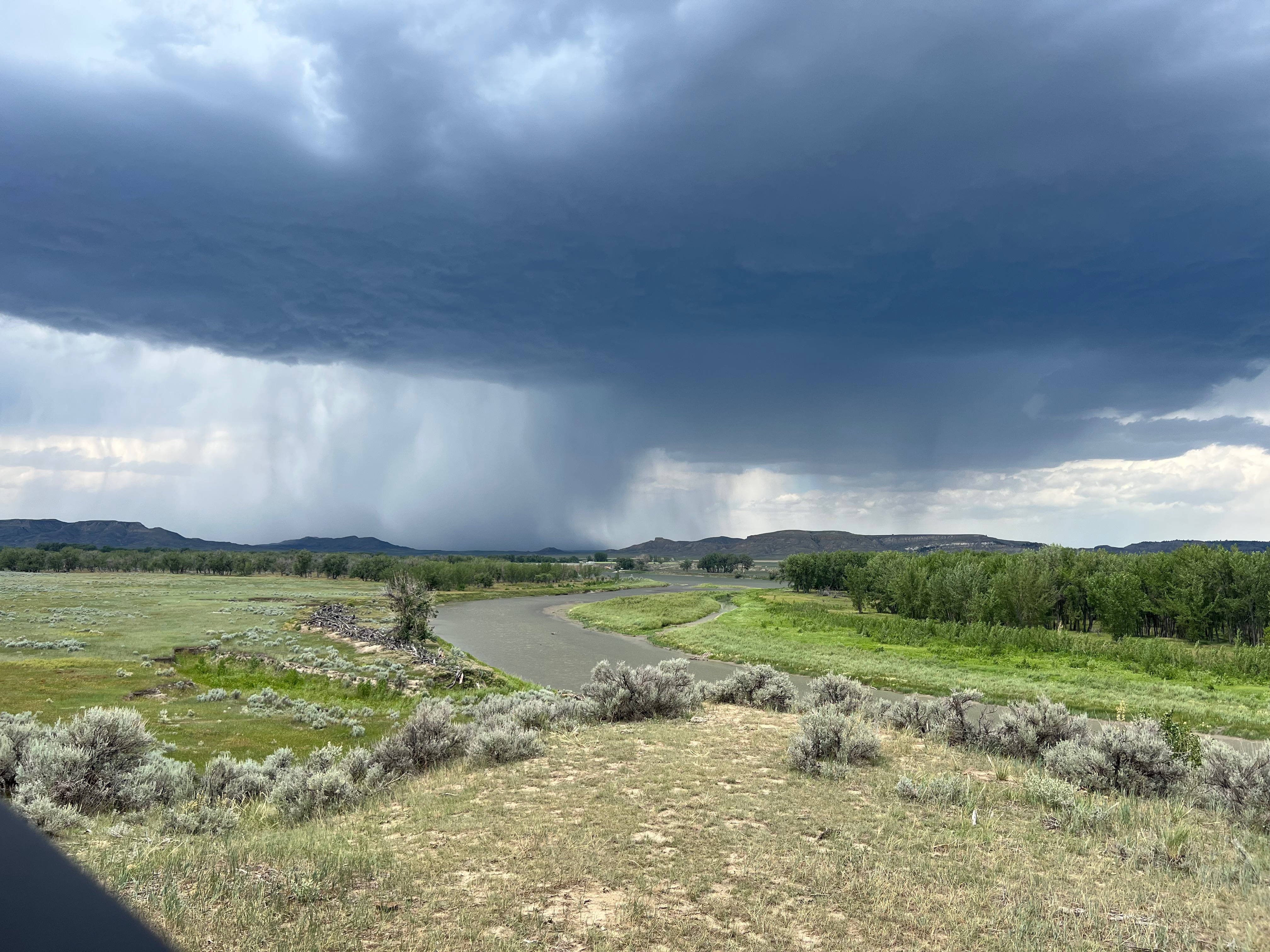
Rainstorm approaching over the Missouri River bordering the American Prairie Reserve in eastern Montana, a curious mix of private land and public access that I’m still not sure how I feel about. But it lacks fences and “No Trespassing” signs and feels like . . . possibility.

To break open the heart-shaped box

Walking composition

Where time and attention remain whole

Essay (about time and silence that turned into one about caregiving that turned into something about capitalism that turned into time and silence again . . . apologies for the inconvenience)

5% of last quarter’s revenue from On the Commons went to FAST Blackfeet. Next quarter’s 5% will go to All Nations Health Center. I encourage everyone to support similar organizations and initiatives, however you can, wherever you are.


During my most recent stay at a Forest Service cabin in early March, I thought off and on about time and silence. Most of the cabins I stay at are out of cell phone range, have no electricity (some do, but otherwise are heated and lit by propane), no internet, are limited to a stay of three nights, and are out of the way of people and traffic and most other noise. When I’m there, the silence is tangible and my sense of time changes drastically.

I go to these cabins partly because I continuously crave being alone, and partly (mostly) because I’m able to get so much more work done there. At home, the amount of work time available on a daily basis is almost laughably limited. Most of my days end up dissipated by dust devils of commitments. I’m constantly paring them back, but something always comes in to replace them, even if it’s just a stomach bug or bad head cold my kids brought home from school. 

These time-ravenous commitments aren’t new, though they wax and wane. When I was writing my book about walking, my kids were very little and my younger sister’s family, including a toddler and a newborn, were living with us in a small house. My work space was a desk in the short, open hallway outside of my kids’ shared room. Some months into the project, I broke down and spent several days hiding myself away in tears. I had a book contract, a comparatively decent advance, and a great editor, but there was simply no way I had the time or space to do the kind of deep thinking and writing the book needed and deserved. Caregivers don’t get to write books, I thought over and over. I got through it, but couldn’t stop thinking that if writing a book was that difficult for me, it would be so much harder for many other people.

The daily circumstances that led to that minor breakdown paralleled how I’d told my publisher I wanted to approach the subject of walking. It’s how I approach a lot of issues and struggles, whether they’re mine or my community’s or the world’s, by asking one question: What are the barriers? What I lacked was something I’d craved ever since having a baby but really most of my life: time and mental quiet.

I started reserving myself U.S. Forest Service cabins once or twice a year only a couple of years ago. The weeks-long writing residencies I’d been to were productive and even fun, but expensive, and I found that almost inescapable socializing swallowed a lot of residency hours I couldn’t afford to lose. (There is a hilarious passage about this seemingly universal aspect of writing residencies in Martha Grimes’s novel Foul Matter. It makes me laugh hard every time I read it.) I just needed time, and my mind to myself. A place where hours and attention weren’t chopped into little pieces.

That first cabin stay, which was only for two nights, I was astonished at how much I got done. Same for the second. The third reservation I gave up because of a copy editing deadline. That was in Covid’s second autumn, when I was trying not to be bitter about humanity, and was so ground down by homeschooling for the second school year in a row, my days looking a lot like they had when my kids were tiny—dictated by meals and cleanup and meltdowns and a momentary rhythm of math and reading and music practice in the mornings—that I’d become less a thinking person than a mass of rage and despair fed by potato chips, beer, and gummy bears.

None of these getaways have been easy. Without intending to, I somehow started out motherhood as a full-time stay-at-home parent who worked late at night and early in the morning and spent all day caregiving. I’d never wanted to be a stay-at-home mom (and have also come to loathe the word “mom”; a friend said recently it feels loaded with societal expectations of a narrow, fixed identity that disallows any other sense of self, and I feel that very much), but fell into it due to a number of factors, including our first baby’s nearly eight-week prematurity and month-long stay in the hospital’s Neonatal Intensive Care Unit, the fact that I’d worked freelance from home for years, and my spouse’s job, which required him to travel more than half the time. And the reality that childcare in the U.S. is outrageously, horrifyingly expensive. 

So when I needed to travel somewhere to research my book, or wanted to go away to a writing residency or conference, the logistical maneuvering was intense and exhausting. When my spouse travels for work, he packs, picks up his passport, and goes. But I’m the primary caregiver. When I go away, I put in days of arranging or rearranging appointments, checking on homework or long-term projects and other activities, making sure rides to anywhere needed are taken care of, touching base with everyone’s mental health, making sure everyone’s caught up on laundry and has showered recently . . . I won’t go on. If you know this routine, and its reverse when you return home, I bet you feel it in your bones. If you don’t know it, I’m not sure I can help you feel it. It was something my spouse and I fell into rather than consciously chose, but restructuring it has proven more difficult than I’d imagined. Covid brought an immediate stop to the business travel and it mostly hasn’t returned, which helps.

Last summer was the first time I went away somewhere offline and out of service and just . . . went. It was August, so there was no school to worry about, but my kids are also getting old enough to not need me so much. So when I got a week’s notice that I was off the waitlist for a two-day wilderness trail crew, I filled up the gargantuan gas tank of my ancient truck and watched the gauge visibly drop as I drove to a trailhead near the Continental Divide.

A few weeks later, I packed the piles and piles of research papers and articles waiting to be organized, a few books, food, coffee, sleeping bag, and went to a Forest Service cabin. I went again last month and have already reserved next fall’s stay. It’s getting a little easier on everyone. Kind of. A little.

Which is a relief because I desperately need this time. You’d think with my kids in school there’d be enough hours in the day to work, but between everyone’s appointments and errands and other commitments, school holidays, sick days, volunteer work that I try really hard to constrain, giving occasional walking-related presentations, and a variety of personal obligations, there is rarely a week where I can look forward to a full day’s work. A full day being defined as completely uninterrupted hours from 9 to 3. 

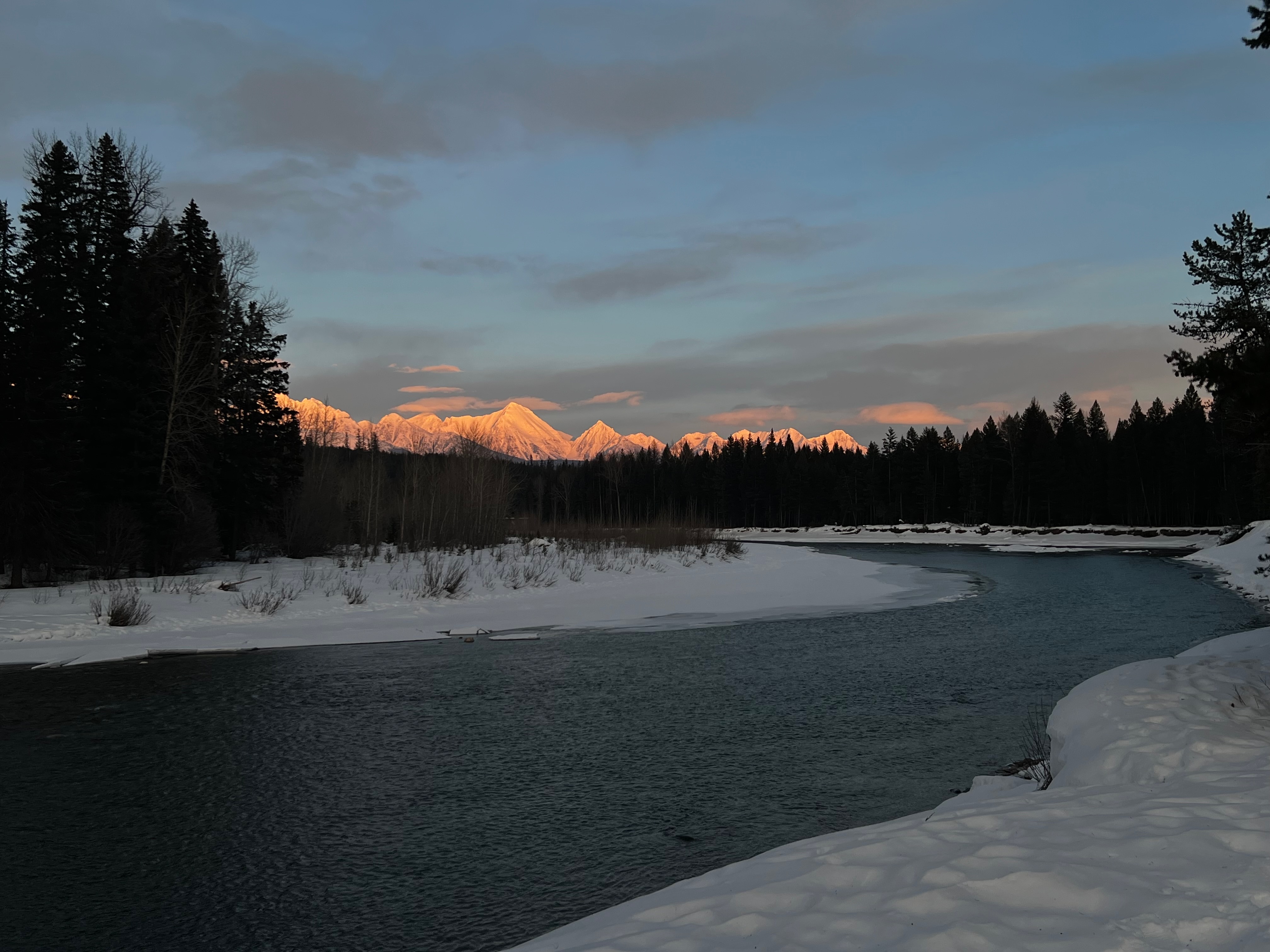
When I’m away, by myself and offline, all that time is inverted. Open, ample, unspoken for. It’s luxurious. I get up at five or six and make coffee. Depending on the time of year, the first or second cup comes down to the river with me while I watch the sunrise. I stay there as long as I feel like, listening to whatever the river has to say and watching the peaks brighten in the sunlight. Then I walk back to the cabin and get some homemade granola, yogurt, and a couple of the peaches I skinned and froze last summer out of the cooler. Eat in no hurry, brush my teeth in no hurry, make some mint tea with the leaves I dried last fall in no hurry, and sit down to read and write. In no hurry. Through every moment the silence feels saturating, the relief of it tangible.

The first full day this last trip, after visiting the ice-slushed river for sunrise and then eating breakfast, I wrote for what felt like hours, read a chapter of a book for research, felt sleepy, took a short nap, made tea, made revisions on a printed draft of an essay; realized it was sunny and maybe warmer out, so took some personal letters out to the porch and wrote to people with more tea and a bare aspen tree and the sunshine for company (if you got a letter from me recently, I meant but forgot to tell you where I was writing from), read another chapter and thought surely it’s nearing late afternoon, I’ve gotten so much done. It wasn’t even eleven in the morning.

Not having to parent and run a household isn’t the only factor here. Being offline and away from phone service matters a lot. I once said to one of my mentors—who doesn’t have a cell phone or even a car—that being online felt like spending the day with a baby or toddler, which an acquaintance once wonderfully characterized as, “It really only does take half your time, but the problem is it takes 30 seconds out of every minute.”

Even if I’m not looking at the internet, even if I have Wi-Fi turned off, it feels similar. Just knowing it’s there is a constant draw on attention that drains away energy and focus, but also intrudes on attentiveness to the world. As I’ve said before, I really do enjoy the dialogues we have here, the shared ideas and comments. But I can’t do the kind of writing I do without making time for immersive attention in the world.

Letting the places I love pull me into themselves—the rivers, the starry nights, the moonrise over Glacier, the birdsong in a campground on early summer mornings, the snap of cold on a winter walk—and to not have to talk for days, even online, lets me be as much my full, authentic writer-self as possible. As a human being, that’s probably as good as I get. 

Not everybody has these opportunities, or whatever their equivalent might be. When I first started my walking book, I spent a lot of time thinking about what mattered to me about it. I was tired to death of walking stories about philosophers and poets, the Wordsworth siblings and Henry David Thoreau. I wanted to write about walking that meant something to everyday people, which meant never losing sight of the question of barriers. If I believe that walking is a human right and fundamental to our evolution and health and well-being, what does that mean for places without sidewalks, for disability access and universal design, for all the ways in which walking is unsafe or inaccessible for far too many people? The question I pinned above my desk and carried with me was Who has the right to walk and where?

Reading "The Book of Trespass," by Nick Hayes

Threadable-adjacent reading discussion on land ownership

The most recent Threadable reading* for Land Ownership was a selection from Nick Hayes’s 2021 book The Book of Trespass.

I chose two excerpts from this book: from the chapter titled “Fox,” pp. 47 (starting with “I’m sitting in Room 35 of the National Gallery.”) – 58 (end of chapter); and the chapter titled “Sheep,” pp. 111 (starting with “In The Gentle Art of Tramping, the Edwardian journalist and traveller . . .”) – 122 (end of chapter).

*(https://threadablenative.page.link/Rxp8yegeZ1vXy4u19 if you want to try the Threadable app and need the link! Only works on iOS/Apple devices for now.

For anyone new to On the Commons an overview of this project is here. Please feel free to comment or email me with any questions.)

Unfortunately, I could not find any free versions of this book or sections of it online. But it’s a fun book to read, so I recommend the whole thing!

5% of this quarter’s On the Commons paid subscriber earnings will be given to FAST Blackfeet to support food sovereignty and sustainability.


The premise of The Book of Trespass is straightforward: in trespassing on many of England’s large private estates, Hayes is able to trace back the history of each to its original theft, usually from the common people during the enclosure acts. He’s an excellent writer, which allows him to clearly demonstrate the lack of real foundation for private land ownership and the injustice of laws against trespassing and for enclosure.

In an echo of what we previously read in Erik T. Freyfogle’s presentation of law—especially property law—as a story society tells itself about the values it holds, Hayes quotes anthropologist Clifford Geertz writing that:

“Law is not so much a set of norms, rules, principles, values . . . but a part of a distinctive manner of imagining the real. Nowhere is this more true than in the realm of real property laws. Property law has, in effect, helped us to re-imagine and reinvent what we understand to be the real world.”

Part of this reinventing has been a saturation of imagination—about not only what is possible, but what is acceptable. What is right, moral, ethical, or just. Hayes has a great passage describing what happens when property ownership and control (and wealth in general) exerts its power over not just our physical freedoms, but our social relations and interactions. After a run-in with one estate’s gamekeeper, he unpicks the discomfort of the gamekeeper’s social expectation:

“[The] gamekeeper wanted us to ackowledge that what we were doing was shameful: eyes lowered, hats off, a sheepish acceptance of his authority. But like the wall we were sitting on, his authority came from a line drawn not by common consensus but by private considerations masquerading as a moral standard.”

Private considerations masquerading as a moral standard. This phrase encapsulates so much of how a society dominated by land ownership, which then translates into wealth, starts to warp and unbalance the power relationships between people. It’s private considerations masquerading as a moral standard that brings modern North American conservationists, for example, into automatic and absolute acceptance that “private property is bedrock” while repeatedly refusing to question the justice of how that land was transformed, via repeated outright theft, from land into real estate. Into property.

When enclosures first started, there was no acceptance of this supposed bedrock. Instead, there was an understanding that what was happening was theft. The taking of that which belonged to all for the benefit and profit of a very few.

The quote here is from a passage about the Diggers of Warwickshire,

“which argued against: ‘Incroaching tyrants who grins the poor so y they may dwell by themselves in theyr herds of fatt weathers [sheep] . . . onely for theyre own private gain . . . they have depopulated and overthrown whole towns and made thereof sheep pastures . . .’”

Hayes documents some of the devastating effects enclosures had on the common people of England, similar to many covered in Andro Linklater’s Owning the Earth, in both instances taking place repeatedly over centuries.

Six million acres of land enclosed—stolen—in less than 100 years by the dominant class of landowners. And that was after centuries of enclosure had already forced hundreds of thousands off of the land they lived on and in relation with. Every estate, every village, had its own story of enclosure, theft, homelessness, and starvation.

Understanding this theft, how it happened, what its effects has been, and how it manifests in modern land ownership and power relationships, is why I find Hayes’s book so compelling. His trespassing isn’t in North America or even Ireland; it’s in England, where this specific approach to theft of the commons was born, where the relationship between people and the commons was broken by powers that wanted the land for themselves and their pocketbooks, an imposed breaking and theft that was then imported to any lands that colonizers could step on and attempt to claim.

It’s also where these thefts were vigorously and violently resisted.

This is something I’ve written about myself, in an essay on riots for the Center for Humans and Nature, starting with Kett’s Rebellion against enclosure of the commons in 1549.

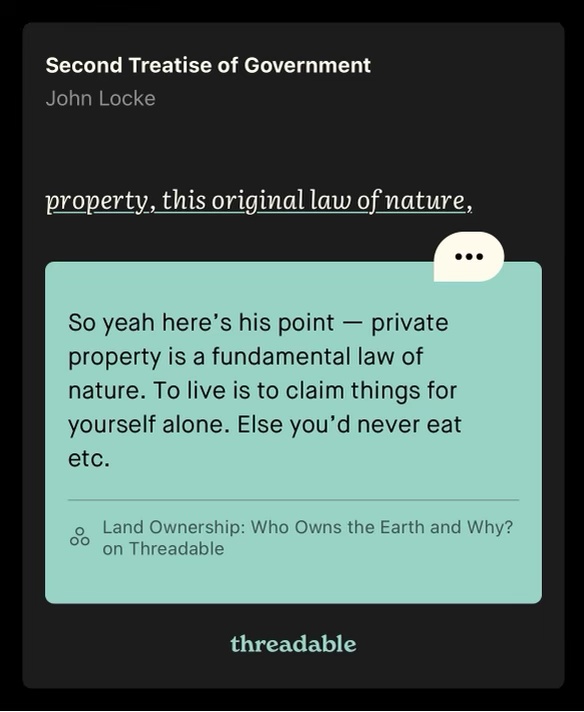
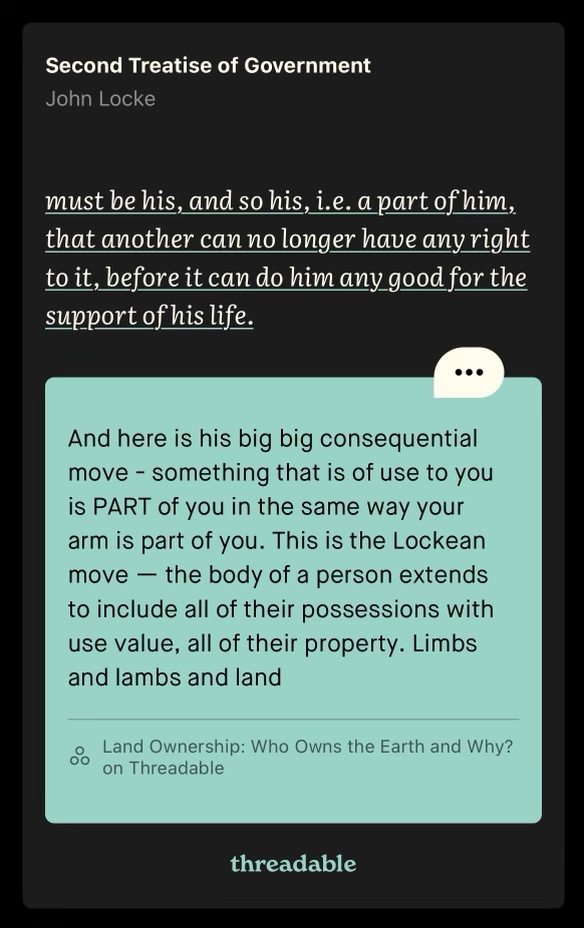
And it does infuriate me that this history is so little known. Like so much other history buried by the dominant culture and dominant class and dominant mindset, its invisibility to most people allows our imaginations to atrophy. It allows us to accept without questioning that private property is bedrock (of what exactly? Nobody ever really explains that), that land ownership is a norm that we cannot and should not question. It allows us to accept without examining that people like William Blackstone and John Locke were correct when they wrote, with zero evidence and very little reasoning, that private land ownership was somehow just “accepted on all hands” as the only way to run society, that without it humanity will descend into chaos, disorder, and violence.

But these rebellions were extremely active during these men’s times. There is no way they would not have been conscious of them, which makes me wonder if they ignored those realities on purpose, in order to wipe the reality of resistance from the history books. Hayes writes of both Blackstone’s and Locke’s patrons: Locke’s being the Earl of Shaftesbury, leading him, wrote Hayes, to write “essentially in defence of colonialism.”

“And Blackstone himself was writing under the financial patronage of George III and was the Member of Parliament for a rotten borough,* which put him in Parliament by virtue of his landholdings alone.”

*(Getting into rotten boroughs here is too much of a tangent, but I described it a bit in that essay on riots, and if you’re into fiction and like 19th-century British novels, Anthony Trollope’s Palliser series of books is all about Parliament, including rotten boroughs, pocket boroughs, and the fight for the unpropertied for the right to vote.)

There was no objectivity in their writings. There was thought, but as we’ve seen in reading their work on land ownership, it wasn’t of terrible depth, and nowhere were either of them able to point to a true, original justification for private property in land except for slapdash dependence on the Genesis book of the Christian Bible.

But people did fight back, and that history is still there to learn.

I’d intended to write more in this piece about the history of trespass itself, as someone kindly sent me some original legal papers on the subject going back to the 1100s in England. But that ancient history seems to involve trespass suits that included destruction of property or loss of life, which doesn’t have much to do with the simple act of stepping foot on someone else’s land being such an egregious offense as it is today—or if it does, that history wasn’t part of what I read. However, Brian Sawers wrote an excellent paper on the almost complete absence of trespass laws in America before 1865 (an in fact gives many examples of courts deciding for hunters and others, and against landowners, in cases of trespass), and how their introduction was due purely to post-Civil War racism. He published an article about his research with The Atlantic.

Trespass, like all property law, is another story created by a dominant culture and pressed upon society until it was finally accepted as “meant to be.” But it wasn’t. And it doesn’t have to be.

The Book of Trespass is a fierce, wonderfully wrought act of resistance against private land ownership itself. It’s a fun read (and includes Hayes’s own lovely ink drawings), but it’s also a necessary tool. We’ve had a few of those, like Nick Estes’s Our History Is the Future, Andro Linklater’s Owning the Earth, and Erik T. Freyfogle’s The Land We Share. By piecing them together, and at the same time refusing to uncritically accept the bedrock philosophies of a few propertied men with vested interests in the status quo, we can begin, at the very least, to realize that it didn’t have to be this way. We don’t have to accept that the private considerations of the powerful and heavily propertied get to dictate moral considerations for the rest of us.

The final reading will be from Mary Christina Wood’s Nature’s Trust: Environmental Law for a New Ecological Age. Like Freyfogle, Wood is a law professor. Her focus in this book is largely on agency capture and the difficulties that private property rights create for environmental regulation. The section I chose is from the latter part of the book, where she discusses limiting private property rights in the interests of the public good, and the importance of shifting away from thinking about land as a commodity, and to begin to think of it instead as a commonwealth.

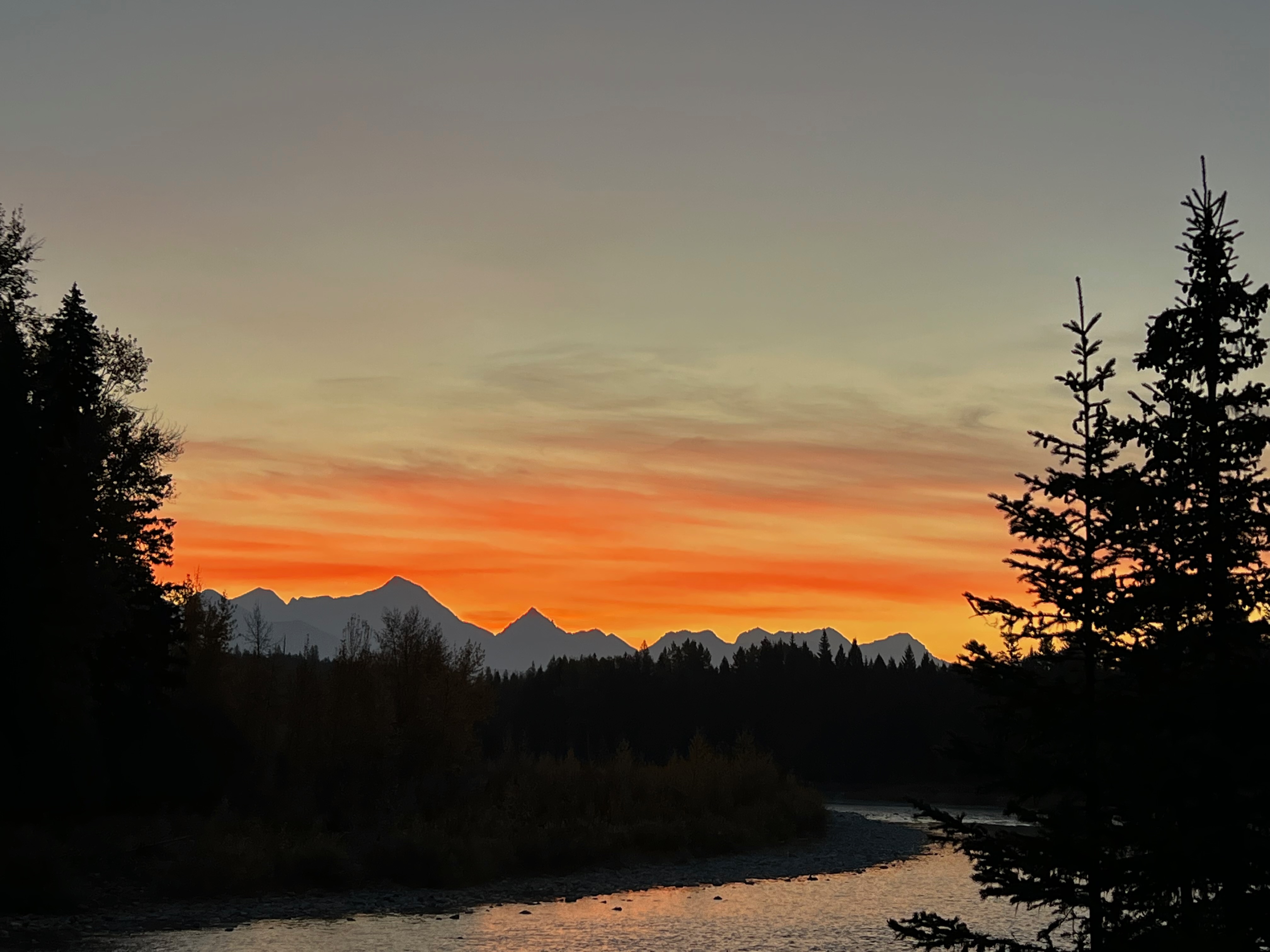
A view across the Flathead River’s North Fork. I wish I could share the quiet of this place with you.

Nature's not here for the stoke

Walking composition

“Sometimes you risk everything for a life worth living, even if you’re not the one that’ll be alive to see it.” —The Marrow Thieves, Cherie Dimaline

Quick note: Starting in April, I will be donating 5% of the proceeds from this newsletter to Indigenous-run organizations and nonprofits, with a focus on my local region. My intention is to donate to one organization each quarter, starting with FAST Blackfeet. I have more ideas lined up but please feel free to make suggestions, especially if it’s in my general region.

I’m telling you this less to encourage paid subscriptions than to encourage looking around wherever you live and seeing what you can do to support sovereignty in all its forms.

The last three walking compositions were open to everyone for reasons of content or photos (the most recent, on faith and atheism, had a lot of thought-provoking comments, including on the complexity of the word “faith”); these posts are usually for paid subscribers only. If you want access to paid subscriber material but can’t or don’t want to pay, just email me the code word “tribble” and I’ll set you up.

But if you can, and find this work valuable, give it a whirl, as my bagpipe teacher used to say.

Last Saturday morning I headed out of the house before sunrise to meet a friend on the ski mountain to go skinning, the first time in weeks I’ve been able to go on a weekend early enough to miss the ski crowds.

A crescent Moon, looking enormous and golden-yellow in the pre-dawn light, hovered over the far range that, once we got to a higher elevation, would reveal the peaks of Glacier National Park behind it.

But we never got that far. We clicked our toes into bindings and skinned up the bunny slope, past a couple of guys standing outside the high-end rental condos staring at the sky. Maybe they’re looking for late stars, I thought, until I saw the drone one of them was controlling hovering above us.

“Is that legal?” I mumbled to my friend, this technically being National Forest Service land leased by the resort.

“Probably not,” she said. I thought about saying something to them but the bone-deep weariness that’d been dragging at me for days met up with my wariness of confrontation, and I left it. I didn’t even have the energy to persuade myself the guy was probably an asshole. He looked nice enough, and how many condo renters do I ever see out enjoying the early morning?

We kept skinning until we got past the bunny slope and to the bottom of the first major hill, where we stripped off layers and I switched from gloves back into thick mittens. Even with the vigorous climb, my hands were freezing.

The first significant hill is intense. I’ve always disliked it. It’s steep and grueling, with a curve at the top around a continuous grade that seems to keep going and going. It’s where all the super-fit people first start zipping uphill past me. But that’s not why I dislike it. I dislike it because there are certain patches where the groomed snow’s often frozen enough that my skins slip. Usually, I can manage these spots by sneaking further out into the hill a little ways, where the grip is better. Saturday, though, even that didn’t do it, and I kept slipping back and catching myself with my poles until, finally, I fell over and had to stop myself sliding down the hill. Below, I saw other people struggling with the same issue, which made me feel slightly less idiotic but not less precarious.

I tried a few different methods of getting myself up to the top of that first hill, but knew that even if I made it, there were two other patches partway up the mountain that would be just as bad. Finally, while one guy wandered to the middle of the hill and struggled past us and another fell over below, I looked up at my friend and told her I didn’t think I could do it. “You go ahead,” I said, since her skins seemed to be gripping better. “I’m going to try to figure out how to get down.”


There was a magazine article I read years ago that I can’t remember the title or author of, or even the subject of, but I do remember some version of a line that stuck with me: Nature doesn’t exist for your stoke.

It felt important to read at the time because outdoorsy activities like cross-country skiing, mountain biking, trail running, rock climbing, and the like (I’m sure there are lots of others) tend to be represented as an unalloyed good, barely having an impact on the non-human natural world, especially when compared to, say, gold mining. Which, obviously, is true. Last week I signed up for a 6-day wilderness trail crew in August organized by the Glacier-Two Medicine Alliance; and even though, as I’ve written before, I’m not convinced that hacking out vegetation to make room for trains of pack mules is how people should be approaching nature, I guess I’d rather be supporting backcountry campers, outfitters, and guides than, say, the bank accounts of Rio Tinto executives.

There’s really no comparison between the scale and impact of those uses. But just because there’s no comparison doesn’t mean the question shouldn’t be asked. Even plain old hiking can have devastating impacts on elk populations, if trails are sited close to calving grounds. The scale of impacts matter, but what also matters is how humans approach the world we share and depend on. Our attitudes toward it. Is it there for our use, including recreation, or for its own, to be engaged with on the terms of its own needs and desires?

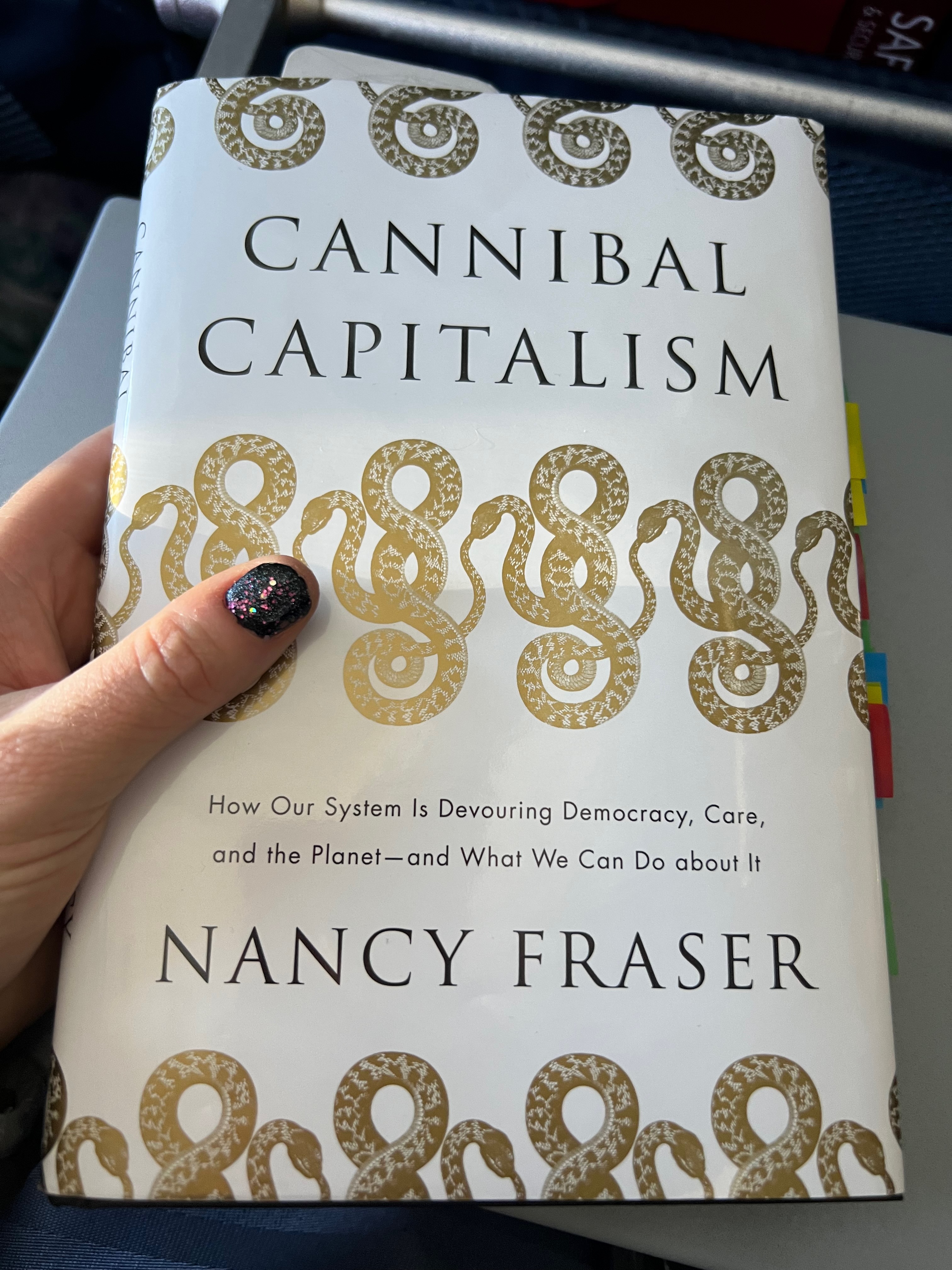
In the comments on the post about John Locke, a subscriber (thanks, Stefanie!) recommended Nancy Fraser’s Cannibal Capitalism, which I started reading a couple days ago. Some of the theoretical language is complex to get my head around, but Fraser’s points are clear:

“Structurally capitalism assumes, indeed inaugurates, a sharp division between the natural realm—conceived as offering a free and constant supply of ‘raw material’ available for appropriation—and an economic realm, conceived as a sphere of value, produced by and for human beings. Along with this goes the hardening of a preexisting distinction between Humanity—seen as spiritual, sociocultural, and historical—and (nonhuman) Nature, seen as material, objectively given, and ahistorical.”

Fraser went on to make the point that this divide is strengthened by a forced separation between the rhythms of human life and that of nature:

“Capitalism brutally separated human beings from natural, seasonal rhythms, conscripting them into industrial manufacturing, powered by fossil fuels, and profit-driven agriculture, built up by chemical fertilizers.”
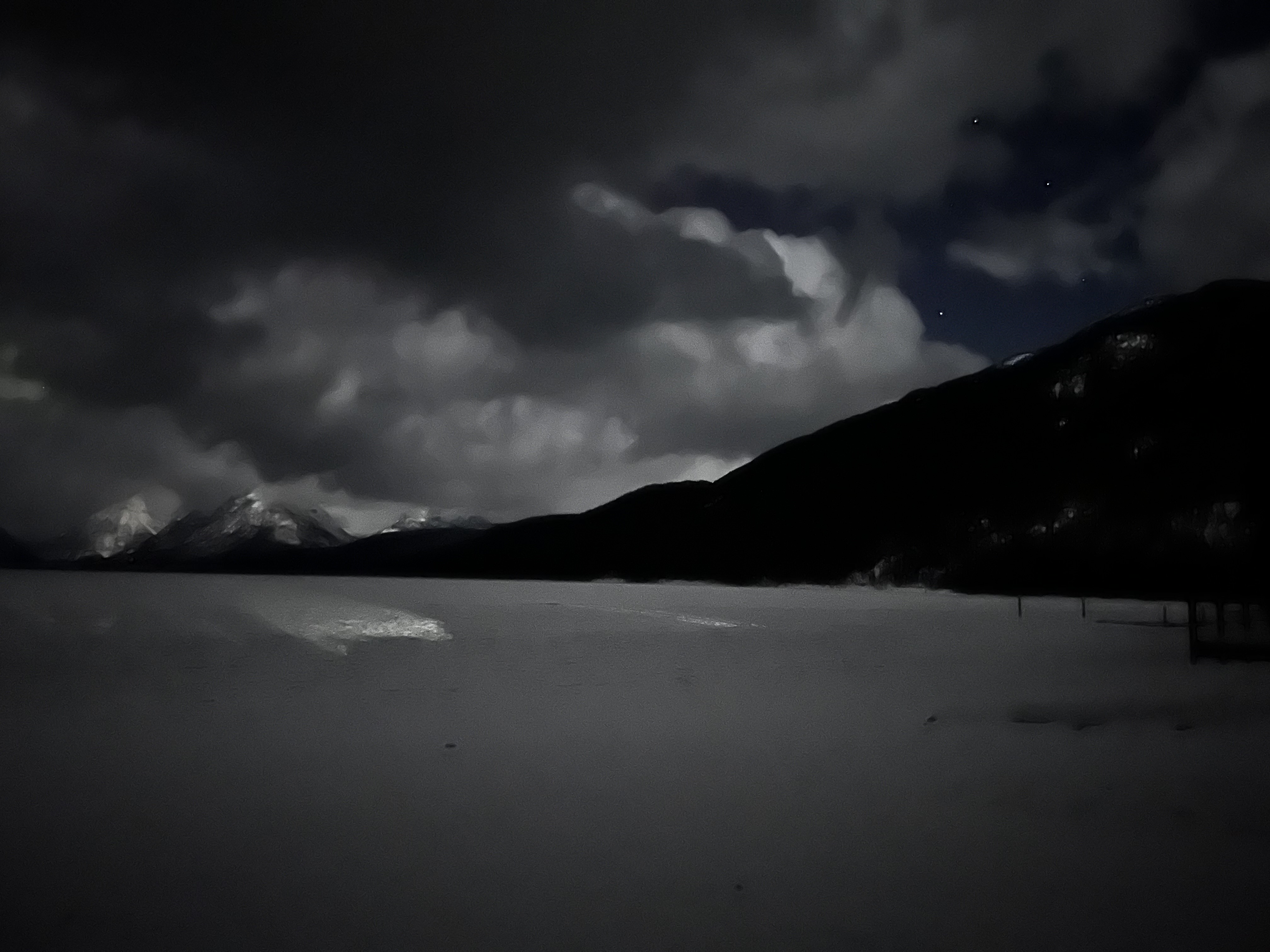
There’s something about an outdoorsy lifestyle—which I engage in plenty of, from hunting to hiking—that constantly risks becoming absorbed into this framework, where the “sphere of value” is narrowed down to what gratifies us. At what point are we imposing our activities on the world we live in, rather than making forays within the limits and needs of our local ecosystems?


It took me half an hour to get off of that hill. Bracing myself against the slick, groomed slope, I managed to strip the skins off my skis and twist the bindings back into position, but couldn’t find a place to put them back on that wouldn’t risk the ski just taking off downhill on its own. I finally dug my heels into the frozen snow and inched across to the edge of the run, where the groomers hadn’t been and there was more friction and a couple of moguls I could use to stand my skis and then myself on. I skied down the harsh, frozen snow until landing at the bottom, where I dug a thermos of tea out of my pack and read my friend’s text saying she’d only made it a few minutes further and would be down shortly.

I was sore for two straight days after that, in all the places that those of us who don’t physically labor much usually have to make special efforts with machines at the gym to strengthen, like the top of the chest and backs of the shoulders. I don’t really recommend trying to keep yourself from sliding down an icy slope into other skiers as a reliable workout regimen, though. There are a lot of bruises.

I have to watch out for my own expectations from this world all the time, not just when trying to go skinning up an icy hill. I get frustrated with people where I live complaining about snow and winter and gray days, and sometimes remind them (nicely) that without the snowpack, the rivers and lakes suffer in summer. But I’m no better. We recently had three straight days of cloudless, sunny skies, and before the end of the first one I could feel myself starting to grumble. The sun just kept shining. But just because I personally might be happy with, say, two sunny days every couple of weeks, it doesn’t mean that’s what the ecosystem needs.

This bird doesn’t really care what I think about extended daylight hours and too much sunshine.

We all need more than we’re getting. We need more rest, care, connection. True community, friendship, love. We need laughter and time to wander in the world and put our hands in soil and sit by rivers. We need more movement and real stimulation for our minds, wildness within ourselves and within the world. We need more of a lot of things, and to let go of a lot of other things. The one thing we don’t need are any more ways to demand that nature to serve us.


Some stuff to read or listen to:

  • On the Land Clinic newsletter, a guest post by Ione IronHorse Martel Jones about land that was taken from her family by eminent domain to build a dam on the Snake River, and the fight to get it back: “My family’s story is challenging for a reason, it’s been buried in a system that is intentionally complicated and emotionally draining. This hard place is forcing us to think about other ways to imagine land return. Could there be such a thing as a reversal of eminent domain?”

  • Science writer Jill Neimark wrote a deeply reported piece for STAT on the effects of the toxins released through the Ohio train derailment. One of her interviews was with Rebecca Gasior Altman, an environmental sociologist currently working on a book about plastics. If you’ve never read Altman’s Aeon essays “American petro-topia” and “Time-bombing the future,” I highly recommend them.

  • I’ve been working my way through history professor Timothy Snyder’s recorded Yale lectures on Ukraine (link is to his Substack explainer, with links there to podcasts and YouTube videos). If you’re interested in the history of that region, lectures 1-6 in particular dwell on the more ancient history of Kievan Rus and its precursors, reorienting the history of the region away from Europe and more rightly toward Africa and the Mediterranean. (If you’re more reading- than listening-minded, Orlando Figes’s recent book The Story of Russia covers a lot of the same historical ground.)

  • On the Reframing Rural podcast, author of Pushed Out: Contested Development and Rural Gentrification in the US West Dr. Ryanne Pilgeram talked about a high-end housing development built on the site of a closed mill in her hometown of Dover, Idaho, and the effects it’s had on locals: “On the ground, the issues boil down to the haves and the have-nots: the person with multiple homes paying for sole access to the best beach in Bonner County, and a community raising funds for their one and only community hall.” (This is an excellently produced story, and I don’t disagree with anything in it. But as with many of these stories, there is still a de facto acceptance of the original theft of land in North American, even with a thoughtful telling of that theft.)

  • The Rev. Dr. Donald Perryman and Kennedy Smith on Building Local Power on the fight to keep “dollar stores” (in the form of Dollar General) out of neighborhoods in Toledo, Ohio: “The reality is that they’re gonna hire three or four people, and they’re gonna to pay poor wages, and they’re going to artificially promote people to assistant manager so that they don’t have to pay overtime, and they’re going to overwork them. And, they’re going to harm a lot of locally owned businesses.”

  • On the subject of intellectual property, the commons, and language, I keep rereading this article about elders who worked with the Lakota Language Consortium to preserve the Lakota language, only for the nation to later find that the Consortium (not affiliated with the Lakota nation) expected them to pay for materials that had been created from their language. This is one of those areas of property where I think the dominant culture can blind many to the damage it does through claiming ownership by adding a bit of labor and materials to something that by rights belongs to others.

Walking with faith

Walking composition

“Sing me again the saga of sin
and separation,
of humans and hierarchies;
I’ll sing you the ballad of glacial bodies
of many creatures made of water and belief—”
—from “Of Eons and Epochs” in
Copper Yearning, Kimberly Blaeser

Last night my daughter and I made another attempt at seeing an aurora, this time driving up to Glacier National Park much later, around midnight, with an Enya CD playing instead of bad ’80s rock on the radio.

While she dozed, I drove through the dark, fighting off minor panic attacks at the wholesale lack of visible highway striping because winter is only just ending and those lines won’t get repainted for a while, if ever this year; and crawling through the heavy fog that frequently hangs around where the highway dips down to cross the river.

Instead of a cloudy night with Moon just behind us and a bad photo that came out like an oil painting, the sky over the lake was crisp and clear and full of stars. No aurora in sight until I took some photos and we spotted a smear of red along the horizon. The patch of sky-color, which probably isn’t visible in the photo above, reminds me of one of those 3-D optical illusion pictures that were popular in the late 1980s and early ’90s. If I open the photos on my phone and make sure the screen background is dark and am not looking at it anywhere with sunlight, I can see the red. Otherwise, it’s invisible. Is it there?

Maybe, as with so much of life, the answer is up to each person who looks at it.


Last week a subscriber asked a question in the comments related to my self-description as an atheist, a question I actually always appreciate because it doesn’t seem to me that what I mean by it is what most people mean by it. It’s never a bad thing to be offered a chance to be understood.

I’ve been thinking about the question ever since then, and find myself strangely reluctant to talk about it more in depth, partly because I am an intensely private person—there are very few friends, even close friends, to whom I’ll open up parts of what might be called a true self—and partly because I wrote a long essay about this years ago and much of what I could say would be repeating myself. It centered around seeking faith in a Russian Orthodox Church in St. Petersburg, and the longing and loneliness that comes from not having it:

“From childhood on, I have always been told that atheism is a willful choice to reject God—a choice to say there is no god, no deity—and agnosticism is simply the empiricist’s way of saying that there could be a god but we don’t know one way or the other. . . .

“It never occurred to me to choose not to believe. Who would choose such a thing? Only the most self-confident and satisfied person would choose to live like this. . . .

Atheism was never a choice.”

That essay is ten years old. Older, actually, since it had been sitting around for several years before it got published. Let’s say fifteen years. A lot has changed for me since then, but I’m not sure the English language has been able to change with it.

Since I’ve been dwelling so much on language and metaphors recently, it did occur to me this week that “atheism” might not be the most accurate word for missing faith. I know what the popular, Richard Dawkins-type characterization of atheism is: like so many other things, some privileged white guy running around telling everyone else in the world what to think.

People point out that “agnostic” is an option, but agnosticism is doubt. What I experience—and I am sure that many others do, too, even if they haven’t identified it—is lack. Like something is missing, or broken. Faith in something goes back to the earliest evidence of human consciousness and I’m willing to bet further than most of us can imagine. It’s hard to take a comprehensive look at the entirety of human experience across millennia and continents and not believe that faith is part of being human.

What does it say about those of us whose experiences might have snapped that connection? What would a person’s life have to be built of to make them incapable of believing there’s something caring in the universe, no matter how much they might want to?

I’m not looking for sympathy about that any more than I’m looking for proselytizing. It’s just something I’d like people to think about.

The popular conception of atheism is not just that it’s a wholesale rejection of faith for oneself; it’s also a determination to tell everyone else that the things they have faith in don’t exist. I’ve never believed in that. I envy others’ faith more than anything else. So maybe “atheist” isn’t the right word. What would be the word, then, for the connections that seem to have gone missing?

When I published that essay, it was a few years into motherhood and I was still haunted by an experience I had shortly after my first baby was born nearly eight weeks early and hovering around not surviving for close to two weeks after that.

“The day they called my husband and me at home to tell us that John needed a second air tube, and that he was ill enough they might need to move him to a tertiary care center, my reality ground itself into little pieces. I could do nothing for an hour but huddle on the floor and sob as I hadn’t done since I was a small child. I was so scared.

That same morning, I had woken up suddenly, just after seven, certain I’d heard John’s voice calling to me. Crying for me. I felt that he was in pain and needed me. It was only later I found out that I’d heard him, a forty-five-minute drive away, at the same minute they’d cut his chest and inserted the tube. I knew because, of course, they wrote down the times of all procedures, and I had checked the clock when I’d woken up (to see if it was time to drag out the breast pump), two hours before they called us at home. That is the part I’ve never told anyone.”

Many would call that a religious experience. Many would say “spiritual.” All I could say was that there were things in this world I could not explain.

This is where the snapped connection comes in. I’ve had other experiences like that. And there was the time I walked a labyrinth in Norwich, England, while researching my book on walking and received an incredibly powerful message that lives in me to this day. I would like to walk labyrinths all the time just to touch base with it again.

Once, last year I was sitting by a river, at a spot I love, and water spoke to me. The river had something to say, and I listened.


I don’t know that I’m comfortable anymore with the description “atheist” but I honestly don’t know what to replace it with. “Spiritual but not religious” conjures up way too many unpleasant experiences with unpleasant people, usually involving a campfire and a guitar and probably a whole lot of hamfisted and thoughtless cultural appropriation. To say that everything is connected, everything is alive, is perhaps the closest. Is there a word for that? Maybe not in English.

I wonder sometimes if English has had its day. There are languages with far more acknowledgment of life inherent in every syllable without bowing to hierarchies that burden almost all of it—life, that is, as well as syllables. Maybe it’s time to start retiring some of its less relevant words. There are, as they say, no atheists in a foxhole.

English can’t even capture last night’s aurora encounter. Did we “see” it if the only appearance of color was on my phone’s camera? And even then, the red streak is only visible if the photos are viewed under certain conditions. Have I fulfilled my promise to see an aurora, or do I need to try again? (Going to see an aurora is never a waste of time, even if unsuccessful, but the combination of night driving and the next day’s tiredness are . . . a lot.)

Maybe faith is the same. Maybe if I turn my mind slightly and look at things in a different light, under the stars, I’ll find what I’m looking for. I suspect that whatever happens will remain private, between me, Moon, the rivers, mountains, trees, and stars. Or maybe not. Maybe it will show me an entirely different way of talking about everything, including myself.

Ninepipes National Wildlife Refuge, where I spent some time the other day and heard many red-winged blackbirds but, due to the thick fog, only saw two. They were there, even if I couldn’t see them.

No list this week. I’ve got a few big deadlines coming up and have been very overwhelmed and also for some reason am not sleeping much.

I’m doing some preparation reading for an upcoming Threadable circle on Science Fiction, Fantasy, and Belonging—thanks to Stefanie for a fantastic selection of recommendations!—and also have been reading:

  • Elinor Ostrom’s Governing the Commons, her research on commons-based ownership and management systems for which she received the Nobel Prize in economics.

  • Steven T. Newcomb’s Pagans in the Promised Land, which was disconcerting because he leans heavily on the book Metaphors We Live By, which you might remember reading about a couple weeks ago, and I picked the book up a day after finishing that post.

  • I’m making very slow progress on Abdullah Öcalan’s The Sociology of Freedom, which is well worth it. Öcalan has been a leader in the Kurdish struggle for liberation and has been in isolation in a Turkish prison since 2011.

  • Wergen: The Alien Love War, by Mercurio D. Rivera, which, if you like science fiction, is I promise much better than its godawful cover indicates.

  • I’m in the middle of Cherie Dimaline’s book of short stories A Gentle Habit and also recently finished Hunting by Stars, her sequel to The Marrow Thieves.

  • One very short essay to recommend: Hao Jingfang’s “I Want to Write a History of Inequality,” which accompanied her Hugo-nominated science fiction short story “Folding Beijing,” both translated by Ken Liu.

  • And two very kind subscribers sent me an unlocked PDF of the paper about Mary Wollstonecraft’s feminist critique of property, which I’d mentioned in the land ownership post on John Locke. Which means I can share it for anyone who’s interested.

Darkness in the lights

Walking composition

“The world is airtight
yet held together
by what it does not house,
by the vanished. They are everywhere.”
—from “The Vanished” (“Die Verschwundenen”), Hans Magnus Enzenberger

Last week I spent a lot of time being very cold sitting by the North Fork of the Flathead River—pictured above during a freezing sunrise—near a Forest Service cabin I try to rent for myself a couple times a year. It’s only for two or three nights, but every time I get an unexpected amount of work done and still manage to sleep a lot and spend long, long periods by this river and even just be a bit lazy. It’s a miracle of time-luxury, as if the hours spread out far beyond their known limits.

My phone had a handful of saved podcast episodes for the two-hour drive, including an interview on the Subverse with designer Dilip Da Cunha about his book The Invention of Rivers. The line separating land from water, he has written, is “one of the most fundamental and enduring acts in the understanding and design of human habitation.” He also calls this separation “the first colonialism, which took a wetness that is everywhere and turned it into a land and water binary.”

What is a river? How can we find a river’s beginning? Where would you identify that first trickle, the initial hint of flow, the moment water shifts from being rainfall or snowflakes to being river?

To get to the river from the cabin, I had to walk about a few minutes through still-deep snow, sometimes falling through the hard crust well past my knees and nearly dropping my coffee. When I got there, after greeting the sunrise, I (unwisely, considering the temperature), splashed icy river water on myself.

Rivers, I learned some years ago, are ecosystems that can spread for miles underground, unlimited to their visible flow. When I sat on the rocky bank, it seemed that the river was over there, while I was dry over here. But under the rocks, the river extended far beyond what I could see. I had snow in my hair and river water on my face; and the coffee steaming out of my cup was made with, of course, water. Where did the snow end and the river begin? At what point did the river cease being river and become an avenue for risking frostbite on my face? As the coffee steam mingled with the freezing river mist, could anyone have distinguished one from the other?

What is a line, after all, but a mathematical construct, an ideal? Human mathematics, which needs those imaginary lines, is a language for understanding life’s patterns and relationships; it’s not life itself. Yet lines have been employed for millennia to declare and then enforce boundaries that life, including human life, has no relationship with.


I caught up on nearly a year’s worth of Nautilus magazine while I was away, and one of the articles that got my attention was about research on plummeting global populations of insects.

I almost avoided that article because I didn’t want to get more depressed by reading something I already knew too much about, but it turned out to not have that effect. The writer was spending time with scientists whose theory is that insects are evolving to avoid nighttime light, and since entomologists tend to try to attract them using said light, they’re not finding the insects that are there.

It’s an early-stage and hopeful theory that I hadn’t heard before. But what interested me was my own emotional and mental responses to the writer’s approach: dread, hesitation, and worry followed by cautious uplift, curiosity, and hope. An arc that was followed in turn by wondering what effect this kind of research and article would have on other people.

There’s constant debate among science writers and people working in related fields, and scientists themselves, about how to make people care about huge existential problems that don’t always immediately affect them. Like climate change. When David Wallace-Wells wrote his New York magazine piece (followed by his book The Uninhabitable Earth; full disclosure, I haven’t read either of these) about worst-case climate scenarios, there was a lot of heated argument about how he should have presented such dire realities to evoke less fear, along with intense debates over how his approach might be effective, versus the ways in which it could backfire. My science writer friends and I talked about it at length.

Reading this piece about insects made me think about that debate again. The author, Oliver Riskin-Kutz, seemed to maintain a careful balance of informative storytelling that kept me, at least, on a thin edge of wondering, “Do I hope, or do I despair?” It was interesting to try to observe another writer’s skill in refusing to push the presentation of research one emotional way or another, while at the same time not pretending to objectivity.

The question of “Do you scare people to get them to care about things like climate change or water pollution or authoritarianism, or do you give them hope?” which Wallace-Wells’s essay and book poured fuel on, is, I think, the wrong one. The conventional wisdom that humans are incapable of considering long-term consequences of our actions is an extremely narrow-minded view that leads to misguided approaches, but aside from that, there are something like eight billion people on this planet. All of us have different compulsions, worries, hopes, experiences, and identities. Maybe one of you will read that article and find it dull, or misleading, or far more hopeful than I did.

What gives me a rare spark of hope or pushes me into despair is going to be very different from what does the same for you. It’s determined by my own feelings of identity and belonging, not just by what I value and what matters to me and who and what I love, but by my upbringing, the kind of work I’ve done, physical and emotional realities and injuries, the people who’ve affected my life in large and small ways, and countless other factors. Kindness, compassion, and trust, for example, are high values for me less because of their being common in my life than by the many ways I’ve experienced the opposite, or seen others experience the opposite, and have struggled under the effects those experiences have had.

The question of what changes people’s minds, what persuades them to be better, to care more, in the end almost feels like a shallow one while still being essential. It’s essential because, to change the paradigms we live in we need pretty much every tool and strategy—build it up and care for the falling while burning it down, as I wrote a couple weeks ago—but it’s shallow because the question both assumes a nonexistent homogeneity among human experience, and makes poor use of the power of narrative and storytelling.

Writing, and art itself, have capacities to reach into every individual in different ways, to speak to or help articulate identities and values. It can be empowering, for ourselves and for our behavior toward others. Erik Hoffer noted in The True Believer that those with a creative or artistic mindset are the only ones he saw who don’t succumb so easily to propaganda and the lure of authoritarian mass movements. Aleksandr Solzhenitsyn talked about the power of art in his Nobel Prize acceptance speech:

“Who could impress upon a sluggish and obstinate human being someone else’s far off sorrows or joys, who could give him an insight into magnitudes of events and into delusions which he has never himself experienced? Propaganda, coercion, and scientific proof are all equally powerless here. But fortunately there does exist a means to this end in the world! It is art. It is literature.

They both hold the key to a miracle: to overcome man’s ruinous habit of learning only from his own experience, so that the experience of others passes him by without profit. Making up for man’s scant time on earth, art transmits between men the entire accumulated load of another being’s life experience, with all its hardships, colors, and juices. It recreates—lifelike—the experience of other men, so that we can assimilate it as our own.”

Reading that piece about insects changed something for me, though I’m not sure what yet. Not anything enormous or significant, just a slight shift. Opened up a new way of looking at the world, maybe, which is one of the beautiful things that narrative can do.

Art, including storytelling, draws lessons from the world all around us, like the sunset alpenglow I got to enjoy for more long, lingering minutes with only the river’s conversation last week. But it also draws from an intuitive sense for how these sights and experiences make us feel. At least, it has the capacity to do so. Considering the varied beauty I got to experience in this one location and how badly I didn’t want to leave it even when completely numb from the cold, that’s a capacity worth exploring.


On the night of the full Moon last week, I got up as I usually do at this cabin around one-thirty in the morning (I do not know why and might write about this more, but I think it has something to do with the almost total lack of artificial light) for a while and spent a little time on the porch gazing up at Her before going back to sleep. Moonlight reflected off of ice clumps on a bare-branched aspen tree next to the porch, so brightly it was like the tree had its own starscape.

I’d watched Her rise from behind the snow-covered Rockies earlier that night just before I went to sleep, enormous and golden, overwhelming. A being to worship, just as the Sun felt coming up from behind those same mountains each morning. I took a video of the full Moonrise from when I first noticed the glint of cold, bright light shining along the edge of one of the peaks, straight out the cabin’s small, warped window panes, and later shared it with my sisters.

It was a miraculous sight that went straight to the core of everything that matters, if that makes sense, even though it’s one I’ve seen versions of many times before, including from behind those same mountains.

Art still has much to learn from experiences like this. For one thing, we need a world where they remain possible, a world where everyone has an opportunity, if they want it, to get away from the noise and demands and unwanted light of electronics, cars, and schedules. But it’s necessary for people to pay more attention to the art, too. To ask more of it, even. To ask it not just to entertain or to challenge, but to remind us of life’s promises and our own potential. To show us how unconfined life is by our boundaries and definitions, like rivers that have little need for the lines drawn on a map. Narrative that breaks down ossified paradigms. There is storytelling that does this, everywhere; it just needs more of us giving more of our attention to it.

Start paying attention, and you can see the subversive power of art articulated in countless ways. Some of them, as with a well-written science article about entomology, without pretending to subversion but only to curiosity—which has its own power of subversion—and what might be called a hope for hope. Showing us what the world can look like when an artificial line is erased. A light in the darkness, even if it’s about searching for darkness among the lights.


Some stuff to read or listen to (note that Nautilus only allows 2 free reads):

  • Susan Mathews’s short introductory episode (scroll down to Episode 2) to the Subverse’s season on water, “From the stars to the tidepool,” was a beautiful meditation on where Earth’s water came from and what it means to all levels of life: “At some point, star water turns fish water.” (The Subverse links are to their website, but the podcast is anywhere.)

  • Historian Sunil Abritt also on the Subverse podcast (scroll down to Episode 5) talking about hydrocolonialism, an “ecology of fear,” and his book Unruly Waters: How the Mountain Rivers and Monsoons have Shaped South Asia’s History. (I honestly didn’t know I could be this interested in monsoons.)

  • Rebecca Davis Gibbons with a short piece about the justice owed to people affected by nuclear testing in the Republic of the Marshall Islands, in the Bulletin of the Atomic Scientists: “My friend said that justice would mean returning home to a safe environment and sufficient medical care. But more important than any of that, for him, is an apology. The United States ‘is a powerful country and can do many things,’ he said. ‘But it cannot apologize.’”

  • Mary X. Dennis with a difficult and introspective essay in Nautilus on trying to cope with enduring, acute grief after her brother’s sudden death: “Karin didn’t focus on the event of my brother’s death, the way the PTSD therapists had. She focused on him—not on the trauma of his death, but on the relationship I had lost. . . . My favorite version of myself was the person my brother saw me as, and she helped me to realize that even though he’s no longer here, I am still that person.”

  • Also in Nautilus, Nell Freudenberger wrote a thoughtful essay on the disconnect between foreign research scientists studying coral reefs, and Indigenous Māʻohi people in Tahiti, including the scientists’ lack of local knowledge and insights about coral health remedies due to lack of outreach.

  • Regan Penaluna writing in Aeon about the scholarly work of 17th-century philosopher Damaris Cudworth Masham and how Masham’s relationship with philosopher John Locke affected her life as well as her philosophy. (It’s a sympathetic essay, but Locke doesn’t come across to me as treating anyone well.)

  • Thanks to my mom for this one: Frank Jacobs writing in Big Think’s “Strange Maps” on a map of the ancient Paratethys Sea, which once had a surface area of over a million square miles but evaporated between 7 and 10 million years ago, leaving behind remnants like the now equally-disappearing Aral Sea.

  • And some of you might have heard of the new conspiracy theory surrounding the idea of 15-minute cities. As someone who’s written a book about walking and walkability, I find the whole resistance to changing car-centric culture utterly bizarre. So did someone who wrote a piece for McSweeney’s introducing us to the appeal of the 15-hour city: “The 15-Hour City represents what we think are all the best qualities of a modern city: a lack of social connections, a profound sense of alienation, and a constant stream of being flipped off by drivers from New Jersey.”
    (Something that baffles me about this movement is that conspiracy theorists are linking the idea of being able to walk to whatever you need within 15 minutes to—weirdly—Stalinism. In my book I wrote quite a bit about the freedom of walking that my father had growing up in Leningrad under Stalin when other freedoms were out of reach. This was . . . not what I was talking about.)

Reading "Second Treatise of Government," by John Locke

Threadable-adjacent reading discussion on land ownership

The most recent Threadable reading* for Land Ownership was a selection from John Locke’s 1690 book Second Treatise of Government, Chapter V: Of Property.

*(https://threadablenative.page.link/Rxp8yegeZ1vXy4u19 if you want to try the Threadable app and need the link! Only works on iOS/Apple devices for now.

For anyone new to On the Commons an overview of this project is here. Please feel free to comment or email me with any questions.)

Locke’s Treatise is in the public domain, and there are many different places online where you can read the text. I have a hard copy (my eyes are always tired from copy editing, so hard copies tend to be my go-to), but there are online PDFs, such as this one from the University of York. The link in the first paragraph is to the Project Gutenberg ebook version.


It’s hard to know where to start with John Locke because, as with William Blackstone in the previous reading, his ideas about the basis of private property, especially private ownership of land, are both foundational and surprisingly shaky.

Locke’s idea was that men (only men, of course, and only white men I’m sure) gained ownership of land by “mixing” their labor with it: planting, tilling, harvesting, that kind of thing. Basically, once you worked the land you could claim it as your own.

That’s not actually nothing. He spends a fair amount of time dwelling on what happens in the space between, say, a piece of fruit hanging on a tree and its location in your hand, at which point it is “yours” to eat. Or is it? It’s actually a curious philosophical question. I’ve personally spent a lot more time thinking about what effect one’s private ownership of land, food, water, etc., has on other people. How much land can you claim for yourself before it deprives others of their right to survival? What property rights can you exercise before it start to erode others’ rights?

The fact of when something becomes “yours” feels a little different, more philosophical but also tangible. I can’t claim the pie cherries from my neighbor’s cherry tree no matter how many cherries I could personally pick—and despite the fact that they’re rarely in town when the cherries are ripe—because the tree isn’t mine. Yet when I gather chokecherries along the public paths in town, I transfer public claims over that fruit to my own private use and benefit. And to the benefit of whoever receives the chokecherry jelly I make.

(Also I deprive the bears of food. Or maybe they deprive me of food. I’m not sure, but publicly owned fruit trees and wildlife is an issue I’m having to think about now that I’m on the city’s Parks Board.)

So it’s not simply, as one Threadable reader pointed out, the Locke sees the mixing of labor as the first element of ownership, but the question of how one justifies claiming resources, such as food, for oneself—a claim that is necessary to live.

Locke’s perspective is one I didn’t really pick up on in the reading and it had to be pointed out to me: that the ownership claim is an extension of claim over oneself. That people* have ownership of themselves, and their self-ownership extends then to the property they own, whether land or gold or cows. “The body of a person extends to include all of their possessions with use value,” as this commenter wrote. “Limbs and lambs and land.”

*(Remember, for Locke only white men are people, and likely only white men who are property owners to begin with are people—not an uncommon view; Immanuel Kant believed that only property owners and those who held public office could be considered citizens; anyone who worked for wages was in his view disqualified. It’s important to remember here that it’s been less than 150 years since any kind of non-landowner was allowed to vote, including men. Being a woman, I would not be considered a person in Locke’s eyes.)

I kind of wish I’d included Mary Wollstonecraft in these land ownership reading selections because she has some major critiques of Locke, and of private property in general, but am saving her for when I start writing the chapter on ownership of people for No Trespassing. However, there’s a great paper on her feminist critique of property (paywalled, unfortunately; just love the enclosure of knowledge we swim in) in which the author, Lena Halldenius, makes some acute observations about Wollstonecraft’s views of property:

“Property is a selfish principle, invoked by the rich under the false name of liberty in order to protect themselves against the claims of the poor,”

a principle that not only prioritizes the lives of the privileged, but also completely excludes women from ownership of anything, since in her time women never could own themselves. They were the property of men, a state that plenty of U.S. lawmakers would like to see us return to.

On Locke, Halldenius explains his view that,

“Land, originally held in common, can be turned into an object of private right through a performative act of appropriation. Labor is his term of choice for that act whereby a thing is acquired out of the common stock and turned into a person’s property.”

It’s a pretty succinct explanation, and exposes the problems that I had with Locke’s logic, which came down to three issues: 1) Like Blackstone, Locke several times says that nobody will ever claim more property or resources (like food) than they can actually use themselves, and therefore privatizing the commons for one’s own benefit doesn’t harm anyone else; 2) his definitions of land as “unused” or “waste,” which—again like Blackstone—he uses much of North America as an example of, claiming that it’s okay for colonizers to privatize land on that continent because the people who live there aren’t using all of it; and that 3) both subduing nature (Earth) and the command to labor come from God and are therefore unquestionable.

Point (3) came up in Blackstone, so I don’t really want to belabor the point that a command from God isn’t a good enough reference point for private ownership of land. Both he and Locke really tried to press that point, and on that basis alone it’s disturbing to me that much of our modern-day conceptions of property law still rely on their philosophies. But aside from that, even if you believed in the religious claims he’s making, it doesn’t logically follow that a divine command to labor mixed with the gift of Earth from God translates into private land ownership. There’s no there there.

Locke’s claim about it being “wrong” to take more land and resources than one needs, and that it won’t happen, is flat-out frustrating. You can say it’s wrong until the sun turns chartreuse, but it doesn’t stop people from doing it. Referring to that and his idea of “unused” or “waste” land, he tries several times to say that private claim over them is always achieved by “common consent.” He says this without, however, ever giving any actual evidence. Whose consent? When? How? Why would anyone who didn’t personally benefit consent to private ownership and gain rather than something more equitable?

One of the reasons it was so frustrating for me to read that was because everything he wrote about letting his horse chew grass, or tilling a certain field, or gathering acorns, is easily applied to a commons-based shared-use system. No privatization is required for any of it. Aside from which, he never addresses how this “common consent” happens, only that it does. Similar, again, to Blackstone, who said that it was “on all hands agreed” that land was made better use of when it was privatized. I bet those hands were not the ones doing most of the work on that land.

What he’s saying in this above quote—“there are still great tracts of ground to be found, which lie waste, and are more than the people who dwell on it do, or can make use of”—is that if colonizers anywhere in the world see land that they perceive to be unused, they have a right to take it. Which contradicts any waffle he makes about “common consent” anyway. Whose consent? I think we know the answer, but Wollstonecraft said it succinctly:

“It is only the property of the rich that is secure.”

And by extension colonial and imperial powers.

Dwelling on Locke’s philosophical question about when something becomes yours to consume or use or simply to keep is an interesting one. But none of his ideas either defend or effectively argue for private ownership in land. Aside from all the other logical inconsistencies, he never addresses the issue of how someone can “own” land that others do all the labor on. Why don’t the people working on a farm or great English estate own the land? Because—he never says this in this section but its reality might be somewhere else in the Treatises—their labor is also owned. It’s just self-justifying hierarchies all the way down.

Neither Blackstone nor Locke nor any of the other people with their money and influence and titles and centuries of reference can answer the essential question: Where did private property begin? And why?

You can take an apple from a tree, and then it’s yours. And we can debate about the philosophy that happens between the existing and the taking and the consuming. But to justify the reams of legal principles and decisions around private land ownership—especially when we remember previous readings about enclosures of the commons, the Christian Doctrine of Discovery, Johnson v. M’Intosh, and centuries of theft of Indigenous lands worldwide—we’re going to have to do a whole lot better.

I don’t think we can. After all these readings, “I took it; now it’s mine” is still all we’ve got going for private land ownership, and that is no basis on which to share an ecosystem, a planet, or a life.

Only two more readings left! Nick Hayes’s The Book of Trespass, and Mary Christina Wood’s Nature’s Trust: Environmental Law for a New Ecological Age. I’m afraid neither of these are in the public domain but both are well worth reading. Hayes’s book is particularly delightful. He’s an engaging writer and doesn’t hold back his low opinion of private ownership of large English estates and the theft they originated in. He also includes his beautiful ink drawings throughout the book.

I am once again going to be offline for several days, and will respond to comments, etc., when I return. Thank you for traveling with me on this weird journey. Please enjoy this photo off into the wilderness from a ski day I took with some friends last week. The snow ghosts and cloud banks were off the charts beautiful.

Burn it down, build it up; catch the light, and the falling

Walking composition

“Scheming on a thing, that’s a mirage
I’m trying to tell you now, it’s sabotage.”

— “Sabotage,” Beastie Boys

Sunday night my daughter and I folded ourselves into the car to try to find some Northern Lights. The Kp index was at 6, well within our zone, and she’s been wanting to see the aurora for over a year. We drove up to Glacier National Park to walk by the lakeshore at Apgar about a half-hour’s drive from our house.

I’m not a good night driver. Even as a teenager I avoided it because my night vision is iffy. Walking is okay, but driving I can’t seem to process the headlight-lit information quickly enough and feel precarious. Every now and then, though, it feels good. To be out on the road at night, few other cars, ’80s rock on the radio except never the good ’80s rock, the songs you could never quite sing along or dance to but couldn’t headbang to, either. It reminds me of rare freewheeling teenage nights. Alone in my parents’ car before I wrecked it one icy day, sixteen years old and driving that same road back at night from my summer restaurant job near West Glacier. Listening to the same damn radio station.

I rolled into the parking lot and we walked out to the lakeshore under moonlight that moved in and out of clouds. It was still far too overcast to see anything but a few stars, and we kept turning around to stare at the Moon, shivering in the wind that blew across the frozen lake. We saw no aurora, but didn’t want to leave. Wouldn’t it be nice, we both said, if we could just spend the night here in the quiet under the stars peeking out of the gap in the clouds?

I took a photo, which was terrible, except I kept it because it looked like an oil painting.

“Should we try going up the North Fork?” I asked her, mindful of our mutual tiredness and my poor night vision and school the next day. She shrugged.

“Why not?” So we drove back south again, wiggled through the back streets of Columbia Falls, and headed up the North Fork, talking almost the whole time of the pains of middle school and the stupidity and cruelty of the Montana state legislature. An entity I wanted to assure my daughter I’d protect her and all the other kids and every vulnerable person from, but is that a promise any of us adults have shown ourselves capable of keeping?


Tuesday mornings almost every week, I volunteer in my daughter’s sixth-grade classroom. I thought I was done volunteering in my kids’ classes after elementary school but her teachers decided on a book clubs routine enabled by parents like me who didn’t realize they were getting into a year-long commitment. So Tuesday mornings I walk her to her entrance and then go around to the front of the school to check in as a volunteer, make small talk with the office staff while they print out a sticker that sometimes, for some reason, has my old driver’s license photo on it from almost ten years ago when I still kept my hair short and my skirts long.

I’ve worked in textbook publishing for so many years that garnering enthusiasm for rubrics or worksheets is something I can no longer even fake very well. Does it matter if students can identify the main idea or give supporting details? Not really. Half the time those questions aren’t even written well enough for students to understand what they’re looking for, but that’s not the point. The point is that nobody really gets anything out of answering questions that are only designed to get them through standardized tests anyway.

Actually, that’s not the point either. The point is something I figured out when I first volunteered to read with kids in my son’s first-grade class, and the reason that later I created a math games program for third-graders with a couple of other women: you’re almost never there to help them learn. You’re there to be an adult that they can connect with, who can help a kid be seen—especially for the kids who are so often unseen, and the ones who might not have adults in their lives who make their own existence feel safe, much less special. Ideally, you can help them build the confidence they need to read the paragraph, or add up the numbers, or decipher the word problem, or write that personal bit of narrative. That they’re competent and smart and deserve to use their voice. That they’re important to someone. That they’re worthy. Because they all are. That’s why I show up.

My book clubs group is so far all girls. It just shook out that way somehow. The books we read are old-fashioned, which makes them challenging. Some of the girls don’t like to read. We have to read but I’m not going to force them to like it. I let them chat a bit. Talk about what their mornings were like and how confusing it is to figure out what’s going on in the story. The morning we met right after a lockdown drill, I let them spend the first few minutes telling me how stupid lockdown drills were and what they’d suggest doing instead. I can’t really say adults know better because we’re the ones who have somehow let a world with lockdown drills solidify around them.

Middle school is such a tough time. I went to four different middle schools and was miserable at every single one. At the last one, I joined cheerleading, which my father recently said he thought was because I was trying to understand the dynamics of popularity, but I had to let him down: it was my fourth school in three years, and as a very nerdy kid probably on my fifth or sixth reread of Lord of the Rings, I was just trying to fit in. (It didn’t work, but at least the other cheerleaders were nice to me.)

When I gather at the table with the kids and we try to make our way through the confusing old-fashioned book, I let them wander in and out of what we’re meant to be doing. Connect with each other, laugh over something, use Taylor Swift songs to explain vocabulary words, look up birds of the Arctic on my phone since that’s where the book is set and we don’t know any of them. Some time ago, I started bringing snacks, because I remember what it’s like to be the hungry kid who’d barely gotten herself and her little sister to the bus on time.

I bring our attention back to the worksheets to write down themes and predictions and vocabulary but with uncertain feelings: I don’t know what kinds of lessons will be most useful for them in the future. Do any of us?


As my daughter talked about school and dreaded gym class and asked questions about the Montana state legislature that it pained me to answer honestly, I drove the car up the North Fork Road until we hit gravel, the snow banks on each side getting higher as the trees closed in and the snow started to fall more heavily. We wouldn’t be seeing any stars, much less auroras, but drove further anyway until we got to the curve where the valley opens out, my mind split between the dark road in front of me and the one driving our conversation. Take a flamethrower to all of it, I thought of the current legislative agenda, and all the larger structures and paradigms it relies on. Of the rage of not being heard, of all the ways there are of not being heard; of the frustration of knowing that at the same time somebody has to be methodically digging for the roots of these structures so that burning them down doesn’t result in them sprouting back stronger than ever; and that somebody has to be building something new, or rebuilding something old—better, in either case. Something alive, something able to withstand the maw that eats everything good.

I turned off the car and we got out. It was so dark and quiet we couldn’t even hear the river. The snow fell in thick flakes, hard, like it was being driven by a growing wind but there was no wind. We stood and smelled the snow and pine and after a while went home, peering up as we drove for the first sight of moonlight.

The next day the sun came out and people posted photos of the brilliant auroras on social media. The newspaper printed one covering the whole sky from the same lake we’d driven up to, but several hours later. I’d forgotten that auroras are best seen in the middle of the night.

I walked through the far side of town for two hours, near the wastewater treatment plant, and spent a while by the river listening to birdsong. I couldn’t stop thinking of the questions my daughter asked, the things that worried her. How they were the seeds of the worries that anyone paying attention carries full-grown. Of her friends and the kids in her books clubs group and all the other kids here and everywhere and how different their choices might be from what mine once were when they’re old enough to drive that road at night. Of how tired I am of adults saying that they put their hope in younger generations, when it’s we who should be fighting for a world that gives them something to hope for. And of the sunrise that morning, cast pink, and the moonlight behind the lake the night before, where I wanted to stay.

Town felt warm, ducks active on the river, magpies everywhere. (But the magpies have been everywhere all winter long. They’re more than ready to take over my house.) The next day it snowed all day and into the night, piling up at least six more inches, but that one day you could tell spring was inevitable. I hope I can hear whatever lessons it has for me, and with clearer vision.

The first insistent birdsong I’ve heard this year, standing at this spot by the river. Definitely feels like spring is coming, despite the several inches of snow we got the next day.

Some stuff to read, listen to, or watch:

  • Brave the Wild River, by Melissa L. Sevigny, about botanists Elzada Clover and Lois Jotter and their 1938 Colorado River expedition to document the plant life of the Colorado River, is available for pre-order. I read an early draft of this book and couldn’t believe how quickly I zipped through it. Melissa is a beautiful writer. Her book Mythical River is I think one of the best books I’ve read about water in the American West, and in addition to dealing with its complex history and the entanglement of water governance and abuse, it highlights Sevigny’s ability to thread her poetic sensibilities with her journalistic expertise. Brave the Wild River came out of her riveting essay “The Wild Ones” in The Atavist.

  • Ingrid Harvold Kvangraven in Aeon with a profile of Egyptian economist Samir Amin, his criticisms of Edward Said, and the concept of Eurocentrism: “Amin’s attention to how colonial legacies have shaped the economic and social structures of the world economy in a variety of ways opened the door for a wealth of scholarship on colonial legacies, imperialism and unequal exchange.”

  • Shannon Mattern writing in Places Journal about public drinking fountains and visiting the 19 reservoirs that supply New York City’s water: “The project, he argued, was animated by the conviction that water should be ‘a commons, not a commodity. . . . That drinking water should be freely available to the public, rather than being a private good, bottled in plastic by a corporation and sold for profit. I believe that’s why conservative commentators have been so critical of this initiative.’”

  • The movement for car-free cities or city centers is growing, writes Patrick Sisson in City Monitor, while reminding readers that cities long predate cars, and will outlast them. (Considering that pedestrian deaths from cars in the U.S. increased nine times faster than population since Covid started and large SUVs collectively emit more carbon pollution than many countries, a shift away from car-centrism is long overdue.)

  • I think I’ve shared this one before, but recently reread Lee Nellis’s piece in Mountain Journal on seemingly radical land conservation ideas for the Greater Yellowstone area, including granting citizenship rights to migrating wildlife and a nod to Henry George’s Land Value Tax, along with a shift in the stories we tell. “We cannot combat the dominant myth with facts. Those of us who want to live in a world made magical by wildness must offer a better story. We must offer a compelling narrative of gratitude, humility, restraint, and reciprocity.”

  • Longtime international journalist Indra Adnan on the Planet: Critical podcast on the failures of mainstream media and the alternatives people build when democracy feels like it’s failing: “You say there’s no low-hanging fruit. This is the low-hanging fruit. The possibility of relationship between people all over the globe, which means there’s a possibility of us coming into empathy with each other.”

  • Tuesday I attended a four-hour webinar on the Doctrine of Discovery that had extensive discussion of Johnson v. M’Intosh (including a phrase-by-phrase breakdown of the decision’s reliance on paradigms of domination) and more recent cases showing the pervasive influence of that 1823 case. The organizers—including Steven Newcomb, author of Pagans in the Promised Land—have said they’ll put the webinar recording online when it’s ready, but in the meantime some of the materials are available in shorter versions via Red Thought.