Attending to our attention

Walking composition

“‘Things have been going wrong for a lot longer than you think,’ Alden said. ‘It’s just that they’ve finally gone wrong enough for you to notice.’” —Caught in Crystal, Patricia C. Wrede

The other day someone was showing me one of those ChatGPT artificial intelligence things that can write a letter for you given a few simple parameters. I don’t need an AI to write a letter for me, but the point was how well it performed the task: AI is learning so fast.

I snapped a little bit at the person (unfairly; it’s not their fault that I saw streams of threads about this on Twitter a few weeks ago and got heartily sick of it) because my immediate response was irritation at the ubiquitous, fascinated, admiring glee with which many people are lauding these chat AIs’ effectiveness. “You know what would be awesome?” I said. “It would be awesome if all the people falling all over themselves about the potentials of AI would direct that energy for a while to the potentials of human beings. How many kids’ minds would outstrip ChatGPT in months if we directed all that research and investment money to making sure they’re fed and get enough sleep and have safe, secure homes and neighborhoods? What about human potential?”

It wasn’t the technology that got me; it was the attention. How much of it these developments get, as if yet another technology will completely change the paradigms of the dominant human society and how we relate to one another; whereas the actual relating we do, and the actual suffering that happens both separate from and caused by many of these same technologies, is ignored.


One of my favorite childhood books was Norton Juster’s The Phantom Tollbooth. I’m not sure it made its way out of the U.S., or even how many people in the U.S. have read it—though it was pretty popular—but if you haven’t, I think it holds up relatively well, with some caveats. Being both a math person and a word person (and someone who’s easily entertained), I enjoy the cities Dictionopolis and Digitopolis equally.

But my favorite city concept in the book is Reality, which became invisible because people stopped looking at it:

“One day someone discovered that if you walked as fast as possible and looked at nothing but your shoes you would arrive at your destination much more quickly. Soon everyone was doing it. They all rushed down the avenues and hurried along the boulevards seeing nothing of the wonders and beauties of their city as they went.”

Milo remembered the many times he’d done the very same thing; and, as hard as he tried, there were even things on his own street that he couldn’t remember. . . .

“Because nobody cared, the city slowly began to disappear. Day by day the buildings grew fainter and fainter, and the streets faded away, until at last it was entirely invisible. There was nothing to see at all.”

“Hasn’t anyone told them?” asked Milo.

“It doesn’t do any good,” Alec replied, “for they can never see what they’re in too much of a hurry to look for.”

Attention is a fascinating thing, and despite being frequently mentioned in criticisms of digital technology, I don’t think it gets nearly enough attention of its own. There’s a reason our attention plays such a big role in tech companies’ profits, and why news media dove so hard into clickbait (to get our attention). And why so many of us feel frequent urges to smash our smartphones with all their mental demands.

Attention means something. It’s not passive. Attention, and what we give ours to, has real-world effects.


The person showing me the AI’s letter-writing skill happened to be my spouse—who’s worked in cybersecurity and data protection for decades now; it’s part of his job to follow tech’s cutting edge and its inherent risks—so he took my brief annoyed digital tech rant in stride. He’s heard it before.

I’m not anti-tech. I wrote about this directly in A Walking Life. The fear that “we might become cyborgs someday” slightly exasperates me. We’ve been something like cyborgs since the first hominins picked up tools. Spoken language is a technology. So is visual art, and reading, and so are glasses and shoes and decorative jewelry and walking sticks. We interact with objects we find or make in ways that make them part of us all the time, and have done so probably since before Homo sapiens were even a species.

This doesn’t, though, mean that all technology is good for humans, much less the rest of life, or that every development serves to make our lives better. The Luddites, as I wrote about in the book, didn’t smash knitting frames because they hated technology. They smashed them because the owners of the factories were replacing skilled human operators with either machines or less-skilled operators of those machines because they could make far more profit, leaving the people without work and therefore without ways to feed and support themselves and their families. And churning out shoddy materials in the process.

I got into the subject of Luddites and technology because A Walking Life, being about walking, by extension was also about cars, car-centric culture, and how much destruction they’ve caused. The history of resistance to ceding our roads and streets to cars—which was immense in the early 1900s—has been wiped from our collective imaginations, convincing us that this is the world we wanted.

With digital technology, we’re in the very first steps of going down a similar path. I give attention to AI not because I think it’s cool, but because its development and implementation are integrated—often invisibly—with private property, ownership, and any hope of an equitable future.

Attention is not enough to control technology’s impact on our lives. It never was and never will be. But it is a necessary element, and we only have so much of it on any given day. What could change, what needs could be met, if a classroom of hungry kids and the beauty of every starlit night got the same attention given to every twitch of AI development? If every story about digital tech were centered first on the fact that no technology is going to solve our problems on its own?

Our attention plays a role in where we go from here, and where we end up. Giving attention to the wrong stories allows those in power to conceal a fundamental question: Does this technology serve us, or do we serve it?


Some stuff to read, listen to, or watch:

  • Speaking of attention and car-centric culture, this interview with the War on Cars podcast about a study by environmental psychologist Dr. Ian Walker on what car culture has done to us psychologically was really interesting. Especially when he pointed out that even people who don’t drive give “car behavior” a pass.

  • And speaking of tech, The Markup did an analysis of how tech companies largely gutted a Right to Repair bill in New York State: “These particular TechNet edits all have a common theme—ensuring that manufacturers retain control over the market for the repair of their products.” (I was thinking about the Right to Repair this morning as I pulled out a pair of jeans I bought less than six months ago that I already need to patch. What if I were only allowed to use fabric and thread and methods approved by the clothing company that made the jeans? Or had to send them to a certified technician?)

  • Kate Wagner writing in The Baffler about architecture firms’ complicity in the travesty that is NEOM, also known as “The Line,” the 105-mile-long completely enclosed and automated city being envisioned in the desert of Saudi Arabia: “The year-round ski resorts, indoor shopping malls, and bespoke manses of NEOM will be built on the backs of human suffering. They actively harm the world, not improve it. This is obvious to anyone with a conscience.”

  • This episode of Building Local Power, the podcast from the Institute for Local Self-Reliance, isn’t that long but packed in a lot of information about the role of monopolies in inflation: “In 2021 these markups skyrocketed, way beyond the cost of whatever a company might need to acquire in order to sell a thing. . . . It’s the highest level on record, and the largest one-year increase on record. . . . This is straight corporate profiteering.” (I particularly appreciated the few minutes of focus on the loss of pay and worker rights in the trucking industry starting in the 1980s.)

  • Iraq war veteran and author of Learning to Die in the Anthropocene Roy Scranton writing in Emergence magazine on what people mean when they say, “the end of the world.” “We can hardly make sense of it without attending to the realization that the world has already ended, over and over, for countless peoples and epochs.”

  • My head’s been lingering in bleak places recently, so I’m immensely grateful to Sherri Spelic for sending me this hour-long conversation between Ross Gay and Clint Smith about Gay’s recent book Inciting Joy: “You scratch a little bit and everyone’s broken-hearted.” (There was so much to love in this conversation. One thing that really stuck with me was his point that there’s a lot of discussion about epigenetic trauma, but none about epigenetic joy. That literally never occurred to me.)

  • And an interview on the podcast Storytelling Animals with Stan Rushworth and Dahr Jamail, co-editors of one of the more important books I read last year, We Are the Middle of Forever: Indigenous Voices from Turtle Island on the Changing Earth. (The podcast link is to a YouTube audio file, but Storytelling Animals seems to be on all podcast platforms.)
Planting the seeds of subversion

Walking composition

“Being independent of Nature was considered one of the defining characteristics of freedom itself. Only those people who had thrown off the shackles of their environment were thought to be endowed with historical agency; they alone were believed to merit the attention of historians.” —The Great Derangement, Amitav Ghosh

It’s barely February, and my fingers are already itching to rummage through the box of seed packets I have stored away. I’ve been thinking of soil, and digging, and planting. Of the new bed of strawberries my stepmom and I planted last year, and the golden raspberry starts my mother gave my daughter that we planted by the fence. Of ordering compost for delivery in April, and of some new plant starts a neighbor’s promised to give me and teach me to care for and harvest that I’m very excited about.

It’s been snowing a lot this last week and the temperatures have stayed cold after easing up from another sub-zero dip, so it’s not a change in weather that’s got my mind turning to the garden. More light, maybe? Slightly longer days? I hadn’t thought of this possibility until reading Bryan Pfeiffer’s recent Chasing Nature post on longer days, birdsong, and squirrel sex. I’d always, without thinking much about it, assumed that life, humans included, responded to the warmer temperatures of spring, but now I’m thinking it’s the slow drips of added light that have me wanting to get my hands in the dirt.

I heavily over-ordered seeds the last couple of years, so don’t have the satisfaction of browsing through the seed catalogues to find new things. Except for potato and onion starts, which I get locally, there’s more than enough in my box to be going on with.

There is nothing like food and seeds to make me both hopeful and hopeless about how we relate to land, the planet, commons, and one another. The social and environmental challenges where I live feel enormous. Most days it’s hard to force myself to keep my energy and time directed at work, family, friends, and the few areas where I can make a difference.

But then seeds arrive while snow is still deep on the ground, and I look inside the little packets and think about the tiny specks that somehow turn into food enough to feed multitudes, how my own little garden more than fed three families last year. And am reminded that if we can somehow turn this damn thing around, dismantle this system, and start caring for one another and disable any incentives to hoard and take, that somehow, miraculously, most of what we need is right in front of us.


Yesterday I got a brief email update from a sawmill I once worked at in upstate New York, New York Heartwoods. Although I now haven’t lived there in nearly a decade, I stay subscribed because I can honestly say working there helped save my life once, not necessarily physically, but emotionally and mentally. I had two very small children at the time, and had never intended nor desired to be a stay-at-home mom, not to mention being one and working at the same time (most of which happened in the middle of the night, a capacity I no longer have). But there I was, rapidly dying inside, when I had the chance to take a rustic woodworking class at the nature museum* where one of my kids went to preschool twice a week, and from there to New York Heartwoods, which the rustic woodworking artist introduced me to. I learned to run a small Wood-Mizer mill and they sent me on a chainsaw safety course in midwinter. Which taught me that I never want to use a chainsaw again if I can help it. I can, but I don’t want to.

*(This one-minute video features that nature museum’s playground. The rustic woodworker I learned from designed it and built the amazing gate you can see at the beginning, and the preschool kids got to build the little bench stools with wooden mallets he’d made for each of them. It was an incredibly cool project, and it still makes me laugh to remember that with all of the fun rustic features that were built, the kids’ ever-favorite thing to do was to pound the sand pile with wooden mallets.)

Working at the sawmill a couple days a week—interning, really—helped keep me from going completely numb and got me into embodiment research, but I was also intrigued by their mission: they only worked with downed or scavenged trees. The point of the mill was to introduce circularity within a wood milling system, which fit right in with efforts I’d been making toward local food systems and a long-term despair over single-use plastics.

We worked with a lot of city ash trees felled by emerald ash borer, for example, and cedar that had to be cleared from farm fields. I spent one entire day planing cedar planks for someone who’d rescued them, already milled, from her family’s farm and was making an art installation out of them; and another day dragging enormous old barn beams out from a fallen building and taking them back to the mill to be sawn into boards that would be lightly sanded and used for shelves. The mill’s shady, forested yard was full of beauties, every one of them cared for, whether milled and kiln-dried or not. I don’t ever plan on moving away from Montana, but do sometimes miss working with hardwood.

The brief email update about New York Heartwoods reminded me of how much work needs to be done in bringing consumption, and responsibility for it, closer to home. And to make it accessible—though I admire the company’s mission and was happy to be learning from it for a while, the clientele tended to be art galleries and high-end clothing stores, not, say, the local public school district.

It maybe came through more forcefully to me because I’ve been reading Harsha Walia’s Border & Rule: Global Migration, Capitalism, and the Rise of Racist Nationalism (one of you suggested this book to me, and I’m sorry I’ve forgotten who!), and had just the night before read the chapter on garment workers in Bangladesh. If I needed a reminder of the interconnections between commodification, profit-making, poverty, climate-forced migration, and hardened militarization of borders, well, this book says it all, and very clearly. It’s not just “Who’s Your Farmer?” it’s who’s making everything. Whose labor is being exploited, whose water is being poisoned, whose home and land is being taken, whose forests are being razed, whose children are starving . . .

Who benefits from all of it. And how it might be possible to begin changing these dynamics and dependencies while serving the people who suffer from them rather than those who profit.


Only four corporations control more than half of the world’s seed supply, by which I mean they own patents on the seeds and prosecute anyone who even seems to violate those patents. It can be difficult to find seeds that are unrelated to those corporations or their control, even seeds that aren’t genetically modified—before I started watching for it, I’d sometimes come home with plant starts that I then noticed were labeled with “illegal to propagate.” How, I wondered, is it possible to make planting seeds illegal? But as the history of property ownership shows us, you can make almost anything legal or illegal, no matter how immoral or nonsensical.

The first year I moved back to Montana, I took my kids to an annual spring Free the Seeds event at the community college, which featured workshops on things like composting and growing microgreens but was mostly about encouraging people to bring and freely exchange seeds. Over a thousand people were there, and it was one of the most encouraging sights I’d seen in a long time.

There is a lot of research that traces privatization, commodification, and ownership back to two probable original subjects of purchase and control thousands of years ago: seeds, and women. The keys, in other words, to life.

Maybe that’s why the fingers itch to get in the soil, why planting seeds feels so satisfying and foraging berries and roots never feels as tiring as sitting at a desk. In doing these things, we can serve something bigger than a system designed to crush the life out of everything. At the very least, we can feed one another. But with a little extra effort, the seeds we share can be a subversion of the forces that desire to own and profit from all that makes life possible.


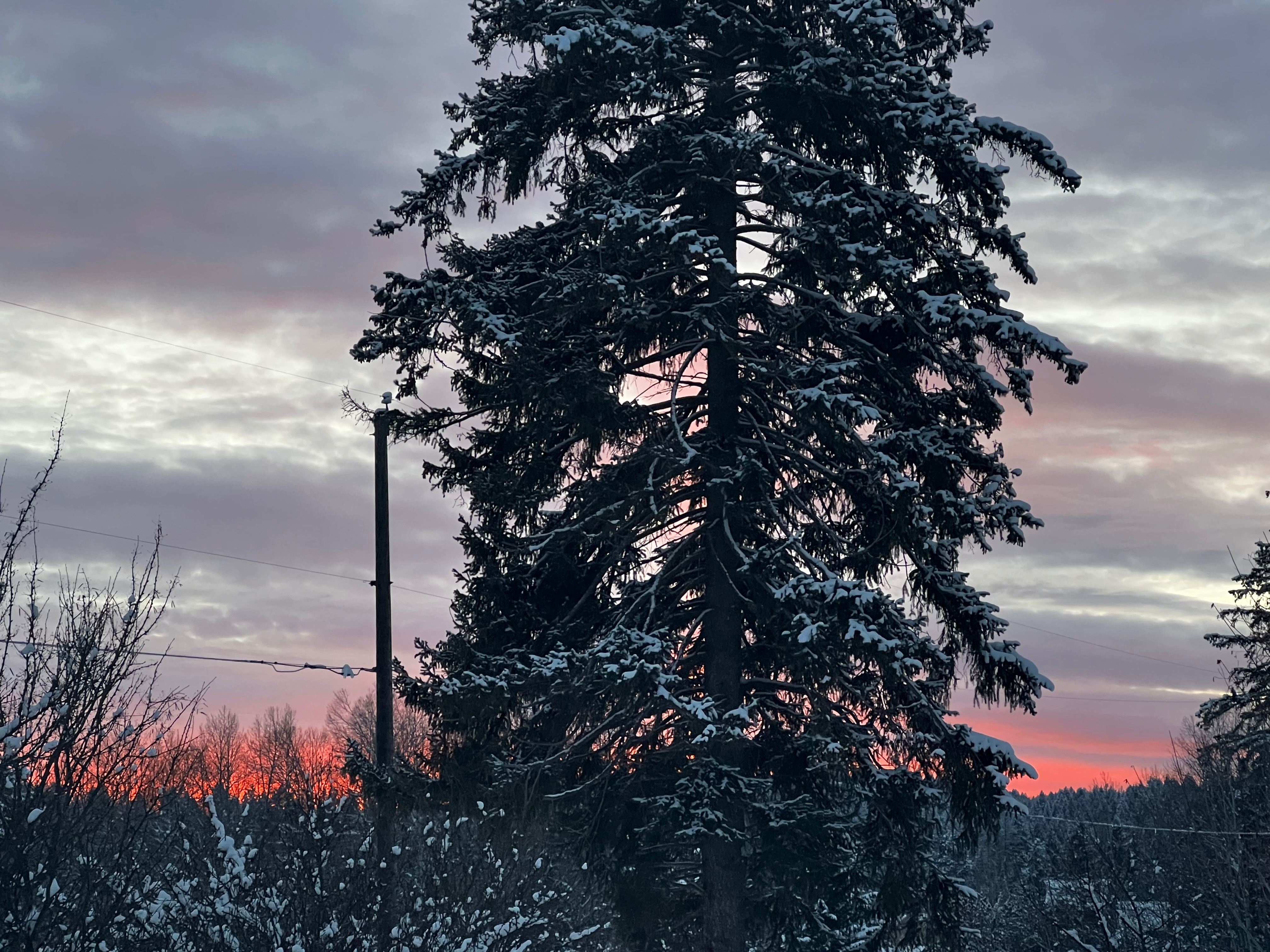
It’s been so persistently overcast lately that seeing fringes of sunset last night after days of heavy snowfall was just . . . words don’t do justice to how it made me feel, and neither does the photo I took.

Some stuff to read, listen to, or watch (this is a podcast-heavy one, so it’s mostly listen):

  • Stories for Action podcast with ethnobotanist Rose Bear Don’t Walk on Indigenous food sovereignty, native plants, and her “Recovering Our Roots” program: “Traditional plant knowledge has kind of been diminished in how we exercise our own food rights here. And it’s really interesting that that’s a piece of knowledge that’s decreased, because when we talk about our creation stories, for the Salish in particular, the animals and the plants were here long before the human, and they coexisted on the land to really understand how to live and how to have symbiotic relationships. When the humans arrived, the animals and the plants taught us everything that we know about being Salish.”

  • Also from Stories for Action, a conversation with Patrick Yawakie, founder of the People’s Food Sovereignty Program, about food sovereignty and his work with Billings, Montana-based, Indigenous Vote.

  • Looking back at 20 years of the Scottish Outdoor Access Code and the future of the Right to Roam in Scotland and England on the Scotland Outdoors podcast.

  • From The Conversation, a review of 7,000 studies on loneliness that looked at how infrastructure and design contribute to feelings of loneliness and isolation. (I particularly liked the tidbit about Dutch supermarkets that have introduced “slow checkouts” for people, especially older people, who like to chat and have a little connection while getting groceries.)

  • Two episodes about using AI to watch, forecast, and locate wildfires from MIT Technology Review’s podcast In Machines We Trust: “You know, if you get a big fire up here, you get all these people that are up here in VRBOs and who, you know, maybe got a taxi or an Uber, or they have these mountain shuttles that bring people up here. But that adds a whole new complexity to it cuz now they don’t have an avenue to get out. They don’t have a vehicle to get out and they, half of ’em don’t know how to get out or where to go.”

  • Rethinking clothing through considering “fibresheds”: the life cycle of fibers from soil health to raising sheep to spinning mills to dyes to designers to workers, to the end product itself, a three-part series from Farmerama: “Natural dying is something we’ve been doing for thousands of years. . . . There were some scraps of blue cotton died with indigo that was discovered by some archaeologists in Perus in 2016, and they’re estimated to be 6,500 years old. . . . right up until the mid-19th century, when synthetic dyes were developed. Just 170 years later, 99% of our clothes are colored with synthetic dyes, whether the clothes are made from natural fibers or from synthetic fibers. Synthetic dyes are made from crude oil.”

  • I finally got around to listening to most of Burn Wild, the newest podcast from Leah Sottile and the BBC: what goes into defining “ecoterrorism” and who’s accused of it? I really think Sottile is one of the most important journalists working today, especially the way she approaches extremism, as I wrote about at more length in the wake of the U.S.’s attempted coup—oh, look, exactly 2 years ago today. Weird.

  • From Grist, a report on a study about how to drastically reduce lithium mining and its extremely toxic impacts. (This is kind of a no-brainer—massively build out public transportation options and convert cities to being walkable/bikeable, plus a reduction in vehicle battery size, which means a big reduction in average vehicle size—but so are most of the answers to this planet’s physical problems. At least, all the answers that will have any real effect are. We need to have infrastructure that makes using less even possible for most people.)

  • A barely-over-three-minute video about waste and what this craving is for new things and who cleans up the discards through a reimagining of Italo Calvino’s Invisible Cities, via Dark ‘n’ Light magazine.

Reading "Progress & Poverty," by Henry George

Threadable-adjacent reading discussion on land ownership

The most recent Threadable reading* for Land Ownership was a selection from Henry George’s 1879 book Progress & Poverty, Part VII: Justice of the Remedy, Chapter I: The Injustice of Private Property in Land (in my copy this is pages 333-346.)

*(https://threadablenative.page.link/Rxp8yegeZ1vXy4u19 if you want to try the Threadable app and need the link! Only works on iOS/Apple devices for now.

For anyone new to On the Commons an overview of this project is here. These Substack posts are for anyone who doesn’t have iOS or doesn’t want to use Threadable but still wants to know about the readings; the subtitles are marked with “Threadable-adjacent reading discussion on land ownership.” Please feel free to comment or email me with any questions.)

Progress & Poverty is in the public domain (released from private enclosure!), and there are many different places online where you can read the text. On this archive.org link, the selection we are reading starts on page 333 and ends on page 346, the end of the chapter.


I put off writing this post because when I start talking about Henry George, I find myself unable to stop, and I don’t want to inflict all the passages I underlined in the entire book on everybody, no matter how compelling I think they are. It just gets hard for me to curtail a tendency to quote from his book because when it comes to land ownership, George says almost everything.

I first read George’s Progress & Poverty a couple of years ago, and was immediately taken with his ability to go straight to the heart of land ownership and its injustice. The section we read on Threadable prompted a lot of discussion about land, ownership, and, unexpectedly, the Puritan ideal of productivity and what it says about who has a right to live and participate in society. This was an important point because part of George’s argument takes off from John Locke’s philosophy that ownership is given by mixing land with labor. I think he’s partly using that philosophy to bolster his arguments rather than relying on Locke entirely, but would have to go back into earlier parts of the book more carefully.

Fundamentally, George maintains that land ownership is unjust, inexcusable, and the root of most of the wealth inequality he observed in his time. That inequality shocked him—the title of his book reflects his initial question regarding how land and people could have so much wealth and “progress,” and at the same time such immense poverty.

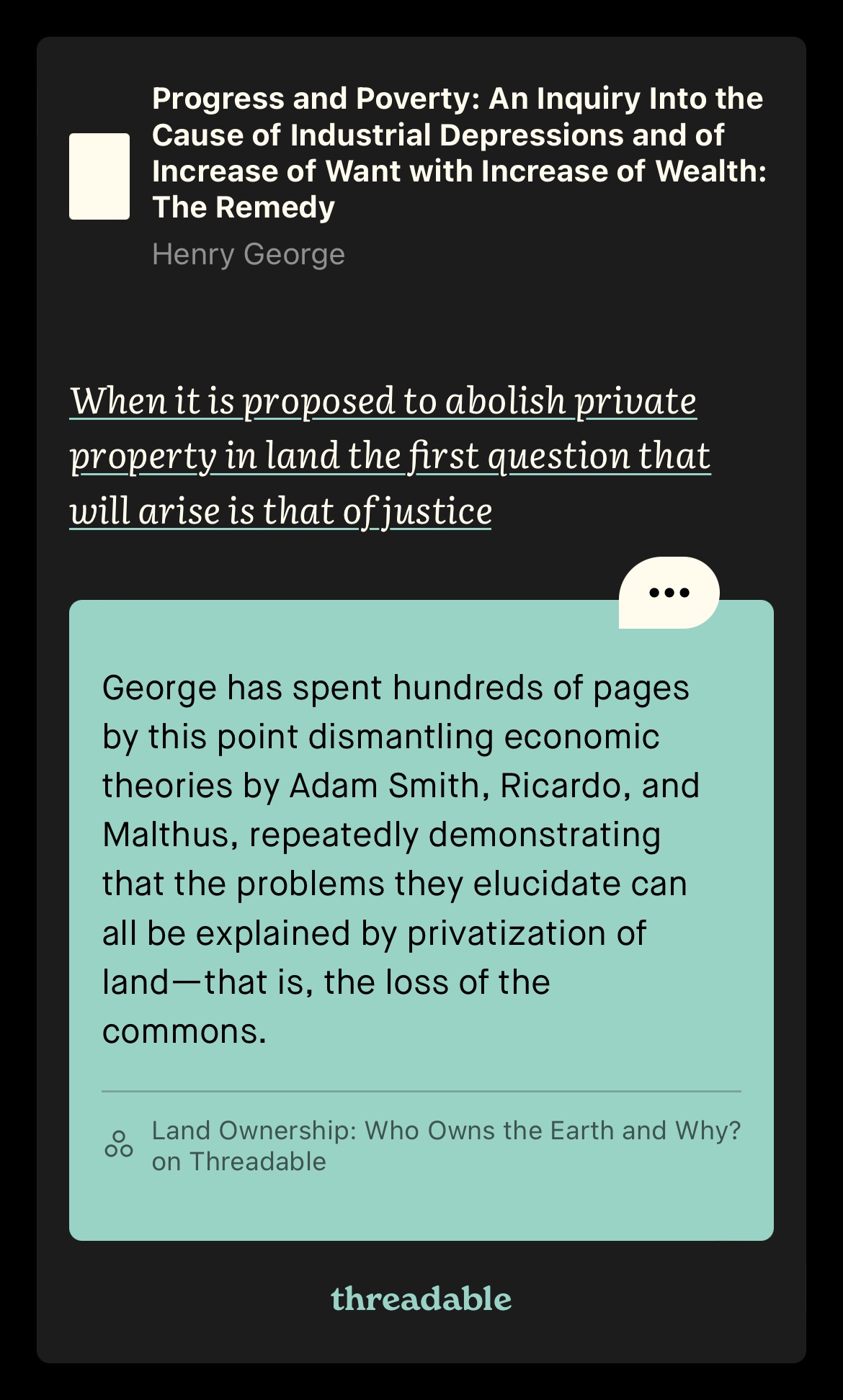
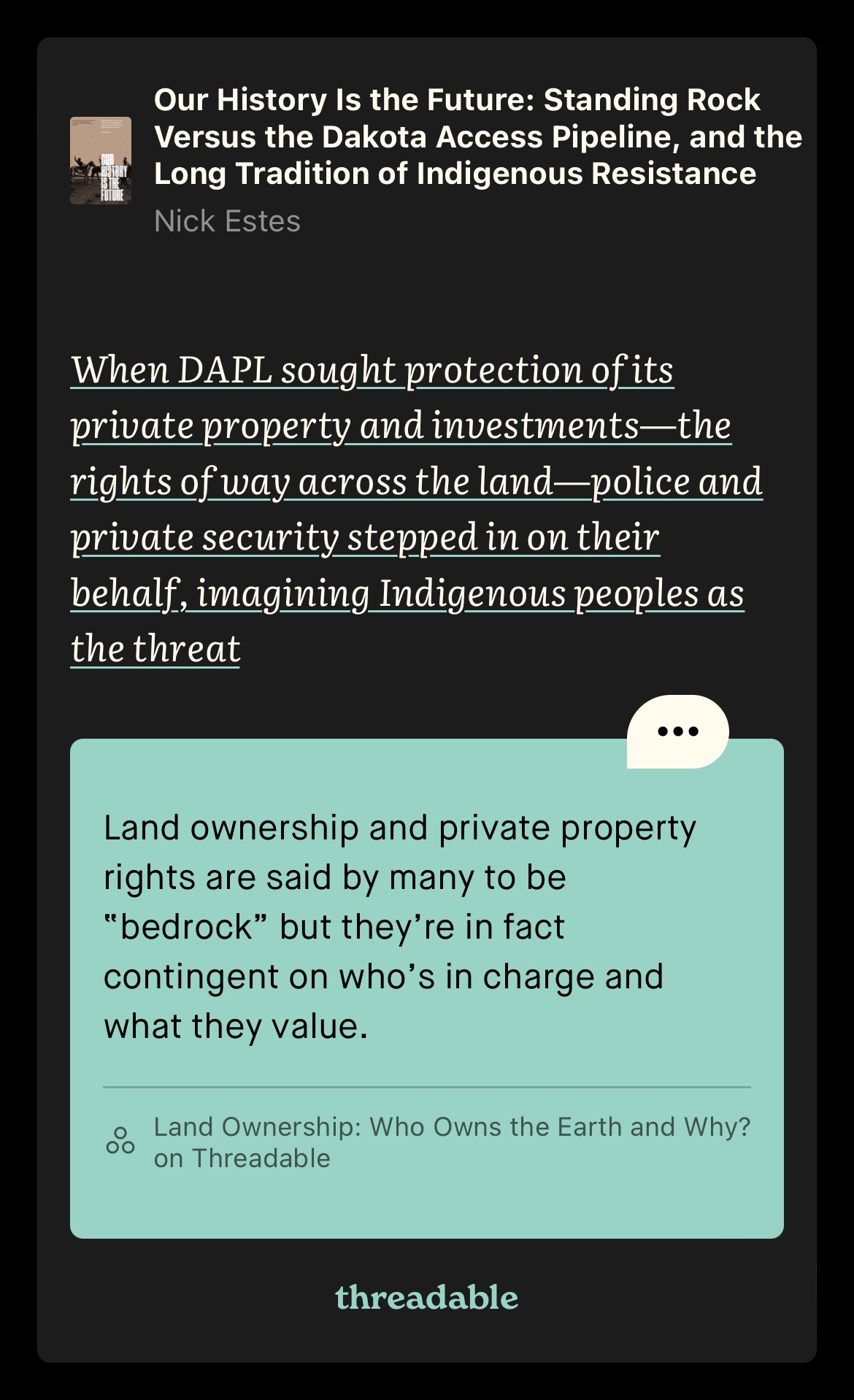
The quoted line below, from the beginning of the reading selection, states his perspective directly: “When it is proposed to abolish private property in land . . .”

That is George’s desire, to abolish private property in land, and he makes a strong case for it. The “justice” he speaks of is the vested interest that landowners already have in the land they have title to. But as I’ve quoted somewhere else in this newsletter previously, part of his case is that, the further back in time ownership goes—his example is closely tied to big landed estates and nobility in England—the more compounded the injustice of that ownership is and the more harm it has caused and will continue to cause in the future.

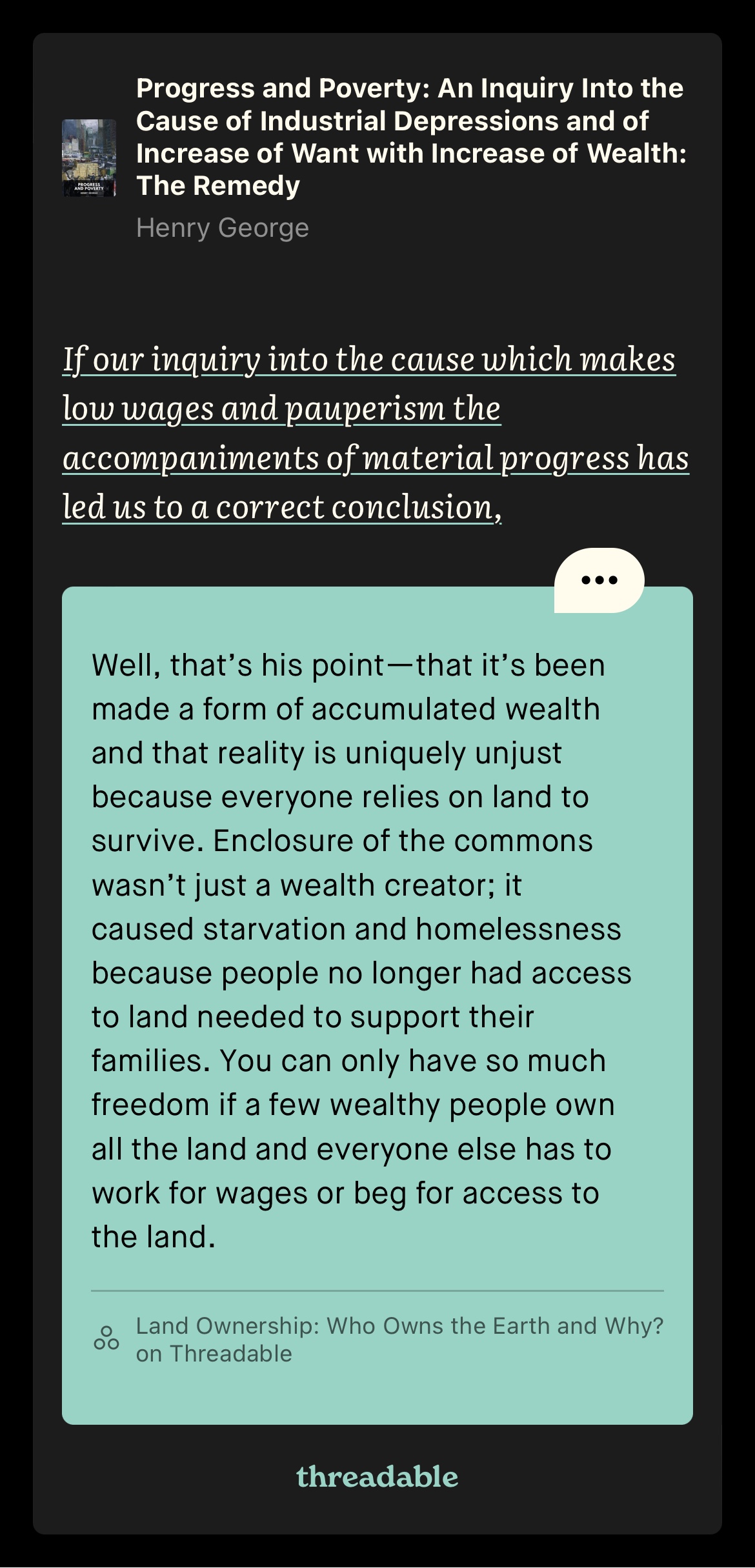
This came up briefly in the comments on the last On the Commons post, that once land is owned, it is much easier to control other aspects of people’s lives because you control their access to survival, something that George repeatedly addressed when it came to labor and ownership. I disagree with Locke’s idea that labor grants ownership, but George’s point was that when land is privately owned, many more people are prevented from laboring on it or for it at all, except at the behest or whim of the owner.

Even if you’re, as one reader said it seems that George was, a productivist and lean on the idea of labor and productivity to back up ownership, that doesn’t in fact give an answer as to the genesis or the morality of ownership itself. Thomas Paine wrote about this himself in his own theory of property rights:

“There could be no such thing as landed property originally. Man did not make the earth, and, though he had a natural right to occupy it, he had no right to locate as his property in perpetuity any part of it; neither did the Creator of the earth open a land-office, from whence the first title-deeds should issue.”

George, unlike other writes on land ownership, doesn’t shy away from the question at the base of it. There is no real answer given to the question of where ownership comes from. There are centuries of legal opinions and philosophical arguments, but go back far enough—or not even that far—and ownership comes down to one thing: “I took it; now it’s mine,” with all the power and dominance and entitlement that ownership entails. Extend that attitude to water, seeds, labor itself, data, air, attention, historical narrative, . . . all the things of the commons that comprise not just human life but all life, all of it can be enclosed and commodified. Not because it’s a law of nature, but because it was taken, and the taking was then justified.

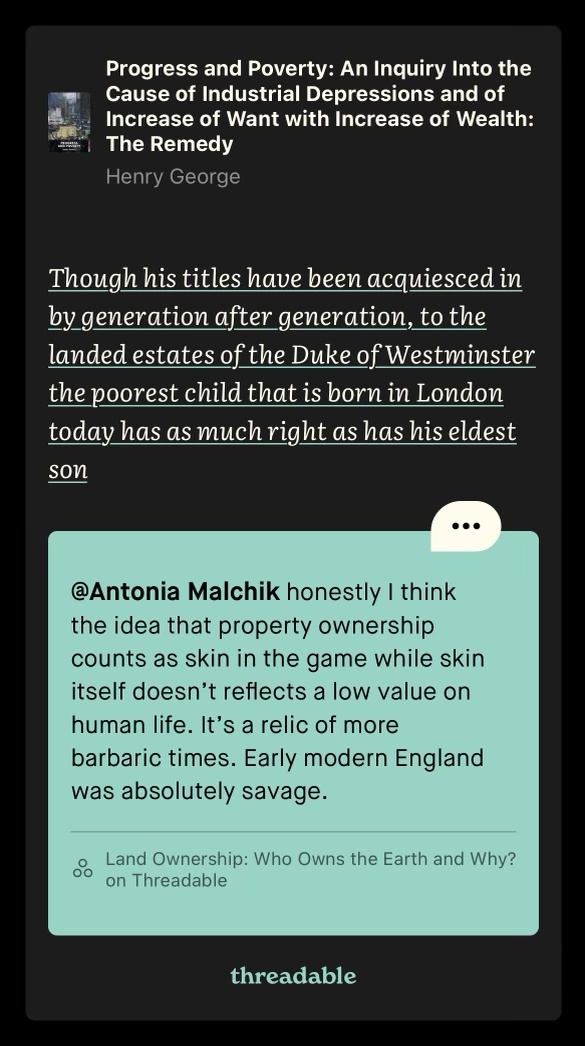
Within Threadable, we had a discussion about how land ownership was until very recently—not even 150 years ago—bound up with a right to vote, even for white men, and what that says about how people think of having “skin in the game.” As one reader put it when I mentioned homelessness and affordable housing objections, we are still living with a legacy of property ownership somehow implying “skin in the game” while skin itself—being alive, fed, housed; the right to exist—doesn’t. When I hear current objections to affordable housing and renters and who has a “stake” in the community they live in, it differs very little from the kind of vicious language directed at people kicked out of their homes and villages during enclosures of the commons in England hundreds of years ago.

There is much more here and I could keep going, but if I do I probably won’t stop! George’s book is within the public domain, but there are also many Georgist economists quietly at work around the world. And there is a Substack devoted to George, Progress & Poverty, and how some of his ideas could be put into practice today.

It’s all wrapped up in the injustice of land ownership. As George points out toward the end of his book, those injustices have an effect on what are classified as more abstract human rights as well: equality, happiness, the freedom to speak, to be heard, to vote, to have a say in one’s society.

“These rights are denied when the equal right to land—on which and by which men alone can live—is denied.”

The next reading is from William Blackstone’s 1750s writing on property ownership. (Spoiler alert: he can’t find good grounds for land ownership, either, and ends up leaning on Genesis from the Christian Bible and dominionism.) After that it’s John Locke and his idea that labor creates property (Blackstone disagrees), followed by Nick Hayes’s The Book of Trespass and finally Mary Cristina Wood’s Nature’s Trust as the final reading.

I’ll be offline for a few days and will respond to comments and thoughts when I get back.

Stories are porous (so are we)

Walking composition

"I will not forget where 
I come from. I 
will craft my own drum. Gather my beloved 
near and our chanting 
will be dancing. I 
will not be played. I 
will not lend my name 
nor my rhythm to your 
beat."
—from "What I Will," Suheir Hammad

There’s a story my father’s told me that I’ve referred to many times, in essays, in my book, in tweets when I had a Twitter account, in conversation, in my mind. It wasn’t even a story, really. More of a line. A moment or an image, of him and his parents and his two older siblings sitting around their dining table in Leningrad in the 1960s, reading loose-leaf pages of Solzhenitsyn and passing each page on as they finished it.

Almost exactly twenty years ago, my older sister and I interviewed our father while we were visiting him in Moscow, and he told that story again. Or told the moment. The line. I’ve been trying to listen to some of those old tapes for parts to share here (my tape recorder is giving out, so the sound’s been wonky), and when that section was playing a few days ago, there was an undertone I had only vaguely remembered: how important literature was to ordinary Soviet citizens during those times. Essays, novels, short stories, poetry—the way my father describes it, whether it was his parents or him and his teenage friends, people couldn’t get enough.

This 10-minute recording is taken from hours of interviews done over several days in 2003. The excerpts I quoted here are from this recording. The shrill sound about 30 seconds in is the phone ringing. Apologies for that.

“Starting in early 60s, we started reading all underground literature that wasn’t published at all. It was just typed on typewriter and given from one to another. At that time started reading Solzhenitsyn’s novel, and we would get into loose leaves, like this folder, and we would go in our family around the table—we had a big dining room table, so we were sitting around this table and we would have this book, like Cancer Ward, for one night, and we would sit around the table and give each other leaf. After one read, we would give to next person, and we would go around the circle and read the whole novel in an evening. And that happens to a lot of underground literature. I loved a lot of Soviet literature, too. But I read, I read everything, so much stuff.”

Do you think literature was a big part of Soviet society? I asked him. I remember sitting there on the couch in his old apartment in the Frunzenskaya district, my sister trying not to fall sleep, the horrendous, shrill drill of his apartment phone interrupting us.

“Oh, during Soviet times specifically, but I think overall, I cannot vouch for whole population because I worked as a metal worker when I was going to the unique school, and workers in my—”

How old were you?

“Fifteen. I was fifteen, I went to work as a metal worker. There was a pretty substantial class of people, a layer of people, that were very much into literature. You know, if you’d go by tram or bus, like 80 percent of people were reading book. And some of them were reading detective stories, simple things, but most of them were reading literature. So to a degree it’s a pretty vast difference from what I saw in the United States. . . .

We had to stay the whole night in line to get subscription to like 18 volumes of Dostoevsky. Some books—when finally Pasternak volume was printed, you would have to go through hell to get the book, because it’s a very limited edition, and you would have to go through friends of friends, etc., pay tremendous amount of money, and etc. to get a book of Pasternak’s poetry. Same with Marina Tsvetaeva, small, small volume finally came out. . . . Chekhov, you would get a volume of Chekhov, and you would have to put a special effort to get the subscription for like 15 volumes of Chekhov’s. Same with just about any classic writer.”

Do you think—was it more important to people because it was Soviet times?

“It had something to do with it. It was, you know, outlet for ability to do creative thinking or enjoy something. But I don’t know. It’s a big, big discussion.”


The original epigraph I chose for my book on walking was a poem in the Coleman Barks version of Rumi, the one that goes:

“Today, like every other day, we wake up empty
and frightened. Don’t open the door to the study
and begin reading. Take down a musical instrument.

Let the beauty we love be what we do.
There are a hundred ways to kneel and kiss the ground.”

Subscribe to continue reading

Subscribe to get access to the rest of this post and other subscriber-only content.

Who sees the best of ourselves?

Walking composition

"Like eagle rounding out the morning
Inside us.
We pray that it will be done
In beauty.
In beauty." 
—from "Eagle Poem," Joy Harjo

Last week I stood outside the middle school playground for a long time after dropping my daughter off, watching the sunrise, or what I could see of it. It tends to be overcast most of the time in winter where I live, but recently we’ve been getting some beautiful sunrise colors while rarely seeing the actual sun. It passes, somehow, from behind the mountains and into the clouds without showing itself, but still spreading its fiery colors and pastels across a sliver of sky.

While I was standing there, a friendly acquaintance drove by. (We really need a word for someone who’s more than an acquaintance, someone you’re generally happy to see, but neither you nor they feel any need to “get together.”) He told me he was headed up to the ski mountain to go skinning* with some people, and that it was a special skin because it was the anniversary of the death of the person the main skinning route, the Benny Up trail, is named after.

This person hadn’t been someone I’d known, but many of the people I’m close to did, and the whole county-wide community was affected when he died in an avalanche several years ago. My friendly acquaintance had known him well, and said he made everyone feel like their best self, that thousands would say he had been their best friend. He was just that kind of person.

One of my goals in life, this friendly acquaintance told me, is to be the person his friend thought he was. And then he left and I thought, damn. A heck of a goal, yes, but what a heck of a person to have that kind of effect in this world.


A short time after this acquaintance drove off, I was still standing there and was surprised by not one but two bald eagles flying overhead, on a direct path to somewhere.

One of the eagles aimed for the top of the trees in front of the train station a short distance away. He was hard to miss as I walked past, especially as he got ready to take off again. (I think this was a male? I can’t really tell but the wingspan looked about right.) I watched him until he was long out of sight, winging toward the mountains. I love those birds so much. Seeing one is always a gift, but two within moments of each other?

Reading "Our History Is the Future: Standing Rock Versus the Dakota Access Pipeline, and the Long Tradition of Indigenous Resistance," by Nick Estes

Threadable-adjacent reading discussion on land ownership

The most recent Threadable reading* for Land Ownership was a selection from Nick Estes’s book Our History Is the Future: Standing Rock Versus the Dakota Access Pipeline, and the Long Tradition of Indigenous Resistance, from the middle of Chapter 6: Internationalism, to the end of Chapter 7: Liberation, pages 242-257.

*(https://threadablenative.page.link/Rxp8yegeZ1vXy4u19 if you want to try the Threadable app and need the link! Only works on iOS/Apple devices for now.

For anyone new to On the Commons an overview of this project is here. These Substack posts are for anyone who doesn’t have iOS or doesn’t want to use Threadable but still wants to know about the readings; the subtitles are marked with “Threadable-adjacent reading discussion on land ownership.” Please feel free to comment or email me with any questions.)

Unfortunately, I couldn’t find any excerpts of this section online. However, about 37 minutes into this talk, Estes reads a solid chunk of the final chapter. But I also think this is an important book, even a vital one, and if you can read the whole thing, I recommend it. (Credit to Chris La Tray for recommending ages ago that I move it up my TBR pile.)


“In 1980, the US Supreme Court confirmed the Oceti Sakowin’s claim that the Black Hills had indeed been stolen. ‘A more ripe and rank case of dishonorable dealing will never, in all probability, be found in our history,’ the ruling stated. As a result, the court awarded a $106 million settlement. The Oceti Sakowin responded nearly unanimously under a popular slogan: ‘The Black Hills are not for sale!’ In the spirit of Standing Rock and the Treaty Council’s original 1974 contention, they considered a full restoration of the illegal taken lands to be the only just solution. And this gets to the heart of the matter. The Oceti Sakowin’s struggle for is land is not about getting reparations, apologies, or reconciliation. It is about justice and ending the settler-colonial system.”

I started the Threadable reading selection at this passage in Chapter 6 because it immediately poses the question of justice, both when it comes to land theft and when it comes to land ownership. The Black Hills, like most other land in North America, were stolen. I personally cannot imagine having had that happen, and happily accepting cash as recompense. They’re not equivalent.

Which really, although Estes doesn’t directly address this often in the book, gets to part of the heart of the issue with land ownership. Forcing people into a market relationship with land steals away something that is bigger than money, more intangible and more important and impossible to restore without restoring the land itself.

Our History Is the Future was one of the first books I read that got straight to the point of the American project: acquisition and privatization of land. The section I chose for the Threadable reading is just one that addresses some of the consequences of these efforts, and what resistance might look like going forward and internationally, but many different sections could have taken its place. Estes writes incisively about the fundamental incompatibility between a collective-oriented form of land relationship, and the colonial project of privatization—one that will be familiar for those who read some of Andro Linklater’s Owning the Earth. It was an extension of same project that led to mass starvation, displacement, and civil unrest in Britain starting particularly in the 1400s with enclosures of the commons. Take that which is common to all, managed by all, relied on by all, and fence it off for one owner’s private profit.

In the Americas, this was combined with the government’s and settlers’ hunger for land that they saw as open to claim, except for the people they saw as being in the way, or as holding “progress” back:

“There is one essential reason why Indigenous people resist, refuse, and contest US rule: land. In fact, US history is all about land and the transformation of space, fundamentally driven by territorial expansion, the elimination of Indigenous peoples, and white settlement.”

In an hour-long presentation Estes gave on the book, he explained its structure as tracing four separate invasions into Indigenous land and life across North America: the fur trade, elimination of the buffalo, the 1944 Pick-Sloane Plan (a series of dams that forced relocation of many Native American communities; it was part of a project to continue forcing assimilation), and the recent North American oil boom. (I did wonder why the Dawes Act and forced allotment wasn’t considered a separate invasion as well, but he didn’t address it in that particular talk.)

The recent oil boom is particularly interesting to think of as an invasion because toward the end of Our History Is the Future Estes makes a point of noting whose property rights were protected at Standing Rock and elsewhere—the pipeline company’s. Which is a demonstration of obvious and ruthless injustice, but also, to me, of a truth that so many people try to ignore: private property rights depend on whose values and whose property is being defended at any given period in time, and they’re subject to change. There is nothing in fact reliable about property rights, no matter how immutable they might feel.

Which goes back to some of the legal history covered in particular in In the Courts of the Conqueror, a book covering ten legal cases, all of which demonstrate that property rights depend not on an abstract legal conception of those rights themselves, but on who holds them and how they benefit. When we’re talking about the colonization of North America, land—and who gets to live on it—were, and are, determined not by rights but by who wanted it and who has been willing to use power, dishonesty, subterfuge, and repeated violence to take possession of it.

“To carry out the land cessions, the US government needed settlers to hold private property in perpetuity. Private ownership (or “fee simple”) is seen, under US law, as the highest possible form of ownership, while Indigenous occupancy is seen as temporary; thus, collective Indigenous ownership and use could be dissolved for private ownership, but not the other way around. But because private property is exclusive, the two systems of land tenure fundamentally could not overlap.”

In that talk I linked to, Estes said that he thinks of “Standing Rock as a decolonization movement for North America.”

That project is going to require far more than acknowledgments or any other kind of easy nod to past and ongoing wrongs that leave the compounded injustices intact. Estes referred in the book to several instances of failures of imagination on the part of courts and settlers regarding how we could live without colonialism, especially in relation to land, failures that demonstrate “a limit to the project of settler justice,

which can extract an admission of wrongdoing, but cannot reorder the world or redistribute wealth, especially land, back to its rightful owners.”

But admissions of wrongdoing simply aren’t enough. “Under capitalism,” he wrote, “neither Democrat nor Republican can save Indigenous lands or Black and Indigenous lives.” The values prioritized by private property law and commodification, underpinned by a paradigm of ownership, won’t allow it, just as they won’t allow many other things that truly matter.

There is so much more in this book, and I highly recommend people pick it up and read it, or at a minimum look for more talks and papers from Estes. I really don’t think we can make progress on almost any front of justice without scraping down to the true bedrock of not just North America, but many continents: The land was stolen.

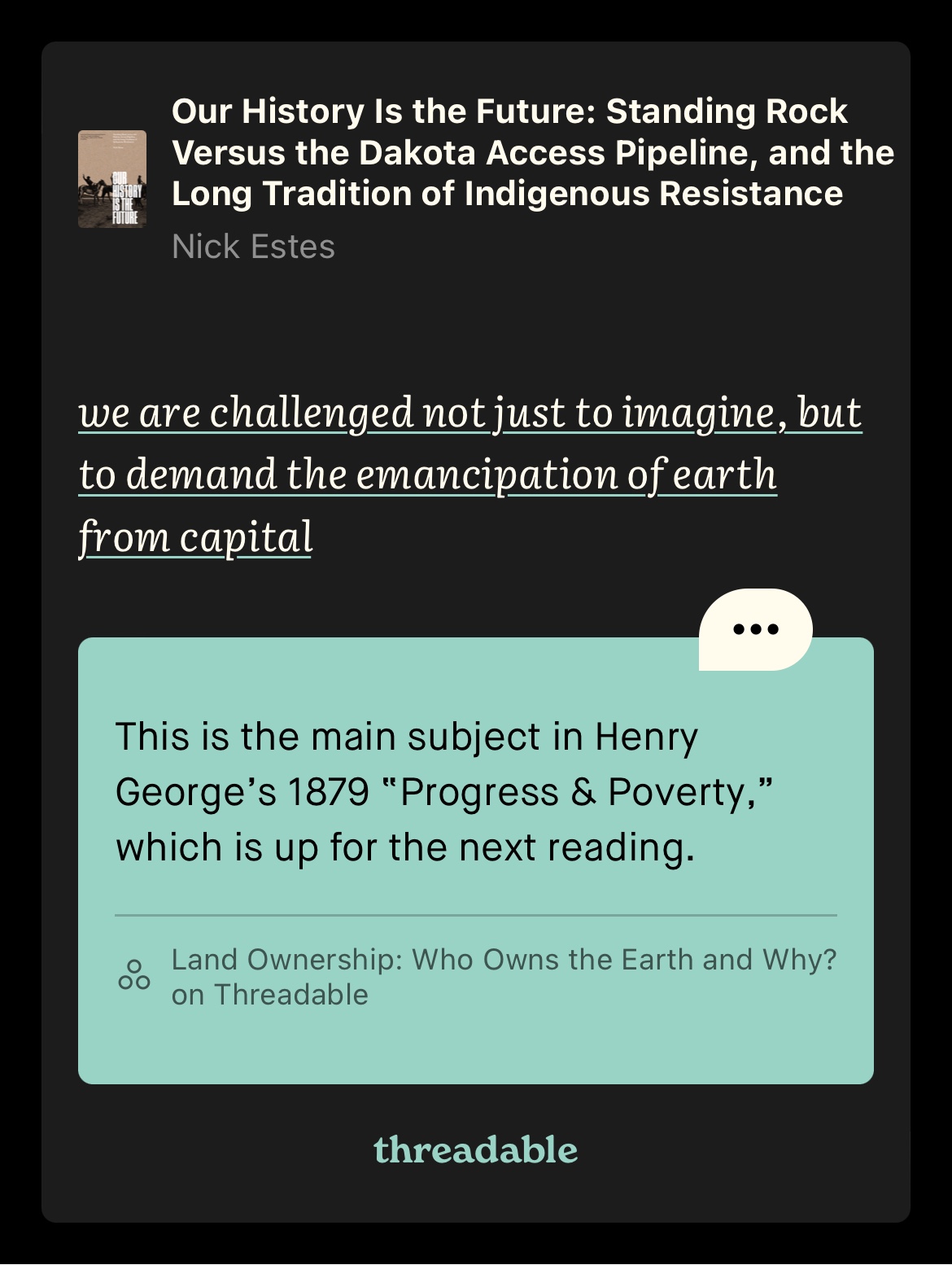
This will be the subject of the next reading, an excerpt from Henry George’s 1879 book Progress & Poverty, the section in which he makes the case that private land ownership is absolutely unjust, and in fact more so the longer it’s owned because its injustices are compounded.

“We are challenged not just to imagine, but to demand the emancipation of earth from capital,” wrote Estes.

George did. And he came close to succeeding.

Every river begins with a breath

Walking composition

“We have to accept that our world changes radically and perpetually, and that it changes with us and in us, and that we have an obligation to perceive, to intuit, to sense this change. That’s how we reach utopia.”
—
The Archipelago Conversations, Édouard Glissant and Hans Ulrich Obrist

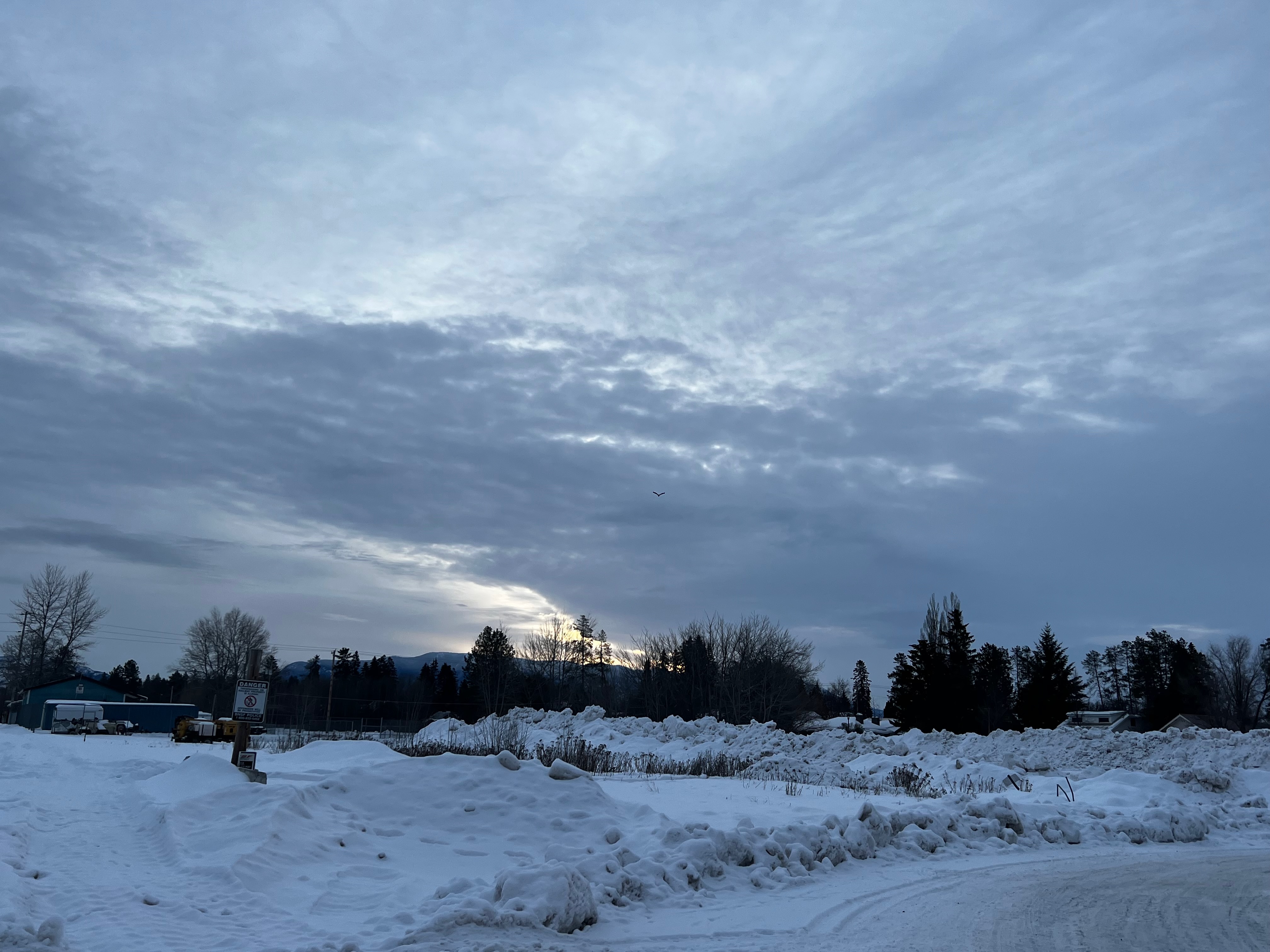
There are some days when I’m out walking around town, watching watching watching, and the sky literally takes my breath away. It’s rarely because of a stunning sunset, though those happen, too; it’s moments like the one pictured above, when the varied texture of the clouds and the range of blue-gray color make me hungry to stand and watch for hours. Especially in winter, when for several months at a time we rarely see the sun. There are spots, and moments, when the sky is so subtly its own perfect thing that you can almost feel it breathe.


The beginning of a new year seems like a good time for a brief book update. I’ve been working on the research side of No Trespassing, so far almost exclusively focused on land ownership. There’s a lot of reading to do, but there are also two visits I wanted to make. One is to the ranch my mother grew up on, outside of Geraldine, Montana. The family who owns and works it bought it from my grandfather in the mid-1990s. I haven’t been there since I was a child.

My mother has written and talked about the place a lot, but I’d like to visit myself to get a sense of it. The first chapter of the book is about ownership of land, and includes discussion of enclosures of the commons and land theft in North America, including the Homestead Act and my own family’s history related to it. I love Montana more than I can usually express. It’s made me who I am. But I was only born here because the land my relatives owned was stolen for the benefit of homesteaders like them. I might not possess that land myself now, but I’m still here because of it, and want to face what that means.

The second visit is to the Badger-Two Medicine area right against the Rocky Mountain Front. It’s a place I’ve been a little obsessed with since even before I moved back to Montana in 2014. Sacred land to the Blackfeet Nation, this area is currently “owned” by the U.S. Forest Service, and has been the subject of numerous lawsuits regarding oil leases issued in the early 1980s. The Badger-Two Med isn’t a big subject in the book, but I mention it in the Introduction because the oil leases pose critical questions about ownership, taking, right of use, and the changing story of private property rights that are central to what I write about.

Finding a sense of place when I’m writing is really important to me, so even though the subject revolves around the Badger-Two Med’s legal case, I didn’t want to write about it without having some sense of what was at stake, even a tiny sense. Last fall I got very lucky and saw a notice for the annual gathering of the Glacier-Two Medicine Alliance, an organization that was formed in the 1980s to fight oil leases in the Badger-Two Medicine. They’re still at it because there’s still one lease remaining, and I learned a great deal from presentations by the Alliance, most especially from the Blackfeet members who gave talks, and from the second day’s hike into the hills where the oil lease is located (this hike was where my favorite aspen grove pictures were taken).

I’m hoping to have time to really dig into writing and revision of the Introduction and first chapter of No Trespassing over the next two–three months, after which I’ll publish them here for paid subscribers (though, as always, if you can’t or don’t want to pay, just email me the code word “tribble” and I’ll get you a paid subscription).

After that, it’ll be on to research for the second chapter, which is about water.

Though really, every time I think about it, it’s all about water. Doesn’t every river and cloud begin with a breath?


The sky breathes, animals and trees breathe. Every one of those breaths carries a little water, mostly unnoticed by humans. Rivers and pounding seashores, smokestacks and campfires, glaciers and tectonic plates, you and me. It’s all breathing, all movement, all exchanges of atoms combined into gasses we take for granted but depend on for our lives, our health—even our moods. A humid day, like the kind that blanketed every summer when I lived in upstate New York, leaves me in a state of grouchiness that’s difficult to shake.

I think this is one of the reasons I’ve never found weather boring: it’s always felt alive to me. One recent day it was -40°F (which is also -40°C, fun fact) here with wind chill, cold enough to get frostbite in a thoughtless moment; a few days later it was literally raining and snow was sliding off the trees. This week temperatures have settled into a moderate, “normal” winter range and it’s been snowing for a couple of days.

We’ll get some more snow, and calm winds. Most days it’ll be overcast with a heavy gray inversion layer over my town. If I go skiing and manage to get above the clouds, I might be fortunate enough to see a magnificent sun halo.

And in a few months the damp smell of a Chinook wind might be in the air, and the clouds will start developing a rumpled-silk quality that I find fascinating, and our days will get long and eventually it will get hot, or maybe summer will be full of rain and thunderstorms like it was when I was a child, or it’ll snow and then flood in mid-June like it did last year. Or wildfire smoke will choke this entire region. And no matter what, the stars and moon will be up there reminding me of the seemingly eternal time frames in which my life—all of our lives—barely have time to make a memory.

There’s really nothing more interesting than the weather. It reminds me that we exist and evolved on a living, breathing planet. That we’re walking and reading and raging and loving within the largest unseen river we can possibly imagine. And that its eddies and flows and turbulence and rapids and waterfalls and riffles and floods will determine our lives, whether we will it or not.

In the Badger-Two Medicine, looking out toward the plains of eastern Montana.

Some stuff to read or listen to:

  • By Vaia Errett in Winter 2022 of Montana Quarterly, “Holding Water,” an article about the increasingly intractable tension between those who hold water rights and all of those who need water on the Jefferson River near the Tobacco Root Mountains. Print only, unfortunately, but this article is worth reading if you can get a copy, for its attempt to take a more straightforward look at the impossibility of continuing to allocate water based on first-in-time rights, and the seeming impossibility of changing that system.

  • Many of you are participating in my Threadable reading circle on Land Ownership. I’ve mentioned the reading circle on Water Politics and the World a few times because I’ve become a bit of a fangirl and got hooked on the readings. It’s led by Varsha Verkatasubramanian, a dam historian and author of an article in Current Affairs about the history and problems that led to the collapse of two dams in northern Michigan. On dams: “Whole valleys worth of trees are killed in the process. Bacteria in the water decompose the plants, generating carbon dioxide and methane. This is why dams are a critical source of greenhouse gasses—the world’s 52,000 largest dams are responsible for over 4 percent of the total warming from human activities. Reservoirs contribute 25 percent of human-caused methane emissions, the largest single source in the world.”

  • The Building Local Power podcast on shifting paradigms of profit and the public good, and the history of the Institute for Local Self-Reliance.

  • A great conversation on the Reframing Rural podcast about class inequality, cultural extraction, and rural gentrification with Butte-based journalist (and author of the incredible forthcoming nonfiction book Blood Money, which I have read and recommend) Kathleen McLaughlin: “Is it that much different that someone buys a multimillion dollar home at the Yellowstone Club and spends several weeks a year there, or a couple of weeks a year there and helps drive up the prices for working class Montanans. Is that that different than the Copper King, William Clark, owning mansions all around the world that were built with wealth from Butte Copper? I’m not sure. I mean, it’s just a different pattern of extraction.” (Link includes a transcript for those who’d rather read than listen.)

  • A subscriber (thanks, Charles!) sent me this Economist article about the history and evolution of the city grid, and how to think about city layouts that serve people rather than cars.

  • In my last essay post, I referenced hearing the line “it’s not about critical mass; it’s about critical connection” recently and said I couldn’t remember where from. It was via another subscriber (thanks, Jake!), who had sent me an obituary about the person it comes from, activist and philosopher Grace Lee Boggs: “Always the philosopher, Grace never had the final answer but would push us to think dialectically, to learn from the past but not get stuck in it.”

  • Along the lines of finding hope or its equivalents when forces and circumstances are arrayed against it—and in line with my longstanding belief that science fiction is the best fiction because it helps us truly imagine different ways of being, especially with Octavia Butler—“How to Survive in a Broken World,” Jesmyn Ward on the optimism and empathy of Octavia Butler in Literary Hub: “This is the real gift of her work, a gift that shines in Bloodchild: in inviting her readers to engage with darker realities, to immerse themselves in worlds more disturbing and complex than our own, she asks readers to acknowledge the costs of our collective inaction, our collective bowing to depravity, to tribalism, to easy ignorance and violence. Her primary characters refuse all of that.”

Realizing a better future requires us to imagine one

The first step might be believing in what’s possible

A few weeks ago I was a guest on an international roundtable webinar-type thing for walkability advocates. It was a delightful hour and a half—I don’t get to spend much time talking about the policy-wonky and urban planning aspects of walking and walkability, at least outside of serving on my city’s bike and pedestrian advisory committee. It can be a relief sometimes to have conversation with people who already understand the structural and psychological barriers that make walking so inaccessible for so many, who don’t need concepts like “legacy infrastructure,” “Shoup Test,” or “universal design” explained.

One of the participants was in a country that is currently facing enormous upheaval and resistance against an authoritarian regime. I desperately wanted to ask him about it, what he sees, what he thinks, but had no idea if he needed to take the same kinds of precautions in talking openly as my father does when he talks to me from Russia. So I didn’t ask. But toward the end of our time, he said something along the lines of, “When our revolution succeeds.”

Brief, unrelated conversation followed on that line’s heels, and a few minutes later our time was over, leaving me wishing we could spend another ninety minutes just listening to what he had to say about where his country is going. I want to know what’s out there, or at least someone else’s experience of it.

A lot of the podcast listening and essay-reading I do is for the same reason: I want to know what’s out there. To find the stories of people trying something different. A new (or old) way of using space, or presenting history, or shaping an economic system, or relating to land and water. It’s partly curiosity on my part, but we also need to find these stories, to give them attention, to see if the way we live in this world could be different. If the way we live with one another could be different. We need examples that help us imagine a better world, and especially ones that show us viable ways of getting there.

People get asked all the time: What gives you hope? It’s not a question that interests me very much, even in the rare times when I’m feeling hopeful. I want to know what people are hoping for, what they’re ready to build, what visions of futures they’re working toward. I’m interested now more than ever, in part because I live in a liberal-leaning small town in an overwhelmingly conservative-to-right-wing county in a conservative U.S. state; the futures that many people I live near are dedicated to building—and they’re extremely dedicated and know exactly what they want to achieve and how—horrify me on several levels.

I want to know, as specifically as possible, what kind of better world people are ready to fight for.

When considering whether or not to include a podcast or essay in the Walking compositions’ “Stuff to read or listen to” lists, I’m usually looking for something extra. Not stories that are more unique or more heartwarming. More robust might be a way to put it. It’s about finding the people doing good in the world—even if that “good” is simply an in-depth explanation of why things are so awful (Crusades researcher Thomas Lecaque on the Conspirituality podcast is an example of this)—but also seeing what they’re doing to dismantle or create alternatives to destructive systems in the first place. Feeding hungry kids, while also articulating the systems that keep those kids from getting food. I want to see models for how we might recreate our communities, and our world, and what’s stopping us, all of which I’m more likely to find in Strong Towns or Frontiers of Commoning than in the New York Times.

I also look for more complex histories than I heard growing up, like the This Land podcast detailing land theft, genocide, and the forced allotment system and what they have to do with the 2020 McGirt v. Oklahoma U.S. Supreme Court decision; or Farmerama’s four-part series on Scottish land ownership’s entanglement with profits from slavery in America. We can’t build a better future if we don’t stop long enough to look the past—and the present—in the face, and with more depth than is allowed by consuming the daily news cycle.

That same daily news cycle can also blinker us, I think, to possibilities of a different kind of life. I’ve had several conversations over the last few months in which the person I was talking with at one point said some version of the line, “But I don’t see anybody doing that.” Each time, I found myself overwhelmed with frustration because what they meant was that, in whatever news sources they rely on, they hadn’t seen stories of anybody working hard enough to build a better world—or a better whatever-aspect-of-the-world’s-problems we were discussing—to believe that it’s realistic. Or there aren’t enough people working on it, or it’s not scalable, or the weight of everything striving to destroy any chance of a better world is just too crushing to overcome. And yet people are doing this work. It’s everywhere, even if it doesn’t make it into news headlines or my state legislature.

After I watched Adam Curtis’s recent six-part BBC series on the fall of the Soviet Union and the subsequent collapse of democracy in Russia, TraumaZone, I wanted to see if he had any kind of overarching summation about what happened over those decades. The series tracked closely with my experiences of life in the Soviet Union and 1990s Russia; and what to do about it all, or where Russia might possibly go from where it is now, is a question that eats at me every day.

In one conversation, he related the psychological state of the Soviet Union at the time of its collapse to Britain both currently and leading up to the 2016 Brexit vote, and the dangers in not having viable alternatives to a failing system:

“The overwhelming thing you get from talking to Russians during that time is that no one really believed in that system any longer. And they knew that no one in charge believed in it any longer. But what people also knew was that those in charge had no idea of any alternative. So everyone just accepted it as a system that no one believed in, but because there was nothing else, you just went along with it. So when it collapsed, it came as a terrible shock. . . .

We have a very different society from Russia thirty years ago, but I would argue that what the most defining characteristic of our present society in Britain is that everyone knows that somehow this system isn’t working, but no one, whether they be in the opposition or in the government or amongst the journalists or amongst many millions of people, have any idea of what other system would work. So we just sort of accept it, lurching from one position to another, all trying to rework that system but underneath we know that they know that we know it isn’t working. And it becomes this horrible feedback loop of knowing it isn’t working but not having any alternative. We are at the end of something.”

The end of what? Profit-rewarding, wealth-hoarding capitalism, maybe, or worship of pure individualism? As much as I want answers, I respect Curtis for not wrapping it all up in a neat bow for me, much as I think his insistence on not seeing alternatives must be at least partly willful—if I can see them, so can he. I suspect he just doesn’t think they’re realistic, which is something he could spend more time examining.

Here’s what happened, he said, and here’s partly why, and here’s where we’re seeing those same dynamics replaying themselves.

“I wanted to tell the story but I also wanted to show what it was like. . . . I started it before the invasion of Ukraine. . . . Then the invasion happened and it became clear to me that what I should be trying to do is say, ‘Look, this is the strange collapse of belief in everything that gave you Vladimir Putin. . . . He was born out of the implosion of an empire, and then the implosion of a democratic system, and you need to learn from that.’”

A strange collapse of belief in everything. That’s quite a statement, but I can’t say it’s wrong.

When belief in “everything” collapses, many turn to conspiracy theories to make sense of the world, and others for some kind of apocalyptic Millenarianism, while others reach for familiar paradigms of social and cultural structures. To hierarchies of gender, race, class, and human over nature. “Sensemaking” is a whole modern realm explored by people who are often, it seems to me when I spend enough time listening to their podcasts, frightened by lack of collective beliefs in the cultural stories that are losing their power, and convinced there are no viable alternatives. We need the order of hierarchies, they say, even if billions of people suffer. Without them, everything unravels. (For how many hasn’t it been unraveling, I wonder?)

In crises, Americans are often reminded of TV show host Fred Rogers’s lovely advice to “look for the helpers.” Wherever we are now, whatever is crumbling or unraveling or just increasingly miserable, we still need to find the helpers but we also need to find the people articulating how the problems were created, how they’re being perpetuated, and what needs to be changed or undone to address them. This is hard, because most things shaping the dominant cultural imagination are still stuck in a paradigm that no longer serves anyone. Even those who benefit most from it seem pretty unhappy a lot of the time.

In an interview about a new book cowritten with Rebecca Giblin, Chokepoint Capitalism, novelist and cultural/technology critic Cory Doctorow said that one of the editors they pitched really liked the book but wouldn’t buy it because all the fixes offered in the second half of the book “are structural solutions. There’s nothing that an individual can do to resolve this. It’s going to bum people out.” Well, yeah, said Doctorow:

“Oh, dude, you’re so close to getting it. Because of course there’s no solutions for individuals to unwind structural problems. But instead we can embrace the idea that there are structural ways that we can intervene that will take the bullies away from the gate. . . .

They all require that you think of yourself as part of a polity, not as an individual. None of these are things that we’re going to solve individually.”

On the surface, this idea seems hackneyed, almost threadbare. Solidarity! Work together! Collective action! But to commit to it requires a fundamental shift in how we view the rhythm of our days as much as the arc of our lives. It requires us to not just say we need community and interconnection, but to begin thinking about what that might look like. To take a clear-eyed look at how deep the problems go, and how massively things need to change to turn them around.

“Indigenous resistance is not a one-time event. It continually asks: What proliferates in the absence of empire?” wrote Nick Estes in Our History Is the Future: Standing Rock Versus the Dakota Access Pipeline, and the Long Tradition of Indigenous Resistance. Estes didn’t leave the question hanging. He had an answer, defining freedom as not “the absence of settler colonialism, but as the amplified presence of Indigenous life and just relations with human and nonhuman relatives, and with the earth.”

The question “What proliferates in the absence of empire?” is one that we can all be asking. It’s overwhelming for people who haven’t considered it before but it’s a place to start, maybe the place to start. It’s that question, or some form of it, that I’m holding as I delve into materials online and in print and in my community. What is already being built? What is possible?

The commons in many forms are a huge part of the answer, but they might not look like what we expect. They’re varied and ecological, unique to communities and cultures and ecosystems alike. The shape of solutions might be scalable, but the specifics aren’t. Maybe it’s this individuation that tricks so many of us into thinking that there is no collective will for change, or enough people making that change happen.

Even Adam Curtis lamented at not seeing where alternatives are to be found. Things are crumbling, and people want something different, but nobody in charge is filling that need, he worried.

“All those things that used to be in a way a block against trying to say, ‘Oh, no, we could try it a different way.’ . . . In a way, the way is now open. And what I’m waiting for is for someone to realize that. Because I suspect that all people want is to be able to say, ‘None of this seems to work. What could work? What could inspire us?’ And all you need is for someone to actually take that and run with it.”

I think he might be looking in the wrong direction. Who exactly is meant to be taking things and running with them? Political parties? Faith leaders? He didn’t say, though the surrounding context included critiques of the British Labour Party.

The one option that didn’t seem to occur to him are the people who are already building alternative structures. Who are already running with it. I can’t remember where I read this recently, but I thought it was a great perspective-shift: Don’t look for critical mass; look for critical connection.

I do hope, despite my general aversion to hope, that people are learning to give more attention to work being done all around them, whether it’s on watersheds, anti-monopoly law, food sovereignty, seed banking, sidewalk repair, housing, . . . there are endless problems in endless iterations, and so many people and organizations already doing the work to change them. Will it save the world? Who knows. Will it save us? Who knows. Does the work have to be done anyway? Yes. So we might as well pitch in, even if it’s just by giving more of our regular attention to people building alternatives to a collapsing system that is determined to break people and ecosystems alike.

Could that walkability advocate on the webinar a few weeks ago have imagined his country would revolt against an oppressive regime? I don’t know. But someone had to imagine it before it could happen.

“While many will agree that colonialism is wrong, they cannot imagine a future without it,” wrote Estes toward the end of Our History Is the Future.

He’s right. But let’s try. Because once we get started, there are all kinds of things possible that we never imagined could happen.

I can never get enough of aspen trees, and their interconnected root system is always inspiring to me. This grove is in the Badger-Two Medicine area near the east side of Glacier National Park. A couple of trees had bear claw marks all the way to the top.

Whose untold stories become part of our own

Essay

When I was little, maybe eight or nine years old, I used to clean house for an older woman, Cora, who lived across the street from us. Mostly dusting and floors, for which she paid me 25 cents an hour. I did it for a couple of other families in Belgrade, too. Cleaning houses was my first job. And while we were pretty poor, I don’t want to mislead anyone into thinking that my family needed to supplement our food stamps with that money. My quarters mostly went to buy Jolly Ranchers down at the Kwik Way.

I loved Cora. She was kind to me and chatted calmly while I wiped down her surfaces and knickknacks, and she never balked at handing over the quarter or two. My mother later told me some stories about her, like how she and another friend had once climbed down Yellowstone’s version of the Grand Canyon when they were young women, assisted only by their hat pins.

When Cora had to go into a nursing home in Bozeman, nine miles away, my parents took me to visit. I brought her one of the art projects I’d done in school, where we’d been using plastic wrap and aluminum foil to paint shiny snow and Christmas scenes. It was hard seeing her like that, laid up in bed in a bare room outside of her home, which had always felt comfortable and welcoming to me. It was harder when she died a short time later, on Christmas Eve. My parents told me after we got out of church that night, and I resisted having a photo taken with my sisters because I’d been crying.

Losing Cora that night is one of the minor reasons Christmas is difficult for me. She’s lingered in my head all these years. The grief I felt then, and later at her memorial service, are still tangible nearly four decades later, along with a growing wish that I’d known her when I was older, could have asked her about her life. That she lingered as more than a shred of memory for me, when her life was likely so very full.

Why do some people pull us into their lives, their influence remaining long after we’ve lost touch or they’ve passed away? There is no reason that Cora should have had such an effect on me, that I should have loved her so much and taken her death so hard, nor any good reason why her story has somehow become intermingled with mine. No reason that I can pinpoint, that is. I’ve searched for the bare facts of her life here and there, poking around in Newspapers.com archives, looking for old historical society records, and found nothing but a confirmation of her existence. But her effect on me is very real. I almost named my daughter after her, this woman who, objectively speaking, I barely knew.

Maybe some of the deepest impacts on us come from the people who slip out of this life without leaving many noticeable marks behind.

My older sister, who has five years on me, says that what she remembers being told is that Cora climbed alone out of the Yellowstone canyon using a hat pin, that one of her friends had fallen and Cora did what she needed to do to get help.

This is a lesson I’ve taken from most of the women in my life. From both my grandmothers in particular—my maternal grandmother, who believed in women’s education and independence and who lived a life of professional and voluntary service to others; and my paternal one, an engineer who raised children under Stalin and as a refugee during the Siege of Leningrad and whose ability to cope with impossible times I wish I’d had more time to learn from. They did what they needed to do, whether to survive or to help others do so.

There are no closed systems

Walking composition

“The word ‘economics’ makes me hiss like Gollum in Tolkien’s The Hobbit: ‘I hates it, I hates it, I hates it forever.’ For I believe classical economic theory, and all the theories it presupposes, is destroying the magic ring of life.” —The Abstract Wild, Jack Turner

At the beginning of this school year, when both my kids were enrolled back in school, I made a slight shift in my life. Since I was almost guaranteed a 25-minute walk to school, and at least the same back home, I decided to give myself permission to walk for one hour per day without listening to podcasts. As someone who’s chronically overcommitted and overwhelmed, walking and listening is one of the ways I get stuff done. It also, though, contributes to the feelings of overwhelm and burnout. Something needed to shift.

I failed almost immediately—there is so much work to get back to! and relatives to phone! and Taylor Swift to listen to!—but have definitely been walking more often, most days, without listening to anything, and finding myself more relaxed after a walk, as well as more focused. (I’m also getting through far fewer podcasts. And essays, too, since I use the Curio app to catch up on many of those.)

Even though I live in a small town and rarely find anywhere to walk that my feet haven’t been before, it’s been a bit of a relief to nudge attention more into the lake, the treetops, the eagle that just flew by, the paucity of chokecherries in my usual foraging spots, the irritation of increased traffic and larger vehicles, the only time I have ever seen a muskrat in the river.

Being connected to the world around us as deeply as we’re able is one of the reasons I care about walking so much. “At its core, this book is about deep human connection,” I wrote in the introduction to A Walking Life. I still believe that, but believe even more that everything is about deep connection. Or should be. And that same connection extends far beyond the human.


In her book Doughnut Economics, economist Kate Raworth laid out a model for a different, more realistic economic system—one that meets human needs within local and planetary ecological boundaries. To do so, she first had to dismantle the models and convictions that have become hardened in economists’ (and laypeople’s minds), beginning with the idea of any economy as a closed, self-reliant system.

She started with a 1948 book by Paul Samuelson, titled Economics, and its iconic Circular Flow diagram, which was an inspiration for engineer Bill Phillips to build a hydraulic machine called the MONIAC machine (Monetary National Income Analog Computer) that generations of economics students have believed to be a perfect model of economic flow.

But it was missing something.

Subscribe to continue reading

Subscribe to get access to the rest of this post and other subscriber-only content.