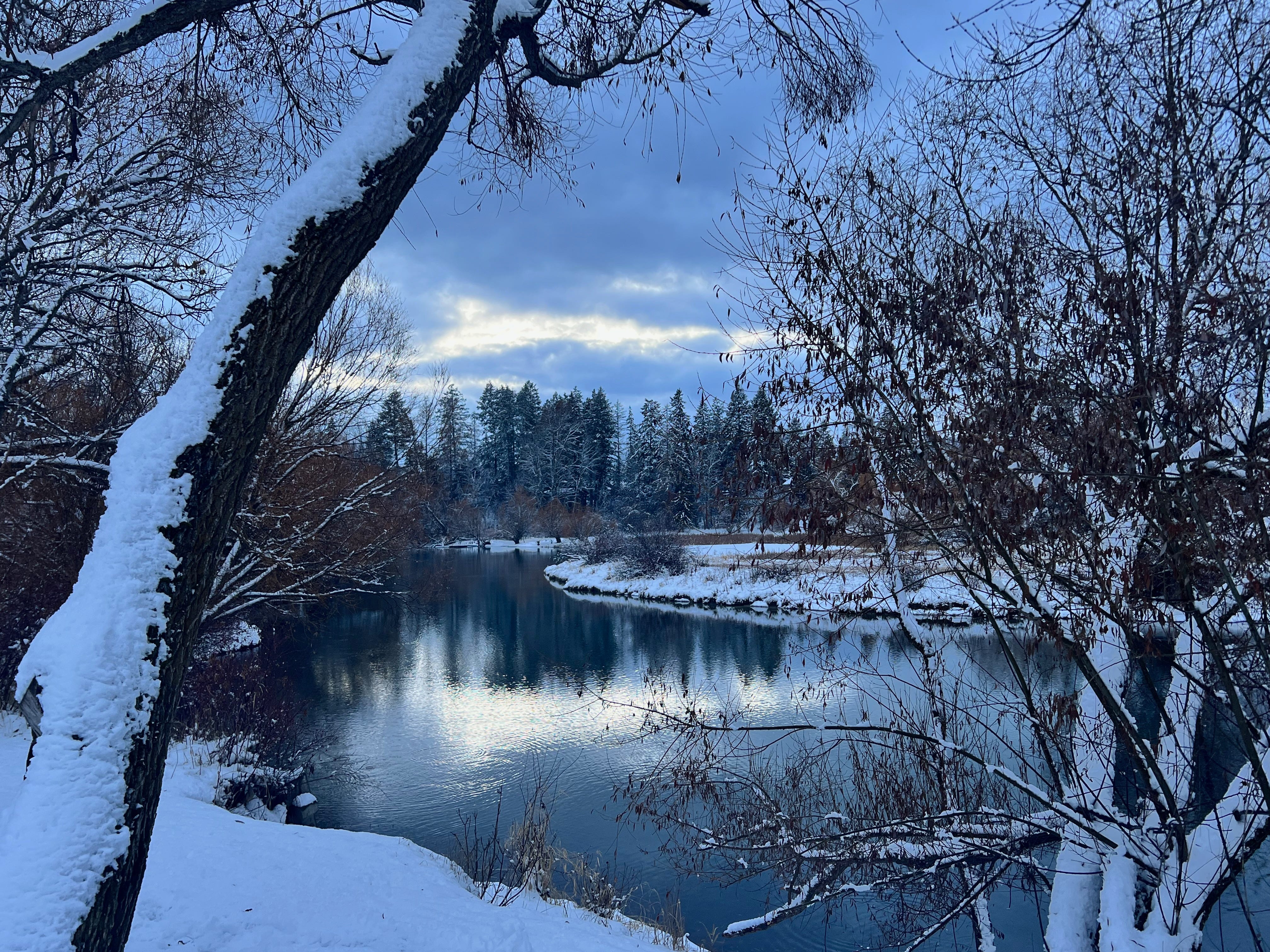
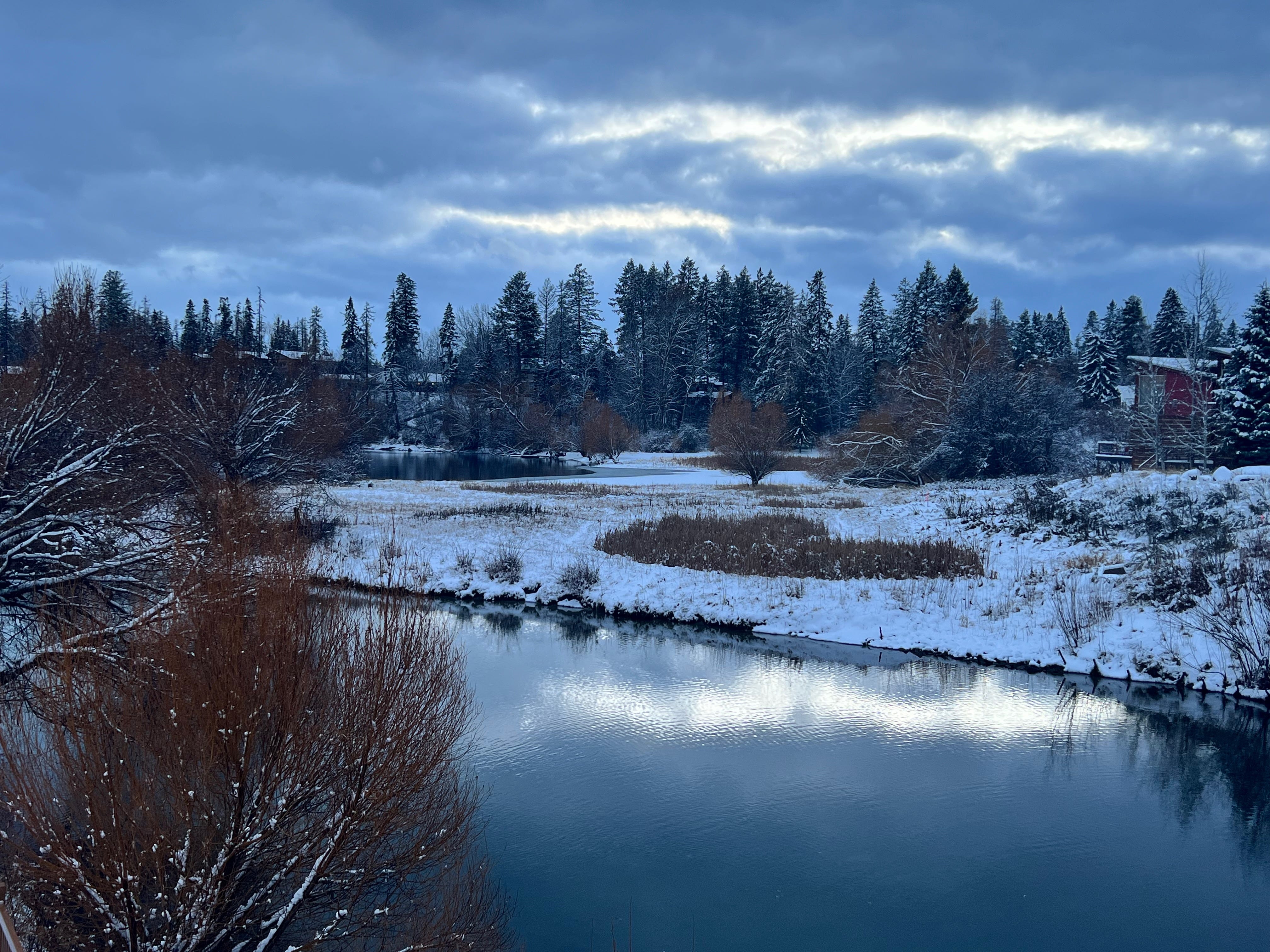
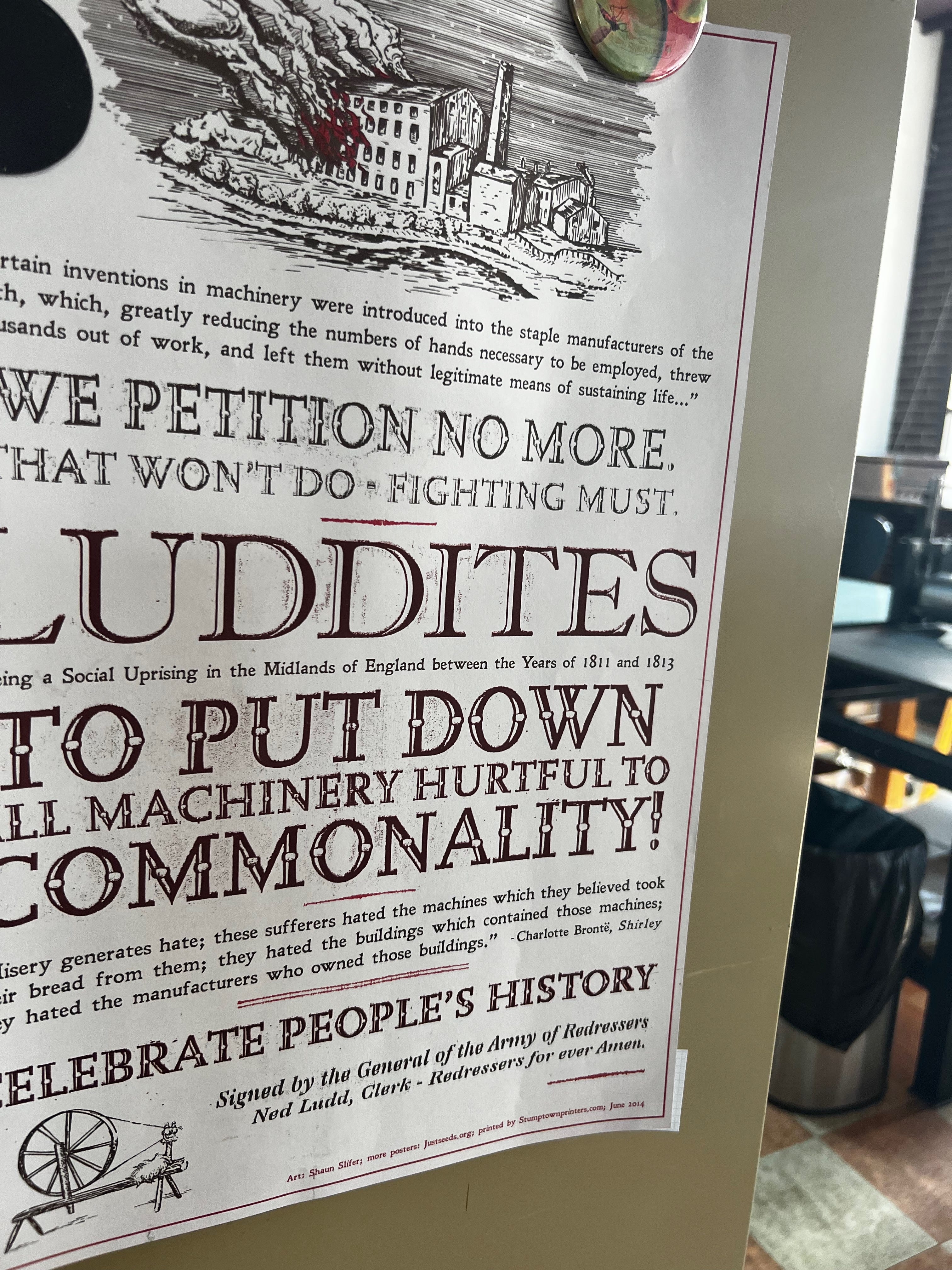
We had fresh snowfall recently, which was sadly washed out by rain for the next several days, but before it went I took a long walk around town to soak it all in. Look at that light! The photo brings out the blues, but in person it was more shades of gray with blue tint, and this light is precisely why gray is my favorite color. The clouds, the river, the flat light on the snow, the rocks in the riverbank. The way a splash of indirect sunlight gives all of it depth.
It’s hard to believe this river was a Superfund site not that long ago, that its waters were siphoned off and temporarily drained to allow a massive cleanup from a century of contamination from the rail yard. A friend of mine says that when her parents were growing up, the river used to catch fire.
I spend a lot of time thinking about that kind of contamination, what property rights allow and what they steal from the rest of life. But just as often, the beauty of this river snags me, pulls me to pause and sit alongside, dangle my feet in her gentle current. When there’s yet another leak from the rail yard that requires quick containment and a warning to people to stay clear of that area, it’s a reminder of how precious it all is, how easily these gifts are used up and discarded. Yet with a change in perception and a clarification of what we value, it’s just as easy to respect and care for them. The more people I listen to, the more it’s clear how many yearn for a reality that reflects those values. They just want to know how to get there.
For the next few weeks, I’m going to be republishing some older essays. There are many more people subscribing than when I started this newsletter over three years ago, and I wanted to share revised and updated essays that directly speak to what this whole project is about: ownership, private property, the commons, and the book I’m working on. These essays will go out as emails and comments won’t be enabled, but you’re always welcome to email me. I’ll try to continue adding an audio version to each post.
So far I’ve chosen essays from 2020 and 2021 on the East India Company and the dangers of corporate monopoly combined with state military power, the Doctrine of Discovery, an essay on loneliness that feels somehow timely again, and one on dirt, soil, and commodification. Anyone who’s been reading a while, if there’s one that stuck in your mind, feel free to make a recommendation.
I’m going to start with an essay that was in the winter 2014 issue of the small literary journal The Jabberwock Review. It’s never been published online. It’s a personal essay about a snowstorm in 2010 that brought home my own dependence on fossil fuels and roads, and was probably what got me started thinking about both car-dependence, and therefore walking, and private property.
Last week I attended a webinar recommended by subscriber Chad, who writes the newsletter Scientific Animism. It was given by designer David Dylan Thomas and was titled “No, Seriously, F*ck Engagement: Building a More Human Web.” It was billed as being for designers, which I am not, but it was really about capitalism, the insanity and injustices of the systems we live under and the stories that perpetuate them, and what people can do within their own work to forward a more humane world. It was uplifting, challenging, refreshing, and left me with more tangible optimism than I’ve had since attending the Reclaiming the Commons conference last summer.
Thomas ended with some advice about identifying our own values as well as identifying and challenging our assumptions—which reminded me of what one of my mentors told me over a long phone call after I got my first book contract: identify your biggest assumption (about walking in my case) and push at it from every direction you can think of.
Thomas went one step further from that, and I want to leave you for now with his words, one of the more solid pieces of advice I’ve heard in a long time:
“Co-imagine the future with the people hurt by the present.”
I imagine each of us walks with that idea very differently. What do those words mean in your own life?
May you and the weather find peace with each other, wherever you are.
A Walking Life starts with what mainstream news sources call a “refugee crisis.” I don’t like that term any more than I like the term “migrant”—I love the richness that words hold, the worlds they carry, but their ability to flatten is equally powerful. These are shorthands that limit how we think about one another: a crisis of refugees, or a crisis for people who’d been forced to become refugees?
The story was one that dominated news headlines in 2015: people fleeing war in Syria, on foot, stuck for a time in Hungary before being allowed to cross the Austrian border and on into Germany. Vienna, Austria-based BBC reporter Bethany Bell, an old friend of mine, was reporting from the border, where she sent me pictures of the piles of abandoned shoes “worn-out and inadequate to the monumental task they were being given,” I wrote. “In between interviewing refugees, Bell took pictures of bedraggled shoes and a prosthetic leg abandoned on the pavement. Another pile of donated shoes waited to be put to use.” In her interviews, she found an unexpected sense of hope, and, she told me,
“‘for me there was something deeply human in it. For all the things we create for ourselves, the homes we build, the lives, sometimes you just have to walk away.’
Walking is both our first step and last resort when fleeing war or persecution. A refugee doesn’t have the luxury of restraining his step with respect to political margins.”
Journalist Kathleen McLaughlin wrote recently about the line a lot of us living in . . . let’s say “politically challenging” places hear on a regular basis: why don’t you just leave? Which not only, as she points out, ignores financial and other constraints, but also, as she also points out, ignores the reality that harmful or violent politics don’t stop at borders.
The spectrum of who flees, who’s forced out, who’s being put at grave risk by staying, and who stays to fight no matter what the cost, is vast. It’s determined by factors that accumulate and pull on one another and is, in the end, beyond anyone else’s individual judgment. Not everyone can leave. Not everyone is allowed to stay.
All I can personally say is that the story of whether or not one leaves a home, and how, and what level of choice is or is not involved, is the story of humanity. It is in this particular story that my writing about walking and my interest in private property intersect most profoundly, and in ways that often surprise me.
A couple of weeks ago I came across an article some of you might have seen, about a database compiled by The Atlantic of the books used to train generative-AI systems. I figured my book had to have been used, along with the 20 years’ or so worth of writing I have online, since last winter my spouse put my name into ChatGPT and said, “Look! It can write an essay in your style!” (This conversation did not go well, though I think we eventually got to the point of me being able to explain why the last thing in the world I want is a machine to do my writing for me, especially one that’s stolen my work to do so.)
Sure enough, A Walking Life is in the database. It winded me a bit to see it verified.
To be clear, the copyright issue is the least of my concerns. If you want to go to a local library and photocopy every page of A Walking Life and pass it around to people who want to read it, I’d actually be thrilled. That is, after all, how my father and his family read Solzhenitsyn in the Soviet Union, though photocopiers were highly controlled and only in government offices and a bureaucrat risked his life to get those stories out into regular people’s hands. The more copies of my book are purchased, in whatever form, the happier (theoretically) my publisher is and the better chance I have of selling them or someone else on another one, but it’s far more important to me that people read it than that those reads show up in the graph provided for me in my publisher’s author portal.
It’s a completely different thing to have a multi-billion or -jillion or whatever-dollar company steal my work and then use it to both make more profit for itself, and to put other writers and artists out of work.
It’s also impossible to disentangle complaints about AI and other digital tech from the long history of technology being used to deliver more profits to a few, steal masses of people’s labor, and provide lower-quality services and products to people paying for them, along with building unjust and destructive structures that humanity and the rest of life simply have to live with going forward as best we can. Roads, highways, and automobiles are the examples I usually bring up but there are plenty of others. In A Walking Life I wrote about the Luddites, who are usually characterized as anti-technology but weren’t that at all. What they objected to was being forced out of their jobs—with no compensation or safety net—by machine adoption that made more money for the factory owner while also producing shoddier products.
It’s not about whether technology exists or not. It’s about how it’s used, its effects on people and ecosystems—the energy and water consumption of AI and data centers is absolutely staggering—and whether its role in the world is to contribute to life’s well-being or make it worse.
“The planning structure always fits well into the needs of the powerful,” said physicist and technology philosopher Ursula Franklin in a series of 80s-era lectures (undying gratitude to Jake for sending them to me; they’re amazing). “It rarely fits well into the needs of the powerless, and that is where the struggle sits.”
She gave that lecture long before talks of artificial intelligence became rampant, but whether we’re talking about AI, highway systems, railways, or the mills and machines that powered the Industrial Revolution, her questions hit home:
“Do people matter, or are people in the way? The technology will come once we make the decision whether indeed people matter or whether they are just in the way, and you design more and more stuff to make more and more people unnecessary, unneeded, and redundant. Don’t ask what benefits. Ask whose benefits, whose costs.”
The theft of my book, which took years of research and writing to produce, hasn’t done anything to improve my life, and I doubt it has anyone else’s, but it’s certainly contributed to someone acquiring just that bit more wealth, which can then be used, as wealth always has been, to tip the scales of injustice a little bit more in their favor. My cost, their benefit. That is what enclosure is, both historically and currently: taking that which was in use by all or already belonging to someone in one form or another, and making it your own for the purposes of private profit.
Neither I nor any other writer or artist has been given a choice in the matter, nor can we disentangle ourselves from the systems we’re being frog-marched into, not unless we give up creating entirely. And I can’t think of a single writer I know who would even consider that. We create because we can’t help it, because it brings us joy, because to not do so would be to flee one of the things that makes us feel most alive.
“There is no reason,” I wrote in A Walking Life,
“why our online lives can’t be used as a tool to enrich our restored communities, no reason why we can’t recover from the flu with some good friends bringing us soup and others bolstering our spirits through Instagram.”
Which, in my feverish and brain-fogged state when I came down with Covid last week—a week after getting a third booster shot!—I was delighted to notice was exactly what happened: A friend came by and left a jar of soup and some leftover huckleberry galette by my door. My brother-in-law offered to drop off more turkey broth. Another friend brought me groceries on her way home from work at the rail yard and included a bar of nice chocolate she knows I like.
And then a friend online, whose newsletter Berkana is one of the most beautiful and thoughtful on Substack, sent me a short video of someone making turmeric chai that was so soothing to listen to and watch I let it loop several times before realizing it was something I could actually do (the brain fog of this virus is very, very real for me). So I made some and drank it and did so again in the middle of the night when I couldn’t sleep, and you know what? I felt better the next day!
A Walking Life is about a lot of things, but at its core it’s about being fully alive beings on a fully alive planet. Walking leads us into every one of these subjects because walking is how we evolved. From the perspective of evolutionary biology, it’s what makes us human. And it’s what can shine a light most clearly on the barriers that have been placed to prevent our full exploration of that humanity.
The Authors Guild, of which I am a member, has filed a class-action lawsuit against several of the companies who’ve used published books to train AI. I gather some of the basis for the complaint is that the content was scraped from a site of pirated works. I’m curious where the lawsuit will lead, though it’s currently only for fiction and I’m not going to get too hung up on its potential. For nonfiction writers and others not immediately affected by the lawsuit but whose work is in the database, the Guild encourages us to write letters to the companies involved and provides a form for that purpose.
Which honestly made me laugh. I appreciate the thought but have better things to do with my day than beg any one of these enormously wealthy and powerful people to please not steal my work to make themselves richer. I can spend that time making more turmeric chai, for example. Or sewing up the hole in my kid’s blanket. Or writing a letter to my county commissioners about their gutting of the county library system, which I doubt they’ll care about but at least they’ll read (maybe). Or I could go for a walk.
These huge, systemic problems can’t be solved by piecemeal approaches, and in any case my focus is on the deeper structures that make the harms possible. Technology has been used both to improve human and non-human life for millennia, and it has been used to control and destroy it far more often. It depends on who benefits, who pays the costs, and who decides.
Perhaps most damaging of all, it’s been used to determine what we think we can imagine: a way of being in the world and living together that’s not determined by the control, power, and ownership of a very few. A world where food, shelter, health, soul-fulfillment, relationships, and even the joyful gifts of creativity are not dependent on tricking us into thinking we can only succeed in competition with one another.
I want us to unburden ourselves at the very least of restrictions around what we conceive as possible, and to contemplate a world where leaving means to wander freely, rather than being forced to flee—whether on foot or in the worlds of our own imaginations.
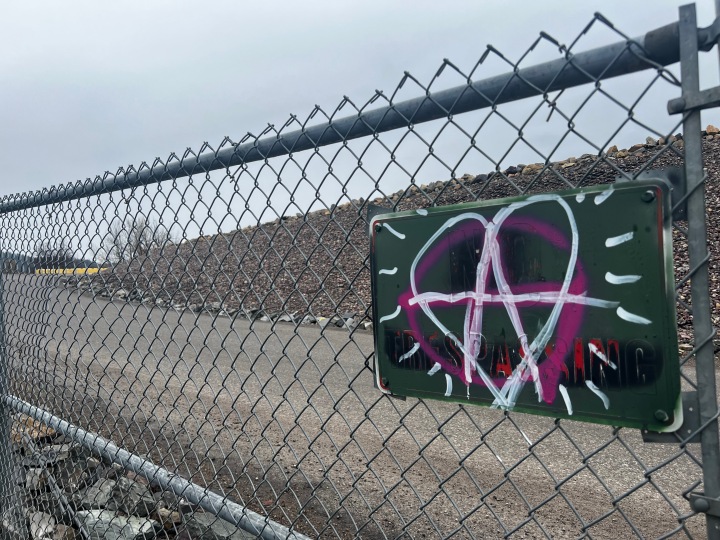
Someone’s been updating the No Trespassing signs on the fencing around the rail yard in town.
For several years, before and for a while after I had kids, I worked on a mystery novel set in eastern Montana. I wrote sketches and backgrounds for the major and minor characters; mapped out plot points, detailed motivations, and background for the murderer (he was a paleontologist selling fossils on the black market to pay for his mother’s cancer treatments), rewrote the entire thing start to finish at least eight times, went to a couple of encouraging mystery writers conferences, and generally had a fun time pitting my two main characters—half-sisters full of mutual resentment—against each other.
One day, sitting in a small, dusty library in an old building in upstate New York and struggling with another revision of said novel, I realized that I’d been forcing the writing for at least a couple of weeks. I dreaded sitting down to any of my works-in-progress, and actually started sneezing whenever I picked up the mystery novel, as if I were allergic to it. But I wasn’t allergic (maybe that was the library); the desire to write had left me.
I don’t mean I was blocked—“writer’s block” is very often just fear—or that I was stuck. This was something new. The desire to craft narrative, to feel the glide of a pen across a notebook or a printout of a manuscript, was just gone.
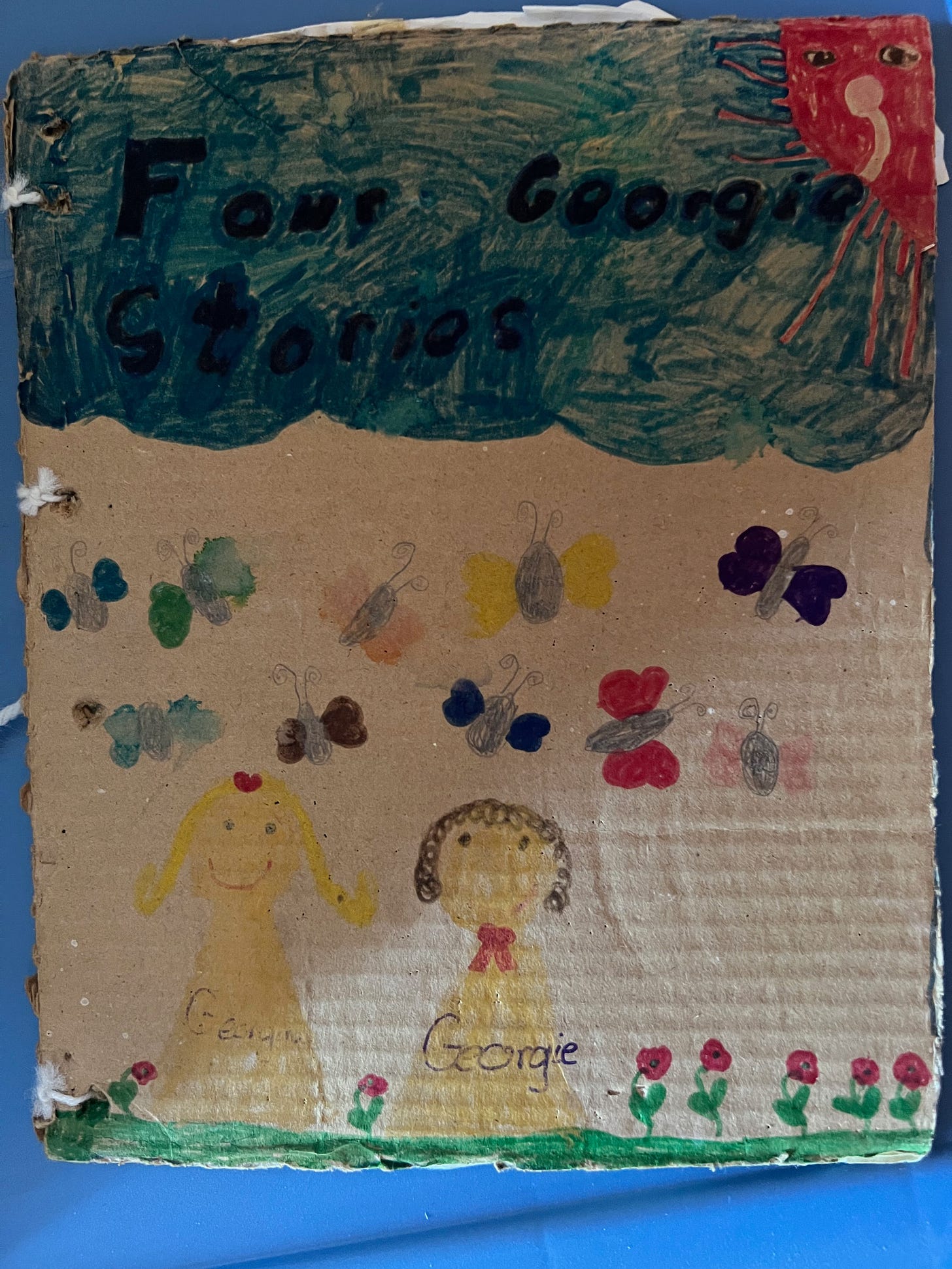
It was the oddest feeling. The urge to write had been with me almost as long as I could remember. I wrote my first stories at an age so young I barely remember them, though I still have the first “book” I wrote when I was maybe seven or eight years old.
Four Georgie Stories, featuring the adventures of a ghost named Georgie and his friend Georgina
Losing writing showed me how much it’s part of whatever “me” is. I imagine visual artists and musicians and dancers and in fact creators of any kind feel the same. Before writing left, I would have been hard-pressed to explain its neverending urgency to someone who didn’t already know what I was talking about. Like most writers, I received piles of rejections before my essays began finding an audience. Anyone who’s been bitten by a creative bug knows what I mean when I say rejection won’t stop you: It’s not an expression of ambition or some vision of success that keeps you going; it’s the writing itself. I could never have published anything in my entire life and that would have made me sad but it wouldn’t have stopped the writing. “Being a writer” is a full-on embodied thing that exists no matter what kind of feedback or public notice you do or do not get.
Which is, really, strange. I didn’t know how strange until it wasn’t part of my daily existence. I woke up and didn’t feel a need to write. I had a kid-free hour or two and didn’t bring out an essay to revise. I opened my copy editing work for the day and never turned off my work timer to dive into an idea that had just come. I read books for pleasure and never felt a twinge of envy or wonder “How did they do that?” It was probably the most free I’ve ever felt because I realized I could do other things with my life. I could become a firefighter, or apply to do a graduate degree in mathematics, or get a job at one of the local farms.
It was only when it wasn’t there that I realized how much space writing took in every moment of every day, every breath, every thought.
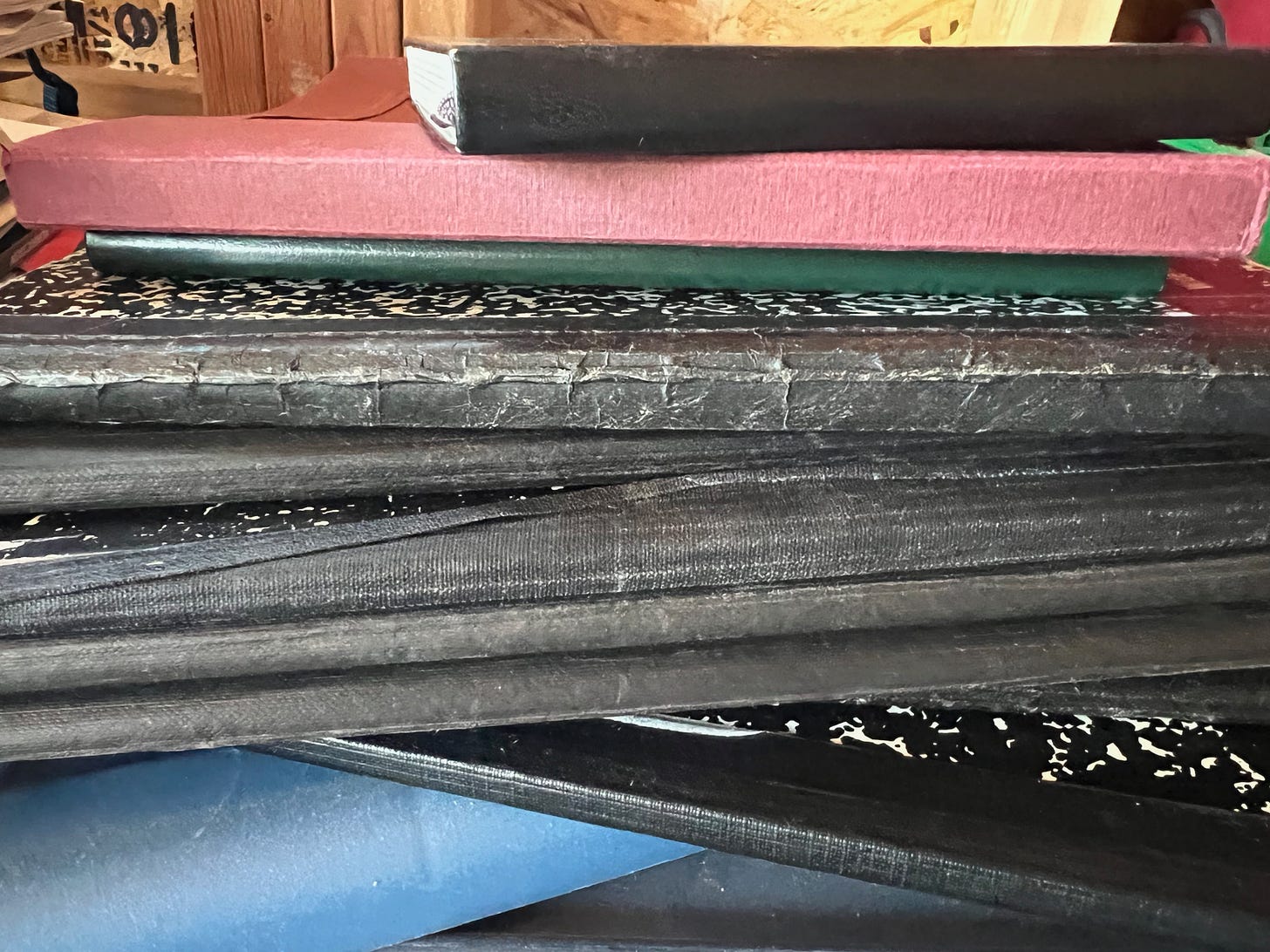
An accumulation of finished private journals (care of Ex Libris Anonymous, where I buy these in bulk), which I burn . . .
And the same of notebooks filled with first drafts, which I keep.
The absence only lasted about three months. I don’t know what writing was off doing during that time—maybe it was sick of reading that mystery novel for the fiftieth go-round. But when it came back, it saturated everything all over again; I could still go pursue firefighting or mathematics or picking overpriced organic tomatoes for weekenders from New York City—I could cook a stew or try to grow cucumbers and kill thistles and not be drawn to turn each of those acts into metaphor for human existence!—but wanting to write about that life was going to ride along no matter what I tried go after.
I’ve only talked to one other writer-friend who’s experienced this absence. She told me she thinks of her writer self as a middle-aged white guy who sits at a battered desk in a dirty office scribbling stuff out and throwing it to his assistant out front to type. And sometimes the writer dude disappears for no reason and the assistant bides their time playing Minesweeper (this conversation was before games other than Minesweeper and solitaire were widely available).
It was an interesting lesson to go through. I’m not sure any of us understand what writing is—what creativity is, for that matter; Arthur Koestler wrote a whole book about it (The Act of Creation, with lingering themes in The Ghost in the Machine) and didn’t really come to persuasive conclusions—much less why some are driven to do it no matter what the circumstances. As my father is fond of reminding me, Dostoevsky wrote in a freezing shack with his family all around, in exile in Siberia, which is partly why I’m not picky about the mechanics or location of the writing I do. I’ve written in coffee shops and libraries, at home with babies climbing on me and on campings trips in the early morning with frozen fingers.
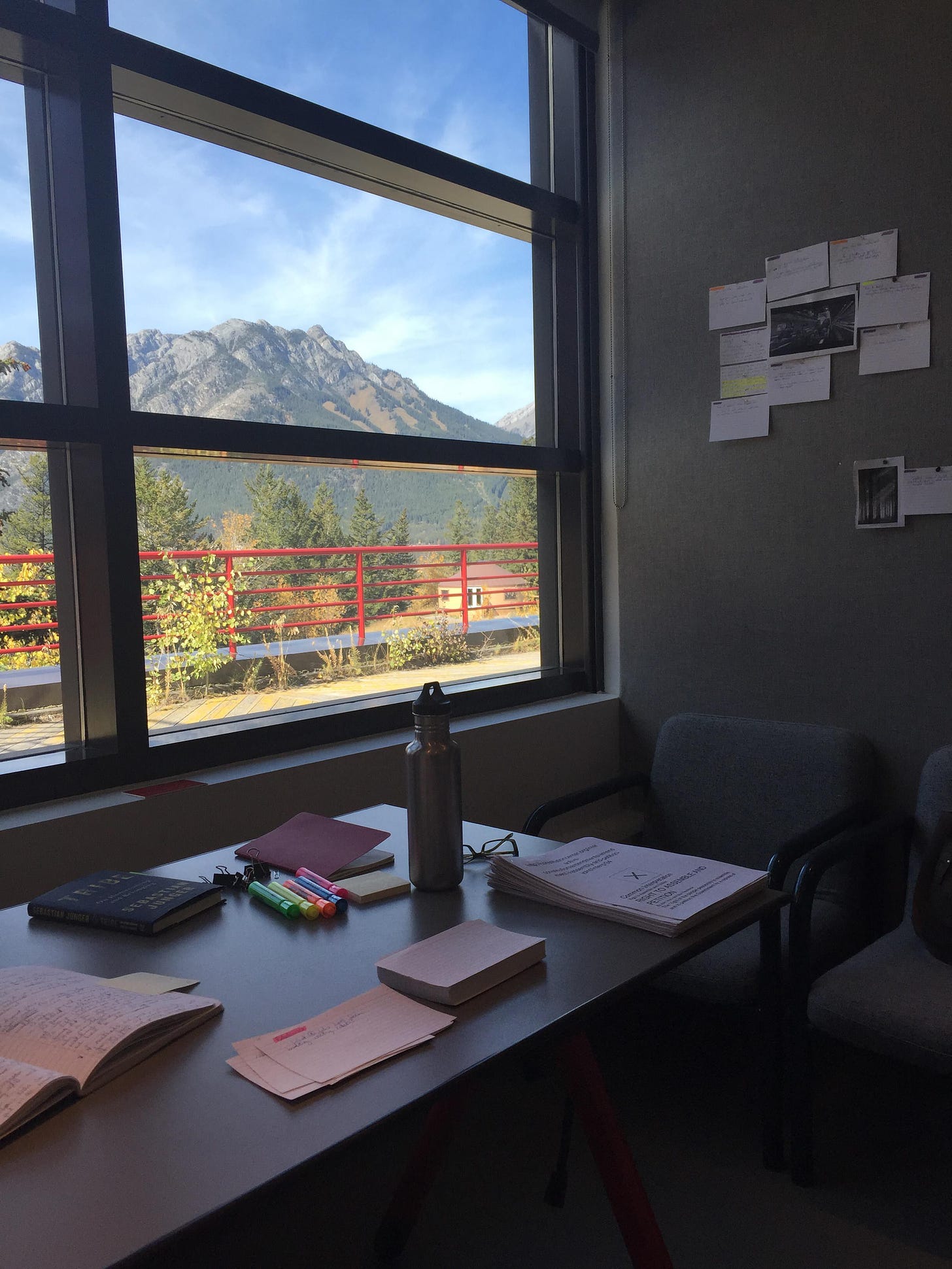
My office during a 2016 writing residency in Banff, where I always long to get back to; I don’t need a special writing space, but it is incredibly luxurious and productive to have one
When my last book proposal was rejected, I thought a lot about the time that writing went on vacation. It wasn’t that I was going to write the book no matter what; it was knowing that I could ask my writer self if this was still an idea worth pursuing and could trust the answer (yes). I’m a slow learner—and a slow writer—but I’ve heard enough internal “meh’s” to know when something isn’t going to let go.
I’m always curious about people’s relationship with writing and art. With creativity. There’s a tremendous amount of conflation between writing itself and “getting published,” especially getting a book published. I’m always intrigued when people say they hope to “become a writer”—I remember saying things like that, only realizing later that it was just something I was, not something I could choose to become. Does every one of us have to untangle those two things for ourselves, come to terms with the writer who’s going to be a driving, urgent force in our lives no matter what “success” or recognition we do or do not achieve?
Many of my favorite Russian writers and poets existed in frankly horrific circumstances. Exiled, jailed, living in extreme poverty, loss of children, loss of freedom, loss of country and home. They didn’t write because they hoped for a steady stream of book contracts and speaking engagements for the rest of their lives; they wrote, often at risk of government rebuke, censorship, or worse, because they could not help themselves. This has been true of artists all over the world, and over millennia. The best writers I know right now are writing because the stories want to be told, need to be told, and through them.
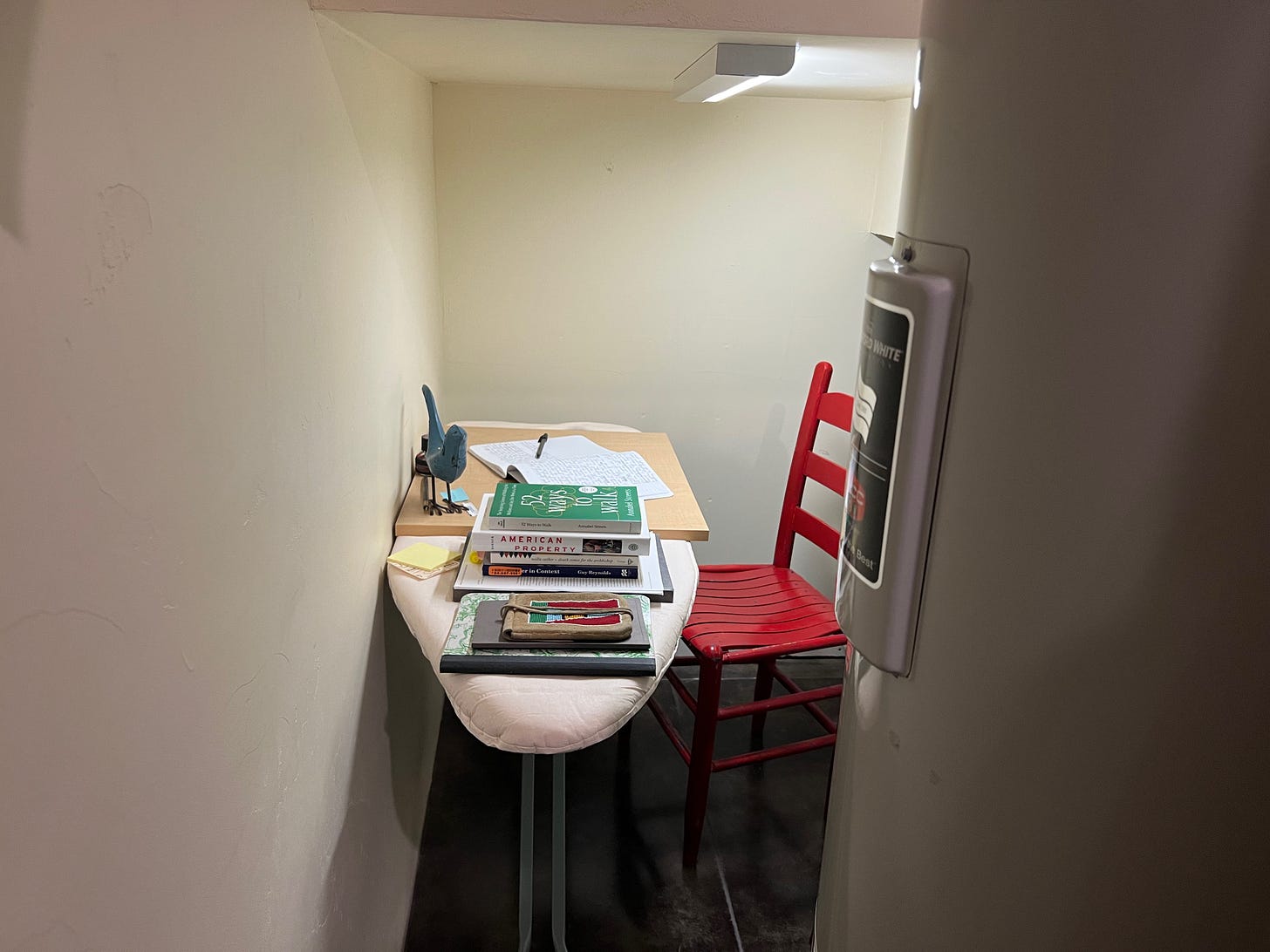
It’s not ambition that keeps people going; it’s more like an internal insistence. Not being able to help oneself. It’s why days or weeks without writing time leave me incredibly cranky and difficult to live with. It’s why I’m at this moment sitting at an ironing board set up under the stairs and behind the water heater (it’s the only place I have a chance of not being interrupted for a while, with the added bonus of making me feel more Russian than I actually am by being cold and uncomfortable and smelling strongly of pickles because we have a bucket of them fermenting in the same tiny space).
The glamorous office of someone who can’t help writing
When that last book proposal was rejected and I thought about the time years ago when writing left, I couldn’t help remembering how much easier life was, how many more possiblities there were for how to spend my time. It hasn’t left in over a decade, but its absence is still visceral. It taught me a straightforward lesson: writing has nothing to do with either form or success—it’s either there or it’s not. A book is one form, as is a magazine byline, as is a blog, as is a speech, as is a letter to an old friend; and that all the book contracts in the world, either behind you or ahead of you, mean nothing when you’re exploring that next idea, seeing if it holds firm, asking it what it wants to be.
What matters in the end is your commitment to the story itself. Like any relationship, where you go together will be unexpected. It will have its griefs as well as its joys and there is always the potential of heartbreaking loss. Success and accolades are never guaranteed, and even when they come, they don’t change what writing—what stories—need from you. The writing might abandon you for a time, but what the story needs to know is that you will never leave it.
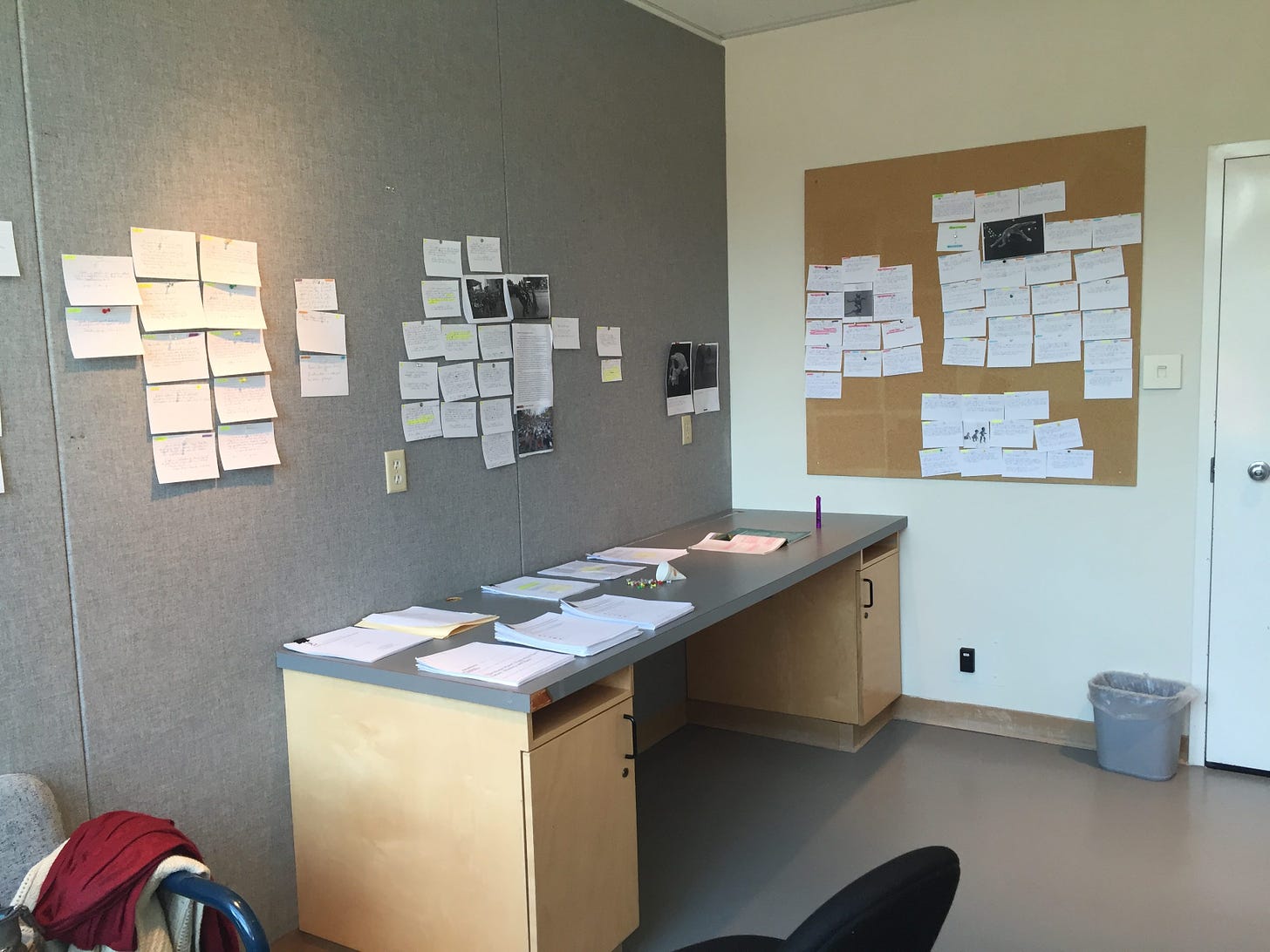
Working on A Walking Life at the Banff Centre for Arts & Creativity shortly after signing my book contract—the kind of treatment and space book projects probably deserve (yes, book, I’m working on it; we’re working with a little less wall space here under the stairs)
Good news! I’ve finally finished the first messy, painful 10,000-word draft of the first full chapter of No Trespassing, on land ownership. After several attempts to structure it around the ranch in eastern Montana where my mother grew up, I came at it from a different direction—starting with a paper I’ve been wanting to share with you all for over a year studying intergenerational economic mobility in Florence, Italy, from 1427 to 2011.
Now begins the messy, painful process of overhauls, edits, and revisions. This isn’t an easy process for me. I have a particular kind of work ethic—a quintessential Taurus personality if you prefer that framing. I like deadlines and assignments and really prefer working with an editor who can both collaborate and push back. Doing this book project without one feels like walking on thin air a lot of the time. Or onto the narrow bridge over the abyss out of Khazad-dûm. I don’t like heights. Or having flaming Balrogs in hot pursuit.
But whether on my own or under contract, a book is always a sustained slog with moments of piercing joy. Thank you all for continuing to walk this path with me. It’s you who ensure those moments of joy come more often, and find their way into this space.
Audio version. Apologies for my voice being a little shaky. I was so cold!
When I was fifteen, I had my first major experience of culture shock. My family had just left the Soviet Union, where we’d been living in Moscow for several months. We exited the country as we’d arrived, by train and nerve-wracking encounters with Soviet customs and border patrol. There is a woman somewhere on this planet who lives in my memory standing forever at the door to the train car, weeping as she watched the customs officers carry away the violin she’d been playing.
Back in Helsinki, Finland, outside of the Iron Curtain, I had a minor meltdown brought on by the ice water and cloth napkins in a restaurant. To this day I can feel the strangeness of it, leaving a country where sometimes there were sausages in the supermarket and mostly there weren’t, and my younger sister and I quickly learned to find the growing line whenever we smelled bread; to one where ice water and cloth napkins, much less restaurants people ate in and customs officers who didn’t confiscate everything of value, were considered normal.
The real culture shock came a few days later. My younger sister and I were sent to stay with our oldest sister, who was at college, while our parents moved our life back to Montana. One day we two younger ones went for a walk to a grocery store and found ourselves wandering around the aisles confused and weirded out, unsure how to think about all that food we were looking at, all that choice.
When I was thinking about writing this, my mind kept trying to insert the word “abundance” in that line rather than “choice.” There’s so much! Look at all those cereal boxes! All those varieties of sliced meats! All that bread and you don’t even have to stand in line for it!
During the time we lived in the Soviet Union, my sister and I didn’t go to school. We had Russian lessons most mornings for two or three hours, and then wandered the city on our own. We often ended up outside a metro station, where people sold trinkets or Bazooka gum from small tables, and babushkas sold roasted syemechki, sunflower seeds, wrapped in newspaper cones, and there was a marozhonoye stand that sold soft, almost tasteless ice cream in soft, almost tasteless cones. When I had some kopeks in my pocket, I’d buy sunflower seeds, or fresh bread if we happened to come across a sidewalk kiosk that was selling some. There wasn’t much else to spend money on.
It was surreal to walk the aisles of an American grocery store again and see the stocked shelves. I was too young to understand that experience fully, or to understand that choice has little relationship to abundance, especially if the choice is a mirage created by advertising, packaging, and small tweaks in sugar and salt content. All I could say was that something felt wrong. All that choice, and yet all I saw was emptiness.
Hunting season is almost wrapping up here for me. I haven’t been out that much and haven’t yet brought anything home, but no matter what my hunting seasons look like, they always make me think a lot about abundance.
Last week I was out in a new-to-me spot that a friend introduced me to. I didn’t see a single deer except for a buck we passed on the drive in, which I waffled too long on stopping for until he ran off, but I got to spend a couple of hours watching a flock of chickadees being busy and at least another hour watching a tree’s respiration mist off of its trunk into shafts of sunlight, which I’ve never really observed before. Like some kind of avant-garde film except it’s life, not a movie, right there in front of you: a tree, breathing.
Like the woods around here often are, it was utterly silent. Soaking into that lack of noise is indescribable. To sit by a big boulder surrounded by tiny spikes of juniper moss, an occasional raven call overhead, and falling larch needles that sound like the lightest, gentlest rain. Trees exhaling into the last of autumn’s sunlight.
And I saw something that for the first time in my hunting years made me wish I had someone next to me to share with, just for a few moments: a squirrel digging up a mushroom and running across the forest floor to take it up a tree. A squirshroom in action! (For anyone new here or who missed that post, an explanation of squirshrooms is in the post about my Master Naturalist course.) I’d never heard about squirrels’ mushroom habits until a couple months ago and suddenly they’re everywhere.
Hunting season usually caps off my frantic finishing-of-garden-tasks with a break of snowfall in between. It hasn’t been snowing enough here—when locals complain about the snow, my reminder is that without it we don’t have rivers, or water to drink, and it’s not all about our human comfort or desires anyway—and I’m behind in my gardening tasks. We finally got the carrots stored away, and I’m about finished with the potatoes that my spouse dug up. I hope to have more luck with them this year after losing most of last year’s potatoes to winter’s deep freeze-thaw cycle.
A kind person in town—a subscriber here!—let a friend and me pick as many apples as we could manage from her trees, and I spent many hours peeling and coring and slicing, with my dad’s help before he went back to Russia, and now have many servings of dried apple stored away for when winter starts to get serious—same for peaches, skinned and pitted and sitting in the freezer next to the huckleberries, which I made a concerted effort to pick far more of this year, along with a few grouse whortleberries, all of which I’m trying not to break out too early. And the jars of chokecherry jelly, which are a complete pain to achieve because there’s no easy shortcut to processing chokecherries, but which, come January, will evoke summer with more heady mustiness and memories than even the most perfect peach.
All of these things, the hunting included, take time, patience, community efforts, intact ecosystems, clean water, attention, and care. They also take human lives free of violence, oppression, and inequality. They take a kind of unquantifiable abundance and richness that can only be destroyed, never replaced, by aisles of cereal boxes and flavored yogurt and sliced lunch meats and all that is required to create and maintain the systems that make those full, empty grocery store shelves possible.
A couple days ago I was watching sunrise over the train yard in the early morning, and a long set of cars with double-stacked containers labeled Amazon Prime rolled past. I’d be preaching to the choir here to go on about the pointlessness and waste that consumption represents. About all that’s bent and broken in this world to force it into temporary consumer “choices” loaded into those containers.
I could quote from many books to illustrate that point. From Amitav Ghosh’s The Nutmeg’s Curse or Edward Posnett’s Strange Harvests (which I really liked and think about a lot) on what happens to abundance when cannibal capitalism turns its sights on commodification; or from Abdullah Öcalan’s The Sociology of Freedom, on the 5000-year history of the powerful requisitioning “surplus” labor, resources, and time for its own purposes of accumulation long before capitalism came onto the scene to streamline the process. Or from one of the many articles I’ve read and podcasts I’ve listened to recently on seed-saving and food sovereignty.
Instead, I wonder if you could quote from your own life. Find the spaces in your memories, or in today, where abundance feels real, or what you’ve consciously turned away from because you know it’s a false replacement. What you wish you could change, what you’ve found intractable when trying.
No matter how much we read or study, it’s never a replacement for lived experience.
The train cars reminded me of that feeling long ago, walking around a grocery store full of what was called food and feeling confused, unsatisfied, and, I realized many years later, sad and lost. The realities of life in the Soviet Union are nothing to romanticize—starting with the lack of food and expanding quickly to lack of anything like true freedom—but our particular life there had elements that I missed when they were gone: time to wander and to learn, time for long and aimless walks, time to eat sunflower seeds and watch the river, time to think about what it means to be a person, and what it means to be free.
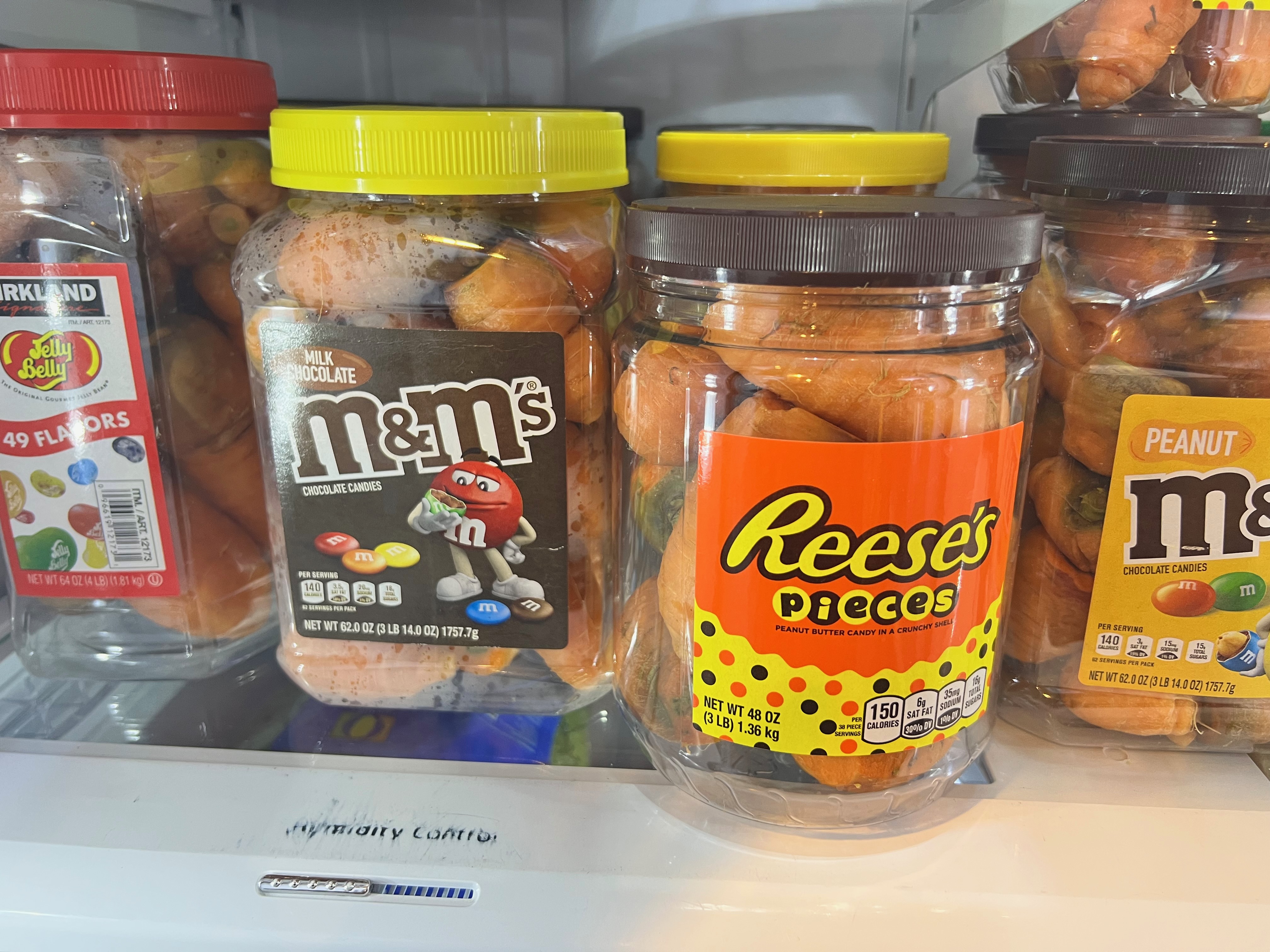
After all that, please feel free to engage in some good-natured ribbing over this evidence of how much candy we went through during the first couple years of Covid. This is NOT all my kids’ doing. There’s a reason I avoid those aisles at Costco, especially the jelly beans, but at least the empty containers are great for carrot storage.
I’ve got a new interview about the physical and social importance of walking on philosopher and former professional baseball player Greg Hickey’s site KineSophy: The Ethics of Human Movement. It gets back into some of the fundamentals of why I think walking and walkability matter more than most people think they do, how walking makes us human, and why I wrote A Walking Life: “Show me a world where we truly have the choice to walk or drive—and by walk I mean walk safely and pleasantly, not having to cross dangerous highways or busy intersections or constantly breathe in automobile exhaust—and you’ll show me a world where we have some freedom of choice about our mobility.”
In addition to the audio version of this essay below, I’m working on recording the Introduction to No Trespassing. I wanted to do it at one of my favorite creeks, but it’s a bit of a drive to get there and back. Speaking of No Trespassing, next chapter of the book is taking a long time, partly because I’m working on another big essay for a publication that intersects with the subject and want to make sure that they cover different territory, so to speak. Thank you for being here—your support helps with all of that!
Audio version, recorded at a public beach on the lake my town is built around, along with ambient noise and my random commentary.
Until a few days ago, I’d only walked a labyrinth once in my life, in 2017, while working on A Walking Life. I’d been on the Norfolk coast in England to visit a sea-pounded shore where fossilized hominin footprints between 800,000 and 900,000 years old had been found. The last chapter of the book is about those footprints and that journey, including the long, absurd saga of trying to reach the coast by train and bus; it’s also about my unintended stumbling across a labyrinth laid out in the courtyard of Norwich Cathedral, and what happened after I decided to walk it. That was the first, and until recently the last, time I’ve met myself in a labyrinth.
On a recent afternoon, “people-d out,” as I said to an old acquaintance, I bailed on the final hours of a conference to venture out to a distant labyrinth someone told me about last year. It’s open to the public but built on private property. Driving toward the house from the highway reminded me of coming in toward the Rocky Mountain Front from central Montana: bending along rural roads up into the hills, snow-dusted mountains in the distance; passing, strangely, a yard full of bright blue peacocks pecking away in the grass.
There’s a reason the shape of a labyrinth is ancient beyond imagination, and a reason they’re found all over the world. I don’t really want to give the reason a name, mostly because I don’t have one, but I felt it that first time, walking one outside the nearly 1000-year-old cathedral in Norwich, the town where the farmer Robert Kett was executed in 1549 for leading the Norfolk Rebellion, one of England’s most violent, desperate mass revolts against enclosures of the commons. The sign erected in Kett’s honor 400 years later has inspired much of my writing about the commons and private property, but at the time I was still immersed completely in walking, and writing about walking.
I’d spent a while in the cathedral, thinking about the generations of footsteps that had worn the stones now smooth under my own, before wandering outside and coming across the labyrinth. Encountering it was a lesson to me in the limits of learning via books rather than experience, as I wrote later (I’ll caveat the “less spiritual than she is religious” phrasing here with reference to an essay I wrote last winter about questioning my self-described atheism):
“Although I’d read as much as I could about labyrinths, including Reverend Lauren Artress’s Walking a Sacred Path, I had never actually seen one. And I hadn’t, to be honest, been all that interested. As a person who is less spiritual even than she is religious, if that’s possible, I tend to be skeptical of any spiritual or religious practice that claims to put us in touch with the divine, much less with ourselves. Walking a labyrinth, I thought, might contribute to my research but wouldn’t actually do anything.
I believed that, that is, until I walked one.
There weren’t many people at Norwich Cathedral that day. I joined four or five milling about the labyrinth, but instead of walking straight into it, I felt compelled, and I still have no idea why, to circumambulate the outside first. While walking, I began to form a question, one drawn from a personal existential struggle I’d been caught up in over the previous year or two.
I wasn’t prepared for what happened when I entered the labyrinth. I carried my question in with me, and as I began walking responses came—not direct answers, just thoughts—pulled from somewhere deep inside, a psychological place that I have only looked into at certain points in my life when all other answers have failed. A place of the heart but also of the soul. And as these responses rose up to meet my conscious mind, my feet slowed down of their own accord. I didn’t choose to slow down, not in the way we usually understand choosing—my feet dragged, as if being drawn down by the ground, as if responding directly to the gravitational pull involved in each footfall. I became acutely aware of how each lift of the foot and step forward related to the grass and dirt and rocky crust and molten core beneath.
I tried walking faster, as an experiment, but each time was pulled back, so I let my feet take the lead and examined the responses of darkness and light that came up to meet me.”
It was eerie to be walking through a labyrinth more recently and find that similar responses pulled on my spine, feet, and thoughts, as if I were stepping back onto a path I’d been on only moments before, though it was almost exactly six years to the day since my feet last wandered a labyrinth.
This time, too, I first walked around the outside of the labyrinth before entering, once clockwise and once counterclockwise, forming an existential struggle into the shape of a question, or as close to a question as I could get.
Maybe we all have the same questions in different shapes and words: How do I untangle this knotty mess of a human, knotty mess of humanity? What good can I do, can my work do, amidst the violence and pain inflicted by those with the most power? My question wasn’t exactly that, but it intersected with those, wrapped also amidst some personal problems—it all feels connected. I suppose it always is.
I was the only person there for a while until a trio of much younger people showed up to run across the circle and take selfies. “You’re messing it up,” one of them said to another as they crossed through the pattern. “You’re doing it wrong.” There probably is no wrong way to walk a labyrinth, I thought, trying to keep my attention instead on that same energy I’d felt once before, slowing my footsteps so much that for one long stretch I was barely walking forward at all.
My feet pulled back and were eventually moving so slowly I could barely comprehend it, much less want to control it. I stopped and took off my shoes and socks, letting the snow-chilled mulch and fallen leaves bind my feet to whatever it is that comes to life in these winding paths. I tried to ignore the awareness of how weird I must look to the trio of twenty-somethings, moving with aching slowness and barefoot. If you think about it for a moment, which I wasn’t able to do until drafting this essay, the whole concept of taking selfies to post online is weirder than walking barefoot.
That first time in the Norwich labyrinth, I hadn’t gone barefoot, but the experience was still similar.
“This part of who I am as a person, a human, knows that this connection to the ground is real. It feels the thin places of the world, the shiver of being closer to some kind of otherness. . . .
I took a long time to walk into and out of the labyrinth. People passed me going each direction. I stepped around a woman crouched on the ground taking photos, and two kids leapt from stone to stone around me, and still I walked, stuck with my questions and responses and the pace my feet insisted on. When I finally exited, it was with an eerie feeling of having been knitted back together, not just within myself, but with far more than I could fathom.”
I’d entered this recent labyrinth a little late in the day, leaving me not much more than an hour to walk it. I used up most of that time winding my way in and reached the center about fifteen minutes before the place’s posted closing time. As I put my shoes back on over cold-numbed feet, I felt saddened at the thought of rushing out, resenting the idea of having to be efficient with time dedicated to existential quandaries and presence.
The unraveling of problems, selves, the world, and humanity need more time than this. All of our time. As I walked out, I tried to maintain the connection I’d found on the way in, the aliveness that came from the ground through the feet and up the spine, and unnameable «whatever it is» that gave me some kind of guidance as I walked more and more slowly through the turns and curves of a space shaped to unwind the self.
“Hi there!” called a voice, startling me as the sun disappeared behind the mountains.
“Hi.”
“We close in five minutes,” the woman said, sounding a little impatient. I tried, only partly successfully, to ditch disappointment and hang on instead to what I’d found. To the small reassurances that showed a way forward, an opening, some kind of way to be in this human-ravaged world. To see if the walk outward could help shape a way for the raveling I know we all need.
A few days later I was listening to an interview with the Sakha singer Suor, or Snow Raven*, and was reminded of the labyrinth and that craving for more time, for all the time in the world, as she described her childhood in Arctic Siberia and the quality of silence that allowed her to learn how to mimic the animals of her home. We all need that, I thought again. The time, the silence, the simplest, most denied freedom to be our most present in the world, for the world.
It’s really what that last chapter of A Walking Life is about, the ways in which we carry the world and ourselves, and especially griefs larger than anyone should ever have to bear, one slow step at a time.
I had to accept the uncertainty and answer the property owner, hoping she would leave me alone for those last few minutes. Leave me to gather together whatever wholeness I’d been given, long enough for me to keep in touch with it a little longer, to have something articulate or tangible to bring out into the world that exists beyond the thin places.
“Thank you,” I said, waving at her. “I’m on my way out.”
* This YouTube channel looks like the kind that would try to persuade you that alien lightworkers walk among us in a hot minute—apologies if I’m misaligning them—but Snow Raven came across as someone with generosity of heart and spirit. Listening to her demonstrate animal language, teach the interviewer how a true yodel is created, and especially hearing her sing a traditional Sakha song about an hour in, is lovely.
Audio: I’ve had a few conversations recently with friends who are having trouble reading. Even I’ve found myself reading far fewer books this year. Maybe it’s burnout, maybe it’s the internet, maybe it’s Covid. I have no idea. But I’m trying something I’ve been wanting to include for a while here, which is reading these essays aloud for anyone who’d rather listen than read. I can’t promise to do it every time, but I’m going to try.
Thank you for being here! It makes a difference. Paid support has recently helped make possible a research trip that covered hundreds of miles and many hours in the genealogy and local history sections of a small-town library, and disconcerting time with a haunted doll. The research is making it into No Trespassing and a separate big essay project on private property; the haunted doll I hope won’t (I did put a picture of her in the Chat).
Earlier this week I was walking my nieces over to my house when it was still dark. We got shoes and coats on and checked to make sure their lunch bags were in their backpacks, even though I’d watched their dad pack everything before he left for work. We locked their house and I paused to breathe in the cool early-morning air that I can never get enough of, and glanced up at the sky. It had been overcast for days but that morning was dark-bright clear, the stars speaking of both distant galaxies and ancient cosmology stories.
“Look!” I said, pointing up, “there’s Venus!” They were so excited as I told them how that bright star-point was actually a planet hovering high in the southeast. Then we found Jupiter, almost as bright and a little lower in the west.
It’s one of the things I’m most grateful for about where I live, that we can still see the stars. The light pollution continues to grow, and it’s nothing like being at a cabin or camping, but when I take my first step outside between four and five in the morning, I can, if it’s not cloudy and there’s no moonlight and I let my eyes adjust for long enough, trace out the path of the Milky Way, and am often rewarded for patience with a shooting star, which never fails to feel magical.
Last night as I went to bed, Moon was out low in the southwest, looking almost like a Harvest Moon, all big and golden and bright even though She’s only in Her waxing crescent phase, not even a quarter full. I wonder what it feels like to Her, when She’s only partially sunlit but all of that side is still washed in a golden glow. Does She feel Her own beauty? Does She ever wonder how many of us are taking the time to let our eyes linger on Her light?
In the evenings, my younger kid and I often go outside if Moon happens to be visible before I go to bed, and we watch Her together. They took immediately to the Anishinaabe teaching of Moon is Grandmother, and together we speak of Her that way. Maybe I’ll ask them, or my nieces, who see the brightness of Venus with such fresh, starstruck eyes, what Moon might be thinking.
It delights me to no end to see how easily children’s attention is directed to the world they instinctively love. We all start out that way, loving the world and attending to it.
This last June, I received a gift from one of my neighbors: a small handful of sweetgrass starts. I’ve been interested in growing sweetgrass ever since moving here and being told by a mutual friend all about this neighbor and his relationship with ceremonial sweetgrass.
He can be a hard person to catch, but last winter I ran into him plowing his driveway while I was walking the dog. After we’d chatted a bit about the winter’s extreme weather fluctuations that saw days of -40°F winds and frozen snow followed by days of rain, I told him that I’d really love to learn how to grow sweetgrass if he’d be willing to teach me.
When I walked down to his place in June and said I was still interested, he introduced me to the sweetgrass bed in his yard. We talked about how to tell the difference between sweetgrass and quack grass—not easy but a necessity because quack grass grows everywhere here—and he showed me how to harvest and dry the grasses. Then he gently pulled a few roots out of the ground so I could start a patch in my garden.
“Sweetgrass is friendly,” he told me, “but likes respect. And it likes to be alone,” as in, not mixed in with a bunch of other plants.
I can relate to all of that, I thought.
I planted her in a bed she could have all on her own. Almost every morning since then, I’ve gone out and talked with her at least briefly, unless I’m away, one of the small stitches of early-morning ritual that includes looking at the stars and Moon and then writing by candlelight before getting people up for school, which I use to connect with the world and also keep myself from unraveling.
Since my neighbor gifted me those plants, I’ve thought a lot about the kind of respect they like, about respect in general, respect and recognition and what we give attention to: people, beings, things. How we attend to this world. It brought me back to why I wrote A Walking Life and why I’ve devoted so much of my time and energy to living it.
Last week I was in Great Falls, Montana, as part of a research trip that also took me through Lewistown and Raynesford, and included a side jaunt to Stanford to see if the Judith Basin County Museum does indeed have over 2000 salt and pepper shaker sets. (It does. People are weird.)
There was a talk being given while I was in Great Falls that I wanted to attend, and I had to make a choice between a 7-minute drive or walking, which would take around an hour and fifteen minutes. As I often do, I grumbled with myself about the walk. It’s not a pretty one. It’s along very busy roads with few trees, and there is no sidewalk or road shoulder for a good chunk of it, which is always a reminder of how much of a risk walking places can be. But I knew that unless I got really caught up in my writing and worked until the last minute, I’d walk.
Every time I do this, I’m reminded of why it’s so important that people get out of our cars and start walking places, when there’s time and opportunity, or maybe especially if you have to make time and opportunity. If it’s not easy, if it takes effort. Because it shouldn’t be that way but it is, and you can’t see where walking is made difficult if you don’t do it yourself, which means that you can remain ignorant of the needs of those who can’t or don’t drive. In the U.S., that’s around a little over 30% of the driving-eligible population. Advocating for walkability and public transportation sounds boring and policy-wonky to most people, and it can take a lot more dedication than higher-profile causes, but if we want a planet livable for humans, much less the rest of life, shifting away from individual cars and toward walking and public transit would make more of a difference than almost any other change we need to make.
A car-centric culture makes it easy to wrap ourselves in a perception of the world as existing for our own comfort and ease, never existing for its own sake. I put 850 miles on my car last week doing research, and I don’t think that’s a thing to be proud of, even if I enjoyed many hours of driving by myself on mostly unpopulated roads through landscapes I love. If you can’t walk or take public transportation places—if there’s no choice—it’s a good starting point to ask why that’s the case and what you can do about it.
And there’s much you don’t notice when you’re in a car, much that will never catch your wandering attention. If I hadn’t taken that hour-plus walk in Great Falls along unpleasantly busy roads with mostly too-narrow sidewalks until there was no sidewalk left, I might never have seen the beautifully colorful mural of buffalos painted along the walls of an underpass* dominated by racing traffic. Or the nonfunctioning payphone (I checked; no dial tone) still sitting against the building of a business that looks closed at first glance but I think might be . . . I have no idea, actually. I spent a while trying to figure out what it was, which made me late for where I was going, but it remained a curiosity.
Or the fact that all along this busy, traffic-choked route were ditches full of broken bottles and plastic bags and cans and other trash, and in all of them grew patches of short perennial sunflowers. I was so delighted seeing their bobbing yellow heads each time that I forgot to take pictures.
There is so much in the world to give our attention to. But because walking has been so effectively built out of our daily lives, doing so requires intention. It requires us to make choices.
This week I finally cut a few strands of sweetgrass, dried them, and got in touch with my neighbor to learn what to do next. He rode his bike over to my yard and we went through the small handful together, pulling out a few more bits of quack grass. He tapped the short blades together, braiding them deftly but not so quickly I couldn’t follow. “Not too tight,” he said, “or it won’t burn well.”
He showed me how to pull-knot the end and handed the braid back to me. There are so many gifts in that one bundle, from his sharing of plants to his sharing of knowledge, that I felt overwhelmed. It felt right, to feel overwhelmed.
If I want to give sweetgrass the respect it should have, I have to go through each blade, one by one, to pull out the quack grass that’s mixed in. It’s not easy. The differences between the two plants are subtle, and even sorting the small handful I harvested took a lot of time.
It feels like worthwhile work. Why not give close, caring attention to that which matters to us? Trying to turn myself into a carer of sweetgrass reminds me of walking itself, of all the reasons I wrote A Walking Life in the first place and why I realized I’d have to live what I preached in it: because all the world needs our attention and care, and an essential element in getting there is re-finding our own places as embodied, living creatures in this life-filled world. Walking, like plants, like life, shouldn’t be relegated to wilderness areas or even parks—all places I love to spend time in but almost all of which require an automobile to get to. The very tools we use to “access nature” are directly complicit in making existence so difficult and tenuous for all of life. Why should any of us assume the world right in front of us, broken as the dominant culture has tried to make it, is less worthy of attention?
The bed I cleaned out for the sweetgrass already has quack grass creeping in. That will never end. Quack grass is ubiquitous here, very friendly, and seems to have no interest in being alone. That doesn’t mean I should give up growing the sweetgrass, or give up hoping I can someday know her well enough to make gifts from her, and to teach my younger kid to do the same. All it means is that my full attention is required to nurture something beautiful and honorable and worthy.
Life asks us, constantly, to take a little more time, make a little more effort, give a little more attention. Not just for the rest of life’s sake, but for humans’ own. Everything we do to reconnect ourselves to the rest of the living world, whether it’s watching moonlight in the early hours, teaching children to look for Venus and read the rest of the night sky, walking places whenever we can and with as much of our present selves as possible, or giving plants the respect and attention they need to thrive, is one step closer to bringing us back to life.
After we talked more about growing, harvesting and braiding methods, my neighbor asked if I wanted some more sweetgrass to braid. He had a bunch ready to harvest and wouldn’t be able to get to it before winter. He came back with an armful, which was so fragrant it made me want to sink into her sweetness (the scent is commonly described as being “vanilla-like” but to me it smells of spring’s first apple blossoms), and I gave him a jar of chokecherry jelly, which is my own longstanding gift to people. It turned out it was his favorite.
I laid the grasses out on pans to dry in the sun and thought about how many more hours it would take to go through them one by one before I even got close to the point of making a braid. So much work, so much attention, and so much a gift to be able to do any of it.
Short stories we read for the Threadable* reading circle on the commons, identity, and belonging in science fiction and fantasy (links are only given when the story is available online):
“Cloud Dragon Skies,” by N.K. Jemisin in her short story collection How Long ‘Til Black Future Month?
“The Heart of the Museum,” by Tang Fei, in the anthology Sinopticon: A Celebration of Chinese Science Fiction
“Robert Greenman and the Mermaid,” by Anjali Sachdeva in her short story collection All the Names They Used for God
“The Red Thread,” by Sofia Samatar in her short story collection Tender
“How to Survive the Apocalypse for Native Girls,” by Kai Minosh Pyle, in the anthology Love After the End: An Anthology of Two-Spirit and Indigiqueer Speculative Fiction
*Threadable is a social reading platform where people can read and comment on books and stories together. This is a continuation of a previous reading circle I led for Threadable on the topic of land ownership.
Samatar was recommended to me by Stefanie, a subscriber here, and I had so much fun reading the short story collection Tender that I ordered her novel A Stranger in Olondria. “The Red Thread” is a spare story set in a future that might or might not be post-apocalyptic but definitely isn’t the world we live in. It hints at a clash between those devoted to a borderless, mobile world, and those who fight for something more fixed—neither, though, clear about who gets to belong where. “Belonging, Fox. It hurts,” wrote the main character to her lost friend. Samatar is one of the best fiction writers I’ve been introduced to in a very long time. Thanks, Stefanie!
I can honestly say that I’d read a full book by any one of the writers in Love After the End, they were all so good. And they break the genre out of its decades-old stifled mold. “These stories include a relationship with the land that isn’t common in science fiction stories,” one reviewer wrote of the anthology. “They assume a greater responsibility for protecting the Earth than I’m used to from a dystopia.”
I chose Pyle’s “How to Survive the Apocalypse for Native Girls” because of the difficult—to me—way they write about kinship and acceptance. “You always gotta ask yourself,” said one character, “who is being excluded here?” If we could make our worlds, our communities, from scratch, what would we choose to guide us, and how? This story was a little gutting for me, and compelling, and I would love to find some interviews with the author about it because it poses some very difficult questions. In the meantime, I’ll be reading more of their work.
I went away to a Forest Service cabin earlier this week and caught up on a lot of offline work and also a lot of offline-self. Usually when I do this, the work gets many hours of determined focus. It still did, but I also spent probably two hours a day, maybe more, just sitting by the river. That’s it. Sitting. Listening. Or hearing maybe. Listening indicates more intention than I want to imply. Every time I thought, “I should go back to the cabin and get some work done,” the river’s flow and ripple answered: “But why?” I watched a dipper play and eat at the edge of a sheltered pool near the shore for a whole hour. I took a video of him but he made me laugh so much I couldn’t hold my phone still.
There were some mice at the cabin. At least, I used to think they were mice. Every time I’ve stayed there, they started racing around the ceiling over the bed after it got dark. But this time I had left my tea strainer on top of the cooler out on the porch—so as not to attract any mice inside, though I should have known better than to leave any food attractants outside—and when I went out in the morning the strainer was gone. Packrat, I thought. Probably. I’ve never seen mice droppings inside this particular cabin, and the droppings outside are larger than regular mice would leave. And I’ve never known a mouse to steal a tea strainer.
I moved the cooler further away and used coffee filters for my tea, and that night listened to the animal scurry around the ceiling and through the walls when I went to sleep. I got up later to watch Moon make Her way across the mostly overcast midnight sky, and the next day went back and soaked in the river again, both physically and metaphorically, letting the rippling water run through my mind and wash out all the detritus that’s been piling up, refreshing some old channels and carving out new ones.
I wondered what you’d find besides my tea strainer if you scouted out the packrat, how many shiny little moments of people’s lives are holed up somewhere. If they, too, sat by the river and left less tangible shiny moments behind.
The Master Naturalist course I’ve been taking finished the week before I went to the cabin. It was more intensive than I was prepared for, but packed with interesting information, and more importantly, provided a way to do exactly what I’d taken it for: to better get to know this land and all the beings I live among. We learned birds, tracking, macroinvertebrates (I’ve written about them before, but I do love caddisflies so much, one of my favorite creatures, and I got to see many of them), and plants. We talked about the Swan Valley’s ecology and long history of human relationship, and the difficult task of widening the window of tolerance for people living among realities like grizzly bears and long winters.
And I learned that squirrels dig up mushrooms and then place them on tree branches to dry for later consumption. I decided to call them squirshrooms. Squirrel mushrooms! Come on, isn’t that the coolest thing you’ve ever heard?
It’s been decades since I did anything like “school,” and many years since I worked 9-5 hours in an office. Sitting for two hours in the mornings watching slideshows devoted to learning about genus and species and the like was pretty taxing. And I know myself well enough to know that I don’t learn science well via lectures or even reading. Things stick in my brain or don’t. The only way for me to get them to stick better is to get my hands involved. I only really learn by doing, which I think is true of more people than realize it about themselves.
Lack of embodied, hands-on learning is one of the things that bugs me most about modern education, especially when it comes to math and science. It’s why I co-created and help run a math games program for third-graders, because too many people think they’re “bad at math” when in reality our most natural way to learn math—through our hands and eyes and experiencing the world—is taken from us at a far too young age.
Science is prone to this, too. I remember how disappointed I was when my son was in 5th grade and looking forward to learning science in earnest, only to find that it started with drills on how to set out objectives, form hypotheses, run experiments, and properly keep a lab notebook.
There are reasons those methods are important, but for most of us laypeople science should always start with getting muddy. It should end that way, too.
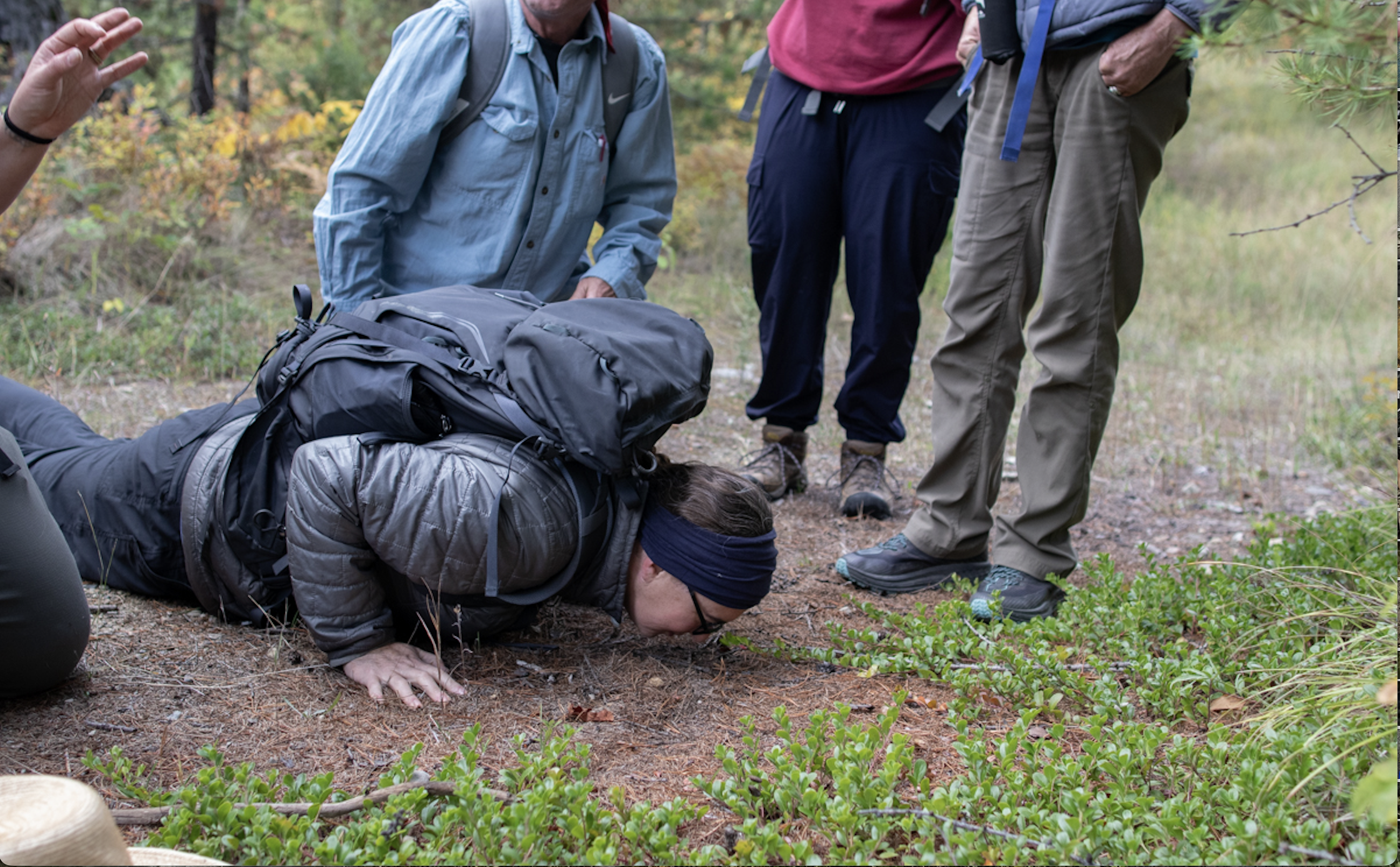
In fact, that goes for all learning. Even all creativity. That there is a picture of me smelling mountain lion pee. I kept going back for more because I couldn’t quite shape words around what it smelled like. The two sensory details that get overlooked in most writing are smell, and the feel of the air. “How would you describe it?” I kept asking the leader of our course as I went back down to smell again. “It’s almost skunky but not quite, almost a metallic undertone . . .”
“Funky,” she finally said. It is. It is funky. Like skunk, but also a trace of the iron smell of blood.
You wouldn’t know this if you didn’t get your nose down into it.
Like everything else in the dominant culture, science teaching has to tick some boxes to be considered acceptable. Learning classifications, species, differences in habits and characteristics in a very specific, head-centered way—people have to do it because that’s what’s accepted and rewarded, and for practicing scientists it’s necessary.
For me, maybe for most of us, true learning happens through experience. I can learn all those classifications, but they’ll only stay in my memory if I relate them first to being in the world: smells, sounds, embodied experiences. I learn backwards, in a way, and I wouldn’t be surprised to find that a lot of other people do, too. The couple hours a day we spent in the classroom won’t stick in my head, but the subtle sign of a mountain lion marking will because I’ll remember the smell of that urine and everything that was associated with learning it.
That’s what science always was to begin with, a way of further exploring and understanding the world we live in. It was, and should be, about curiosity and care and love for a place enough to know it really, really well—with an understanding that our own human lives depended on the health of the rest of the living world. Abdullah Öcalan (the former Kurdistan Workers’ Party leader and a Turkish political prisoner since 1999) wrote about this a bit in his book The Sociology of Freedom:
“The sole purpose of knowledge and science was to ensure society’s continued existence and provide it with protection and nourishment. . . . The profound severing of science from society, and from women in particular, also meant its detachment from life and the environment. . . . In social nature science was understood as divine,”
a reality that he wrote of as being coopted and corrupted by civilization’s monopolization of power and surplus.
When we gave our final presentations at the Master Naturalist course, I started mine by talking about this idea of “widening the window of tolerance,” which is a phrase I’ve often heard in wildlife conservation. While teaching tolerance is necessary, I don’t think it’s sufficient to the task. If the rest of life’s only chance at survival is determined by what certain humans will tolerate, a truly thriving world will continue to diminish.
What’s needed are more relationships with science that do what this course did: rebuild a sense of humans as part of life, integral to it. This sense hasn’t disappeared, as most of us here know; it’s just diminished and damaged. The more energy we put into re-enlivening human beings and human understanding, the less need we’ll have to rely on the narrowing allowances given solely by tolerance.
Science can still do what it originally did: infuse each of us with a sense of belonging to the world we live in.
Over the six days of the course, we hiked miles. We walked through a marsh and a fen. Some of you have probably walked on fens but I haven’t. It was amazing, disconcerting, like being on a paddleboard but it’s the entire ground that’s wobbling. We waded rivers and got down in the dirt.
We found prints of mink and muskrat and spent ages unraveling a story of tracks in a muddy field: grizzly—two, we realized—wolf, mountain lion, coyote, raven. All of us dancing around the tracks from one grassy tussock to another trying not to step on them, kneeling in the mud to measure lion tracks pressed into moss-covered mud and determine whether the canine prints were wolf or domestic dog; speculate on where the animals had gone and what they’d done while they were there.
Watching caddisflies scurry part way out of their shells to scoop in more material, and then standing in the river to spot more of their little casings stuck to rocks. Smelling the grapefruit-pine scent of grand firs, which I’ll always associate now with their flat needles and that one curvy, rutted mountain road that made several of us carsick.
These things will stick with me in a way that learning from a book or talk never would. They lingered with me for days, long enough to bring them up to the cabin, where I applied some of the new knowledge, along with things I already knew, to a place I’ve come to love for many reasons. For the time and peace it gives me, for its ability to bring me back to myself, for the river and moonlight, for memories and associations. For the packrat and her possession of my tea strainer.
Most of all for the place itself. For the fact that it exists, whether or not I ever get to go there. For the river that I can hear in my head right now, whose sound and feel I’ve come to know in all her seasons, who will continue to flow, I hope, long after I’m gone. And for all the life thriving around her, whose existence isn’t dependent on my detailed knowledge but might be dependent on all of our understanding that, just as they’re part of the river, we’re part of them.
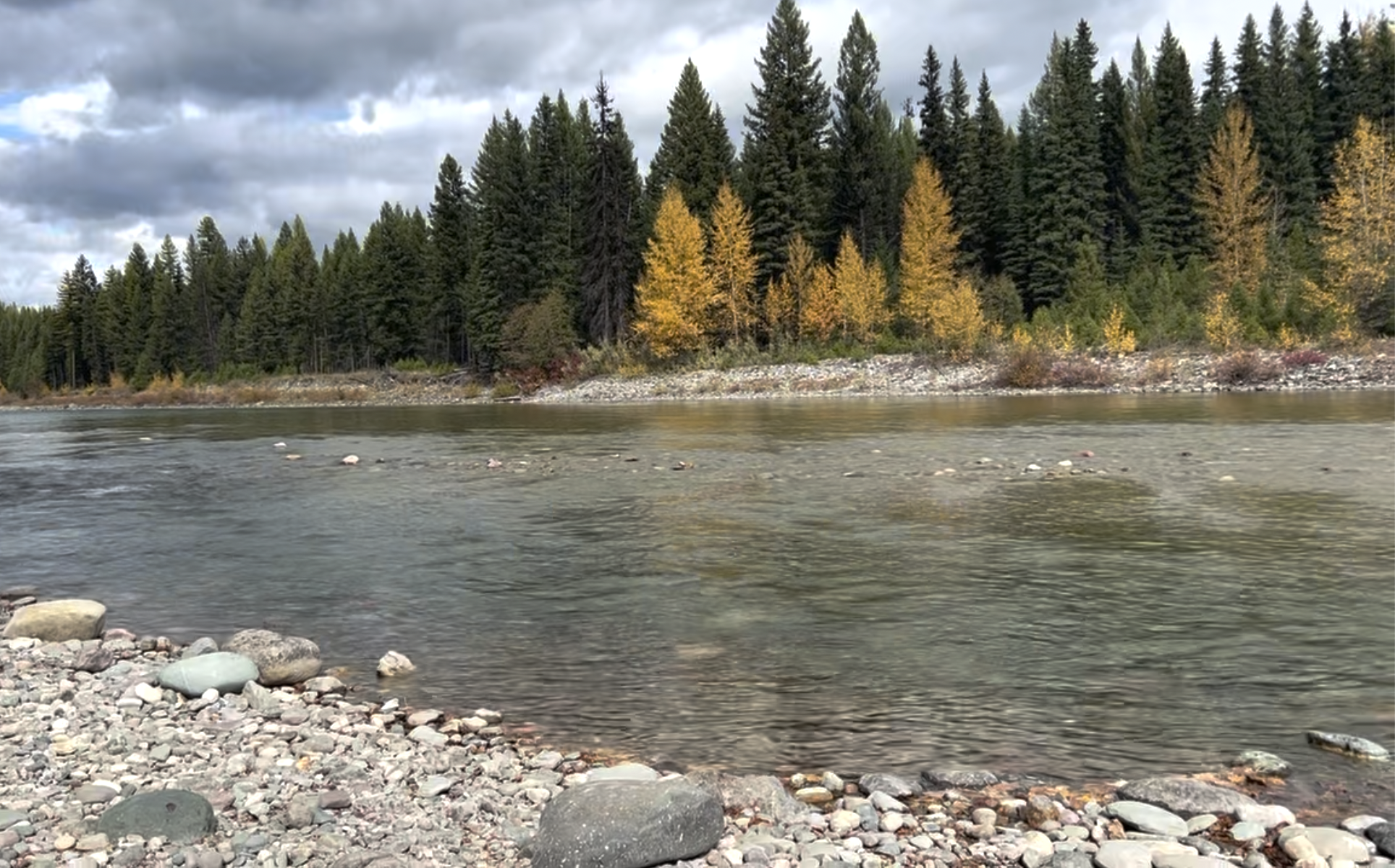
I let my phone record for about 25 minutes as I sat by the river earlier this week. It’s just a recording of running water. I think there’s a bird in there somewhere, and some wind sounds because I didn’t bring down my fuzzy windscreen that I usually use to filter the wind in recordings. But if you need a bit of peace in your day and want to let this play while you do things, or do nothing, it’s here. The photo is right from where my phone and I were sitting.
I’ve been fully immersed in a Master Naturalist course (through Swan Valley Connections—thanks to the inimitable Chris La Tray for talking about how awesome they are; I’m sure he’s written about them at some point), and was planning a post about grizzly tracks, the grapefruit scent of grand firs, caddisflies (among my favorite creatures), and the colonization of science, but on the morning of the third day of the course, I got a message from my father that his cousin Zhenya had died.
It’s been months since I wrote anything here about Russia. I’ve been pretty immersed in Montana both physically and mentally; I also have trouble knowing what to say. Because I have close family there, there are too many things I have to write around. Here in Montana, I can say whatever I want about Putin. They can’t. Many of the things I think and say are illegal there. This is a reality that those of us who’ve only ever known freedom can have trouble grasping, a reality that for various reasons was always part of my upbringing. You learn to live dually, split your mind, develop careful boundaries of trust, and often learn that trust just isn’t possible.
Although much of the English-speaking world has stopped talking about the invasion of Ukraine, anyone who pays the slightest attention to Russia’s current reality and the centuries of history in Eastern Europe* is worried. I’m worried.
But we all, also, live in the ebbs and flows of personal and public concerns, and today I’m setting aside geopolitical worry to honor a personal loss. Zhenya and my father grew up more brothers than cousins. In Russian, the words for “cousin,” dvoyurodnyy brat’ or dvoyurodnyy syestra, contain the words for brother and sister. Partly because of how close my family there is, and partly because of the culture, his daughter Irina and I have always considered each other sisters rather than distant cousins.
Zhenya—Yevgeny Yassin—was a public figure in Russia, an economist with respect and influence. When the Soviet Union collapsed, he was involved in forming a new government and eventually became Minister of Economics. For many years he was the academic supervisor at the Higher School of Economics in Moscow (not pictured above; that’s Moscow State University). He had strong opinions about the promises of the free market and the failures of communism, opinions that took the rise and power of Russian oligarchs to shake. And he was a stalwart advocate of human rights, something his daughter, my sister-cousin, continued: she ran a humanitarian organization in Russia until Putin outlawed it several years ago.
Zhenya was also someone who made me feel more loved and welcomed than almost anyone else in the world. Even though I didn’t meet him or any of the rest of my Russian family until I was fourteen, he made me feel like we’d known each other forever, an integral part of a close-knit family despite the fact that I could barely communicate in the language. He often called me maya malen’kaya mat’, “my little mother,” because he said I looked like his mother. One of my middle names, Evgenia, was given to me in his honor. It’s one of my lasting personal sadnesses that I haven’t been to Russia in over a decade, and lost the chance to see him once more.
When my grandfather in Leningrad died in the late 1980s, my father was still living in exile, unable to return to the Soviet Union after leaving in 1974. I doubt I’ll ever forget that day, the call from my aunt on our party line phone in Polson, starting to understand for maybe the first time what it means to be separated from your family, forever as far as you know. The kinds of fractures it creates. The kinds of bonds it tries to cut. I don’t know if there’s a greater evil humans inflict on one another than forcing families apart. It is something that Russia, like all other places with imperial ambitions, has excelled at throughout its history, particularly when it came to Jewish people, which my family were. My parents’ story has a little more choice in it, but in the end the Soviet authorities still told my father he could leave with my American mother and my older sister, or stay, but if he left it would be forever.
That Zhenya always managed to make me feel like we’d never been separated, never seen our family fractured, is a quality that today stuns me with its loss. To make people feel that welcome in the world as part of your nature is something I wish I could live up to.
My stepmother’s great-aunt, the Russian poet Marina Tsvetaeva, lived for many years in exile and lost her daughters to starvation and the gulag. Like millions, her life in Russia was defined by suffering. And yet what she created in return was poetry, of love and life and a piercing view of the world:
“I am happy living simply: like a clock, or a calendar. Worldly pilgrim, thin, wise—as any creature. To know
the spirit is my beloved. To come to things—swift as a ray of light, or a look. To live as I write: spare—the way God asks me—and friends do not.”
Zhenya didn’t have a simple life, but he, too, cultivated a sharp mind while spreading love and liveliness all around him amidst the realities of the Soviet Union. He is one of the many people who taught me, unintentionally, that what is worthwhile in life is always simple. Maybe a few shots of vodka and debates over politics and economics and literature long into the night. But most of all, that where our true human potential lies is in laughter, hugs, a meal, stories, some good friends, a much-loved family, and mourning the loss of the same. In our connections to one another.
I heard once that who a person is, their fundamental human self, is defined in part by who claims them. Who their people are. Zhenya gifted me that, a profound sense of belonging to people. He will be mourned by many, his public service and accomplishments lauded in newspapers across Europe. But me, I’ll light a candle tonight, and feel the loss of his ready smile, his keen conversation, and how easily he made me feel like I belonged.
The morning that my father’s message about Zhenya came, I drove again the too-long route to the Master Naturalist course, watching sunlight strengthen above a mountain range, rising through cloud cover just thick enough to hide its full brightness but thin enough to spread gold across the sky. A flock of Canada geese winged overhead in the direction of the sun, and as I watched, a few of them somersaulted in the air, wings folded, their flips in that golden light the kind of pure earthly joy that arrives, also, in the smile of someone you love.
*Two good books on that region I read recently were Neal Acherson’s Black Sea and Orlando Figes’s The Story of Russia. I also still recommend Konstantin Kustanovich’s Russian and American Cultures: Two Worlds a World Apart for a closer understanding of Russian worldviews.
Note: I’ve created one extra section in this newsletter where I’m collecting references and resources on all aspects of ownership, the commons, and commodification. It’s not something I’ll email out, but I’ll add to it regularly and it’s there for your use. Feel free to share, send suggestions, and ask questions.
Important regarding subscriptions: Three real-life friends who are paid subscribers to On the Commons have told me that their payments are showing up as coming from Medium, not Substack, which obviously looks fraudulent. Both Substack and Medium use Stripe for payments. I intermittently contract with Medium, so my account has both platforms on it—the payments are still for Substack, but for some reason are being labeled Medium. I’m trying to resolve this issue with Stripe. It seems like a coding issue, and if it’s affected you, I apologize. Fingers crossed a real human works there, somewhere, and can figure it out.
If they can’t fix the problem, I’m not sure what the best thing to do is. I have Venmo, I guess, and PayPal, and a post office box . . .
Or we could just abolish capitalism. Can’t take that long if we all team up, can it?
When I moved back to my hometown—secondary hometown, I call it, where I graduated high school—almost ten years ago, I was moving back for the community. The pace of parenting expectations on the rural fringes of New York City’s orbit, where our kids were born, was exhausting, and I’d been homesick for Montana for 20 years, since I first left for college. I didn’t feel alive anymore, going through the motions of working and parenting and trying to connect with a place I didn’t understand that also had a hell of a lot of poison ivy and humidity and Lyme disease-bearing ticks. So I came home. It wasn’t as easy or straightforward or quick as that, but it’s one of the things I’m most grateful for, that I got to make that choice.
Every time I go on a hike with a friend or pick huckleberries or drive some unnamed gravel road, there’s this flood of gratitude that’s almost absurd. Like gratitude with a thick buttercream layer of extra gratitude. I get to live here, and walk these mountains. I get to slow-breathe the smell of a trail covered in sun-warmed pine needles, and the sharp scent of those same needles in the spring when winter hasn’t yet let go. I can take my kids places where we watch meteor showers with no discernible light pollution. I worry about mountain lions and my aging knees, and spend November hours when I’m meant to be hunting watching chickadees deep in the woods instead.
High-mountain lakes the same indigo-blue of sky the moment it’s losing the last of the day’s sunlight; hillsides smothered in beargrass and grouse whortleberry—how could I not feel gratitude?
Stand on a mountaintop where the air is silent and a hawk soars overhead and look across to ridges draining into gouged-out tracks; imagine what they’re like as spring thaw sets in. Think about the kind of water-force it takes, over how many years, to scour a mountainside into the form of a pastry blender.
I will never stop being grateful for it, and never, I hope, stop remembering that I’m a visitor here. I love it and hope to never leave, and none of it is mine or ever will be.
I spent most of last weekend in East Glacier at the annual Gathering of the Glacier-Two Medicine Alliance, where instead of talking about further legal strategies to appeal last year’s upholding of the last remaining oil lease in the Badger-Two Medicine area, everyone got to celebrate the recent announcement that the lease was being retired.
This really is a huge thing to celebrate, especially for the Blackfeet Nation. It’s not often that anti-extraction efforts get a win like this, and in such a place, too. It was an honor to be present as elders spoke of their families’ relationship with that land and the waters that flow out of it.
From the broader perspective of private property law and the damage it causes, the retirement isn’t an unadulterated success. One point of the settlement stands out: the agreement specifies that, in return for the leaseholder accepting $2.6 million to relinquish their claim, the interested parties drop their appeal against last year’s court decision upholding the lease. If you read that legal opinion—from a D.C. district court judge who’s been favorable to the leaseholders from the outset—you’ll understand why the lawyers for the leaseholders are pleased with this outcome. The opinion defends this kind of extractive private property right on public lands, and on sacred lands, as long as the right is legally granted. Whether it happens in the Badger-Two Medicine someday or elsewhere, that right is currently in good standing in U.S. law.
It’s easy to hide the implications inside legalese, but if you read, say, this one line:
“NEPA and NHPA impose procedural requirements with which government agencies must comply before acting, but neither requires that the agency elevate the preservation of environmental or historical resources above other priorities,”
you have, in a nutshell, the problem with the bent of current property law, which is that no other claim—no matter how ancient, even that of life itself—can take precedent over the private right to extract and make a profit. It’s one of the many reasons, I assume, that the attorneys for the leaseholder were happy with the outcome and said that,
“We think Judge Leon’s opinion at the district court will be a powerful precedent for years to come.”
Law, as I’ve written before, is a reflection of the dominant society’s values at any given time. It’s a story we’re told about what matters. Right now a strong lean into absolute private property rights is a narrative that runs roughshod over ever-increasing aspects of life.
John Murray, Blackfeet Tribal Historic Preservation Officer and someone who’s by now probably been involved in the fight against these leases longer than anyone else alive, spoke at the Gathering of more recent efforts to declare the entire area a National Monument and therefore forever off-limits to oil, gas, and mineral extraction.
That’s not a reliable plan, he said. We never know who’s going to be the next president, or the one after that. He didn’t mention Bears Ears National Monument in Utah and Trump’s reduction of its boundaries to accommodate oil and gas industry preferences, but I’m sure everyone was thinking of it.
The only right answer, said Murray, is to give the land back to the Blackfeet Nation.
At those words, a shock-flash went through the room. I don’t know what a shock-flash is—I just made it up—but I can tell you what it felt like because I was sitting right there. It was like a stiff wind, made of energy, that lasted for less than a second and hit right in the heart as well as the head. I would not have been surprised to see people’s hair standing on end.
The proposal to return the Badger-Two Medicine to the Blackfeet Nation has been around for a few years. I had a conversation last year with someone—another white person—sympathetic to everything regarding protection of the Badger-Two Medicine except, perhaps, hesitation over this one last step.
“We might not be able to do what we just did,” this person said, indicating the hike we’d just been on to view the then-proposed drill site. Not in a defensive way, more that they’d never considered it seriously before and were trying to get their head around it. “We might not be allowed in.”
“That shouldn’t really be up to us, should it?” I answered, thinking of the vast miles of stolen now-Montana land bent under barbed wire fencing and “Private Property” signs, of broken treaties and how little settlers—including me—understand of what Land Back means, much less of sovereignty.
Settler resistance to Land Back is impossible to disentangle from all aspects of colonialism itself. In a 2022 podcast episode discussing the movement to return the Badger-Two Medicine to the Blackfeet Nation, a law professor said that the idea of returning land “can present some real challenging political determinations for Congress and for others who may see the interests that have developed in public lands as too important to be disturbed,” leading the co-host to explain that,
“Public lands are a really, really big deal, especially in the West. Businesses like outfitters, guiding services, equipment retailers, they all rely on access to these public lands. Counties with big areas of federally owned land, they get payments from the federal government, so there’s also public funding at stake.”
It comes down, once again, to the interests of capital, and the continuing legacy of the Doctrine of Discovery. How this perspective views public versus private land and property rights has differences of degree but not always of kind.
That doesn’t mean everyone running a business dependent on public lands access is a bad person, or selfish, or doesn’t care about the land. It does mean that a society’s values regarding relationship with land, water, wild animals, trees, wild berries, . . . is dictated by interests perhaps adjacent to but still dominant over the interests of all other life, including those of the people from whom nearly everything was stolen. That dominance, by its nature, is incapable of giving the only right answer possible. Maybe that was the shock-flash that went through the room: dominance getting a jolt.
Late on Saturday, the Gathering symbolically burned copies of the oil lease in a firepit. The Blackfeet Rawhide Singers sang a song for and of the Badger-Two Medicine as John Murray danced around the fire and placed the first copy on the flames. Everyone was given a stake to burn and Sharpies to write messages. I slunk back into the shade as the drumbeat and song wove their way into my memories of working trail crew along and sleeping next to North Birch Creek in the Badger-Two Med a few weeks ago, and wept a bit. I don’t think I’ve cried in public since I was about 14 years old.
On my way home, I stopped at a creek I’m fond of, near a trailhead leading into the Bob Marshall Wilderness. The parking lot was empty of other cars or people. Last year when I’d camped there, the creek had held a delightful number of cylindrical caddisfly shells constructed from gravel about the size of a sesame seed. I looked for them but it was too late in the year.
The creek ran cold across my bare feet, its sound and movement and chilly reminders of snowmelt all I really need in this world to ground myself in what’s real, and what matters. I sat there letting my feet go numb and the sound run through me, September’s late afternoon sunlight filtering through the aspen trees to glance off the water.
I don’t even know what to call that sound—a trickle, a ripple, a slow rush?
Sometimes the right answer is an action. Sometimes it’s a change in policy, or in culture. And sometimes it’s simply being, sitting there by a creek reminding yourself what it feels like to be alive, in a place you love. It’s asking questions of belonging and responsibility, and struggling with your own place in the world.
That sound is all of life to me. I could have sat there forever, grown cold and hungry, but I never for a moment would have felt alone.