Walking composition
“You don’t waste no time at all. / Don’t hear the bell but you answer the call.”
—“Hammer to Fall,” Queen
Last week I spent a few days at a Forest Service cabin near Holland Lake in Montana’s Swan Valley, an area that holds a lot of childhood memories for me. My family used to camp there a lot. Often enough that those memories are smeared together in my mind, like what a rainstorm does to the chalk drawings my kids and nieces and the neighbor kids make in our driveway.
This was a cabin I’d rented last January but ended up not using because it has an electronic lock—electricity! rare thing in these places and not something I actually want—and it was 15 degrees below zero (–26C) and the battery drained or the mechanism froze. Or something. Anyway, I couldn’t get inside. One of the things that makes me not completely despair over an anti-human digital future is how poorly all this stuff does in the cold. My phone always dies within an hour or so when I’m out hunting or skiing.
Electricity turned out not to be a boon this time, either. The cabin is at the edge of a packer campground. I wouldn’t have minded being surrounded by pack mule and horse corrals waiting for outfitter trips into the Bob Marshall Wilderness, especially as there was nobody there (I suppose the mountains are still too deep in winter for those trips), but stepping outside in the middle of the night to see Moon and the stars and being dazzled instead by street lights shining over every single (empty!) corral was an unpleasant surprise.
It didn’t deter the morning birds, but it was startling—bright lights right on the edge of the wilderness, ostensibly in preparation for heading into wilderness, reminded me of the countless stories I’ve seen about trash heaps at the bottom of Mount Everest, and the mistaken beliefs any of us might harbor about the impacts of our off-grid or wilderness or outdoorsy/nature-y activities.
Morning birdsong, during which you are free to imagine no brightly lit empty corrals in the forest.
And a loon . . . (one call at the very beginning of the recording and one right at the end with the background sound of the nearby running creek in between)
It wasn’t the best few cabin nights I’ve had. Along with a bunch of reading, I was focused on tackling an already overdue essay that proceeded to fall apart in my hands like some aged, friable fabric. And the cabin’s heat went out two hours after I got there. After poking around, I figured that the propane tank was likely empty after the demands of a bitterly cold winter and I was in for three nights much colder than I’d prepared for.
The first night, before I realized the heat was gone completely and wasn’t just being fussy, I delved further and further into my sleeping bag, waking up every hour, and had to talk myself into getting out of bed the next morning only to discover that it was almost ten degrees warmer outside than in.
I probably should have slept outside the whole time for that reason—though the corrals’ streetlights were a strong deterrent—but did spend pretty much all my waking hours outdoors, trying to find patches of sun and going inside only to switch reading material or make more tea. Being underslept and chilly left me without quite enough brain power to tackle the essay that fell apart; I was cold and very tired and a little annoyed at the all-night lighting. I was uncomfortable, in other words, and eventually wondered if that might be good for me. Humans only recently started spending most of their time indoors with access to constant temperature control, and even that’s only for a certain percentage of people. There’s a fair amount of research about what this does to our bodies and the planet, but what about other aspects of ourselves? Our doubts, our fears, our worries, our happiness, our capacity to deal with the problems of the everyday as well as the existential.
Among my favorite parts of The Lord of the Rings is Bilbo’s warning to Frodo: “It’s a dangerous business, Frodo, going out of your door. You step into the Road, and if you don’t keep your feet, there is no knowing where you might be swept off to.”
I always feel that when I start walking. Even in my hometown among familiar alleys and sidewalks and streets: if I just keep going, I could end up anywhere. Any of us could. If you weren’t stopped by fences and freeways or motorways and “no trespassing” signs and militarized borders, you could walk the planet, as long as you had access to a boat at some points. The entire world spills out from every footfall like it’s being remade as you walk. I still think that’s magical.
Looking at the basic trail map inside the cabin and knowing that this campground was an entry point into the Bob Marshall Wilderness complex made my feet tingle. I took a break from the essay that seemed to hate me and headed up the hiking trail. I only wanted to get a couple miles to the waterfall at the far end of the lake, but if I had brought better shoes and more food and some other things, I could have kept going for hours and hours until the snow got too deep and I pitched a tent against a snowdrift with only the stars for company.
I actually didn’t even make it to the waterfall that day, due to a relatively fresh bear track about a mile and a half up the trail. It made me rethink being a solitary, edible human roaming the woods. I wish I’d taken a photo of my hand in it for scale; it’s the kind of thing you can see often enough around here but it still thrills every time. It makes the bear spray I carry seem utterly inadequate, but also gifts me with that deep, ringing feeling of being alive. Bringing to awareness the smell of last year’s pine needles on the trail, the pitch dripping from a newly cut fallen tree, the robins and woodpeckers echoing through the woods, the chilly damp in the air and the acute knowledge of being surrounded by so much life that I can’t see. It’s good to be reminded that it’s not just the stars for company.

The evening I got home from that time away, I opened up one of the few newsletters that I’ve come to know as one that will always inform and surprise me, field biologist Bryan Pfeiffer’s Chasing Nature, to a post about the surge of nature photos uploaded to iNaturalist from people all over Ukraine, whether in active battle zones or not. “Nature inspires those who know how to see it even in the most difficult moments,” Pfeiffer shared from a zoologist colleague in Ukraine.
That essay came at an auspicious moment for me. Sitting outside the cabin wishing for more sunshine or that I’d remembered to bring a sweater, I’d been thinking a lot about a conversation I’d had with my father the previous week, about his recent trip to St. Petersburg in Russia during which he’d visited his family and all the old haunts that had formed the stories of his childhood. Places he’d walked—stories he’d walked, honestly—with my younger sister and me in 1991 after he was finally allowed back into the Soviet Union after 17 years of exile and could show us his homeland.
It’s an almost minuscule sorrow among all the griefs of this war, but it hit me both that my father was trying to face the possibility of never returning there again after he comes back to Montana this time, or at least not soon, and that I might never see most of my family in Russia again. My life changed drastically after meeting them when I was 14 years old. A grandmother I’d never met and whose language I didn’t speak. The only close cousins I have. Relatives who hiked hours in the woods on summer days to collect a year’s worth of berries and mushrooms and who showed me pictures of people I resembled.
It was a world, and people, I never expected to know growing up in Montana during the Cold War. My father was an exile and until I was almost ten years old we didn’t even have a telephone, much less money for overseas calls. I don’t know how much they cost in the 1980s but when we called more often in the early and mid-90s they ran about $10 a minute. Russia was a world completely foreign and yet when I finally went there it was deeply familiar, a feeling that remains inexplicable to this day and one I’m not sure I’ll have the chance to experience again.
I step out my door or onto a trail and imagine walking all the way to Alaska and waiting for a boat, the long trails in northern Russia that my cousins and aunts and uncle—and now stepbrother and nephew and nieces—walk to gather mushrooms in August connected like some kind of ley line to the ones beneath my own feet, kept apart only by the worst consequences that human imagination and greed can conjure up. To lose it, again, is a small loss among all the awful losses of the world, but it’s there all the same.
The second morning, still cold from a night in the cabin and thinking about the multi-dimensional yet fragile qualities of human languages (especially in the hands of someone whose essay is falling to pieces), I walked to the falls from a trailhead on the other side of the lake near the lodge. In summertime, it’s heavily populated but at the end of April I was the only person there for most of the afternoon. At one point before the waterfall I almost turned back because the undergrowth was getting thick and all I could think about was hiding places for mountain lions and—again—how edible humans are. Mountain lions don’t really care about bear spray, as far as I know. You never know where you might be swept off to once you step on a road, including as someone’s lunch. Even Bilbo Baggins narrowly escaped being eaten by trolls. And I don’t really want to get eaten by a mountain lion, but I especially don’t want one to get in trouble for eating me.
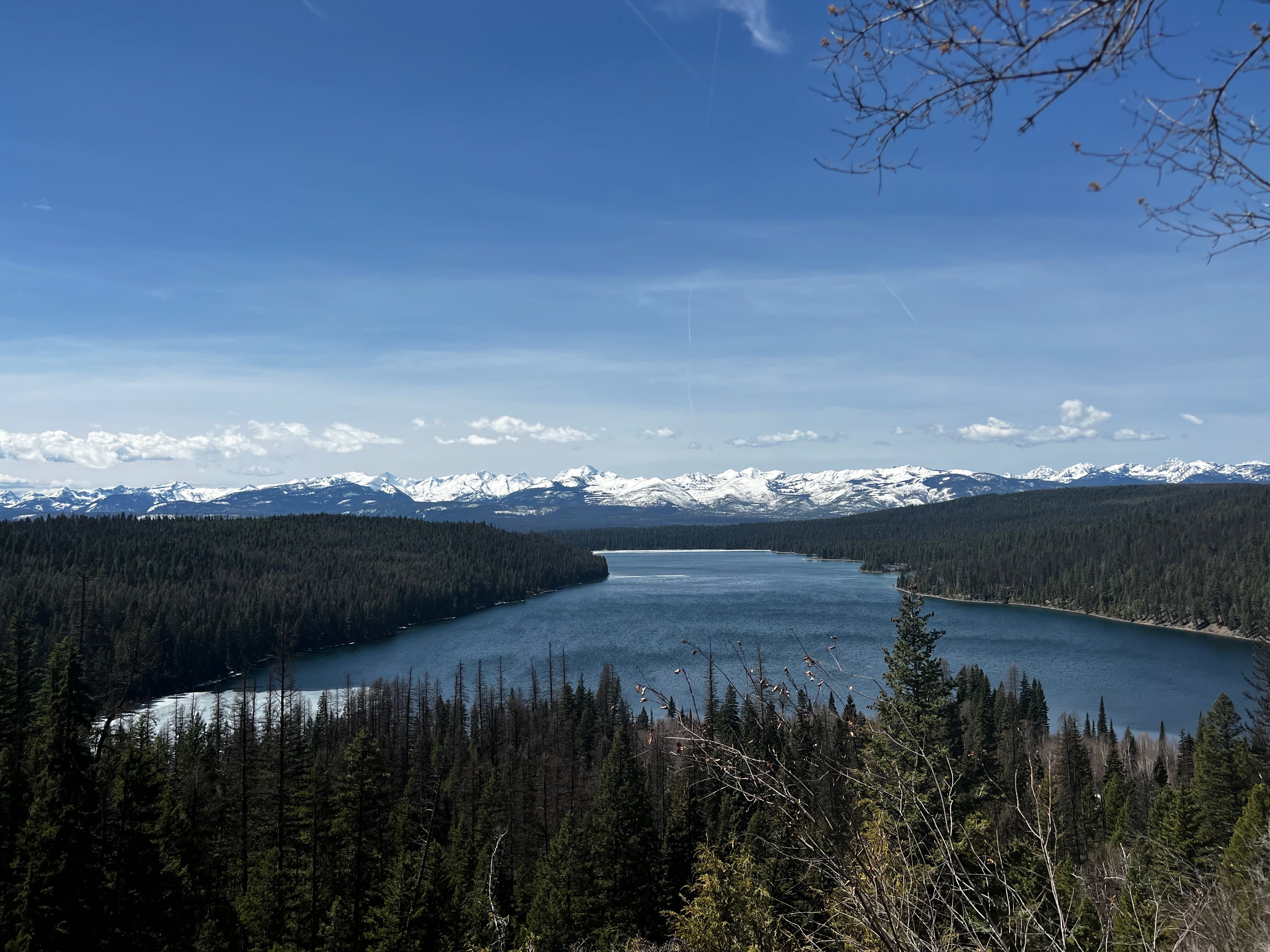
On my way back, I stopped in a sunny opening to look out at the view (that’s the photo up top), at this lake where my sisters and I had spent a notable number of hours jumping from the rope swing after our parents canoed over to it. A lot of memories of the Milky Way bursting with stars and energetic days of paddling and swimming, along with one memory so bad it gave me a panic attack when I drove here for a friend’s wedding some years ago, a reaction that had made me nervous about returning this time. But that, too, is part of a life: a bad experience isn’t discrete, packed away like some curiosity waiting to be dealt with and removed. It’s mixed in with all the good, as they are with it. I needed to come back, and on my own, to spend a little time with the smeared-together sketches of my life that happened here, some of the experiences that make me who I am. Holland Lake was the first place in my life I ever saw the Northern Lights, come to think of it, some summer night sitting outside of the tent as my mother pointed out the shimmer in the sky over the towering mountains.
I was trying to pick that memory out of all the others—how old was I? We camped here enough summers that I can’t remember—when a butterfly circled my head so close that it buzzed the hair that an earlier high wind had picked loose. I moved to take my phone out for a photo while it flew around, but the butterfly wasn’t having it. In fact, every single time I tried to slip my phone out, he disappeared.
I sat down on a rock at the edge of the trail and waited. He landed behind me, where I could just barely see him at the side of my vision. I turned slowly to look at him and he lifted off again. It happened a couple more times so I stopped. No photos, no direct eye contact, got it. I sat there for a long time as the wind died down and the sun got warm, talking in my head to the rocks and the butterfly until another woman came up the trail and the butterfly disappeared.
It seemed early to see butterflies—not to mention the poor confused bee stumbling around the snowbank outside the cabin that morning—but it was not my last butterfly encounter of this trip. I came across several more on the hike down the trail, and later that day as I sat on the steps of the cabin trying to salvage some essay paragraphs, another came to visit and hung out on my hand and in my hair for long enough that I wondered if I needed to invite him to share an early pot roast dinner with me.
“In nature we find our bearings,” wrote Pfeiffer last week, “even in the company of the solitary and prosaic: the ethereal song of a Hermit Thrush, the elegance of a Maidenhair Fern, the glitter of a River Jewelwing damselfly.” Isn’t that the truth? I love that I live among bears and mountain lions, and all the birds of all the seasons here, and the muskrats and otters and beavers on the river that used to be a Superfund site and still sometimes gets oil leakage from the train yard, but do you know what I really adore? Caddisflies. It’s one of the most fascinating things in the world to me to sit on a rocky stream bank on a summer day and spot tiny, gravel-encased caddisflies.
And butterflies, too. The one that kept me company on the trail was a mourning cloak. It’s thrilling to see a fresh bear print in the woods, but what will stick with me far longer are the various discomforts of those days, scouring away the layers insulating me from things I didn’t want to think about too closely, and those moments with the butterflies who wouldn’t leave me. Maybe they sensed that I was struggling with big things that I had been too busy or too comfortable to uncover. That I needed to find my bearings because when it comes to living, there’s no trail that’s going to point the way for us. We have to find our own ways, and we could be swept off anywhere.
Yet another photo—along with caddisflies, I can’t ever get enough of the sky around here!

I had a conversation recently with someone about the onslaught of digital media that keeps getting harder to manage for everyone. I’ve been having this same conversation for at least ten years, and I haven’t even owned a smartphone for that long. It left me wondering about the psychology behind the pressure to click on links. I feel it, too; one of the things I do when I go offline somewhere is catch up on magazines. There are no hyperlinks in print magazines! And it’s always a relief to read something online that doesn’t have them. What is that psychological pressure about, to click on something when you see a hyperlink?
I think the overwhelm is related to the seamlessness of it all—and vaguely remember some articles to that point when hyperlinks first became a thing way back when—which is what makes Substack Notes so exasperating for me (and I’m sure for others), even though I don’t use it: It’s right there, eroding the very feeling that made Substack a bit of a mental and creative refuge in the first place. But the pressure also might be a symptom of a hyper-individualist culture, persuading many that each of us must be informed of and carry and understand all of the information we have access to. That we not only must do it all ourselves, but know it all ourselves, too.
This list was never intended to put pressure on others to read or listen, more of a map of where my own curiosity and research have led recently as well as a resource for people working in related areas (of which there are many here, from environmental law to systems change to urban planning). Would it feel different if I left the hyperlinks out? I’m giving it a try.
Some stuff I’ve read and listened to:
The Timber Wars podcast had Suzanne Simard, forest ecologist and author of The Mother Tree, on to talk about her early forestry work and her research into the “wood wide web.” (This was actually an episode from 2021 but for some reason only recently popped up in my podcast downloads. I haven’t yet read The Mother Tree but have heard good things about it from my science writer colleagues.)
Caroline Tracey writing in January’s High Country News about the role black walnut trees play in organizing for environmental protection and against gentrification in Los Angeles: “Realizing that the walnuts were more than a tool for litigation, they organized Coyotl + Macehualli community events, such as nature walks and ‘guerrilla gardening’ projects where they planted black walnuts in the nearby hills.”
I listened to several episodes of Stories for Action on recent drives and was particularly caught by the conversations with Timothy Ryan, Cultural Educator Mission Mountain Crew at Salish Kootenai College; and Jesse DesRosier, an artist and Blackfeet language teacher: “All these understandings and beliefs are useless unless they are lived. . . . I see our youth and our children adapting to these thinking systems and ways of knowing and really taking them on to the next level. . . . When they start to learn language, they gain their identity back.”
On the In Common podcast, Landon Yoder and Courtney Hammond Wagner, two co-authors of a paper on the commons-resource management design principles of Elinor Ostrom, talked about the large-scale cases—like agriculture and air pollution—that don’t lend themselves easily to Ostrom’s models of the commons. High-level government regulation is resisted and self-motivating limits don’t have enough enforcement, so how do you manage a larger commons?
There were some good articles in the spring issue of Montana Quarterly, including one by Nate Schweber about how McCarthyism and the Red Scare destroyed the life of a Montana range specialist: “In the late 1940s, associations of some of the West’s largest cattle and sheep barons hatched plans to dismantle America’s conservation agencies and . . . to back laws that would force the selloff of hundreds of millions of acres of public land. When that failed . . . the ranching cartels targeted individual Forest Service employees, insisting that they be transferred or fired.”
On Medicine for the Resistance, Patty Krawec talked with astronomer Hilding Neilson about astronomy, stargazing, and colonialism: “The problem is that this was designed solely to erase Indigenous cultures and Indigenous knowledges. And for me, like the Mi’kmaq, for many Indigenous peoples in what is today Canada, you know, what is in the sky, it’s kind of a reflection of the land below; your knowledge is localized. And so if we basically say that constellation is Ursa Major, and your knowledge doesn’t count, that’s all about removing us, removing us from the land, just as much of that—maybe not as much as actually literally removing us from the land, but it’s, it’s part of that disconnection.” (Krawec said she was prompted to do the interview after reading the book The Disordered Cosmos, by theoretical physicist Chanda Prescod-Weinstein, and it looks really interesting so I ordered it after listening.)
I had to interview with City Council this week to reapply for my position on the Board of Parks, and after talking to them about the beaver activity I’ve been seeing along the river paths, I came across some articles about how beaver dams have been beneficial to Ukraine’s war resistance. Because of beavers, the land between Ukraine and Belarus has evidently become too swampy for invasion: “‘On your own land, everything will help you to defend it—the landscape, lots of rivers, which have burst their banks this year.’”
For the record, refraining from linking to these was really hard for me! I listen to podcasts almost purely for research, and to find stories and work that mostly don’t make their way into mainstream or corporate media. Same goes for most of the article reading. I spend about an hour or two a day—while driving around for errands or doing household chores like sorting laundry—looking for those undercurrents instead of listening to NPR or the BBC or more high-profile podcasts or reading The New York Times or The Guardian or absorbing any regular news, really, except my local paper and ICT. I rarely listen to audiobooks—Stephanie Foo’s recent and excellent What My Bones Know was the first one in maybe four or five years? Except for the Upside-Down Magic books that the kids like to listen to on car trips and they have such a great reader they’re a lot of fun, highly recommended—mostly because if it’s for research I take a lot of notes on the page, and if it’s for pleasure, curling up with a paper book and losing myself in an author’s world is how I want to spend that time. (I’ve never read an ebook—no judgment of those; it’s just that I work on screens wearing my eyes out with excruciating attention to detail as a copy editor and want no more screen time than I’m required.)
Crediting people for their thinking and ideas and labor is almost unspeakably important to me; linking to things might be partly my way of crediting people who are doing the work. It drives me nuts when people aren’t credited, even or maybe especially for ideas, and in particular people who are unlikely to get credit or compensation otherwise, which is almost everyone who works outside of academia or accredited professions or who isn’t famous or at least well-known. Using ideas without credit feels like a form of resource hoarding to me—I had a conversation with an historian a few years ago about Yuval Noah Harari’s book Sapiens and how upset many historians were with Harari because he took decades of research and thinking by many people in that field and got famous by presenting it all as his own novel idea with no credit to others. That kind of thing happens more than most people would like to know. The majority of the people and organizations whose work and ideas I look for are unlikely to ever write books of their own—they’re busy doing the work! and/or don’t have entry into the publishing industry, a vast problem all on its own—and I can’t include every single story or bit of research within the narratives I myself write (maintaining a balance of narrative and research is a tricky thing to learn, and more than one editor has had to rein in my desire to quote others). Finding interviews with or articles about them is almost the only way to share their work more widely.
But hyperlinks aren’t credit so maybe this one twitch is just a “me” problem. I might put the links back in next time but haven’t decided yet. And you can always ask me for the source!
Reminder that 5% of this quarter’s On the Commons revenue will be given to All Nations Health Center. Next quarter’s will be given to the People’s Food Sovereignty Program.
 Antonia Malchik